

In 2024, more than 1.46 million federal IDR disputes were initiated under the No Surprises Act. Nearly 97% involved out-of-network emergency or nonemergency services, and 262,441 disputes were found ineligible for the federal process. That volume makes one thing clear: dispute resolution rules aren't a legal footnote. They determine whether a provider's underpayment can be pursued, and what that pursuit will cost. (Congressional Research Service report on federal IDR)
Consider a multi-state anesthesia group whose claims are clean, whose services are documented, and whose payer payments still fall short of contract or applicable reimbursement expectations. The group can't solve the problem by filing every disputed claim. It needs to know which forum applies, whether each claim qualifies, whether the evidence is complete, and whether expected recovery justifies the work and fees. This guide approaches those decisions as revenue-cycle operations, not abstract procedure.
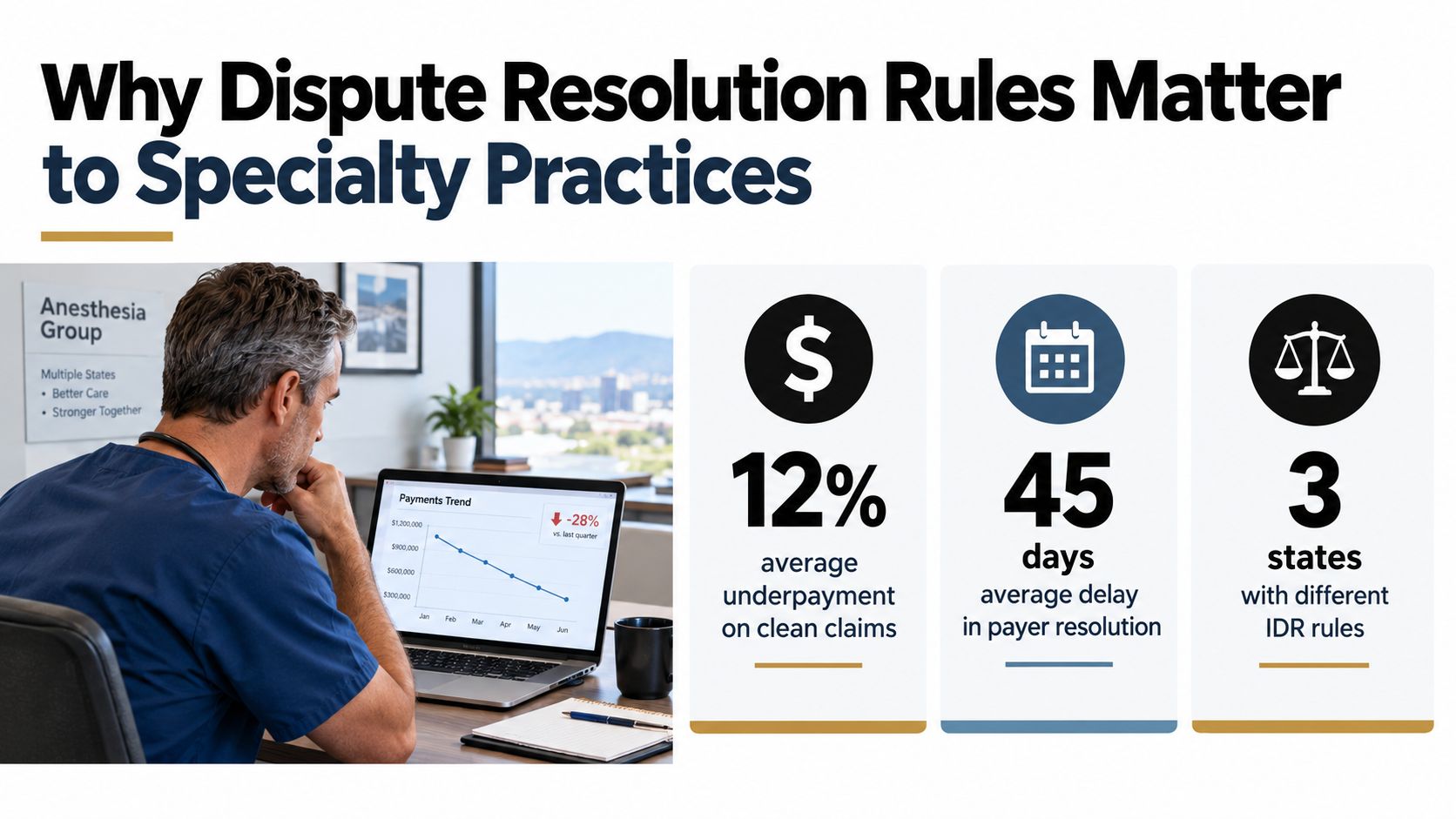
Why Dispute Resolution Rules Matter to Specialty Practices
Underpayment rarely arrives as one large, obvious loss. It appears in mismatched payments, incomplete EOBs, or payer responses that disrupt follow-up. Across states and payer arrangements, specialty practices need to distinguish recoverable cases from disputes likely to consume more staff time and fees than they return.
Rules shape that decision before anyone weighs the merits. Under the No Surprises Act (NSA), eligible out-of-network disputes may enter the federal Independent Dispute Resolution (IDR) process. Other disputes may fall under a state process or a commercial contract's dispute clause. Choosing the wrong route, missing a deadline, or filing an incomplete record can stop a case before review.
Operator's rule: Build eligibility, documentation, and deadlines into claim operations. Assign ownership before an underpayment becomes a legal escalation.
For a high-volume practice, the cost of weak screening extends beyond a single claim. The federal IDR system closed more than 1.37 million disputes in 2024, and just under 19% of closed disputes were found ineligible, according to the Congressional Research Service report cited earlier. Eligibility checks protect staff capacity and dispute fees from being spent on cases that cannot proceed.
Screen at the portfolio level before approving filings. Group claims by likely pathway, completeness of records, expected recovery, and administrative cost. A well-documented claim may still be a poor filing if the likely return does not justify the fee and staff effort. Conversely, repeated underpayments with sound documentation may warrant a consistent process rather than isolated appeals.
A workable program connects claim intake, coding, payer follow-up, routing, evidence assembly, and fee approval. Give each handoff an owner and preserve a record of the decision. This makes escalation repeatable and helps the practice pursue viable claims while limiting avoidable administrative expense.
Federal and State IDR Frameworks at a Glance
The first routing question isn't whether a payment seems unfair. It's which rules govern the dispute. The NSA established a federal IDR process for certain out-of-network emergency, nonemergency, and air-ambulance payment disputes. State processes and commercial contract procedures are separate routes, with their own eligibility criteria, steps, and timelines.
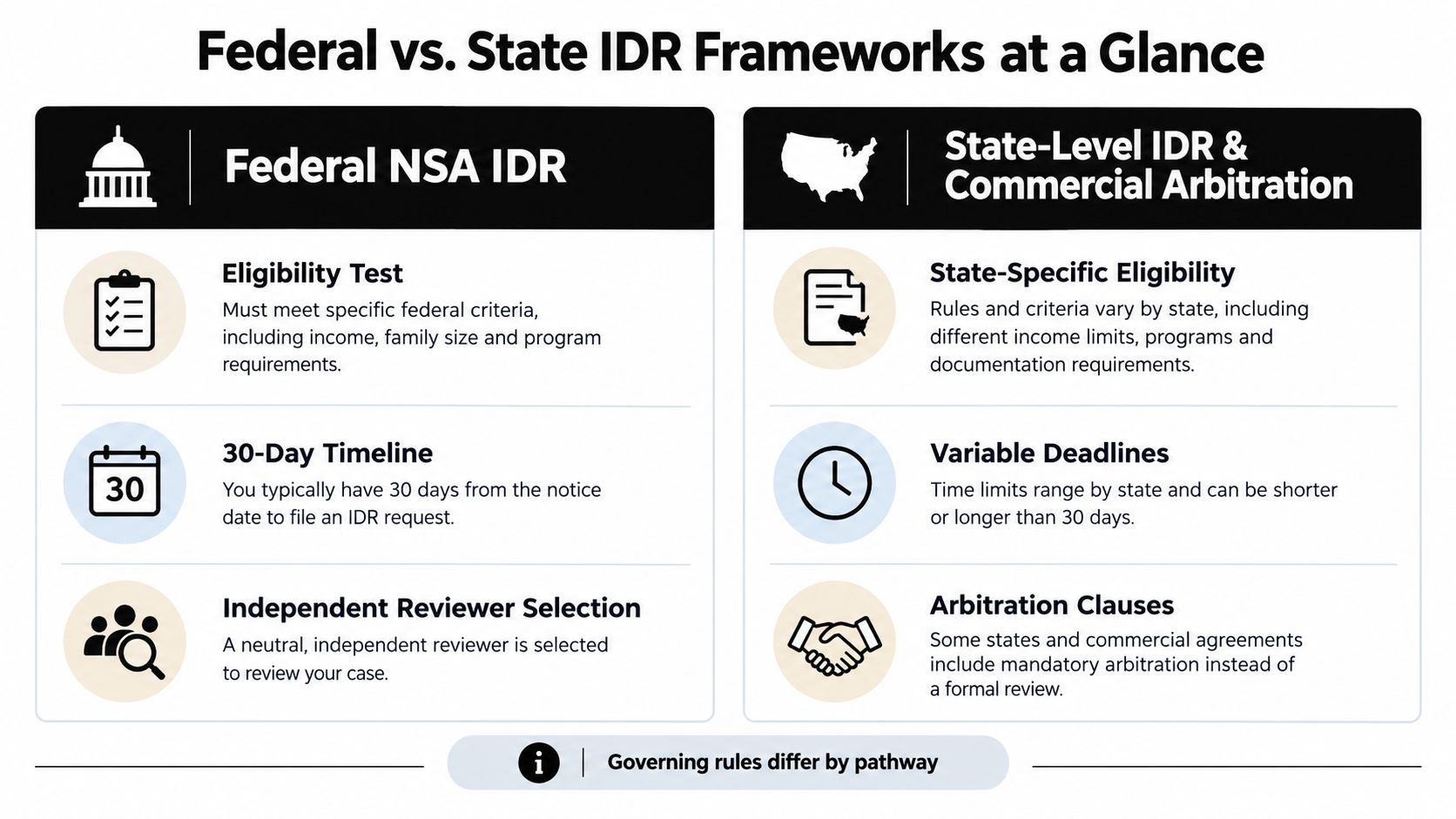
A claim for out-of-network emergency care may qualify for the federal process, but the outcome depends on the claim and the applicable rules. A claim involving nonemergency services, post-stabilization care, or an air-ambulance transport also needs careful routing. Don't infer eligibility from the specialty, the service location, or the fact that the payer and provider disagree. Verify the governing requirements for the specific dispute before opening a case.
State IDR procedures can apply in circumstances where state law governs the insurance arrangement and the claim falls within that state's process. Commercial contracts may instead specify negotiation, arbitration, or another dispute route for disputes outside federal or state statutory procedures. State rules and contract language vary, so a routing decision requires both claim facts and the relevant payer documents.
Build a routing record before filing
For each dispute, record the service, payer, product or plan information available to your team, payment or denial, and the contract or legal pathway being considered. Then verify whether the claim belongs in federal IDR, a state process, or a contract-based procedure. A portal's availability doesn't establish that a claim qualifies for it.
Federal batching rules add another layer. Related claims may sometimes be submitted together only when the applicable requirements are met. A batch that combines claims that don't belong together can create eligibility and processing problems. Keep routing decisions and batch composition visible to both the team preparing the case and the person approving fees.
IDR Timelines and Deadline Management
In federal NSA IDR, the timeline is a chain of distinct steps. A team that tracks only the final filing deadline can still lose the chance to pursue a claim because an earlier notice was late or a necessary document was missing.
The payer generally must issue an initial payment or denial within 30 calendar days after receiving the information needed to adjudicate a qualified out-of-network claim. The parties then have a 30-business-day open-negotiation period, which begins when the open-negotiation notice is first sent. If they don't agree, either side must submit the Notice of IDR Initiation to the opposing party and the Departments within 4 business days after negotiation closes. These timeframes are set out in CMS guidance on the federal IDR process.
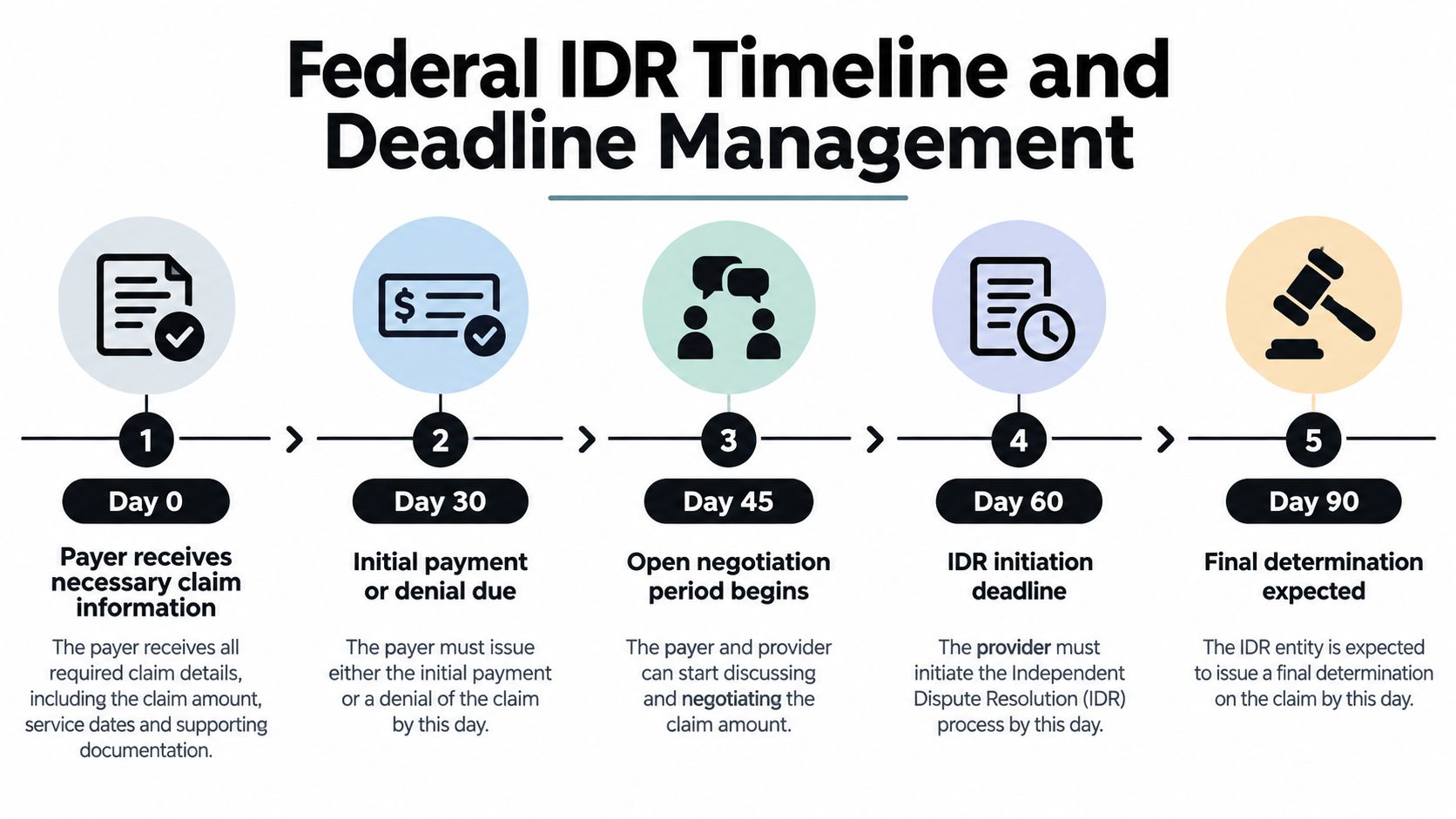
The initiation notice needs enough detail to identify the dispute: services, dates and locations, procedure and place-of-service codes, claim numbers, the complete EOB, scope attestation, contact information for the other party, and the preferred certified IDR entity. Treat that as a controlled submission, not a quick form entry. A missing code or incomplete EOB can delay review or undermine eligibility.
Put the clock in the workflow
After entity selection is finalized, each party has 10 business days to submit its offer and supporting evidence. The certified IDR entity selects one party's offer; it doesn't construct a compromise between them. That makes the evidence and offer strategy due-date work, not something to assemble at the last minute.
Assign an owner to each deadline and retain proof of when notices were sent and received. Keep negotiation correspondence together with the claim record, and use a calendar or case-management system that alerts the team before each cutoff. Batching, eligibility review, and requests for additional information can affect the operational path. Plan for the process your team must manage, rather than assuming that every case will move on the shortest possible schedule.
Evidence and Documentation Requirements
An IDR submission is only as strong as the record behind it. At a minimum, the initiation notice should identify the disputed services and provide the required claim and party information. At the offer stage, the certified IDR entity reviews the competing offers and supporting evidence. A file that can't connect its requested amount to the service, claim, and applicable circumstances leaves the reviewer with less to assess.
Before submission, check the record against the required fields:
- Complete EOB: Include every relevant page and confirm that it corresponds to the disputed claim and payment.
- Service identifiers: Match claim numbers, dates, locations, procedure codes, and place-of-service codes across the notice, claim, and attachments.
- Scope attestation: Confirm that the attestation is complete and consistent with the dispute being filed.
- Offer support: Organize evidence that explains the requested offer and the facts relevant to the service, including applicable specialty or case details.
- Negotiation record: Preserve notices, payer correspondence, and negotiation communications in the case file.
Audit for conflicts, not just missing pages
A document can be present and still be unusable. A code mismatch between the claim and dispute notice, an EOB that omits relevant information, or an inconsistent attestation can create questions about what the case covers. Have a reviewer compare the documents as a set before a filing goes out.
Keep evidence traceable to the claim, and use consistent file names or a case index so the reviewer can find relevant material quickly. Avoid adding documents that don't support the dispute or that contradict the stated service facts. A pre-file audit should answer a direct question: can someone unfamiliar with the claim identify what was paid, what's disputed, and why the offer is supported?
Fee Structures and Cost Exposure
In 2024, parties paid $718 million in total federal IDR fees: $559 million to certified IDR entities and $159 million in administrative fees to the federal Departments, according to the Congressional Research Service report cited earlier. Those aggregate costs make fee exposure a filing decision, not an afterthought.
| Cost Component | Paid To | When Triggered |
|---|---|---|
| Administrative fee | Federal Departments | When the applicable process requires payment |
| Certified IDR entity fee | Selected certified IDR entity | For adjudication under the process |
| Internal operating cost | Provider's staff or service partner | During eligibility review, evidence preparation, filing, and follow-up |
These totals do not establish the cost of an individual dispute. The amount depends on the applicable fee rules and how the case proceeds. Ineligibility, withdrawal, or a batch problem can change both the work required and the value of continuing. A straightforward case is not automatically worth filing if the potential recovery is small.
Budget the net, not the award: Estimate likely recoverable revenue, subtract applicable fees and internal handling costs, then decide whether to file.
For a portfolio, compare expected recovery with costs across the cases under consideration. Sort claims by likely net value before committing staff time and fees. A claim with a modest potential recovery may warrant filing when handling costs are low, while a larger disputed amount may not justify pursuit if eligibility is uncertain or preparation is burdensome. Set thresholds for escalation, pause, or withdrawal, and review them against actual case outcomes.
Providers weighing cash-flow arrangements can compare IDR services without upfront fees. Check the terms carefully: avoiding an upfront fee does not, by itself, establish the total cost or who is responsible for each part of the process.
Common Payer Tactics and Counter Strategies
A payer response can slow a dispute without resolving the underlying payment question. But providers shouldn't assume every delay or challenge is improper. The practical response is to document what happened, identify the rule or record at issue, and make the file harder to derail on process.
| Issue to watch | Counter-strategy | File evidence |
|---|---|---|
| Late or unclear payment response | Track receipt of the claim information and follow up in writing | Submission record, payer response, and dated correspondence |
| Incomplete or redacted EOB | Request the full explanation and preserve the request and response | EOB version history and payer communications |
| Disputed QPA or offer support | Build a clear narrative that connects the offer to the claim and supporting facts | Payment records, service details, and supporting evidence |
| Eligibility challenge | Confirm pathway and scope before initiation; retain the attestation | Eligibility review and case documentation |
| Batch challenge or unwind | Validate the batch composition before filing and preserve the claim-level mapping | Batch list, individual claim records, and coding checks |
The weak counter is an argumentative letter that doesn't fix the record. If a payer disputes eligibility, more rhetoric won't substitute for a complete attestation and clear claim facts. If the EOB is incomplete, preserve the request for an unredacted or complete version rather than relying on an internal summary.
Patterns can differ by payer and specialty. An emergency group, an anesthesia practice, and an air-ambulance provider may face different claim questions and documentation demands, so analyze disputes by payer, service type, and reason for challenge. Providers developing that analysis can review common payer tactics in IDR disputes. Use the results to improve controls, not to assume that a past payer action predicts the outcome of every new case.
Triage Framework for Deciding Which Claims to File
A headline win rate doesn't tell an operator whether a particular claim is worth filing. KFF's early look at the 2025 process reported that providers submitted about 1.2 million disputes in the first half of 2025, and providers won 88% of decided disputes in the first two quarters. The same source notes that the headline rate doesn't show how outcomes vary by specialty, claim size, eligibility, payer, or filing intermediary. (Georgetown University's summary of early 2025 IDR data)
Use five screens before approving a case:
- Eligibility confidence: Can the team support the correct pathway and scope with a complete record?
- Offer support: Does the documentation substantiate the requested offer, including the relevant claim and service details?
- Documentation completeness: Are the EOB, codes, notices, and attestation aligned?
- Payer history: Does the practice have reliable records of the payer's responses, challenges, and negotiation behavior?
- Expected net recovery: After applicable fees and staff or vendor costs, is the likely recovery worth pursuing?
Apply the screens to the portfolio
For an anesthesia group handling a large queue of underpayments, score claims by those criteria and separate ready-to-file cases from cases needing documentation repair. Don't convert volume into automatic filings. If a claim fails an eligibility check, fix the route or stop; if the evidence is incomplete, hold it while the team resolves the gap.
An air-ambulance provider may handle fewer disputes but face higher stakes on individual cases. That doesn't remove the need for triage. The team still needs a supported offer, verified eligibility, and a fee decision tied to expected net recovery.
Set decision thresholds internally based on your own costs, payer experience, and documentation quality. Then review the outcomes by specialty and payer so the thresholds reflect actual operating conditions. File when the record is eligible, supportable, and economically defensible. Batch only when the applicable rules permit it and the claims fit together. Abandon or repair cases that fail those tests rather than paying to discover the weakness later.
Quick Reference for Dispute Resolution Pathways
Use this table as a routing aid, not as a substitute for checking the governing terms. State rules and contract language can vary, while federal IDR has defined eligibility and procedural requirements.
| Pathway | Governing Rule | Typical Use Case | Filing Window | Fee Profile |
|---|---|---|---|---|
| Federal NSA IDR | Federal No Surprises Act process | Eligible out-of-network emergency, nonemergency, and air-ambulance payment disputes | Set by the federal process and its deadline sequence | Administrative and certified IDR entity fees may apply |
| State IDR | Applicable state law and procedure | Disputes covered by a state's process | State-specific; verify the applicable rule | State-specific |
| Commercial arbitration | Payer-provider contract | Disputes covered by a contractual arbitration clause | Contract-specific | Contract-specific |
Start by identifying the payer arrangement and the service. Then confirm whether the dispute falls within federal, state, or contract-based procedures. A dispute that appears similar to another claim may still route differently because the plan, service, or applicable rules differ.
Batching and air-ambulance disputes can create edge cases that a summary table won't settle. Check the federal eligibility and timeline requirements before filing through that process, and review the documentation standards covered earlier. For a state or commercial route, read the governing rule or contract itself. If the forum remains uncertain, resolve that question before committing to a filing or a fee.
Connecting IDR to Revenue Cycle Performance
A dispute-ready case starts upstream. Accurate coding, complete claim data, a retrievable EOB, and a documented payer response give the dispute team a record it can use. If those basics are missing, the team spends time reconstructing facts under a deadline rather than evaluating the case and preparing its offer.
That's why IDR works best as part of revenue-cycle management, not as a separate legal function. Connect underpayment identification to eligibility review, negotiation tracking, document storage, fee approval, and outcome monitoring. A shared workflow helps teams recognize recurring payer issues and distinguish isolated errors from patterns that warrant operational changes.
The operating advantage is proof: A strong case shows what was billed, what the payer did, what the parties attempted, and why the requested offer is supported.
Analytics can help teams organize disputes by payer, specialty, service, challenge reason, and case outcome. Use those views to refine documentation controls and triage decisions, while avoiding assumptions that past outcomes guarantee future ones. Track process measures that your team can act on, such as whether the file is complete before submission and whether the correct pathway was selected.
Treating dispute resolution rules as part of revenue-cycle performance changes the work from reactive escalation to managed revenue protection. Providers evaluating an integrated approach can learn how RCM and IDR workflows work together. The essential discipline remains the same: build a clean record early, assign responsibility for each step, and measure whether the process is producing supportable, economically sound cases.
Arbitration Ready Checklist and Common Questions
Before submitting a federal IDR dispute, check the file in this order:
- Confirm the pathway: Verify federal eligibility before preparing the filing.
- Match the claim details: Check dates, locations, claim numbers, procedure codes, and place-of-service codes.
- Complete the record: Include the full EOB, required scope attestation, and supporting offer evidence.
- Verify the timeline: Confirm that required notices and submissions are within the applicable deadlines.
- Review the batch: Make sure the claims belong together under the relevant rules.
- Approve the cost: Compare expected net recovery with applicable fees and staff effort.
What if the payer challenges a batch? Pause further action on the affected claims, identify the specific basis for the challenge, and check each claim against the applicable batching requirements. Preserve the notices and claim-level mapping.
What if the payer makes a partial payment? Reconcile the payment to the claim and EOB, identify the remaining disputed amount, and confirm which dispute pathway applies before escalating.
When should a team use a state portal? Only when the applicable state process governs the dispute. Verify the relevant law and plan context before filing.
How should staff document non-response? Retain the notice, proof of delivery or submission, follow-up correspondence, and any available record of the payer's response or lack of response. Keep the timeline visible in the case file.
RevGuard integrates specialty-focused revenue-cycle operations with NSA IDR case development, filing, award monitoring, and enforcement. If your team needs a more controlled process for routing underpayments and preparing dispute-ready records, visit RevGuard to discuss your workflow.