

A BCBS claim lands in your denial queue with a timely filing reason. The ERA doesn't tell the billing lead which Blue affiliate's rule applied, whether the member's product changed the clock, or whether the payer is treating a secondary claim like an original submission. The team sees a late-looking date, posts a write-off, and moves on.
That workflow is expensive and often wrong. The BCBS timely filing limit isn't one national deadline. It's a plan-specific contractual control that depends on the local affiliate, product, provider agreement, claim type, and trigger date. A claim submitted 91 days after service can be timely under a 120-day rule and untimely under a 90-day rule, as shown by the published policies of BCBS Nebraska and BCBS Massachusetts. Your job isn't to memorize one number. It's to identify the right clock, preserve evidence, and challenge denials that don't match the governing rule.
Why the BCBS TFL Limit Is the Most Misunderstood Denial Code
A timely filing denial arrives with a code, a balance, and an apparent answer. The billing team should pause before accepting it. Verify which Blue plan adjudicated the claim and which filing provision controls. Blue Cross Blue Shield operates through independent local affiliates, so commercial, Medicare Advantage, BlueCard, and state Medicaid claims can follow different rules even when the member card carries the same shield.
The common mistake is searching for “the BCBS limit,” finding one number, and loading it into the billing system as a universal rule. That shortcut fails across state lines and can fail within one affiliate. BCBS Massachusetts publishes a 90-day standard for certain claims, while BCBS Nebraska publishes 120 days for participating providers unless the provider agreement sets another period, according to the plans' published policies. BCBS Rhode Island's timely filing policy shows another product-specific structure, with 180 days for commercial claims and 365 days for dental claims.
The denial is only the starting point
Use the denial to start an investigation. Pull the member ID card, identify the alpha prefix and home plan when BlueCard applies, confirm network status, and retrieve the relevant provider manual and executed contract. Then classify the claim as original, corrected, replacement, secondary, or appeal.
That classification determines which clock matters. A secondary BCBS Nebraska claim may use the date the provider received the primary payer's EOB rather than the original service date. A filing-limit appeal at BCBS Rhode Island can have a separate 60-day window from the remittance-advice date, shorter than the initial claim window, as described in the Rhode Island policy referenced above.
RCM rule: Never approve a BCBS timely filing write-off from the ERA alone. Verify the affiliate, product, claim path, trigger date, contract, and receipt evidence first.
Why errors spread beyond one claim
A wrong payer-grid entry sends an entire queue toward the wrong deadline. That creates avoidable write-offs, weakens negotiation and dispute positions, and can shift balances to patients when staff mistakenly treat a provider-caused filing failure as the member's responsibility.
Build plan-specific controls instead. Each row should identify the affiliate, product, network status, claim form or claim type, initial filing limit, corrected-claim rule, coordination-of-benefits rule, appeal deadline, trigger date, and evidence requirement. If a row says “BCBS, 180 days,” it offers no operational protection. It is a guess.
The practical test is simple: compare the denial with the affiliate's rule, the product, the claim path, and the documented receipt date. A genuine missed deadline supports a write-off decision. A payer-applied deadline that conflicts with those records belongs in appeal.
What a BCBS TFL Limit Actually Measures
A timely filing limit measures the period available to submit a claim under the applicable payer rule. For an original professional claim, the clock commonly begins with the date of service. For an institutional claim, the governing policy may use discharge or another claim-specific date. The contract determines the obligation, and your internal safeguard should expire earlier so staff have time to correct rejections and resubmit.
Think of a TFL like a statute-of-limitations rule in litigation. It doesn't decide whether the underlying service was medically necessary or whether the claim was coded correctly. It determines whether the claimant reached the door before the procedural deadline. Once the period closes, the payer may deny the claim even when the service itself was valid, unless an exception or documented timely submission applies.
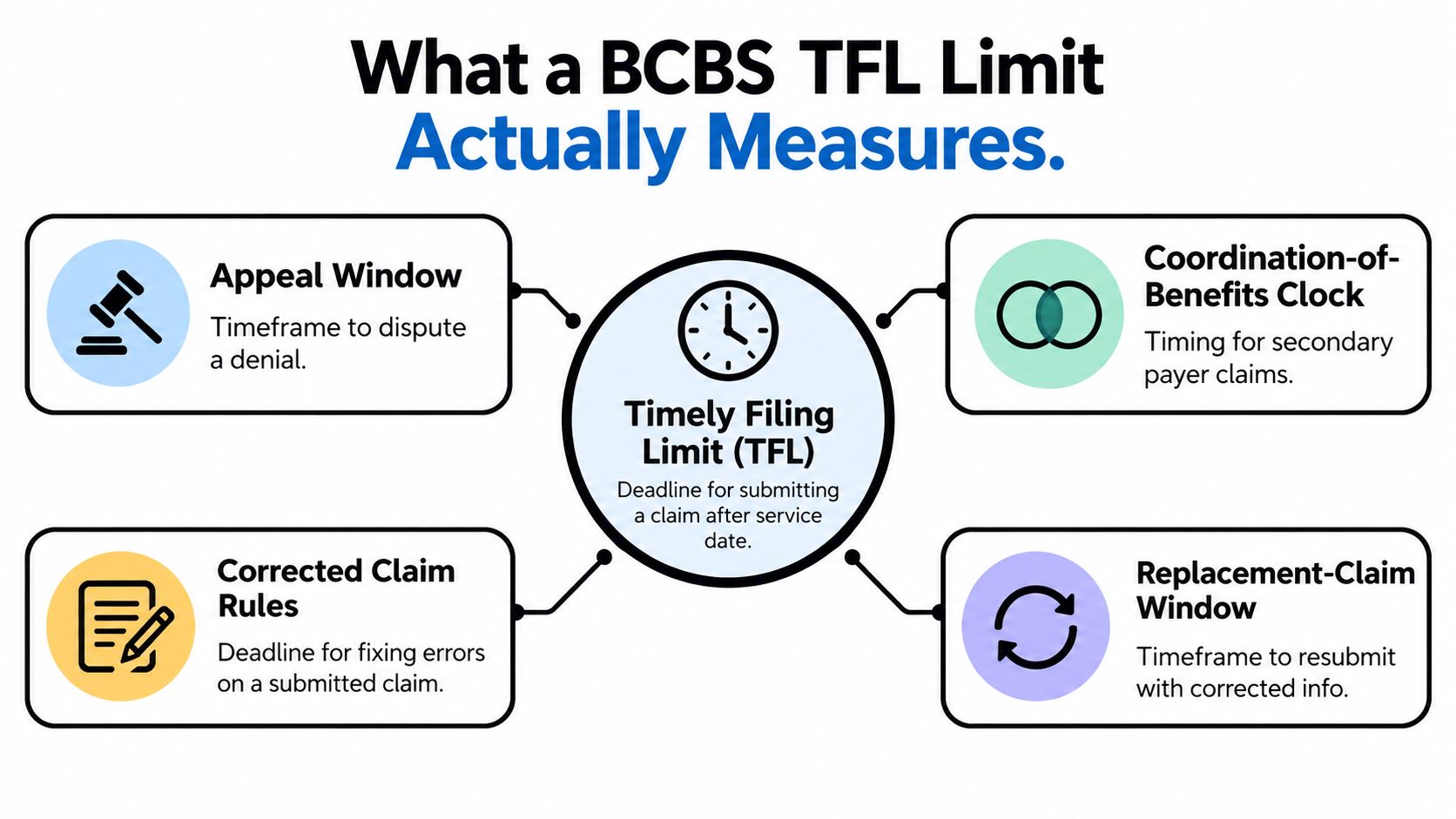
Four clocks that teams routinely confuse
The original-claim clock governs the first submission for services rendered. It normally runs from the applicable service, discharge, or institutional trigger date.
The appeal window starts after an adverse adjudication and gives the provider a route to dispute the payer's decision. It isn't an extension of the original TFL. A claim can be filed on time and still lose because the team misses the appeal deadline.
The coordination-of-benefits clock applies when BCBS is secondary. The applicable policy may measure the period from the provider's receipt of the primary payer's EOB. That is a new operational event requiring a documented handoff.
Corrected and replacement claim rules govern the repair or resubmission of a claim already submitted. They may use a denial, processing, or original claim date, depending on the plan. A corrected claim is not automatically an appeal, and a replacement submission isn't automatically protected by the original filing date.
For a practical framework for separating these deadlines, use this guide to timely filing limits. The important control is to store the applicable contractual deadline separately from the internal work deadline. The payer's rule tells you the outer boundary. Your workflow should force action well before it.
How the Deadline Differs by BCBS Affiliate and Product
A claim that is timely in one BCBS affiliate can be dead in another. That is the point many billing teams miss when they flatten every Blue plan into one filing rule.
BCBS Massachusetts lists a 90-day standard for certain HMO, POS, and PPO claims. BCBS Nebraska requires participating providers to submit clean claims within 120 days of the date of service unless the provider agreement says otherwise. BCBS Rhode Island's commercial policy uses 180 days from the date of service, or from discharge for inpatient admissions, and dental claims get 365 days.
| Affiliate | Standard window | Trigger date | COB exception |
|---|---|---|---|
| BCBS Massachusetts | 90 days for certain claims | Date of service | Product-specific rules apply, so verify the plan policy |
| BCBS Nebraska | 120 days for participating providers | Date of service unless the agreement specifies another period | When BCBS Nebraska is secondary, the period runs from receipt of the primary payer's EOB |
| BCBS Rhode Island commercial | 180 days | Date of service, or discharge for inpatient admissions | The policy measures the period from the primary insurer's processing date when another insurer is primary |
| BCBS Rhode Island dental | 365 days | Product-specific policy trigger | Verify the applicable dental policy |
The number means nothing without the trigger date. A 120-day rule counted from service is a different control from a 120-day rule counted from receipt of an EOB. Your payer grid needs both fields, or your team will misclassify clean claims as late ones.
Why the same service can produce different outcomes
A claim submitted 91 days after service can still be timely under Nebraska's 120-day rule and late under Massachusetts' 90-day rule. The difference lies in the governing contract, not in the claim itself.
The Nebraska policy also creates a secondary-payer exception. When BCBS Nebraska is secondary, the clock starts when the provider receives the primary payer's EOB. Teams that age the claim only from the date of service will write off claims that still have a live secondary filing period under the BCBS Nebraska timely filing policy.
BCBS Rhode Island shows the same problem inside one affiliate. Its commercial claim period is 180 days, while dental claims receive 365 days, according to the published timely filing document. One “Rhode Island BCBS” row does not cover both products.
For specialty groups operating across state lines, build the grid around affiliate, product, network status, claim type, and trigger date. If the team cannot identify all five before submission, it does not know the deadline yet. Providers billing behavioral health, anesthesia, orthopedics, or other multi-state services should also review Blue Cross Blue Shield psychologist billing considerations because specialty workflows often mix commercial, secondary, and corrected-claim paths.
Original, Replacement, Corrected, and Appeal Paths Compared
The most expensive BCBS mistake is treating every denied claim as a routine resubmission. The claim path determines which clock applies, what evidence matters, and whether the team should send a new claim or file a dispute.
| Claim path | What it does | Clock to verify | Correct routing |
|---|---|---|---|
| Original claim | Submits the service for initial adjudication | Service date, discharge date, or other plan-defined trigger | File under the applicable initial TFL |
| Replacement claim | Replaces a previously submitted claim | Payer-specific replacement window and original claim reference | Use the required replacement indicator and reference |
| Corrected claim | Fixes an error on a processed or denied claim | Correction rule, which may use denial or processing date | Follow the plan's corrected-claim format |
| Appeal | Challenges an adverse payer decision | Remittance, EOB, or determination date | Use the designated appeal channel before its deadline |
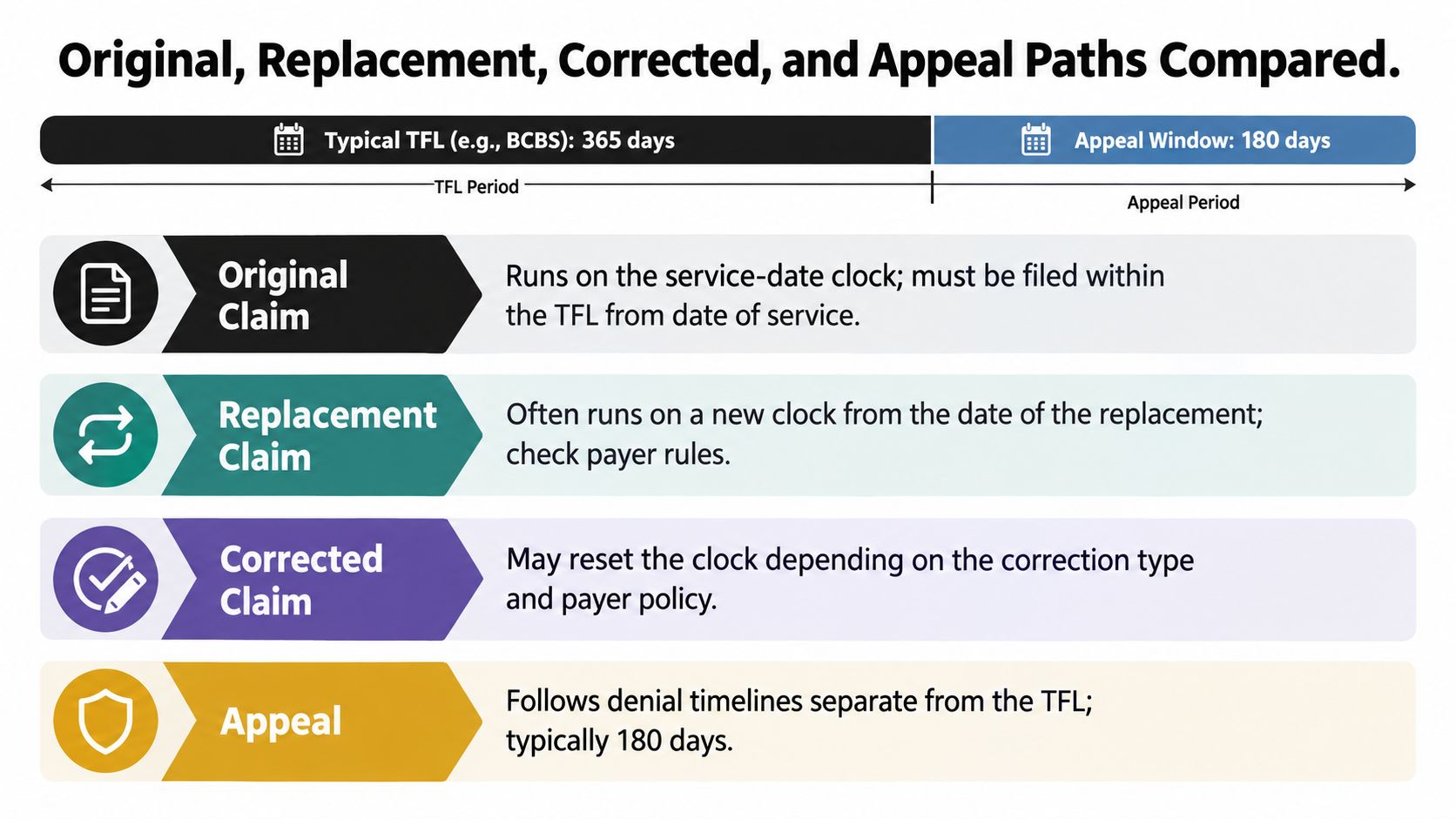
Original claims need receipt evidence
An original claim succeeds procedurally when the plan receives it within the applicable filing period. Internal software may show that someone clicked submit, but that doesn't establish payer receipt. The evidence file should connect the claim identifier, patient, date of service, transmission date, acceptance status, and payer destination.
A rejection is different from an acceptance. If the clearinghouse rejects the claim for missing or invalid information, the claim may not count as received under the payer's timely filing policy. Staff must correct and resubmit while the original clock is still open.
Corrections and replacements are not interchangeable
A replacement claim updates a previously submitted claim and normally requires the original claim reference. A corrected claim fixes a submitted claim under the payer's designated process. The exact mechanics depend on the affiliate and claim form, so the team must use the plan's instructions rather than assume that a new transmission preserves the original filing date.
The distinction affects denial recovery. Resending a claim as a new original can trigger a duplicate denial. Sending a correction through an appeal channel can cause the payer to close the request as procedurally wrong. Route by the reason for action, not by the fact that money remains unpaid.
Appeals run on the remittance clock
An appeal responds to the payer's adjudication. It doesn't revive an expired initial filing period, and meeting the initial TFL doesn't guarantee that the appeal remains open. BCBS Rhode Island's policy, for example, requires filing-limit appeals within 60 days of the original remittance-advice date, so a team can lose the appeal path while still believing the original claim is the relevant deadline.
Keep the remittance, original claim, payer policy, contract provision, and submission proof together. A reviewer needs to see why the route was selected and why the request arrived on time. A long medical-necessity argument won't cure a missing procedural record.
TFL Denials That Are Actually Beatable
A TFL denial is often beatable when the payer has applied the wrong affiliate rule, used the wrong trigger date, or failed to recognize an accepted submission. The denial becomes much harder when the provider submitted after the applicable window and has no qualifying exception. Your first task is to separate those two situations.
Consider the 91-day example. Under a 120-day Nebraska standard, that claim may be timely. Under a 90-day Massachusetts standard, it may not be. The right appeal doesn't argue that the service was important. It identifies the affiliate, product, applicable rule, trigger date, and actual receipt date, then attaches the controlling policy and evidence.
Evidence that changes the result
A credible file should include:
- Plan identification: Member ID card, alpha prefix, home plan, product, and network status.
- Rule identification: Current provider policy, provider manual section, or contract provision.
- Claim history: Original claim, claim control number, denial remittance, and any replacement or correction record.
- Receipt proof: Clearinghouse acceptance or payer acknowledgment that ties the submission to the claim.
- COB proof: Primary payer EOB and documentation of when the provider received it.
- Exception support: Records showing a payer system issue, eligibility event, or other documented circumstance recognized by the applicable rule.
The Nebraska COB exception demonstrates why receipt evidence matters. If BCBS is secondary and the policy starts the period when the provider receives the primary EOB, the EOB receipt date becomes a controlling artifact. Without it, the team may not be able to prove when the secondary clock began.
Payers overstate deadlines when teams let them
A payer's denial explanation can be incomplete without being deliberately misleading. The adjudication system may apply a default rule because the claim lacked the product or COB information needed to identify the correct exception. Staff shouldn't accept the first date calculation without testing it against the contract and claim history.
Appeal position: Prove the payer used the wrong clock. Don't ask the reviewer to excuse a late claim without evidence.
Track receipt, not merely transmission. Archive acknowledgments at submission, preserve primary-payer EOBs when BCBS is secondary, and retain the remittance that created the appeal right. A claim that was accepted within the window can be recoverable. A claim that was only placed into an internal queue cannot.
Operating Model That Prevents BCBS TFL Denials
Prevention starts before the claim is created. The workflow below is designed for a specialty billing operation managing several Blue affiliates at once.
Identify the plan at intake
Capture the full member ID, alpha prefix, product, group information, and network status. Don't let a generic “BCBS” payer name drive routing. If the member is covered through a BlueCard arrangement, identify the home plan before assigning the filing rule.
Verify the applicable control
For each claim, confirm the initial filing period, trigger date, corrected claim rule, COB rule, and appeal path. Compare the provider manual with the executed agreement. If they differ, escalate the discrepancy before billing rather than discovering it after denial.
Create an evidence event at submission
The submission workflow should store the original claim image, transmission timestamp, clearinghouse acknowledgment, payer destination, and acceptance or rejection status. A staff member shouldn't have to reconstruct the record months later from an inbox or a billing system note.

Treat COB as a handoff, not an aging category
When the primary payer adjudicates, route the EOB immediately to the secondary billing owner. Record the date the provider received the EOB, attach the document, and calculate the BCBS secondary deadline from the applicable policy. Don't leave secondary claims in a general follow-up queue.
Age by trigger date
Run separate reports for service date, discharge date, primary EOB receipt, original claim processing, denial remittance, and appeal deadline. Sort short-window claims ahead of claims with more room. A dollar-value queue can hide a procedural emergency.
Escalate before the deadline
Set internal alerts before the payer cutoff. When a claim lacks an acceptance acknowledgment, a primary EOB, or a verified plan rule, route it to a senior biller. When a TFL denial arrives, pause the write-off and initiate a rule-and-evidence review before deciding whether to correct, replace, appeal, or close.
Control point: The team that captures proof at submission wins disputes. The team that searches for proof after denial usually finds gaps.
Linking Upstream Discipline to Downstream IDR Recovery
TFL control and IDR recovery belong in the same revenue-protection system. Clean eligibility data, accurate claim routing, accepted submissions, and preserved EOBs give a dispute team the evidence needed to prove what happened before a payer delayed, downcoded, or underpaid the claim.
Analytics should connect affiliate, product, specialty, denial reason, trigger date, and outcome. That view can reveal whether a recurring problem sits in intake, clearinghouse rejection handling, secondary billing, payer configuration, or appeal execution. It also gives teams a defensible record when they escalate claims through No Surprises Act IDR processes.
For IONM, anesthesia, orthopedics, air ambulance, and other specialty operations, the practical standard is one connected workflow. Upstream RCM prevents avoidable leakage. Downstream dispute enforcement pursues underpayments that remain after the claim was properly filed. Separating those functions leaves evidence and recovery opportunities on the table.
RevGuard combines specialty-specific RCM with enforcement-focused IDR support, from eligibility and clean claim workflows through evidence assembly, payer disputes, and payment recovery. If your team needs affiliate-level BCBS controls and a stronger path for underpaid or disputed claims, visit RevGuard to evaluate the full revenue-protection model.