

The most dangerous timely filing denial is often attached to a claim that was coded correctly, medically necessary, and fully covered. A claim can still become uncollectible because the payer received it after its filing window closed. Medicare makes the rule especially clear: claims must reach the correct Medicare Administrative Contractor within one calendar year of the service date, and late claims are denied as untimely under CMS Medicare billing guidance.
That makes timely filing a revenue protection issue first and a compliance issue second. The clock starts while staff are waiting for documentation, correcting eligibility, resolving a clearinghouse rejection, or handing work from a specialty practice to an outsourced billing team. If nobody owns that clock, the claim can die on a desk long before anyone recognizes the loss.
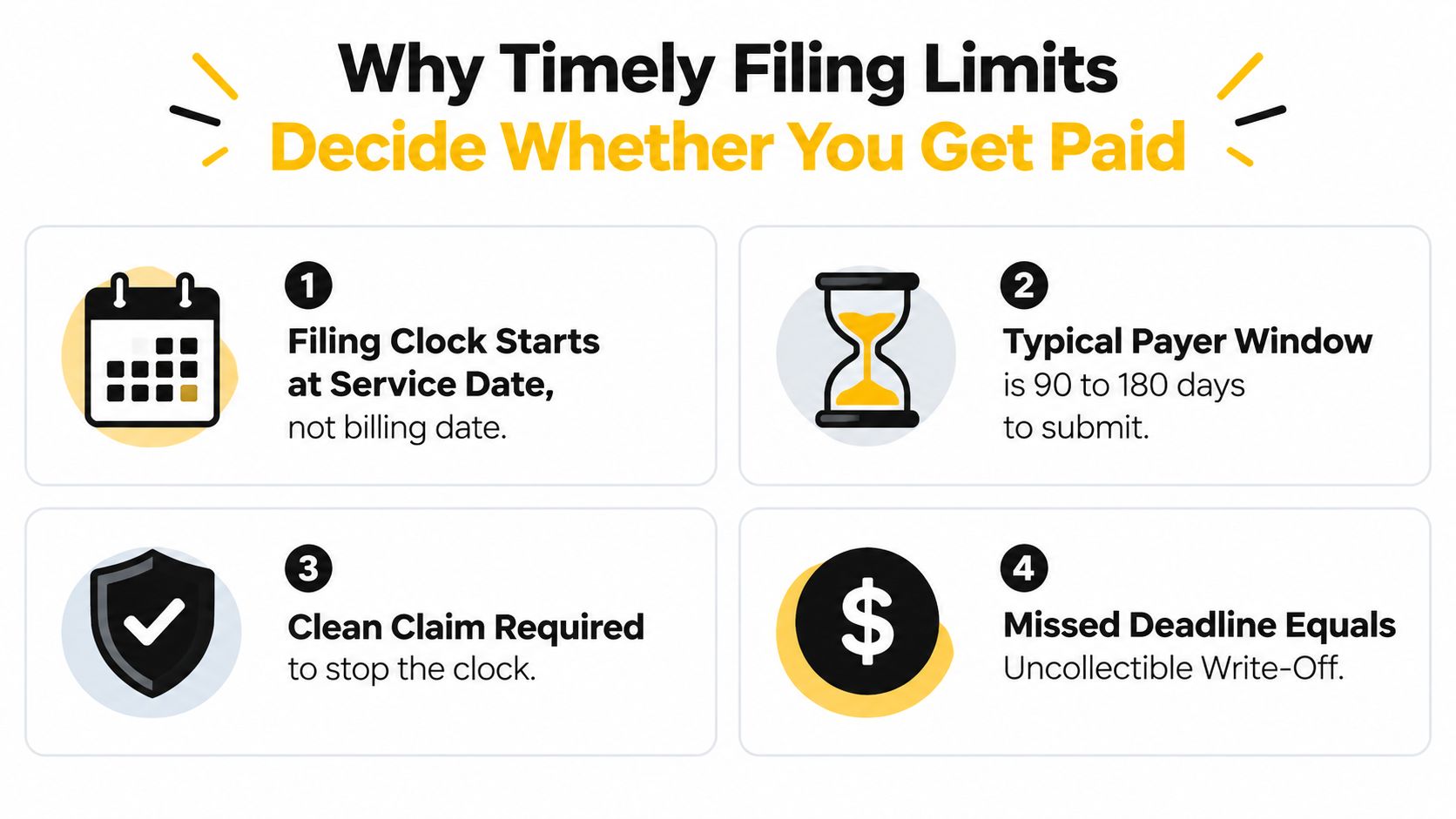
Why Timely Filing Limits Decide Whether You Get Paid
Timely filing is the highest-impact revenue control in the billing workflow. The rule is simple: submit the claim to the correct payer by the deadline measured from the applicable trigger, usually the date of service for an original claim. The payer's receipt date matters, not your internal billing date, the date a provider signs a chart, or the date someone finally notices an unworked account.
A clean claim submitted one day late can be worth exactly zero dollars from that payer. That's different from a medical necessity or eligibility denial, where the organization may still correct documentation, verify coverage, or appeal the payer's decision. A timely filing denial attacks the right to process the claim at all.
Who feels the deadline first
High-volume specialty groups, ambulatory surgery centers, and practices with delayed charge capture carry the greatest exposure. A single missed claim may be manageable. A billing queue that repeatedly delays cardiology procedures, anesthesia encounters, imaging services, or behavioral health visits can turn a process defect into a persistent revenue leak.
Outsourced billing handoffs create another failure point. The provider may assume the vendor has submitted the claim, while the vendor is waiting for a signed note, corrected subscriber information, or a payer routing decision. Neither party may discover the gap until the account is already near the deadline.
Practical rule: Track the payer deadline and the claim's verified receipt, not merely the date someone pressed “submit.”
Build your operating model around three controls:
- Set the clock at intake: Record the service date, payer, plan type, filing limit, and internal submission target as soon as the encounter becomes billable.
- Separate rejected from denied claims: A clearinghouse rejection may require correction and retransmission. A payer denial has entered adjudication and may require a distinct appeal or corrected-claim process.
- Assign a named owner: Every aging claim needs one person responsible for the next action, evidence, and deadline.
A strong medical accounts receivable process should show which claims are approaching the payer's limit, which claims have confirmed acceptance, and which disputes need escalation. Don't let a generic aging bucket hide the filing clock.
The Medicare 12-Month Rule and Its Narrow Exceptions
For Medicare fee-for-service, the default rule is a 12-calendar-month filing limit from the date of service. Part A and Part B claims must arrive at the Medicare Administrative Contractor no later than one calendar year after services were furnished. CMS's Medicare Claims Processing Manual treats this as a receipt-date requirement, so a postmark or internal transmission date doesn't establish compliance if the claim wasn't received in time.
For a service date in 2025, the final filing date is generally the same calendar date in 2026, unless a narrow regulatory exception applies. The rule applies across Medicare claim types, including paper and electronic submissions. Secondary billing doesn't automatically create a new Medicare runway. The Medicare clock remains tied to the service date, not the date another payer finishes processing.
Exceptions require evidence
Medicare exceptions aren't a general remedy for slow charge capture or a vendor's missed work queue. They require documentation showing that a recognized circumstance prevented timely filing.
| Exception Category | Filing Window | Required Documentation |
|---|---|---|
| Administrative error | Exception-based, subject to CMS requirements | Evidence of an error by CMS or its contractor, including relevant correspondence or processing records |
| Retroactive Medicare entitlement | Exception-based after entitlement is established | SSA notice, CMS entitlement documentation, or other official proof of retroactive coverage |
| Retroactively enrolled provider | Exception-based after enrollment is confirmed | Medicare enrollment records and documentation establishing the effective enrollment period |
| Workers' compensation or another primary payer situation | Subject to Medicare coordination rules and documentation | Primary-payer records, payment or denial information, and evidence supporting the delayed Medicare submission |
A billing team shouldn't wait until day 366 to investigate an exception. Gather the official letter, contractor correspondence, eligibility record, or primary-payer evidence while the account is still recoverable. Administrative oversight, staff turnover, software migration, and an overloaded queue generally don't transform a late claim into an exception.
The operational standard is evidence before hope. If the exception file isn't documented, treat the claim as being at risk.
Medicaid and Commercial Payer Filing Deadlines Compared
Medicaid and commercial timely filing limits are fragmented by state, contract, network status, and plan design. A neutral payer summary reports Medicaid filing windows commonly ranging from 90 to 365 days, while commercial plans often require claims within approximately 90 to 180 days. The state-by-state payer filing guide also highlights California Medi-Cal's six-month limit for original claims, illustrating why a generic “Medicaid deadline” is not operationally safe.
The deadline usually runs from the service date, not the date documentation is completed or the claim enters the billing system. That distinction matters for multi-state groups. A provider can use one EHR, one clearinghouse, and one billing platform while operating under several different payer clocks.
Use the plan document as the source of truth
State Medicaid programs publish their own requirements, and managed Medicaid products may impose contract-specific rules. Commercial plans can also distinguish participating providers, nonparticipating providers, employer products, Medicare Advantage products, and corrected claims. Plan names alone aren't enough.
| Payer / Program | Initial Claim Window | Corrected Claim / Resubmission | Notes |
|---|---|---|---|
| Medicare | 12 months from service date | Governed by Medicare rules and the applicable claim stage | Receipt by the MAC controls |
| State Medicaid | Commonly 90 to 365 days | Varies by state and program | Confirm the state manual and plan contract |
| California Medi-Cal | Six months for original claims | Verify the applicable state rule | The state program's published guidance controls |
| Commercial payer | Often about 90 to 180 days | Contract-specific | Network status and product type can change the rule |
| Blue Cross Blue Shield plan | Often 180 to 365 days, depending on region | Verify the local plan policy | The regional plan and member product matter |
The distinction between rejected and denied claims deserves special attention. A rejected claim may never have entered adjudication, so the payer may permit correction and retransmission under its submission rules. A denied claim has been adjudicated and may require a formal appeal, corrected claim, or reconsideration within a separate deadline.
Maintain a payer matrix keyed to the plan ID, not just “Aetna,” “UnitedHealthcare,” or “Blue Cross.” Acquired products and regional plans can carry different filing rules. Put the original claim limit, corrected-claim rule, resubmission requirement, appeal deadline, and evidence standard in the same row.
Corrected Claims, Resubmissions, and Appeals Run on Separate Clocks
A corrected claim, a resubmission, and an appeal aren't interchangeable actions. Each has a different trigger, submission format, deadline, and proof requirement. Treating them as one generic “follow-up” task is how a winnable dispute ages out.
A corrected claim fixes the original submission. For many professional claim workflows, the claim must identify the replacement or void function with the appropriate frequency code and reference the original claim number. Medicare's underlying original filing limit still binds the correction. If the original Medicare claim was never timely filed, changing the claim data on day 350 won't cure the late submission.
A resubmission usually responds to a rejection or payer instruction to send the claim again. The operative date may be the rejection notice, payer response, or remittance advice, depending on the plan. Don't assume the resubmission gets the same treatment as an original claim. Read the payer's provider manual and preserve the first transmission record.
Put every clock in the denial worklist
Formal appeals are separate from both corrections and resubmissions. Medicare's first appeal level generally runs from the remittance advice, while later levels use the decision from the preceding level as the trigger. The Medicare appeal process steps should be documented independently from the original claim submission workflow.
| Action | Trigger Event | Typical Window | Key Documentation |
|---|---|---|---|
| Corrected claim | Discovery of an error on an adjudicated or accepted claim | Payer-specific, often tied to the service date or remittance advice | Original claim number, corrected data, frequency code, clinical support |
| Resubmission | Clearinghouse rejection or payer request for retransmission | Payer-specific and tied to the rejection or instruction | Rejection report, corrected claim file, acceptance confirmation |
| Formal appeal | Adverse remittance or denial notice | Payer-specific, with Medicare levels governed separately | Remittance advice, denial reason, appeal argument, records, proof of timely submission |
Record four fields for every action: trigger date, deadline, owner, and evidence location. A worklist that says “appeal claim” without those fields is incomplete.
For Medicare, a provider should calculate the original service-date deadline even when the dispute appears later. For commercial plans, calculate the appeal deadline from the notice that triggers the appeal. If the payer's letter, remittance, and portal display show different dates, preserve all three and escalate the discrepancy before the shortest plausible window closes.
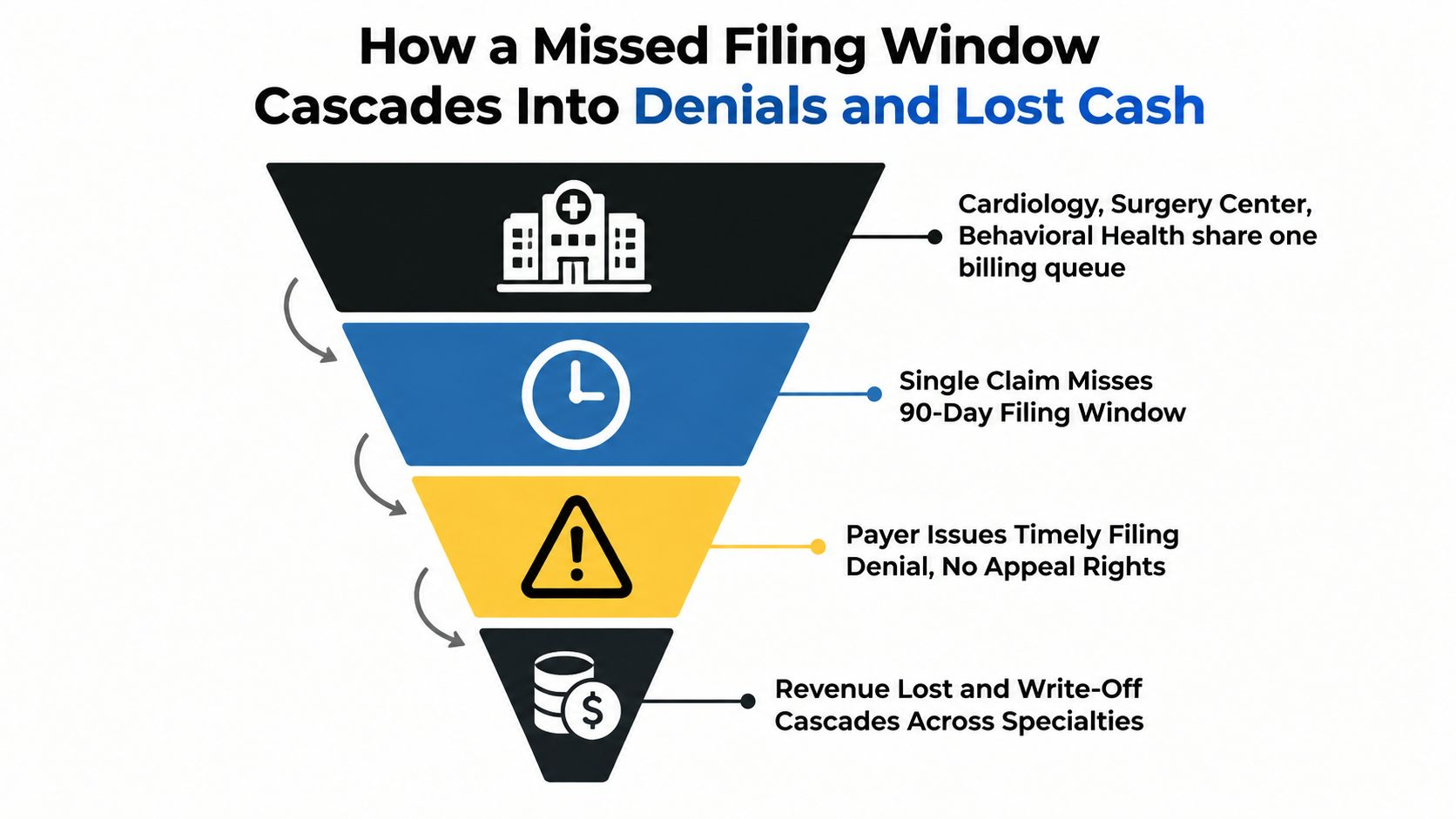
How a Missed Filing Window Cascades Into Denials and Lost Cash
Consider a cardiology group, a same-day surgery center, and a behavioral health clinic sharing one billing platform. Their service lines are different, but the platform uses a common queue and the same staff handoff. One eligibility typo can therefore become a revenue-cycle problem across several specialties if the rejection isn't visible to a named owner.
The claim reaches the clearinghouse on day one and bounces because the subscriber information doesn't match. The billing team doesn't rework it until day 300. By then, the payer's filing window may be nearly exhausted. If the claim arrives after the applicable deadline, the payer can issue a timely filing denial even though the encounter was covered and the original error was administrative.
The financial damage starts before the denial
The claim first appears as unresolved work. Then it moves into an aging bucket, consumes denial staff time, and distorts the cash forecast. Once the payer posts a timely filing denial, the organization may need a write-off review, an exception analysis, or an appeal supported by clearinghouse evidence.
The account also competes with newer claims for staff attention. That creates a queue-management problem, not just a coding problem. A single unresolved rejection can become a late filing denial because nobody distinguished “not accepted” from “not paid.”
A late claim doesn't merely create a denial. It removes the payer's obligation to adjudicate the underlying service.
Use the scenario to test your controls:
- At intake: Was the payer and plan ID verified?
- After submission: Did the clearinghouse confirm acceptance?
- After rejection: Was the claim returned to an owned work queue?
- Before aging: Did an alert identify the approaching filing limit?
- After denial: Did staff preserve the original submission evidence and select the correct appeal path?
When the answer is “no,” the organization hasn't suffered a paperwork delay. It has experienced a working-capital event. Contractual adjustments may rise, cash forecasts become less reliable, and managers may authorize write-offs for claims that could have been recovered if someone had acted while the payer's clock was open.
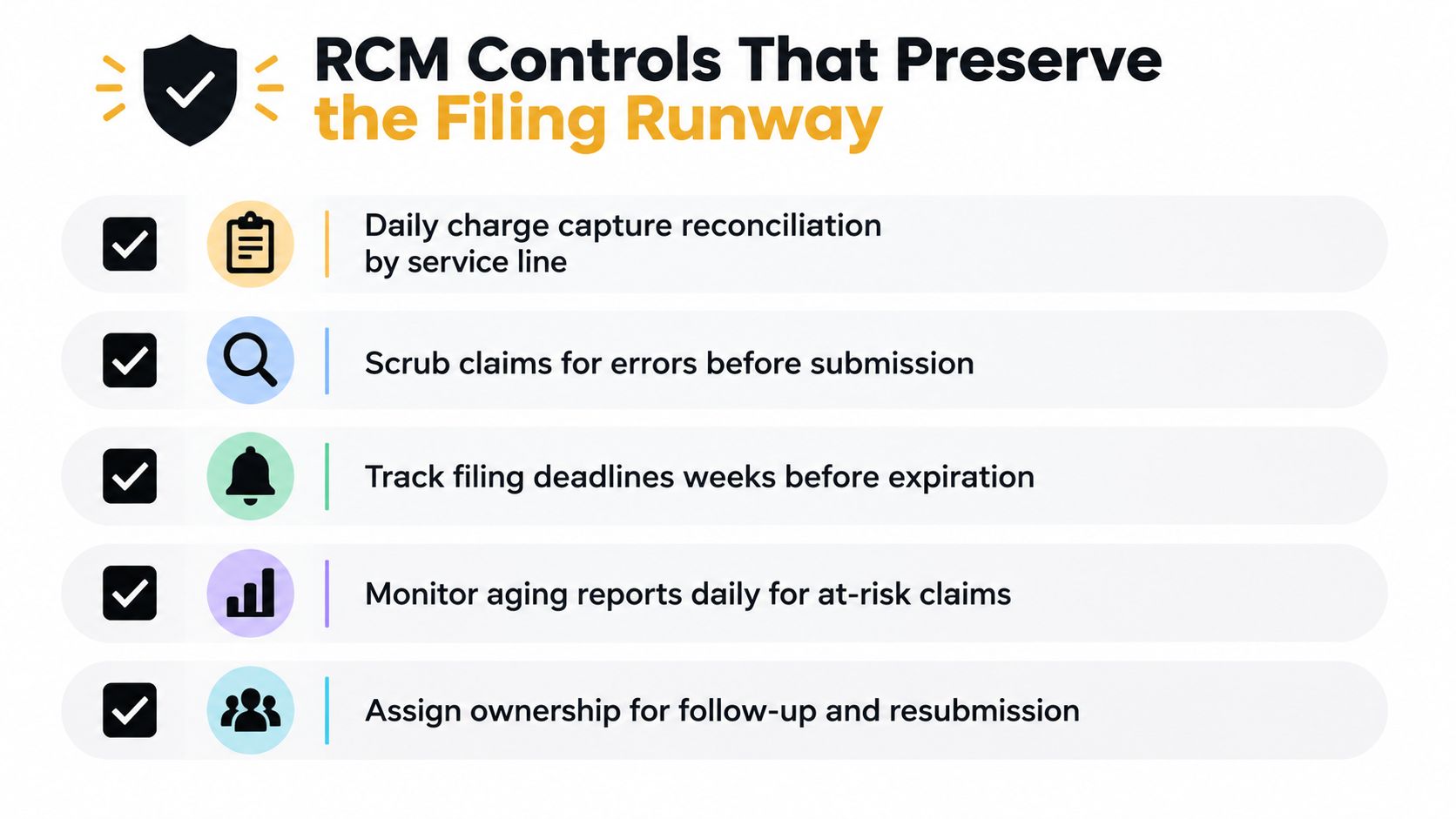
RCM Controls That Preserve the Filing Runway
Revenue cycle teams preserve filing runway through cadence, ownership, and evidence. New technology can help, but no dashboard compensates for an unassigned queue or a payer matrix nobody validates.
Start with charge capture. Reconcile charges daily by service line, including procedures performed in the operating room, anesthesia cases, imaging studies, and recurring behavioral health encounters. The reconciliation should identify services that have occurred but lack a billable claim because documentation, coding, eligibility, or credentialing remains incomplete.
Build controls around the earliest failure
Use a weekly aging sweep to flag claims approaching a meaningful share of their payer window. Don't wait for the final days. A 90-day commercial limit needs a much earlier internal escalation than a Medicare claim with a 12-month federal window.
Your operating checklist should include:
- Reconcile charges daily: Compare schedules, procedure logs, operative reports, and posted charges by service line.
- Review acknowledgments: Confirm that the clearinghouse and payer accepted the claim, rather than relying on a transmission batch alone.
- Triage denials quickly: Assign rejected and denied claims to a queue with a documented next action and due date.
- Maintain the payer matrix: Store filing limits, corrected-claim rules, appeal tiers, plan IDs, and evidence requirements.
- Validate contracts regularly: Provider manuals and payer agreements can change, so assign an owner to verify the matrix on a recurring schedule.
- Preserve proof: Save clearinghouse acknowledgments, portal receipts, remittance advice, correspondence, and paper-mail evidence in the account record.
Create alerts for the 270th day of Medicare's 12-month window, the earliest deadline in each Medicaid program, and the shortest commercial limit among your major contracts. Those are internal controls, not payer requirements. Their purpose is to leave time for correction, retransmission, and evidence gathering.
RevGuard is one example of a revenue protection firm that combines specialty RCM workflows with payer dispute and IDR support. Whether you use an external partner, a clearinghouse dashboard, or your existing practice-management system, the standard stays the same: every claim needs a deadline, an owner, a verified receipt, and a next action.
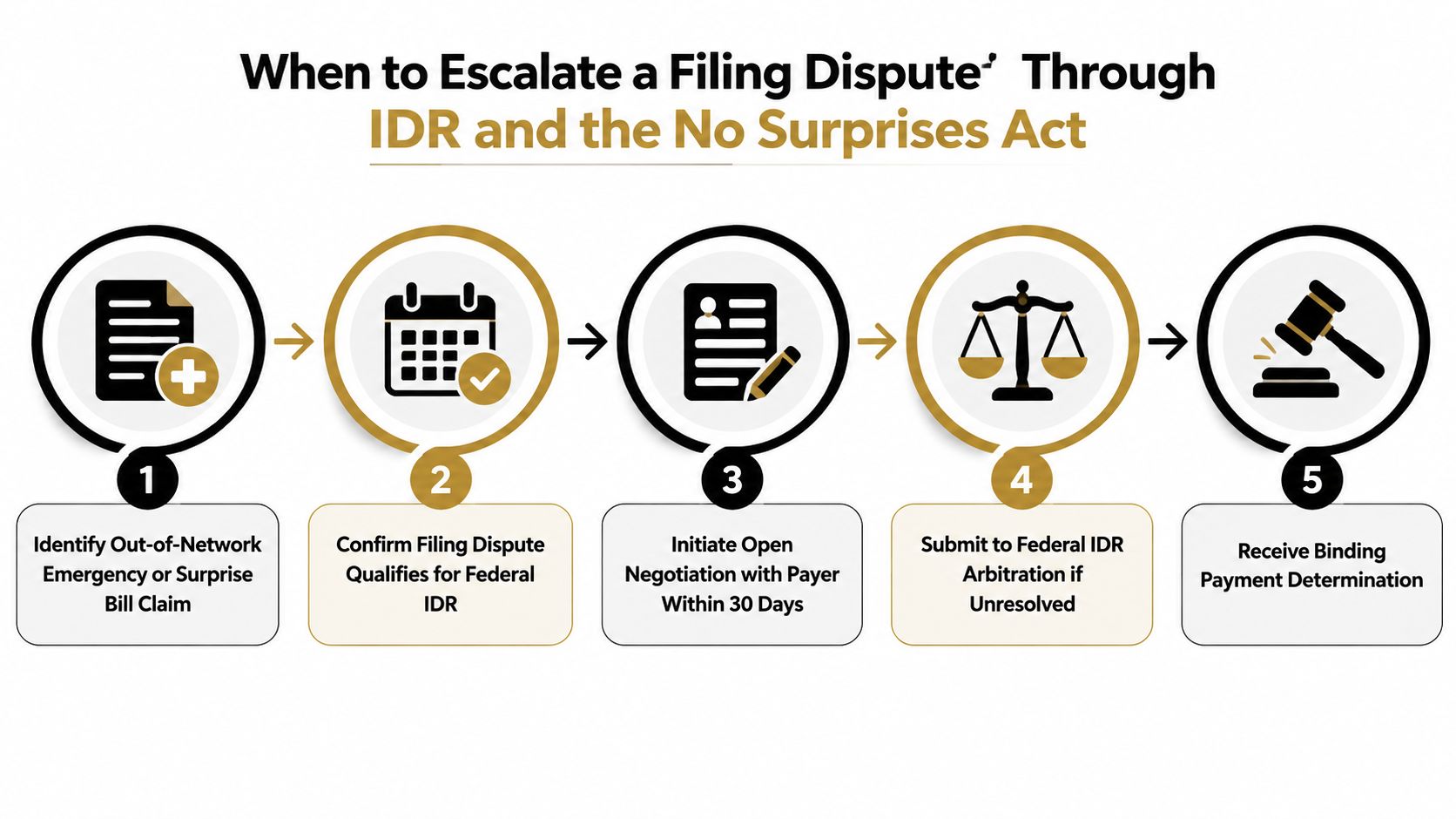
When to Escalate a Filing Dispute Through IDR and the No Surprises Act
A payer's timely filing denial doesn't always end the analysis. If the underlying dispute involves a qualifying out-of-network service under the No Surprises Act, the provider should test federal Independent Dispute Resolution eligibility before writing off the account.
The federal IDR pathway can apply to out-of-network emergency services, post-stabilization services, out-of-network providers at in-network facilities, and air ambulance services, subject to the statute and applicable eligibility requirements. It isn't a general appeal channel for every late claim, but a payer's filing position shouldn't cause a provider to abandon a qualifying surprise-billing dispute without review.
Separate the claim deadline from the IDR deadline
The NSA process has its own sequence. The parties enter an open negotiation period lasting 30 business days, followed by a federal IDR initiation window of 4 business days if negotiation doesn't resolve the dispute. These deadlines are described in RevGuard's No Surprises Act IDR guidance.
That sequencing matters when a payer issues a timely filing denial while also disputing the payment amount. Preserve the original bill, assignment of benefits, provider attestation, medical records, remittance advice, payer correspondence, and proof of service. Then ask counsel or an experienced IDR team whether the dispute qualifies and which notice starts the federal clock.
Escalation rule: Never treat “untimely” as the final answer until you've checked whether the claim sits inside a qualifying NSA dispute and whether open negotiation is still available.
IDR doesn't erase ordinary claim-submission obligations. Providers still need a timely original claim, accurate payer routing, and complete evidence. But when a payer weaponizes a filing position against a qualifying surprise-service payment dispute, the provider may have a separate federal path for resolution.
Sample Timelines, Checklist, and a Monday-Morning Action Plan
A clean Medicare claim should move quickly even though Medicare provides a longer outer limit. For example, a service rendered on January 10 should be charged, coded, scrubbed, and submitted while the encounter is fresh. The team should retain the acceptance confirmation and monitor the claim through adjudication rather than treating the longer federal window as permission to delay.
A disputed commercial claim demands a different response. The team should identify the plan-specific deadline from the member's product and contract, preserve the first submission and rejection records, correct the claim promptly, and calculate any appeal deadline from the remittance or denial notice. If the service may qualify under the No Surprises Act, open a separate IDR hold file immediately rather than burying the issue in the ordinary denial queue.
The operating checklist
Use this checklist as an assigned work standard:
- Charge capture: Reconcile every service line daily and route missing documentation to a named owner.
- Submission evidence: Save the payer or clearinghouse acceptance record for each claim.
- Work queue review: Run a weekly report for claims approaching the shortest applicable filing limit.
- Denial management: Record the trigger date, deadline, reason, owner, and required evidence for every denial.
- Payer matrix: Validate plan-specific rules on a recurring schedule and version the changes.
- Appeal calendar: Enter every appeal deadline from the remittance or denial notice, not from staff memory.
- NSA trigger: Place qualifying out-of-network emergency, facility-based surprise, and air ambulance disputes into an IDR review queue.
Monday morning action plan
The RCM lead should begin by pulling the 90-day filing report and sorting it by oldest service date. Triage the oldest 25 claims, confirm whether each was accepted or rejected, and assign a next action before the workday ends.
Next, review all remittances received during the prior work cycle, calculate appeal deadlines, and verify that every payer matrix row has a current plan ID and filing rule. Open an IDR hold file for each denial that may involve a qualifying NSA service, attach the bill and payer notice, and send the file for eligibility review before the open-negotiation window closes.
The goal isn't merely to submit more claims. It's to make sure no claim can sit untouched without a visible deadline, accountable owner, and documented path to payment.
RevGuard helps provider groups manage payer-specific filing controls, denial workflows, and No Surprises Act IDR disputes as connected revenue-protection processes. If your team is losing claims to missed deadlines or payer underpayments, visit RevGuard to evaluate a more disciplined path from clean submission to dispute recovery.