

Medical accounts receivable isn't a back-office detail. It's where margin is either protected or surrendered.
The starkest proof is this: 84% of healthcare businesses lost revenue due to outdated AR processes in 2024, according to this healthcare AR overview. That same source notes that poor billing practices cost U.S. doctors an estimated $125 billion annually, while medical billing errors cost the industry over $100 billion per year. If a specialty practice still treats AR as a collections queue instead of a revenue protection system, it will keep losing money long before anyone notices the write-off.
In practice, swollen AR rarely starts with the aging report. It starts at registration, eligibility, authorization, documentation, coding, and claim construction. Then it gets worse when payers delay, downcode, or deny, and the team responds claim by claim instead of pattern by pattern. That is why strong AR performance depends on more than billing discipline. It depends on front-end precision, payer strategy, and a clear escalation path when standard follow-up stops working.
The High Cost of Unmanaged Medical AR
Days in AR can look stable on a dashboard while the practice is already losing collectible revenue. The loss shows up in a different form first: missed timely filing windows, avoidable write-offs, underpayments never appealed, and patient balances that become harder to collect because the first statement went out months late.
That is the cost of unmanaged AR. It is not just delayed cash. It is revenue that gets weaker with age.
In specialty practices, I see the same pattern repeatedly. Teams focus on whether claims were submitted, but not whether they were built to survive payer scrutiny, support an appeal, or hold up in a payment dispute. A claim can leave the billing system clean and still be vulnerable if registration missed coordination of benefits, the authorization record is incomplete, the operative note does not support the code set, or the payer has a known pattern of partial payment that no one tracks.
Once that account hits AR, every defect costs more to correct. Staff spend time reconstructing records, chasing signatures, requesting retro authorizations, and reopening work that should have been closed before the date of service. Payers benefit from that delay. The older the balance, the more likely the practice accepts less than it should, shifts confusion to the patient, or writes the account off as too expensive to pursue.
Revenue leakage starts upstream and gets priced downstream
Unmanaged AR usually reflects two failures at once.
The first is operational. Front-end teams may register the patient correctly enough to get them on the schedule, but not accurately enough to produce a defensible claim. The second is strategic. Billing teams may follow up consistently, yet still fail to identify payer patterns such as repeated downcoding, slow-pay behavior, or denials that should move from routine appeal to formal escalation.
That distinction matters. Specialty groups do not just need collectors. They need a revenue protection process that connects intake, documentation, coding, reimbursement, and dispute resolution. That is the practical value of disciplined medical practice management. It gives leadership a way to trace aged balances back to the exact workflow or payer behavior creating them.
AR also affects negotiating position. If a practice cannot document where underpayments start, how often authorizations fail, or which denials should have been contested more aggressively, it loses its advantage in payer conversations and weakens its position in higher-level disputes, including IDR when that path applies.
What unmanaged AR looks like in practice
The warning signs are usually operational before they become financial:
- Old balances pile up without segmentation: High-dollar claims, filing-deadline risks, and appealable underpayments sit in the same queue as low-value status checks.
- Rework replaces prevention: Staff spend their day fixing missing data, requesting records, and rebilling claims that should have been correct the first time.
- Payer pressure goes unanswered: Repeated denials, downcodes, and partial payments continue because no one escalates them by payer, service line, or denial reason.
- Patient AR gets harder to recover: Delayed insurance resolution pushes larger balances to patients after the clinical episode is no longer clear, which lowers collection rates and increases complaints.
A swollen AR ledger is rarely a simple collections problem. It is a sign that the practice is funding payer delay, absorbing preventable process defects, and waiting too long to defend revenue that should have been protected before the claim ever aged.
Decoding the Medical AR Lifecycle
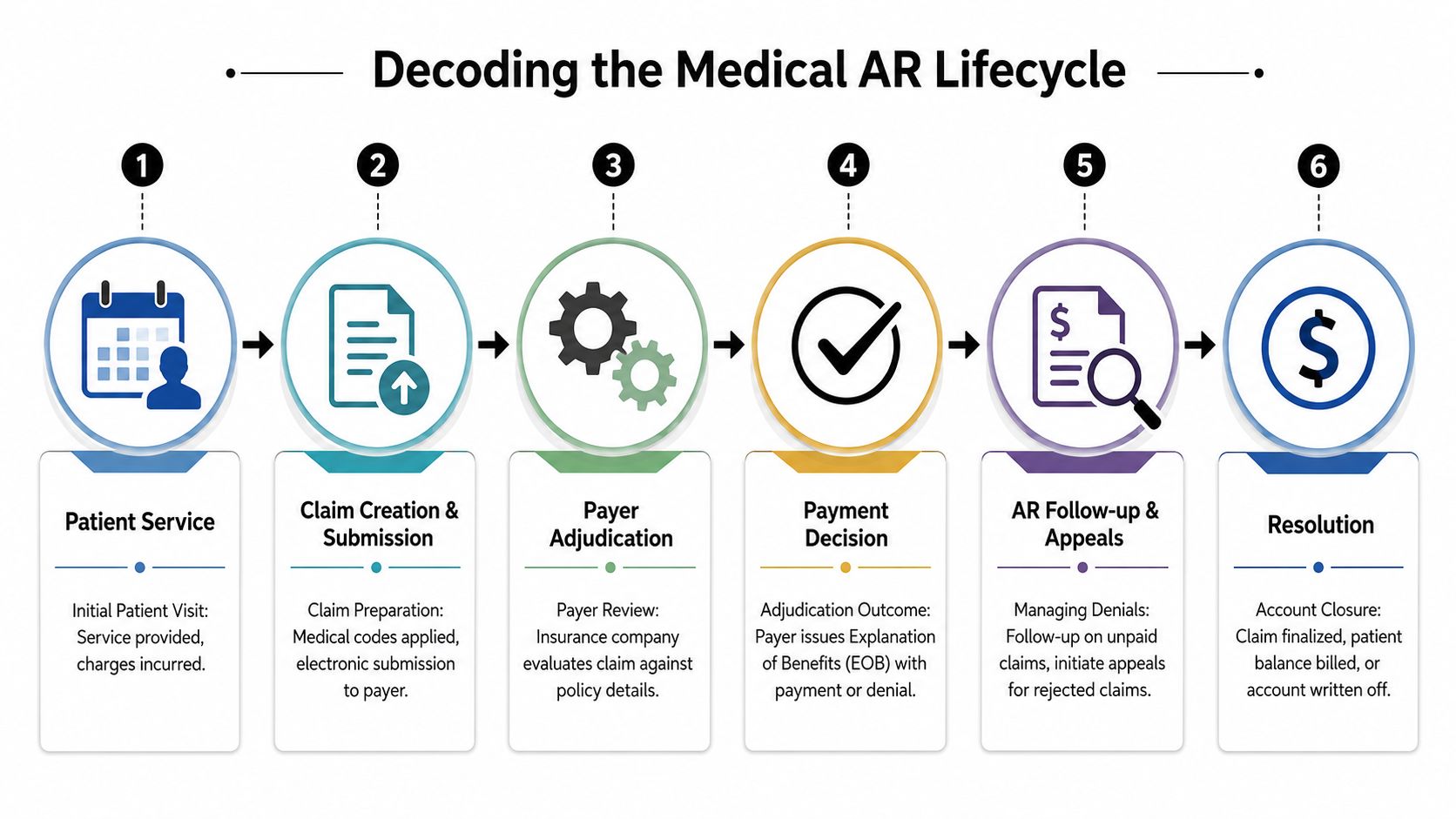
Medical accounts receivable moves like a relay race. Each handoff has to be clean. One dropped baton early in the sequence can turn into a denial, underpayment, or uncollectible balance much later.
Where AR actually begins
AR doesn't begin when a claim is unpaid. It begins before the patient is seen.
At scheduling and registration, the team collects demographics, verifies coverage, confirms payer requirements, and checks whether prior authorization or referrals apply. If any of that data is wrong, the claim may still go out, but it goes out carrying hidden defects. The payer finds them later, and the account lands in AR for reasons that could have been prevented before the visit.
The next handoff is documentation, coding, and charge capture. Clinicians document the service. Coders translate the record into billable codes. Charge entry places the claimable service into the billing workflow. If documentation is incomplete or coding is imprecise, the practice creates either a denial risk or an underpayment risk.
The six operational stages
A practical way to think about the lifecycle is this:
Patient service and intake
The visit occurs, but the financial foundation was set before the patient arrived. Eligibility, authorization, and coverage clarity matter here as much as clinical scheduling.Claim creation and submission
The billing team builds the claim using the documented encounter, applies coding, and transmits the claim electronically. A rushed submission may move fast but still create downstream rework.Payer adjudication
The payer reviews the claim against policy rules, benefit design, coding logic, and internal edits. During this review, payer tactics become visible.Payment decision
The payer issues payment, partial payment, denial, or rejection with an EOB or ERA that has to be read carefully. Many teams post the result without fully testing whether it matches contract terms or legal payment obligations.AR follow-up and appeals
Staff work unpaid claims, corrected claims, reconsiderations, and formal appeals. During these tasks, weak organizations become reactive.Final resolution
The account is paid correctly, corrected and rebilled, transferred to patient responsibility when appropriate, escalated for dispute, or written off based on policy.
A clean claim is good. A clean claim that is also dispute-ready is better.
That distinction matters. Specialty practices dealing with aggressive payer edits can't afford to build claims that only work if the payer behaves reasonably. They need claims that can survive review, appeal, and escalation if necessary.
Operationally, revenue cycle optimization demonstrates its value. The goal isn't merely moving claims faster. Instead, it's creating tighter handoffs so the claim remains defensible from intake through final resolution.
Why the lifecycle breaks down
The lifecycle usually fails at the seams. Registration assumes coding will catch a coverage problem. Coding assumes documentation will support the service. Billing assumes a denial team will fix anything that comes back. Appeals assume someone saved the right records. No one owns the full path.
Practices with strong AR performance assign ownership by failure point. They don't just ask who touched the claim last. They ask where the defect first entered the system and how to stop it from recurring.
Essential Metrics for AR Performance
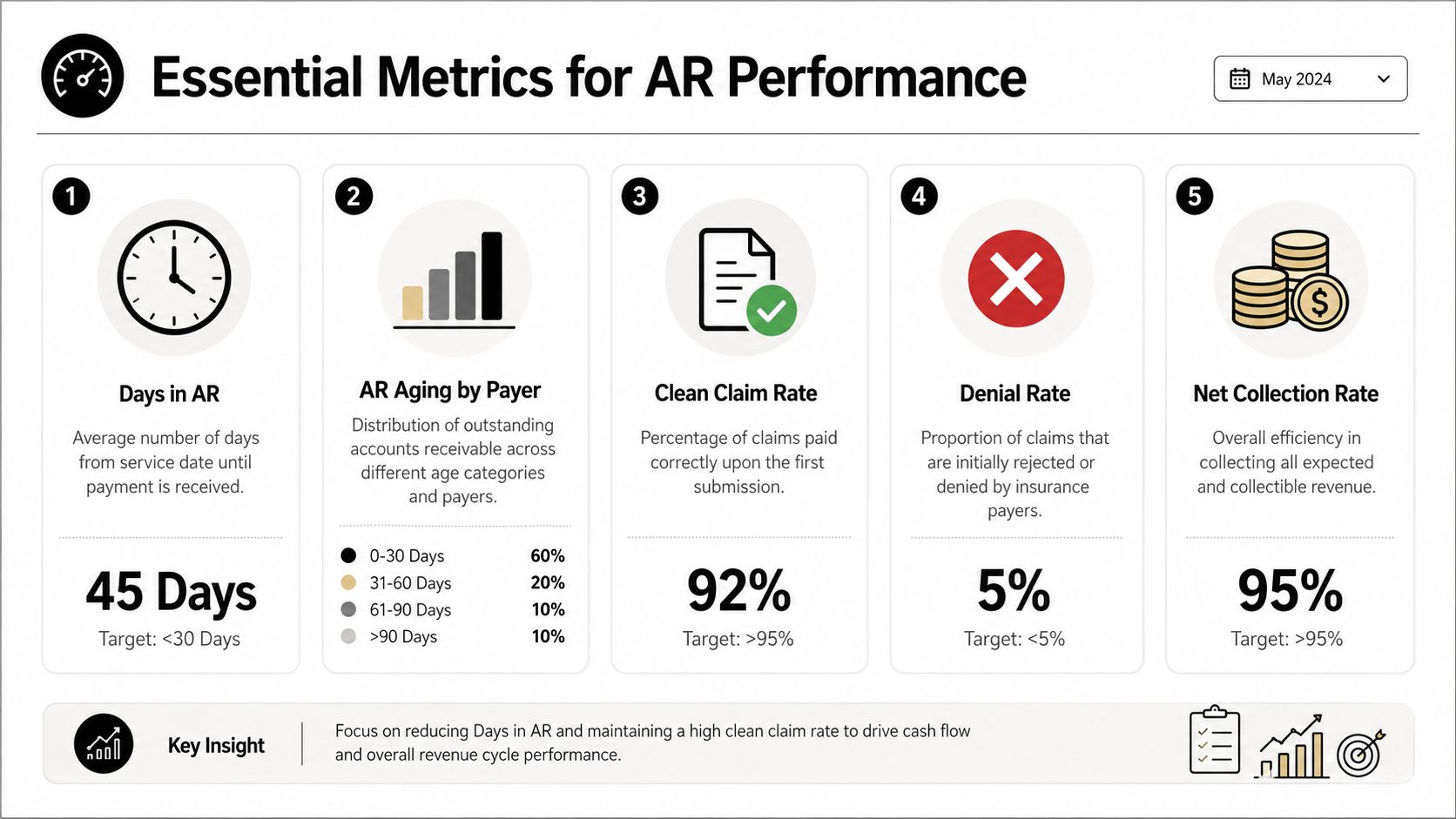
You can't manage medical accounts receivable by instinct. You need a small set of metrics that tell you whether cash is delayed because of speed, quality, payer friction, or collection failure.
The most important benchmark is Days in A/R. For multi-specialty groups, the industry standard is 30 to 40 days, best-in-class practices achieve 25 days or fewer, and performance over 60 days is a serious issue, according to Medical Billers and Coders' benchmark summary.
The five metrics that matter most
Some AR dashboards are cluttered with numbers nobody uses. A better dashboard answers five practical questions.
Days in A/R
Formula: total AR divided by average daily charges. This shows how long it takes the practice to turn services into cash. If days rise, something is slowing adjudication, posting, or follow-up.AR aging by bucket
Group balances into current, moderately aged, and old receivables. This shows whether AR is recent and workable or old and decaying. Aging is often more revealing when segmented by payer, specialty, and location.Clean claim rate
Formula: clean claims divided by total submitted claims. This tells you how often claims go out without defects that trigger front-end rejections or avoidable edits.Denial rate
Formula: denied claims divided by total submitted claims. This shows how much avoidable friction the practice is generating or absorbing.Net collection rate
Formula: payments collected divided by allowed collectible revenue. This tells you whether the practice is receiving what it should receive after contractual adjustments.
Key Medical AR Performance Metrics and Benchmarks
| Metric | What It Measures | Industry Benchmark (Good) | Warning Signal |
|---|---|---|---|
| Days in A/R | Average time from service to payment | 30 to 40 days for multi-specialty groups | Above 60 days |
| AR Aging by Payer | How balances are distributed across aging buckets by payer | Majority concentrated in recent buckets | Growth in older buckets, especially with one payer |
| Clean Claim Rate | How often claims pass through without preventable defects | Higher is better | Frequent rejections or edits before adjudication |
| Denial Rate | Share of claims denied after submission | Lower is better | Recurring denials tied to the same root causes |
| Net Collection Rate | Efficiency in collecting expected revenue | Higher is better | Persistent gap between expected and collected reimbursement |
Operator's view: One metric almost never tells the full story. Rising Days in A/R with a stable denial rate often points to payer delay or posting lag. Rising denial rate with stable AR days often means the team is working hard but fixing the same preventable defects repeatedly.
A good dashboard also needs context. If one payer consistently drives older balances, that should trigger contract review, escalation planning, and targeted auditing of denial reasons. If one provider or service line produces a low clean-claim pattern, education belongs upstream, not only in billing.
Leaders who build these measures into regular review meetings make better decisions faster. They stop arguing over anecdotes and start acting on evidence. This is the primary purpose of revenue cycle management metrics. They convert AR from a backlog into an operating signal.
Why Your Medical AR Is Swelling
When medical accounts receivable swells, the aging report only shows the aftermath. The cause usually sits in one of three places: before the visit, between the visit and the claim, or after the payer responds.

Pre-service failures create avoidable AR
The front end creates more AR than many practices admit. Inaccurate demographics, inactive coverage, missing coordination of benefits, and incomplete authorization checks all produce claims that were compromised before the patient was roomed.
These mistakes are costly because they feel administrative, not strategic. A registrar missing a subscriber ID can produce a rejection. A scheduler skipping a payer-specific authorization rule can produce a denial. A patient estimate delivered late can undermine collections before the first statement is sent.
Watch for these signals:
- Registration errors that keep resurfacing on rejected claims
- Eligibility checks that happen once at scheduling but not again before the date of service
- Authorization workflows that depend on memory instead of tracked ownership
- Weak financial counseling that leaves patient balances unresolved until long after care
Mid-cycle defects weaken reimbursement
Many specialty practices blame payers for AR growth when part of the problem is internal claim construction. Late charge entry extends the billing timeline. Incomplete documentation forces coders to guess or hold claims. Inconsistent modifier use creates edits, denials, and downcoding.
Discipline is paramount. Billing teams can't repair every defect after submission. If the note doesn't support the billed service, if the operative report is incomplete, or if medical necessity isn't clearly documented, the practice enters the appeal cycle already behind.
If a claim needs heroic follow-up to get paid, the build process is usually broken.
Common mid-cycle drivers include coder-biller disconnects, delayed chart completion, and specialty-specific rules that aren't embedded in the work queue. Practices that don't audit these patterns keep treating each denial as a one-off event.
Post-service payer behavior keeps AR inflated
Not all AR growth is self-inflicted. Payers delay payment, request records in fragments, reinterpret coding after the fact, bundle aggressively, and underpay claims that should have been adjudicated correctly.
That changes the management approach. Once the practice has a clean, well-supported claim and the payer still delays or underpays, the issue is no longer basic collections. It's payer conduct.
Look closely for patterns such as:
- Repeated requests for documentation on the same service type
- Systematic downcoding from a specific payer
- Appeal reversals only after multiple touches
- Partial payments that are posted and forgotten instead of challenged
High AR isn't one problem. It's a stack of defects and behaviors. The practice that separates internal failure from payer strategy can fix the right thing faster.
Workflows to Systematically Reduce Your AR Balance
Reducing AR requires a production system. High-balance specialty practices do not get there by asking billers to work harder. They get there by controlling what enters the claim, what gets released, and what gets escalated when a payer stalls, downcodes, or underpays.
The goal is not only to collect old balances faster. The goal is to stop preventable AR from forming and to preserve the records, timelines, and payer history needed to enforce payment later.
Front-end controls that prevent bad AR
AR control starts before the visit. A weak intake process creates downstream work that billing cannot fully repair, especially when the claim later moves into appeal, underpayment review, or formal dispute.
Use a registration checklist inside the practice management system, with assigned ownership for every exception. Epic, athenaOne, eClinicalWorks, AdvancedMD, NextGen Healthcare, and Kareo can all support structured verification workflows if the practice sets rules for who clears eligibility issues, who secures authorization, and who decides whether the patient can stay on the schedule.
A practical front-end standard includes:
- Real-time eligibility checks: Verify coverage at scheduling and again before the date of service, especially for high-cost procedures and out-of-network exposure.
- Authorization tracking: Assign one owner to each authorization requirement. Status should be visible in the scheduling workflow, with escalation rules for pending cases.
- Patient responsibility estimation: Give patients a realistic estimate before service when possible, and document payment-plan discussions early so balances do not become avoidable self-pay AR.
- Demographic validation: Confirm subscriber data, addresses, coordination of benefits, and referral details at every encounter.
These controls do more than reduce denials. They strengthen the file the practice may need later if the payer claims no authorization existed, shifts liability, or pays less than the contract supports.
Mid-cycle discipline that produces enforceable claims
Mid-cycle work determines whether the practice has a claim that can survive scrutiny. In specialty care, that matters because many AR problems are no longer simple billing defects by the time they hit the aging report. They become payment disputes.
Charge capture has to be fast enough to meet filing limits and accurate enough to support the level billed. Documentation queries should be resolved before release when the missing detail affects medical necessity, modifiers, laterality, time, or procedure support. Coders need specialty-specific edits and direct access to clinicians. Generic coding support breaks down quickly in anesthesia, orthopedics, GI, radiology, and emergency-adjacent services where small documentation gaps turn into large payment losses.
Use this operating standard:
- Hold claims for material defects. Missing operative support, unresolved modifier questions, and absent authorization records should stop release.
- Run edits by payer and specialty. A claim scrubber can catch format errors. It will not reliably catch payer-specific reimbursement traps.
- Build the appeal file at first submission. Save operative notes, prior authorization records, medical-necessity support, call references, and correspondence in one place.
- Tag claims with dispute potential. If a payer routinely downcodes or underpays a service line, mark those claims early so AR follow-up knows they may need contract review or IDR-related documentation later.
Some organizations use integrated models, including RevGuard's revenue protection approach, to connect clean-claim workflows with denial follow-up and downstream dispute handling. The operational point matters more than the vendor label. AR falls faster when the team that prevents defects also preserves the evidence needed to challenge payer behavior.
Back-end workflows that recover cash faster
Back-end AR fails when every account gets the same follow-up. Teams stay active, but cash does not move.
Segment accounts by what action is most likely to recover payment:
- By age: Recent claims need quick action before they miss reconsideration or appeal windows.
- By dollar value: High-balance accounts should reach senior staff early.
- By payer behavior: Group claims that show the same underpayment, bundling, or documentation-request pattern.
- By deadline: Filing limits, appeal dates, and external dispute timeframes should control queue order.
- By root cause: Separate registration errors, coding defects, medical-necessity denials, and suspected contract variance so the response matches the problem.
Then define escalation triggers. A first touch should have a purpose, a due date, and a documented next step. Repeated technical denials belong in root-cause correction. Partial payments that do not match contract terms belong in variance review. Claims with clear support and repeated payer resistance belong in formal appeal or dispute preparation, not endless status calls.
One mistake shows up in almost every swollen AR file. Staff post partial payments to close the account, rebill without fixing the issue, or call the payer without a documented objective. That may make the aging report look cleaner for a month. It gives away reimbursement and teaches the payer that the practice will not enforce its rights.
Strong AR workflows protect future revenue while they collect current balances. That is the shift specialty practices need. Medical AR is not only a collections problem. It is an operating discipline and, in many cases, a payer strategy problem.
Choosing Your AR Management Model In-House vs RCM Vendor
This decision isn't ideological. It's operational. A specialty practice should choose the AR management model that gives it control over cash, visibility into payer behavior, and enough expertise to protect reimbursement under pressure.
The market is clearly moving toward specialized support. The global medical billing outsourcing market is projected to grow from $13.56 billion in 2022 to $20.98 billion in 2026, according to CollaborateMD's medical billing trends summary. That projection suggests providers aren't outsourcing only to cut labor. They're doing it because payer complexity, medical debt, and claim management pressure require more specialized infrastructure.
When in-house works well
An in-house model can be effective when the practice has stable volume, low staff turnover, strong management oversight, and specialty-specific expertise already on payroll. It also helps when physicians and operations leaders want direct visibility into documentation issues, front-desk quality, and payer follow-up habits.
The upside of in-house AR includes:
- Direct control: Leaders can change workflows quickly and align staff tightly with clinical operations.
- Closer feedback loops: Registrars, coders, and billers can solve problems together in real time.
- Institutional knowledge: Long-tenured staff often know payer quirks, provider habits, and local operational risks better than any outside team.
The downside is just as real. In-house teams often become dependent on a few key people. Training slips. Specialty knowledge gets thin. Technology investments lag. Compliance oversight varies by manager. When turnover hits, AR ages fast.
When a vendor model makes sense
An RCM vendor can be the right choice when the practice needs scale, depth, broader payer intelligence, or tighter process consistency across multiple providers, locations, or states.
The strongest vendors usually bring:
| Decision Factor | In-House Team | RCM Vendor |
|---|---|---|
| Control | Highest day-to-day control | Shared control with service-level oversight |
| Staffing | Internal recruiting and training burden | Vendor handles staffing depth |
| Specialty Expertise | Depends on who you hire | Varies widely, must be verified |
| Technology | Practice funds and manages tools | Often bundled into service model |
| Scalability | Harder during growth or acquisition | Easier to ramp across locations |
| Payer Escalation | Limited by internal experience | Can be stronger if the vendor has dedicated appeal and contract expertise |
What doesn't work is partial outsourcing with no accountability map. If the front end stays internal, coding is handled elsewhere, and AR follow-up is spread across another vendor plus local staff, claim ownership becomes muddy. Problems bounce across teams and nobody fixes root causes.
The right question to ask
Don't ask whether outsourcing is cheaper. Ask whether your current model reliably produces clean, collectible, and enforceable claims.
If the team can't explain who owns authorization failure, who audits underpayments, who tracks payer patterns, and who escalates repeated denials beyond ordinary appeals, the model is incomplete whether it's in-house or outsourced. The right answer often isn't all-or-nothing. It's a defined operating structure with explicit owners, shared metrics, and clear escalation rights.
Advanced Escalation and Revenue Recovery Strategies
Some AR doesn't need another phone call. It needs escalation.
When a payer repeatedly delays, downcodes, or underpays well-supported claims, ordinary collection tactics stop being enough. The practice has to move from follow-up to enforcement. That means distinguishing between a fixable processing error and a pattern of reimbursement behavior that requires formal challenge.
Standard appeals aren't the endpoint
Many organizations overuse first-level appeals. They resubmit records, wait, receive another adverse determination, and repeat the cycle. That may close some claims, but it doesn't change payer behavior and it doesn't protect long-term reimbursement value.
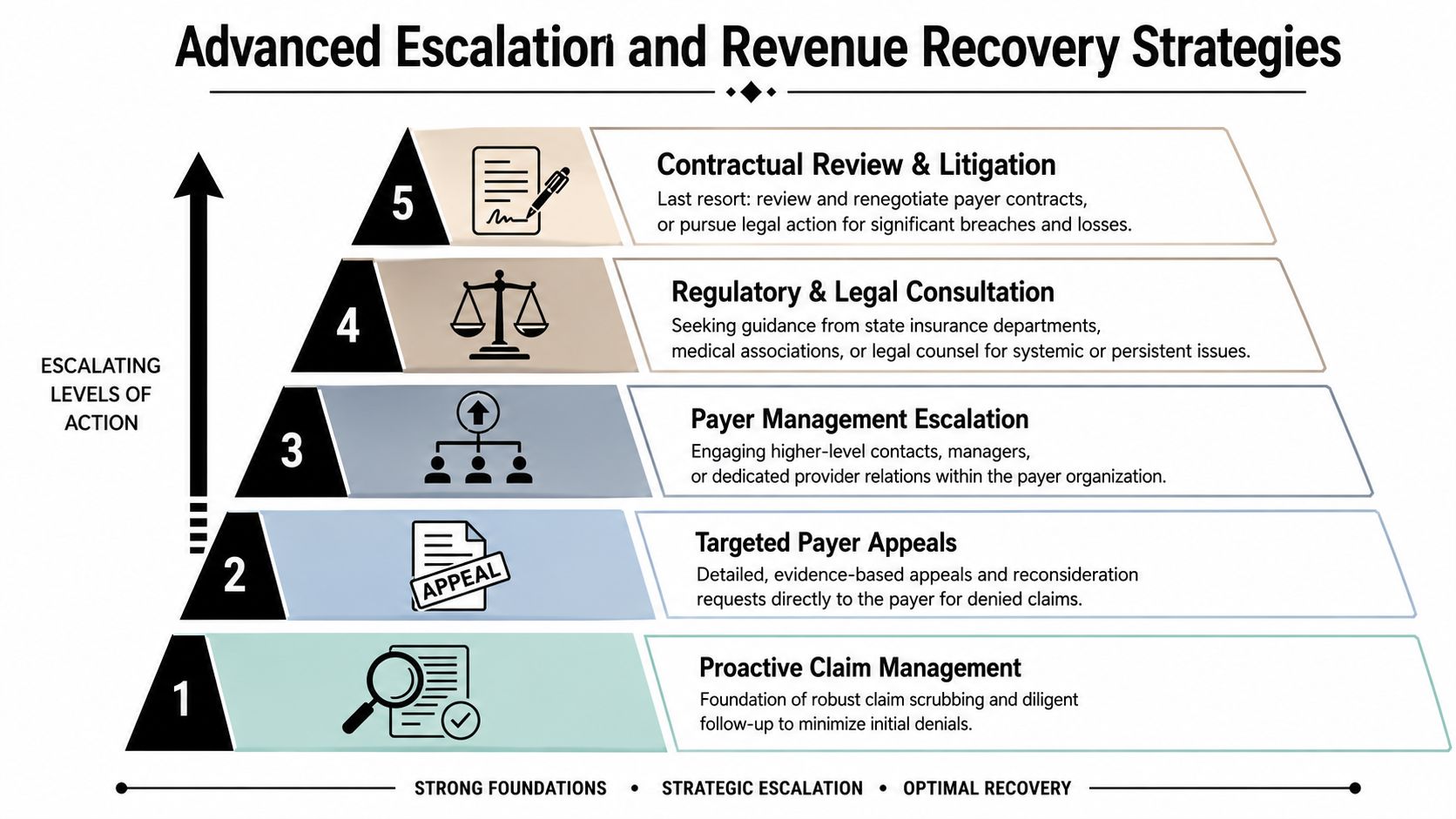
A stronger strategy escalates in layers:
Claim-level precision
Confirm the claim is defensible. Review documentation, coding, authorization history, contract terms, and all remittance language before escalating.Pattern identification
Group similar denials or underpayments by payer, code family, location, and service line. One disputed claim is a task. A repeated pattern is a strategy issue.Management escalation
Move the issue beyond routine payer representatives. Provider relations, contract managers, and payer escalation teams should receive targeted summaries, not scattered anecdotes.Regulatory and legal review
When payment conduct appears systemic, the practice may need guidance on state complaint avenues, contract enforcement options, or federal process requirements.
Where IDR fits into AR strategy
For organizations affected by the No Surprises Act, the Independent Dispute Resolution process can be part of AR management, not a separate legal afterthought. If a claim qualifies and the payer's payment position is unsupported, IDR becomes a structured recovery path.
That only works if the upstream claim is built correctly. Eligibility, coding, documentation, and payment records have to support the case. The evidence packet matters. The timeline matters. The argument matters. Practices that treat IDR as a last-minute filing exercise usually leave recoverable revenue on the table.
Escalation works best when the payer realizes the practice tracks patterns, preserves evidence, and will pursue formal remedies when ordinary channels fail.
This is the larger point. Advanced revenue recovery isn't about being aggressive for its own sake. It's about signaling that the organization won't normalize wrongful underpayment.
What mature payer strategy looks like
A mature medical accounts receivable function does four things well:
- Separates noise from signal: Not every denial deserves formal escalation, but repeated conduct does.
- Builds evidence early: The team saves records and correspondence while the claim is fresh.
- Routes claims intentionally: Standard follow-up, appeals, negotiation, and formal dispute each have different owners.
- Feeds lessons upstream: Every successful escalation should improve intake, coding, documentation, or contract monitoring.
Practices that do this well don't just recover old balances. They shape future payer behavior. Over time, that is one of the few reliable ways to reduce avoidable AR tied to underpayment and delay.
RevGuard helps provider groups connect front-end RCM discipline with downstream revenue enforcement. Its model combines eligibility, coding, billing, AR follow-up, payer negotiations, patient collections, and No Surprises Act dispute support so practices can build cleaner claims upfront and pursue underpayments more systematically when payers don't reimburse appropriately. If your organization needs a tighter link between medical accounts receivable management and formal recovery strategy, review RevGuard as one operational option.