

Most advice about the Rx BIN number starts with a definition. That's not the main problem.
The problem is that teams treat it like a minor card detail, then wonder why a clean-looking pharmacy claim gets rejected, routed to the wrong processor, or dropped into manual follow-up. In revenue cycle terms, that's not a harmless typo. It's a front-end data failure that creates back-end cash drag.
A new billing manager usually sees the denial first. The deeper issue is upstream. Registration captured the wrong field, staff copied the medical card instead of the pharmacy benefit details, or someone assumed every plan works the same way. By the time the claim fails, your staff is already spending time on rework instead of posting payments or resolving higher-value denials.
The Rx BIN Number Puzzle
Teams lose cash on Rx BIN errors because they treat the field like a card detail instead of a routing control.
That mistake shows up fast in operations. A claim can look complete, pass internal edits, and still fail because the pharmacy transaction was pointed to the wrong processor. Once that happens, the denial is rarely isolated to pharmacy staff. Billing works the rejection, patient accounts takes the call, and if the case later ties into NSA or IDR activity, the file starts with questionable source data.
Where the confusion starts
Part of the problem is that BIN does not always mean the same thing across workflows. In pharmacy, it is a routing identifier tied to claim submission. In NSA and IDR conversations, staff may use “BIN” loosely when they mean a different plan, benefit, or case identifier. Those are separate functions, but front-end teams often hear the same shorthand and enter the wrong value in the wrong place.
I see this most often during intake and follow-up. A registrar is told to “get the BIN off the card.” A biller later assumes that number belongs in a pharmacy claim. Then an IDR packet is built from the same account, and no one is fully confident which identifier came from the pharmacy benefit and which came from medical coverage records.
One sloppy label can create two expensive problems: a rejected pharmacy claim and a dispute file that needs manual cleanup before anyone can defend reimbursement.
The financial risk is straightforward. Staff time shifts from payment posting and high-balance follow-up into preventable rework. A small data error at registration becomes a denial, a callback, a corrected claim, and sometimes a documentation problem that weakens downstream reimbursement arguments.
What denial looks like in practice
The pattern is usually easy to recognize once a manager knows what to look for:
- The claim appears clean at first pass. Demographics, member ID, and date of service all look reasonable.
- The transaction rejects or lands with the wrong processor. The team then has to determine whether the issue is the BIN, PCN, group number, or the wrong insurance card entirely.
- Recovery costs more than prevention. Staff make calls, re-enter data, resubmit the claim, and explain delays to patients while A/R ages.
That is why the Rx BIN number deserves more attention than it usually gets. It sits at the front of the routing path, and mistakes there create avoidable denials that drain labor and delay cash.
What an Rx BIN Number Actually Is and Is Not
An Rx BIN number is a pharmacy routing identifier. It is not a general medical billing number, and it is not a catch-all identifier for every insurance workflow.
According to HelpAdvisor's description of the NCPDP pharmacy BIN, the Rx BIN is a standardized 6-digit identifier assigned by the National Council for Prescription Drug Programs, beginning with 0, and used to route electronic pharmacy claims to the correct insurer or PBM.
Working definition: The Rx BIN is the first routing key that tells the pharmacy transaction where to go. If that key is wrong, the rest of the claim data doesn't matter.
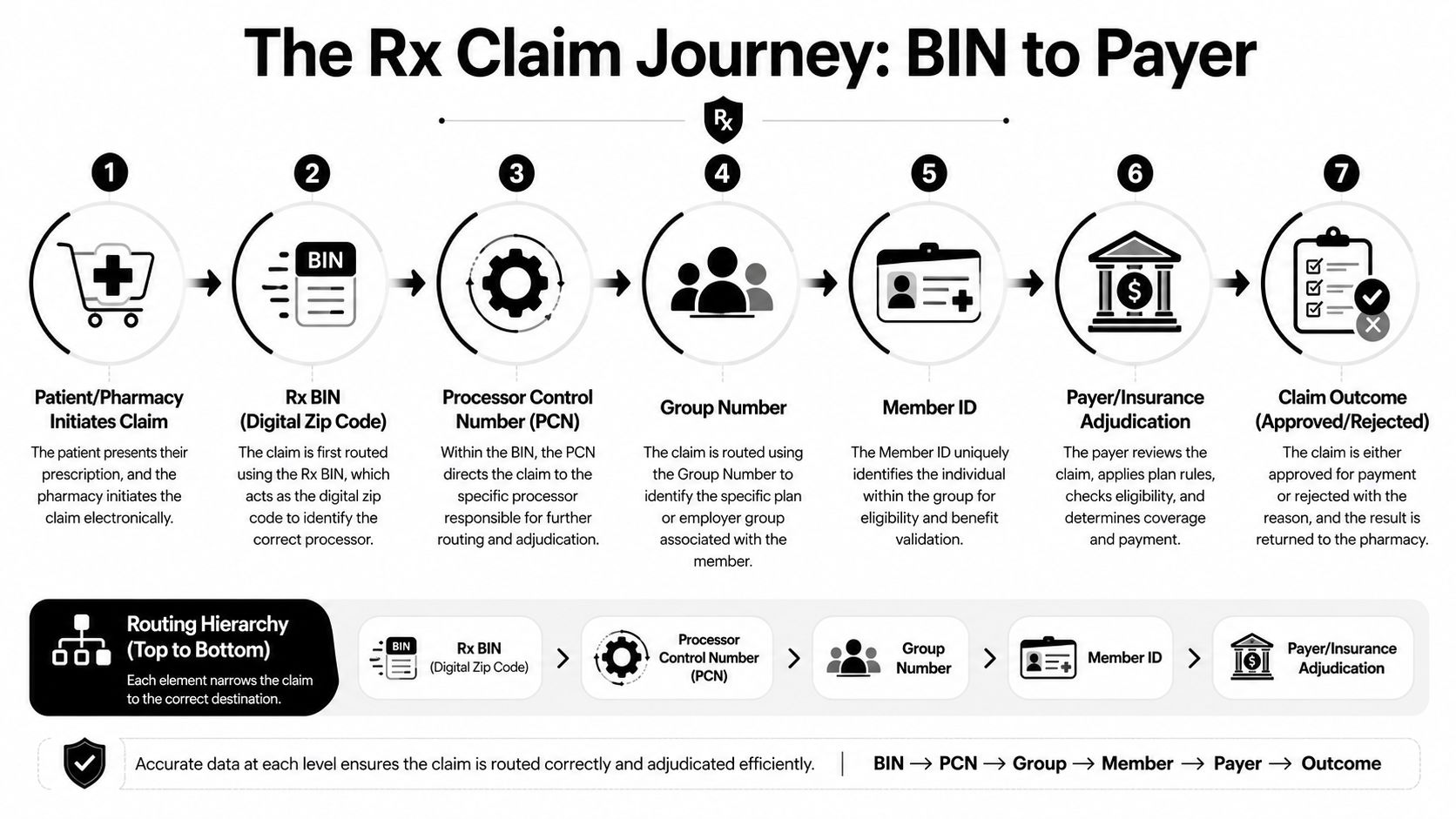
The best analogy for training staff
Use a mailing-address analogy because it sticks.
- BIN is the ZIP code. It gets the claim to the right destination network or processor.
- PCN is the street. It tells that processor which internal route or benefit package to use.
- Group number is the apartment. It narrows the claim to the correct plan structure.
- Member ID is the person receiving the mail. It identifies the individual beneficiary within that setup.
If your team enters only the BIN correctly, that's not enough. You've sent the claim to the right city, not the right doorstep.
What the Rx BIN is not
Here, billing teams get into trouble.
| Item | What it does | Why it gets confused |
|---|---|---|
| Rx BIN | Routes pharmacy claims to the correct payer or PBM | Staff see “BIN” and assume it applies across all billing contexts |
| Medical payer ID | Routes medical claims through clearinghouse workflows | Teams assume pharmacy and medical routing use the same logic |
| NDC | Identifies the drug product | Staff sometimes mix product identification with claim-routing fields |
| IDR case identifiers | Support dispute documentation under NSA workflows | The same acronym appears in a different process |
The operational rule that works
Teach staff one simple rule: medical claims and pharmacy claims don't route the same way.
If the card only supports medical billing, don't force a pharmacy interpretation onto it. If the patient has separate pharmacy benefit information, capture that directly. If there's no clear Rx section, don't guess. Guessing creates the kind of denial that takes far longer to fix than to prevent.
The Routing Chain of Command
A pharmacy claim can fail even when the BIN is right. That's the part many newer managers miss.
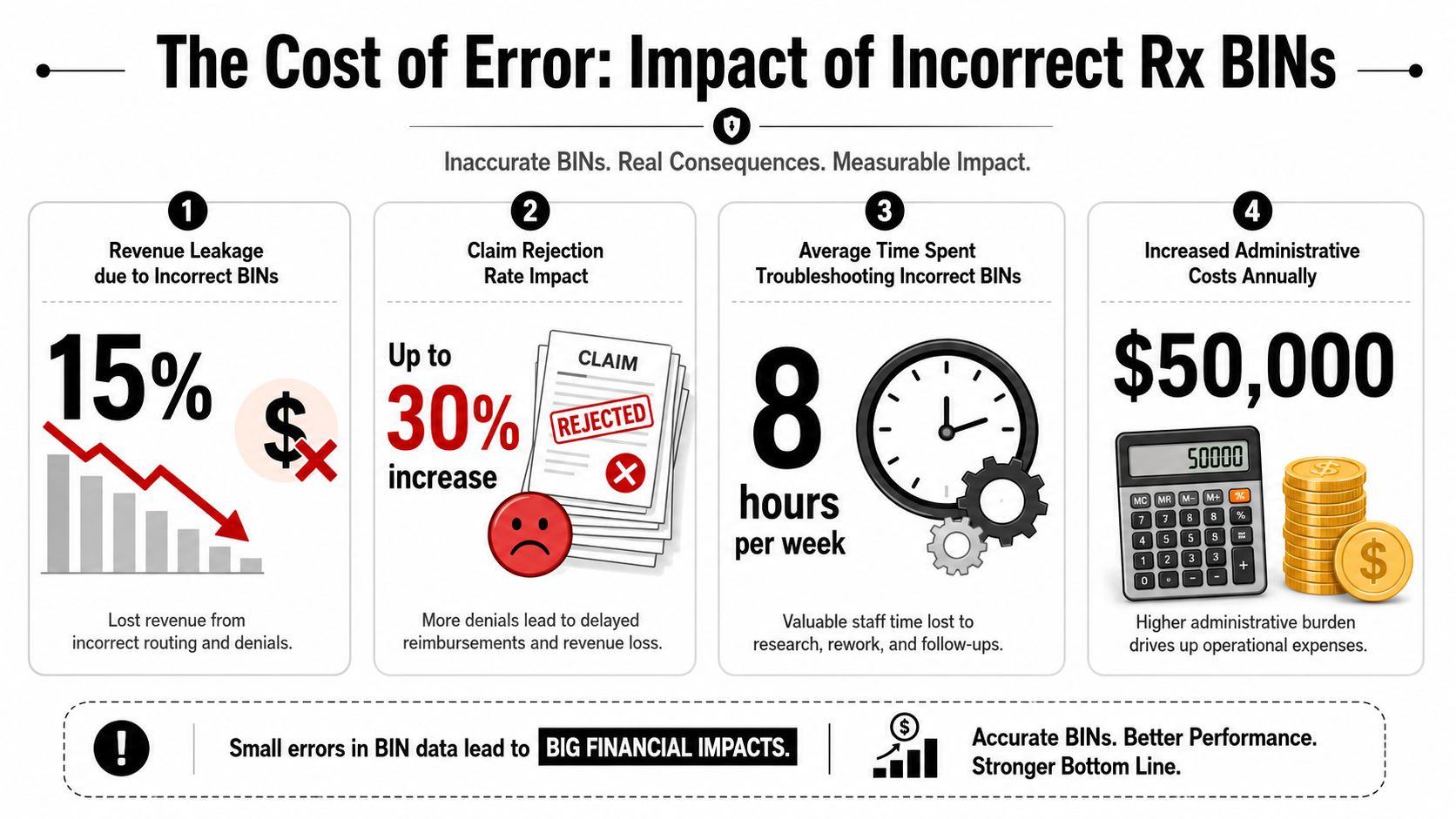
The routing chain is hierarchical. The BIN gets the claim to the right payer or PBM. The PCN tells that payer which internal benefit package to use. The group number narrows the claim further. Then the member ID ties the transaction to the person covered under that setup.
Why a correct BIN can still produce a denial
Drug Channels explains the BIN-PCN relationship clearly: the Rx PCN is an alphanumeric code that identifies the specific benefit package within the payer identified by the BIN. The same source gives a practical example. TRICARE uses BIN 003858 and PCN A4, which shows that one BIN can support multiple routing layers and benefit configurations.
That means a claim can be “half right” and still dead on arrival.
A correct BIN with the wrong PCN is like mailing a package to the right company but the wrong department. It arrived in the building, but nobody can process it.
How this plays out inside operations
Here's the sequence billing managers should walk through with staff:
Registration captures the card image or manual entry.
If the wrong section of the card is used, the error starts before claim creation.The claim transmits to the pharmacy processor.
The software reads BIN first, then applies PCN and group logic.The processor checks for a valid routing combination.
If any linked field doesn't match the processor's expected plan structure, adjudication stops.Staff moves into manual correction.
Calls begin. Notes get added. Resubmission waits. Cash does too.
This is also where teams need to understand the difference between pharmacy routing and broader claims infrastructure. If your staff needs a refresher on how medical claims move through a separate channel, review how a clearinghouse in medical billing works. It helps new managers stop applying medical-claim logic to pharmacy denials.
What works and what fails
What works
- Training staff to validate BIN, PCN, group, and member ID together
- Saving successful plan setups by payer and product line
- Escalating repeated routing failures as a process issue, not a one-off denial
What fails
- Re-entering the same card data repeatedly without comparing prior paid claims
- Assuming the BIN alone is enough
- Treating pharmacy denials as generic eligibility errors
Why Rx BIN Accuracy Is Critical for Revenue Recovery
Rx BIN mistakes look small at intake and expensive in A/R.
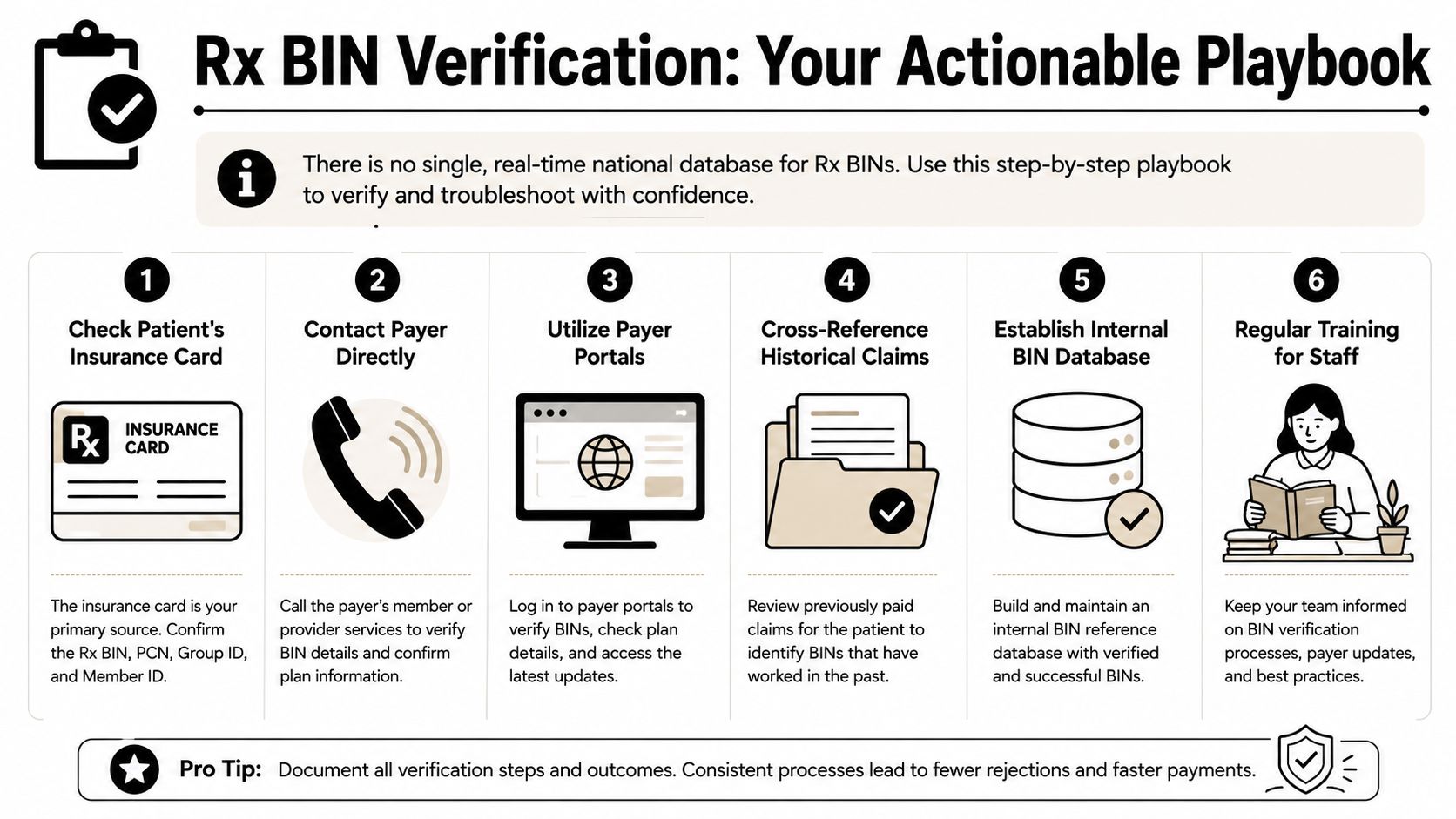
A single wrong digit can push a claim into the wrong processor, trigger a rejection, and turn a clean payment cycle into avoidable rework. Revenue cycle leaders feel that cost in three places at once: more touches per account, slower cash, and weaker denial signal because a routing error gets buried under generic eligibility or registration labels.
The financial problem is not the denial alone. It is the labor attached to it. Staff has to reopen the account, compare the card image, verify whether the patient gave a medical card instead of the pharmacy benefit card, and resubmit before timely filing pressure gets tighter. If that claim later feeds an underpayment appeal, out-of-network dispute, or NSA/IDR packet, the bad front-end data has already weakened your documentation trail.
According to the Ohio Medicaid pharmacy billing reference guide, the Rx BIN number is tied to Medicare Part D or MA-PD plan identification rather than serving as a universal feature across standard commercial, Medicaid, or TRICARE pharmacy benefits. That same guide states that 40% of patients incorrectly assume the number applies to all insurance cards, and it links missing or misrouted claims data to 15% of initial prescription denials. For billing managers, that matters because patient confidence in the card does not equal routing accuracy.
Why this hits A/R harder than people expect
Front-end routing errors rarely stay at the front end.
They increase follow-up volume because collectors end up fixing setup problems instead of working collectible balances. They extend days to payment because every corrected submission restarts part of the clock. They also distort reporting. If the denial is coded as eligibility, the registration failure that caused it stays hidden, and managers keep coaching the wrong team.
That is how avoidable pharmacy routing mistakes start showing up in your medical accounts receivable reporting and aging trends. The account looks harder to collect than it really is. The balance ages. Cash forecasting gets less reliable.
There is also a downstream compliance angle. In NSA and IDR work, teams need clean claim history, clean plan identification, and defensible proof that the claim was submitted to the right channel on time. If the original routing data was wrong, the dispute file starts from a weaker position. Operations then spends more time reconstructing what should have been correct on day one.
The trade-off that matters
Billing teams can spend an extra minute verifying pharmacy routing fields up front, or they can spend ten to twenty minutes correcting the account later. That is the actual choice.
A tighter intake process raises front-end effort a little. It lowers total cost per paid claim. That is the metric that matters.
Operational takeaway: The cheapest pharmacy denial is the one your team prevents before the claim leaves the system.
A Practical Guide to Rx BIN Verification and Troubleshooting
Teams waste time looking for a master Rx BIN directory that does not exist. The better answer is a controlled verification process that catches routing errors before they turn into avoidable denials, rework, and delayed cash.
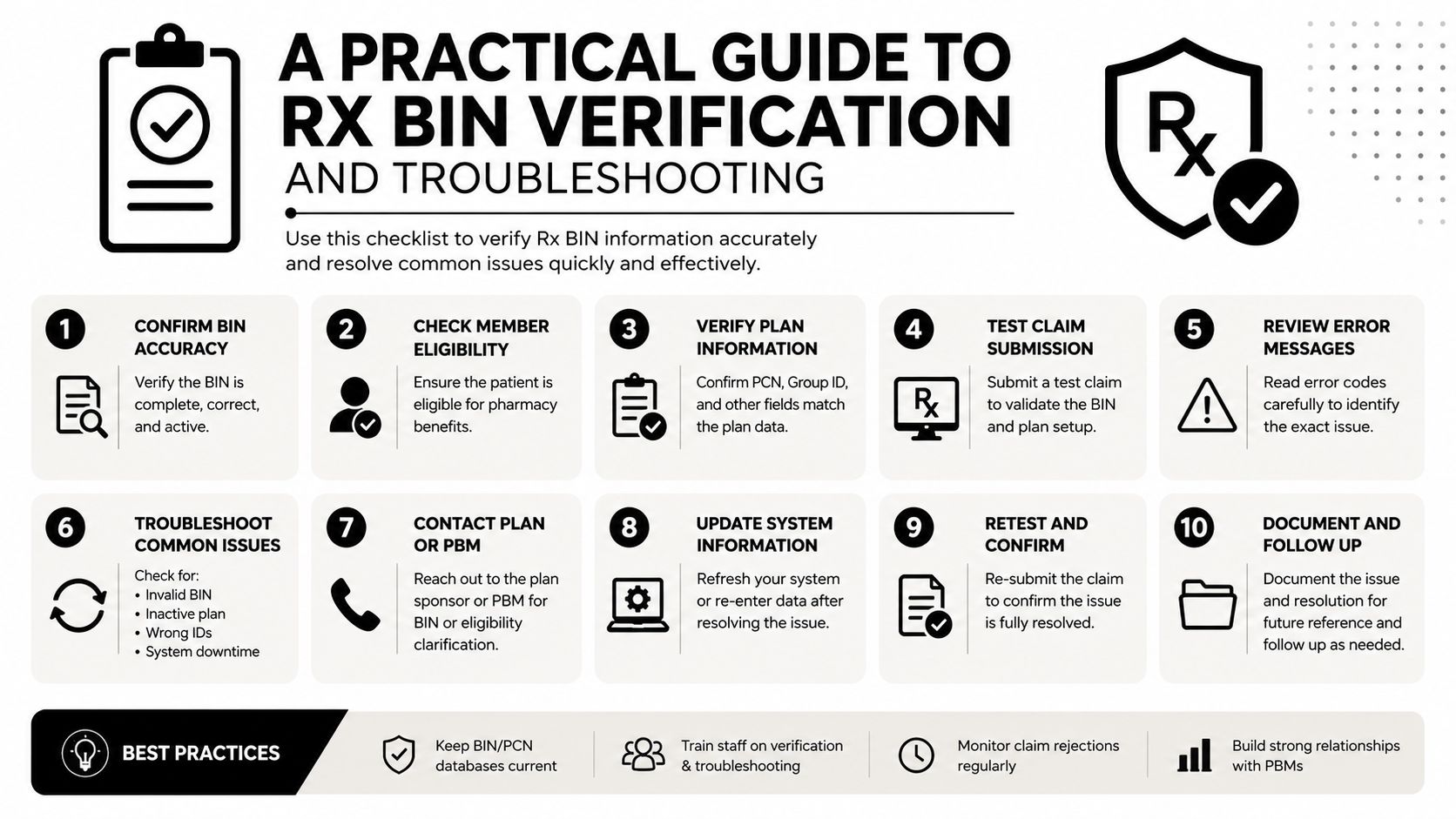
An overview of Rx BIN verification limits notes that there is no publicly accessible, real-time national database to verify Rx BIN numbers by health plan or insurer, and that pharmacy underpayments are often tied to BIN routing errors when staff cannot verify routing automatically.
The workflow billing teams should use
Use the same process every time. Variability is what creates write-offs.
Start with the current card image
Work from the front and back of the patient's active card. Do not rely on old registration notes, scanned copies from prior visits, or fields copied forward in the PM system. If the patient has a digital card, compare that version too.Confirm the benefit you are routing
Billing staff often pull data from the medical ID card when the pharmacy benefit is administered separately. Check for an Rx section, a separate PBM name, or a second card. If those details are missing, stop and verify before the claim goes out.Validate the full routing set together
BIN alone is not enough. Confirm BIN, PCN, group, and member ID as one set, because the claim router reads them that way. A correct BIN with the wrong PCN still sends the claim down the wrong lane.Check your own paid-claim history
A recent paid pharmacy claim is often the best internal proof of the right routing path. Use adjudicated claim data, not memory or tribal knowledge from the last time this payer changed PBMs.Document the source of truth
Note whether the routing came from the card, the payer call, the PBM portal, or prior paid claim history. That note matters later if the account turns into a payment dispute or an NSA or IDR file review.
Common failure patterns
The errors are usually small. The financial effect is not.
- Character confusion: O becomes 0, I becomes 1, and transposed digits send the claim to the wrong processor.
- Old card usage: The patient presents last year's card or an outdated screenshot from a mobile app.
- Wrong line of business: The employer changed plans or the payer changed PBMs, but legacy routing stayed in your system.
- Copy-forward error: Registration carries over pharmacy fields from a prior encounter without confirming that coverage is still active.
- Partial verification: Staff confirms the BIN and skips the PCN or group number, which creates false confidence and predictable denials.
A short script for payer or PBM calls
When the card is unclear, staff needs a script that gets to routing fast.
“We are verifying active pharmacy claim routing for this member. Please confirm the current Rx BIN, PCN, group number, processor name, and whether the pharmacy benefit is carved out or handled with the main plan.”
That wording gets to the operational question. It also reduces vague call notes that are useless later.
Tell staff to record the date, time, representative name, and exactly what was confirmed. If the claim denies after that, your team has support for escalation, rebilling, or dispute review.
What to build internally
Strong revenue cycle teams do not depend on memory. They build controls.
- Maintain a payer-PBM matrix: Track successful routing combinations by payer, product, and employer group where applicable.
- Trend denials by root cause: Separate invalid BIN, wrong PCN, inactive group, and member ID mismatch. One denial bucket hides the actual fix.
- Create front-end hard stops: If BIN is entered without PCN, group, or source documentation, send the account to review before submission.
- Train registration and billing together: Front-end mistakes become back-end denials, so both teams need the same definitions and the same verification standard.
- Audit after payer changes: When a payer or employer changes PBMs, test a sample of claims early instead of waiting for underpayments to show up in month-end reporting.
One practical rule helps here. Treat Rx routing like lockbox instructions for a payment. If one digit is off, the transaction does not land where it should. In RCM terms, that means more touches per account, more avoidable aging, and weaker documentation if the balance later needs formal dispute support.
From Data Entry to Dispute-Ready Claims
Revenue leakage rarely starts with a dramatic failure. It usually starts with one field entered fast, trusted too easily, and left unverified.
Rx BIN errors fit that pattern. A wrong BIN, or a BIN entered without the matching PCN, group, and member ID, can push a claim into the wrong routing path, trigger a preventable denial, and add days or weeks of rework. By the time the account reaches escalation, the team is no longer fixing data entry. They are rebuilding the file, chasing payer notes, and explaining why the original submission failed.
That matters in any pharmacy-related workflow. It matters even more when the same account later touches NSA review, underpayment appeal, or IDR preparation. As noted earlier, pharmacy BIN data and IDR case identifiers are different systems. Teams that mix those concepts create two problems at once: a bad claim and a weak dispute record.
The standard to hold your team to
Use a standard your staff can apply quickly and your managers can audit later.
| Question | Strong process | Weak process |
|---|---|---|
| Did staff confirm which benefit should process the claim? | Yes, with payer or PBM documentation | No, based on the medical card or prior habit |
| Was the full routing set verified? | BIN, PCN, group, member ID, and source of truth | Partial entry with missing fields |
| Could a supervisor defend the account in an appeal or IDR file? | Yes, notes show who confirmed what and when | No, notes are vague or missing |
The financial impact is straightforward. Clean routing lowers touches per account, shortens A/R time, and gives the team a usable record if payment still goes sideways. Bad routing does the opposite. Staff time shifts from collection to correction, cash posts later, and the dispute file starts with a preventable credibility problem.
Managers should also make sure staff can read payer responses correctly. Many denial follow-ups stall because the team cannot distinguish a routing failure from an adjudication issue on the remittance or explanation. A clear understanding of an EOB in medical billing helps teams separate pharmacy routing errors from medical payment decisions and choose the right next step.
Treat the Rx BIN field like bank routing instructions. If it is wrong, the transaction does not reach the right destination. In revenue cycle terms, that means avoidable denials on the front end and weaker support on the back end when the account has to be appealed, rebilled, or prepared for formal dispute review.
RevGuard helps provider groups, ASCs, hospitals, and multi-state platforms protect revenue before and after denial. If your team needs support with front-end claim accuracy, underpayment recovery, or No Surprises Act dispute strategy, learn how RevGuard connects specialty RCM with enforcement-driven IDR to turn avoidable leakage into recoverable revenue.