
A referral lands on your desk late in the day. The patient needs your specialty care, needs it soon, and their plan shows out-of-network. Clinical leadership wants the case accepted. Finance wants to know whether the work will be paid correctly. Operations already knows what happens next if the process is loose: endless calls, unclear authorizations, mismatched claim edits, and a payment that arrives far below what was negotiated.
That is the world of single case agreement insurance.
Handled well, a Single Case Agreement can open access to a patient your group would otherwise have to decline, while preserving in-network cost sharing for the patient and a workable reimbursement structure for the provider. Handled poorly, it turns into expensive administrative labor followed by underpayment. The agreement gets celebrated at approval. Then the remittance posts at the wrong rate, someone says it's a “system issue,” and weeks of margin disappear.
The providers that perform best with SCAs don't treat them as exceptions managed from email inboxes. They treat them as a revenue cycle function with tight intake rules, standardized documentation, disciplined negotiation, and enforcement after payment. That last part is where many guides stop too early.
Beyond the Network Your Strategic Guide to SCAs
A common scenario looks like this. A patient calls because the in-network options either don't offer the service, can't see the patient fast enough, or would disrupt treatment already underway. Your team confirms the plan, checks benefits, and realizes the case might be salvageable through a Single Case Agreement rather than a one-off self-pay discussion or a weak out-of-network reimbursement gamble.
An SCA is a temporary, patient-specific contract between an out-of-network provider and a payer for a specific episode of care. It establishes reimbursement terms for that single patient and lets the patient use in-network cost sharing for that case, as outlined in Behave Health's definition of a Single Case Agreement. That makes it far more strategic than a casual “network exception” conversation.
The first operational question isn't whether an SCA exists in theory. It's whether the case is worth pursuing with discipline. Teams that understand out-of-network benefits strategy for providers know an SCA can protect both access and margin, but only if the agreement is structured well enough to survive billing and payment.
Most SCA failures don't begin at payment. They begin at intake, when the team accepts vague approval language instead of a contract with usable terms.
The upside is meaningful. The fee per session or service isn't locked to a standard in-network contract rate and can be negotiated more flexibly. The downside is just as real. A verbal “yes” from the payer is not a collectible asset. A signed agreement with precise terms is. Even then, collection risk doesn't end when care starts. It shifts into billing accuracy, remittance review, and enforcement.
That's why experienced revenue teams view SCAs in two phases. Phase one is approval. Phase two is making the payer honor what it approved.
Assessing SCA Viability and Patient Eligibility
Monday morning intake. A parent says the plan has no one in network who can take the case. The clinician wants to start this week. Billing has seen this movie before. If eligibility is soft or the network gap is only anecdotal, the team can spend days chasing an SCA that never gets approved, or worse, gets approved loosely and paid badly later.
The intake screen has to answer one business question first. Is this case likely to produce a collectible agreement with terms your team can enforce after treatment starts? That standard keeps staff focused on files with real access issues, real medical need, and a payer record you can build on if reimbursement breaks down after approval.
The fastest triage framework
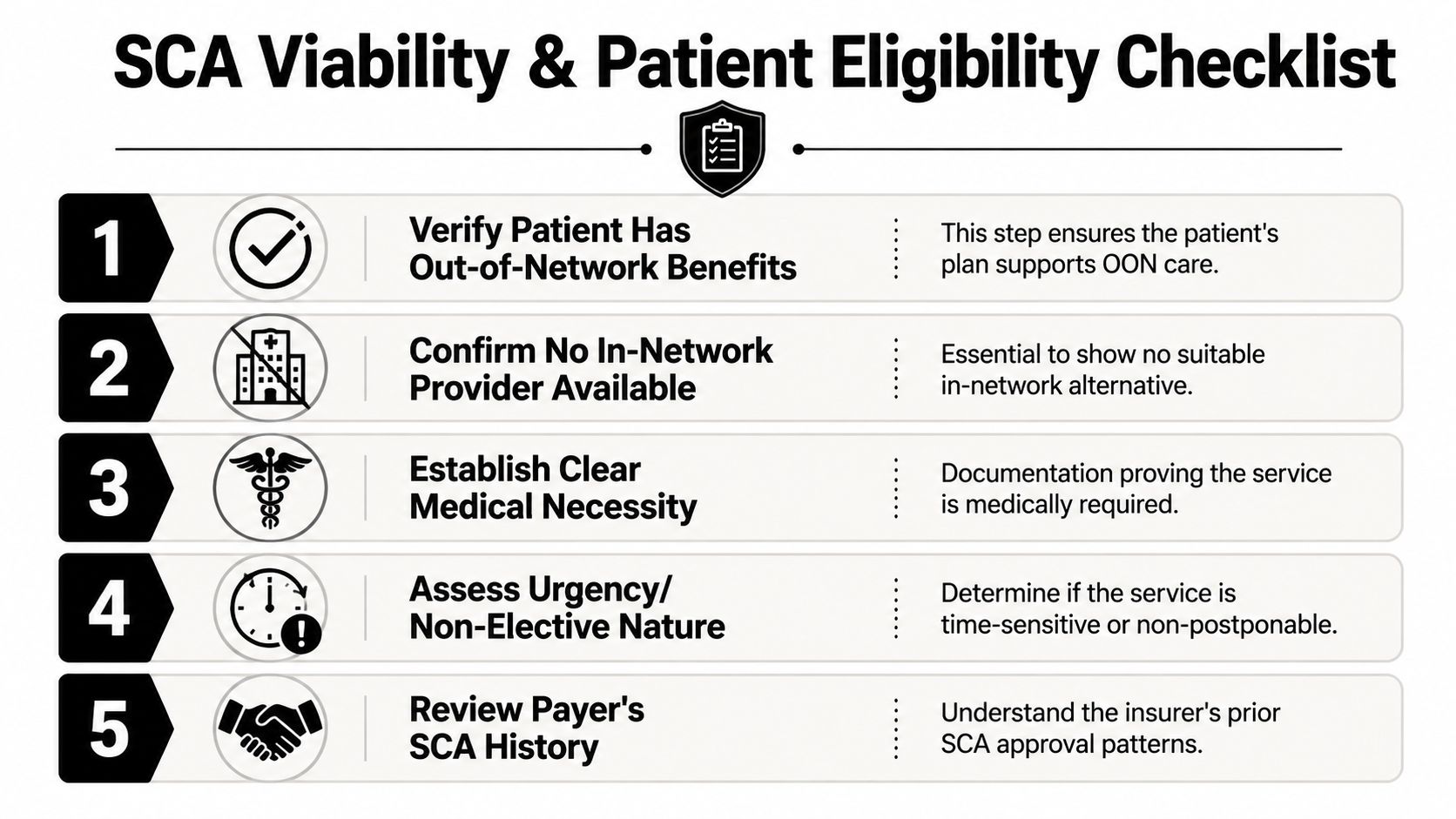
Start with benefits and plan rules. Confirm active coverage, the member's cost share, whether out-of-network benefits exist, whether the payer considers SCAs for this service, and whether any referral or authorization requirements apply. A disciplined medical eligibility verification process for complex cases prevents the usual waste: building a request packet for a plan that excludes the service, requires a different pathway, or has no mechanism for a single-case exception.
Then pressure-test the file on five points:
- Network gap: Directory presence is not enough. The question is whether an in-network provider is available, qualified, and able to treat the patient in the needed timeframe.
- Medical necessity: The case needs a clear clinical reason for this level of care and for your provider specifically.
- Continuity of care: Existing treatment relationships carry weight if a change in provider would disrupt progress or create avoidable risk.
- Access barriers: Travel distance, wait times, age-specific limitations, language needs, and program fit all matter if staff document them precisely.
- Operational fit: Your team must be willing to negotiate terms, obtain the authorization details, bill exactly to the agreement, and audit payment afterward.
I pass on more cases for weak facts than for weak payer behavior.
What a strong file looks like early
Strong candidates are usually obvious at intake. The patient or family has already called in-network options. Referral sources can explain why your program fits the diagnosis, acuity, or treatment modality better than listed alternatives. The access problem is specific enough that a payer nurse or case manager can repeat it internally without rewriting the story.
Weak candidates look different. The patient prefers your group. The physician likes your clinicians. The directory lists alternatives, but no one has tested availability, scope, or wait time. Preference is rarely enough, and it does nothing for you later if the payer underpays and you need to point back to the basis for the exception.
A simple screen helps teams make the call fast:
| Screening question | Strong signal | Weak signal |
|---|---|---|
| Is there a true network gap? | No suitable in-network option identified after documented outreach | Directory shows alternatives and no one tested them |
| Is the need clinically specific? | Specialty need or level of care is documented | Generic request with no support |
| Is continuity of care real? | Active treatment relationship or transition risk is clear | New consult with no disruption concern |
| Can staff prove the access problem? | Calls, referrals, wait times, and failed placement attempts are logged | No outreach log or vague patient report |
Practical rule: If intake cannot state the exception clearly in three sentences, the payer will not approve it cleanly, and your billing team will have nothing useful to enforce later.
Where teams lose time and margin
The first mistake is treating eligibility and SCA viability as separate tasks. They are one file. If the scheduler captures one version of the case, utilization review writes another, and billing inherits a third, the payer gets room to deny, reframe, or underpay.
The second mistake is accepting soft support. “No one nearby.” “The family prefers us.” “Care should start soon.” None of that survives payer review. Documented calls, failed placement attempts, diagnosis-specific needs, and continuity risk do.
The third mistake matters most after approval. Teams often screen only for clinical fit and forget to ask whether the payer is likely to administer the SCA correctly once claims start hitting. Some plans approve the case, load the contract poorly, process claims out of network anyway, and force the provider to prove the agreed rate line by line. That is why the intake record should capture facts with future enforcement in mind. If payment later misses the contracted rate, the same intake documentation helps establish why the exception was granted and supports escalation, including No Surprises Act IDR when the payer refuses to honor the deal.
Building an Ironclad SCA Request Packet
A payer can deny an SCA for many reasons, but most preventable denials come from weak assembly. The packet is incomplete, inconsistent, or too casual. When that happens, staff usually respond by sending more emails. That doesn't fix a flawed file.
Successful SCAs depend on a standardized evidence packet that includes a clinical summary, care plan, documented outreach to in-network providers, and referral notes. Providers who follow that process report approval within 2–3 weeks, while inaccurate code entry or missing documentation commonly causes delays or denials, according to Solum's SCA negotiation overview.

Build the packet like it may become evidence later
That mindset changes the quality of submission immediately. Instead of sending just enough to get a care manager to say yes, assemble the file so a different payer department, and if necessary a dispute reviewer, can understand exactly what was requested and why.
The packet should usually include:
- Clinical summary: A concise statement of diagnosis, presenting need, and why the requested service is appropriate.
- Care plan: The services expected, the likely cadence, and the billing structure tied to actual codes your team intends to submit.
- In-network outreach log: Dates, names, outcomes, and why listed alternatives were unavailable or unsuitable.
- Referral support: Notes or documentation from the referring clinician when applicable.
- Provider credentials: Licensure, specialty information, and any documents the payer asks for repeatedly.
- Benefits and patient identifiers: Accurate policy data, diagnosis details, and demographics that match payer records.
- Negotiation cover note: A short, direct request that states the fair rate sought and the basis for the exception.
The packet has to be internally consistent
Payers look for contradictions. If the clinical note says one thing and the requested services say another, the file stalls. If diagnosis coding shifts between intake and submission, expect delays. If your outreach log says there is no available in-network provider but the referral note says the patient prefers your practice, the payer will use the weaker language.
Many organizations underestimate revenue cycle discipline regarding single case agreements. SCA work isn't just utilization management. It requires coding review, demographic accuracy, benefits validation, and document control.
Use a pre-submission checklist before the file leaves your office:
- Match codes to the care plan. Don't ask for broad treatment categories and then bill differently later.
- Check names and IDs carefully. One transposed digit can push the request into manual rework.
- Document the exception clearly. The payer shouldn't have to infer why out-of-network care is justified.
- Save every communication. Keep emails, fax confirmations, portal screenshots, and call notes in one case file.
- Prepare the financial logic. If rate discussion begins immediately, your team should already know the target.
A dispute-ready SCA starts before approval. If the file is sloppy at intake, it will be weaker at negotiation, weaker at billing, and weaker on appeal.
What doesn't work
A thick packet isn't necessarily a strong packet. Dumping unorganized records on the payer creates friction and invites selective review. Another bad habit is sending generic medical records without a short narrative that ties them to the exception request.
The cleanest packets are readable in layers. A payer nurse can skim the summary and understand the need. A contracting rep can find the requested services and rates. A claims reviewer can later trace exactly what was authorized.
That organization is what turns “we thought this was approved” into “here is the agreement, the support, the claim match, and the payment variance.”
Negotiating Rates and Finalizing the Contract
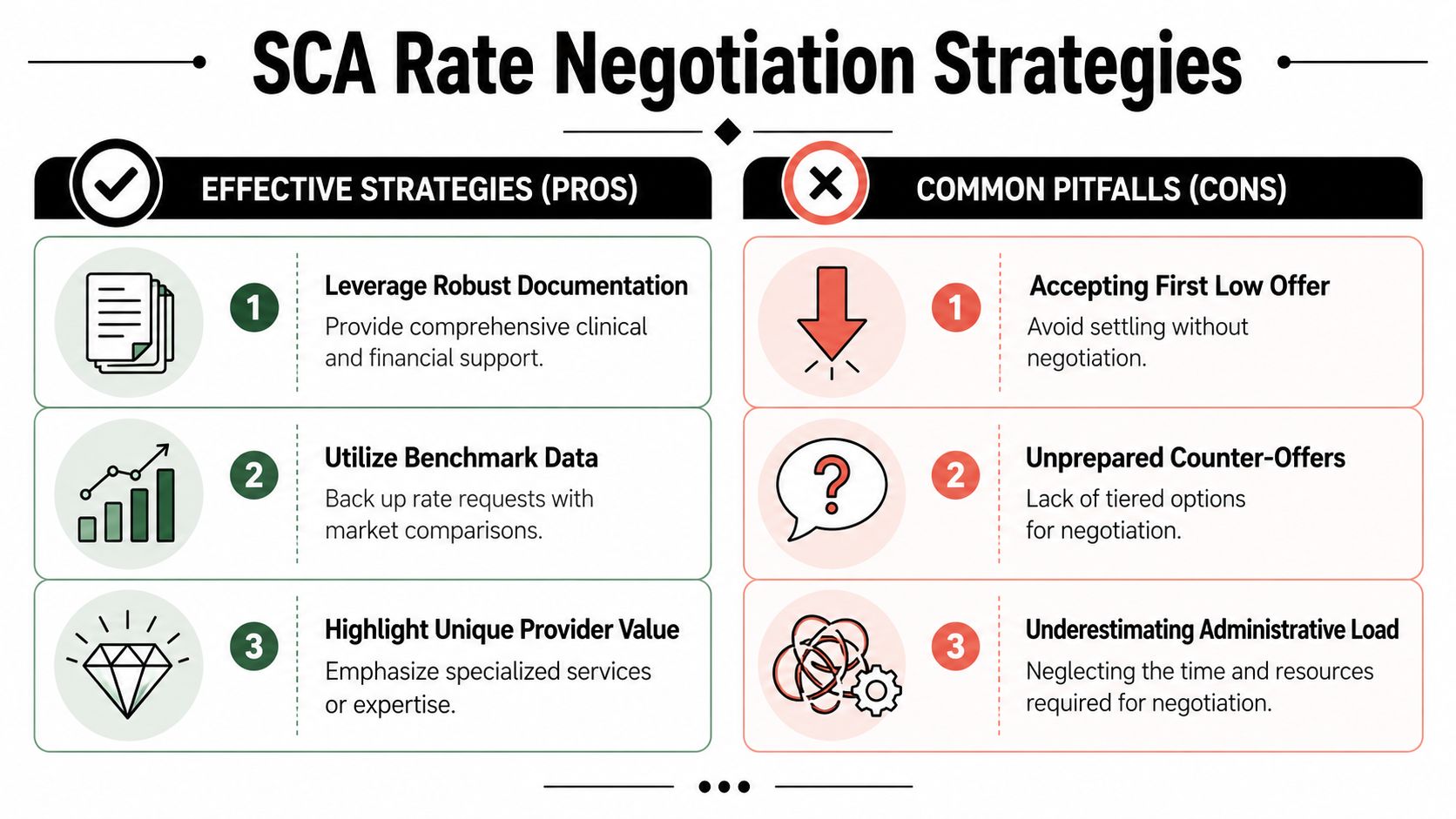
Once the payer agrees to move forward, the critical negotiation begins. At this point, many providers give away value because they treat the discussion as a courtesy request instead of a rate-setting exercise tied to a specific patient need.
SCA reimbursement rates are not constrained by in-network contracts, and providers can often negotiate closer to standard rates, typically with minimal discounts of 10–20% off regular fees. Providers can also use prior SCA rates with the same insurer as a basis for negotiation, based on Plutus Health's guide to Single Case Agreements.
Don't negotiate from the payer's starting point
Payers often open with what they pay in-network providers or something close to it. That frame benefits them, not you. The entire reason the SCA exists is that the case falls outside normal network adequacy. Your group is solving the payer's access problem for a named patient.
A stronger posture is simple. Quote your regular rate. Then justify any concession narrowly based on the scope and duration of the case, the specialty involved, and the administrative burden of one-off management. If your team has historical SCA rates with the same payer, bring them into the conversation early. Prior accepted rates make it harder for the payer to argue your current ask is unreasonable.
What to say and what to avoid
Useful negotiation language is concrete. Weak language sounds apologetic.
A practical comparison:
| Better approach | Weaker approach |
|---|---|
| We can accept this patient under a patient-specific agreement at a fair rate for the authorized services | We're hoping you can make an exception |
| These are the CPT codes and expected service parameters | We'll figure out coding after approval |
| We've previously executed comparable SCAs with this payer | We don't usually do these, so whatever works |
| Please confirm all terms in writing before treatment | A verbal approval should be enough for now |
If the payer says, “We only pay our in-network therapy rate,” or the procedural equivalent in your specialty, that's a signal to negotiate, not a signal to stop.
Terms that matter more than the headline rate
A decent rate can still produce bad revenue if the contract language is loose. Review every operational term before services begin.
Focus on these points:
- Covered codes: Make sure the agreement lists the actual CPT or service categories your team expects to bill.
- Dates of service: The authorization window has to match the treatment plan. If the dates are too short, fix that before claims go out.
- Patient identity: Confirm the named patient is correctly listed.
- Units or visit limits: If there are session caps or service limits, they need to be explicit.
- Claim submission details: Use the exact billing address or claims pathway stated in the agreement, not the generic address your staff uses for routine claims.
- Authorization number: If the payer assigns one, it must appear in your billing workflow.
- Billing responsibility: Clarify whether your group bills directly and whether any special attachments are required.
Finalize it in writing or don't count it
The agreement must be in writing with rates, authorized services, any expiration terms, and claim instructions clearly stated. If the payer sends partial language or a vague email saying the case is approved, keep pushing until the terms are complete.
Many downstream denials come from one preventable mistake: treatment begins based on verbal assurances, while billing never receives a complete contract. That creates two versions of reality inside the same organization. Clinical operations thinks the case is approved. Accounts receivable discovers later that nothing collectible was documented tightly enough.
Executing Flawless Billing and Claim Follow-Up
A signed SCA doesn't pay itself. Once care is delivered, the claim has to mirror the agreement exactly. In this critical phase, revenue teams either protect the negotiated value or accidentally give the payer an opening to reprice, reject, or delay.
Make the claim match the contract
The billing team should work from the agreement, not from memory and not from standard payer habits. If the SCA names specific services, dates, or authorization instructions, every one of those elements needs to carry into the claim submission process.
That means checking:
- Diagnosis coding alignment: Use the diagnosis information reflected in the approved case file.
- Procedure coding alignment: Bill the services authorized, in the form the agreement contemplates.
- Authorization data placement: Include the SCA authorization number where your claim workflow requires it.
- Submission route: Send the claim to the payer location or channel specified in the agreement.
- Attachments and notes: If the payer expects the contract or supporting documentation, build that into the submission protocol.
For providers using the CMS 1500, discipline matters. The form itself isn't the hard part. The hard part is making sure your staff doesn't process the claim like any other out-of-network encounter. SCA claims need a separate path, separate review logic, and a visible connection to the agreement.
Follow up before the claim goes cold
Waiting passively is expensive. Once the claim is submitted, confirm receipt, confirm the claim is tied to the authorization, and document every status touchpoint. If the payer rep says the contract isn't visible on their side, fix that immediately. Don't wait for the EOB to reveal the mismatch.
A clean follow-up cadence usually includes:
- Submission confirmation: Verify the claim was received at the correct destination.
- Authorization match check: Confirm the payer has linked the claim to the SCA.
- Status monitoring: Watch for pends, repricing activity, or requests for records.
- Variance review: Compare payment to the agreed rate the moment remittance posts.
- Rapid correction: If payment is off, open the inquiry while the case is fresh and the documents are easy to retrieve.
Billing teams lose leverage when they discover the error late. Early variance detection gives you cleaner call notes, clearer timelines, and fewer excuses from the payer.
Keep one audit trail
The best SCA billing operations maintain one case file from intake through payment. Agreement, authorization, claim form, submission proof, EOB, payer call notes, and any appeal drafts all live together. That sounds basic. It also separates disciplined organizations from those that spend months reconstructing a file after an underpayment surfaces.
Enforcing SCAs and Escalating Underpayments with IDR
Monday morning, the ERA posts, and the payer paid your approved SCA at its standard in-network rate. The claim was billed correctly. The authorization is on file. The agreement is signed. At that point, the issue is not claim correction. It is contract enforcement.
That distinction matters because many SCA losses happen after approval, not before it. Providers spend weeks resubmitting clean claims, reopening tickets, and asking for reprocessing, while the payer keeps the discussion framed as routine billing. That is how margin disappears on single case agreement insurance. Actual work starts once the payer fails to honor the negotiated rate.
Treat underpayment as a contract variance on day one
Teams recover more when they classify the problem correctly from the first call. If the remittance does not match the SCA, open a variance file immediately and work the case as an enforcement dispute.
That file should include:
- The signed SCA: The reimbursement terms, covered services, and patient-specific conditions.
- The billed claim: Proof that the claim matches the approved scope and coding.
- The remittance and denial detail: ERA, EOB, adjustment codes, and any repricing language.
- The authorization record: Approval number, dates of service, and linked notes from the payer.
- The communication log: Call notes, portal messages, emails, reference numbers, and payer explanations.
- The supporting clinical and intake documents: Records that show the services delivered were the services approved.
I have seen this play out hundreds of times. The payer says the claim paid by system logic. Your file needs to show that system logic does not override a signed patient-specific agreement.
Build the dispute around enforcement, not rework
Repeated resubmission usually wastes time. It also creates a bad record. Once a payer has underpaid an SCA, the priority is to force a clear explanation for the variance and tie every response back to the agreement terms.
Ask direct questions:
- Which term in the SCA did the payer apply when pricing this claim?
- What fee schedule or repricer produced the lower amount?
- Who has authority to compare the paid amount to the contract rate?
- Will the payer treat this as a pricing correction, appeal, or formal payment dispute?
Those questions move the case out of generic claims inventory and into the right channel. Billing teams lose their advantage when they discover the error late or let the payer keep the issue framed as ordinary processing.
Use the No Surprises Act and IDR where it fits
A first-level appeal is not always enough. Providers should assess early whether the underpayment belongs in a formal escalation path under the No Surprises Act. This No Surprises Act summary for providers is a useful reference for the rules, timelines, and dispute structure.
The operational point is straightforward. IDR works best when the evidence was built before the underpayment happened. A strong SCA file already establishes why the out-of-network exception was approved, what services were authorized, who the rendering provider was, and what rate the parties agreed to. When those facts are documented cleanly, the payer has less room to blur the issue into coding noise or internal repricing.
Not every underpaid SCA will qualify for IDR, and not every case should go there. The trade-off is time, cost, and the amount at stake. For low-dollar variances, aggressive internal escalation may be enough. For larger balances, repeat payer behavior, or obvious departures from agreed terms, formal dispute action often protects more revenue than another month of routine follow-up.
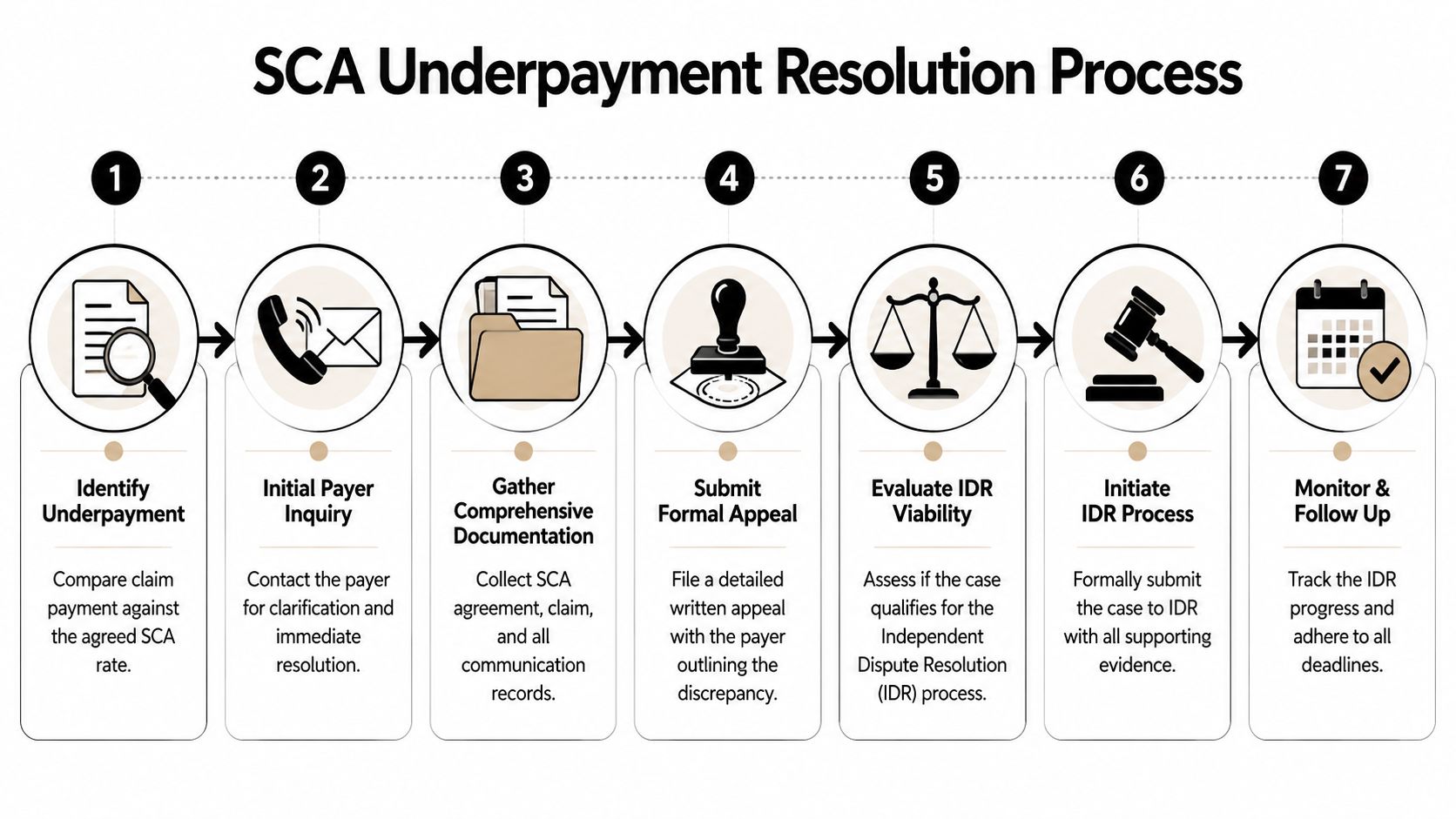
Use a disciplined escalation ladder
Underpaid SCAs need a repeatable process.
- Identify the variance immediately. Compare the remittance to the contracted rate as soon as payment posts.
- Open a documented payer inquiry. Request the exact reason the payment differs from the SCA.
- Submit a written appeal with the agreement attached. State the expected amount, paid amount, and shortfall.
- Require a contract review. Push the payer to confirm whether the SCA was loaded, bypassed, or ignored.
- Evaluate formal dispute options quickly. Do not let aging or internal handoffs burn filing windows.
- Escalate with a complete evidence set. Keep the argument centered on the signed agreement and the payer's payment variance.
- Track recovery by payer and failure mode. Patterns matter. If one plan repeatedly defaults SCAs to standard pricing, future cases should be staffed and monitored accordingly.
An SCA only protects revenue when the payer pays to the agreement.
The strongest organizations do not separate contracting, billing, and dispute work. They run one case architecture from intake through payment recovery. That is the gap many SCA guides miss. Getting the agreement approved is only half the job. The harder and more valuable skill is enforcing the rate after the payer underpays, then using IDR when the facts and the economics support it.