

If you're managing contracts out of shared drives, old email threads, scanned PDFs, and someone's memory, you're not managing contracts. You're hoping the payer paid correctly.
That approach breaks the moment cash gets tight, a denial trend spikes, or a payer starts drifting away from the rate sheet without saying a word. Most practices feel that pain downstream. The billing team sees odd remits. Appeals take too long. Leadership hears that revenue is soft, but nobody can point to the exact clause, code, or amendment causing it.
That's why payer contract management can't sit in legal or operations as a filing exercise. It has to function as a revenue protection system. The contract tells you what should happen. Your RCM workflow tests whether it did happen. Your dispute process enforces the difference when it didn't.
Building Your Payer Contract Management Foundation
The first job is simple to describe and tedious to do. Build one single source of truth for every payer agreement, amendment, fee schedule, letter of agreement, and policy attachment that affects reimbursement.

A lot of teams stop at document storage. That isn't enough. A repository that only stores PDFs still forces your staff to read contracts line by line every time a payment dispute appears. What works is a repository that turns those documents into searchable operating rules.
Start with a true contract inventory
Pull contracts from every place they live. That usually includes credentialing files, payer enrollment folders, legal, finance, billing, regional offices, and old email chains. Don't trust the payer's portal to be complete. It often isn't.
Create an inventory that includes:
- Payer and plan name: Commercial plan, product line, delegated network, and any narrow network variation.
- Contract status: Executed, pending, terminated, superseded, or unclear.
- Effective documents: Master agreement, amendments, fee schedules, exhibits, and letters of agreement.
- Operational owner: Who inside the organization is responsible when the contract creates a billing or payment issue.
- Renewal mechanics: Auto-renewal language, notice windows, and termination requirements.
If you find verbal understandings that were never documented, treat them as non-existent until they're confirmed in writing. Internal folklore doesn't hold up when a payer underpays.
Practical rule: If your posting team can't identify the governing fee schedule within minutes, your contract repository still isn't operational.
Build a clause library, not just a folder structure
Every contract should be broken into tagged clauses that matter operationally. Payer contract management begins to pay off, as your billing team, contracting team, and denial team are now all working off the same terms.
Track clauses that directly affect reimbursement and enforceability first:
- Timely filing limits: Claims, corrected claims, reconsiderations, and appeals.
- Payment terms: Fee schedule basis, update methodology, multiple procedure logic, modifier treatment, and payment timing.
- Carve-out definitions: Implants, drugs, anesthesia units, pathology, DME, monitoring, and other specialty services.
- Bundling and downcoding language: Especially where payer policy tries to override contract language.
- Recoupment terms: Lookback period, notice requirements, offset rights, and documentation standards.
- Escalators and update provisions: Medicare-based updates, annual fee schedule refreshes, or renegotiation triggers.
- Termination provisions: Without-cause exit rights, cure periods, and notice deadlines.
- Dispute procedures: Informal review, payer escalation path, arbitration language, and governing timelines.
Tag what the business will actually use
The best repositories answer practical questions fast. Can this code be carved out. Does this payer allow separate payment under this modifier. How long do we have to challenge a variance. When does the amendment become effective. Those answers need to be tagged, not buried.
A useful tagging schema usually includes a core set like this:
| Contract field | Why it matters |
|---|---|
| Contract entity | Prevents posting and appeal errors when the legal entity differs by state or TIN |
| Product lines covered | Stops staff from applying PPO logic to HMO claims |
| Fee schedule source | Tells finance what benchmark or exhibit controls payment |
| Amendment effective date | Prevents retroactive confusion during reconciliation |
| Notice window | Keeps the practice from missing a negotiation or termination deadline |
| Priority clauses | Flags language on bundling, recoupment, carve-outs, and appeals |
A contract repository becomes valuable when people use it during daily work. If only legal can effectively engage with it, it's still a static archive. The foundation is solid when payment posting, denial management, contracting, and leadership all pull from the same record and get the same answer.
From Data to Dollars with Payer Behavior Analytics
Once the contracts are structured, the next move is to compare promise versus performance. In this process, payer behavior analytics separates disciplined payer contract management from passive administration.
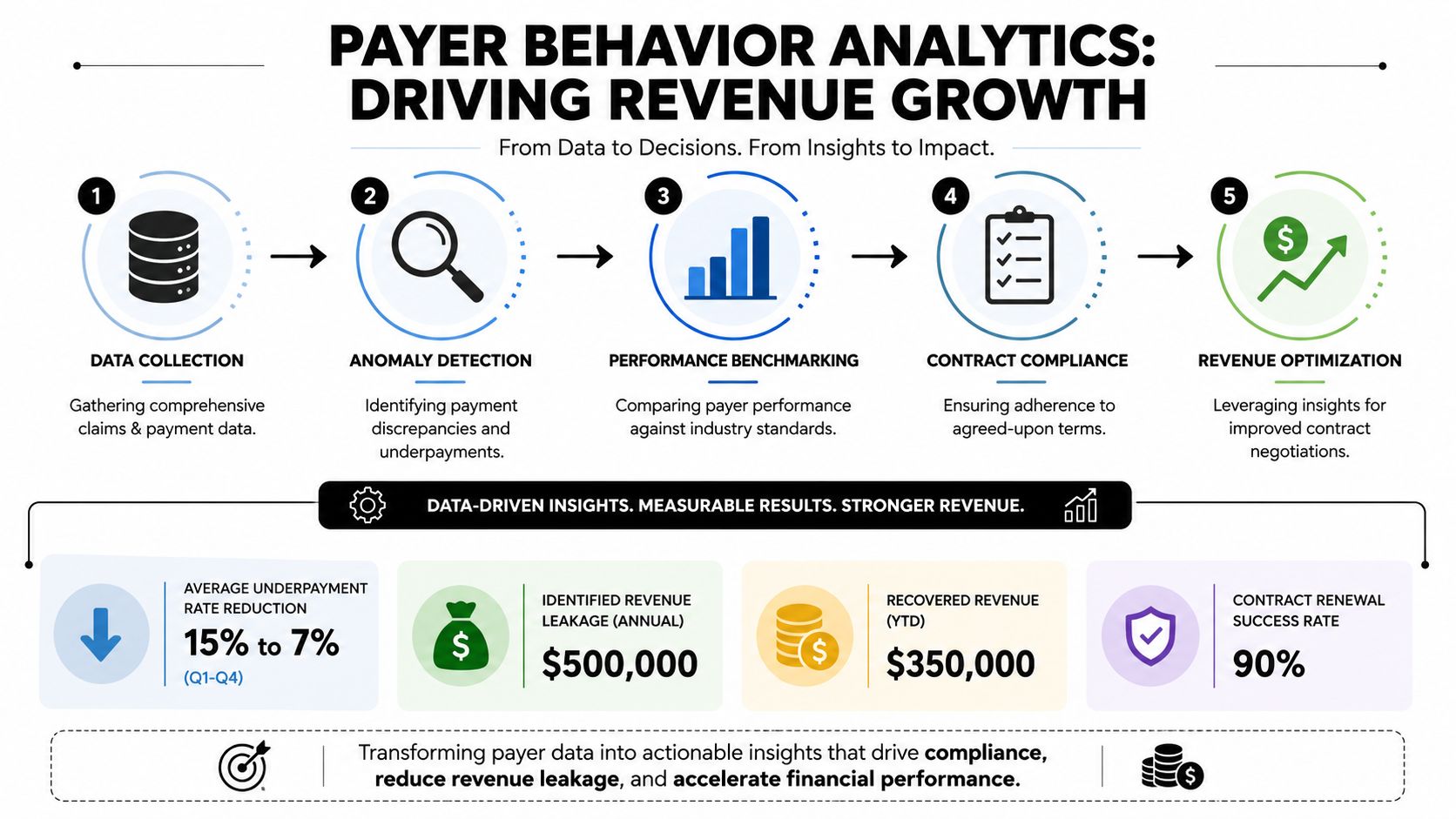
Most practices know their collections by payer. Far fewer know whether each payer is paying according to contract at the CPT code level. That gap is where leakage hides. Specialty practices that actively track payment variance at the CPT code level identify an average of 7-11% in recoverable revenue from systemic underpayments that would otherwise go unnoticed, according to RevGuard's payer underpayment research.
Measure payment behavior at the code level
Top-line reimbursement reporting won't catch the problem. A payer can look acceptable in aggregate while consistently shaving payment on a cluster of high-value services, applying bundling edits too broadly, or drifting on a fee schedule update.
You need a line-by-line comparison between:
- Expected allowed amount based on the governing contract term.
- Actual allowed amount from ERA or EOB data.
- Variance reason such as underpayment, downcoding, bundling, delayed payment, or misapplied modifier logic.
That analysis should sit at the CPT or HCPCS level, with payer, plan, place of service, and modifier detail available. If your data model stops at claim total, you're missing the behavior pattern.
Watch for patterns, not isolated misses
A single underpaid claim may be a posting issue. A repeated variance on the same code, same payer, same setting is usually a payer behavior issue.
The patterns that matter most are usually these:
- Systemic underpayment: The payer pays below contracted allowable on a repeatable set of codes.
- Silent downcoding: The submitted service is accepted but reimbursed as if a lower-level service applied.
- Bundling creep: Separate reimbursable services get folded into a primary procedure even when the contract supports distinct payment.
- Delay tactics: The payer eventually pays, but only after repeated touches, corrected claims, or unnecessary documentation.
- Policy override behavior: The payer cites internal policy where the contract language should control.
The useful question isn't "Was this claim paid?" It's "Was this claim paid exactly as the contract required?"
Benchmark with relevance, not vanity
Benchmarking matters, but a lot of teams do it badly. They compare rates to a generic benchmark, get a rough sense of being low, and walk into negotiation with weak footing.
Useful benchmarking is specialty-specific and geography-aware. It should tell you whether your rates for actual high-volume services are competitive enough to justify the administrative burden of staying in-network. It should also show whether a payer's fee schedule logic is structurally bad, even if one headline service looks acceptable.
What doesn't work is negotiating off a broad statement like "your competitor pays better." What works is code-level evidence tied to your mix of services.
A practical example from specialty billing
An anesthesia group doesn't usually lose ground through one dramatic denial. It loses ground through repeated unit miscalculations, carve-out confusion, and selective underpayment on higher-acuity cases. The contract may be clear, yet payment posting still shows recurring variance.
When the group can isolate the exact procedure family, the expected allowable, the payer's repeated shortfall, and the clause controlling reimbursement, the conversation changes. You're no longer arguing about impressions. You're documenting noncompliance.
That same discipline applies in orthopedics, gastroenterology, radiology, and emergency services. Every specialty has its own pressure points. The method is the same. Define expected payment precisely, compare it against actual payment consistently, and log the variance reason in a way that supports escalation later.
Mastering the Modern Negotiation Cadence
Most practices still treat contract negotiation like a renewal-season event. That's too slow and too passive. Payers don't wait for renewal to test edges, reinterpret terms, or let bad implementation stand. You shouldn't wait either.
The strongest contracting teams negotiate on a cadence, not a deadline. They use actual payer behavior to decide when to push, what to fix, and whether the right move is a full renegotiation, a targeted amendment, or a narrow letter of agreement.
Stop bringing complaints and start bringing evidence
Payers are used to hearing that rates are low or denials are frustrating. Those conversations go nowhere unless the provider can show a contract-performance problem tied to a practical ask.
Bring a package that includes:
- Payment variance by code family: Not every disputed claim. A grouped pattern with enough detail to show repeat behavior.
- Operational impact: Which services are affected, where staff rework is increasing, and what contract ambiguity is creating the issue.
- Requested remedy: Fee schedule correction, carve-out clarification, amendment language, implementation fix, or retroactive true-up.
- Fallback path: If the payer won't reopen the whole agreement, propose an LOA for a defined set of services or sites.
Many teams find themselves stuck. They ask for a broad increase when the better first move is to force correction of a narrow but valuable defect. Mid-contract fixes are often easier to win than total repricing.
If the payer is violating the contract, don't frame it as a favor request. Frame it as a compliance correction with supporting documentation.
Choose the right vehicle
Not every issue deserves the same response. The biggest mistake I see is using full-scale renegotiation for problems that should have been handled through a shorter operational path.
Use this decision logic:
| Situation | Best move |
|---|---|
| Repeated underpayment on a small set of codes | Targeted amendment or LOA |
| Broad rate misalignment across major service lines | Formal renegotiation |
| Implementation failure after a signed deal | Escalated operational remediation |
| Ambiguous carve-out or bundling term | Written clarification before broader talks |
| Chronic noncompliance tied to high-value services | Negotiation paired with enforcement prep |
A lot of payers will agree to "review" an issue just to burn time. Put deadlines on your side, not theirs. Assign an owner, set a follow-up cadence, and document every response.
Negotiate before the renewal window controls you
If you wait until the notice period is approaching, the payer has an advantage. They know you're boxed in by timing, network concerns, and executive pressure to avoid disruption.
The better approach is continuous preparation. Review payment behavior regularly, identify the contracts that are failing operationally, and open targeted discussions while there's still room to escalate. That's especially important when amendments, carve-out implementation, or specialty reimbursement logic have drifted.
For practices that need outside support on this work, payer contract negotiation services can be useful when they include contract language review, fee schedule modeling, and payer outreach tied to implementation follow-through.
Know what doesn't work
Some negotiation habits waste months.
- Leading with emotion: "This payer is awful" may be true internally, but it isn't a strategy.
- Accepting headline fixes: A payer may offer a visible concession on low-impact services while leaving your meaningful codes untouched.
- Separating contracting from RCM: If negotiators don't know how claims are adjudicating, they'll miss the core problem.
- Failing to memorialize changes: Verbal commitments die in implementation.
A modern negotiation cadence works because it's tied to lived payment behavior. It treats the contract as an active instrument, not a document that only matters every few years.
Automating Intelligence with Dashboards and KPIs
If your payer contract management process still depends on manually maintained spreadsheets, you're going to miss trends until they become revenue problems. Spreadsheets are fine for cleanup. They aren't a durable operating system.
What works is a dashboard that blends contract terms, claims data, remittance data, and escalation status into one view. The point isn't prettier reporting. The point is faster detection and cleaner decision-making.
Build KPIs that trigger action
A dashboard should help three groups at once. Posting teams need variance visibility. Contracting leaders need payer trend visibility. Executives need a short list of risks that deserve attention.
The most useful KPIs answer a specific operational question.
| KPI | Calculation | What It Tells You |
|---|---|---|
| Expected vs actual allowed variance | Contracted allowed minus posted allowed, grouped by payer and code | Whether a payer is paying to contract |
| Underpayment queue age | Days from variance identification to resolution | Whether recovery work is moving or stalling |
| Denial rate by payer category | Denied claims divided by submitted claims, grouped by payer and denial class | Which payer behaviors are creating preventable rework |
| Payment turnaround trend | Average days from clean claim submission to payment posting | Which payers are slowing cash conversion |
| Contract renewal watchlist | Contracts flagged by notice date, amendment status, and unresolved issues | Which payer relationships require action before timing closes |
| Appeal overturn pattern | Overturned appeals divided by appealed denials, grouped by payer issue type | Whether denials are valid or just being challenged inconsistently |
Keep the dashboard close to operations
The worst dashboards are executive vanity tools. They summarize revenue broadly and hide the operational drivers that matter. If the billing manager can't use the dashboard to assign follow-up work today, it's too abstract.
Good dashboard design includes:
- Drill-down capability: Leaders can move from payer summary to claim-level detail without asking for a separate report.
- Clause linkage: Variance views tie directly back to the controlling contract term or fee schedule.
- Work queue status: Staff can see whether an issue is pending payer response, internal review, appeal, or escalation.
- Exception visibility: The dashboard highlights changes in payer behavior, not just historical averages.
Operator's view: The best KPI is the one that tells your team what to do before month-end close exposes the problem.
Teams looking to formalize this reporting structure can use frameworks from broader revenue cycle management metrics work, then tailor them around payer variance, contract compliance, and dispute readiness.
Automation matters because payer behavior changes faster than annual reviews. If your dashboard updates after the issue is already old news, you're still operating reactively.
Closing the Loop with RCM and IDR Integration
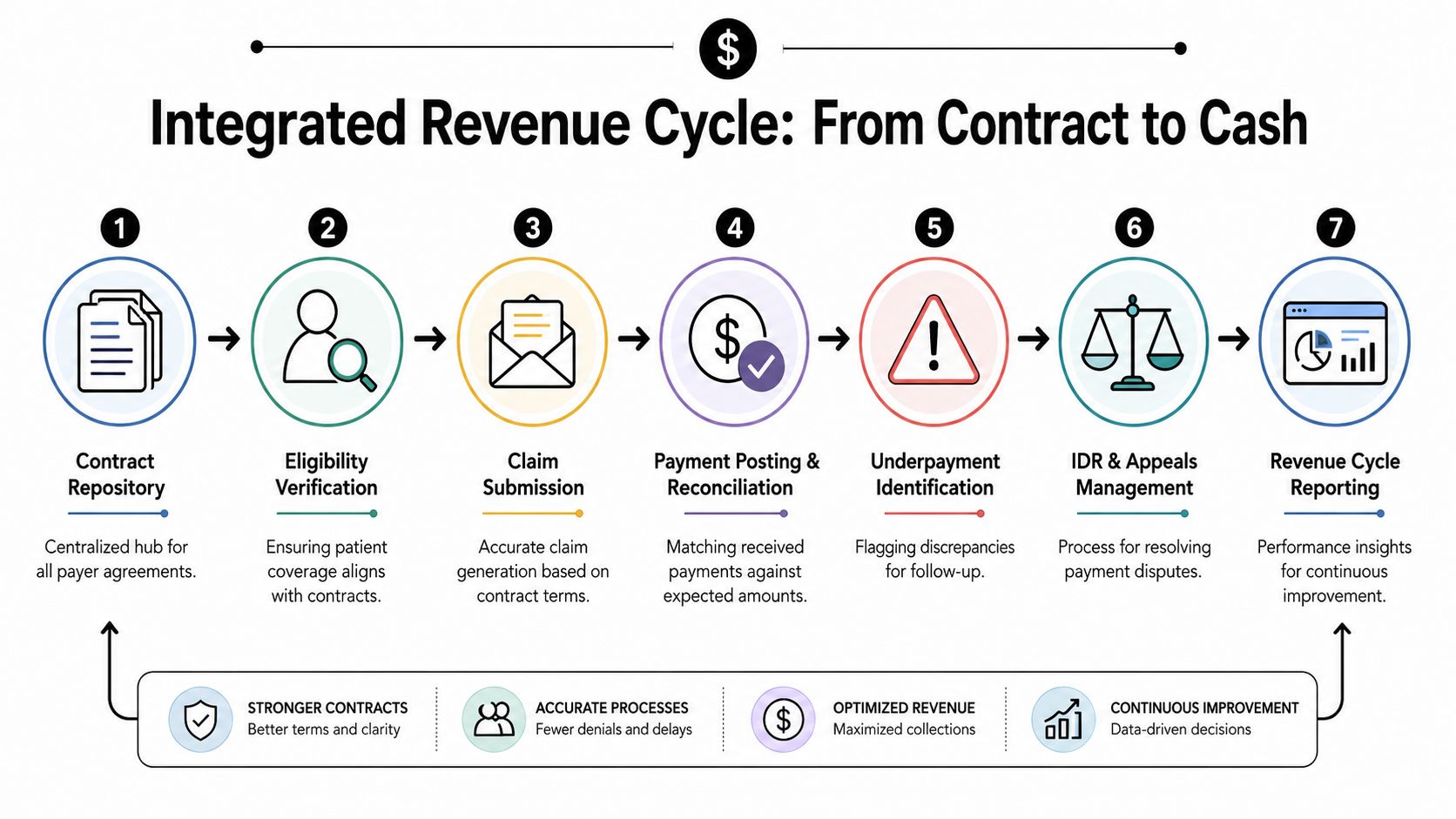
Most payer contract management programs fall apart when they build a decent repository, run some analytics, maybe even renegotiate, but never connect the contract to enforcement.
A contract only protects revenue if your revenue cycle team can use it in real time, and if your dispute process can turn that documentation into a recoverable claim. That's the difference between administration and revenue protection.
Make the contract visible inside daily RCM work
When a claim is denied, delayed, or paid short, the team shouldn't start from scratch. They should be able to answer a sequence of practical questions quickly.
- What contract governs this claim
- What should the payer have done
- Which clause or fee schedule supports that expectation
- Has this issue happened before with this payer
- What escalation path applies
That requires contract intelligence to sit inside eligibility review, claim build, payment posting, denial management, and appeal workflows. If the contract only comes out after multiple failed touches, you're burning time and weakening your position.
Build every variance like it might become a dispute file
Not every payment dispute belongs in formal escalation. But every meaningful one should be documented as if it might need to be defended later.
The file should include:
- Contract support: Governing agreement, amendment, and relevant reimbursement language.
- Payment evidence: ERA, EOB, posting detail, and expected versus actual comparison.
- Clinical and coding support: Claim form, medical records if needed, coding rationale, and modifier support.
- Communication log: Every email, call note, portal submission, and payer response.
- Escalation history: Reconsideration, appeal, peer review, or contract-level complaint.
That discipline pays off twice. It improves ordinary appeal outcomes, and it creates a dispute-ready evidentiary package when informal efforts fail.
Most providers lose leverage when the issue leaves the billing office and enters a formal dispute channel. The file gets thinner right when the standard of proof gets higher.
Connect contract enforcement to IDR under the No Surprises Act
For organizations dealing with out-of-network disputes and other payment conflicts that move into formal resolution, the work done upstream becomes critical downstream. Contract language, reimbursement history, payment variance analysis, and communication records all help establish what the payer did, what it should have done, and why the provider's position is supportable.
That's why the operational link between RCM and dispute resolution matters so much. A clean claim without contract support is vulnerable. A strong contract without disciplined posting and documentation is hard to enforce. The combination is what creates a credible dispute posture.
Teams that want a clearer picture of this operating model can review how RCM and IDR work together in a connected workflow. The core idea is straightforward. Claims should be built, posted, reconciled, and escalated in a way that preserves evidence from the first touch, not reconstructed after the payer has already defined the story.
What actually changes when integration is real
The difference shows up in execution:
| Reactive model | Integrated model |
|---|---|
| Denial team hunts for terms after the fact | Staff can identify governing terms during follow-up |
| Appeals rely on generic templates | Appeals cite contract language and payment variance history |
| Contracting and billing work separately | Contracting decisions reflect live adjudication behavior |
| Formal disputes start with incomplete files | Escalations begin with organized documentation and chronology |
That's the unique payoff. Payer contract management isn't just about getting better paper. It's about building enforceable claims and preserving reimbursement value when the payer tests the boundary.
From Reactive Firefighting to Proactive Revenue Protection
Most practices don't need another theoretical guide telling them to "review contracts regularly." They need an operating model that holds up when payers underpay, reinterpret terms, or drag issues out until staff gives up.
That model starts with a usable repository. It gets stronger when actual payment behavior is measured against contract terms. It becomes effective when negotiation happens continuously, not just at renewal. And it changes the financial posture of the organization when contract data feeds directly into RCM follow-up, appeals, and dispute escalation.
The shift is strategic. You're no longer reacting to each low payment as an isolated annoyance. You're identifying payer behavior, documenting noncompliance, and deciding where to correct, negotiate, or enforce.
That's what mature payer contract management looks like in practice. It isn't administrative overhead. It's one of the clearest ways a specialty group, hospital, ASC, or multi-state platform can defend reimbursement without waiting for the payer to define the outcome.
If your organization needs a tighter link between contract terms, payment variance detection, RCM execution, and formal revenue enforcement, RevGuard provides an integrated model built around those functions.