

Most advice on how to dispute a medical bill starts in the wrong place. It assumes the provider is the problem, the patient is the victim, and the only path forward is confrontation.
That framing misses how medical billing breaks. In practice, many disputed balances start with claim processing mistakes, payer edits, delayed adjudication, out-of-network misclassification, or downcoded services. The patient sees a bill. The provider sees an underpaid or misprocessed claim. Both are reacting to the same breakdown.
A good dispute process lowers the temperature. It replaces anger with documentation, vague complaints with line items, and phone frustration with a record that someone can act on. When patients and provider offices approach the issue that way, disputes become less about fighting and more about correcting the file.
Challenging a Bill Is Not a Declaration of War
The most useful shift is mental, not procedural. Disputing a medical bill isn't accusing someone of fraud. It's asking for the account to be validated before money changes hands.
Patients often assume that if they challenge a charge, the provider's office will get defensive. Provider offices often assume a patient dispute is just resistance to payment. Both reactions make the process harder than it needs to be. Most billing teams will respond better to a calm, specific dispute than to a broad complaint that the bill is “too high.”
The real conflict is often upstream
A patient statement is the end of a chain. Before it appears, someone verified eligibility, coded the visit, submitted the claim, waited for adjudication, posted the payer response, and transferred any remaining balance to the patient. Errors can enter at several points. By the time the bill arrives, the person opening the mail usually has no visibility into what happened upstream.
That's why a dispute should focus on accuracy, not blame.
If the insurer processed the claim incorrectly, the provider may want that fixed as much as the patient does. If the wrong code was billed, the provider needs to correct it. If the balance should never have reached patient responsibility, everyone benefits from catching it early. This is also why strong medical billing compliance practices matter. Clean documentation and disciplined workflows reduce the chance that a simple account issue turns into a collections problem.
Practical rule: Treat the first dispute as an audit request. That tone gets better results than treating it like a legal threat.
What works better than outrage
In my experience, disputes move fastest when the person raising them can answer three questions clearly:
- What charge is being challenged
- Why it appears incorrect
- What documents support the objection
That structure helps patients. It also helps billing managers, patient advocates, and compliance staff sort valid issues from emotional but unsupported complaints.
A disputed bill is often fixable. A paid bill with no paper trail is much harder to unwind. So the goal isn't to “win” an argument. The goal is to stop the account long enough to determine what is owed, by whom, and why.
Your Pre-Dispute Intelligence Gathering
The first real win in a billing dispute usually happens before anyone picks up the phone. A patient who can point to a specific line item, claim adjustment, or coverage conflict gives the billing office something concrete to investigate. A provider office with that same file can often recover underpaid revenue from the payer while correcting the patient balance. That is why good disputes start as fact-finding, not confrontation.
A clean file changes the tone of the conversation. It also changes who the dispute is really about. In many cases, the patient and provider are not fighting each other. They are trying to trace whether the payer misprocessed the claim, whether the account was posted incorrectly, or whether the bill went out before rework was complete.
A practical starting point is simple: get the detailed bill and compare it line by line against the insurer's Explanation of Benefits. Patient Fairness's medical bill dispute guide points to that same foundation because it is the fastest way to spot duplicate charges, coding concerns, or services that do not match what was received.
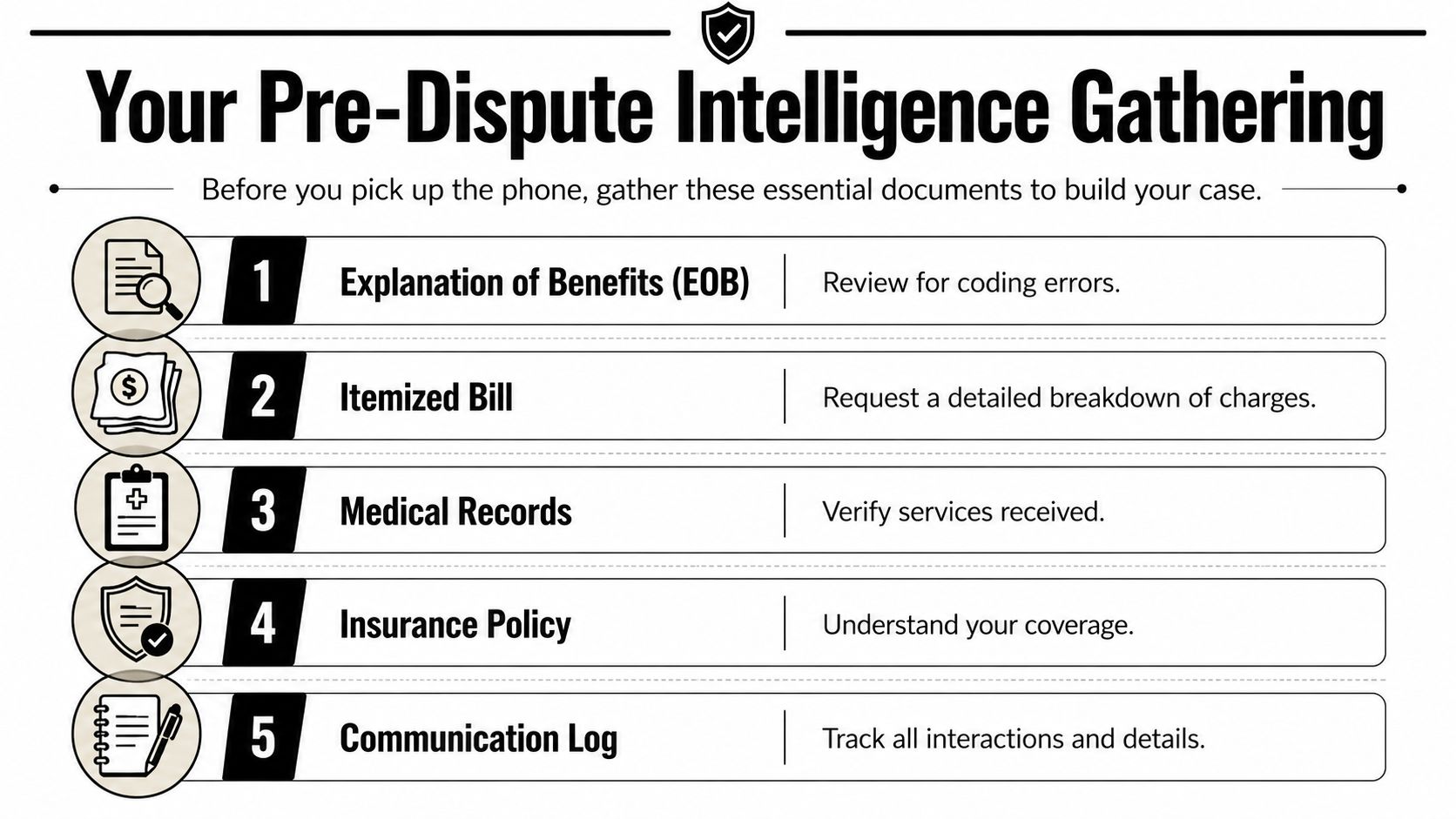
Start with the five documents that matter
Build a working file, not a paper stack.
- Itemized bill: Request the detailed statement with every charge listed separately.
- EOB: Use it to see what the insurer allowed, denied, reduced, or assigned to patient responsibility.
- Medical records: Pull the relevant notes if the disagreement is about whether a service happened or whether it was justified.
- Insurance policy materials: Review the plan language if the issue looks like a coverage exclusion or benefit limit instead of a billing mistake.
- Communication log: Track dates, names, departments, reference numbers, and what each person said.
If the EOB is hard to read, review this guide to how an EOB works in medical billing before comparing documents. Misreading the adjustment codes leads people to challenge the wrong party.
Compare the bill against the EOB like an auditor
Review the account one line at a time. Totals hide the actual problem.
Check these points:
- Date of service: Confirm the bill matches the day care was delivered.
- Provider identity: Verify the rendering clinician or facility is the one involved in the visit.
- Duplicate charges: Flag repeated services, supplies, or procedures on the same date.
- Service level: Look for coding that seems inconsistent with the visit or treatment provided.
- Services not received: Mark anything the patient did not receive or any clinician the patient never saw.
- Bill to EOB mismatch: Note where the provider bill and payer processing do not line up.
That last issue matters more than patients often realize. If the EOB shows one result and the patient statement shows another, the account may need claim rework, corrected posting, or a rebill. In provider offices, that is revenue cycle work, not just customer service.
Red flags that deserve immediate follow-up
Some findings deserve quick attention because they often signal a larger account problem.
| Red flag | Why it matters | Next move |
|---|---|---|
| Duplicate line items | May reflect double billing or a posting error | Ask billing to validate each charge against the chart |
| Service not received | May indicate a coding, charge entry, or identity problem | Request record confirmation |
| Higher-level service than expected | May require a coding review | Ask for documentation support for the code billed |
| EOB and provider bill do not align | The claim may have been reprocessed or posted incorrectly | Ask both payer and provider for current claim status |
A vague complaint stalls. A marked-up bill with three specific discrepancies gets attention.
Build the dispute file before you speak
Assemble the packet before making calls or sending messages. That reduces inconsistent explanations and helps every party work from the same facts.
Include:
- The marked-up itemized bill
- The relevant EOB
- Any supporting medical records
- Notes identifying the exact charges in question
- A dated log of calls, portal messages, and letters
If the dispute may fall under a formal patient-provider process, deadlines matter. Patient Fairness notes that patients should pay attention to the plan's 180-day appeal window and, for Patient-Provider Dispute Resolution cases, a 120-day filing window from the initial bill when charges exceed the Good Faith Estimate by $400 or more, along with a $25 filing fee. It also notes that collection activity is restricted during review when that process applies. Keep those dates in the file from day one. Missing a deadline turns a strong billing challenge into a procedural loss.
Executing the Formal Dispute and Negotiation
A formal dispute works best when it lowers the temperature. Patients often assume they are fighting the provider. In many billing cases, both sides are trying to correct the same problem. The patient wants an accurate balance. The provider wants the claim paid correctly and the account kept out of unnecessary collections.
That shared interest matters. It changes the tone of the conversation from accusation to account resolution.

What the dispute letter needs to say
A good dispute letter is short, specific, and tied to documents already in the file. Billing teams and patient advocates can work with a precise request. They cannot do much with a general statement that the bill feels wrong.
Include these elements:
- Account identifiers: Patient name, account number, date of service, and claim number if available
- Formal dispute statement: State that you are disputing specific charges on the account
- Line-item detail: Identify the exact dates, CPT or HCPCS codes, or charge descriptions in question
- Reason for dispute: Duplicate billing, service not received, EOB mismatch, coding concern, missing adjustment, or another documented issue
- Attachments list: Itemized bill, EOB, records, physician note, Good Faith Estimate if relevant, and prior correspondence
- Requested action: Correct the bill, reprocess the claim, place the account on hold, or issue a revised statement
Use direct language.
“I am formally disputing the charges listed below and request written confirmation that the account will remain under review until the disputed items are resolved.”
That wording does two jobs. It identifies the account as contested, and it asks for a documented status the billing office can apply internally.
Use the phone to route the case, not to argue it
Calls still matter, but the purpose is operational. Confirm where the dispute should go. Find out who can review adjustments. Get the account noted correctly.
Keep the call tight:
- Start with the identifiers: Account number and date of service
- State the issue in one sentence: “I am calling about a formal dispute of specific billed charges.”
- Ask for the right reviewer: Billing supervisor, patient financial services lead, coding review contact, or patient advocate
- Confirm the workflow: Where to send the dispute, whether the account will be placed on hold, and when to expect a response
- Document the result: Name, title, date, reference number, and the exact next step promised
Front-line representatives often can explain balances but cannot approve corrections. In provider offices, I have seen disputes drag on because the account never reached the person who could compare the bill, the remittance, and the posting history.
One sentence helps keep the discussion on track:
“I am requesting review of documented billing issues, not a courtesy discount.”
That signals that the problem may involve posting, coding, or payer adjudication, not just affordability.
Negotiation starts after the account is cleaned up
Some disputes end with a corrected balance. Others confirm that part of the bill is valid. That is the point to negotiate terms.
If the remaining patient responsibility is accurate, ask about options that fit the account status:
| Option | Best use case | What to ask |
|---|---|---|
| Prompt-pay discount | You can resolve the balance soon after corrections are posted | Ask whether a reduced amount is available for payment in full |
| Interest-free payment plan | The balance is accurate but unaffordable in one payment | Ask for the monthly amount, term length, and default terms in writing |
| Financial assistance or counselor review | Income, household size, or uninsured status may qualify the account for relief | Ask what documents are required and whether collections are paused during review |
This is also where payer math becomes useful. Understanding the insurer's allowed amount for the service helps both patients and provider offices test whether the posted balance makes sense, especially when the billed charge, contracted rate, and patient responsibility are far apart.
What to avoid during the negotiation stage
A few mistakes create avoidable losses.
- Do not pay the full balance while the disputed items are still unresolved, unless you have been told in writing that payment will not waive review
- Do not rely on call-center assurances without written follow-up
- Do not send a vague complaint with no line-item references
- Do not spend 30 minutes debating policy with someone who cannot change the account
- Do not treat every dispute as fraud or bad faith when the issue may be payer processing or a posting error
The strongest disputes are calm, specific, and documented. That helps the patient. It also helps the provider office separate a fixable billing problem from a true payment issue, which is often the first step toward recovering the right reimbursement.
Escalating Your Case to the Insurance Payer
Sometimes the provider can't fix the problem because the provider didn't create it. If the payer denied, underprocessed, or misclassified the claim, the next move is an insurance appeal.
Many patients often lose momentum here. They keep calling the provider's billing office even after it's clear the account reflects the insurer's adjudication. At that point, the dispute needs to shift from “why is my bill wrong?” to “why did the payer process this claim this way?”
Internal appeal versus external review
These are not the same process.
An internal appeal goes back to the insurer. You're asking the health plan to re-examine its own decision. That usually works best when you can point to plan language, a coding mismatch, or documentation the payer overlooked.
An external review involves an independent third party after the insurer denies the internal appeal. That route becomes important when the plan won't reverse itself and the issue turns on coverage or medical necessity.
Here's the practical difference:
| Path | Who reviews it | Best for |
|---|---|---|
| Internal appeal | The insurer | Claim processing errors, coverage misreads, missing documentation |
| External review | Independent reviewer | Denials that remain after internal appeal, especially medical necessity disputes |
Match the evidence to the reason for denial
Not every appeal needs the same packet.
If the issue is a billing or processing error, focus on administrative proof:
- The EOB
- The provider bill
- Any coding mismatch
- Notes showing payer statements that conflict with the claim outcome
If the issue is medical necessity, your evidence needs to get more clinical:
- Doctor's letter explaining why the service was necessary
- Relevant medical records
- Any prior authorization history
- A concise explanation of why the denial rationale doesn't fit the patient's case
That distinction matters. I see appeals fail because people submit the wrong kind of support. A claim denied on medical necessity usually won't be reversed by sending only a billing statement. A coding issue usually doesn't need a long clinical narrative.
Appeals fail when the evidence answers a different question than the one the payer asked.
Keep the timeline visible
Appeals are deadline-sensitive. If you miss the filing window, even a strong argument can die on procedure.
Earlier in this guide, the key patient-side timing rule was already established: filing must occur within the applicable appeal window. When you escalate to the payer, treat every date as operationally important. Save denial notices, portal screenshots, and fax confirmations. If the insurer says it never received your appeal, your proof of submission becomes part of the case.
It also helps to tell the provider's billing office that the payer appeal is pending and ask them to note the account. That won't solve every problem, but it can reduce unnecessary account movement while the insurer reviews the dispute.
The Provider's Playbook The No Surprises Act and IDR
This is the part most patient guides miss. A disputed bill isn't always just a consumer problem. It can be the first visible sign that a payer has underpaid, downcoded, or wrongly classified a claim.
That matters because providers have their own enforcement path.
Content in this area often stops at itemized bills and patient complaints. But a key gap is the provider-side use of the No Surprises Act timeline. According to CHBMD Billing's discussion of disputing medical bills, 90% of current guides focus on patients requesting itemized bills, while providers can use the NSA's 90-day dispute window to force arbitration when payers underpay or downcode. The same source notes that 17% of anesthesia and air ambulance bills are incorrectly processed as out-of-network.
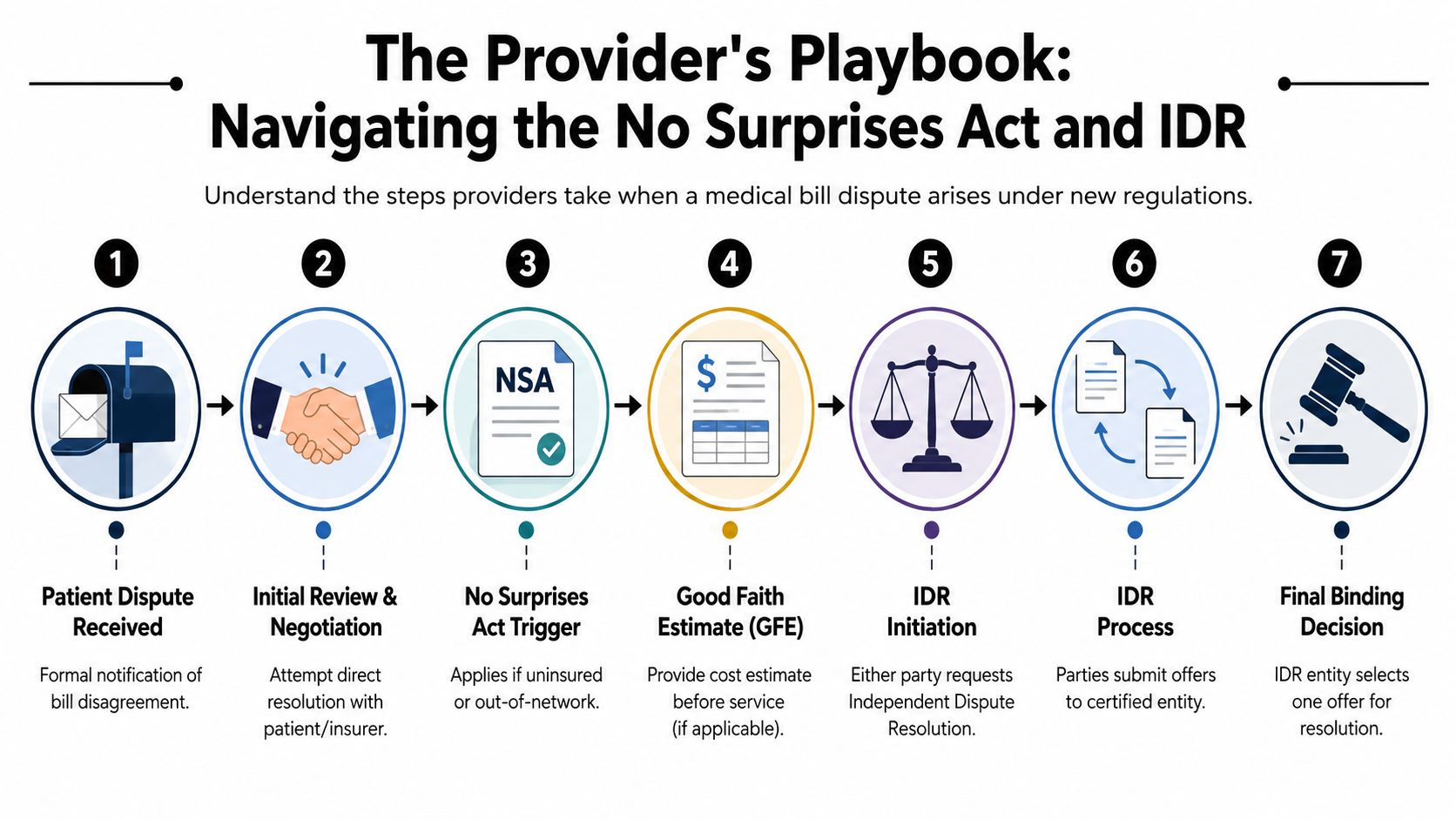
When the patient dispute reveals a payer issue
A patient may receive a statement and think the provider is overbilling. The provider reviews the account and sees something else:
- The payer applied the wrong network status
- The payer reduced the claim through downcoding
- The payer underpaid relative to the submitted service
- The payer shifted cost to the patient after flawed adjudication
In those situations, the patient and provider are not natural opponents. They're often looking at opposite sides of the same processing error.
Why this changes provider strategy
For providers, especially in high-friction specialties, a complaint about a balance bill can be an early warning signal. Handled correctly, it can trigger a larger review of payer behavior across similar claims.
That's the operational value of linking front-end dispute handling with backend reimbursement strategy. Instead of treating each complaint as an isolated account issue, strong revenue cycle teams ask:
- Is this balance the result of an actual patient responsibility amount?
- Did the payer process the claim correctly?
- Does this claim belong in a broader NSA or arbitration workflow?
That mindset changes outcomes. It turns a reactive billing defense into a revenue integrity function.
Building an arbitration-ready file
Providers who do this well don't wait until a dispute explodes. They build files that are usable in escalation from the start.
The essentials usually include:
- Accurate coding and documentation
- Clean proof of eligibility and benefits
- Payer correspondence and remittance detail
- Contracting and network status support
- Patient communication records when balance concerns arise
A patient complaint can be the first clean signal that an underpayment exists. Smart offices don't just suppress the complaint. They investigate the payer trail behind it.
This is especially relevant for practices exposed to surprise billing disputes and out-of-network complexity. When the facts support it, the provider's path may extend far beyond rebilling the patient account. It may involve preparing a dispute file suitable for formal resolution against the payer.
Tracking Resolution and Measuring Success
A dispute isn't finished when someone says, “it should be fixed.” It's finished when the paperwork proves it.
For patients, that means the account has to close cleanly. For provider organizations, it means the outcome has to feed a repeatable system. Otherwise the same issue keeps resurfacing under a different account number.
What resolution looks like for patients
Patients should look for three things before treating the matter as closed:
- A corrected bill or zero-balance statement: The account should reflect the adjustment, not just a phone promise.
- Written confirmation: Ask for a letter, portal message, or statement showing the outcome.
- A final reconciliation against the EOB: Make sure the revised balance matches the payer's adjudication or the agreed resolution.
If the issue involved a formal dispute or payer appeal, save every final document. If the account later gets mishandled, those records become your defense.
What provider offices should track
Provider teams need a different lens. One account matters to the patient. A pattern matters to the revenue cycle.
Useful dispute tracking includes:
| Measure | What it shows |
|---|---|
| Denial patterns by payer | Which plans repeatedly create avoidable balance issues |
| Time to resolution | How long disputes stay open before closure |
| Root cause category | Whether the problem starts in coding, posting, eligibility, or payer adjudication |
| IDR outcome trend | Whether formal payer escalations are recovering value consistently |
A dashboard helps because disputes create operational noise. Once you can sort them by payer, specialty, denial type, and outcome, the work becomes less reactive.
A visual view of healthcare revenue protection workflows can help teams think at that level:

Why tracking changes behavior
When teams measure disputes systematically, they stop treating them as customer service interruptions. They start treating them as signals.
That shift matters for both sides. Patients get cleaner resolutions and fewer repeat errors. Providers get visibility into payer conduct, weak workflows, and reimbursement leakage that would otherwise stay buried in individual accounts.
If your organization needs help connecting patient billing accuracy, payer dispute strategy, and No Surprises Act enforcement, RevGuard offers a focused model built around specialty RCM, IDR execution, and payer-behavior analytics. For groups dealing with recurring underpayments, downcoding, or complex out-of-network disputes, that kind of integrated approach can turn scattered billing problems into a controlled revenue protection process.