

The healthcare revenue cycle management market was valued at US$ 169.7 billion in 2025 and is projected to reach US$ 505.8 billion by 2035, growing at 11.54% CAGR according to healthcare RCM market sizing projections. That growth matters because it reflects a hard reality inside provider organizations. Getting paid has become more complex, more technical, and more exposed to payer behavior than many finance teams were built to handle.
For specialty groups, ASCs, hospitals, and multi-site platforms, revenue cycle management services are no longer a support function. They are a financial control system. If patient access is loose, coding is inconsistent, claims go out dirty, remits aren't audited, or underpayments go unchallenged, revenue leaks at every handoff.
Most RCM advice stops too early. It focuses on clean claims, front-end edits, and denial reduction. Those things matter. But they don't solve the full problem when a payer receives a clean claim and still delays, downcodes, or underpays. A modern RCM strategy has to do both jobs well. It must prevent avoidable revenue loss upstream and enforce correct payment downstream.
Why Revenue Cycle Management Is Your Practice's Financial Lifeline
Every missed eligibility check, coding error, underpayment, and unresolved denial pulls cash out of the practice. In specialty care, those misses stack up fast because reimbursement is high-value, rules are payer-specific, and a single broken handoff can affect an entire case.
Revenue cycle management services sit inside that risk. They connect patient access, documentation, coding, claim submission, payment posting, A/R follow-up, and payer dispute action. When those functions are managed as separate tasks instead of one financial system, the CFO usually sees the result in three places first. Cash slows, write-offs rise, and payer performance gets harder to explain.
RCM is a margin control system
Too many organizations still treat RCM as clerical throughput. That is expensive.
Front-end staff are not just entering data. They are protecting claim viability. Coders are not just closing charts. They are defending medical necessity and payment accuracy. Billing teams are not just sending claims. They are determining whether the account enters the payer's system cleanly enough to avoid delay, rework, or avoidable downgrade.
One weak step changes the economics of the whole encounter. A registration error can trigger an eligibility denial. A missing authorization can stop payment on an otherwise appropriate service. Incomplete documentation can force downcoding. If the remittance is posted without scrutiny, an underpayment gets normalized and the practice loses revenue it earned.
Clean revenue starts before the visit and ends only when the payer's reimbursement is correct.
That last clause is where many RCM programs fall short. They focus on claim production, not payment enforcement.
Strong RCM does two jobs
The first job is operational. Get the claim right before it leaves the practice.
The second job is financial enforcement. Confirm that the payer paid according to contract terms, fee schedule logic, policy rules, or, when applicable, federal dispute standards. Specialty practices need both. A clean claim does not protect revenue if the payer delays, reprices, or underpays after adjudication.
That is the gap many guides miss. They stop at denial prevention. The better model ties upstream discipline to downstream recovery, including escalation pathways such as Independent Dispute Resolution for eligible out-of-network payment disputes under the No Surprises Act. Used correctly, that process is not just a compliance obligation. It is a way to recover dollars that would otherwise stay underpaid.
What a CFO should expect from RCM
A credible RCM function should produce visible financial results, not just activity reports. It should help the practice:
- Reduce revenue leakage by catching errors before submission and identifying underpayments after remittance
- Shorten time to cash by cutting rework, avoiding preventable denials, and resolving stuck accounts faster
- Lower avoidable write-offs by fixing root causes instead of aging accounts until they become bad debt or contractual noise
- Improve patient financial experience with clearer estimates, cleaner statements, and fewer preventable balance disputes
- Support defensible reimbursement by connecting billing operations with appeal rights, audit readiness, and IDR eligibility where applicable
In practical terms, the goal is simple. Build a revenue cycle that does not just move claims out the door. Build one that protects payment from intake through final resolution.
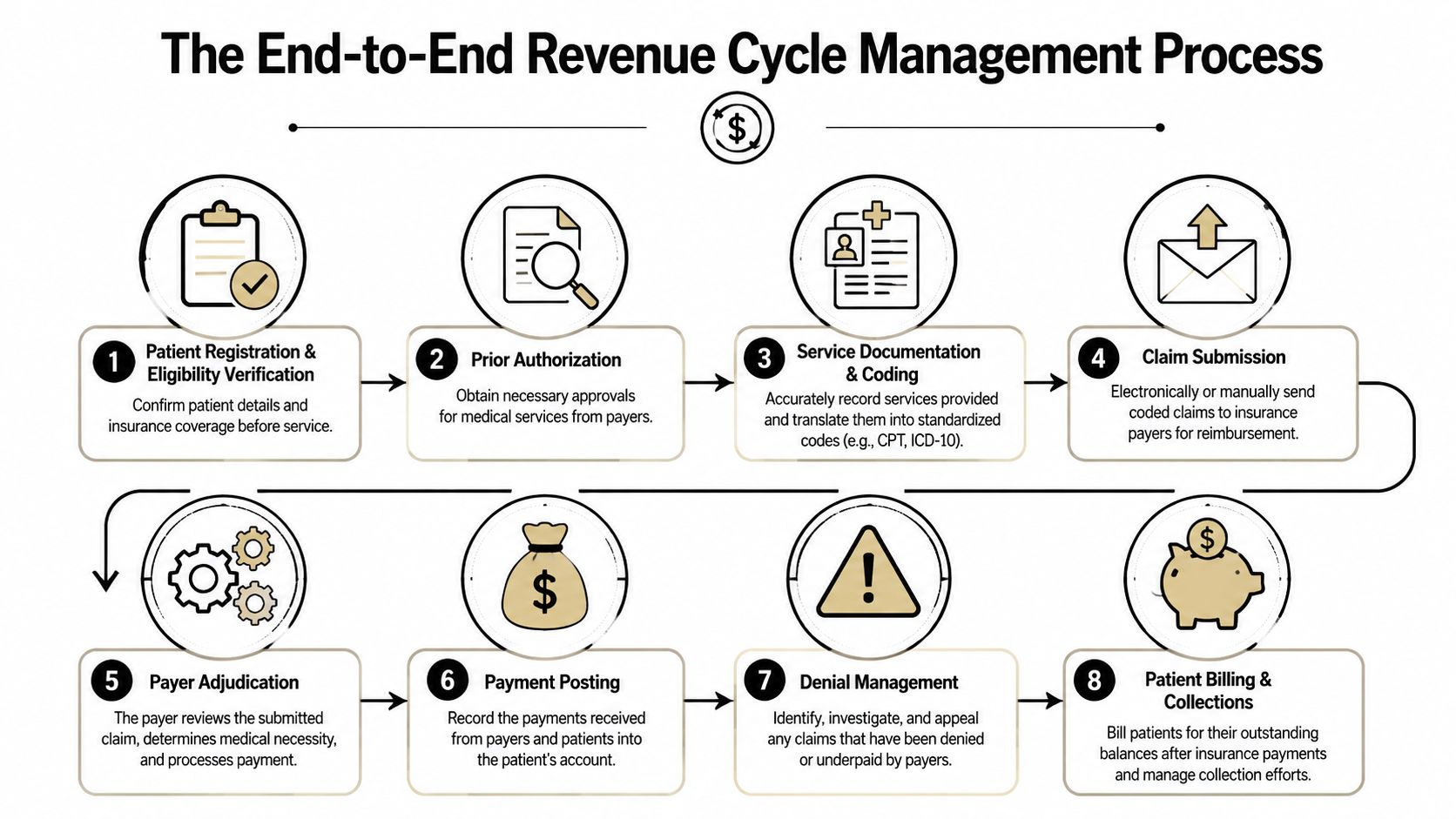
The End-to-End Revenue Cycle Management Process
A healthy revenue cycle follows a sequence. Break the sequence in one place and the damage usually shows up two or three steps later.
The easiest way to think about revenue cycle management services is to view them as one continuous chain from patient intake to final payment resolution.
Patient access sets the claim's odds
The first stage is patient registration and eligibility verification. During this stage, teams confirm demographics, subscriber details, plan coverage, coordination of benefits, and any referral or authorization requirements tied to the encounter.
If staff rush this step, the rest of the cycle inherits the error. A wrong member ID, inactive policy, missing authorization, or incorrect payer order can produce a technically avoidable denial later. Specialty practices feel this more sharply because payer edits are often less forgiving when procedures, implants, anesthesia, monitoring, or urgent transport services are involved.
Prior authorization sits next to eligibility, but it deserves separate operational ownership. Teams need a reliable process to identify which services require authorization, obtain it on time, and document it in a way billing can use. Authorization that exists but can't be proved is operationally no better than authorization that was never obtained.
Documentation and coding create the reimbursement story
The next stage is service documentation and coding. This process converts clinical work into billable language.
Charge capture should reflect what was provided. Coding should reflect what the record supports and what payer rules require. Specialty groups often lose money here in two ways. They either under-document and leave reimbursement unsupported, or they over-rely on generic coding workflows that don't account for specialty-specific nuances.
Think of coding as the legal and financial translation layer between care delivery and payment. If the translation is weak, the payer gets room to reduce, reject, or reinterpret the claim.
A practical workflow at this stage includes:
- Daily charge reconciliation so missed encounters or ancillary charges don't sit unnoticed
- Coder access to complete documentation rather than partial charts or delayed addenda
- Payer-specific edit logic for recurring modifiers, bundling issues, and medical necessity patterns
- Feedback loops with providers when documentation habits repeatedly create billing exposure
Submission is not the finish line
Claim submission should send a clean, complete claim through the clearinghouse and into the payer with as little manual intervention as possible. But submission isn't success. It's just the handoff into payer adjudication.
Once the payer adjudicates, the practice needs disciplined payment posting and remit review. This is the stage where many teams make a costly mistake. They post the payment and move on. That approach misses underpayments, downcoding, incorrect adjustments, and payer behavior that should trigger follow-up.
A paid claim is not always a correctly paid claim.
Denial management belongs after remittance because not every failure happens at first pass. Some claims are denied outright. Others are partially paid in a way that still produces revenue loss. Effective follow-up means identifying the issue, classifying the root cause, correcting what can be corrected, and escalating what should be contested.
The cycle ends with patient billing and collections. This step works best when the earlier stages were handled well. Patients pay more reliably when statements are accurate, balances make sense, and financial expectations were clear before service. If patient collections feel chaotic, the cause often sits upstream in registration, benefit verification, or payment posting.
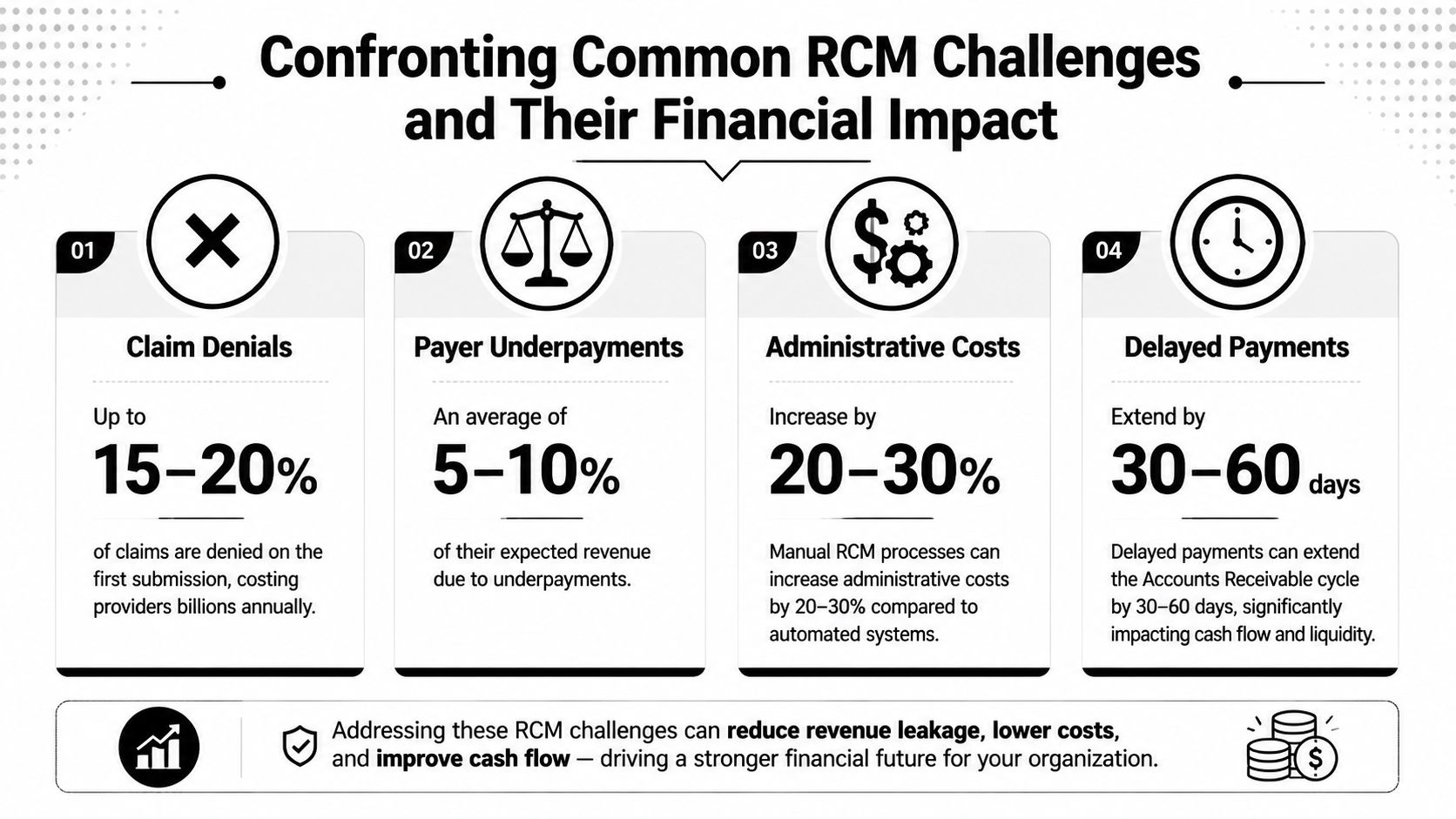
Confronting Common RCM Challenges and Their Financial Impact
Most revenue cycle problems aren't isolated events. They repeat in patterns.
A payer repeatedly rejects the same authorization scenario. A specialty group sees recurring coding edits on the same service line. Payment posting misses a consistent underpayment pattern because staff are focused on volume, not variance. Those patterns are where margin slips away.
Denials are expensive because they multiply touches
The cleanest benchmark here is straightforward. The industry benchmark for denials is below 5%, which corresponds to greater than 95% clean claim acceptance, and the ideal cost to collect is between 3% and 6% of net patient revenue according to RCM KPI benchmarks from iMedClaims. Once denials rise above that range, organizations don't just lose time. They create more work in corrections, resubmissions, appeals, and review.
That additional work inflates labor cost and slows cash. It also pulls experienced staff into preventable tasks instead of higher-value analysis.
Common denial drivers usually fall into a few buckets:
- Front-end errors such as eligibility mistakes, missing authorizations, and demographic mismatches
- Clinical support gaps where documentation doesn't substantiate the billed service
- Coding mistakes involving modifiers, diagnosis linkage, bundling, or payer-specific edits
- Timely filing failures caused by weak work queues or poor ownership
Underpayments are harder to catch than denials
Denied claims are visible. Underpaid claims often aren't.
That's what makes them dangerous. The payer sends a remittance. The balance moves. Staff assume the account is resolved. But if the service was downcoded, paid below expectation, or adjusted incorrectly, the practice may be accepting avoidable revenue loss as normal reimbursement.
Many practices build denial workflows and still leave money on the table because they don't build underpayment workflows.
This issue is especially serious for specialties that already face aggressive payer behavior. In those settings, a mature RCM function has to include remit analytics, payer variance review, and a defined escalation path for disputes. Otherwise, the practice will work hard to create clean claims and still get paid incorrectly.
Coding and technology failures create compounding loss
Coding errors don't just create denials. They can also subtly suppress reimbursement through missed charges, unsupported levels, or unchallenged payer edits. In specialty environments, generic coding support often misses the operational details that drive payment integrity.
Legacy technology makes this worse. If reporting is delayed, teams can't see where claims are stalling. If dashboards don't segment by payer, location, service line, or denial category, leadership ends up looking at totals instead of causes. That makes it difficult to fix the leak.
A useful way to separate signal from noise is to ask three questions:
| Question | What it reveals |
|---|---|
| Where do claims fail first? | Front-end registration, coding, or claim edit weakness |
| Where do payments diverge from expectation? | Underpayment, downcoding, or contract variance |
| Which issues repeat by payer or service line? | Systemic patterns worth redesigning or escalating |
When CFOs start asking those questions consistently, RCM becomes manageable. Without them, it remains reactive.
Key Performance Indicators to Measure RCM Health
Nearly every specialty group can produce a denial report. Far fewer can show, in one monthly view, where cash is slowing, where reimbursement is falling below contract, and which payer patterns should be pushed into formal dispute workflows. That is the difference between basic billing oversight and revenue protection.
The right KPI set should do more than track claim production. It should tell leadership whether the problem starts before submission, during adjudication, or after payment posts short.
Clean claims ratio and denial rate
Start with clean claims ratio and denial rate because they expose preventable friction early. A high clean claims ratio usually reflects disciplined registration, authorization, charge capture, coding, and edit management. A falling ratio usually points to process drift, not random variance.
Use these measures together.
- Clean claims ratio shows how often claims pass through the system without front-end defects
- Denial rate shows how often payers or clearinghouses reject, deny, or suspend payment
- Denial category mix shows where to assign operational ownership
That third point matters. If denial volume is concentrated in eligibility, prior auth, modifier use, or medical necessity, the fix is usually operational and specific. Adding more A/R follow-up staff will not solve a broken intake script or weak coding review.
Teams that want a more structured dashboard can benchmark against common revenue cycle management metrics.
Days in A/R and aging over 90 days
Days in A/R still matters because it compresses multiple failures into one visible outcome. Slow charge entry, weak claim edits, delayed secondary billing, poor follow-up discipline, and payer payment lag all show up here.
But CFOs should not manage A/R as a single blended number. A practice with acceptable overall A/R can still have one payer, one location, or one service line carrying old balances that are unlikely to convert cleanly. That is where margin erodes subtly.
Review aging with at least four cuts each month:
- Payer
- Age bucket
- Location or rendering group
- Balance class, including denied, underpaid, and unresolved zero-pay claims
A/R over 90 days deserves its own review, especially in specialties that deal with frequent downcoding, post-payment edits, or out-of-network payment pressure. Old A/R is not just a collection delay. It is often a sign that staff are chasing the wrong accounts while payer underpayments go unchallenged.
Net collection rate and payment variance
Net collection rate remains useful, but on its own it can hide payer behavior that deserves escalation. A practice may post a respectable net collection result and still lose margin through repeated partial payments, silent bundling, or underpaid out-of-network claims.
That is why I prefer pairing net collection rate with payment variance tracking. Compare expected reimbursement to actual reimbursement by payer and CPT family. Then isolate the variance into categories your team can act on:
- contractual adjustment posted correctly
- denial requiring appeal
- underpayment requiring payer reconsideration
- payment dispute that may belong in the No Surprises Act IDR process
Mature RCM separates itself from basic billing. Clean claims get you in the door. Payment variance review tells you whether the payer honored the obligation after the claim was accepted.
Cost to collect
Cost to collect is a management discipline metric. If collection costs rise, the first question is not whether staff need to work harder. The first question is why the organization is spending labor on rework, avoidable edits, low-yield appeals, or manual payment research that should have been prevented upstream.
A useful reading of this metric includes trade-offs. Some specialty groups should accept a slightly higher cost to collect if that spend funds stronger contract modeling, remit review, and dispute escalation that recover materially more cash. Cutting cost too aggressively can create a false win. The cheaper operation is not the better one if net yield drops.
A practical leadership scorecard should answer four questions every month:
- Are claims getting out clean and on time?
- Where is A/R aging by payer, service line, and denial class?
- Are we getting paid what contracts and rules support, not just getting paid something?
- Which underpayments should stay in routine follow-up, and which should move into formal appeal or IDR review?
If leadership cannot answer those questions quickly, the problem is not only performance. It is control.
How to Select the Right RCM Services Partner
Choosing an RCM partner isn't the same as hiring a billing vendor. A billing vendor can move claims. A real partner should improve control, reduce manual burden, and help your finance team understand payer behavior well enough to act on it.
That distinction matters more now because 90% of healthcare systems report staffing gaps in their revenue cycle teams, which raises the value of analytics-driven operating models that reduce manual work, especially in complex specialties, according to Richard Kerby's discussion of healthcare RCM staffing gaps.
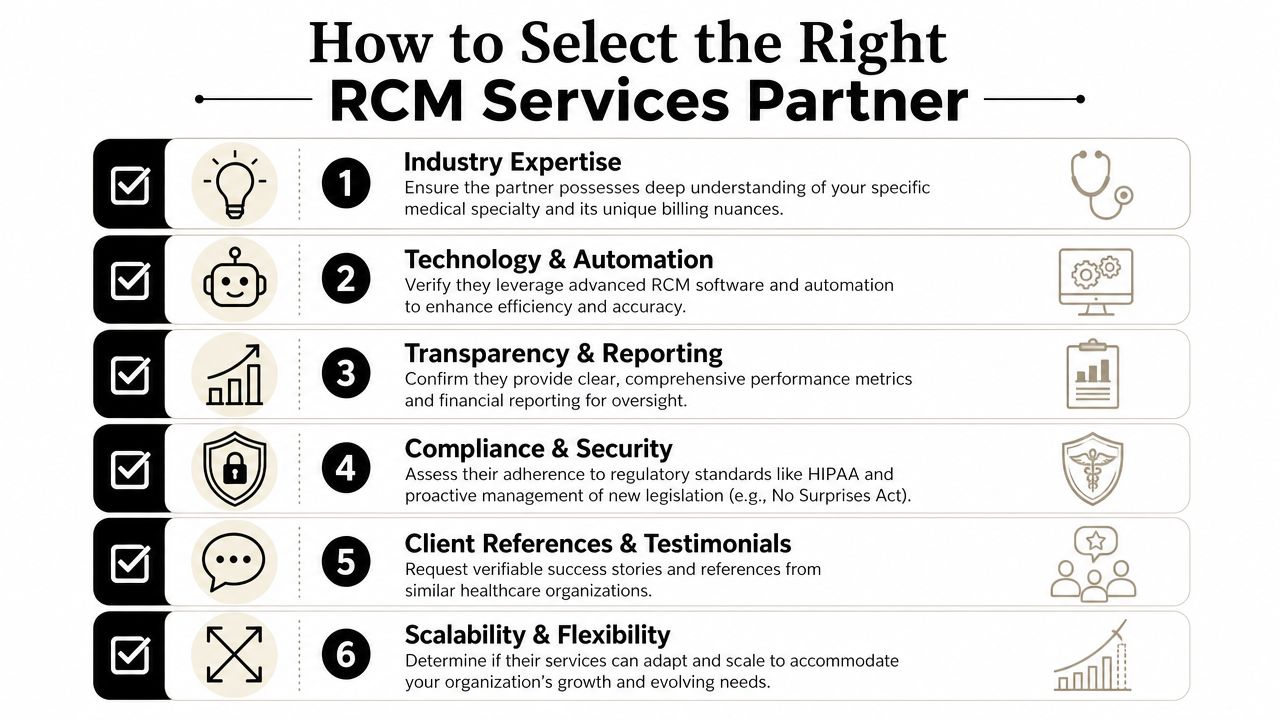
What separates a strategic partner from a commodity vendor
A generic vendor usually promises end-to-end support. That phrase sounds good but often hides shallow specialty expertise. If your group operates in anesthesia, orthopedics, cardiology, dermatology, gastroenterology, radiology, emergency services, or another complex area, you need more than general billing support.
You need a partner that understands the friction points unique to your specialty. That includes coding patterns, documentation requirements, payer edits, charge capture risk, and the disputes that commonly arise after payment posting.
Ask practical questions like these:
- Who owns specialty coding accuracy? Don't accept broad claims about coder experience. Ask how the vendor handles specialty-specific documentation and recurring payer edits.
- What happens after payment posting? If the answer focuses only on denials and ignores underpayments, the model is incomplete.
- How are dashboards structured? Finance leaders need reporting by payer, denial category, service line, aging bucket, and location. Summary reports alone won't help you manage.
- How much manual work is still happening? Staffing pressure doesn't disappear just because claims are outsourced. The partner should reduce touchpoints, not merely relocate them.
- How do they support escalation? A good partner should have a process for appeals, payer negotiations, and dispute-ready evidence development when payment is contested.
The right questions to ask before you sign
Vendor selection improves when CFOs push past sales language and test operating depth. A short checklist helps.
| Evaluation area | What to ask |
|---|---|
| Specialty fit | Which specialties do you support with dedicated workflows rather than general billing logic? |
| Analytics | Can we see payer behavior trends, not just collection totals? |
| Workflow design | Which tasks are automated, and which still require manual touch? |
| Compliance | How do you adapt workflows for changing rules, including the No Surprises Act? |
| Escalation | How do you handle underpayments, downcoding, and repeat payer variance? |
A strong partner should also be willing to map your current state before proposing a fix. If they can't identify where your cash is leaking, they probably won't stop the leak after go-live.
For organizations comparing options, a useful starting point is reviewing how different medical billing companies position specialty support, reporting, and workflow scope.
One practical fit test
Here's the simplest fit test I use. Ask a prospective partner to describe how they would handle one real claim that went through your system incorrectly. Not a hypothetical. A real one.
If they can trace the failure from intake to remit, show where the process broke, and explain how they'd prevent recurrence, they understand revenue cycle management services. If they answer only at the billing level, they're probably too narrow.
One example in this category is RevGuard, which combines specialty-specific RCM workflows with payer negotiation, analytics, and dispute support under the No Surprises Act. That's a different model from firms that stop at claim submission and denial follow-up.
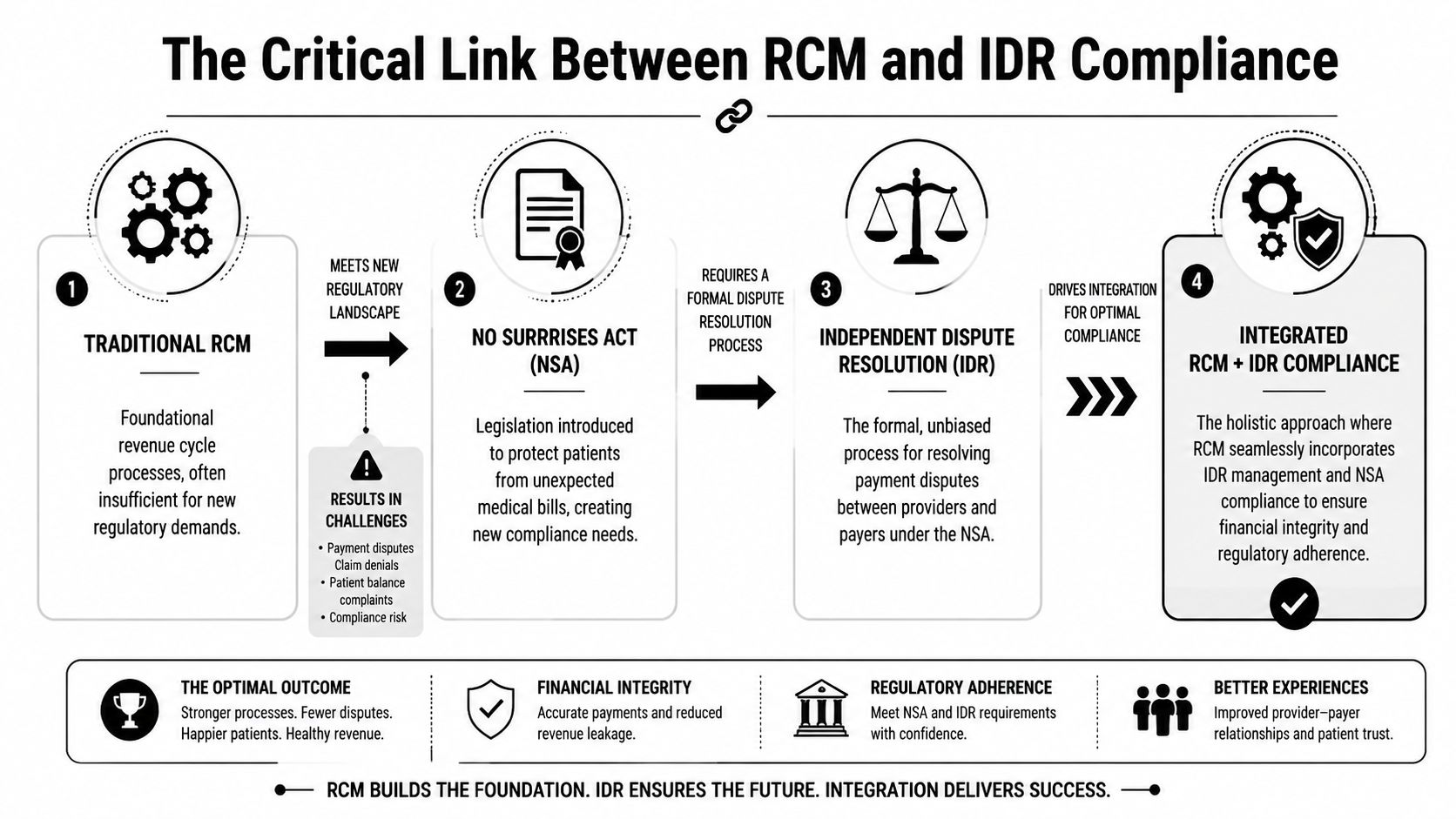
The Critical Link Between RCM and IDR Compliance
Traditional RCM was built around a simple premise. Submit a clean claim, follow up if denied, post payment, bill the patient if needed. That model doesn't fully match today's payer reality.
Many providers now face claims that are technically clean but still paid incorrectly. The denial-prevention playbook doesn't solve that problem by itself. That's where the connection between revenue cycle management services and Independent Dispute Resolution, or IDR, becomes critical.
Clean claims create dispute-ready claims
The key insight is simple. A strong IDR position starts long before arbitration.
If registration is sloppy, authorization support is incomplete, coding is weak, or documentation doesn't support the billed service, the practice enters any downstream dispute at a disadvantage. By contrast, when the claim is accurate, timely, well documented, and correctly coded, the organization has a much stronger basis to challenge an improper payment decision.
This is why the front end and back end can't be separated anymore. The same discipline that improves first-pass payment also improves the quality of the evidence package when a payer dispute escalates.
The No Surprises Act changed the enforcement path
One of the most overlooked gaps in RCM strategy is this: most guides focus on denial prevention but fail to address the use of IDR when payers systematically delay or underpay clean claims. That gap is especially important in specialties facing recurring underpayment, as noted in Office Ally's discussion of revenue cycle challenges and the need for IDR pathways.
The No Surprises Act created a structured process that can function as more than a compliance burden. For the right claims, it becomes an enforcement mechanism. That matters for provider organizations that have historically absorbed downcoding or underpayment because the billing team had no formal process to pursue resolution beyond standard appeals.
A practical overview of the law's operational impact is available in this No Surprises Act summary.
Providers shouldn't treat NSA compliance as a separate legal project. It should be built into the revenue protection workflow.
What integrated RCM and IDR looks like in practice
An integrated model closes the loop in a way standard billing services often don't. It typically includes:
- Front-end claim quality controls so fewer disputes are lost on avoidable technical defects
- Remit analysis and variance detection to identify underpayments, not just denials
- Case development using documentation, coding logic, payer communications, and reimbursement support
- Formal escalation paths when the claim belongs in arbitration rather than ordinary follow-up
For CFOs, the strategic point is this. IDR isn't a replacement for strong RCM. It's the enforcement layer that makes strong RCM financially complete.
Your Playbook for RCM and Revenue Protection
If your organization wants tighter cash flow, lower rework, and stronger reimbursement control, don't start with a platform demo. Start with an operating diagnosis.
Revenue cycle management services produce the best results when leadership treats them like a margin strategy. That means identifying where revenue is leaking, deciding which problems belong to process redesign versus staffing versus payer escalation, and holding every part of the cycle to measurable standards.
Start with a focused audit
Run a practical review of your current operation using the KPI framework discussed earlier. Look at first-pass performance, A/R aging, old A/R concentration, net collection, and collection cost. Then break those metrics down by payer, specialty, location, and denial category.
You are looking for concentration, not just underperformance. A single payer with recurring underpayments is a different problem from broad front-end inaccuracy. A single location with weak registration discipline is a different problem from enterprise-wide coding drift.
Fix the leak where it starts
Once the pattern is clear, assign each issue to the earliest operational point that can prevent recurrence.
That usually means decisions like these:
- Tighten patient access when eligibility and authorization failures keep surfacing
- Improve coding governance when the same modifiers, diagnosis links, or service lines create denials
- Strengthen remit review when paid claims still show payment variance
- Escalate systematically when payer behavior shows a repeatable underpayment pattern rather than isolated error
This sequencing matters. Practices waste time when they throw more follow-up labor at a problem that begins in registration or documentation.
Decide whether your current model is enough
At this point, most finance leaders hit the core decision. Can your current team and current vendor manage both halves of the problem?
Many can handle claim production. Fewer can manage specialty complexity, payer analytics, underpayment recovery, and IDR readiness in one coordinated model. If those capabilities live in separate silos, revenue protection usually breaks at the handoff.
A strong operating plan should leave you with clear answers to three questions:
- Which revenue leaks are preventable before claim submission?
- Which losses happen after the payer receives a clean claim?
- Who owns enforcement when the payment is wrong?
If those answers are vague, your RCM strategy still has a gap.
If your team needs a tighter link between clean claims, payer behavior analytics, and downstream payment enforcement, RevGuard offers a model built around specialty-specific revenue cycle management and IDR-driven revenue protection. It's a practical next step for provider groups that want to reduce denials, improve visibility, and pursue underpayments through a structured compliance pathway rather than absorb them as routine loss.