

In 2024, more than 1.46 million federal No Surprises Act IDR disputes were initiated, while certified IDR entities closed more than 1.37 million. That was about 4.5 times the disputes closed in 2023 and more than 25 times the number closed in 2022, according to Congressional Research Service analysis of Congress and CMS materials. No Surprises Act IDR is no longer a niche escalation route. For specialty providers, it has become a core revenue protection function that demands the same operational discipline as eligibility, coding, denial management, and collections.
The providers that recover consistently don't treat arbitration as a paperwork exercise. They screen eligibility before filing, build evidence around the statutory factors, anticipate payer objections, submit a defensible offer, and connect every outcome back to the revenue cycle. The process is technical, but the winning pattern is practical: prepare the dispute before the payer gives you a reason to file it.
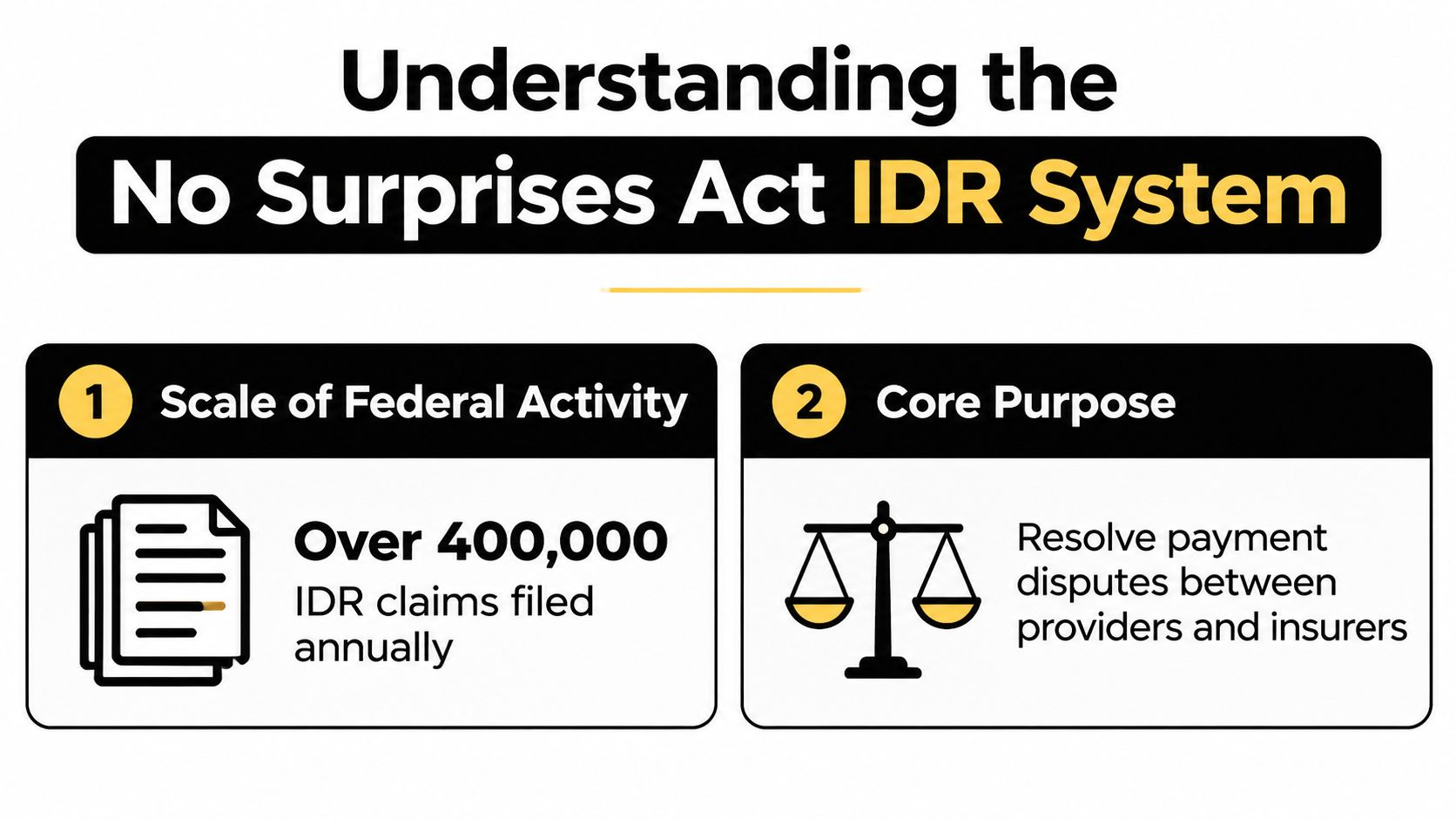
Understanding the No Surprises Act IDR System
The federal Independent Dispute Resolution system addresses a defined payment dispute. A provider furnishes a covered out-of-network service, the health plan issues or supports an initial payment, and the parties disagree about reimbursement. Rather than leaving the patient responsible for the gap, the No Surprises Act sends the dispute to a certified IDR entity, which selects either the provider's offer or the plan's offer.
The reviewer does not split the difference. Each party submits one proposed payment amount with supporting information, and the selected offer becomes the payment determination. A weak valuation package can therefore lose even when the service clearly qualifies. The operational question is whether the record supports the amount, not just whether the provider is owed more.
Qualification comes before arbitration
Staff often call every escalation an “IDR case,” but eligibility and arbitration require separate decisions. The dispute must first satisfy the applicable coverage, service, jurisdiction, and procedural requirements. Only after that screening should the team spend time building a valuation and preparing an offer.
State and federal routes can differ. State law and the patient's insurance arrangement may place a dispute in a state process, while federal IDR generally covers federally regulated plans and matters outside a state pathway. Specialty groups working across states need claim-level jurisdiction screening, not one universal intake rule.
Federal IDR activity has reached a scale that makes informal workarounds risky. CMS-reported figures through May 31, 2026, included 6,336,032 initiated disputes, with 1,433,289 initiated during the first five months of 2026. IDR entities closed 1,354,911 disputes during that same 2026 period, according to reported federal IDR updates. Every missed deadline, incomplete record, or poorly supported offer can affect recovery.
A repeatable workflow should capture eligibility, jurisdiction, payment history, evidence, submission status, and the final determination in the revenue cycle system. For a plain-language explanation of the statute and its operational implications, review this No Surprises Act summary.
Who Qualifies for Federal IDR
Eligibility should be decided before anyone invests time in valuation. A provider's first task is to apply a simple filter to the claim, the service setting, the patient's coverage, and the procedural record.
Start with the service and setting
Federal IDR commonly applies to emergency services, certain non-emergency services furnished by an out-of-network provider at an in-network facility, and air ambulance services. The setting matters because an out-of-network service performed at an in-network facility can create the exact surprise-billing exposure the law addresses.
Ask whether the provider was out of network, whether the facility was in network, and whether the service falls within a covered category. A licensed clinician and an eligible facility may have standing to initiate a dispute, but the answer depends on the service, plan, and governing jurisdiction.
Test the notice and payment conditions
The next question is whether the patient received the required advance notice about the provider's out-of-network status. If the legally required notice and consent process was completed, the dispute may not qualify for the federal pathway. Registration and consent records should therefore sit beside the claim record, not in a disconnected patient-access system.
The initial payment or denial also matters. Providers generally can't jump directly into formal arbitration without completing the required initial payment determination and open negotiation steps. A denial, an inadequate payment, or a failure to reach agreement can trigger the next stage, but the file must show what happened and when.
Screen for jurisdiction and exclusions
State-level IDR may apply instead of federal IDR, particularly where state law governs the applicable insurance product and provides a qualifying dispute pathway. Medicare and Medicaid-related arrangements require separate handling, and dual-eligible situations shouldn't be routed automatically into federal commercial-plan workflows.
Build a claim-level checklist with these questions:
- Coverage: Is the plan subject to the federal process, or does a state pathway govern?
- Service: Is the claim for emergency, qualifying facility-based, or air ambulance care?
- Network status: Was the provider out of network while the relevant facility was in network?
- Notice: Does the record establish whether the required patient notice and consent process applied?
- Procedure: Are the initial payment, open negotiation, and filing records complete?
- Threshold: Does the disputed amount satisfy the applicable CMS threshold?
The minimum threshold is not a detail to estimate casually. Confirm the current requirement and document the calculation before filing. A well-supported valuation cannot rescue a dispute that fails an eligibility gate.
The Filing Process and Critical Timelines
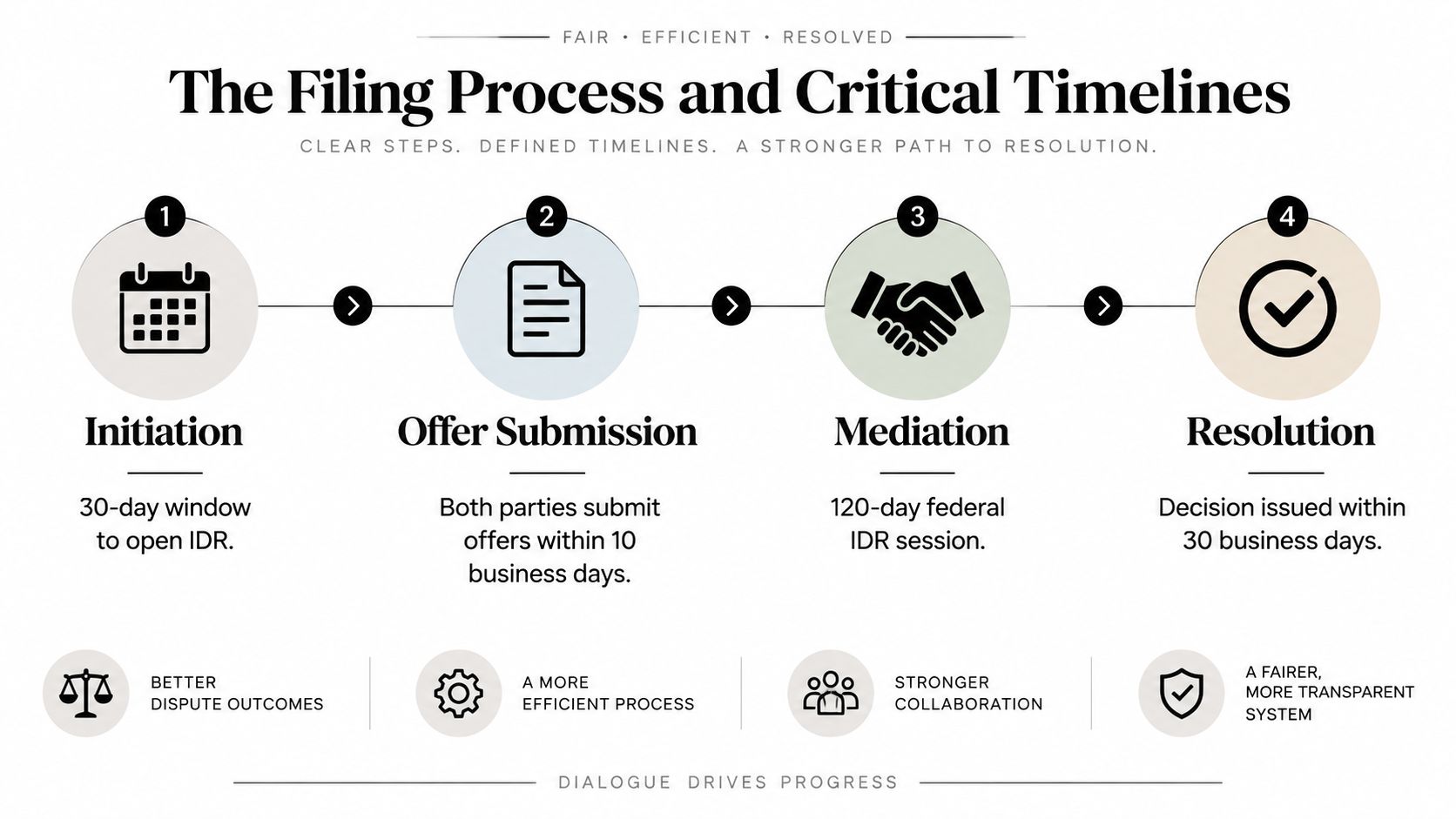
A successful IDR filing is a controlled sequence, not a single upload. The case starts with the qualifying payment determination or denial, moves through open negotiation, and reaches formal IDR only when the parties remain apart. Each handoff needs a dated record, a named owner, and supporting documentation.
Map the case from trigger to submission
Record when the provider received the qualifying payment determination or denial. From that date, calculate the applicable 120-day window for initiating the dispute and preserve the payer notice that starts the clock. The parties then have a 30-day open negotiation period before formal arbitration can proceed. Staff who wait for an informal payer response without tracking the period can lose the filing opportunity.
After negotiation closes without agreement, the initiating party selects a certified IDR entity from the CMS roster and submits the dispute through the required channel. The file should contain the eligibility record, payment history, service details, negotiation history, and proposed offer. Assign responsibility for monitoring entity notices, fee instructions, documentation requests, and offer deadlines. A shared tracker or work queue is more reliable than individual email reminders.
Treat the information exchange as the merits stage
The information exchange often determines whether the provider's position is credible. Both parties submit relevant documents, explain their offers, and address the statutory factors. Prepare the evidence package before the IDR entity issues its notice, leaving time to check claim-level facts rather than assembling records under deadline pressure.
Use a file sequence that keeps operational control visible:
- Trigger review: Confirm the qualifying payment or denial date and preserve the original notice.
- Open negotiation: Save the request, payer responses, proposed amounts, and closing date.
- Entity selection: Choose a certified IDR entity and retain the submission confirmation.
- Evidence exchange: Submit the offer and supporting factors in a concise, indexed package.
- Decision monitoring: Track the determination, payment due date, and any correction or enforcement issue.
The provider should also reconcile the IDR record with its billing and payment systems. That check catches mismatched claim numbers, missing remittance details, and amounts that changed after the initial submission.
Use batching carefully
Batching can reduce repetitive work when claims involve the same provider, payer, service category, and relevant circumstances. Batched disputes represented about 27% of determinations in the last half of 2024, compared with 15% in the first half, according to Congressional Research Service coverage of CMS data. The operational gain disappears when staff combine claims with different eligibility facts, service complexity, geographic conditions, or valuation evidence.
Missed filing, offer, or information deadlines can lead to dismissal, an adverse procedural result, or loss of the provider's opportunity to present its position. Assign one owner, one backup, and one source of truth for every deadline. High-volume IDR work requires disciplined scheduling because informal follow-up cannot reliably manage a large dispute inventory.
Building Evidence and Valuation Strategy
The central IDR mistake is submitting a number first and searching for justification afterward. The provider's offer should emerge from the evidence package, not the other way around.
The certified IDR entity must choose one offer. That structure makes the package persuasive only when it connects the requested amount to the service's actual characteristics and to the statutory factors. A generic statement that the provider is highly specialized won't carry the same weight as records showing the clinical complexity, operational burden, market position, and cost structure behind the offer.
Turn each statutory factor into an argument
The reviewer considers the qualifying payment amount, relevant data from the American Medical Association, tiered-network contribution information, the type of facility, and the complexity of care. Providers shouldn't merely mention these factors. They should explain what each one reveals about the disputed service.
| Factor | What It Measures | Provider Action |
|---|---|---|
| Qualifying payment amount | The plan's benchmark for the service and market | Review the calculation, identify limitations, and avoid treating it as the full value of the claim |
| American Medical Association data | Specialty and service context | Use relevant specialty data that reflects the actual procedure and provider role |
| Tiered-network contribution percentages | Network design and reimbursement context | Explain whether the plan's network structure makes the benchmark representative |
| Facility type | The clinical and operational setting | Document whether the service occurred in an ASC, hospital, emergency setting, or other facility |
| Complexity of care | Intensity, risk, and resources required | Tie the offer to clinical records, staffing, technology, duration, and unusual circumstances |
Outlier costs deserve their own section. For anesthesia, that might include case acuity, staffing requirements, and unusual coverage conditions. For air ambulance, the package should address aircraft operations, crew requirements, geographic access, and mission-specific constraints. For any specialty, the argument needs to distinguish the claim from the ordinary service assumptions embedded in a broad benchmark.
The peer-reviewed analysis of NSA IDR outcomes found providers won 86.4% of disputes, and the mean winning offer was 2.65 times the QPA, as reported in the published analysis. That doesn't establish an automatic multiplier for a provider's offer. It does show why QPA anchoring isn't the end of the valuation discussion when the evidence supports a different amount.
Build a reviewer-friendly file
Start with a one-page case summary. State the service, eligibility basis, payer offer, provider offer, and the strongest differentiating facts. Follow it with an indexed evidence file, a factor-by-factor narrative, source explanations, and a short rebuttal to predictable payer arguments.
Providers should also understand the benchmark they are challenging. This guide to the Qualified Payment Amount can help teams frame QPA review as an evidence question rather than a number-copying exercise. The best package is concise enough to move through quickly and detailed enough to support every material assertion.
Common Payer Tactics and Strategic Counters
Payers often gain ground before the reviewer reaches valuation. They may frame the dispute as ineligible, present the QPA as conclusive, or introduce evidence that obscures the actual payment question. Specialty providers should prepare a response for each move before filing, with eligibility documents separated from the valuation record.
Low QPA anchoring
A payer may treat the QPA as the correct reimbursement by definition. Test whether the benchmark reflects the service at issue. Examine the facility type, specialty, case complexity, staffing requirements, and unusual cost profile. Then connect each difference to a specific document and a revised offer.
Keep the response claim-specific. Identify the service and relevant market, explain the benchmark's limitation, and attach evidence that addresses the gap. Broad complaints about underpayment rarely carry much weight without records tied to the disputed claim.
Eligibility challenges
Federal IDR eligibility is a major operational gatekeeper. A payer may challenge network status, notice and consent, service category, plan jurisdiction, batching, or filing timing. The CRS analysis of CMS data describes the scale of eligibility screening in the federal process.
Build the eligibility file before arguing value. Include plan information, facility and provider network records, patient notices where applicable, payment or denial history, negotiation correspondence, and filing dates. Keep these materials easy to locate rather than burying them in a valuation appendix. One missing eligibility record can prevent the reviewer from considering an otherwise well-supported offer.
Irrelevant data and medical-necessity distractions
A plan may submit efficiency metrics, general cost data, or medical-necessity arguments that do not answer the statutory valuation question. Separate the issues in the response. If the service was processed as eligible, explain why a later objection does not change the payment dispute. If clinical appropriateness is challenged, address the medical record directly, then return to the factors that support the proposed amount.
Delay through batching or process friction
Batching can be appropriate, but grouping claims with different facts may make the provider's evidence appear inconsistent. Agree only when the claims share the required characteristics and can be supported by one coherent narrative. Otherwise, explain why separate treatment permits a more accurate review.
Federal outcomes have generally favored providers, according to CRS analysis. That pattern does not justify filing every underpayment. It supports disciplined preparation: counter the payer's procedural objections, isolate the relevant valuation facts, and make the reviewer's decision easier.
Practical rule: Defend eligibility first, then defend value. A strong valuation argument has no effect if the dispute is screened out.
Integrating IDR Into Your Revenue Cycle
IDR works best when it begins before the claim leaves the practice. Registration, coding, authorization, contracting, payment posting, and arbitration should share the same facts. If the team has to reconstruct the case months later, missing documentation becomes a recovery ceiling.
Engineer readiness upstream
At registration, verify the patient's plan, facility participation, provider participation, and service context. Capture authorization details and the payer's reference information in structured fields. Coding teams should use specialty-specific precision because a vague or inconsistent service description weakens both the claim and any later valuation argument.
Clean claim engineering also means preserving the facts that explain complexity. A specialty practice should retain procedure details, operative or anesthesia records, staffing information, facility data, and unusual resource requirements in a way that can be retrieved without a manual chart chase.
Prior authorization deserves the same treatment. Authorization isn't a substitute for IDR eligibility, but the record can help establish what the payer knew about the service, setting, and clinical circumstances. Consistent documentation reduces avoidable denials and gives the dispute team a stronger factual base when underpayment remains.

Feed outcomes back into management
Payment posting should classify underpayments by payer, specialty, service, facility, and reason. The IDR team can then use those patterns to prioritize disputes, while contracting teams use the same information to prepare negotiations. A payer that repeatedly anchors to a narrow benchmark presents a different contracting problem from one that misclassifies services or delays payment.
A practical IDR-ready pipeline includes:
- Claim-level eligibility fields: Store network, plan, facility, service, notice, and jurisdiction data.
- Evidence retrieval: Link clinical and operational records to the claim rather than storing them in isolated folders.
- Deadline controls: Trigger tasks for negotiation, filing, offer submission, and payment monitoring.
- Outcome analytics: Compare payer offers, provider offers, determinations, dismissals, and payment completion.
- Contract feedback: Send recurring dispute patterns into pricing and negotiation decisions.
Providers evaluating an integrated workflow can review this RCM readiness checklist for NSA IDR. RevGuard is one option that combines specialty-focused RCM workflows with NSA IDR filing, evidence packaging, case tracking, and payment enforcement. The strategic point is broader than any vendor. IDR should be a controlled extension of revenue protection, not a disconnected legal queue.
Real-World Case Examples and Outcomes
Representative scenarios show how the strategy changes by specialty. The examples below illustrate practical operating patterns, not documented client results or guaranteed recoveries.
An anesthesia practice sees recurring underpayments from a commercial payer. The team doesn't send the same appeal repeatedly. It first separates eligible disputes, validates facility and network facts, and assembles specialty-specific benchmark material. The evidence package then explains case acuity, staffing, coverage demands, and outlier costs that a generic QPA comparison fails to capture. The provider's offer is tied to those facts, with a short rebuttal addressing the payer's likely claim that the benchmark already reflects the service. The operational outcome is a defensible arbitration position and a repeatable process for similar cases.
An air ambulance provider faces a different valuation problem. A broad benchmark may not reflect geographic access, aircraft readiness, crew requirements, mission complexity, or the operational cost of serving remote locations. The provider organizes dispatch records, mission details, clinical documentation, geography, and cost evidence around the specific flight. Instead of arguing that air ambulance is “different” in the abstract, the submission shows exactly why the disputed mission falls outside ordinary assumptions. That evidence gives the reviewer a reason to select the provider's offer rather than merely accept the plan's anchor.
An orthopedic ASC uses IDR outcomes as management data rather than isolated wins. Its team groups disputes by payer, procedure, facility, and payment behavior, then takes the pattern into contract discussions. The ASC can ask for clearer reimbursement terms, address recurring service classifications, and adjust pricing assumptions before the next dispute cycle. Here, the financial benefit comes from converting case-level information into a contracting strategy.
The common thread is positioning. Because the reviewer selects one offer, the provider controls the recoverable amount only to the extent that the offer is credible, eligible, and supported. IDR doesn't replace contracting discipline, but it gives providers a structured response when contract terms or payer behavior leave material reimbursement unresolved.
Next Steps and Key Takeaways
Federal IDR has matured into a high-volume payment mechanism, and the data show that providers can prevail when they prepare the right disputes with the right evidence. The process still punishes weak eligibility screening, missed deadlines, generic valuation arguments, and disconnected documentation.
Start with a focused readiness review:
- Audit underpayments: Identify payer and specialty patterns that justify immediate attention.
- Screen pending claims: Check federal eligibility, state jurisdiction, notice records, and procedural dates.
- Review entity selection: Compare certified IDR entities and confirm your team understands their submission requirements.
- Test documentation: Confirm that each claim can produce a complete evidence package without manual reconstruction.
- Close the loop: Send determination and payment data to contracting, pricing, registration, and payer-performance teams.
The program continues to evolve, and high volume increases the value of disciplined operations. Providers that build a systematic pipeline now can turn recurring disputes into a measurable revenue protection capability instead of treating each underpayment as a fresh emergency.
RevGuard helps specialty providers connect clean claims, eligibility screening, evidence packaging, IDR filing, case tracking, and payment enforcement in one revenue protection workflow. Visit RevGuard to assess how its RCM and No Surprises Act IDR capabilities can support your dispute-ready claims pipeline.