

A 100% increase in clinical documentation audits, combined with final denial-dollar increases of 34% for professional claims, 84% for hospital outpatient claims, and 148% for hospital inpatient claims, has changed the financial role of the medical record. These figures, reported in a 2024 denial and audit analysis, show why medical necessity documentation can't remain a retrospective coding exercise. It has to function as a payer-specific evidence system, built early enough to support adjudication and complete enough to withstand an audit or Independent Dispute Resolution proceeding.
A defensible record does more than describe what happened. It connects the patient's condition to the service, the service to the applicable coverage rule, and the level of care to the documented risk. That connection protects reimbursement without asking clinicians to write essays or revenue-cycle teams to reconstruct clinical reasoning months after treatment.
Why Medical Necessity Documentation Is Now a Revenue Safeguard
Medical necessity has always been tied to payment. The Social Security Act established the long-standing Medicare standard that services must be “reasonable and necessary” for the diagnosis or treatment of illness, and CMS later reinforced that diagnostic and therapeutic services must be supported in the record. Medicare contractors have also described medical necessity as the “overarching criterion for payment”, while cautioning that providers shouldn't bill a higher-level service when a lower-level service is warranted. The CMS-related documentation guidance explains the practical effect of that standard.
The payer question isn't just, “Did the clinician provide this service?” It is, “Does the record prove why this service, at this intensity and level, was justified for this patient?” That distinction affects E/M visits, imaging, procedures, anesthesia, inpatient admissions, and utilization review. A clinically appropriate encounter can still generate a denial when the note leaves the indication, severity, or risk implicit.
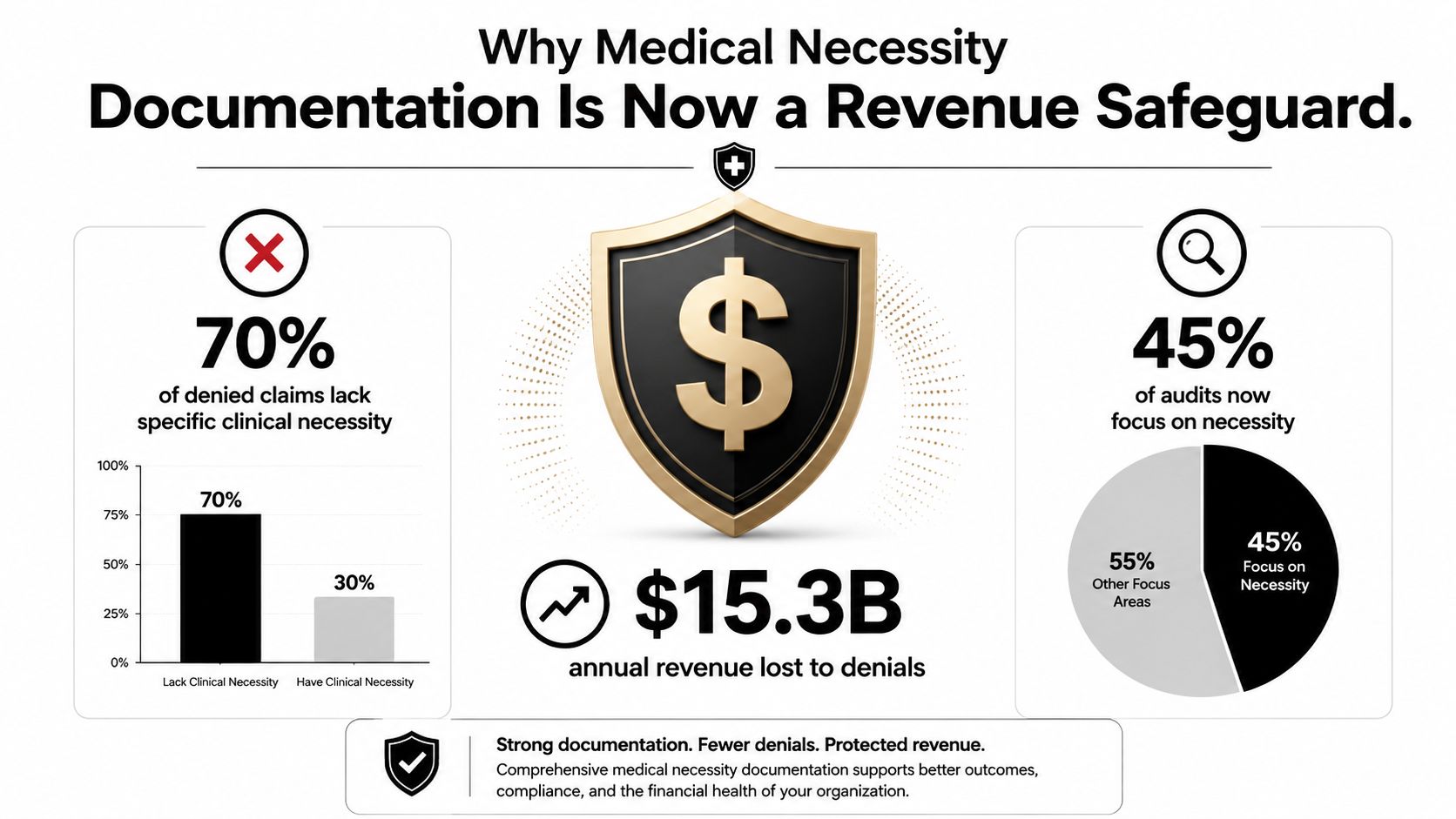
The financial signal behind the audit activity
The same 2024 analysis reported a 122% increase in commercial payer requests-for-information denials, while denied amounts per claim increased by 4.2% to 6.9% across settings. A separate benchmark reported medical-necessity denials rising 75% for outpatient claims and 140% for inpatient claims, with coding-related denials increasing by more than 125%. Those numbers don't prove that every denial is preventable, but they do establish a clear operational reality. Payers are testing clinical justification more aggressively, and incomplete records give them a straightforward basis for withholding payment.
A broader claims dataset reported denial rates reaching 11% of all claims in one year, nearly 20% of claims denied on industry averages, and a 23% increase in clinical validity denial rates from 2016 to 2020, as summarized in the same industry denial coverage. For a high-volume specialty, even a small documentation weakness repeated across encounters can become a material accounts-receivable problem.
Practical rule: A note should make the medical necessity decision easy to verify, not easy to infer.
Revenue-cycle leaders should treat the chart as the first part of the claim, not an attachment reserved for appeals. A useful medical accounts receivable workflow links authorization, coding, clinical review, claim submission, denial categorization, and appeal evidence. That structure lets a team identify whether a denial reflects a missing fact, a payer-policy mismatch, a coding issue, or a disagreement that belongs in escalation.
The Clinical Elements Payers Test
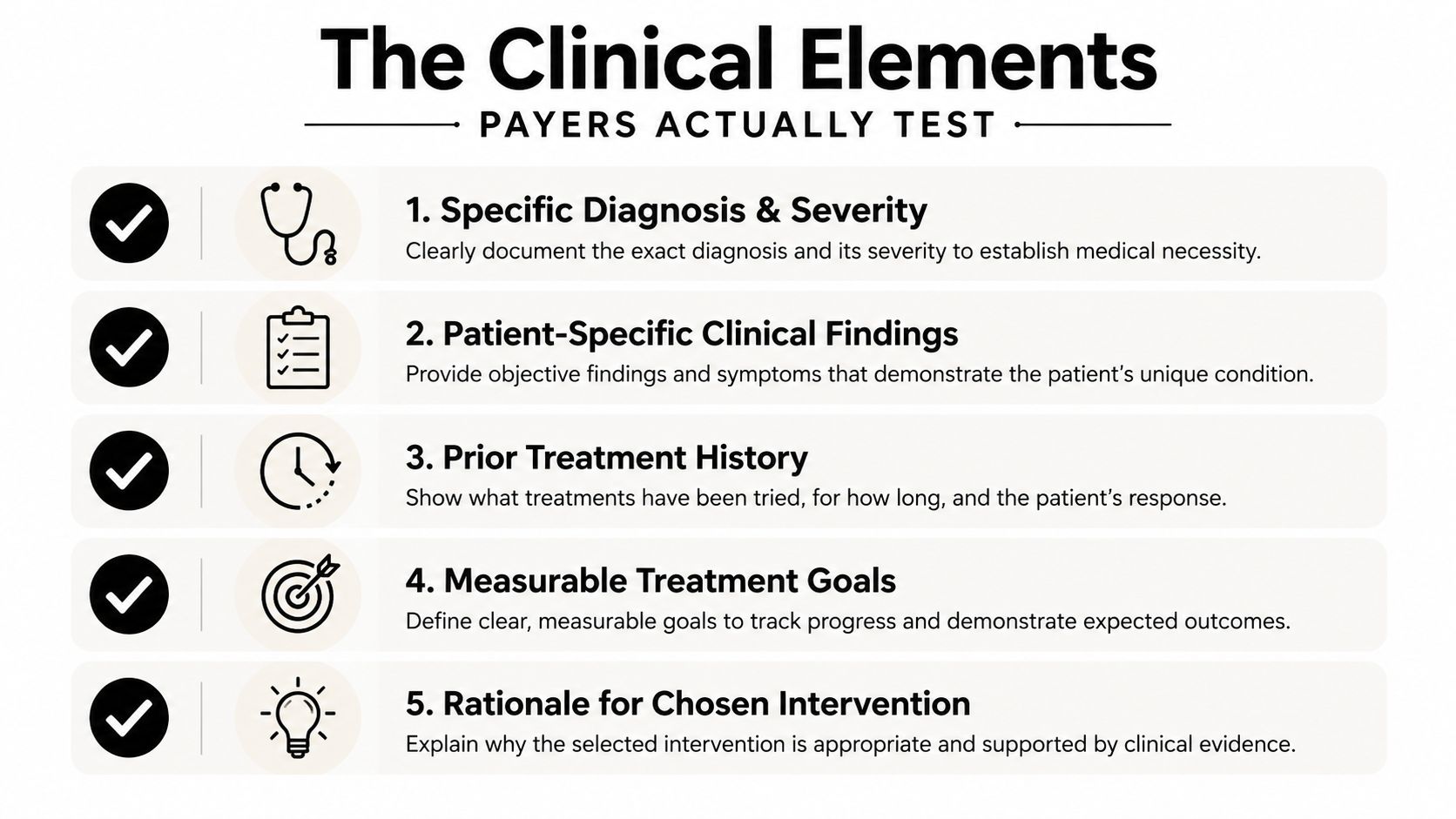
Payers test five connected questions, even when their policies use different terms: what condition is being treated, how severe it is, which objective findings support the assessment, why this service was selected, and what risk follows if care is delayed or delivered at a lower level.
A diagnosis by itself rarely answers those questions. “Knee pain,” “abdominal symptoms,” or “respiratory distress” identifies a problem, but does not establish why an MRI, endoscopy, anesthesia service, admission, or other intervention was required. The record must connect the patient's condition to the service and show the decision that followed.
Start with the payer rule, not the template
Before submission, map three elements to the applicable coverage policy:
- The diagnosis and severity. Record the specific condition, relevant stage or severity, and symptoms that make the service clinically appropriate.
- The ordered or delivered service. Identify the procedure, test, treatment, or level of care clearly enough for a reviewer to understand what occurred.
- The patient-specific rationale. Explain why this patient needed the service at this point, including objective findings, failed or unsuitable conservative treatment, and foreseeable risk.
For an orthopedic MRI, “chronic knee pain” provides weak support. A stronger record describes symptom duration and functional effect, examination findings, prior treatment, the suspected condition, and how imaging will affect management. The wording must match the actual record and payer policy. Copying policy language into a note to satisfy a checkbox creates a vulnerability during review.
An anesthesia record requires separate support. The surgical procedure may be medically necessary, while the anesthesia claim still needs documentation of the anesthesia service, patient risk, relevant comorbidities, and the monitoring or management provided. A generic procedure description does not establish why the anesthesia component was required.
Make the clinical story auditable
Gastroenterology records often weaken when they list symptoms without showing the reasoning behind the procedure. A defensible endoscopy record connects the indication with symptoms, history, abnormal findings, screening or diagnostic purpose, and the expected clinical decision. If the policy requires prior treatment, state what was tried, whether it failed, and why repeating it is unsuitable.
For admission or continued inpatient care, document the expected length of hospitalization along with severity, required services, monitoring needs, and risk of adverse outcomes. A retrospective reviewer must be able to reconstruct the decision as it stood at the time, rather than rely on the eventual outcome.
A payer-specific evidence package should carry the same logic from the chart into initial adjudication and, if needed, IDR review. The team should be able to retrieve the policy, relevant clinical facts, order or service details, and supporting treatment history without asking a reviewer to infer the connection. Clinical documentation improvement workflows can help teams build that retrieval and feedback process around actual denials.
Use this internal test before submission or appeal:
- Does the diagnosis explain the service?
- Do objective findings support the stated severity?
- Does the treatment history support escalation?
- Does the note identify the expected clinical benefit?
- Does the record address risk if care is delayed or provided at a lower level?
Education alone fades when it is disconnected from payer outcomes. Targeted review of denied claims gives clinicians concrete examples of what the payer could not verify and lets revenue-cycle teams refine the evidence package before the next submission.
Building EHR Templates That Capture Necessity Without Adding Burden
The best template doesn't ask clinicians to document every possible fact. It prompts for the facts that change the coverage decision and places those prompts inside the existing clinical workflow.
Start by separating universal fields from service-line fields. A general E/M template might capture the problem addressed, severity, relevant examination findings, decision-making, treatment response, and follow-up plan. An imaging-order template can focus on the suspected diagnosis, red-flag findings, prior treatment, and how the result will guide management. An inpatient template should support severity, intensity of services, anticipated course, and risk.
Design around decisions, not clicks
A useful smart phrase can follow the clinical sequence:
- Problem: What condition or symptom is being evaluated?
- Evidence: What patient-specific findings support the assessment?
- Prior management: What treatment was attempted, and what happened?
- Decision: What service is being ordered or performed?
- Purpose: How will the result or intervention change care?
- Risk: What adverse outcome is being avoided or managed?
Use discrete fields only where structured information improves retrieval, such as laterality, symptom duration, prior treatment status, or authorization identifiers. Free text remains important for reasoning. A payer reviewer needs the clinician's judgment, not a string of disconnected selections.
Templates should also vary by encounter type. A procedure template can require the indication, anatomic site, lesion or condition characteristics, technique, and medical rationale. A telehealth template should prompt for the remote modality, available examination limitations, patient-reported findings, reviewed records or images, assessment, and plan. A recertification workflow should surface the underlying condition, ongoing need, progress, and physician certification requirements.
Put prompts where the omission occurs
A warning at claim scrubber stage is often too late. The clinician may no longer remember the decision, and the revenue-cycle team may be unable to obtain a meaningful clarification. Put the prompt at order entry, pre-procedure planning, admission, or the point at which the clinician decides to escalate treatment.
Avoid forcing a hard stop for every missing field. Excessive alerts create click fatigue and encourage copied language. Use hard stops for information that determines whether the order can proceed, and use passive prompts or reviewer queues for information that can be completed before billing.
Run periodic audits against actual payer denials. If a payer repeatedly requests treatment history for a service, add a focused prompt for that service. If a field produces boilerplate that reviewers ignore, remove or redesign it. Template governance should involve clinicians, coding, utilization review, compliance, and denial staff, because each group sees a different failure point.
Common Documentation Pitfalls That Trigger Denials
A defensible clinical story must also function as a payment record. Clinicians know the patient, chronology, and reasoning. Payers review what the submitted file states explicitly, often against one narrow coverage criterion. A denial usually reflects a missing connection, not merely a missing sentence.
Hospital revenue-cycle data has placed initial denial rates around 11% to 12% of claims, with medical-necessity or level-of-care issues representing roughly 6% to 14% of denials. Provider leadership literature has cited healthy overall denial performance at under 5%. The denials and CDI guidance reports that nearly 60% of returned claims may never be resubmitted and 30% to 40% of medical-necessity denials are never appealed. Those figures make a practical point: documentation must support the initial claim and remain usable in a reconsideration or IDR file.
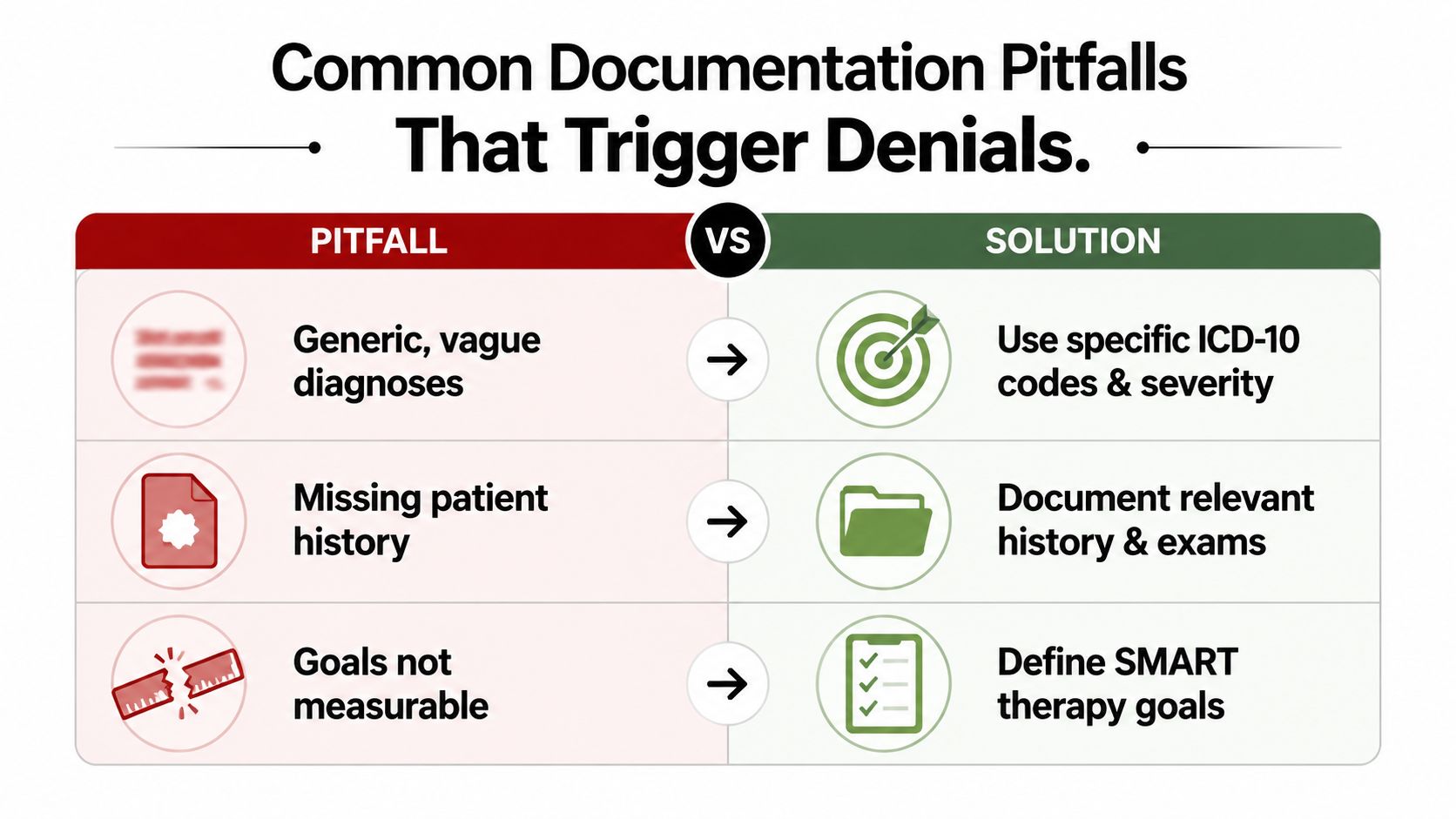
What looks sufficient but fails review
A vague diagnosis hides the decision. “Back pain” does not explain why advanced imaging was ordered. Document the relevant symptoms, duration, functional impact, objective findings, suspected pathology, and treatment history. Tie those facts to the service and the payer's coverage requirement.
Copied-forward history damages credibility. Repeating an old condition without current severity or response can make the service appear unjustified at the encounter under review. Update the facts that changed the decision, and remove stale language that no longer reflects the patient.
Authorization is mistaken for payment protection. It may support coverage review, but it does not replace the clinical record. The file still must show that the service occurred, was billed at the correct level, and was medically necessary.
A procedure note omits the indication. Technical details establish performance. They do not necessarily establish why the procedure was needed. Keep the indication, relevant findings, and clinical purpose in the same evidence trail.
Telehealth documentation ignores the remote setting. CMS CERT-related coverage has highlighted missing or inadequate support for medical necessity, physician certifications or recertifications, face-to-face encounters, and physician narratives. Telehealth claims can also fail because of missing information, submission errors, non-covered charges, or duplicate claims. Telehealth-related denials rose 84% in 2025, per the CMS CERT report, as summarized in coverage of the CMS 2025 CERT report.
The correction is targeted evidence, not longer notes: the exact indication, current findings, treatment history, clinical purpose, required attestations, and payer-specific support needed if the claim later reaches IDR.
Assembling Evidence Packages That Win IDR and Arbitration
An IDR file shouldn't be built from whatever survives in the chart after a denial. The strongest packet begins at the time of service and preserves the relationship between the clinical decision, payer rule, claim, payment dispute, and requested resolution.
For a disputed service, assemble the record in a logical order:
- Coverage and authorization material. Include the payer's policy, authorization, referral, utilization-review correspondence, and any request for information.
- Clinical record. Include the relevant physician note, procedure or anesthesia record, diagnostic findings, treatment history, and certifications or attestations.
- Medical rationale. Add the patient-specific explanation of why the service was appropriate, the level selected, and the consequences of delay or under-treatment.
- Guideline support. Attach the guideline criteria or evidence-based literature relied upon, with the relevant passages identified rather than buried in a large document.
- Claim and payment history. Show what was billed, what the payer paid or denied, the denial reason, prior correspondence, and the unresolved amount.
Payer-specific assembly matters because an evidence package should answer the actual coverage objection. A commercial payer's policy may emphasize a different prerequisite than a Medicare coverage rule. A packet that contains every available document but misses the specific criterion will still feel incomplete to an arbitrator.
The physician attestation should be concise and personal to the case. It should identify the condition, findings, service, clinical rationale, policy or guideline connection, and why the billed level was appropriate. It shouldn't introduce facts that aren't supported elsewhere in the record.
An arbitrator shouldn't have to reconstruct the medical necessity argument from disconnected pages.
Under the No Surprises Act, Independent Dispute Resolution support is most effective when the upstream claim is already dispute-ready. RevGuard is one option that combines specialty-specific revenue-cycle processes with IDR workflows, including evidence assembly and case enforcement. The larger operational lesson applies regardless of vendor: coding, authorization, clinical documentation, payment variance, and dispute preparation need a shared evidence trail.
Audit-Proofing Your Documentation and Resubmission Strategy
Build a defensibility packet at the time of service, while the clinical facts, authorization trail, and payer requirements are still easy to reconcile. Include the indication, relevant conservative-treatment history, objective findings, applicable guideline criteria, payer policy language, physician attestation, and a clear index showing where each point appears.
Run a focused pre-bill review:
- Confirm the service: The record identifies what was provided, when it occurred, and who performed it.
- Confirm the level: Code, modifier, units, place of service, and level of care match the documented work.
- Confirm necessity: Diagnosis, findings, clinical rationale, and risk support the service under that payer's rule.
- Confirm completeness: Required signatures, certifications, recertifications, face-to-face elements, and supporting reports are present.
- Confirm the packet: Authorization, clinical records, guidelines, and payer correspondence are stored together and easy to retrieve.
Once a denial arrives, classify the failure before resubmitting. A missing document may call for a records submission or corrected claim. A coding mismatch may require correction and internal education. A medical-necessity disagreement needs an appeal that answers the payer's stated rationale point by point. Repeating the same note rarely changes the result.
Track denials by payer, service line, code family, reason, missing documentation element, and appeal result. As noted in the denials and CDI benchmark material, the resubmission gap deserves operational attention. An unworked denial becomes a revenue decision, whether or not the underlying claim was supportable.
Prioritize claims with strong clinical support, meaningful reimbursement, timely-filing risk, or a repeatable root cause. Feed those findings into EHR prompts, payer matrices, clinician education, and pre-bill review. Audit-proofing does not prevent every challenge. It gives the organization a payer-specific evidence package that can support initial adjudication and downstream IDR arbitration.
RevGuard connects revenue-cycle management with medical necessity and authorization alignment, denial recovery, and Independent Dispute Resolution evidence preparation. If payer-specific clinical support is assembled too late, visit RevGuard to assess how dispute-ready documentation can fit into the claim lifecycle.