
Monday morning usually starts with a familiar argument inside the revenue cycle team. Billing says claims are getting denied for preventable reasons. Coding says the note didn't support the code. Physicians say they documented what mattered clinically. Finance looks at days in A/R, underpayments, and appeal queues and asks why so much work is being redone after the encounter is over.
In specialty practices and hospital-based groups, that problem usually isn't a billing problem first. It's a documentation problem upstream. If the note doesn't clearly establish severity, medical necessity, chronic condition status, procedural complexity, or the clinical reasoning behind a treatment decision, the rest of the revenue cycle is working from a weak file.
That's why clinical documentation improvement has moved from a hospital compliance project into a core revenue protection discipline. It's also becoming a much larger market. The global clinical documentation improvement market reached USD 4.88 billion in 2024 and is projected to reach USD 10.44 billion by 2034, with a projected 7.90% CAGR from 2025 to 2034, according to Precedence Research's clinical documentation improvement market analysis. That growth makes sense. Payers are scrutinizing notes harder, reimbursement depends on specificity, and “good enough” documentation keeps turning into costly downstream friction.
The Hidden Costs of Incomplete Patient Stories
A denied claim report rarely says, “your organization lost revenue because the patient story was incomplete.” It says medical necessity not supported, diagnosis insufficiently specified, documentation inconsistent, or records requested. But those are all versions of the same failure. The note didn't give the payer, auditor, coder, or arbitrator a complete enough picture to support payment.

Where practices actually feel the loss
In specialty settings, incomplete documentation creates damage in several places at once. Some of it is obvious. Some of it hides for months.
- Immediate underpayment: The service gets paid below its supported value because the record doesn't fully capture acuity, complexity, or coexisting conditions.
- Preventable rework: Coders, billers, and physicians spend time reopening charts, answering questions, and building appeals that could've been avoided.
- Weaker payer positioning: Once a claim is challenged, a thin chart gives your team very little negotiating power.
- Distorted operational data: If documentation misses the true clinical picture, your reports won't reflect what your providers are treating.
That last point matters more than many groups realize. When documentation is vague, leadership may think it has a coding issue, a denial issue, or a staff productivity issue. Often, the root cause sits inside the note.
Why “clinically sufficient” often isn't financially sufficient
Clinicians document to support care. Payers review records to decide whether they'll pay. Those are related goals, but they aren't identical. A physician may understand exactly why a procedure, transfer, or intervention was appropriate. If the chart doesn't state that reasoning with enough specificity, the claim still becomes vulnerable.
Practical rule: If a neutral reviewer can't understand the patient's acuity, risk, and medical necessity from the note alone, the organization is asking coding and billing to compensate for missing evidence.
That's where clinical documentation improvement changes the equation. It doesn't ask clinicians to produce longer notes for the sake of it. It tightens the record so that the medical story is complete before the claim leaves the building.
For practice partners, the financial stakes are real. Documentation determines whether reimbursement reflects the care delivered, whether denials can be prevented before submission, and whether disputed claims can be defended later. In a payer environment where downcoding and documentation challenges are routine, weak notes don't just create administrative hassle. They create avoidable revenue leakage.
What Is Clinical Documentation Improvement
Clinical documentation improvement is the discipline of making the medical record precise, clear, accurate, and complete enough to support care, coding, compliance, and payment. The simplest way to think about it is this. If the encounter note is the blueprint for everything that follows, CDI makes sure the blueprint is usable by every downstream reader.
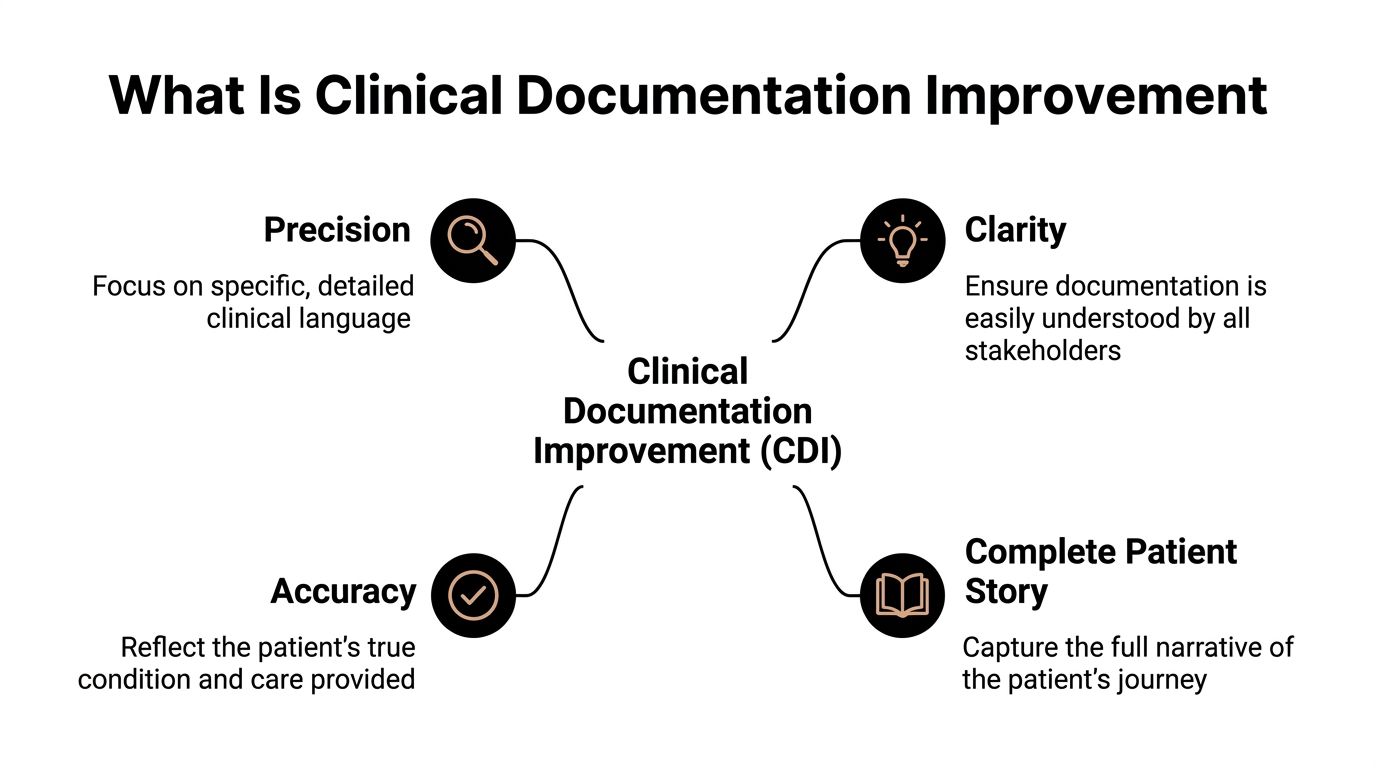
The blueprint has to work for more than one audience
A strong clinical note has to make sense to several groups:
| Reader | What they need from the chart |
|---|---|
| Treating clinicians | A reliable clinical picture and decision trail |
| Coders | Specific diagnoses, condition status, and support for code assignment |
| Billing teams | Clear support for claim submission and defense |
| Auditors and payers | Evidence of medical necessity, severity, and consistency |
That's why CDI isn't the same thing as coding. Coding translates documented care into reportable codes. CDI improves the documentation itself so coding has solid material to work from.
What CDI is and what it isn't
The best CDI programs don't turn physicians into copy-and-paste note writers. They focus on quality over volume.
A practical CDI approach usually looks like this:
- Review the record early: Identify gaps while the encounter is still current or before the bill is finalized.
- Spot ambiguity: Look for missing specificity, unsupported diagnoses, internal inconsistencies, or absent cause-and-effect language.
- Clarify through queries: Ask focused, clinically justified questions when the record needs confirmation or refinement.
- Educate over time: Use recurring patterns to coach providers so fewer queries are needed later.
A complete patient story isn't longer by definition. It's simply harder to misread.
In specialty practice, that distinction matters. An orthopedic group doesn't need more note bloat. It needs documentation that clearly ties symptoms, imaging, prior treatment, risk factors, decision-making, and procedural necessity together. Anesthesia, air ambulance, GI, oncology, dermatology, and radiology each have their own pressure points, but the principle is the same. The record should reflect the actual work and actual clinical judgment already happening.
Good CDI is collaborative. It sits between providers, coders, compliance leaders, and the revenue cycle. When it works well, it reduces confusion instead of adding bureaucracy. The final chart is stronger, the claim is cleaner, and the organization spends less time trying to reconstruct intent after payment has already gone off track.
The Business Case for CDI Excellence
If a practice treats CDI as a documentation clean-up exercise, it will underinvest in it. The business case is much stronger than that. Effective CDI changes denial rates, reimbursement integrity, operational workload, and even patient outcomes.
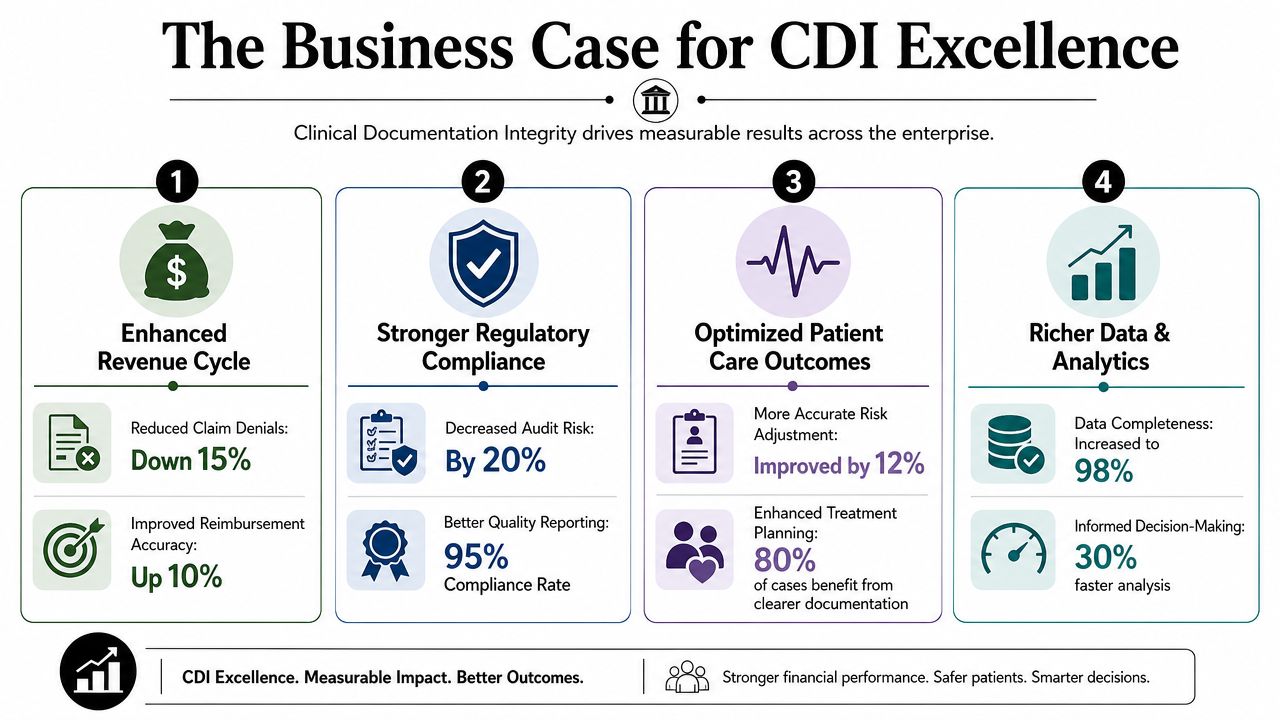
The numbers leadership pays attention to
The strongest public data point for executives is denial reduction. Health systems that implement active CDI programs see a 25% to 30% reduction in claim denials, according to Waystar's overview of clinical documentation improvement in healthcare. That alone changes the economics of the revenue cycle because denials are expensive twice. They delay payment, and they force administrative rework.
The same source reports that effective CDI programs can reduce patient readmission rates by 38%, and some healthcare institutions have reported revenue increases of up to $1.5 million. Those results matter because they show CDI isn't just about reimbursement capture. Better documentation also improves how the organization communicates patient risk, condition status, and continuity needs across the care team.
Four areas where CDI pays back
Here's where mature programs usually show value:
- Financial performance: Cleaner claims go out the door with stronger support. Underpayments, downgrades, and preventable denials become less common.
- Operational efficiency: Teams spend less time chasing clarifications after discharge or after claim submission.
- Compliance strength: The organization relies less on aggressive interpretation and more on chart-supported coding.
- Clinical quality: Clearer notes improve handoffs, risk capture, and the consistency of care documentation.
A denial prevented before submission is much cheaper than a denial appealed after remittance. That sounds obvious, but many organizations still put more process around appeals than around upstream note quality.
What works and what doesn't
What works is targeted CDI tied to real denial patterns, high-risk service lines, and recurring documentation gaps. What doesn't work is measuring success by query volume alone. A program can send many queries and still fail if physicians don't trust the process, if education never reaches root causes, or if analytics don't connect documentation issues to payer behavior.
Field observation: The strongest CDI programs aren't the ones generating the most activity. They're the ones removing the most downstream friction.
For specialty groups, that means looking beyond generic hospital metrics. The question is whether documentation supports your actual payer reality. Does the note defend medical necessity for procedures? Does it support chronic condition capture where risk adjustment matters? Does it hold up when a payer reviews for downgrade opportunities? If not, the business case for CDI isn't theoretical. It's sitting in your aging report.
Anatomy of a Compliant CDI Program
A strong CDI program needs structure. Without structure, queries become inconsistent, provider trust drops, and compliance risk increases. The center of that structure is the query process.
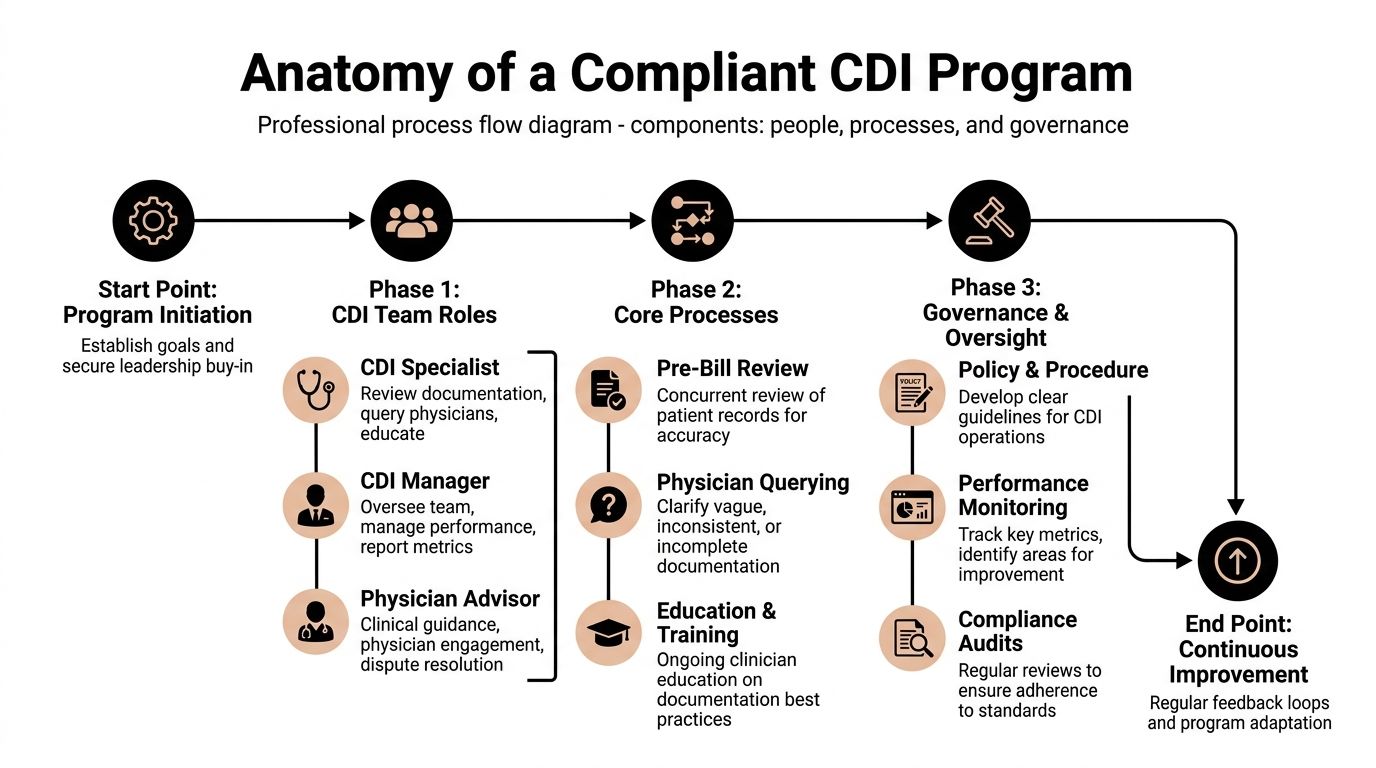
The query process has to be clinically grounded
A compliant CDI program must use a structured query process based on the “Guidelines for Achieving a Compliant Query Practice,” published jointly by AHIMA and ACDIS, so queries stay specific, non-leading, and clinically justified, as outlined in AHIMA's CDI education resources.
That standard matters because the line between clarification and suggestion is where organizations get into trouble. CDI specialists should identify documentation gaps based on the medical record, then ask for clarification in a way that gives the provider room to exercise independent judgment.
What the workflow should look like
In practice, compliant programs usually follow a disciplined sequence:
- Record review: A CDI specialist reviews the chart prospectively or before bill submission.
- Gap identification: The specialist notes missing specificity, conflicting documentation, or unsupported condition capture.
- Query drafting: The question is framed around clinical indicators in the record, not around reimbursement goals.
- Provider response: The physician clarifies, confirms, rules out, or declines based on clinical judgment.
- Coding alignment: Coding proceeds from the clarified record.
A few operational rules keep this process safe and useful.
- Use evidence from the chart: Queries should point back to documented findings, treatment, or clinical indicators already in the record.
- Avoid answer steering: Don't frame the question so that one revenue-favorable answer is clearly being pushed.
- Keep education attached: When the same issue repeats by service line or provider, turn it into targeted coaching.
- Coordinate with compliance and coding: CDI can't operate on its own island. Teams that want a stronger compliance framework often benefit from reviewing adjacent coding compliance practices alongside CDI workflows.
The people matter as much as the policy
Programs fail when they treat CDI as a software problem instead of a people-and-governance problem. The strongest teams usually include CDI specialists, coding leadership, a physician advisor or physician champion, and operational oversight from revenue integrity or compliance.
A provider will engage with CDI when the process feels clinically credible, fast, and fair.
What doesn't work is sending vague, templated, or repetitive queries with no service-line context. That creates provider fatigue and teaches clinicians to see CDI as revenue chasing. What does work is disciplined review, good clinical reasoning, and a governance model that protects both accuracy and integrity.
Measuring What Matters in CDI
Many CDI dashboards are busy and unconvincing at the same time. They count activity but don't prove value. Leadership doesn't need a report showing how many queries were sent unless that activity connects to cleaner claims, stronger reimbursement support, or lower preventable rework.
Start with outcomes, not motion
The first mistake is overvaluing process volume. Query counts can be useful, but they're only context. A high query rate may mean the program is active. It may also mean providers are documenting poorly, templates are failing, or CDI is intervening too late.
The more useful lens is outcome-based. Ask questions like these:
- Which denial categories dropped after documentation education?
- Which specialties still produce preventable clinical validation disputes?
- Where are coders repeatedly holding claims for the same documentation issue?
- Which payer edits map back to missing specificity or weak medical necessity language?
If the dashboard can't answer those questions, it's not helping management.
Build a dashboard leaders can act on
A practical CDI scorecard usually needs a mix of operational and financial indicators. Not every organization will use the same fields, but the structure should be comparable.
| Metric type | What to watch | Why it matters |
|---|---|---|
| Process | Query turnaround, provider response patterns, unresolved clarifications | Shows whether workflow friction is slowing claims |
| Financial | Denials tied to documentation, downgrade trends, pre-bill hold reasons | Connects CDI to revenue protection |
| Quality | Capture accuracy for severity-related documentation, recurring service-line gaps | Shows whether the chart reflects true patient acuity |
| Audit readiness | Patterns in payer requests and internal review findings | Reveals where documentation remains vulnerable |
For many organizations, CDI and audit work should converge when persistent issues arise. If a medical necessity denial or coding dispute keeps surfacing, the issue belongs in a shared review loop. A stronger medical billing audit process can help isolate whether the failure starts in provider documentation, coding interpretation, edit logic, or payer behavior.
What mature teams do differently
Mature teams don't just measure aggregate results. They break results down by physician, specialty, service line, and payer. That's the only way to see whether one ortho location is struggling with procedure justification, whether one imaging site is weak on chronic condition documentation, or whether one payer is targeting a narrow documentation issue repeatedly.
They also treat trends as operational signals, not just reportable facts. If query response quality declines, that may mean providers are overwhelmed. If one denial category rises, that may indicate a template problem or a training gap. The dashboard should tell leaders where to intervene next, not just where performance stood last month.
Implementing a High-Impact CDI Program
Monday morning. The group expected a routine payment cycle. Instead, one payer downcoded a block of high-acuity visits, another asked for records on procedures already performed, and finance could not tell whether the problem started in the note, the code set, or the appeal packet. That is usually the point when a practice realizes CDI is not a coding side project. It is part of revenue defense.
A high-impact CDI program starts by identifying where documentation is weakening claims before submission and where it is leaving the practice exposed if the payer challenges the claim later. For specialty groups operating under growing scrutiny, the goal is broader than cleaner claims. The goal is to produce records that can survive payer review, support appeals, and stand up in disputes under the No Surprises Act overview and dispute process requirements.
Start with a gap analysis tied to dollars at risk
The first step is a baseline review focused on specialties, providers, and payers that are already creating write-offs, delays, or extra labor. Broad CDI assessments sound organized, but they often miss the point. A cardiology group and an orthopedic ASC rarely have the same documentation failure pattern. One may struggle with medical necessity language for testing. The other may lose ground on procedure context, prior conservative treatment, or laterality.
The review should answer four practical questions:
- Where is revenue breaking down: Look at denials, downcodes, underpayments, and pre-bill edits by payer and service line.
- Which notes fail under scrutiny: Identify whether the gap is severity, chronicity, failed prior treatment, procedure rationale, diagnosis specificity, or site-of-service support.
- Who owns each handoff: Map the route from provider note to coding review to claim submission to appeal support.
- Which claim types need dispute-ready documentation: Flag the services most likely to end up in payer challenge, audit, or arbitration.
That last point changes how practices implement CDI. If a service line routinely ends up in payment disputes, the chart has to do more than justify code selection. It has to support the narrative later used by revenue cycle, legal, or arbitration teams.
Staff for judgment, not just chart coverage
Programs fail when leadership treats CDI as a volume function. Reviewing more charts helps only if reviewers know what matters in that specialty and what payers attack after the bill drops.
The Association of Clinical Documentation Integrity Specialists describes common CDI credentials such as CCDS and CDIP through its ACDIS certification resources. Credentials alone are not enough, but they are a useful floor. In practice, the stronger hires combine coding fluency, clinical reading skills, and a working knowledge of payer behavior. They know the difference between a note that supports billing and a note that will hold up in an appeal.
For physician groups, one experienced CDI lead with targeted specialty support often outperforms a larger generic review team. The trade-off is coverage. A lean team has to focus on high-risk encounters first and resist the urge to review everything.
Build in phases that match operational reality
Enterprise launches look good in project plans and stall quickly in clinics. A phased build works better.
- Start with one or two pressure points. Pick the service lines with repeat denials, frequent downcoding, or high-dollar payer friction.
- Set physician rules early. Define what must appear in the note for common high-risk encounters and procedures.
- Create a query process providers will answer. Queries need to be clinically precise, short, and routed fast enough to matter.
- Align CDI with coding and denials. If CDI findings never reach the coding team or appeal staff, the same weaknesses keep showing up downstream.
- Add technology after the workflow is clear. Software should support review, communication, and tracking. It should not force clinicians and coders into one more disconnected queue.
A physician champion helps, especially in specialties where documentation changes affect pace in clinic. Partners will accept added documentation work only when the connection to payment protection is clear and the requests are clinically reasonable.
Design the workflow around high-risk evidence
Strong programs define what evidence has to be present before the claim leaves the practice. That sounds strict, but it is cheaper than fixing missing support after a denial.
For example, if a pain management group routinely disputes medical necessity, pre-bill CDI should confirm that the note captures symptom severity, functional impairment, prior failed treatment, imaging or exam correlation when relevant, and the physician's reasoning for the intervention selected. If those facts are inconsistent or missing, the claim may still go out. It will be weaker on first-pass review, weaker on appeal, and weaker again if the case reaches arbitration.
That is the operational shift many groups miss. CDI should not only ask, "Can we code this?" It should also ask, "If this payer challenges payment six months from now, will the record carry the argument?"
Keep the program live
CDI implementation is not a build-and-freeze project. Payer behavior changes. Templates drift. New physicians bring different habits. Service mix changes after acquisitions or contract shifts.
Teams that sustain results run short feedback loops. They review disputed claims, trace losses back to documentation patterns, revise templates, and update provider education using actual cases from the practice. That discipline is what turns CDI from a compliance task into a revenue protection system.
The Ultimate Strategy Linking CDI to IDR
A payer underpays a high-acuity case six months after the date of service. The physician remembers why the procedure was appropriate. The billing team knows the contract history. None of that carries the case if the chart does not show the clinical story with enough precision to survive external review.
That is why mature groups treat CDI as part of revenue defense, not just claim production. Clean claims matter. Claims that hold up under dispute matter more in specialties that see frequent downcoding, medical necessity denials, or out-of-network payment conflicts.
A clean claim is not the finish line
Once payment is challenged, the chart becomes the record everyone works from. IDR entities, appeal reviewers, and payer auditors do not fill in missing reasoning on the practice's behalf. They read what was documented.
The strategic target is a dispute-ready claim. That means the note supports medical necessity, patient acuity, prior failed treatment when relevant, procedural context, and the physician's reasoning for why this service, on this date, in this setting, was appropriate. If those elements are absent at the point of care, the practice is forced to argue from memory, assumptions, and late addenda. That is a weak position.
A complete patient story is not longer by definition. It is harder to misread.
Why this matters for IDR
Many physician groups still separate CDI, coding, and reimbursement disputes into different lanes. That structure creates avoidable losses. The documentation team focuses on code capture. The denial team tries to repair missing support after the fact. Legal or RCM leadership then builds an arbitration file around a chart that was never designed to carry the argument.
Under the No Surprises Act, the outcome of an IDR case often depends on whether the record gives the reviewer a coherent clinical and payment narrative. Groups that expect to use No Surprises Act arbitration workflows should build documentation standards with that end point in mind. The claim file should already contain the facts the practice will need if the payer disputes reimbursement.
What dispute-ready documentation looks like
Documentation that protects revenue downstream usually includes four features:
- Specific medical necessity language: The note explains why the service was appropriate for this patient, on this date, in this care setting.
- Acuity and complexity that match the case: The record captures the actual clinical burden instead of a generic summary.
- Consistency across the chart: Assessments, orders, procedure notes, and supporting records align on the key facts.
- Usable facts for payer disputes: The file gives RCM, legal, and contracting teams evidence they can cite without reconstructing the encounter.
I have seen strong appeal letters lose because the chart left too much unsaid. I have also seen average appeal letters win because the note was clear, specific, and internally consistent.
The strategic shift is straightforward. CDI should sit at the front end of the revenue protection model. In payer-facing specialties, it supports cleaner claims, lowers avoidable denials, and gives the practice a stronger evidentiary position when payment turns into arbitration.