

Denied or underpaid oncology claims usually start failing long before billing submits them. The weakness is often upstream: eligibility was incomplete, authorization did not match the regimen, drug units were entered incorrectly, documentation did not support medical necessity, or the charge build left too much room for payer edits. In oncology, revenue protection starts before the patient is treated.
General medical billing processes are not built for this level of exposure. A single encounter can carry expensive drugs, administration charges, labs, imaging, modifiers, and payer-specific rules that change without much notice. One front-end miss can turn into a denial, a partial payment, or a long appeal cycle that ties up cash and staff time.
The teams that perform well treat the revenue cycle as one connected control system.
Clean claims and payer disputes are part of the same job. If the front end is weak, appeals become arguments without records. If the front end is disciplined, an underpaid claim becomes evidence: verified benefits, correct authorization, accurate coding, complete documentation, and a defensible expected reimbursement. That is the standard oncology programs need now. The strongest teams do not just push claims out the door. They build dispute-ready claims that hold up when a payer downcodes, delays, or pays below contract.
The Escalating Financial Complexity of Cancer Care
Cancer care carries some of the highest reimbursement exposure in healthcare. A single course of treatment can combine costly drugs, repeated administrations, labs, imaging, pathology, supportive medications, and frequent changes in regimen. That level of complexity changes the revenue cycle job from routine billing to financial risk control.
The pressure is not theoretical. Oncology programs are dealing with higher drug spend, tighter utilization management, narrower medical-necessity interpretations, and more aggressive payment review. Payers know where the dollars sit. They target site of care, drug selection, units, modifiers, sequencing, and documentation support. If an organization manages oncology with a standard multispecialty billing model, margin erodes in small pieces until the loss is hard to ignore.
Why general RCM models fail here
General RCM models are built for services that are more predictable. Oncology is not.
An oncology claim reflects a chain of operational decisions. Benefit design affects where treatment can occur. Authorization affects whether the regimen, drug, and frequency are payable. Clinical documentation affects medical necessity support. Charge capture affects whether the billed claim matches what was ordered and administered. Payment posting then has to catch underpayments that many payer systems will not flag on their own.
Three realities make oncology different:
- High-cost drugs magnify minor errors: One unit error, NDC mismatch, or authorization gap can wipe out margin on the encounter.
- Payer policy changes hit operations fast: Teams have to keep up with drug policies, biosimilar requirements, frequency edits, diagnosis restrictions, and site-of-care rules that change with little warning.
- Revenue risk extends well past claim submission: The work does not end when the claim drops. It continues through payment variance review, denial recovery, contract enforcement, and, when necessary, formal dispute action.
That last point matters more than many teams admit.
In oncology, a clean claim is not only about getting paid faster. It is also the foundation for winning when a payer underpays, delays, or reinterprets its own rules after the fact. If the record is incomplete, appeals turn into staff opinions. If the record is tight, the organization has proof: the verified benefit, the approved authorization, the ordered regimen, the administered units, the supporting note, and the expected reimbursement.
What financial pressure looks like in practice
Financial stress in oncology rarely arrives as one dramatic denial. It shows up in patterns that drain cash and labor.
A payer starts asking for records on a drug that had been paying cleanly for months. Another payer reimburses below contract on administration codes and counts on low appeal follow-through. Another shifts a therapy from medical to pharmacy benefit without clear notice, leaving staff to sort out rejected claims after treatment is already scheduled. Each issue looks manageable by itself. Together, they create aging A/R, rework, write-offs, and avoidable patient balance problems.
The operational trade-off is real. Teams can spend their day reacting to denials, or they can spend it building claims that hold up under scrutiny and can be defended later. Strong oncology RCM programs choose the second path. They treat financial clearance, documentation, coding, claims editing, payment review, and dispute support as one connected process built to produce dispute-ready claims.
That is the standard cancer programs need now. Standard billing discipline is no longer enough when payer behavior includes systematic underpayment as much as outright denial.
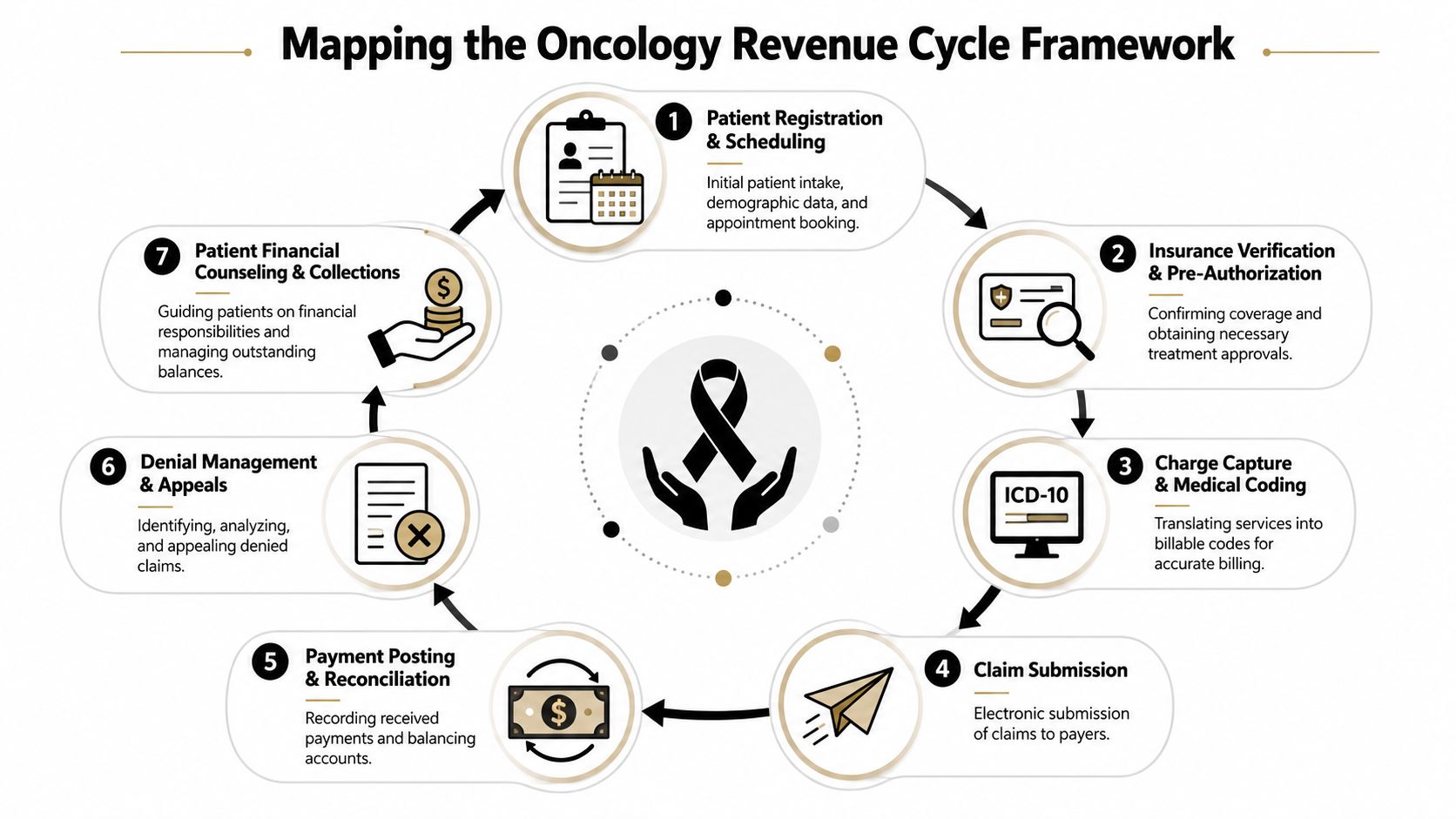
Mapping the Oncology Revenue Cycle Framework
Most revenue cycle maps look neat on paper. Oncology rarely is. A realistic framework has to account for treatment plans that evolve, benefits that differ by drug and site of care, and documentation that has to support both payment and later dispute work.
Patient access sets the financial trajectory
The cycle starts before the first infusion chair is occupied. Registration and scheduling teams need more than demographics and an insurance card. They need the treatment setting, rendering provider, expected regimen, and enough lead time to surface payer restrictions before care is delivered.
Insurance verification in oncology has to answer practical questions, not just "active or inactive." Does the plan carve out specialty drugs? Is the treatment covered under medical or pharmacy benefit? Is the intended site of care approved? Are there frequency, step-therapy, or biosimilar requirements?
If those questions aren't answered up front, the billing office inherits a denial that could've been prevented.
Authorization and financial clearance do the heavy lifting
Prior authorization is where many oncology revenue cycle failures begin. The operational goal isn't merely obtaining an approval number. It's matching the approved service, diagnosis, drug, units, dates, and setting to the claim that will eventually be submitted.
A workable front-end process usually includes:
- Regimen review: Confirm what is being requested, including administration and drug components.
- Payer rule matching: Check the payer's policy for site, sequencing, documentation, and code expectations.
- Authorization logging: Store approval details in a structured format the billing team can see and trust.
- Financial counseling: Explain expected patient responsibility before treatment starts, especially when balances will accumulate over a series of visits.
Practical rule: If your authorization team and your billing team can't see the same approval details in the same workflow, you'll spend the back end rebuilding facts that should've been captured once.
Mid-cycle accuracy is where oncology claims are won or lost
Charge capture in oncology needs discipline. Drug charges, wastage where applicable, administration services, evaluation and management work, and ancillary services must be captured in a way that reflects what happened clinically and what the payer expects contractually.
That means coders can't work in isolation from clinical operations. They need documentation that supports regimen intent, administration details, diagnosis linkage, and medical necessity. They also need current payer logic. A technically correct code paired with unsupported documentation is still a vulnerable claim.
Here's the framework in a simple operating view:
| Revenue cycle stage | What oncology teams must control |
|---|---|
| Registration and scheduling | Accurate patient, provider, and encounter setup |
| Eligibility and benefits | Coverage specifics by drug, benefit type, and site of care |
| Authorization | Approval details that match diagnosis, service, and timing |
| Charge capture and coding | Drug, administration, and diagnosis accuracy |
| Claim submission | Edits, scrubbing, and payer-specific formatting |
| Payment posting | Contract comparison, variance detection, and reconciliation |
| Denials and patient collections | Root-cause correction, appeal support, and balance resolution |
The back end isn't just collections
Once a claim is filed, the work shifts from construction to verification. Payment posting teams have to look beyond whether money arrived. They need to confirm whether it arrived correctly. In oncology, underpayments often hide inside otherwise closed claims unless someone compares reimbursement against expected terms and service details.
Patient collections also need a specialty approach. Oncology patients aren't moving through a one-visit transaction. They often face recurring balances over a treatment arc. Teams that communicate early, clearly, and compassionately usually preserve both collection performance and patient trust.
Navigating Critical Oncology Revenue Risks
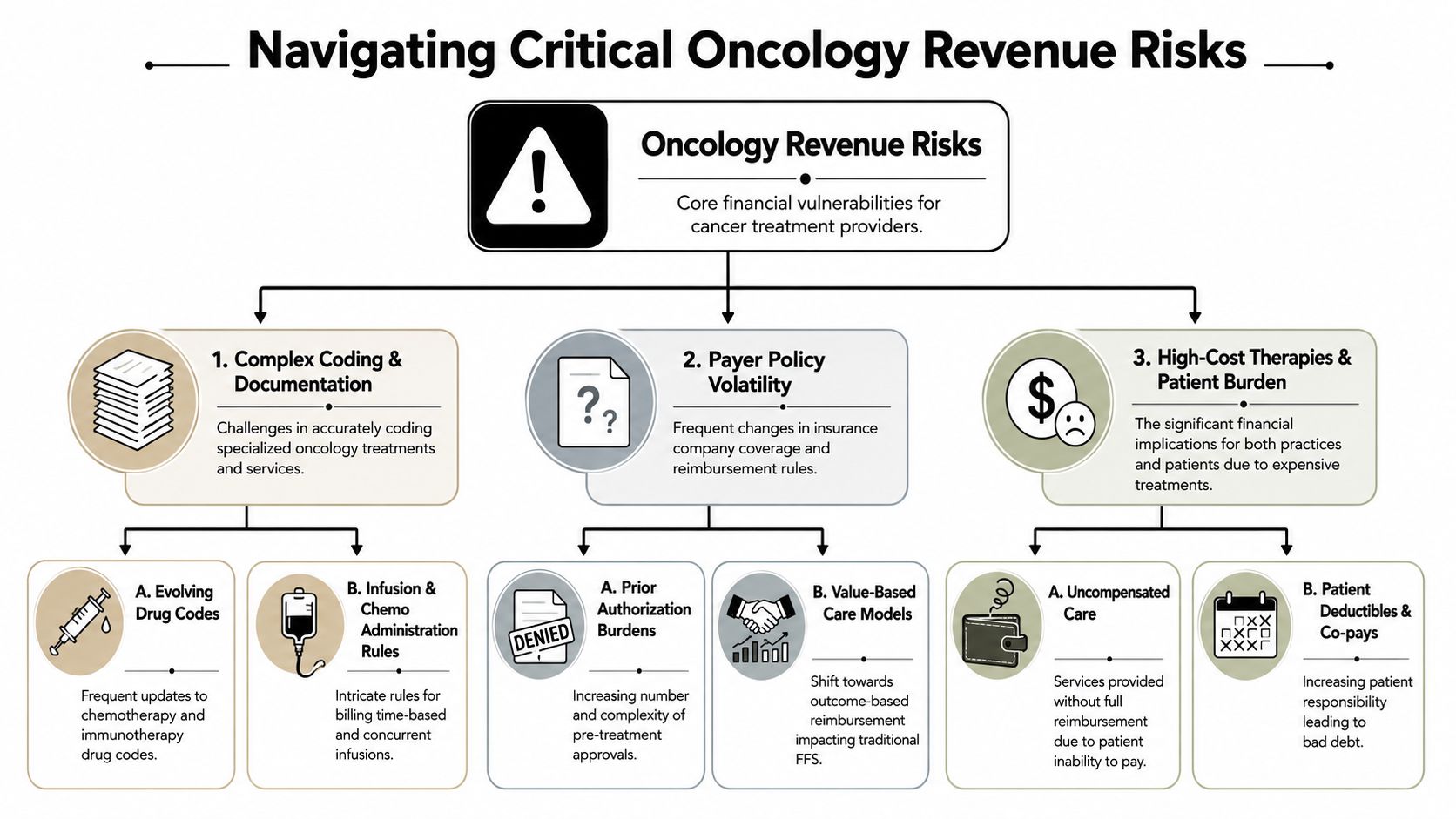
The biggest revenue threats in oncology aren't random. They repeat. They cluster around a few operational failure points, and each one can turn a clinically appropriate claim into delayed cash, reduced reimbursement, or unrecoverable write-off.
Drug coding mistakes create expensive errors
Oncology billing is unusually exposed to coding detail. Drug claims often require precise alignment between product selection, units, administration, and supporting documentation. If the drug code is outdated, the units don't reconcile to the clinical record, or the claim logic doesn't match payer expectations, reimbursement can stall quickly.
Infusion encounters add another layer. Administration coding rules can become complicated when hydration, supportive medications, sequential services, or multiple infusion events occur during the same visit. Small mistakes aren't small in financial impact when the underlying therapy is high cost.
A strong compliance review process helps here. Teams that routinely audit drug coding logic, modifier use, and documentation support are far less likely to feed avoidable denials into the back end. For organizations tightening controls, a focused review of oncology coding and compliance workflows can reveal where claim vulnerability starts.
Prior authorization failures remain the most common denial engine
This is still the most predictable oncology risk. In oncology revenue cycle management, 30 to 40% of claims are initially denied because of authorization gaps or coding mismatches involving complex CPT and HCPCS coding for infusion therapies, according to Rivet Health's oncology RCM analysis.
That figure tracks with what many oncology leaders see operationally. The denial itself may post as missing authorization, invalid units, noncovered drug, or medical necessity review. But the root cause often started much earlier:
- Eligibility wasn't verified thoroughly enough
- Authorization details didn't match the final treatment
- Regimen changes weren't rechecked
- Codes on the claim drifted from the approved request
The practical lesson is simple. Prior authorization is not an administrative checkpoint. It's a clinical-financial control.
Site-of-care policies reshape reimbursement without changing the medicine
Payers increasingly steer oncology treatment into specific settings. The therapy may be identical, but reimbursement logic often isn't. If the ordering team, authorization staff, and billing office aren't aligned on site-of-care policy, the practice can deliver appropriate treatment and still walk into a preventable payment dispute.
This risk often shows up in two ways. First, a payer challenges the setting after treatment and reduces reimbursement. Second, the payer approves a service but expects it in a different location than the one ultimately billed. In both scenarios, staff members lose time proving why the encounter was appropriate where it occurred.
Documentation gaps weaken both claims and appeals
A weak note doesn't just threaten first-pass payment. It weakens every downstream appeal.
When documentation doesn't clearly support diagnosis, regimen rationale, administration details, or medical necessity, the billing team loses its advantage. The claim may still leave the door, but it isn't defensible. That's the difference between a merely submitted claim and a dispute-ready claim.
The strongest oncology claims read the same way from clinical note to authorization file to coded claim to appeal packet. Payers exploit every mismatch.
A useful way to view these risks is by failure mode:
| Risk area | What breaks | What follows |
|---|---|---|
| Drug coding | Code, unit, or administration mismatch | Denial, delay, or underpayment |
| Authorization | Approval gap or mismatch to final claim | Initial denial and rework |
| Site of care | Setting not aligned to payer policy | Reduced payment or post-service challenge |
| Documentation | Medical necessity or service detail incomplete | Failed appeal and weak dispute record |
Most oncology practices don't lose revenue because they don't work hard enough. They lose it because these four risk categories keep producing the same damage across different payers and different claim types.
Operational Steps to Strengthen Your Revenue Cycle
Fixing oncology revenue cycle management starts with process design, not heroic denial work. The most reliable gains come from reducing claim defects before submission and structuring every handoff so the next team doesn't have to reconstruct missing facts.

According to athenahealth's oncology revenue cycle management overview, oncology practices using advanced automated RCM platforms can achieve a 98.75% clean claim rate, while also reducing staff workload by up to 35%. Those numbers matter because they reinforce a simple operational truth: automation is most valuable where rules are complex and expensive to miss.
Start with front-end standardization
Most oncology denials are born before the claim exists. Front-end teams need scripts, work queues, and escalation rules that are specific to oncology, not borrowed from primary care or general multispecialty scheduling.
A practical front-end build usually includes:
- Benefit verification by treatment type: Check whether the therapy routes through medical or pharmacy benefit and flag site-of-care restrictions before treatment day.
- Authorization matching: Require staff to document approved service details in a format coders and billers can use without reinterpretation.
- Regimen change checkpoints: When a physician changes drug, dose, schedule, or setting, force a recheck instead of assuming prior approval still applies.
These aren't glamorous fixes. They work because they remove ambiguity.
Put oncology-specific edits in the middle of the workflow
Claims scrubbing only helps when the edit logic reflects oncology reality. Generic edits catch missing fields. Specialty edits catch reimbursement risk.
That means your mid-cycle controls should test for issues such as diagnosis-to-drug alignment, administration consistency, unit accuracy, modifier logic, and documentation dependencies. Many teams rely on their practice management system alone and assume payer edits downstream will sort things out. That's backwards. The payer's edit engine exists to protect the payer.
A stronger mid-cycle model usually combines:
- Coder review of high-risk encounters
- Rules-based claim scrubbing before submission
- Exception work queues for regimens with frequent payer friction
- Rapid feedback loops to nursing, pharmacy, and access staff when recurring defects appear
Build a clean claim culture, not just a clean claim report
A published clean claim metric means very little if staff members don't know what caused failures. The best-performing oncology teams review claim fallout in operational terms. Which payer rejected the claim? Which regimen was affected? What front-end field was wrong? Which document was missing?
Here's a useful distinction:
| Approach | What happens |
|---|---|
| Reactive billing office | Staff rework denials after remits arrive |
| Preventive oncology RCM team | Staff identify defect patterns before claims leave the system |
That shift changes staffing burden and cash timing. It also changes morale. People do better work when they can solve root causes instead of repeatedly repairing the same avoidable errors.
A denial team shouldn't be the first group to discover that your process is broken.
Reconcile payments with the same discipline used for claim submission
A clean claim doesn't guarantee correct payment. Oncology organizations need payment posting and variance review processes that compare actual reimbursement against expected reimbursement, especially for high-value encounters.
In this process, many operations leave money on the table. Staff members post payments, close balances, and move on unless the underpayment is obvious. Payers know that. They count on volume and complexity to conceal unfavorable payment behavior inside routine remittance activity.
To tighten this area, focus on three habits:
- Separate payment posting from payment analysis: Posting confirms receipt. Analysis confirms correctness.
- Flag repeated payer patterns: One underpayment may be a mistake. A repeat pattern is a policy problem.
- Preserve evidence early: Save the authorization, note, coding logic, and remit relationship while the claim is still fresh.
Those habits are what make downstream appeals faster and stronger.
Essential KPIs and Analytics for Oncology Practices
Most oncology groups track standard revenue cycle metrics. That isn't enough. You need analytics that expose where oncology-specific friction lives, which payers create it, and whether your process is improving the quality of claims before denial work begins.
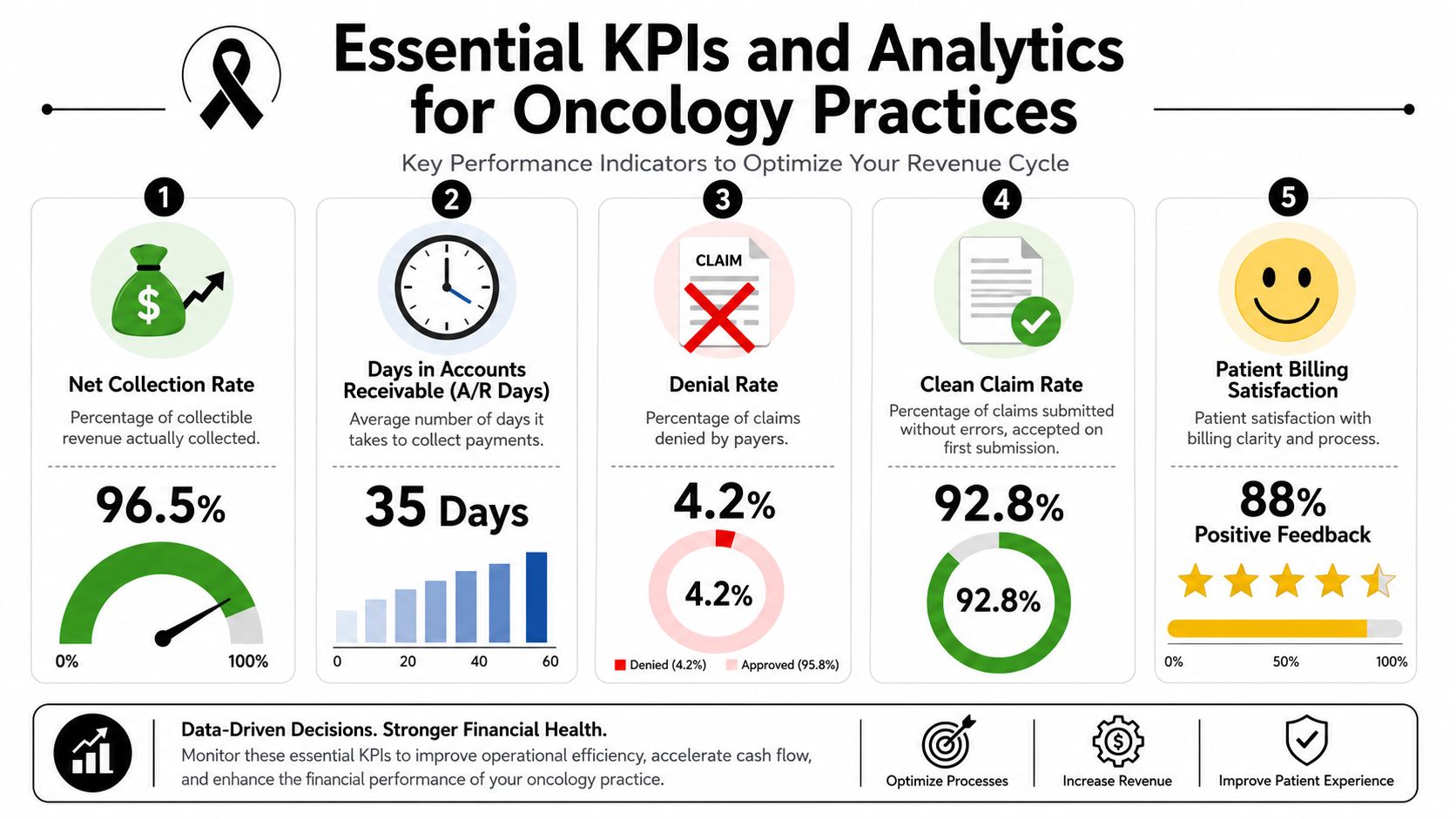
A useful analytics model doesn't drown leaders in dashboards. It highlights where operational defects and payer behavior intersect. Teams building that reporting layer usually benefit from more focused healthcare revenue cycle analytics workflows that connect claim quality, payment behavior, and recovery performance.
KPIs that matter more in oncology
Start with metrics that answer operational questions, not vanity questions.
- Denial rate by payer and drug category: This tells you whether a denial problem is broad or concentrated. If one payer repeatedly rejects certain oncology services, you likely have either a payer-policy mismatch or a targeted payer behavior issue.
- Prior authorization success rate: This reveals whether front-end controls are preventing downstream fallout.
- Clean claim rate for oncology encounters: In this specialty, clean claims are less about bragging rights and more about controlling rework, delay, and appeal weakness.
- Payment variance by payer: This helps detect underpayments that routine posting misses.
- Appeal overturn pattern by denial reason: If your team wins certain appeal types consistently and loses others, the issue may be evidence quality rather than appeal effort.
Read trend lines, not isolated numbers
A single month's denial rate can mislead. Oncology volume and regimen mix can shift. What matters is the pattern across time and across payer cohorts.
Leaders should ask:
- Is the same payer driving repeated defects?
- Are denials concentrated around certain services or regimens?
- Did a workflow change improve front-end performance or just move work downstream?
- Are underpayments appearing after claims that were technically clean?
Those questions separate management from monitoring.
Build dashboards around decisions
The best oncology KPI dashboards support action. If a metric doesn't tell someone what to investigate next, it isn't useful enough.
Good analytics don't just describe loss. They identify who needs to fix what, and where.
A practical dashboard for oncology revenue cycle management often includes these views:
| Dashboard view | What it helps you decide |
|---|---|
| Payer denial trend | Which payer needs workflow correction or escalation |
| Authorization exception queue | Which patients or regimens need intervention before treatment |
| High-value claim aging | Which claims deserve urgent follow-up |
| Underpayment variance report | Which remits need contract or dispute review |
| Appeal outcome view | Which arguments and documents are winning |
The point of oncology analytics isn't to create a prettier monthly packet. It's to spot payer behavior and internal defects early enough to protect cash flow before leakage becomes normalized.
Payer Negotiations and Independent Dispute Resolution
Standard denial management isn't enough when a payer underpays oncology claims systematically. If you only appeal one claim at a time without identifying the pattern behind those claims, you're doing administrative cleanup while the payer continues the same behavior.
That's why enforcement belongs inside oncology revenue cycle management. It isn't separate from operations. It's the final expression of operational discipline.
Distinguish errors from patterns
Every payer makes occasional processing mistakes. Those should be corrected quickly and closed. The more serious problem is repeat behavior: downcoding expensive therapies, applying narrow policy interpretations inconsistently, or paying below what the claim and supporting record justify.
The signal usually appears in clusters:
- The same payer underpays the same type of service repeatedly
- The same rationale appears across multiple remits
- Standard reconsideration produces delay but not correction
- Contract language or payment logic gets applied in a one-sided way
At that point, you're no longer solving isolated denials. You're confronting a reimbursement strategy.
Why dispute readiness starts upstream
According to Office Ally's discussion of RCM challenges and dispute strategy, claim denials increased 16% between 2018 and 2024, while many oncology guides still stop at denial resolution and don't address enforceable arbitration strategy for systemic underpayment. That's a major gap in how many organizations think about payer resistance.
A strong dispute position is built long before legal or arbitration language enters the conversation. You need a file that shows consistent alignment among the clinical record, authorization details, coded claim, submitted claim, and payment variance. If those pieces don't match, the payer has room to argue ambiguity.
That's why clean claims matter beyond first-pass payment. They create credibility. They make it easier to demonstrate that the service was appropriate, properly documented, correctly billed, and improperly paid.
Treat IDR as a business capability
When payer behavior becomes systemic, organizations need structured escalation. That includes payer negotiations, formal underpayment review, and where applicable, Independent Dispute Resolution under the No Surprises Act.
Many providers still treat this as occasional rescue work. That's too narrow. High-value oncology claims justify a repeatable enforcement process with clear intake criteria, evidence assembly standards, and payer-pattern tracking. Teams that want a stronger framework for this often review their broader payer contract management approach alongside dispute workflows, because contract interpretation and payment enforcement usually intersect.
A practical enforcement model usually includes:
- Pattern identification: Group claims by payer, service type, and denial or underpayment rationale.
- Evidence assembly: Pull the authorization record, clinical note, coding support, submitted claim, and remit comparison.
- Escalation sequencing: Decide what should be handled by reconsideration, formal appeal, negotiation, or IDR.
- Outcome tracking: Record which arguments succeed so the next dispute starts stronger.
If a payer repeats the same underpayment behavior across similar oncology claims, your response should be systematic too.
The strategic payoff
Organizations that connect upstream precision to downstream enforcement gain an advantage. They don't just hope to be paid correctly. They can prove when they weren't.
That changes negotiations. It also changes internal confidence. Revenue cycle staff members become more effective when they know the organization won't stop at "denial resolution" if the payer's conduct is broader than a one-off claim issue.
Achieving Measurable Financial and Operational Outcomes
Strong oncology revenue cycle management produces two kinds of results. The first is operational. Staff spend less time chasing preventable defects, rebuilding missing records, and working avoidable denials. The second is financial. Cash arrives with less delay, fewer claims leak value, and underpayments are easier to identify and challenge.
Those outcomes don't come from one tool or one heroic manager. They come from connecting the full cycle.
What improvement actually looks like
When an oncology practice tightens access, coding, payment review, and dispute readiness, several changes usually become visible:
- Cleaner submissions: Fewer claims leave the system with basic mismatches between authorization, coding, and documentation.
- Faster issue detection: Teams catch high-risk claims and payer trends before they age into larger collection problems.
- Lower rework burden: Staff stop spending so much time reprocessing defects that should've been prevented.
- Stronger underpayment recovery: Payers face more complete, better organized challenges when reimbursement doesn't match the record.
None of that is theoretical. It changes how teams work every day.
The compounding effect of dispute-ready claims
The most important shift is cultural. Once teams understand that a clean claim also serves as future evidence, front-end accuracy stops feeling like clerical perfectionism and starts looking like revenue protection.
That mindset changes decisions across the cycle:
| Operational habit | Downstream benefit |
|---|---|
| Precise authorization capture | Stronger response to payer denials and underpayments |
| Consistent documentation support | Better appeal and arbitration posture |
| Accurate coding and edits | Fewer preventable defects to unwind later |
| Payment variance review | Earlier detection of systemic payer behavior |
Clean claims protect cash flow today. Dispute-ready claims protect reimbursement value tomorrow.
Why oncology needs this integrated model
Cancer care doesn't give providers much room for administrative sloppiness. The cost structure is too demanding, payer behavior is too aggressive, and the documentation burden is too high. Standard RCM can keep the lights on for simpler specialties. Oncology needs more.
The organizations that perform best treat revenue cycle work as a coordinated specialty function with three jobs: prevent avoidable denials, detect payer underperformance quickly, and enforce payment rights when payers don't reimburse fairly. That's the operating model that matches today's payer reality.
RevGuard helps provider organizations build that kind of protection into the full lifecycle. Its model combines specialty-specific RCM with Independent Dispute Resolution under the No Surprises Act, so teams can reduce front-end leakage, identify payer patterns, and pursue recoverable underpayments with stronger evidence. If your organization wants a more disciplined approach to oncology revenue cycle management, visit RevGuard.