

A credentialing delay isn't an admin nuisance. It's a revenue stoppage. Healthcare organizations lose an average of $7,500 per physician per day when credentialing drags, and the process typically takes 90 to 120 days on average, according to Medwave's credentialing statistics roundup.
If you manage a practice, hospital service line, ASC, or specialty group, that number should change how you think about a medical credentialing service. Credentialing is not back-office paperwork. It is the first control point in your revenue cycle. If it fails, claims fail later. If it slips, cash flow slips first.
Too many organizations still treat credentialing like a compliance file that lives in a drawer until renewal season. That's a mistake. A strong credentialing operation protects billing readiness, keeps providers productive, reduces avoidable denials, and prevents the kind of upstream revenue leakage that billing teams can't fully repair after the fact.
Beyond the Checklist Why Credentialing Is Revenue Protection
The common assumption is wrong. Credentialing is not just a prerequisite for compliance. It is the opening move in revenue cycle management.
A provider can deliver flawless care, your coders can code correctly, and your billing team can submit clean claims. None of that matters if the provider wasn't properly credentialed and enrolled with the payer at the right time. The claim may be delayed, denied, or trapped in rework because the error happened upstream.
The real job of credentialing
Think of credentialing as the point where your future claims either become billable or become vulnerable.
A capable medical credentialing service does four things that directly affect revenue:
- Verifies provider legitimacy: Payers and facilities need validated licensure, training, certifications, and related qualifications before they'll recognize a provider.
- Establishes billing eligibility: Enrollment determines whether the provider can submit reimbursable claims to a payer.
- Prevents avoidable denials: In some specialties, 30% of denials stem from upstream enrollment failures, as described in Credex Healthcare's discussion of upstream revenue leakage.
- Protects go-live timing: New hires, expansion sites, and acquired groups don't produce expected revenue if payer enrollment lags behind operational launch.
Practical rule: If a provider isn't enrollment-ready, they aren't revenue-ready.
That's why I advise practice managers to stop asking, “Who can process applications?” Ask, “Who can protect time to bill?”
Why compliance language hides the real risk
Compliance framing makes credentialing sound passive. Revenue framing shows the actual stakes.
When credentialing is handled poorly, the damage spreads beyond one delayed application:
| Revenue risk | What happens in practice | Why it matters |
|---|---|---|
| Delayed payer enrollment | Provider sees patients before enrollment is complete | Claims may not pay on time, or at all |
| Missing recredentialing deadlines | Existing participation status lapses | Claims start denying unexpectedly |
| Incomplete documentation | Payer asks for clarification or resubmission | Billing activation gets pushed back |
| Weak coordination with billing | Demographics, taxonomies, and payer records don't align | Claims fail even after approval |
For high-value specialties, this problem gets worse fast. Air ambulance, anesthesia, orthopedics, oncology, and similar fields can't afford a “submit and wait” model. Their reimbursement depends on precision, timing, and payer-specific follow-up. Treating credentialing like generic admin support is how organizations create preventable denials before the first claim even leaves the clearinghouse.
A medical credentialing service should sit close to finance and operations, not off to the side as a clerical utility.
The End-to-End Medical Credentialing Process and Timeline
Credentialing isn't one task. It's a chain of dependencies. If one link is weak, the timeline stretches and your provider's billing start date moves with it.
Use this visual as the high-level map.
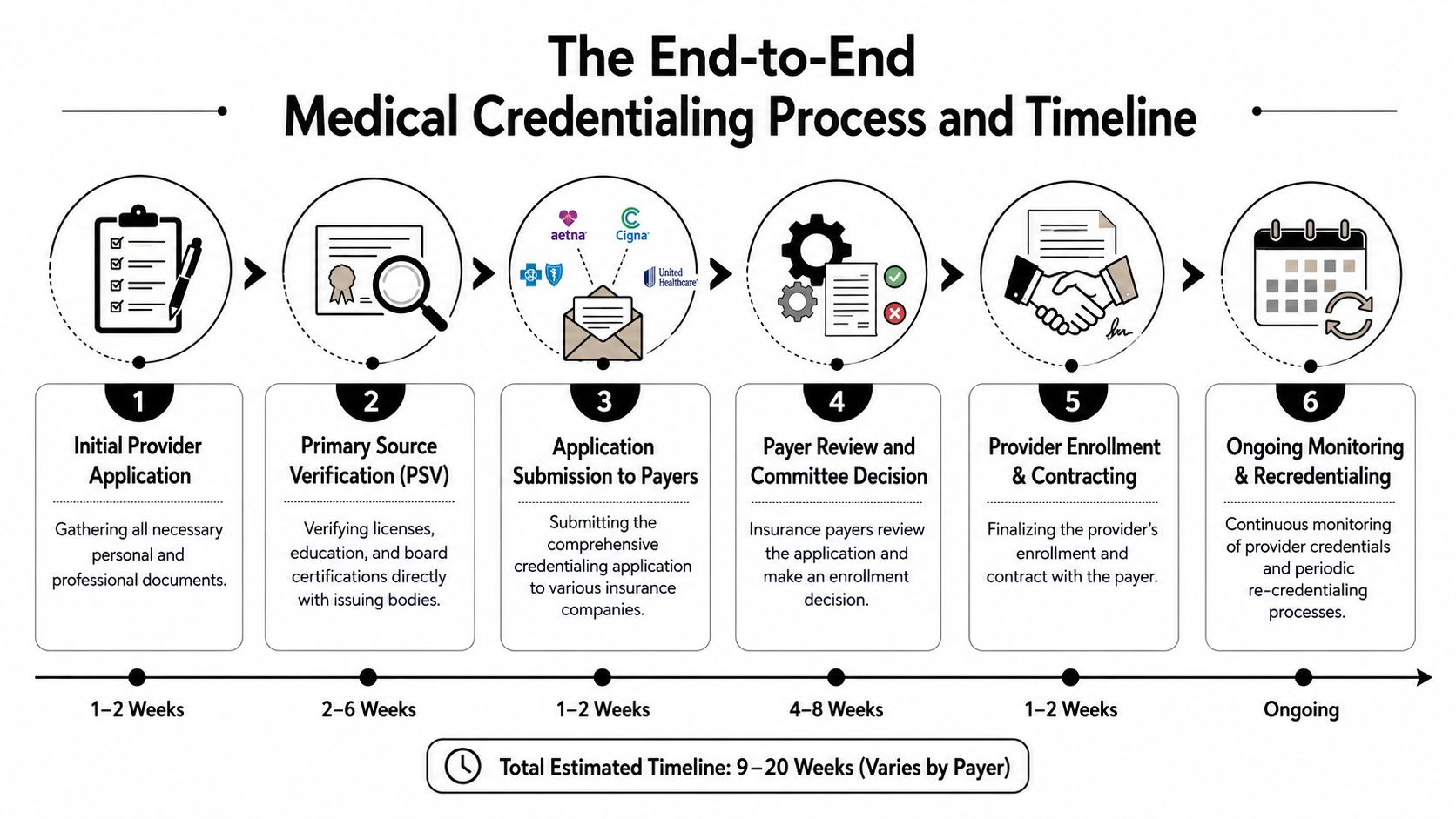
Step one through step three
A good way to think about the process is this: you're building a professional record that must survive scrutiny from multiple independent reviewers.
Initial provider application
The file starts with core identity and professional documents. That usually includes licenses, education history, training history, board status, work history, malpractice information, and facility affiliations.Primary Source Verification
This is the point many managers underestimate. Primary Source Verification, or PSV, requires direct cross-checking of qualifications with original issuers, not copies sitting in your HR file. Symplr's provider credentialing guide explains that licenses, board certifications, and similar credentials must be verified directly with original sources, and that work history gaps exceeding 30 days must be documented and explained because unexplained gaps create red flags that delay payer enrollment. See Symplr's provider credentialing guide.Application submission to payers
Once the file is complete and verified, applications go out to each payer. It is often at this stage that many in-house teams lose control. Submission is not completion. It's the start of payer-specific review cycles, follow-up, and documentation requests.
If your team submits an application with unresolved work history gaps, the payer doesn't “work around it.” The file stalls.
Step four through step six
After submission, you enter the part of the process that feels opaque unless your service partner is disciplined.
Payer review and committee decision
Commercial plans, Medicaid programs, and facilities all review files differently. Some move clean files efficiently. Others generate repeated requests for additional detail. Hospital committees may also evaluate the file for privileging, especially where the provider needs authority to perform specific procedures.
Provider enrollment and contracting
Approval alone isn't the whole story. The provider must be loaded correctly into the payer system, linked to the right entity information, and aligned with contract participation details. Such administrative mismatches can then create downstream billing trouble even after “approval.”
Ongoing monitoring and recredentialing
Credentialing isn't finished once the provider is active. Documents expire. Licenses renew. Board statuses change. Recredentialing cycles arrive. If nobody owns ongoing monitoring, the organization invites future denials.
What the timeline really means operationally
The average process takes time because multiple outside parties control parts of it. Medwave reports average credentialing timelines of 90 to 120 days in many organizations, and that's why you can't wait until a provider's start date to begin. See the linked Medwave source in the opening section for the timing reference.
From an operations standpoint, the lesson is simple:
- Start earlier than feels necessary
- Collect explanations for gaps immediately
- Track every payer separately
- Treat follow-up as active work, not clerical checking
- Align billing setup with enrollment status before go-live
A serious medical credentialing service doesn't merely complete forms. It manages sequence, verification discipline, payer follow-up, and recredentialing controls so the provider reaches billing readiness with fewer surprises.
The Financial Impact of Credentialing Delays and Denials
A physician who can see patients but cannot bill is a revenue leak, not a growth asset. That is the financial reality of credentialing.
The organizations that treat credentialing as paperwork usually discover the cost in accounts receivable, write-offs, and denied claims months later. The organizations that treat it as revenue engineering protect cash flow before the first claim ever leaves the practice.
This infographic captures the business impact at a glance.
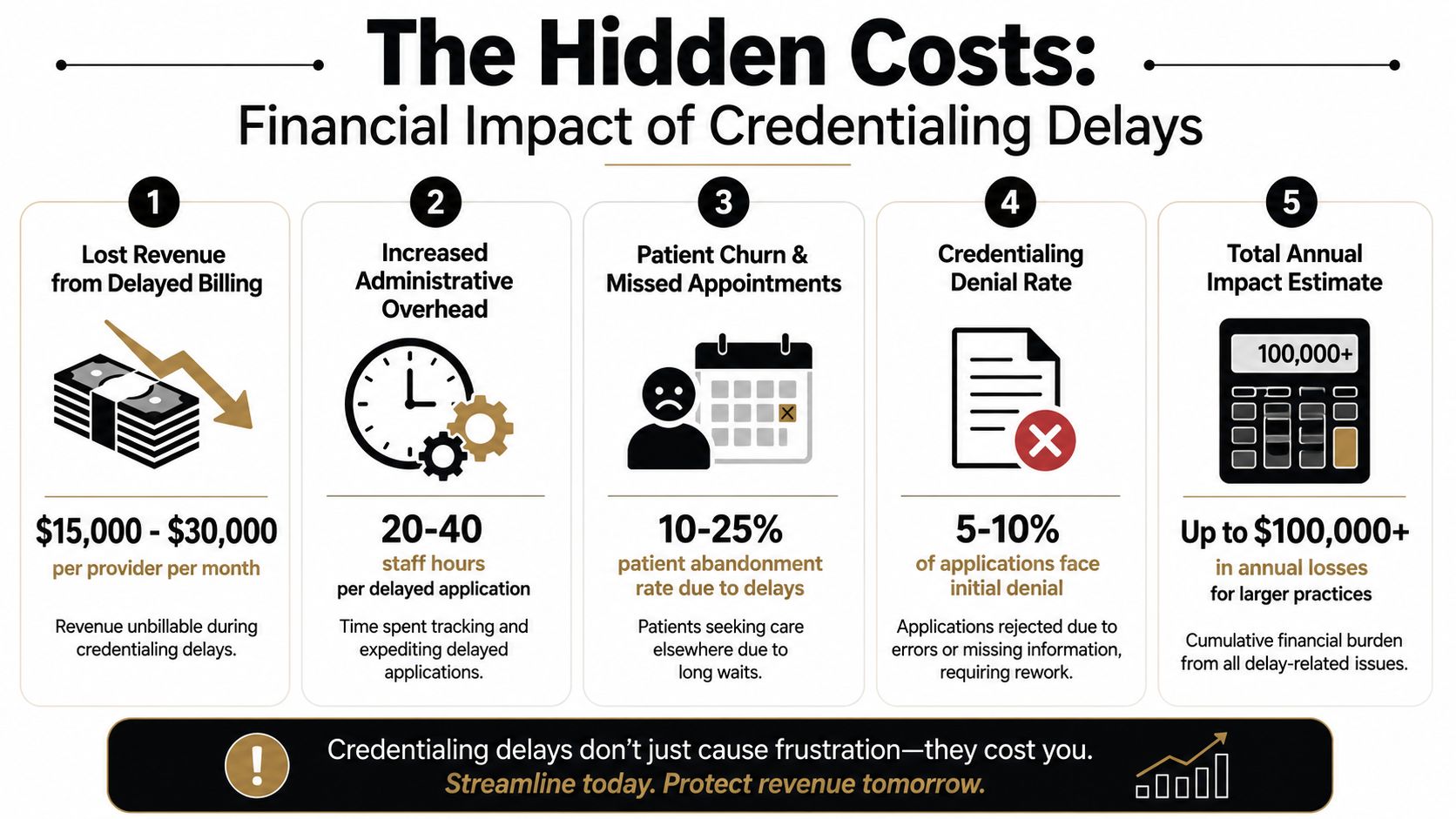
Delays create an immediate revenue gap
The provider may be staffed, scheduled, and clinically productive. None of that matters if payer approval is incomplete or payer records are wrong. Revenue is blocked until claims can be submitted cleanly under active enrollment.
Earlier in this article, we cited Medwave's reporting on typical credentialing timelines. Those delays carry direct financial consequences because every day of non-billable provider time reduces collections, pushes out ramp-up, and strains working capital. In high-value specialties, the loss is worse because each missed day represents larger average claim value and higher downstream rework when billing teams try to clean up preventable enrollment defects.
This is the part many practice managers underestimate. Delayed credentialing does not only postpone revenue. It reshapes it. Cash arrives later, labor costs rise, and some claims never recover.
Denials often start upstream
Denial teams usually get blamed for outcomes they did not create. By the time the claim rejects for enrollment, network status, or payer file mismatch, the root cause is already behind you.
That is why credentialing belongs in the same financial discussion as billing, coding, and collections. If you are seeing repeated denials tied to provider setup, payer activation, taxonomy mismatch, or entity alignment, review credentialing alongside your healthcare denial management strategy. Separate reviews miss the handoff failures that create preventable denials in the first place.
A common pattern looks like this:
- A provider starts seeing patients before payer activation is confirmed
- Claims are filed with incomplete, inactive, or mismatched enrollment data
- Payers deny, pend, or re-route claims that should have paid cleanly
- Billing staff spend hours on avoidable follow-up and appeals
- Cash posting slows while AR and administrative cost increase
That is not a billing problem. It is a credentialing control failure with billing consequences.
Practice managers should measure financial exposure, not form completion
Stop asking whether the file was submitted. Ask when the provider became billable, how many claims were held, and which denials tie back to enrollment or payer setup. Those are management questions. They show whether credentialing is protecting revenue or delaying it.
Use a simple operating view:
| Question | Why it matters |
|---|---|
| How long from provider hire to billable status? | Shows the real revenue lag tied to onboarding |
| Which denials trace back to enrollment or payer file errors? | Identifies upstream causes that billing cannot fix alone |
| Which payers create the longest cash delay after submission? | Pinpoints where follow-up discipline affects revenue most |
| How many claims were held or reworked because credentialing was incomplete? | Connects administrative failure to labor cost and collections risk |
A medical credentialing service should prevent revenue loss before claims are generated. If it cannot shorten time to billable status, reduce enrollment-related denials, and give your team visibility into payer-specific failure points, it is not protecting cash flow. It is only processing paperwork.
Navigating Payer Requirements and Specialty-Specific Needs
Generic credentialing advice falls apart the minute you deal with specialty complexity.
A family medicine group with a stable payer mix has one set of risks. Anesthesia, air ambulance, oncology, imaging, IONM, and hospital-based specialists face a different environment entirely. Payer behavior shifts by specialty, by product line, and by geography. A medical credentialing service that treats all providers the same will miss where the actual delays happen.

Not all payer timelines behave the same way
Many vendor sales pitches become useless. They'll tell you they “work with all major payers.” That statement doesn't tell you whether they know how your payer mix behaves for your specialty.
Healthcare Revenue Group's analysis of credentialing selection notes that average commercial credentialing timelines commonly run 60 to 120 days, while Medicaid and hospital privileging timelines vary significantly based on backlogs. That nuance matters most in high-complexity specialties such as air ambulance and anesthesia, where generic services often fail to accelerate prolonged timelines.
That single point should change how you vet vendors. “Average timeline” claims are almost meaningless unless the vendor can break them down by payer type and specialty.
Specialty complexity changes the operating model
A payer may process one specialty cleanly and drag another through repeated requests. Hospital-based and procedural specialists often deal with more moving parts, including facility privileges, payer contracting nuances, and location-specific enrollment issues.
Here's where specialty-specific friction usually shows up:
- Air ambulance and emergency transport: Multi-jurisdiction complexity, volatile payer behavior, and urgent deployment needs make delays especially costly.
- Anesthesia and hospital-based groups: Facility alignment and privileging dependencies can stall operational start dates.
- Oncology and infusion-heavy specialties: Payer scrutiny and contract details can affect launch timing and reimbursement readiness.
- Multi-state specialty platforms: State-by-state enrollment variation creates documentation drift and process inconsistency.
A vendor that can credential a straightforward clinic may still struggle with a high-complexity specialty group.
Rural and urgent-need settings face a different problem
When organizations serve rural or underserved areas, a delayed credentialing file isn't just a billing issue. It can keep a provider out of the field longer than necessary.
That makes speed and precision more than convenience. They become workforce deployment tools. If your organization staffs transport medicine, emergency response, hospital coverage, or hard-to-recruit specialty services, you need a partner that understands urgency, state variation, and payer escalation.
A practical way to assess fit is to ask for process detail, not marketing language:
| What to ask | Why it exposes capability |
|---|---|
| Which payers cause the longest delays for our specialty? | Shows whether the vendor knows actual payer behavior |
| How do you handle state-specific enrollment variation? | Tests multi-state depth |
| What's your process for privileging-dependent specialties? | Reveals facility workflow maturity |
| How do you track follow-up when payers request additional information? | Shows whether they actively manage files |
If a medical credentialing service can't answer those questions with clarity, it's probably built for generic volume, not specialty revenue protection.
How to Evaluate and Select a Medical Credentialing Service
Choosing a medical credentialing service is not a purchasing exercise. It's a risk decision. The wrong partner doesn't just create inconvenience. It creates claim denials, delayed go-lives, provider frustration, and avoidable cash disruption.
The first filter is simple. Don't buy “credentialing support.” Buy a process owner.
What good selection looks like
A credible vendor should show you how they manage the entire path from provider intake to billing readiness. They should also explain how they handle recredentialing, payer follow-up, and enrollment defects that later show up as denials.
Many organizations still choose based on price or general reputation. That's backwards. In some specialties, 30% of denials come from upstream enrollment failures, and the right service treats credentialing as a revenue engineering function that produces dispute-ready claims when payers deny improperly. That framing comes from the earlier upstream leakage analysis and should be central to your evaluation.
Vendor Evaluation Checklist
| Evaluation Criterion | Vendor A | Vendor B | What to Look For |
|---|---|---|---|
| Specialty experience | Specific experience with your provider type, not generic physician groups | ||
| Payer mix familiarity | Clear knowledge of your commercial, Medicaid, and facility enrollment risks | ||
| Work history and PSV discipline | A documented method for catching gaps and verification issues early | ||
| Multi-state capability | Consistent handling of out-of-state providers and expansion markets | ||
| Recredentialing controls | Calendar ownership, reminders, document refresh, and lapse prevention | ||
| Billing coordination | Alignment with taxonomies, provider setup, and claims go-live readiness | ||
| Reporting transparency | Real status tracking, aging visibility, and escalation notes | ||
| Denial linkage awareness | Ability to identify when enrollment defects cause downstream claim issues | ||
| Technology model | Portal visibility, document control, and audit trail access | ||
| Accountability | Named contacts, follow-up cadence, and escalation procedures |
Questions worth asking in the sales process
Use blunt questions. They surface weak operators fast.
- What happens after submission? If the answer is vague, they're probably not doing disciplined payer follow-up.
- How do you handle unexplained work history gaps or missing source verification? You want a process answer, not reassurance.
- How do you coordinate with billing teams before a provider starts seeing payer patients? This tells you whether they understand revenue timing.
- How do you report stuck files? If they can't show aging, bottlenecks stay invisible.
- Can you support our broader billing ecosystem? Some organizations need a credentialing-only vendor. Others need a partner that fits within broader medical billing company evaluation criteria.
Buy transparency before you buy promises.
One practical example in this category is RevGuard, which includes credentialing within a broader revenue protection model that ties enrollment work to RCM and dispute workflows. That type of setup can fit organizations that want credentialing linked closely to denial prevention, rather than managed as a stand-alone admin service.
Red flags you shouldn't ignore
A vendor should concern you if they:
- Rely on generic status updates: “In process” is not meaningful reporting.
- Avoid specialty discussion: If they can't speak to your field, they'll learn on your files.
- Separate credentialing from billing readiness: That creates handoff errors.
- Lack escalation structure: Payer delays require active management, not passive waiting.
The right medical credentialing service should make your revenue cycle safer, not just your compliance files neater.
Implementing and Measuring Credentialing Success with KPIs
Once you've selected a partner, the next mistake is going hands-off. Credentialing needs operating metrics. Without them, you'll hear that things are “moving” while providers still aren't billable.
That matters even more in a growing market. The global medical credentialing services market was valued at $4.66 billion in 2025 and is projected to reach $7.5 billion by 2035, reflecting a 4.9% CAGR, according to Wise Guy Reports' market analysis. The growth matters because it signals how strategically important credentialing has become to healthcare operations.
This KPI framework is the minimum standard.
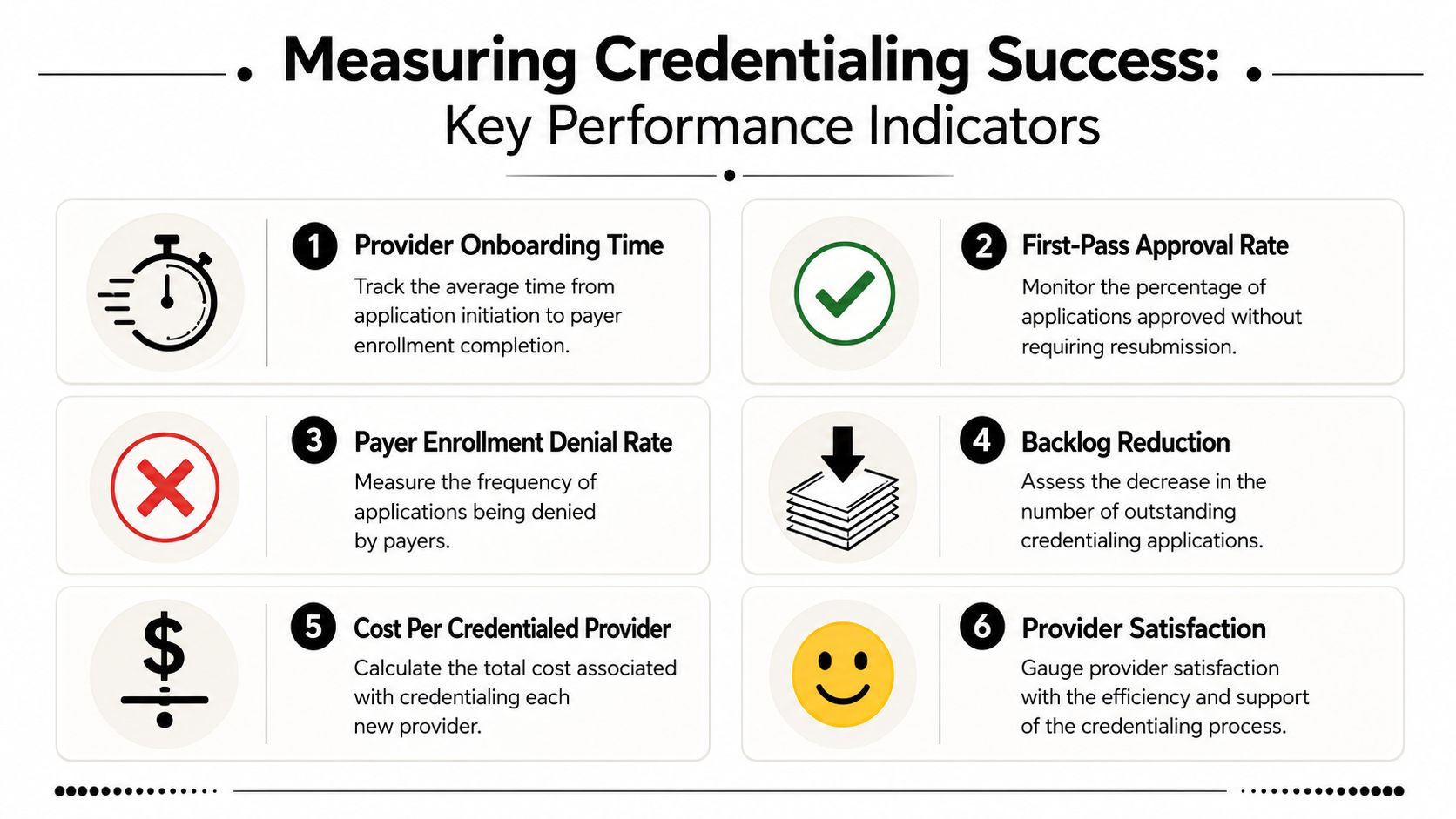
The KPIs that actually matter
Don't stop at “applications submitted.” Submission is activity, not outcome.
Track these measures instead:
- Provider onboarding time: Measure the span from intake to completed payer enrollment.
- First-pass approval rate: Track how often files move through without resubmission.
- Payer enrollment denial rate: Separate payer denials from ordinary requests for additional information.
- Backlog volume: Count outstanding files by payer, specialty, and aging bucket.
- Cost per credentialed provider: Include internal labor and vendor costs together.
- Provider satisfaction: If providers constantly chase updates, your process is under-managed.
A practical operating cadence
You don't need a giant committee. You need a repeatable review rhythm.
I recommend a monthly checkpoint with operations, credentialing, and billing leadership focused on three questions:
| KPI review question | What you want to learn |
|---|---|
| Which providers are not yet billable? | Immediate revenue exposure |
| Which files have stalled, and why? | Process bottlenecks and payer issues |
| Which denials traced back to enrollment defects? | Upstream leakage that needs correction |
Use those meetings to force action. Escalate aged files. Fix document gaps. Align billing setup before the provider starts seeing payer patients. Review your broader revenue cycle management metrics alongside credentialing so leadership can see whether enrollment performance is helping or hurting cash flow.
What gets measured in credentialing gets billed faster. What doesn't gets discovered in denied claims.
What success should look like
Success is not just “everything is organized.” Success means providers become billable with fewer surprises, recredentialing deadlines don't lapse, and billing teams stop inheriting preventable enrollment defects.
That's the standard. If your medical credentialing service can't show progress in those terms, it's operating as a file processor, not a revenue protection function.
If your organization needs credentialing handled as part of a broader revenue protection strategy, RevGuard is one option to evaluate. The firm connects credentialing with revenue cycle management and payer dispute workflows, which can be useful for specialty groups, hospitals, ASCs, and multi-state platforms that want to reduce upstream denials and protect cash flow more deliberately.