

Most advice on peer to peer reviews starts from the wrong premise. It treats the call like a fair-minded clinical conference where two physicians compare notes and the stronger argument wins.
That's not how many providers experience it. Many physicians describe payer-driven peer to peer reviews as a mechanism that delays treatment and adds friction, and broader analysis of peer review processes has described them as “opaque, slow, and susceptible to conscious and unconscious bias” in a discussion summarized in this physician thread and related commentary. If you walk into the call expecting collaboration, you often give up the one advantage you still control, your documentation.
The practical frame is different. A peer to peer review is not just a chance to overturn a denial. It's also a discovery event. You're testing the payer's clinical rationale, identifying gaps in its position, locking in statements that may matter later, and building a record that can support escalation if the denial stands. Practices that understand that distinction handle these calls differently from the start.
Reframing the Purpose of Peer to Peer Reviews

Peer to peer reviews are often framed as clinical conversations between equals. For most practices, they function more like a managed checkpoint inside the payer's denial process. That distinction matters because it changes what success looks like.
The call can still reverse a denial. It can also give you something just as valuable if the denial stands, a record you can use in appeal, contract dispute, or Independent Dispute Resolution. Teams that treat P2P as a single chance to persuade the payer usually under-document the exchange. Teams that treat it as both an advocacy event and an evidence-gathering event preserve options.
The wrong metric is call outcome alone
A verbal approval is helpful, but it is not the whole job.
Practices still get burned after "successful" calls when the approval is not reflected correctly in the authorization file, the claim is not reprocessed, or the payer changes the basis for nonpayment later. The reverse is also true. A denied P2P can still strengthen your position if your team captures the reviewer's name, specialty, stated rationale, policy references, and any failure to address the treating physician's documented facts.
Use a simple operating rule: every peer to peer review should leave behind a file that another reviewer, appeals nurse, arbitrator, or attorney can understand without guessing what happened on the call.
That is where many organizations fall short. The physician remembers the conversation. The payer's notes are sparse or inaccessible. The chart is strong, but the post-call record is too thin to support escalation. If your organization already has a formal healthcare denial management process, peer to peer reviews should sit inside that process as a documented step with assigned owners, deadlines, and follow-up controls.
What a well-run P2P is actually doing
A strong P2P does more than argue medical necessity in real time. It helps the practice answer four operational questions:
- What is the payer relying on? Policy language, missing documentation, coding assumptions, level-of-care criteria, or a reviewer's unsupported judgment.
- What did the reviewer commit to on the record? Names, dates, cited criteria, disputed facts, and any acknowledgment of chart elements.
- What evidence will matter if the case escalates? Contemporaneous notes, denial letters, policy versions, and mismatches between the record and the payer's rationale.
- What is the next lane? Reprocessing, formal appeal, contractual escalation, or an IDR path depending on the claim and plan type.
That last point changes how experienced revenue cycle teams prepare clinicians for these calls. The objective is not to "win the conversation" in the abstract. The objective is to create a clean factual record while giving the payer a fair chance to reverse course.
This isn't cynicism. It's operational realism.
Payer reviewers do not always work from the same assumptions as the treating physician, and they may have limited time, limited specialty alignment, or a narrow view of the chart. Your side has to compensate for that by making the medical necessity argument specific, documented, and traceable. If the denial is upheld, the file should already contain the raw material needed for the next stage.
That is the shift in mindset. A peer to peer review is not just a call to salvage one claim. It is an early deposition of the payer's position, and in difficult cases, it becomes the foundation for the IDR strategy that follows.
The Pre-Call Preparation Playbook
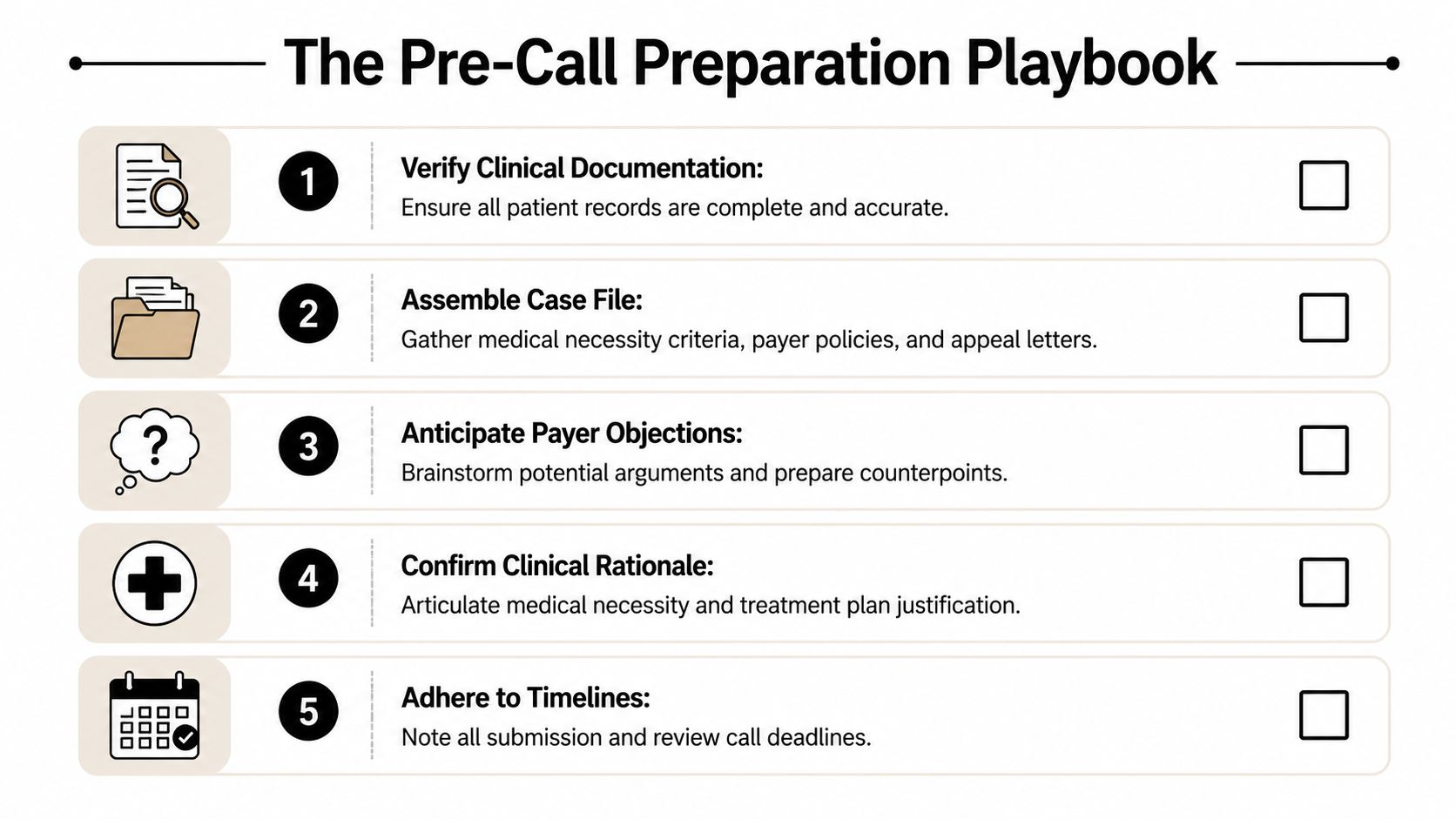
A peer to peer call is often treated like a last-minute physician task. That is one reason practices lose them.
The call goes better when the clinical argument, denial rationale, and payer policy are already lined up before anyone speaks. That prep should also produce a record your team can use later if the payer refuses to reverse the denial and the dispute has to move into a formal escalation track.
Preparation has to be narrower and sharper than “gather the records.”
Build a case file that can survive appeal or IDR review
Start with the denial itself. Identify the exact service denied, the date of service, the denial reason, the policy cited, and whether the payer is disputing medical necessity, level of care, site of service, experimental status, prior authorization, or something else.
Then assemble a working packet:
- The denial notice with the exact rationale highlighted.
- The payer medical policy in effect on the date of service.
- The chart excerpts that matter. H&P, progress notes, failed conservative treatment, imaging, pathology, medication history, risk factors, and prior interventions, depending on the case.
- The authorization history if there was prior approval, modification, or conflicting guidance.
- A one-page clinical brief for the physician doing the call.
- Internal claim notes showing what was submitted, what was corrected, and what the payer has already said.
If your team does not connect this prep to the broader claim adjudication process, the same denial pattern will repeat. Many peer to peer losses start upstream with poor policy matching, weak issue classification, or records that answer the wrong question.
This file is not just for the call. It is the beginning of your dispute record.
Convert the case into criteria the reviewer has to address
General statements rarely move a payer medical director. “This was medically necessary” is too easy to dismiss. The stronger approach is to break the case into checkable elements tied to the payer's own standard.
As noted earlier, explicit criteria produce more consistent review than subjective judgment. Use that reality to your advantage.
Your prep memo should look like this:
| Payer criterion | Patient-specific fact | Chart support |
|---|---|---|
| Required symptom severity | Symptoms documented as persistent and clinically significant | Office note dated [insert date] |
| Failure of conservative management | Prior treatments attempted and inadequate | Treatment history section |
| Objective findings | Imaging, lab, pathology, or exam supports intervention | Diagnostic report |
| Contraindication to alternative | Alternative option unsuitable or already failed | Specialist note |
That table does two jobs. It helps the physician stay focused during the call, and it forces the payer reviewer to agree, disagree, or sidestep a specific point. If the case later moves into appeal or IDR, that distinction matters.
If the denial relies on vague language, pull the discussion back to policy criteria and charted facts.
Give the physician a brief they can use in real time
Do not hand the physician a stack of records five minutes before the call. That wastes their time and weakens the presentation.
Use a one-page brief with these fields:
- Patient snapshot: age, diagnosis, acuity, and key history
- Denied service: exact CPT, HCPCS, drug, level of care, or procedure
- Why it was necessary: three to five decisive facts
- Why alternatives were not appropriate: prior failure, contraindication, urgency, or progression
- Policy alignment: bullet-by-bullet match to payer criteria
- Requested outcome: overturn denial, approve service, reprocess claim, or confirm authorization
- Record goals: what the physician needs the reviewer to state clearly on the call if the denial is upheld
That last item is usually missing. It should not be. At RevGuard, we prepare physicians to make the best approval argument available, but also to pin down the reviewer's position with enough precision that the next team can use it.
Anticipate the payer's argument before the call starts
Payer objections are predictable. The exact wording changes. The pattern usually does not.
Build rebuttals in advance for the objections you are likely to hear:
- Medical necessity challenge: Document severity, progression, failed alternatives, and objective findings.
- Alternative treatment argument: Show why the alternative was unsuitable for this patient, not just generally available.
- Experimental or investigational label: Pull the exact policy language and compare it to the service rendered.
- Documentation insufficiency: Match what was submitted against what the payer claims was missing.
- Site-of-service issue: Tie the setting to the patient's condition, monitoring needs, and risk profile.
This preparation protects the physician from getting pulled into hypotheticals or broad clinical debates. The goal is a controlled record anchored to the denial, the policy, and the chart.
That is how you improve the odds of a reversal. It is also how you avoid wasting a bad peer to peer call by turning it into useful evidence for the next stage.
Conducting the P2P Call to Control the Narrative
The payer wants a wandering conversation. You want a short record anchored to the denial reason, the policy criteria, and the patient's documented facts.
Control starts in the first minute.
Open with a structured summary
A weak opening sounds like this: “I'm calling about my patient and wanted to explain why I think this should be approved.”
A strong opening sounds like this:
“I'm the treating clinician for this patient. I'd like to focus on the denial reason, the applicable policy, and the documented facts that support medical necessity. I have three specific points that address the denial directly.”
That opening does three things. It narrows the scope, signals that you're organized, and discourages the reviewer from turning the call into an abstract discussion.
Then move immediately into the facts:
- The diagnosis and relevant clinical status.
- The denied service.
- The policy criteria at issue.
- The chart evidence that satisfies those criteria.
Keep it brief. If you need more than a few minutes to explain the clinical story, your preparation was too loose.
Don't argue in generalities
When a payer medical director says, “I'm not sure the service was medically necessary,” many clinicians respond with broader explanation. That often weakens the case because broad explanation invites more subjective disagreement.
Use the chart and the policy.
Try language like:
- “The denial cites medical necessity. The patient met the policy requirements based on documented failure of prior management, objective findings, and the treating specialist's assessment.”
- “The issue isn't whether another approach exists in theory. The issue is whether this patient, on this date of service, met the payer's own criteria.”
- “I'd like to stay with the denial basis in the letter. If there is a different reason for non-approval, please state it clearly for the record.”
That last sentence matters. It forces clarity. Many peer to peer reviews drift because the payer's real objection isn't the one printed on the denial notice.
Redirect when the reviewer interrupts or wanders
Some reviewers rush. Some interrupt. Some ask broad questions that aren't tied to the denial. Don't mirror the chaos.
Use polite resets:
- “I want to make sure we address the stated denial reason first.”
- “Let me answer that using the chart.”
- “Before we move on, did you review the note dated [insert date]?”
- “Can you identify the specific policy requirement you believe was not met?”
- “If your concern is alternative treatment, I can address why that option wasn't appropriate in this case.”
In these situations, many treating physicians lose control. They assume politeness means allowing the reviewer to dominate the call. It doesn't. Politeness and control can coexist.
The most effective clinicians on these calls don't sound angry. They sound precise.
Handle common objections with a repeatable pattern
Use the same three-part structure each time:
- State the objection clearly.
- Tie it to the policy or denial language.
- Answer it with documented facts.
Here are examples.
Objection: Not medically necessary
Response:
“The denial states the service wasn't medically necessary. The record documents the patient's condition, prior treatment history, and the specific clinical factors that made the denied service appropriate. Which element of that documentation do you believe fails the policy?”
Objection: Conservative treatment should have continued
Response:
“The patient already underwent prior management without adequate resolution, and that history is documented. If the payer believes additional conservative treatment was required, please identify the policy language supporting that position.”
Objection: A lower-cost alternative was available
Response:
“Availability isn't the same as appropriateness. In this patient's case, the alternative was not suitable because of the documented clinical factors in the chart. I'm happy to walk through those one by one.”
Ask questions that matter later
The call isn't only about persuasion. It's also about record-building.
Ask for:
- The reviewer's name and specialty
- Whether they reviewed the full submitted record or only selected materials
- The exact policy or guideline they relied on
- Whether the denial basis is unchanged after the discussion
- What additional documentation, if any, would alter the outcome
- Whether the decision will generate written confirmation
Write the answers down in real time. If the payer later changes rationale, says the issue was procedural rather than clinical, or claims no new facts were presented, your notes become important.
Know when to stop
There's a point where more talking hurts you. If the reviewer is entrenched, has stated the denial will stand, and won't identify a concrete missing element, close professionally.
Say:
“Thank you. I want to confirm that the denial is being upheld based on the rationale you stated today, and that no additional clinical documentation was identified as necessary to change that determination.”
That statement limits later revisionism. It also sets up the next step, whether that's appeal, contractual escalation, or IDR-related evidence development.
Post-Call Documentation for Downstream Success
A favorable peer to peer review that isn't documented is fragile. An unfavorable one that isn't documented is wasted.
The work after the call often determines whether the practice gets paid.
Capture the record immediately
Document the call while details are fresh. Don't wait until end of day.
Your internal note should include:
- Date and time of the call
- Patient identifiers consistent with your privacy protocols
- Claim or authorization reference
- Name, title, and specialty of the payer reviewer
- Denial reason discussed
- Policy cited by the payer
- Clinical facts presented by your clinician
- Questions asked and answers given
- Decision status at end of call
- Any promised next steps or turnaround statements
- Reference or tracking number provided
If no reference number is provided, document that too. Silence is also part of the record.
Send a same-day summary email or portal message
You want a timestamped confirmation attempt in writing. Even if the payer never replies, your message helps establish what was discussed.
Use a template like this:
Subject: Summary of Peer to Peer Review for [patient/claim reference]
Today, [clinician name] completed a peer to peer review regarding the denial of [service] for 2026.
We discussed the denial basis of [insert stated reason], the applicable policy identified on the call, and the following clinical points:
- [Key fact one]
- [Key fact two]
- [Key fact three]
Our understanding from the call is that:
- [approval upheld / denial upheld / pending review]
- [any additional documents requested]
- [reference number if provided]
If any part of this summary is inaccurate, please advise promptly in writing.
This doesn't need to sound aggressive. It needs to be clean.
Update every system that touches the claim
One common breakdown is that the physician knows the outcome, but patient access, billing, utilization review, and appeals staff don't. Then the organization misses deadlines or resubmits the wrong packet.
Update:
- The EHR or UM note if appropriate
- The billing system
- The denial tracker
- The appeal calendar
- Any centralized payer issue log
Field note: If your organization can't see the peer to peer outcome in the same workflow as the claim status, you'll keep losing recoverable revenue to handoff failures.
Separate verbal wins from operational wins
A reviewer may say the service is approved, but the claim may still sit unpaid because the authorization wasn't linked, the processor wasn't notified, or the denial code wasn't reversed.
Treat these as separate checkpoints:
| Call outcome | What to verify next |
|---|---|
| Verbal approval | Written confirmation, auth linkage, claim reprocessing |
| Denial upheld | Appeal deadline, full note, escalation package |
| Pending review | Due date for decision, responsible payer unit, follow-up owner |
That distinction is where many organizations leak money. They stop at “the doctor won the call” and fail to verify that the claim moved.
Connecting P2P Outcomes to IDR Strategy and KPIs
A peer to peer review only has strategic value if the organization turns the result into a repeatable decision. One call is an event. A pattern across payers, services, facilities, and denial reasons is intelligence.
That's why every P2P outcome should feed a broader reimbursement strategy instead of sitting in a note field that nobody analyzes.
Use the call to decide the next lane
After the documentation is complete, sort the case into one of three tracks:
- Accept and monitor: The denial was reversed and the claim is moving correctly.
- Standard appeal path: The denial rationale is weak, but the matter still fits a conventional appeal route.
- Escalation-ready dispute: The payer held a poor position, changed reasoning, ignored clear documentation, or created a record that supports a stronger downstream challenge.
The unique value of peer to peer reviews is that they often expose the payer's real posture. Sometimes the written denial looks technical, but the live discussion reveals that the reviewer is relying on generalized assumptions or incomplete file review. That matters when deciding whether further effort is worth it.
Track behavior, not just outcomes
Most practices track whether the call was a win or loss. That's not enough.
Useful internal KPIs include:
- P2P overturn rate by payer
- Denial reason by service line
- Time spent by clinician per call
- Rate of verbal approvals that convert to paid claims
- Rate of failed P2Ps that progress to successful downstream recovery
- Reviewer consistency issues and repeated policy disputes
You don't need a sprawling analytics program to start. You need enough structure to answer practical questions. Which payer repeatedly shifts rationale? Which service lines consume the most physician time? Which denials are poor candidates for peer to peer and should move faster toward formal escalation?
For organizations that want to mature that tracking, a focused set of revenue cycle management metrics is the right backbone.
Why this matters for IDR thinking
The article's core shift is simple. Don't treat the peer to peer review as the finish line. Treat it as evidence development.
A bad payer interaction can still help the provider if it produces a strong factual record. A weak clinical review, inconsistent rationale, or refusal to identify missing elements can all inform whether the case should continue and how it should be framed. When organizations do this well, peer to peer reviews stop being isolated frustrations and become part of a disciplined revenue protection system.
Frequently Asked Questions on P2P Reviews
What's a realistic success rate for peer to peer reviews
Hard data is scarce, and that's part of the problem. Providers ask for clear success-rate benchmarks, but the evidence base is thin. Research on other kinds of peer review shows that process changes don't always produce the hoped-for lift. In one example summarized by Absolutely Maybe in PLOS, adding specialist reviewers to systematic reviews produced only a 4.4% difference, far below the 15% target. The practical takeaway is that you shouldn't build your workflow around optimism about the call itself. Build it around disciplined preparation and a clear escalation path.
Who should own the workflow if the call requires a physician
The physician should own the clinical presentation. Non-clinical staff should own everything else they can lawfully and competently handle. That includes packet assembly, denial classification, scheduling, policy retrieval, note prep, post-call logging, and follow-up. If a practice makes the physician do all of that, the process becomes inconsistent and expensive.
What KPI matters most
The most important metric is usually not just overturn rate. It's whether peer to peer effort converts into paid claims or defensible escalations. A verbal win that never gets paid is operational failure, not success.
What's the most common mistake
Sending the clinician into the call with the full chart and no distilled argument.
That error invites a payer reviewer to define the discussion, cherry-pick details, and keep the conversation abstract. The best peer to peer reviews are built on a short, explicit case summary tied directly to the payer's stated policy and denial reason.
When should a practice stop chasing the call and escalate
Escalate when the payer won't identify a concrete missing element, changes rationale during the discussion, or upholds the denial despite a clearly documented case aligned to the policy. At that point, more phone time usually doesn't improve the file. Better documentation does.
RevGuard helps practices, facilities, and specialty groups turn denials, underpayments, and failed peer to peer reviews into structured reimbursement recovery. If your team needs a tighter connection between front-end RCM discipline and downstream IDR enforcement, explore RevGuard.