
Coding compliance moved out of the back office a long time ago. It now sits at the center of revenue protection, denial prevention, audit readiness, and payer dispute advantage.
The wake-up call is simple. In 2024, coding-related denials surged by 126%, with 42% of all denials tied directly to coding issues and 90% of claim denials stemming from preventable technical errors, according to this coding denial benchmark report. For practice administrators, that means coding compliance isn't a documentation exercise. It's a cash flow strategy.
A weak compliance program creates three problems at once. It delays payment, increases rework, and weakens your position when a payer challenges medical necessity, downcodes a claim, or asks for records. A strong program does the opposite. It produces cleaner claims, more defensible documentation, and fewer avoidable write-offs.
Why Coding Compliance Is Your Top Revenue Priority in 2026
Nearly half of denied claims never make it back out the door. That is why coding compliance belongs on the 2026 revenue agenda, not just the audit agenda.
The revenue cycle exposes coding failure late. You see it in a denial posted weeks after the visit, an underpayment discovered during reconciliation, or a records request that follows a payer's pattern analysis. By that point, the practice is spending staff time on rework, appeal prep, and payment recovery instead of collecting cleanly the first time.
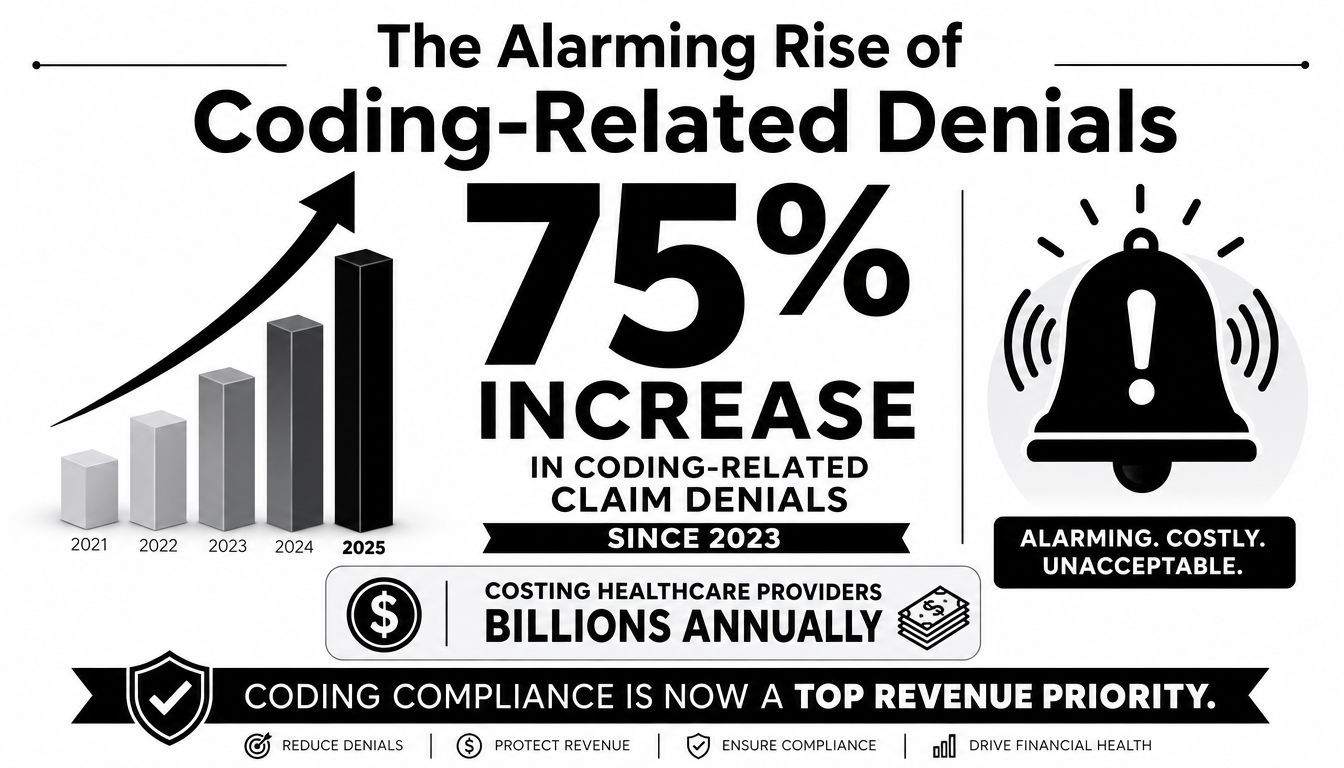
Denials are only the visible part of the problem
Denials get attention because they are easy to count. The larger financial risk often sits in claims that were paid incorrectly, coded conservatively, or never challenged after a payer reduction. Undercoding is a compliance problem in its own right. If the documentation supports a higher level of service, missing that code creates revenue leakage, distorts provider productivity, and weakens the record you need if payment is questioned later.
That is the part many administrators underestimate. Overcoding brings obvious audit exposure, but undercoding drains margin subtly and month after month. I have seen practices focus so heavily on avoiding scrutiny that they train clinicians and coders into defensive downcoding. The result is fewer denials on paper, but lower reimbursement, unreliable benchmarking, and a false sense of compliance.
As noted earlier, industry benchmarks showed a sharp rise in coding-related denials in 2024, and those errors also drive resubmissions, appeals, payer scrutiny, and write-offs when staff never get back to the claim. The same pattern shows up in aging AR, coder queues, and unstable net collection rates.
Practical rule: If your team is fixing coding after denial, you are paying twice. Once in delayed reimbursement, and again in labor.
Compliance is how you build a dispute-ready claim
A compliant claim is financially durable. It matches the note, diagnosis selection, procedure code, modifier use, and medical necessity support closely enough that the payer has less room to downcode, deny, or recoup later.
That requires more than a periodic chart audit. It requires a working process that connects provider documentation, coding review, edit logic, and feedback loops. Practices that build that discipline into daily operations produce cleaner claims and spot missed revenue earlier, especially in high-volume service lines where small coding misses add up fast. A structured medical coding workflow and oversight process helps close both sides of the risk. Unsupported codes that trigger denials, and supported codes that never get billed at the level earned.
Practices that treat compliance as a once-a-year review usually react to payer behavior after cash has already slowed. Practices that treat it as a revenue control function protect payment speed, reduce avoidable write-offs, and put themselves in a stronger position when a payer disputes the claim.
Decoding Coding Compliance in Healthcare
Coding compliance is the discipline of making the claim match the chart, the service, and the payer's rules at the same time. In practice, that means applying ICD-10-CM, CPT, HCPCS, and NCCI correctly so the claim stands up on diagnosis specificity, medical necessity, code pairing, and edit logic. The core definition and denial implications are outlined in this overview of medical coding compliance and preventable denials.
Administrators usually hear about compliance in the context of overcoding risk. That is only half the problem. Undercoding creates its own compliance exposure because it reflects a process that cannot reliably convert documented care into the billed claim. It also drains revenue unnoticed, especially in high-volume encounters where small level-of-service misses repeat all month.
The coding language works like a set of interlocking rulebooks, and the claim only holds if those rulebooks align.
- ICD-10-CM drives diagnosis specificity and supports medical necessity.
- CPT defines physician and outpatient services and often determines reimbursement.
- HCPCS captures supplies, drugs, transport, and other reportable items that CPT does not fully cover.
- NCCI edits govern code pairings and bundling logic so separately reported services meet edit standards.
A claim can still fail when one element is correct on its own. A valid CPT code with a weak diagnosis can deny. A documented procedure with the wrong modifier can reject. A fully supported visit can also be billed below the level earned, which creates no denial at all and still costs the practice money.
That operational blind spot matters. Overcoding gets attention because it is visible during audits. Undercoding often sits in plain sight inside stable denial rates, lower-than-expected reimbursement per visit, and providers whose documentation supports more than the claim reflects.
Clean coding starts upstream. Charge capture design, documentation templates, provider query rules, and coder review standards all shape whether the final claim is accurate and defensible. A stronger medical coding workflow and oversight process reduces variation between coders, shortens rework cycles, and helps the practice catch both unsupported charges and missed billable value.
Coding compliance is a production process. It should produce claims that are supportable, payable, and billed at the level the documentation actually earns.
Industry analysis has found that a meaningful share of denials tied to coding issues can be prevented with tighter controls. The practical goal is not theoretical perfection. The goal is consistent claim accuracy at scale, with fewer denials on the high side and less silent revenue leakage on the low side.
Identifying Top Coding Risks and Denial Drivers
Most compliance conversations start with overcoding. That's understandable, but incomplete. The more useful approach is to look at the patterns that create denials, revenue leakage, and audit risk in both directions.
Some errors produce obvious denials. Others produce silent underpayment. Both belong on the same risk register.
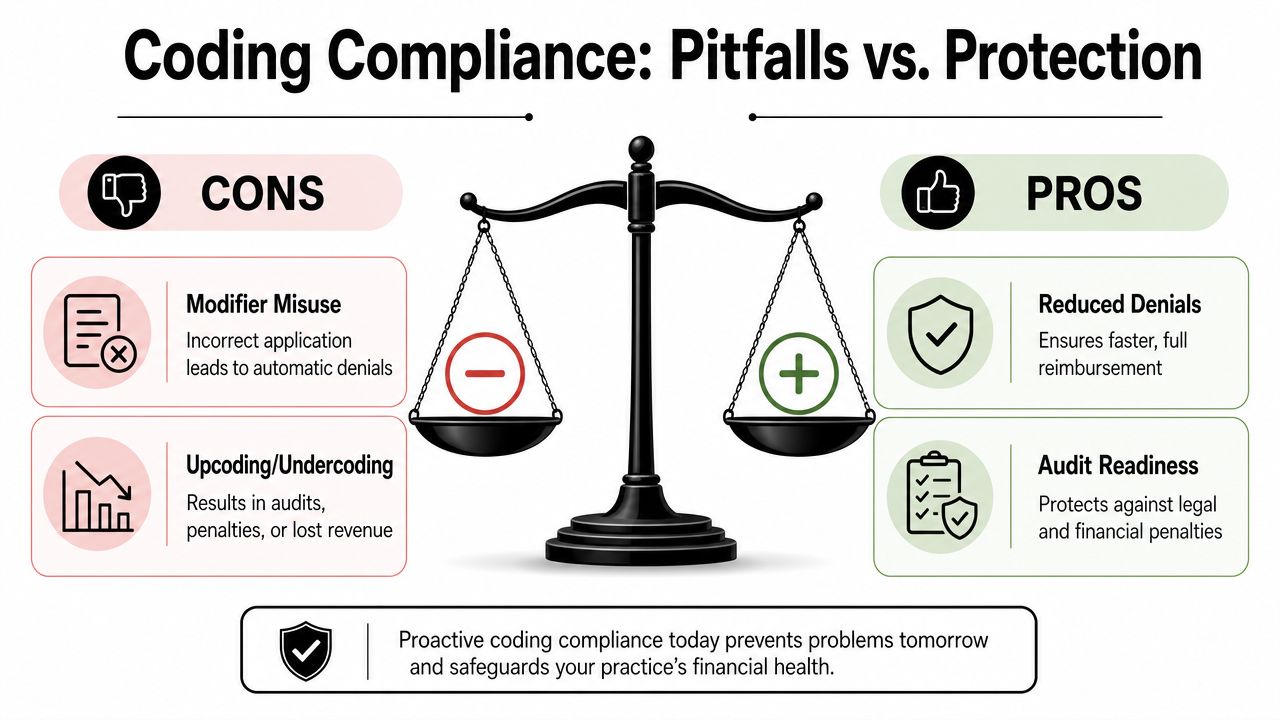
The denial drivers that show up repeatedly
A handful of issues account for a disproportionate share of coding cleanup work:
- Modifier misuse can trigger automatic edits, especially when the modifier doesn't match the documentation or payer rule.
- Diagnosis and procedure mismatch creates medical necessity denials when the ICD-10-CM selection doesn't support the CPT or HCPCS billed.
- Unsupported service levels lead to downcoding, recoupment risk, or prepayment review.
- Unbundling errors expose the practice to denials and compliance scrutiny when components are billed separately despite edit logic.
- Missing documentation elements leave the coder guessing, which usually ends in either a query delay or a weak claim.
These aren't abstract compliance misses. They are operating failures. Every one of them adds touches to the account and gives the payer an easier path to nonpayment.
Undercoding is not a safe strategy
This is the risk many organizations still get wrong. Some providers and even some managers assume billing a lower code is conservative and therefore safer. It isn't.
The American Medical Association guidance is explicit. "Undercoding isn't a solution" and providers should report the "entirety of the work performed", as stated in the AMA-linked discussion of undercoding as a compliance liability. That matters because undercoding creates two exposures at once. It causes direct revenue leakage, and it can signal that the organization is not accurately reporting services rendered.
If the record supports the work, the compliant answer is to code the work. Not more than the work, and not less.
Undercoding also distorts operational data. It makes providers look less complex than they are. It weakens benchmarking. In some settings, it affects risk adjustment and payer contract performance reviews. It trains the organization to accept avoidable loss as a form of compliance discipline.
What works and what doesn't
What works is targeted review of high-risk code families, recurring modifier patterns, and payer-specific denial categories. What doesn't work is generic advice to "be careful" without tying findings back to actual charts, actual coders, and actual providers.
A mature team treats both overcoding and undercoding as accuracy failures. The standard isn't caution. The standard is truth supported by documentation.
Building an Effective Coding Compliance Program
Practices do not get consistent coding accuracy from good intentions. They get it from a control structure that holds up on busy clinic days, during staffing gaps, and under payer pressure. The most useful model for that is the three-line structure Conifer outlines in its overview of coding, coding quality, and compliance oversight. Operations keeps charts moving. Quality checks whether codes match the record. Compliance confirms the organization can show policy, oversight, remediation, and repeatable discipline.
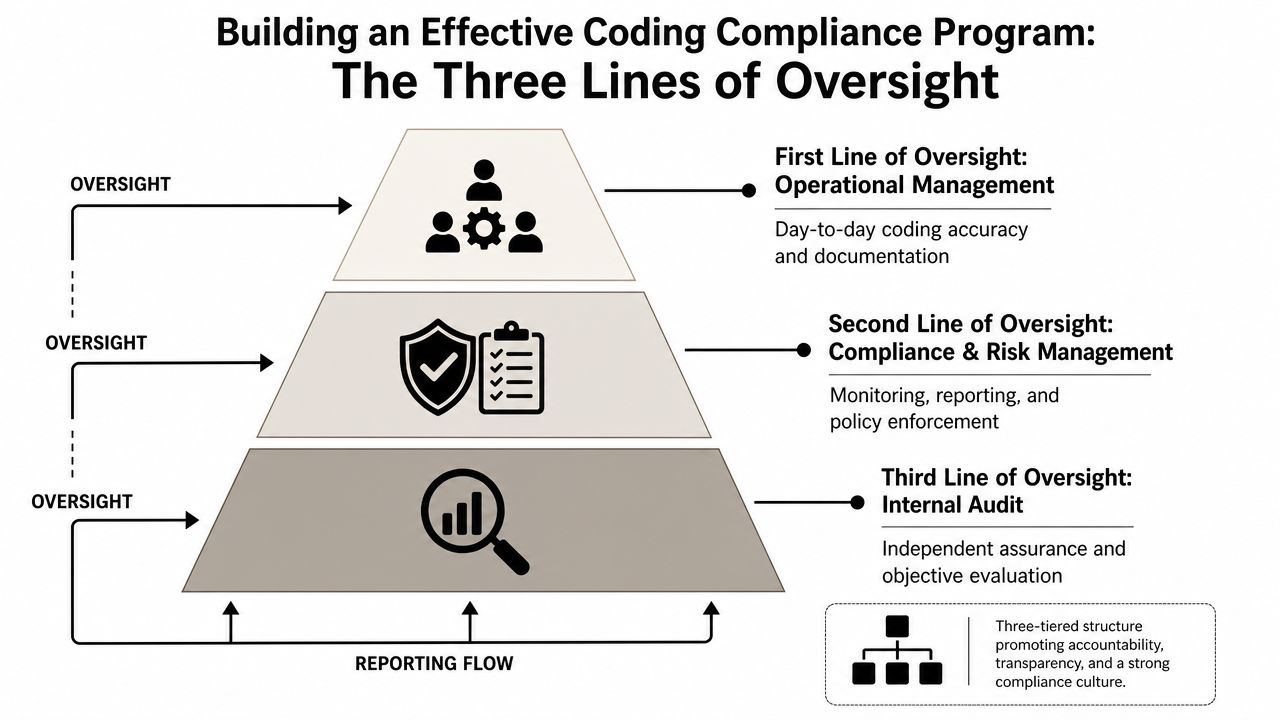
Start with governance, not software
Software can speed review, but it will not fix unclear accountability. In practice, weak governance creates the same result every time: inconsistent coding decisions, uneven provider education, slow remediation, and audit findings that never change behavior.
A written program should identify who owns coding policy, who audits, who delivers provider feedback, who approves corrective action, and who escalates unresolved patterns. If those roles are vague, teams either duplicate work or assume someone else is handling it.
At minimum, the program should include:
- Defined ownership for coding operations, audit, compliance review, provider education, and final escalation
- Written policies covering documentation standards, query rules, modifier use, annual code updates, and corrective action steps
- Routine internal audits designed to find patterns by payer, specialty, provider, location, and code family
- Incident response steps for repeated errors, unsupported billing, and high-risk trends that require repayment, education, or broader review
I have seen many organizations spend heavily on technology while leaving these basics loose. They usually end up with faster inconsistency.
Build the workflow around where risk enters the claim
A strong program is built around handoffs. Risk shows up when documentation is incomplete, when coders fill gaps from habit, when edits fire too late, or when education stops at a slide deck.
The workflow needs to be specific:
- Set documentation standards by service line. E/M, surgery, therapy, infusion, and diagnostic testing do not fail for the same reasons.
- Require a formal query process. Coders should clarify unsupported or ambiguous documentation instead of guessing.
- Audit targeted risk areas. Random sampling has a place, but focused reviews find repeated loss faster, especially in undercoded visits, modifier usage, and payer-denied services.
- Assign remediation with deadlines. Findings should tie to an owner, a corrective action, and a date for follow-up.
- Re-audit the same issue. If the pattern returns, the first intervention did not solve the problem.
For teams reviewing whether current controls are changing outcomes, this guide to medical billing audit practices is a useful benchmark.
One point gets missed in many compliance plans. The audit workflow has to look for revenue leakage from undercoding as aggressively as it looks for overstatement. If the record supports a higher-level service, additional procedure work, or a better-supported diagnosis set, failing to code it is still an accuracy problem. It lowers reimbursement, distorts provider productivity, and weakens the practice's own data.
Use technology to reduce inconsistency, not replace judgment
Technology has a clear role. It should reduce avoidable manual variation and surface issues early enough to prevent rework.
The best use cases are straightforward:
| Control point | Best use | Common mistake |
|---|---|---|
| Pre-bill edits | Catch missing fields, code conflicts, and unsupported combinations | Treating a clean edit as proof that the claim is accurate |
| CAC support | Present likely code options and improve coding consistency | Letting the tool drive the final code without chart-level review |
| EHR integration | Keep code sets current and align documentation to billing requirements | Using poorly built templates that create vague, cloned, or incomplete notes |
Technology should help coders work faster and more consistently. It should not replace chart judgment, provider clarification, or focused audit review.
The practical test is simple. A compliance program should lower denials, reduce rework, catch both undercoding and overcoding, and show a clear trail from finding to fix. If it cannot do that, it is an administrative exercise, not a revenue protection system.
Tailoring Compliance for High-Risk Specialties
A generic compliance plan usually fails in specialty environments. The rules may be universal, but the risk isn't. The coding issues in anesthesia don't look like the issues in orthopedics, and neither look like the issues in air ambulance.
Many organizations tend to overestimate the value of general coding knowledge. In complex specialties, that isn't enough. Coding Network argues that organizations need specialized proficiency tests to identify knowledge gaps and notes that leading groups assign accounts only to coders who score 95% or higher on skills assessment tests, as described in its article on medical coding compliance and specialty validation.
Where specialty risk actually shows up
Consider how different the controls need to be:
- Anesthesia requires disciplined handling of time, concurrency, and documentation alignment between the record and billed units.
- Orthopedics often carries higher CPT complexity, modifier sensitivity, and surgical package questions that generic audits can miss.
- Air ambulance depends heavily on medical necessity support and precise transport-related documentation.
In each setting, coder competency must be tested against the specialty's actual chart types and denial patterns. A broad certification may show baseline skill. It doesn't prove readiness for your service mix.
Generic audits miss specialty-specific loss
One of the most practical points from the specialty compliance discussion is that auditors should give appropriate weight to high-risk CPT codes, not treat all code categories as if they carry the same compliance exposure. That's especially important in procedural specialties, where a single coding error can have outsized reimbursement and audit implications.
A stronger model uses specialty-focused review:
- Coder validation before assignment
- Procedure-specific audit tools
- Provider education tied to specialty templates
- Escalation rules for high-risk CPT families
- Recurrent testing when payer rules or documentation expectations change
The point isn't to make compliance heavier. It's to make it relevant.
Sample coding compliance KPIs by focus area
The right KPI set should show whether your program is improving accuracy, reducing avoidable rework, and identifying weak spots by specialty.
| KPI | Description | Target Benchmark |
|---|---|---|
| Coding Accuracy Rate | Percentage of audited charts coded correctly against documentation and applicable rules | Set an internal threshold by specialty and raise it as performance stabilizes |
| Denial Rate by Coder | Tracks whether denial patterns cluster around specific staff or work queues | Trend downward over time and review outliers quickly |
| Documentation Query Rate | Measures how often coders need clarification before final coding | High rates may indicate provider documentation gaps or unclear templates |
| Modifier Error Rate | Monitors misuse in specialties where modifiers drive payment and edits | Keep under close monthly review in procedural service lines |
| Audit Repeat-Findings Rate | Shows whether the same issue reappears after education or remediation | The target is sustained reduction, not one-time correction |
A specialty program works when these measures lead to action. If the data sits in a dashboard and nobody changes assignments, templates, or training, the KPI set isn't doing its job.
Linking Compliance to Revenue Protection and Dispute Readiness
The strongest reason to invest in coding compliance isn't solely that denials are expensive. It's that compliant claims are easier to defend when a payer delays, downcodes, or underpays.
A claim becomes dispute-ready when the coding, documentation, and clinical rationale line up cleanly from the start. That consistency matters in ordinary appeals, payer reconsiderations, and disputes that fall under the No Surprises Act workflow. Teams that need a quick operational reference can review this summary of the No Surprises Act framework.
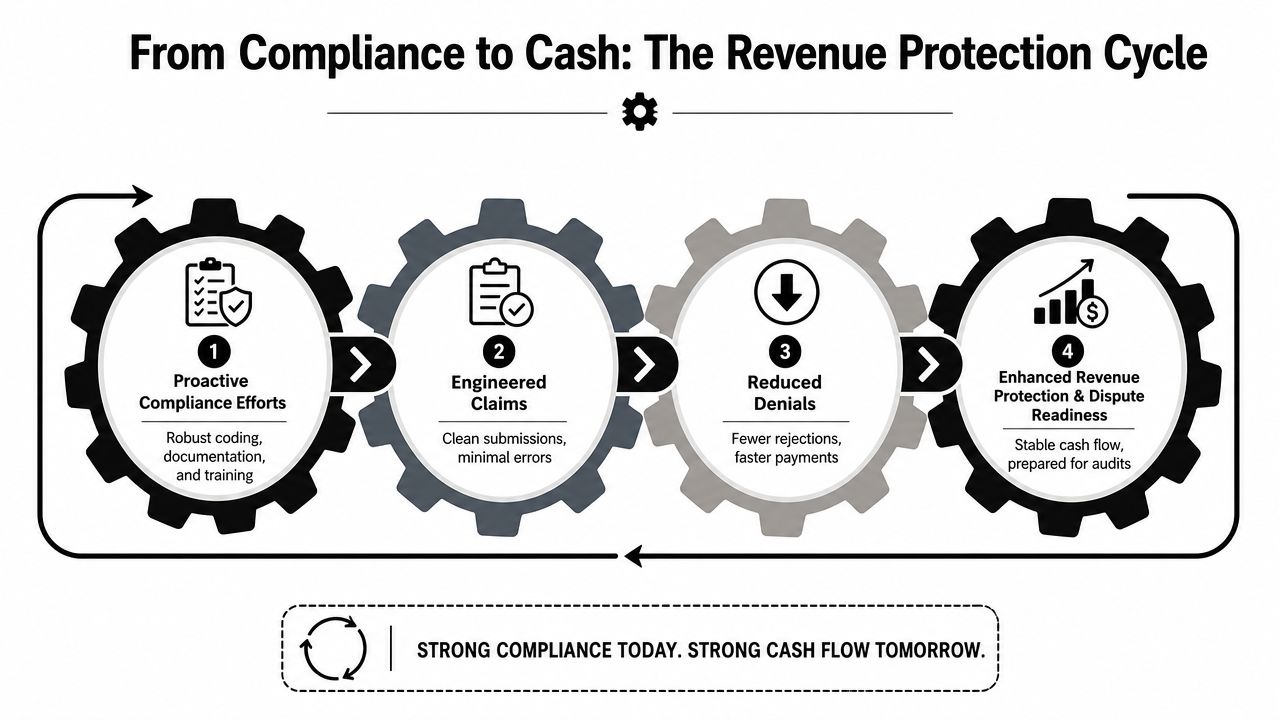
The upstream work becomes downstream evidence
When a payer challenges a claim, the practice needs more than a billed code. It needs a record that shows why the code was selected, why the service was medically necessary, and why the documentation supports the level billed.
That is what a compliance program produces when it's functioning well:
- Clear documentation support for the billed service
- Consistent code selection aligned with guidelines and payer expectations
- Traceable internal controls that show the organization applies standards consistently
- Fewer contradictions between the chart, claim, and follow-up correspondence
A disputed claim is much easier to defend when the original coding decision was made inside a disciplined process rather than improvised at bill drop.
Compliance strengthens cash flow, not just audit posture
Administrators often separate compliance work from revenue recovery work. In practice, they are linked. Strong coding compliance reduces denials on the front end and gives the team better evidence on the back end when payment is contested.
That matters in a payer environment where reimbursement friction is normal. If your operation wants full and timely payment, the claim can't just be billable. It has to be supportable under review.
Conclusion Your Path to Proactive Compliance
Coding compliance is one of the few revenue cycle disciplines that improves performance in multiple directions at once. It reduces preventable denials. It limits rework. It protects against recoupment and audit exposure. It also closes the quieter leak that too many organizations ignore, which is undercoding work that was performed and documented.
The most effective programs don't rely on annual training and broad reminders. They define ownership, audit the right risk areas, use formal query workflows, validate coder skill by specialty, and remediate problems until they stay fixed. They also reject the false choice between compliance and reimbursement. Accurate coding supports both.
If you're responsible for a specialty practice, ASC, hospital department, or multi-state provider platform, this is the right time to pressure-test your current model. Review your denial drivers. Look for repeat audit findings. Examine whether undercoding is being tolerated as a form of risk avoidance. Confirm whether your coders are qualified for the specialties they touch.
Reactive cleanup is expensive. Prevention is operationally cleaner and financially stronger. In the current payer environment, a bulletproof coding compliance program isn't a nice upgrade. It's core infrastructure.
RevGuard helps healthcare organizations build cleaner, dispute-ready claims and protect reimbursement across complex specialties. If your team needs support with coding, audit strategy, denial prevention, or No Surprises Act dispute enforcement, explore RevGuard to see how an integrated revenue protection model can strengthen both compliance and cash flow.