

You're probably dealing with a claim that should never have become a dispute in the first place. Your team verified eligibility, obtained authorization if required, rendered a medically necessary service, submitted a clean claim, and then the payer responded with a payment that doesn't reflect the work, the acuity, or the market reality. For specialty groups, air ambulance providers, anesthesia groups, and emergency-facing practices, that pattern isn't unusual anymore. It's operational.
That's why understanding the arbitration process steps matters. Under the No Surprises Act, the Independent Dispute Resolution process gives providers a structured path to challenge underpayments. It isn't quick money, and it isn't automatic. But when a practice manager understands how the process works, where payers try to weaken the record, and what happens after the award, arbitration stops feeling like a legal side project and starts functioning like revenue recovery.
Setting Expectations for the IDR Journey
A new practice manager usually sees the dispute only at the end. The EOB arrives. The allowed amount is far below expectation. Everyone asks the same question: can we fight this?
In NSA disputes, the answer is often yes, but only if the team treats IDR as a disciplined process rather than a last-minute appeal. The provider's strength comes from preparation, timing, and a clean factual record. That matters because arbitration is designed to be more efficient than court litigation, but it still requires sustained coordination between operations, billing, and legal review.
What the timeline really means
For complex arbitration matters, a realistic reference point is that the process from filing to final award in international arbitration typically lasts 11 to 22 months, which is still shorter than traditional litigation that can run for years, according to Hughes Hubbard's comparison of arbitration timelines. Domestic healthcare IDR under the NSA is designed to move faster, but that benchmark is useful because it resets expectations. A dispute may be faster than court, yet still long enough to affect forecasting, reserve planning, and cash timing.
That's the first mindset shift. Arbitration is not a same-quarter fix for every underpayment. It's a revenue protection channel.
Practical rule: If leadership expects IDR to behave like a corrected claim, they'll under-resource it and then conclude it doesn't work.
The process also follows a recognizable structure. Claims don't move from filing to payment in one jump. They move through intake, selection, briefing, decision, and often post-award collection activity. If your team hasn't mapped those handoffs, deadlines get missed and strong cases lose momentum.
Why this process exists for providers
For specialty providers, NSA IDR is usually the point where a payment dispute finally gets evaluated outside the payer's internal logic. That's the opportunity. The risk is that many groups enter the process with the wrong assumptions. They think the claim itself should speak for itself. It won't.
A clean claim proves submission. It doesn't prove why your payment position is more credible than the payer's.
That's why managers should know the operational basics of the law before looking at any single case. A plain-language No Surprises Act summary helps align the billing team, executives, and physicians on what the statute does and does not protect.
The operational commitment
IDR works best when the practice accepts three realities early:
- The dispute file must be built intentionally. Missing support rarely gets fixed by stronger rhetoric later.
- The payer will usually frame the case around its preferred benchmark. If you don't widen the evidentiary lens, you're accepting their framing.
- Winning the award is not the same as collecting the money. That issue becomes critical later.
If you start with those expectations, the rest of the arbitration process steps become much easier to manage.
Pre-Filing Strategy and Evidence Assembly
The strongest IDR cases are usually won before the portal filing starts. By the time the dispute is formally submitted, your team should already know the payment theory, the key exhibits, the weaknesses in the payer's likely argument, and which facts matter to a neutral reviewer.

Build a dispute-ready file, not a claim file
A claim file is administrative. A dispute-ready file is persuasive.
That means pulling together more than the UB, CMS, operative note, and remittance. The arbitrator needs a coherent explanation of why this service, in this market, by this provider, warranted more than what the payer issued. If the record is just raw documentation, the payer usually benefits because it can simplify the case into “provider billed high, plan paid appropriately.”
A stronger pre-filing packet usually includes:
- Negotiation history: Preserve open negotiation communications, payment positions, and any inconsistent payer explanations.
- Clinical complexity support: Highlight acuity, comorbidities, service intensity, unusual circumstances, or specialty-specific complexity that separates the case from a routine encounter.
- Provider-specific context: Include training, experience, service-line specialization, or facility capability when those facts help explain value.
- Market context: Assemble comparable service information from the geographic area, especially when the payer is trying to anchor the case too narrowly.
- Contract history when relevant: Prior contracted relationships can matter because they show what the payer itself has previously recognized as commercially reasonable.
Don't let the QPA become the whole case
One of the most common provider mistakes is treating the payer's preferred benchmark as the only benchmark. In practice, many payers write their story around the Qualifying Payment Amount and dare the provider to move the discussion somewhere more grounded.
You have to move it.
That doesn't mean ignoring the QPA. It means refusing to let it function as the complete case. If the patient's presentation was complex, if the service required subspecialty expertise, if the setting created unusual resource demands, or if local market realities support a different payment level, the evidence packet should say so clearly and early.
The provider's job isn't to sound offended by a low payment. The provider's job is to give the arbitrator a better payment rationale than the payer offers.
What works and what doesn't
What works is curated evidence. What doesn't work is volume for its own sake.
A concise summary memo often helps more than dropping hundreds of pages into the submission and expecting the arbitrator to connect the dots. If you include operative notes, chart excerpts, contracts, and correspondence, organize them around a payment thesis. Label them cleanly. Tie each exhibit to a reason it matters.
A practical checkpoint is to ask whether someone outside your specialty could understand the dispute in a short review session. If not, the file is still too internal.
For teams trying to standardize preparation before disputes arise, an RCM readiness checklist for NSA IDR is useful because it forces the organization to define ownership for evidence, deadlines, and specialty-specific support before the payer underpayment lands.
Navigating the IDR Portal and Selecting an Arbitrator
Once the evidence is assembled, execution matters. A surprising number of avoidable losses come from poor portal hygiene, incomplete data entry, or casual arbitrator selection. The filing step looks administrative, but it's strategic.

Treat portal entry like part of the argument
In the United States, arbitration generally follows six to seven core stages: filing a demand, submitting an answer, selecting an arbitrator, holding a preliminary hearing, conducting the evidentiary hearing, and issuing a written award, with answers commonly due within 14 to 30 days, as outlined in this overview of U.S. arbitration procedure. Healthcare IDR has its own rules and portal mechanics, but the operational lesson carries over. Early-stage entries shape what the case becomes.
If your intake team enters the wrong service details, omits necessary identifiers, mismatches claim support, or uploads a disorganized file set, you create friction that the payer won't help fix. Large payers are often better at procedural patience than smaller provider groups. They know confusion favors delay.
How to think about arbitrator selection
Practice managers often assume any certified entity is fine as long as the case gets assigned. That's too passive. Arbitrator selection is one of the first real decisions in the dispute.
What you want is not a “provider-friendly” decision maker. You want one with the discipline to evaluate a specialty claim on the record rather than defaulting to the payer's framing. For highly specialized services, that means checking whether the decision maker appears comfortable with medical complexity, facility-based services, and non-routine reimbursement issues.
Review candidate history where possible. Look for patterns such as:
- Specialty familiarity: Has the decision maker handled disputes involving comparable services or similarly technical claims?
- Reasoning quality: Do prior decisions appear to engage with the evidence, or do they rely heavily on one benchmark?
- Repeat payer appearance: Does the same payer or payer family show up repeatedly?
- Conflict posture: Are there signs that one side is effectively a repeat player in front of that neutral?
The repeat-player problem is real
Many providers become overly trusting. In employment arbitration, repeat employer and arbitrator pairings reduced employee win probabilities by 40.2%, according to the Consumer Finance Monitor paper discussing arbitration outcomes. That statistic comes from a different dispute context, but the lesson is directly relevant. Institutional familiarity can affect outcomes.
A provider doesn't need to allege misconduct to act cautiously. If a large payer appears repeatedly in front of the same neutrals, your team should examine that pattern and avoid assuming neutrality is self-proving.
If an arbitrator has seen the same payer's arguments over and over, the provider should ask whether that history changes how a new case will be heard.
Practical submission discipline
Before final submission, use a short internal review:
- Confirm patient and claim identifiers match every attachment.
- Check the chronology so the negotiation record and payment history are easy to follow.
- Review file names for plain-English labels rather than internal shorthand.
- Test the narrative by asking a non-clinical manager to explain the dispute back to you.
- Lock the deadline owner so no one assumes someone else hit “submit.”
The portal is just the vessel. The core issue is whether the case enters it in a form that helps the arbitrator understand your position quickly and correctly.
Crafting Your Offer and Arguing Your Case
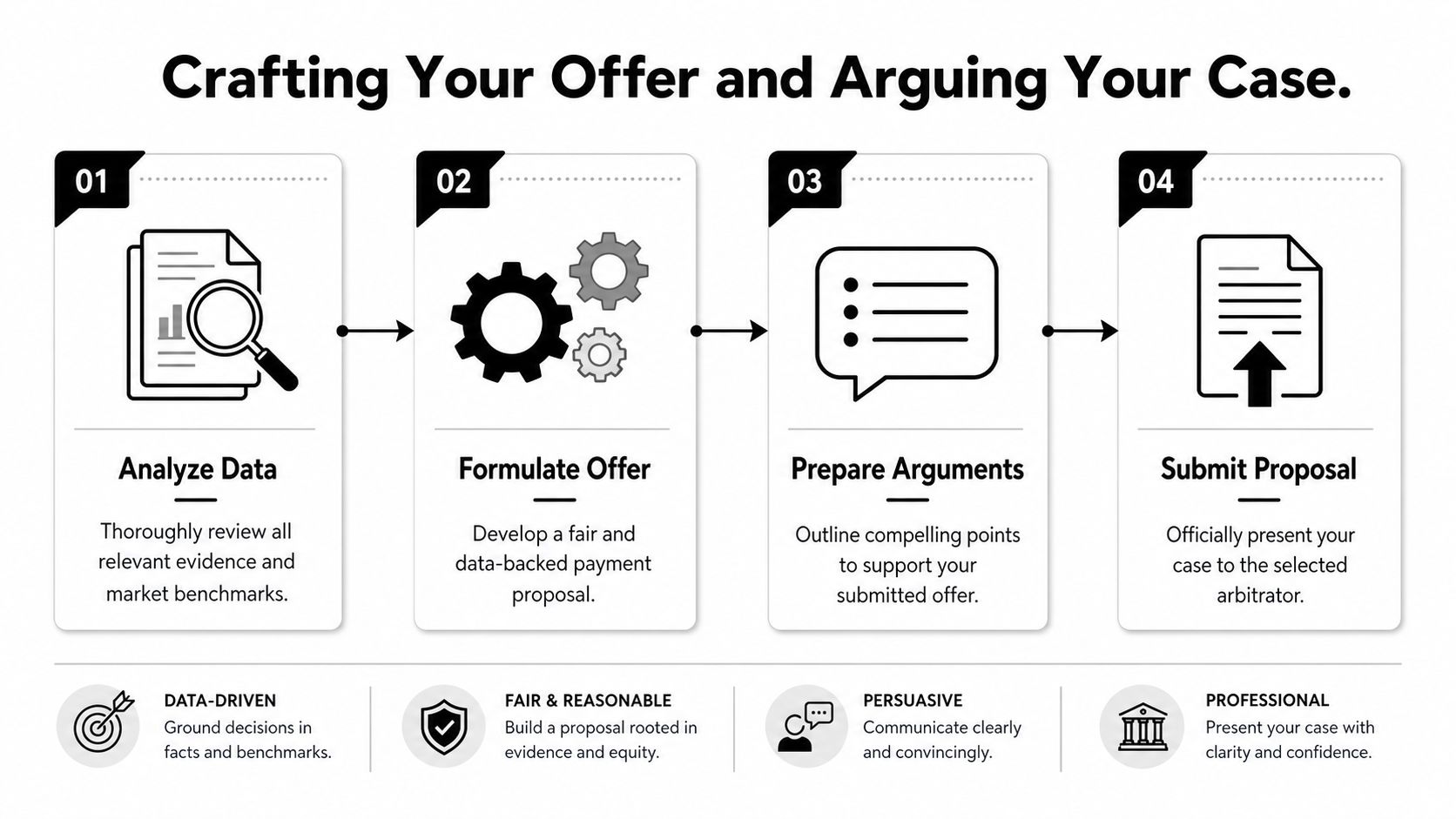
Once the case is active, the core question becomes simple: what payment amount can you defend, and can you explain that amount better than the payer explains its own number?
At this stage, many providers drift into one of two bad habits. They either submit an aspirational figure with weak support, or they become so defensive that they effectively accept the payer's framing and argue only at the margins. Neither approach works well.
Make the offer feel inevitable
The offer should read like the natural result of the record, not like a negotiation tactic. Your submission needs to connect payment to facts the arbitrator can evaluate: provider training, patient complexity, service intensity, prior relationships, market context, and the logic behind why the payer's position is too narrow.
The broad structure of arbitration is standardized into six stages: case initiation, arbitrator invitation and vetting, arbitrator appointment, preliminary hearing and information exchange, hearing stage, and award stage, according to Pepperdine Caruso School of Law's explanation of the arbitration process. In healthcare IDR, the briefing often does most of the heavy lifting because many disputes are decided on written materials rather than a traditional live hearing.
That changes how you should write. Dense legal prose usually performs worse than a clean reimbursement argument with disciplined exhibits.
The 6 core stages of an IDR case
| Stage | Provider's Key Action |
|---|---|
| Case initiation | Submit complete dispute information and frame the payment issue clearly |
| Arbitrator invitation and vetting | Review potential neutrals for fit, conflicts, and repeat-player concerns |
| Arbitrator appointment | Confirm the record is organized before the case moves forward |
| Preliminary hearing and information exchange | Clarify scheduling, submission rules, and evidentiary expectations |
| Hearing stage | Present a concise written argument supported by targeted exhibits |
| Award stage | Review the written decision promptly and prepare for next-step enforcement if needed |
How to structure the actual argument
A practical provider brief usually works best when it answers four questions in order:
- What happened? Summarize the service, payment, and dispute posture in plain language.
- Why is the provider's amount supported? Tie the offer to acuity, expertise, market facts, and case-specific evidence.
- Why is the payer's amount incomplete or distorted? Address benchmark overreliance, selective comparisons, or omission of complexity.
- What should the arbitrator do? State the requested payment outcome cleanly.
This is also the stage where upstream revenue cycle work matters. If the original claim documentation is weak, if peer-to-peer discussions were poorly handled, or if the team failed to preserve coverage and medical necessity support, the arbitration brief becomes a repair job. That's harder. Stronger peer-to-peer review processes often improve the record long before a dispute needs formal escalation.
Key takeaway: The best arbitration briefs don't try to say everything. They make it easy for the arbitrator to adopt one payment story and reject the other.
What payers often do here
Payers rarely submit weak-looking arguments on purpose. They typically do something more subtle. They simplify.
They recast a complex specialty encounter as a routine service. They lean on one payment benchmark as if it resolves the whole matter. They cite administrative consistency as though consistency itself proves fairness. And they benefit when providers answer with outrage instead of analysis.
Your job is to reintroduce complexity in a usable form. Not more noise. Better framing.
Critical Pitfalls That Can Derail Your Arbitration
A specialty group can do months of work, file on time, submit a clinically sound case, and still lose for reasons that have little to do with medical merit. I see that happen when the team treats IDR as a legal event instead of an operating process. The loss shows up in the award. The root cause usually sits upstream in documentation, case triage, ownership, or payer pattern recognition.
These are the mistakes that create preventable losses and, just as important, bad data. If your organization runs disputes across multiple states or entities, every avoidable miss distorts the playbook you use for the next hundred claims.
Pitfall one, choosing a neutral too casually
Arbitrator selection is not administrative cleanup. It is case strategy.
The repeat-player concern was already addressed earlier in the article. The practical lesson is simple. If a payer appears often in the same arbitrator pool, your team should not approve a neutral just because the name looks acceptable and the deadline is close.
Stronger teams build a short review step before selection is finalized. They check prior payer appearances where available, flag disputes with outsized financial or precedent value, and require a second set of eyes before accepting the neutral. Speed matters, but so does pattern recognition. A rushed selection decision can shape the outcome before the merits are even read.
Pitfall two, flooding the record with weak material
Overstuffed files usually signal weak case discipline.
I still see practices submit the full chart, duplicate notes, internal emails, repetitive declarations, and every summary anyone touched. That approach makes the arbitrator work harder and gives the payer more small inconsistencies to point at. In a limited record process, volume does not equal credibility.
A better file is selective and purposeful. Include the documents that prove acuity, explain why the service was not routine, support your payment position, and rebut the payer's framing. Cut the rest.
The best record is the one an arbitrator can understand quickly and cite easily.
This also affects post-award performance. If your submissions are inconsistent from case to case, your RCM team cannot reliably analyze why certain arguments win, why certain payers resist, or which specialties need better front-end documentation.
Pitfall three, relying on billed charges as the core story
Charges can support the record, but they rarely carry the case by themselves.
If the provider's position reads like a defense of the charge master, the payer gets an opening to present itself as the reasonable party using a cleaner benchmark. That is a familiar tactic, and arbitrators see it often.
The stronger argument explains why the payment amount fits the service. Use market comparability, prior contracted history if relevant, provider training, case complexity, access issues, and any specialty-specific facts that explain why a stripped-down benchmark misses the mark. The point is not to say your number is higher. The point is to show why it is better grounded.
Pitfall four, Misinterpreting the Payer's Tactic
Payers often win by narrowing the case, not by disproving it.
They recast a complex specialty encounter as routine. They reduce a nuanced reimbursement question to one benchmark. They characterize consistency as fairness and hope the provider responds with broad complaints instead of targeted rebuttal.
A common example is a high-acuity service that gets reframed as interchangeable with a standard encounter. Once that frame takes hold, the provider is forced to argue uphill. The fix is a disciplined response that ties complexity to specific chart facts, physician qualifications, care setting, and market conditions. Keep it tight. If you cannot explain in a few sentences why the payer's framing is incomplete, the arbitrator may accept it.
Pitfall five, treating deadlines as back-office details
Deadline failures do not look dramatic inside the workflow. They look like a missed handoff, an unassigned task, or a final review that never happened.
That is why high-performing teams assign clear ownership. One person owns timing. One person owns evidence completeness. One person approves the final submission. Shared responsibility sounds collaborative, but in IDR it often produces silence at the exact point a payer is waiting for you to miss a step.
For multi-state providers, this becomes bigger than one case. A missed deadline does not just cost an award. It corrupts your reporting. If the denial is logged as a merit loss instead of an operational failure, leadership gets the wrong read on payer behavior, specialty performance, and where the revenue cycle needs repair.
Beyond the Decision Enforcing Your Award and Optimizing Revenue
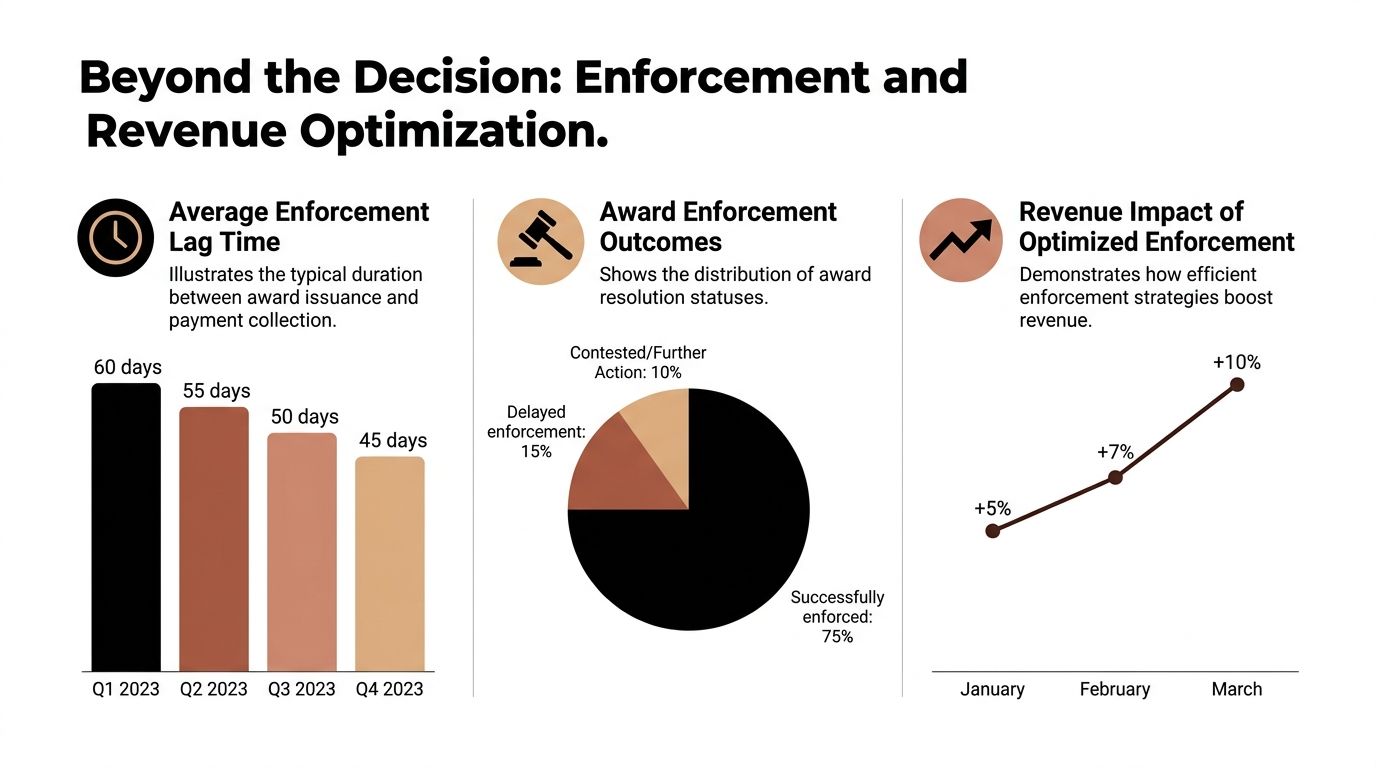
The part most guides skip is the part finance leaders care about most. You can win the award and still wait for the cash.
That gap matters, especially for multi-state platforms and specialty groups carrying large accounts receivable tied to disputed out-of-network payments. The award is a legal victory. Cash recovery is an operational one.
The hidden final step
Recent healthcare arbitration data shows that 34% of binding arbitration awards require judicial confirmation, with timelines varying from 45 days to 180 days depending on the state, according to this discussion of arbitration process and award enforcement. That means post-award enforcement is not an edge case. It's part of the process.
If a payer doesn't pay promptly after the award, the prevailing party may need to seek judicial confirmation so the award becomes enforceable as a judgment. For multi-state provider groups, that creates real friction because confirmation timing and procedure can vary by jurisdiction.
What enforcement looks like in practice
A clean post-award workflow usually includes:
- Immediate award review: Confirm the awarded amount, any compliance dates, and all party identifiers.
- Demand for payment: Send a formal post-award demand tied to the decision and preserve delivery records.
- Escalation review: Decide quickly whether nonpayment requires outside counsel or court confirmation.
- Jurisdiction tracking: For multi-state operators, map where confirmation must occur and who owns that filing.
- Cash posting discipline: When payment arrives, code and trend it separately so your team can measure enforcement lag.
Winning without a collection plan turns the award into a morale event instead of a revenue event.
Use IDR data to improve upstream RCM
The smartest organizations don't treat arbitration as a downstream silo. They feed dispute results back into front-end operations.
If a payer repeatedly argues medical necessity weakness, tighten authorization and clinical-summary workflows. If certain specialties win when they present prior contract history, make that documentation easier to retrieve. If one payer consistently underpays a service family, flag those claims earlier for dispute-readiness review.
That feedback loop is where arbitration process steps become revenue strategy. The dispute file teaches you which payer narratives are recurring, which evidence patterns persuade neutrals, and where your own claims leave room for attack. Used correctly, IDR data improves coding review, contract strategy, denial prevention, and reserve planning.
If your practice needs help turning underpayments into recoverable revenue, RevGuard combines specialty-focused RCM with enforcement-driven NSA IDR support, from dispute-ready claim design through arbitration filing, award enforcement, and payer-behavior analytics.