

The U.S. healthcare denial management market reached $5.13 billion in 2024 and is projected to reach $8.93 billion by 2030, with projected CAGR of 9.67% to 9.68% according to this market report summary. That number matters because it tells you something important: claim denials are no longer a billing nuisance. They're a structural reimbursement problem large enough to create a multibillion-dollar industry around fixing it.
Most practice administrators still feel denials in fragments. A few unpaid claims. A work queue that keeps growing. A payer that suddenly starts rejecting documentation it accepted last quarter. But when those fragments stack across specialties, sites, and payers, they become one thing: revenue leakage that drains cash flow, adds labor cost, and distorts financial forecasting.
Denial management services exist to stop that leak. In a mature revenue cycle, they don't sit at the very end of billing. They connect front-end registration, eligibility, authorization, coding, claim submission, underpayment review, and payer follow-up into one operating discipline. If you want a useful baseline on payer behavior, review these health insurance claim denial rates alongside your own denial categories and write-off patterns.
The Escalating Challenge of Healthcare Claim Denials
A common mistake is treating denials as isolated staff performance issues. They usually aren't. Denials often reflect a mix of payer rule changes, weak front-end controls, inconsistent documentation, coding drift, and poor visibility into underpayments after adjudication.
That's why denial management services have become a strategic line item rather than an optional clean-up function. When payer enforcement gets tighter, clean claims alone don't guarantee clean payment. A practice can submit accurately and still lose reimbursement through delays, downcoding, technical denials, or payment variances that no one catches quickly enough.
What administrators often miss
Practice leaders usually see the obvious denial categories first:
- Eligibility problems: Registration captured the wrong plan, the coverage changed, or verification happened too early to be reliable.
- Authorization gaps: The service needed prior approval, or the authorization details didn't match what was performed.
- Coding and documentation mismatches: The chart supports one level of service while the billed claim suggests another.
- Timely filing failures: The claim was valid, but the process around it wasn't.
The deeper problem is that each denial creates more than one loss. You lose time. You lose priority in the work queue. You lose predictability. Teams then spend energy reworking claims that should've been paid correctly the first time.
Denials rarely start in the denial work queue. They start upstream, then show up downstream as lost cash.
Strong denial management services change the question from “How do we appeal this?” to “Why did this happen, and how do we keep it from recurring while protecting reimbursement on the claims already affected?” That shift is what separates a billing team that stays busy from a revenue cycle that stays controlled.
From Reactive Fixes to Proactive Revenue Protection
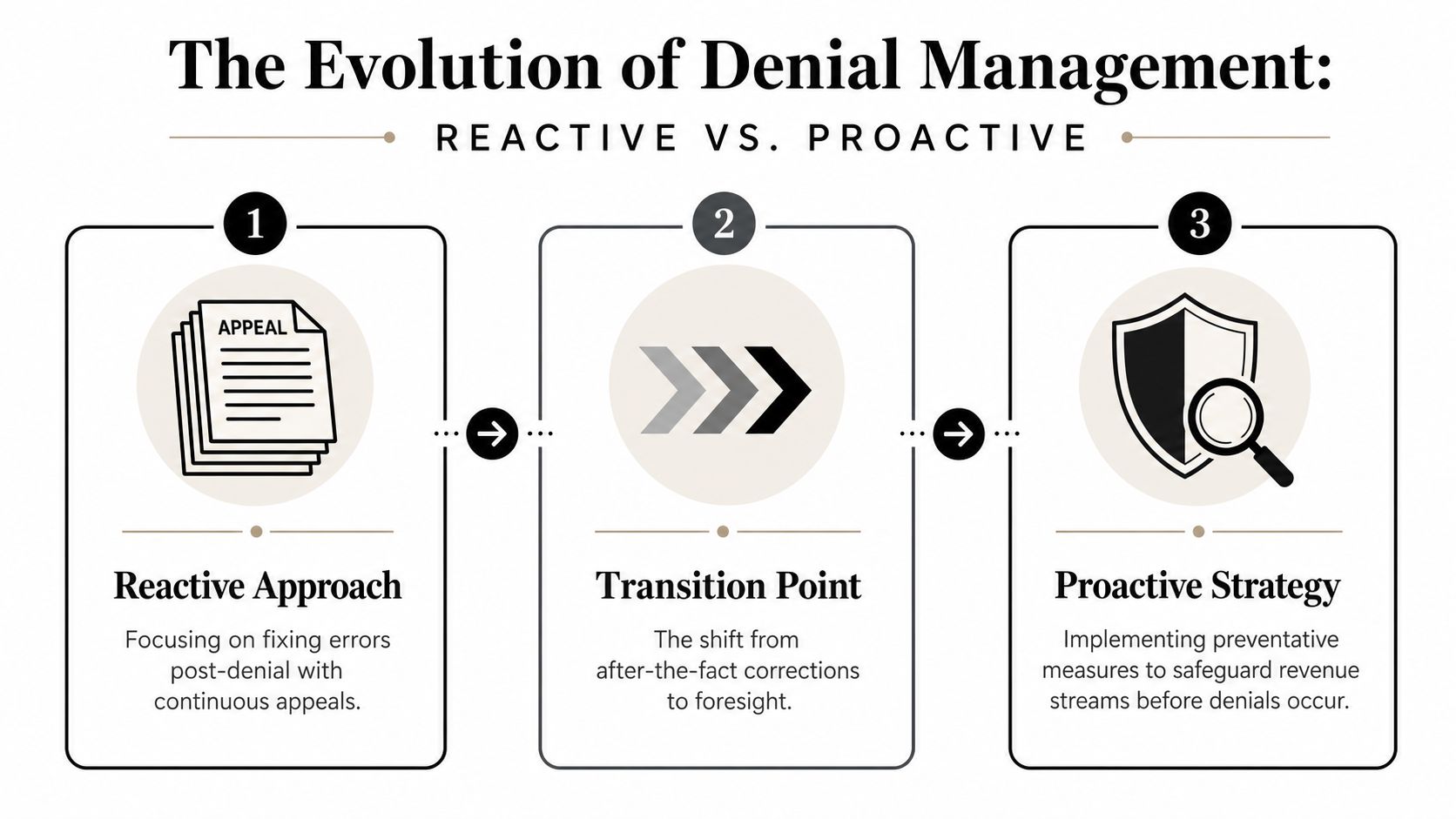
Old-school denial management is firefighting. A denial comes in, someone opens the remittance, pulls the chart, sends an appeal, waits, follows up, and repeats. The team works hard, but the process stays trapped in reaction mode.
Modern denial management services work more like fire-proofing. The goal isn't just to extinguish denials after they happen. It's to reduce the conditions that create them, detect payment issues earlier, and recover dollars with a disciplined process when prevention fails.
The four phases that actually work
Effective denial management follows a four-phase lifecycle: Prevention, Detection, Recovery, and Analysis, as outlined in this denial management lifecycle guide.
Here's what that looks like in practice.
Prevention
These methods provide a critical advantage. Eligibility gets verified before service. Authorization is confirmed against the actual procedure plan. Coding edits and claim scrubbing catch obvious defects before the claim leaves your system.
If a partner can't explain how they reduce avoidable denials before submission, they're probably selling appeals labor, not denial management.
Detection
Claims need active surveillance after submission. You want fast identification of denials, underpayments, and status changes, not a manual review weeks later when filing windows are tighter and account notes are incomplete.
This is also where payer-specific rule awareness matters. One payer may treat a modifier issue as a simple correction. Another may push it into a full appeal cycle.
Recovery
Recovery isn't just “send an appeal.” It means deciding what action fits the denial type, payer behavior, filing deadline, and expected reimbursement. Some claims need corrected resubmission. Others need documentation packages. Some need escalation because the denial reason is only the surface issue.
Practical rule: If every denial goes through the same appeal path, your process is too blunt to protect margin.
Analysis
Many teams often stop too early. They recover money but don't build feedback loops. Analysis should tell you which payers are trending worse, which CPT codes trigger repeat issues, which locations are missing authorization steps, and which staff workflows need retraining.
What proactive really changes
A proactive model doesn't eliminate denials. That's not realistic. It does give you control over three things that matter most: what gets prevented, what gets worked first, and what gets escalated beyond ordinary appeals.
That last point matters more now than it used to. Some reimbursement problems aren't accidental denials at all. They're deliberate payment friction. For those claims, a prevention-and-appeal model is incomplete unless it connects to an enforcement path.
Anatomy of a Modern Denial Management Workflow
The strongest denial management services don't run on spreadsheets and memory. They run on structured workflows, payer logic, and software that can detect variance at scale before a payment issue disappears into aging A/R.
What happens before the denial hits
Modern systems use AI and machine learning for contract-aware reimbursement calculations, comparing remittances against negotiated fee schedules and routing variances into worklists by payer and CPT code, as described in this overview of denial management software. If you want to evaluate the tooling side more directly, this overview of denial management software platforms is a practical starting point.
That matters because many reimbursement problems don't announce themselves clearly. A claim may not come back with a dramatic denial code. It may be paid short. It may be downcoded. It may be processed in a way that hides the variance unless someone compares allowed amounts against the contract.
The day-to-day workflow
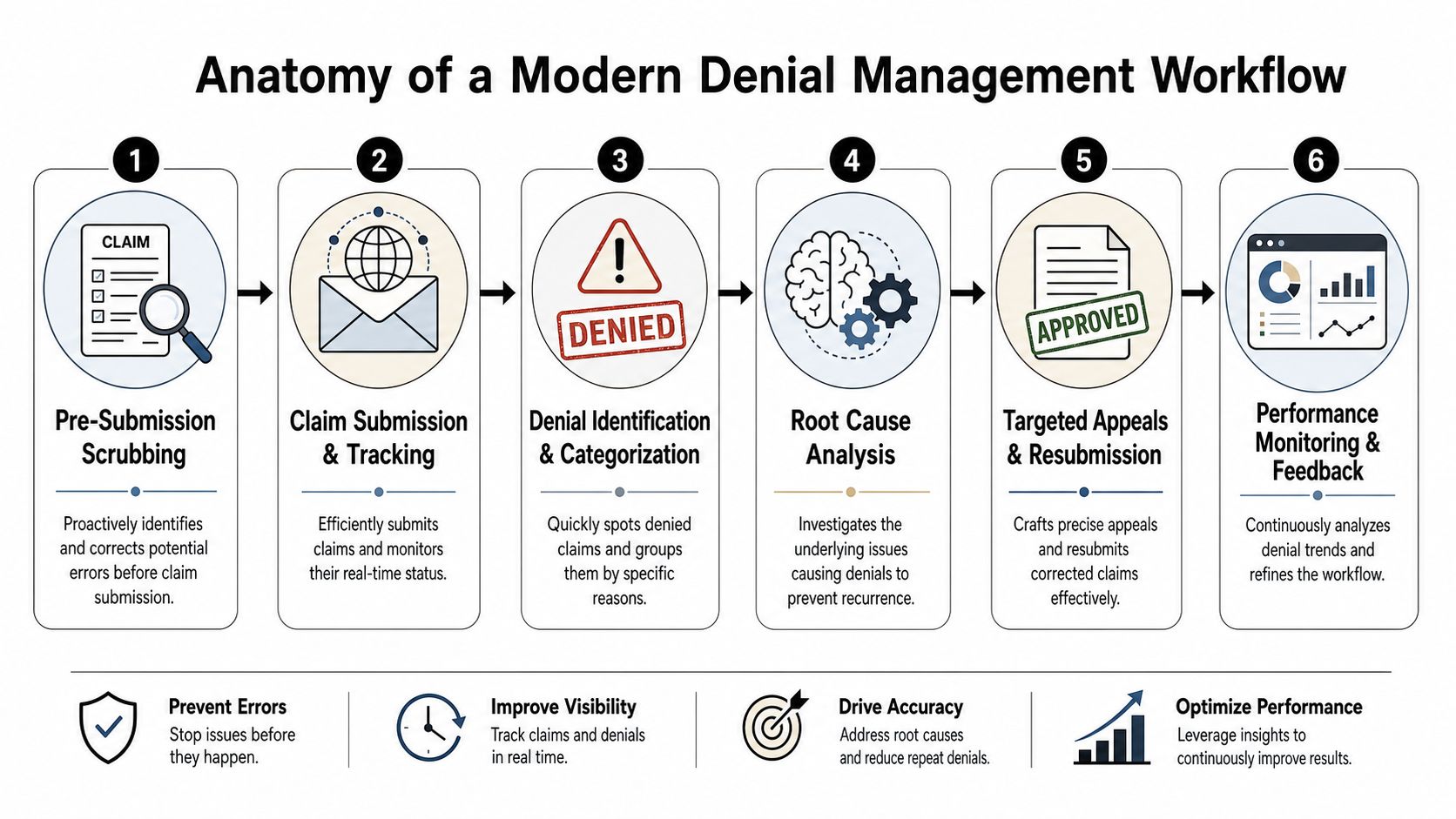
A workable denial operation usually moves through six linked actions.
- Pre-submission scrubbing catches missing demographics, code conflicts, modifier problems, and known payer edits before the claim is transmitted.
- Claim submission and tracking keeps the claim visible after transmission so status changes don't sit unnoticed.
- Denial identification and categorization separates soft denials, hard denials, technical denials, and underpayments into actionable buckets.
- Root cause analysis traces each issue back to the source workflow, such as registration, coding, documentation, or submission timing.
- Targeted appeals and resubmission match the response to the denial type and payer history.
- Performance monitoring feeds the result back into operations so the same breakdown doesn't keep happening.
Where technology helps and where it doesn't
Software is valuable when it does three things well:
- Routes work intelligently: Claims should land with the right team based on denial type, payer, specialty, and dollar significance.
- Surfaces patterns fast: You need trending by payer, CPT code, and denial reason, not a monthly report after the damage is done.
- Supports accountability: Every touch should be documented so you can see whether delays came from the payer, the vendor, or your internal team.
Software is less helpful when practices expect it to replace process discipline. Automation won't fix weak registration habits, vague ownership, or poor documentation standards. It also won't decide which underpayments deserve escalation beyond routine rework. Humans still have to make those calls.
A useful denial platform doesn't just organize denials. It exposes which part of the revenue cycle created them and who has to fix that source.
The best workflows also distinguish between denials caused by internal error and denials driven by payer behavior. If you lump those together, your analytics become noisy and your corrective actions miss the actual problem.
Quantifying the ROI of Denial Management
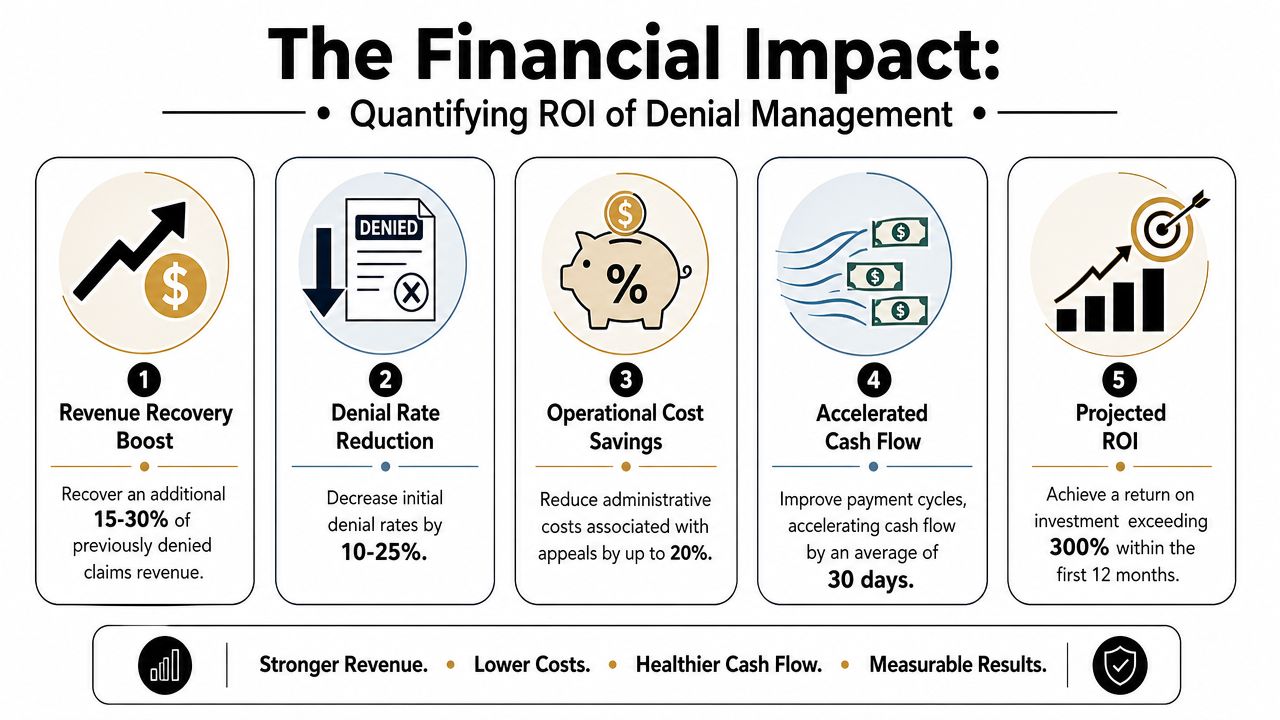
Denial management becomes easier to fund once finance sees the math. The direct administrative cost to rework a single denied claim is $47.77 for Medicare Advantage and $63.76 for commercial claims, according to this denial management analysis. The same source notes that a structured program can reduce a practice's denial rate from 12% to under 5% in 90 days.
The cost isn't just the denial
Administrators often calculate denial cost too narrowly. They count only the missed payment or the extra staff time. In reality, each denied claim can create several layers of expense:
- Rework labor: Staff has to review the remittance, inspect the account, gather documents, and take follow-up action.
- Queue congestion: Denials compete with clean claims, patient calls, payment posting exceptions, and aging follow-up.
- Cash flow drag: Money that should've posted moves later into the cycle, creating unnecessary volatility.
- Avoidable write-offs: Some claims age out or become uneconomical to pursue.
Once you see denials this way, the ROI case changes. You're not buying a service to chase old claims. You're reducing labor waste while preserving reimbursement that the practice already earned.
What a better program actually buys you
A strong denial management program should improve four financial outcomes.
Lower cost to collect
When the team prevents recurring mistakes, fewer claims require manual intervention. That reduces administrative load and protects staff from spending their week on defects that should've been engineered out of the process.
Faster cash realization
Every claim paid correctly the first time shortens the path from service to cash. That improves forecasting and reduces the scramble around month-end collections.
Better prioritization
Not all denials deserve equal effort. High-performing teams segment by recoverability, payer behavior, and reimbursement significance. They don't treat a simple eligibility correction and a payer underpayment dispute as the same kind of work.
Cleaner operational decisions
If denials are mapped correctly, leadership can see whether the practice needs front-desk training, coder support, authorization redesign, or stronger payer escalation.
A denial management service that can't tie work activity to financial outcomes will feel busy without proving value. The right partner should show how prevention, recovery, and escalation change the economics of your revenue cycle, not just the size of your denial log.
Critical KPIs for Measuring Denial Management Success
Most reporting packages drown administrators in detail and still fail to answer the basic question: Is the revenue cycle becoming more reliable? The right KPI set works like cockpit dials. You don't need everything on one screen. You need the few signals that tell you whether reimbursement is stable, delayed, or leaking.
The KPI table worth using
| KPI | What It Measures | Why It Matters |
|---|---|---|
| Denial rate by payer and reason | How often claims are denied, segmented by payer behavior and denial category | Shows whether the problem sits in eligibility, authorization, coding, documentation, or a specific payer pattern |
| First-pass resolution rate | How many claims are paid correctly on initial submission | Reflects the strength of front-end controls and claim quality before rework starts |
| Days in A/R | How long receivables remain outstanding before payment or resolution | Indicates whether denials and follow-up delays are slowing cash conversion |
| Net collection rate | How much collectible reimbursement the practice actually realizes | Reveals whether denied or underpaid claims are turning into preventable revenue loss |
| Appeal overturn performance | How effectively the team recovers denied claims through correction or appeal | Helps separate productive rework from low-yield administrative effort |
| Denial inventory age | How long denied claims sit unresolved in the queue | Highlights whether the team is controlling deadlines or letting recoverable dollars decay |
How to read the numbers together
A single KPI can mislead you. A flat denial rate with rising days in A/R usually means the team is still receiving the same volume of payment friction but taking longer to resolve it. A decent net collection rate can also hide a staffing problem if teams are recovering money only through heavy manual effort.
Look for relationships:
- High denial rate plus low first-pass resolution usually points upstream.
- Moderate denial rate plus aging denial inventory often signals poor work-queue design or weak follow-up ownership.
- Stable first-pass resolution with falling net collection can indicate underpayments or payer tactics that ordinary denial coding doesn't fully capture.
Review these KPIs in one operating meeting with registration, coding, billing, and leadership in the room. If each team reviews only its own slice, root causes stay fragmented.
What good reporting should produce
A useful KPI dashboard should lead to action, not admiration. After each review, leadership should be able to answer three operational questions:
- Which payer behavior changed
- Which workflow failed
- Which corrective action has an owner and deadline
If your current denial management services produce reports without accountability, they're giving you visibility without control.
Beyond Appeals The Role of NSA and IDR Enforcement
Traditional denial management has a blind spot. It works well when the problem is an error that can be corrected. It works much less well when the claim was clean, the documentation was sufficient, and the payer still delayed, downcoded, or underpaid reimbursement in a way that standard appeals won't reliably fix.
That gap is especially important for specialties with high-acuity, out-of-network, or event-driven reimbursement complexity. In those settings, ordinary appeals may recover some dollars, but they often don't provide an advantage against repeat payer behavior.

Where standard denial management stops
Existing content often fails to explain how specialty practices can connect upstream RCM controls to downstream Independent Dispute Resolution under the No Surprises Act, which creates a major gap in revenue recovery strategy, as noted in this discussion of denial management service gaps. For teams that need the policy framework, this No Surprises Act summary helps connect reimbursement operations to dispute rights.
Here's the practical issue. Some claims aren't denied because your staff made a mistake. They're challenged because the payer is taking an aggressive reimbursement position. If your process ends with “submit appeal and wait,” you may be giving away recoverable revenue.
Why IDR changes the model
The No Surprises Act created an enforcement path that matters operationally, not just legally. For the right claims, IDR changes denial management from a passive recovery function into a reimbursement defense function.
That requires a different setup:
- Claims must be dispute-ready upstream: Documentation, coding, and eligibility records need to hold up under scrutiny.
- Payer behavior must be tracked: You need evidence of patterns, not just one-off complaints.
- Case assembly must be disciplined: Supporting materials, payment comparisons, timelines, and procedural compliance have to be organized correctly.
- Escalation rules must be clear: Not every underpayment belongs in arbitration, but some absolutely do.
What this looks like in practice
For specialty groups, the strongest operating model links RCM and enforcement instead of treating them as separate vendors or departments. A platform such as RevGuard combines specialty-specific RCM workflows with IDR case development and arbitration support under the No Surprises Act, which is one example of how practices can structurally connect prevention, recovery, and formal dispute escalation.
That structure matters because upstream quality affects downstream influence. If the claim file is weak, the appeal is weak and the arbitration posture is weak. If the claim is engineered cleanly from the start, the practice has more options when the payer underpays anyway.
The real upgrade isn't adding more appeals staff. It's building a reimbursement process that can prevent ordinary denials and enforce payment when ordinary appeals aren't enough.
For many specialties, that's the difference between administrative persistence and actual revenue protection.
Choosing a Partner and Implementing for Success
A denial management partner should make your revenue cycle tighter, not more opaque. If a vendor leads with generic recovery claims but can't explain specialty workflows, payer segmentation, or escalation paths, keep looking.
What to ask before you sign
Use a shortlist that reflects how denial management really works.
- Specialty fit: Ask how the partner handles your procedure mix, documentation patterns, and payer mix. Orthopedics, anesthesia, air ambulance, dermatology, and gastroenterology don't fail in the same way.
- Workflow design: Ask who owns prevention, who owns appeals, and how root causes get pushed back to registration, coding, and authorization teams.
- Technology capability: Look for claim scrubbing, remittance variance detection, worklist routing, audit trails, and usable dashboards.
- Enforcement capacity: If your reimbursement profile makes you vulnerable to systemic underpayment, ask how the partner handles disputes that go beyond ordinary appeals.
- Reporting discipline: Require KPI reporting that ties operational activity to financial outcomes and payer behavior.
What smooth implementation looks like
Implementation usually succeeds when the practice doesn't outsource accountability. The partner should bring structure, but your internal leaders still need owners for registration quality, coding quality, clinical documentation, and payer escalation decisions.
A practical rollout usually includes:
- Baseline mapping of denial categories, payer trends, and current work queues.
- Rules and routing redesign so claims reach the right people quickly.
- Feedback loops from denials back to the teams creating the defects.
- Governance meetings that review KPIs, payer issues, and open corrective actions.
Denial management services work best when they become part of daily revenue operations, not a side project buried in billing. The practices that improve fastest are the ones that stop accepting denials and underpayments as normal background noise.
If your practice needs a model that links clean-claim discipline with underpayment enforcement, RevGuard focuses on exactly that connection. It supports specialty-specific revenue cycle workflows and pairs them with Independent Dispute Resolution processes under the No Surprises Act, helping provider groups move from reactive rework to active revenue protection.