

A large share of ambulance revenue problems start long before the first denial letter arrives. In a cross-sectional study of over 2 million ground ambulance services, 54.8% were billed out-of-network, and patients faced a mean total financial burden of $434.70 per service, compared with $132.21 for in-network services according to this ground ambulance out-of-network billing study. That gap isn't just a patient affordability story. It's also an operations story, a contracting story, and a documentation story.
New practice managers often inherit ambulance service billing as if it were a back-office task. It isn't. It's a field-to-payment system where dispatch, crew charting, coding, mileage capture, eligibility checks, payer edits, appeals, and legal reimbursement pathways all affect final yield. If any one of those handoffs breaks, cash falls out of the process.
The mistake I see most often is treating claim submission as the finish line. In ambulance billing, submission is just the opening move. The actual work is building claims that can survive review, appeal, and, when necessary, formal payment disputes. That means the run sheet has to support the code. The mileage record has to support the units. The medical necessity narrative has to stand on its own without relying on shorthand that only your crews understand.
Introduction The High Stakes of Ambulance Billing
More than half of ground ambulance trips in the study cited earlier were billed out of network. That figure matters, but the larger operational point matters more. Ambulance revenue is exposed from the first crew note to the final payer decision.
Ambulance service billing puts unusual pressure on the revenue cycle because the service is urgent, mobile, and documented after care is delivered. Eligibility is often incomplete at the time of transport. Clinical details are captured in uncontrolled settings. Once the crew clears the call, missing facts are harder to reconstruct, and every gap weakens the claim's chances in review, appeal, or payment dispute.
I tell new practice managers to treat ambulance billing as a chain of evidence, not a charge entry task.
Claims fail when the record cannot support the full story the bill is trying to tell. A payer is not only checking whether a code exists on the claim form. The reviewer is testing whether the service level, medical necessity, pickup and destination, mileage, and patient condition all align well enough to justify payment. If one element breaks, the rest of the claim becomes harder to defend.
That is why upstream discipline has direct downstream value. Clean dispatch data helps coders assign the right level of service. Complete crew narratives give billers support for medical necessity. Accurate mileage capture limits avoidable edits and recoupments. Consistent QA creates appeal files that are usable later if the payer underpays or if the case moves into the No Surprises Act dispute process.
A weak chart can still be submitted. It is much harder to overturn.
For ambulance providers, that poses a major financial risk. Revenue is not lost only at first-pass denial. It is lost when documentation, coding, and audit controls were never built to withstand payer scrutiny in the first place. The strongest ambulance RCM teams engineer claims so they can survive the entire lifecycle, from initial coding and payment posting through reconsideration, appeal, and formal dispute review.
The Ambulance Billing Landscape Ground vs Air
Ground and air ambulance operations share a reimbursement problem, but they don't share the same risk profile. The economics, payer scrutiny, and dispute dynamics differ enough that a practice manager should treat them as related but distinct businesses.
From a cost and reimbursement perspective, the spread is stark. Between 2012 and 2021, the average price of a ground ambulance trip increased 33% to $1,093, while air ambulance helicopter trip prices increased 84% to $30,151, according to this Health Care Cost Institute review of ambulance trends. That doesn't mean every claim pays near those amounts. It does mean billing errors, underpayments, and network disputes carry very different consequences across transport types.
Ground ambulance has volume complexity
Ground providers usually face a higher number of repetitive operational decisions. Crews move quickly. Documentation quality varies by shift. Non-emergency recurring transports create pattern-based audit risk. Medicaid rules can shift by state. Commercial plans often apply policy language inconsistently.
The result is a revenue cycle with many small failure points:
- Dispatch intake problems: Wrong insurance, incomplete demographics, or weak destination logic
- PCR weaknesses: Sparse narratives, copied language, or unsupported service-level upgrades
- Charge capture errors: Missing mileage segmentation or incorrect modifiers
- Submission defects: Claim edits that could've been caught internally
- Follow-up gaps: Underpayments that post without challenge
Air ambulance has fewer claims and heavier disputes
Air ambulance claims tend to involve higher-dollar balances, more intensive medical records, and more formal payer conflict. A single underpaid claim can justify a deeper reimbursement strategy. That changes staffing needs. Ground operations often need disciplined throughput. Air operations need disciplined case building.
Think of the ambulance revenue cycle as a relay race where each runner can either preserve or lose reimbursement value. Dispatch starts the handoff with demographics and destination details. Clinical crews carry the most important baton, the medical record. Coding translates the transport into billable language. Billing pushes the claim into payer systems. Follow-up and dispute teams decide whether an underpayment becomes a write-off or recoverable revenue.
| Lifecycle point | What must happen | What usually goes wrong |
|---|---|---|
| Intake | Confirm patient and payer data | Incomplete demographics or wrong plan |
| Clinical documentation | Capture necessity, treatment, and transport facts | Narrative doesn't support billed level |
| Coding and charge entry | Match service, modifiers, and mileage to record | Units or codes don't align with PCR |
| Adjudication and follow-up | Validate payment and challenge variance | Staff posts underpayments without escalation |
The strongest ambulance organizations don't separate field documentation from reimbursement strategy. They treat them as the same system.
That's the operating posture that protects revenue. Not faster claim submission alone. Better handoffs from the first touch to final payment.
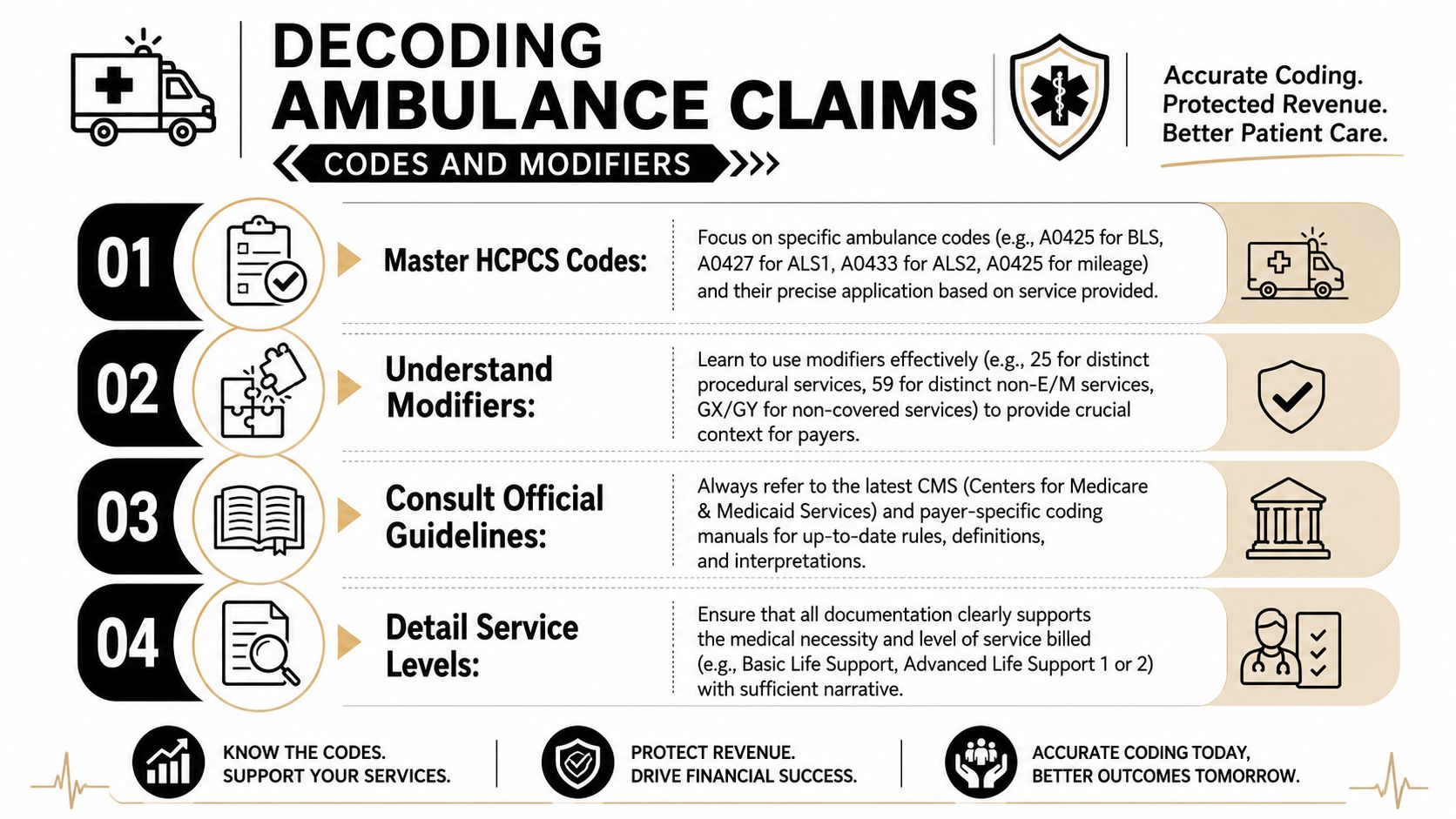
Decoding Ambulance Claims Codes and Modifiers
Coding is where ambulance service billing becomes concrete. A transport happened. Now the organization has to describe it in standardized claim language that a payer will accept, price, and defend if challenged. If the coding team guesses, rounds, or fills gaps that the record doesn't support, the claim may still go out cleanly and still fail later.
Service level coding has to follow the chart
The first coding question is always simple on paper and difficult in practice. What level of ambulance service did the crew provide, and did the chart prove it?
A billing team should never rely on habit-based assumptions such as “this facility usually sends ALS” or “that diagnosis tends to support higher acuity.” Those shortcuts create inconsistent claims and weak appeal positions. The code must follow the documented assessment, interventions, and patient condition.
That same discipline applies to revenue code logic in broader institutional billing workflows. If your operation interfaces with hospital-based billing, the team needs a shared understanding of how service lines map operationally and financially. A quick refresher on revenue codes in healthcare billing helps newer managers understand why claim classification errors can create downstream reconciliation problems even when the ambulance record itself looks complete.
Mileage is where small errors turn into hard denials
Mileage billing deserves its own control process. For Medicare Part B ground ambulance claims, mileage reimbursement uses specific HCPCS codes, including A0425 for the first 7 miles, A0435 for miles 8 through 15, and A0436 for miles 16 and beyond, as outlined in this Noridian Medicare ambulance billing guide. Providers must report mileage in the proper segments rather than treating distance as a single flat line item.
That requirement matters because mileage mismatches are easy for payers and auditors to spot. If the billed units don't line up with the documented transport distance, the claim is vulnerable to denial or downcoding.
A reliable mileage workflow usually includes:
- CAD confirmation that the dispatch record reflects the actual transport event.
- Odometer capture entered consistently by crews.
- Map validation when distance appears unusual or disputed.
- Charge review to confirm the HCPCS mileage segments match the documented trip.
“Close enough” mileage is not close enough for ambulance claims.
Modifiers add context, but they don't rescue weak documentation
Modifiers can clarify circumstances, but they don't substitute for a complete record. If the patient care report doesn't explain why the transport occurred, no modifier can fix the medical necessity problem after the fact.
That's why coding review should ask three questions before claim release:
- Does the narrative support the level billed?
- Do origin, destination, and mileage align across all records?
- Would an outside reviewer understand the transport without internal shorthand?
When those answers are yes, coding becomes a revenue defense tool instead of a clerical step.
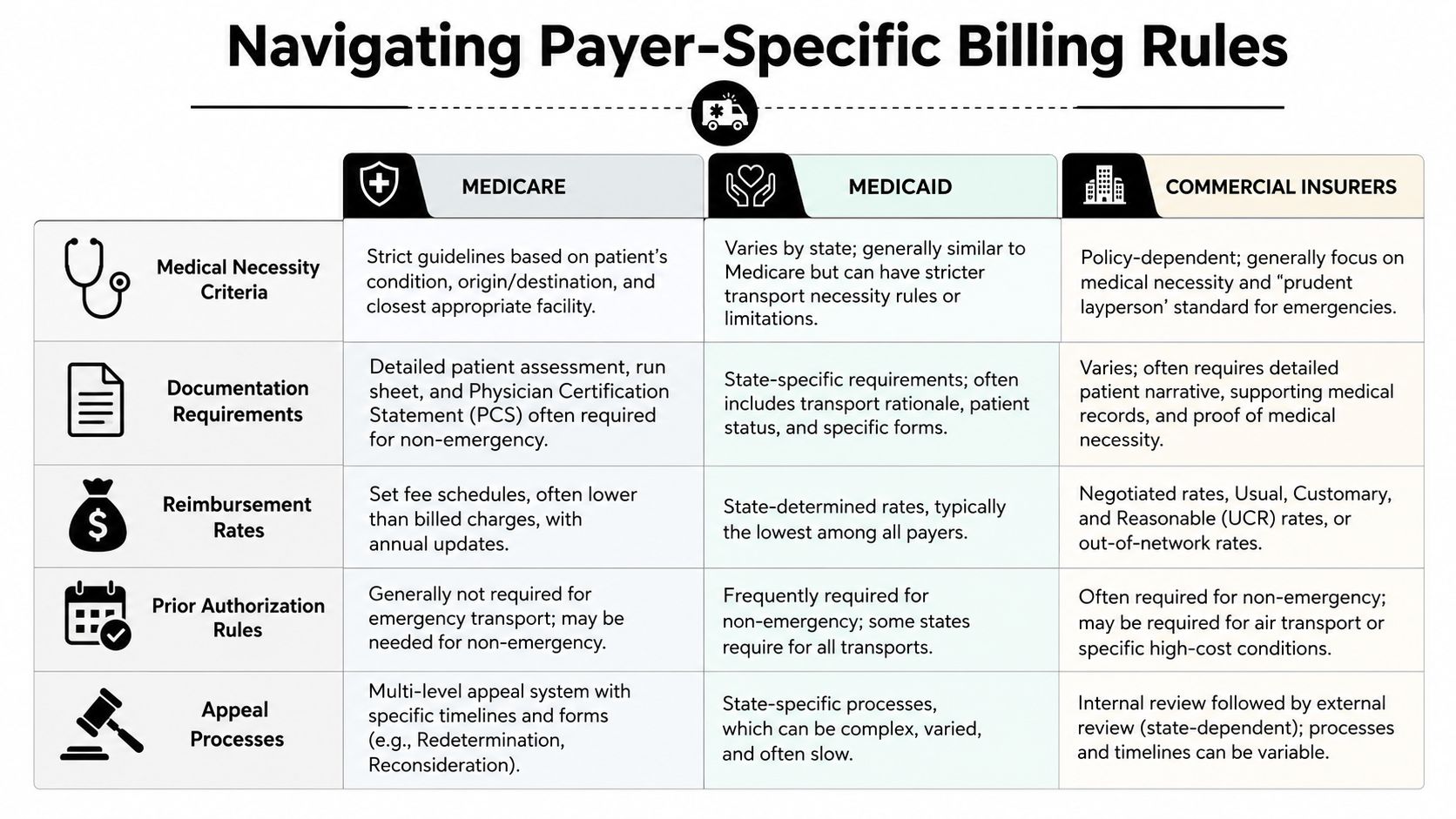
Navigating Payer-Specific Billing Rules
The same transport can move through three very different rulebooks depending on whether the payer is Medicare, Medicaid, or a commercial plan. New managers often look for a universal ambulance billing playbook. There isn't one. There are recurring principles, but the enforcement points differ.
Medicare rewards precision and punishes assumptions
Medicare is usually the clearest framework and the least forgiving when records are incomplete. Coverage turns on documented medical necessity, correct origin and destination logic, and support for the billed level of service. For non-emergency transports, especially recurring ones, paperwork discipline matters as much as coding discipline.
The good news is that Medicare rules are generally defined enough to operationalize. You can train against them. You can audit against them. You can standardize forms and workflows around them.
The common failure isn't that staff don't know a rule exists. It's that they rely on the diagnosis alone instead of documenting transport necessity in clinical terms.
Medicaid requires state-specific controls
Medicaid is less uniform. Eligibility verification, authorization rules, covered destinations, and documentation expectations can vary materially by state and managed care arrangement. That means a central billing office can't treat all Medicaid ambulance claims the same way, especially in a multi-state operation.
A practical Medicaid workflow includes:
- State rule matrices: Keep current rules by jurisdiction and payer plan.
- Pre-transport verification steps: For scheduled non-emergency trips, confirm eligibility and authorization status whenever possible.
- Facility coordination: Receiving and sending facilities often hold details your billing team needs, but nobody requested in time.
- Escalation paths: Denials tied to local policy should route to staff who know that market, not to a generic follow-up queue.
Commercial payers create the widest spread in outcomes
Commercial ambulance billing is where contract terms, network status, prior authorization language, and payment policy interpretation collide. Two plans can review similar claims very differently. One may focus on emergency standards. Another may press heavily on documentation language. A third may pay low and wait to see whether the provider challenges the underpayment.
| Payer type | Main operational issue | Best management response |
|---|---|---|
| Medicare | Strict medical necessity and record support | Standardized documentation and pre-bill audits |
| Medicaid | State-by-state variability | Local rule tracking and authorization controls |
| Commercial | Contract and policy inconsistency | Contract awareness and aggressive variance review |
If your team uses one follow-up script for every payer, it's leaving money on the table.
The strongest payer strategy is to build separate workflows, edits, and appeal templates by payer family. That feels slower at first. In practice, it reduces rework because staff stop forcing unlike claims through the same process.
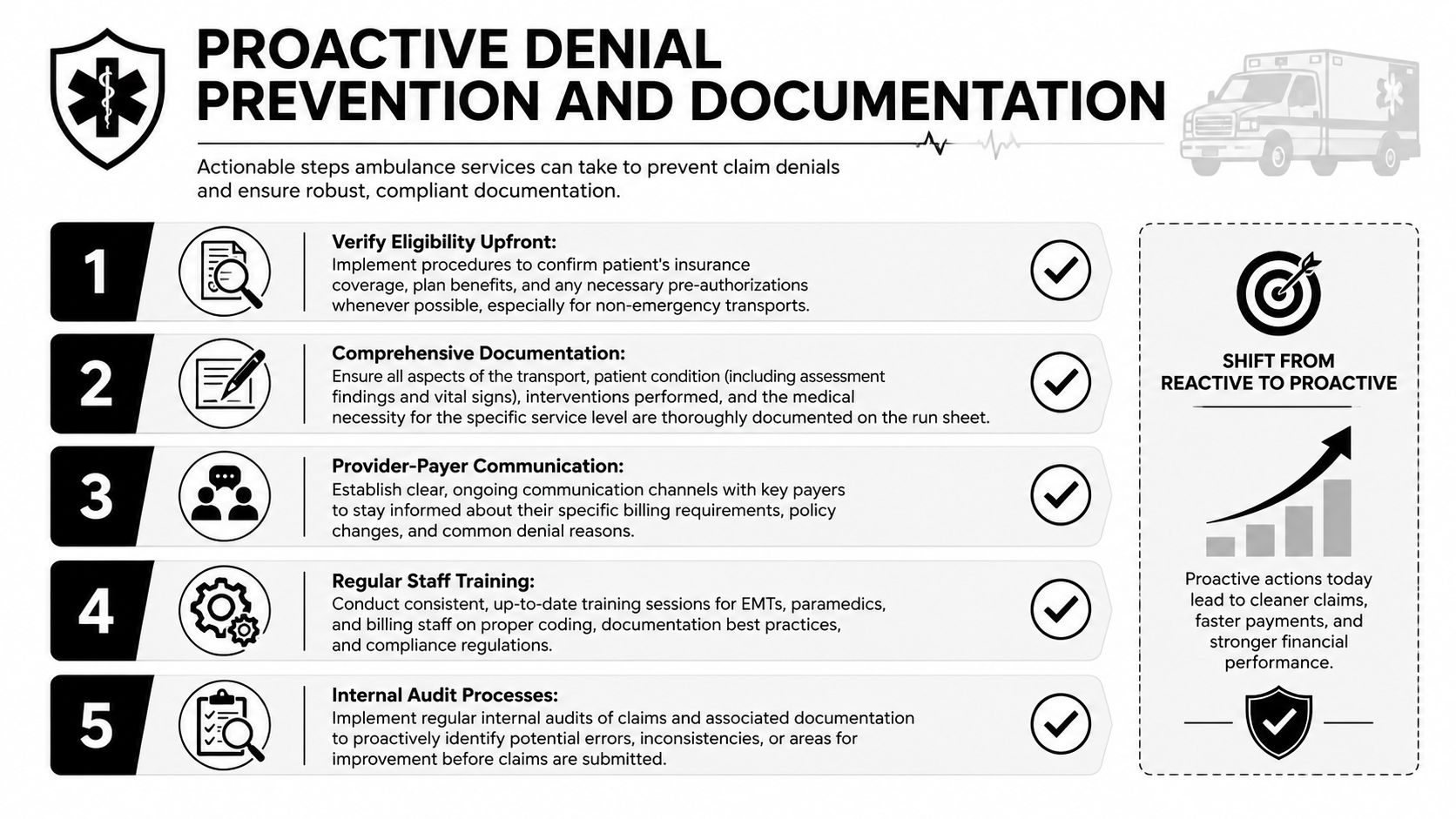
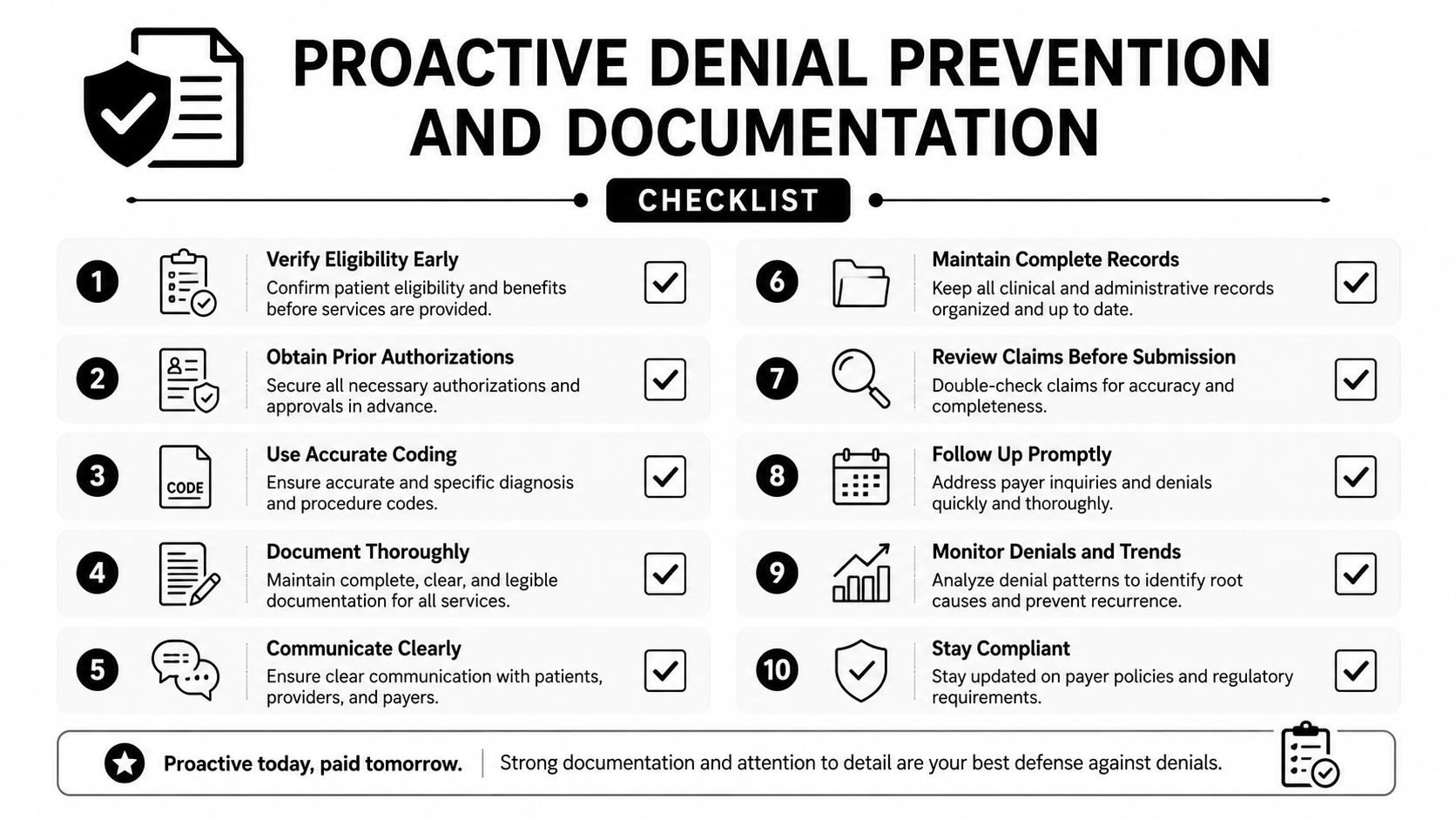
Proactive Denial Prevention and Documentation
Most ambulance organizations say they do denial management. Fewer do denial prevention. Those are not the same thing.
Denial management starts after the revenue problem is visible. Denial prevention starts in the field, before the claim exists, by making sure the medical record can survive scrutiny without explanation from the billing office. In ambulance service billing, prevention is the better lever because many denials are rooted in documentation gaps that can't be repaired later.
Weak narratives sink otherwise correct claims
CMS requires every non-emergency repetitive transport claim to tie to clear medical necessity criteria, such as bed confinement or risk of harm from alternate transport, and weak narratives can fail even when the coding is technically correct, as explained in this ambulance billing documentation guidance. That principle matters beyond repetitive claims. Reviewers read the clinical facts first. If the facts don't independently justify the transport, the code won't save the claim.
That's why generic charting phrases are expensive. “Patient transported without incident” may be true, but it doesn't explain why ambulance transport was necessary. “Requires monitoring” is also weak if the chart doesn't say what was monitored, why, and what risk alternate transport created.
A defensible narrative usually answers these questions:
- What was the patient's condition at pickup?
- Why was another mode of transport unsafe or inappropriate?
- What crew observations or interventions occurred during transport?
- Why was this destination clinically appropriate?
Build a dispute-ready record before the claim leaves
A denial prevention program needs structure, not reminders. Telling crews to “document better” doesn't work. Teams need a checklist, examples, and feedback loops tied to actual denial trends.
A practical framework looks like this:
- Front-end eligibility control: Scheduled transports should trigger payer and authorization review before the trip whenever operations allow.
- PCR quality review: Supervisors or QA staff should audit for necessity language, service-level support, and destination logic.
- Mileage reconciliation: CAD, odometer, GPS, and charge entry should match before billing finalizes the claim.
- Pre-bill edits: Claims with unsupported narratives, missing signatures, or unit inconsistencies should stop automatically.
- Appeal packet readiness: Store records in a way that supports fast rebuttal when payers deny or underpay.
For managers building a more disciplined process, it helps to distinguish prevention from recovery. A broader overview of healthcare denial management workflows can clarify where ambulance-specific controls should sit inside the larger revenue cycle.
The best appeal is the one your team never has to write because the claim was complete, coherent, and well-supported on day one.
What doesn't work
Three habits consistently create repeat denials.
First, billing from habit. If staff code based on destination, diagnosis, or facility preference instead of chart facts, payer patterns will expose it.
Second, relying on cloned narratives. Auditors notice repetitive language quickly, especially on repetitive non-emergency transports.
Third, splitting responsibility too loosely. Crews think billing will fix it. Billing thinks operations will retrain crews. Nobody owns the record quality end to end.
Prevention works when one leader does own it.
The No Surprises Act and Independent Dispute Resolution
The No Surprises Act changed the reimbursement environment, but it didn't solve every ambulance billing problem. The most important distinction is simple. Air ambulance balance billing was prohibited in 2022, but ground ambulance was explicitly excluded, creating a fragmented state-by-state situation for patient exposure and provider underpayment risk, as described in this analysis of the ambulance gap under the No Surprises Act.
That exclusion matters operationally. It means ambulance organizations can't assume one federal protection framework covers the entire service line. Your billing strategy has to reflect transport type, state law, payer behavior, and the quality of your documentation file.
Air ambulance and ground ambulance don't sit in the same dispute posture
Air ambulance providers generally operate within a more defined federal surprise billing structure. That doesn't mean payment is easy. It means there is a clearer enforcement lane when plans underpay or dispute amounts.
Ground ambulance providers live in a more uneven environment. Some states have protections or payment standards. Others don't. Some payers negotiate. Others delay. Some patient accounts become collection problems because there was never a consistent reimbursement framework in the first place.
That's why managers need a payer-response ladder. Not every variance should trigger the same action.
| Scenario | Best response |
|---|---|
| Clean claim, minor payer processing issue | Correct and resubmit quickly |
| Denial tied to missing support | Rebuild file with stronger record if possible and appeal |
| Material underpayment on a defensible claim | Escalate through payer reconsideration channels |
| Eligible federal surprise billing dispute | Prepare a formal IDR strategy and evidence package |
IDR success starts upstream
Independent Dispute Resolution is not a magic tool for bad claims. It's a formal process that works best when the provider can present a coherent reimbursement story backed by complete records, compliant billing, and organized evidence.
That means a strong IDR file usually depends on work completed earlier:
- Clean claim construction
- Clear medical necessity support
- Accurate coding and billing history
- Payment variance analysis
- Timely internal escalation
If your team waits until the dispute stage to figure out what happened on the transport, you're already in a weak position.
For organizations dealing with air ambulance reimbursement or broader payer conflict around surprise billing frameworks, a focused resource on ambulance implications under the No Surprises Act can help operational teams understand where claim preparation and formal dispute strategy intersect.
IDR is most effective when it confirms the strength of a claim you already built correctly, not when it tries to rescue a file that was weak from the start.
The practical takeaway is straightforward. Treat every significant underpayment as both a collections issue and an evidence issue. The teams that recover revenue consistently are the ones that preserve the record early, quantify the payment variance clearly, and escalate with discipline.
Conclusion Engineering a Dispute-Ready RCM Workflow
The strongest ambulance billing operations don't separate coding, documentation, follow-up, and reimbursement disputes into unrelated departments. They engineer one workflow that protects value from intake through final payment. That's the shift new practice managers need to make early.
A dispute-ready workflow starts in the field. Crews document patient condition, transport necessity, interventions, and destination logic in a way an outside reviewer can understand. Billing teams convert that record into precise claim data, including service level and mileage segmentation. Revenue cycle staff then validate not just whether a claim was paid, but whether it was paid correctly and whether the file is strong enough to support escalation when it wasn't.
The operating model that works
The most effective model is disciplined, not flashy. It usually includes:
- Standardized field documentation: Crews chart to clinical and billing requirements, not personal habit.
- Pre-bill QA: Claims stop for narrative, mileage, and charge mismatches before submission.
- Payer-specific workflows: Medicare, Medicaid, and commercial claims don't move through the same rules engine.
- Variance-based follow-up: Staff review underpayments as carefully as outright denials.
- Dispute preparation: Records, communications, and payment history are stored for fast appeal or arbitration use.
What a manager should fix first
If you're newly responsible for ambulance service billing, don't start with the loudest denial category. Start with the handoff that affects the most claims.
For one organization, that may be PCR quality. For another, it may be mileage reconciliation. For a hospital-based service, it may be charge entry consistency between ambulance and facility workflows. For an air operation, it may be underpayment escalation discipline. The point is to identify the first break in the chain and fix it there, not three steps later.
Good ambulance RCM isn't reactive collections work. It's claim engineering. Every clean chart, every matched mileage segment, every payer-specific edit, and every organized appeal file improves both initial reimbursement and subsequent financial advantage. When you run the operation that way, billing stops being a recovery exercise and starts acting like a protected revenue engine.
If your team needs help turning ambulance billing into a dispute-ready revenue workflow, RevGuard supports the full lifecycle from clean claim construction and payer follow-up to No Surprises Act dispute strategy and enforcement-driven reimbursement recovery.