

You're probably dealing with one of these situations right now.
A clean-looking claim went out. The diagnosis was right. The CPT or HCPCS line looked right. The documentation supported the service. Then the remittance came back denied, reduced, or routed into review for reasons that felt absurdly technical.
That's where revenue codes trip people up.
When someone asks, what are rev codes, they usually get a thin definition and not much else. That's not enough if you manage an ASC, hospital outpatient department, imaging center, or specialty group that touches institutional billing. The operational question isn't just what a rev code is. It's when it belongs on the claim, when it doesn't, and how it affects payment logic.
If your team bills both facility and professional services, that boundary matters more than most training materials admit.
The Hidden Reason Your Claims Get Denied
A practice manager usually notices the problem backward. Not from coding. From cash.
An outpatient procedure gets performed, the physician side looks fine, and the facility expects payment without drama. Instead, the claim pends or denies. The payer doesn't challenge medical necessity. It doesn't dispute the diagnosis. It questions how the charge was structured on the institutional claim.
That's often a revenue code issue.
Where the claim breaks
On institutional billing, the payer isn't only asking, “What service was performed?” It's also asking, “Where in the facility did this charge belong?” If that location logic doesn't line up with the rest of the claim, edits fire quickly.
In practice, these are the patterns that create trouble:
- A valid service under the wrong department. The procedure code may be appropriate, but the line is tied to a rev code that doesn't fit the setting.
- A facility claim built like a professional claim. Teams that are stronger on CMS-1500 workflows sometimes underappreciate UB-04 requirements.
- Generic cleanup behavior. Staff use broad or catch-all charge mapping just to move claims out the door, and the payer reads that as inconsistency.
Claims don't fail only because the service was wrong. They fail because the claim tells the wrong story about where the service happened.
Why small rev code errors become expensive
Revenue code errors aren't minor formatting problems. They affect adjudication logic, reimbursement logic, and appeal posture all at once.
If the claim hits a denial edit, cash gets delayed. If the payer accepts the line but interprets the setting differently, you may get paid less than expected. If the pattern repeats, your team ends up working avoidable rework instead of protecting higher-value accounts.
That's why rev codes deserve more attention than they get. They're not filler fields. They're part of the structure that makes a facility claim believable to the payer.
Defining Revenue Codes and Their Purpose
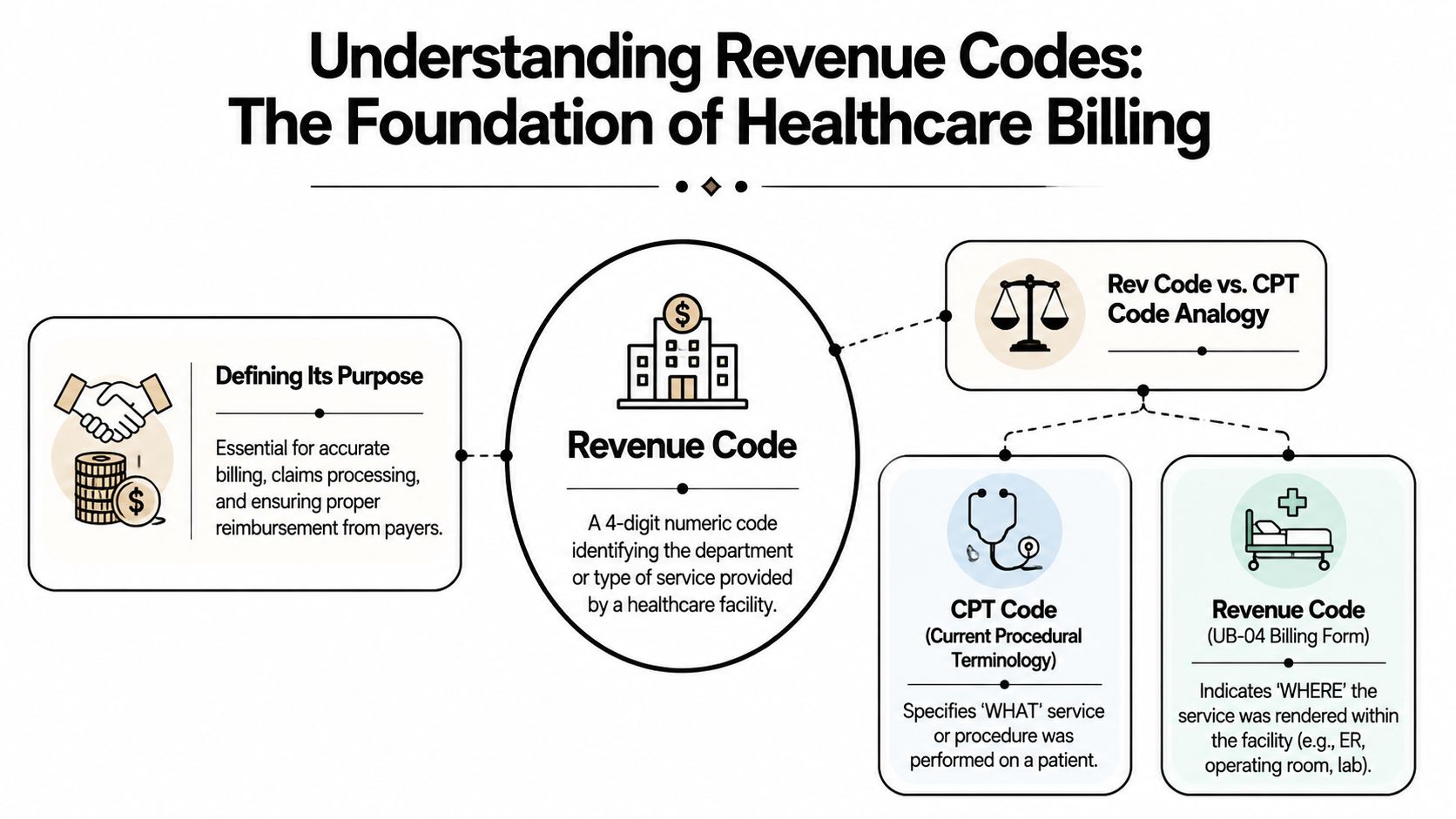
A revenue code is an institutional billing code used on UB-04 and 837I claims to identify the hospital department, accommodation, or ancillary service tied to a charge. CMS line-item guidance for institutional claims reflects that structure, including the relationship between revenue codes and HCPCS reporting, in its Medicaid T-MSIS revenue code data element guidance.
For a practice manager, the operational point is simple. Revenue codes help the payer understand the facility side of the charge. They do not replace CPT or HCPCS, and they do not belong everywhere your organization submits claims.
The distinction that prevents expensive confusion
Revenue codes answer a different question than procedure codes.
- Revenue code identifies the facility department or billing area tied to the charge
- CPT or HCPCS code identifies the service, procedure, drug, or supply provided
That sounds basic, but it is where many specialty groups, ASCs, and hospital outpatient departments get tripped up. Staff may know the professional coding rules cold and still create avoidable edits because the institutional claim needs another layer of context. If your team needs a refresher on the professional side, this medical coding overview is useful background, but rev codes sit in a different part of the billing workflow.
Where rev codes are required and where they are not
This is the point many articles miss, and it is the reason rev code confusion shows up so often in mixed billing operations.
Revenue codes are used on institutional claims. They are generally not used on professional claims. CMS training on the 837I and UB-04 framework makes that distinction clear in its education on institutional claims and revenue code requirements.
That matters if one organization submits both claim types:
- Facility billing through UB-04 or 837I
- Professional billing through CMS-1500 or 837P
I see this create problems in outpatient surgery, pain management, cardiology, and hospital-based specialty clinics. The same patient encounter can produce both a facility claim and a professional claim, but only the institutional side uses revenue codes. Once staff blur that line, charge review gets messy fast.
A practical rule works well here. If the claim is professional, rev code selection usually is not the issue. The issue is that institutional billing logic has been applied to the wrong claim type.
What the code format tells you
Revenue codes are typically shown as four digits, often with a leading zero in system displays and claim files. Small formatting details matter because clearinghouses, scrubbers, and payer edits often expect the code in a standardized format.
A few common categories make the structure easier to recognize:
- 0140 for semi-private room and board
- 0200 for intensive care
- 0920 for other diagnostic services, general
The full revenue code set is maintained through the UB-04 structure governed by the National Uniform Billing Committee. You do not need to memorize the code table. You do need clean charge mapping, clear staff rules about institutional versus professional claims, and periodic review of whether each department is using the right revenue code family for the services it bills.
That is the primary purpose of rev codes. They organize facility charges in a way the payer can process, price, and compare against the rest of the institutional claim.
How Rev Codes and CPT Codes Work Together
Revenue codes and CPT or HCPCS codes work as a pair. One supplies the facility context. The other supplies the service detail.
If those two don't make sense together, the payer has a reason to stop the claim. That's why the most useful answer to “what are rev codes” isn't a dictionary definition. It's a workflow answer: rev codes frame the line item so the payer can interpret the service correctly.
Why the pairing matters
The revenue code tells payers where the charge belongs in the facility, while the CPT or HCPCS tells them what service was performed. Mismatches between the two are a common and preventable source of claim rejections and underpayment risk, as explained in this guide to revenue code and CPT alignment.
A payer edit system reads that pairing for internal consistency. If the service line suggests one setting and the rev code suggests another, the claim can fail before a human ever reviews it.
Common Rev Code and CPT Code Pairings
| Revenue Code | Description | Example CPT/HCPCS Code | Specialty Use Case |
|---|---|---|---|
| 0360 | Operating room services | Surgical CPT code | Orthopedics procedure performed in a facility operating room |
| 0450 | Emergency room | Emergency visit CPT code | Hospital-based emergency evaluation tied to facility resources |
| 0510 | Clinic or outpatient department general | Outpatient visit CPT code | Hospital outpatient clinic encounter |
| 0250 | Pharmacy general | HCPCS drug code | Drug administration or facility-billed medication line |
| 0270 | Medical or surgical supplies | HCPCS supply code | Procedure-related supply usage in an ASC or outpatient facility |
The exact allowable pairings depend on payer edits, claim type, and your chargemaster setup. But the operating principle is stable. The line has to tell a coherent story.
For teams that need a broader coding operations framework, medical coding workflow guidance can help organize how facility and professional logic are separated before claims go out.
Good pairings versus bad pairings
Here's how I teach new managers to evaluate a line quickly.
| Scenario | Good Example | Bad Example | Why It Fails |
|---|---|---|---|
| Orthopedics facility procedure | Surgical CPT under operating room rev code | Surgical CPT under unrelated outpatient clinic rev code | The department doesn't fit the procedure setting |
| Gastroenterology outpatient procedure | Procedure CPT under an appropriate facility procedural department | Procedure CPT under emergency room rev code with no ER context | The place-of-service story is inconsistent |
| Anesthesia support on facility claim | Facility charge mapped to the appropriate departmental line for the encounter | Professional anesthesia service logic forced into a facility rev code line without support | Professional and institutional billing rules are being mixed |
| Drug or supply line | HCPCS drug or supply line under pharmacy or supply rev code | HCPCS drug line under room or unrelated ancillary category | The charge bucket doesn't match the item |
What actually works in production
The teams that keep these claims clean don't rely on memory alone. They build controls.
- Crosswalk your chargemaster carefully. Don't let CPT additions go live without confirming the facility-side rev code logic.
- Split professional and institutional review queues. A coder who works mostly physician claims will miss facility-specific issues if the process doesn't force a second lens.
- Review denials by pairing pattern. Don't just log “coding denial.” Identify whether the denial stemmed from a location-versus-service mismatch.
What doesn't work is broad “bill scrubber will catch it” thinking. Some scrubbers catch formatting. They won't always catch bad operational assumptions.
The Financial Impact of Incorrect Rev Code Usage
A bad rev code can cost you even when the claim pays.
That is the part many practice managers miss, especially in mixed organizations that submit both CMS-1500 professional claims and UB-04 institutional claims. Revenue codes matter on the institutional side because they help define the facility department or service area tied to the charge. Force that logic onto professional billing, or ignore it on the facility claim, and payment starts to drift.
How the money gets lost
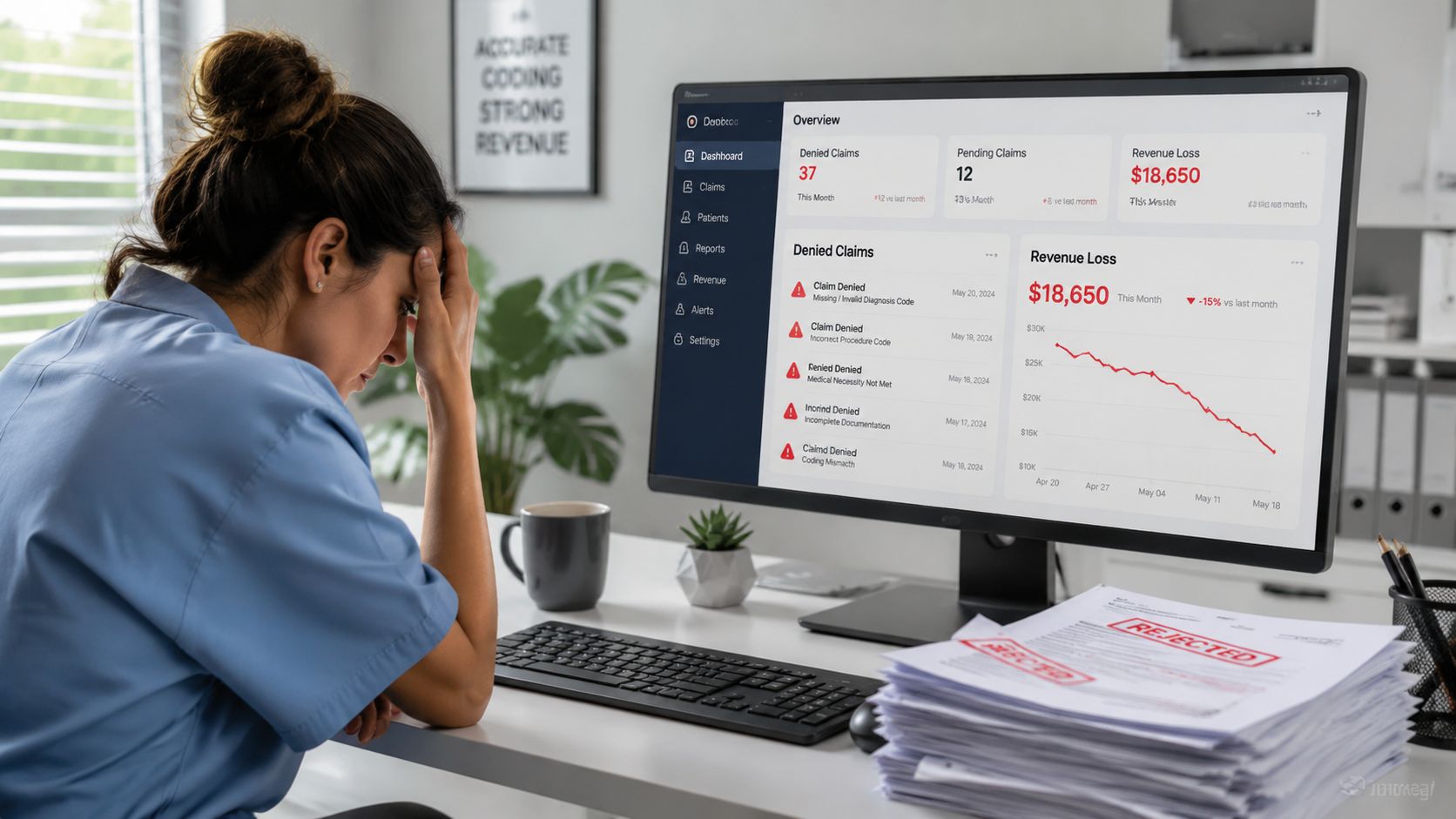
The cleanest loss is a denial. You see it, staff touch it, and the account goes back through correction and resubmission.
The more expensive loss is underpayment tied to a claim structure the payer can live with. A line may reimburse, but under a departmental classification that does not match the actual setting, intensity, or ancillary context of the service. In practice, those are harder to recover because the claim did not fail loudly. It posted.
There is also labor cost. Rev code errors pull in billing, coding, and sometimes clinical staff to verify where the service occurred and how the line should have been built. On high-volume outpatient accounts, that rework can consume more margin than managers expect.
One more problem shows up over time. Repeated inconsistency trains payer auditors where to look. Once a facility develops a pattern of weak departmental logic, more claims get reviewed, more lines get questioned, and cash slows down.
The trade-off between speed and accuracy
I have seen teams keep broad rev code mapping in place because it gets claims out the door. That choice can make sense for a short-term backlog. It is a poor long-term revenue strategy.
Broad mapping speeds submission, but it blurs the facility story on the UB-04. Manual corrections can rescue individual claims, but they rarely fix the chargemaster or interface rule that caused the problem. Delayed CDM maintenance is even worse. New procedures, drugs, and supplies get added faster than the mapping logic is reviewed, so small errors spread across months of billing.
For organizations handling out-of-network facility claims, weak revenue code structure creates another exposure. It gives payers one more reason to challenge how the claim was built before your team ever argues amount due. That is one reason many facilities tighten rev code governance alongside their out-of-network benefits workflow.
If your team cannot explain why a facility charge belongs in a specific department, you should expect payment friction.
Where leaders should look first
Start where rev code errors have the biggest dollar effect and the least visibility after payment posts.
Good targets include:
- Procedure-heavy outpatient services where the facility department affects how the line is interpreted
- Drug, supply, and ancillary charges where mapping often drifts after formulary, inventory, or CDM changes
- Organizations billing both professional and institutional claims where staff sometimes apply physician-claim logic to facility claim setup
Review denials, but do not stop there. Pull paid claims by service line, compare expected reimbursement to actual payment, and look for recurring rev code patterns on the underpaid accounts. That is usually where the recoverable margin sits.
Rev Codes in the Era of the No Surprises Act
Rev code accuracy matters even more once a payment disagreement moves beyond ordinary follow-up.
In disputes, you need the claim to be defensible on its face. That means the billing record should show a coherent facility story, not just a plausible charge total. A revenue code helps establish that context because it anchors the line to a defined institutional department or service area.
Why clean facility coding strengthens payment disputes
Revenue codes are typically 4-digit codes maintained by the National Uniform Billing Committee, and a special code like 0001 represents the total charges on the claim, a detail that receives heavy scrutiny in payment disputes, according to this overview of NUBC revenue code structure and code 0001.
That matters when you're defending payment because disputes often turn on whether the claim was built with internal consistency from the beginning. If your total charges, departmental lines, and service codes align, your position is stronger. If they don't, the payer can attack the structure before anyone even debates the amount.
Building dispute-ready claims upstream
A lot of organizations treat claim production and payment disputes as separate functions. That's a mistake.
The better model is to treat the original claim as the first draft of your dispute file. For out-of-network and underpaid accounts, that means documenting the setting accurately, maintaining internal line logic, and preserving a clean connection between the service and the facility charge.
For teams managing out-of-network reimbursement pressure, out-of-network benefits support is one example of an operational layer that can connect claim accuracy with downstream payment enforcement.
What weakens your position
These habits create problems later:
- Using vague department mapping because “it usually gets through”
- Relying on corrected claims to tell the true account after the first submission fails
- Treating total charges as a summary field only instead of a figure that must reconcile with the underlying revenue center structure
In payment disputes, a messy claim file invites a payer to argue process before value.
The No Surprises Act environment has raised the stakes. Upstream billing precision isn't just an internal quality metric anymore. It supports your credibility when payment gets challenged.
How to Audit and Optimize Your Revenue Code Strategy
Most facilities don't need a theoretical overhaul. They need a disciplined audit path.
If you're trying to answer “what are rev codes” for your team in a way that changes outcomes, make it operational. Audit where rev code decisions are made, where they drift, and where staff mix institutional and professional rules.
Start with your denial patterns
Run your denial review in a way that isolates revenue code issues from general coding issues. If everything is labeled “claim edit” or “coding denial,” you won't see the pattern.
Focus on these buckets first:
- Institutional claims denied for line inconsistency
- Facility claims with corrected submissions tied to department changes
- Underpaid claims where the original line mapping may have influenced adjudication
Then compare the denial notes to the actual claim build. You're looking for repeat combinations, not one-off mistakes.
Check the chargemaster and crosswalks
Your CDM is where many rev code problems start and stay hidden.
Review whether newly added services were mapped deliberately or dropped into generic departmental categories. Ask whether the facility's actual workflow still matches the rev code logic in the system. In many organizations, the chargemaster reflects old operational assumptions that no longer fit the way care is delivered.
A structured review process, whether done internally or through a partner that handles medical billing audits, should test line construction against current institutional billing rules and payer behavior.
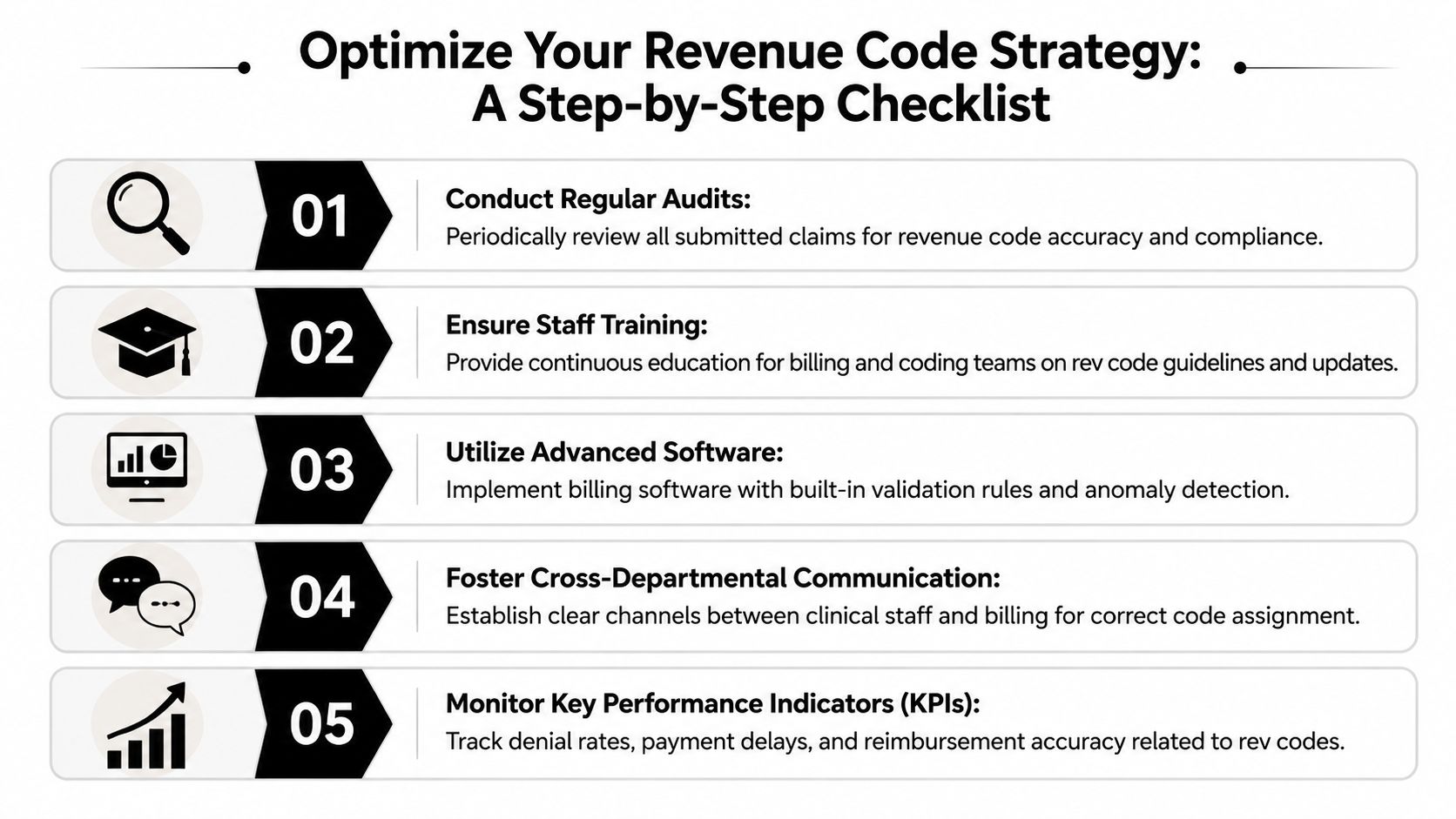
Use a five-part control model
Audit actual submitted claims
Don't rely on policy documents alone. Review what was billed, not what staff think they bill.Retrain around claim type boundaries
The most common confusion point is still institutional versus professional billing. Make that distinction part of onboarding and refresher training.Validate CDM ownership
Someone should own the rev code mapping logic. If ownership is split loosely across departments, errors persist.Create escalation rules
When a new service line doesn't fit the existing crosswalk cleanly, staff need a defined review path instead of making local workarounds.Monitor payment outcomes, not just edits
A claim that paid isn't always a claim that paid correctly. Track where rev code cleanup changes reimbursement behavior over time.
The organizations that do this well treat rev codes as revenue protection, not clerical maintenance.
RevGuard provides healthcare revenue protection and billing support for providers that need tighter control over coding, claims, underpayments, and dispute-ready reimbursement workflows. If your facility is seeing denials or payment friction tied to institutional claim structure, it can help to review rev code mapping as part of the broader revenue cycle instead of treating it as a one-field fix.