

Healthcare revenue cycle management solutions matter because margin is often lost after a claim is submitted, not before. In specialties that face routine downcoding, payment variance, and delayed adjudication, clean claims alone do not protect cash.
That gap is where many RCM programs fail. They improve registration, coding, charge capture, and denial prevention, then leave the practice exposed once the payer processes the claim incorrectly. For emergency medicine, anesthesia, radiology, hospital-based specialties, and other services that see recurring underpayment patterns, the revenue problem is not just operational. It is adversarial.
A practical revenue strategy has to cover the full payment chain. Front-end discipline still matters. Eligibility, authorizations, documentation, coding accuracy, and timely filing all shape claim performance. But specialty groups also need a system for identifying underpayments, enforcing contract terms, pursuing appeals, and using IDR when payer behavior leaves no other path to full reimbursement.
Traditional RCM vendors often stop at the remittance file. That is a real limitation. If the workflow ends when the claim is paid, even when it is paid incorrectly, the practice collects less than it earned and calls the result acceptable.
Modern revenue protection requires integrated RCM and IDR execution. Without that connection, specialty practices get more efficient at submitting claims and no better at recovering the dollars payers continue to withhold.
The High Stakes of Healthcare Revenue Management

Healthcare organizations are spending more on revenue cycle infrastructure because payment recovery has become harder, not easier. Market growth reflects the pressure on margins, the rise in payer complexity, and the cost of letting earned reimbursement slip through the cracks.
Why the stakes keep rising
For a specialty practice, revenue loss rarely comes from one dramatic failure. It comes from a steady mix of eligibility gaps, authorization defects, coding disputes, delayed payment, silent downcoding, and underpaid claims that never get challenged. Each issue looks manageable on its own. Together, they weaken cash flow, distort forecasting, and train the organization to accept less than the contract or statute allows.
Payers understand where traditional RCM stops. Many vendors help practices submit cleaner claims, post payments faster, and work basic denials. That improves operations, but it does not solve the harder problem. A claim can pass through adjudication, post to the ledger, and still be paid incorrectly.
That distinction matters most in specialties that see patterned reimbursement pressure. Emergency medicine, anesthesia, radiology, and other hospital-based groups are often dealing with payer behavior that is repeatable, strategic, and financially significant.
Practical rule: If your team closes the file once payment posts, you will miss a meaningful share of preventable revenue loss.
The leakage most teams still miss
Actual exposure starts after the claim appears resolved.
Traditional healthcare revenue cycle management solutions are built to move work through billing workflows. They are weaker at identifying whether the final payment matched the obligation. That leaves a gap between claims processing and payment enforcement. In specialty settings, that gap is where a large share of margin disappears.
A stronger model ties core RCM controls to underpayment detection, contract variance review, appeal strategy, and IDR execution when payer conduct leaves standard follow-up with little chance of recovery. Practices that add workflow automation for payment variance and appeals management are not adding complexity for its own sake. They are closing the point of failure that legacy RCM often ignores.
I have seen groups with disciplined front-end operations still lose revenue because nobody owned the paid-claim audit, escalation path, or dispute filing calendar. Clean claims are still required. They are not enough.
For leadership, the question is no longer whether the revenue cycle should be efficient. It should. The harder question is whether the organization can prove that adjudicated claims were paid correctly and force recovery when they were not. That is the difference between processing revenue and protecting it.
Deconstructing the Modern RCM Workflow
Think of the revenue cycle as a financial supply chain. Each handoff either preserves value or strips it away. The strongest healthcare revenue cycle management solutions don't treat workflow stages as separate departments. They connect them so that intake, coding, billing, payment posting, and appeals all inform each other.
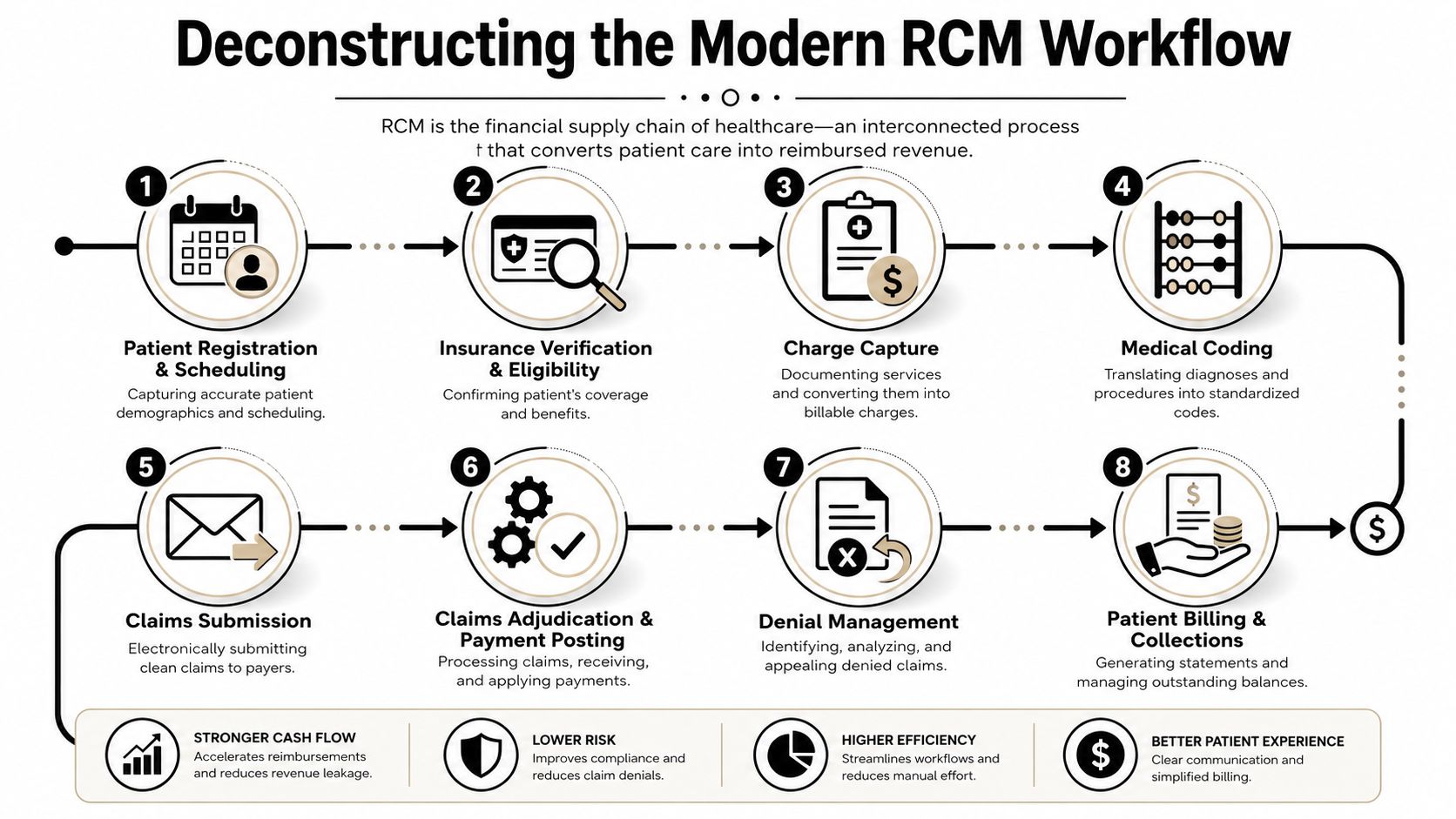
A well-run process produces real operational benefit. As described in this PubMed Central review of RCM practices and outcomes, well-implemented RCM reduces or eliminates claim denials, narrows the gap between claim submission and payment receipt, and reduces the administrative costs tied to billing and denial processing.
Front end controls revenue before care is delivered
The first break point is patient access.
Registration has to capture accurate demographics, subscriber details, plan information, and ordering context. Eligibility verification has to go beyond confirming active coverage. Staff need to verify service-level coverage, authorization requirements, site-of-care rules, referral conditions, and financial responsibility before the encounter whenever possible.
That sounds basic. It isn't. Many denials start because teams document eligibility as a yes-or-no status instead of interpreting what the payer covers for that service line.
A disciplined front end usually includes:
- Eligibility verification before every appointment: Electronic verification reduces avoidable downstream rework.
- Authorization review tied to the actual service: Generic payer checks don't catch procedure-specific requirements.
- Financial clearance: Teams should surface likely patient responsibility early, not after care is delivered.
Practices trying to standardize these steps often benefit from healthcare workflow automation strategies that reduce manual handoffs between intake, coding, and billing teams.
Mid-cycle accuracy determines whether the claim is defendable
Charge capture and coding are where clinical documentation becomes financial logic. If the encounter isn't translated correctly into billable codes, the rest of the cycle is just expensive cleanup.
Many teams rely too heavily on retrospective fixes. They let claims get created, then ask billing staff to repair missing modifiers, unsupported diagnosis links, or mismatched place-of-service data later. That model burns staff time and weakens appeal posture because the source documentation was never aligned from the start.
A claim should be built to survive payer scrutiny before it's submitted, not rebuilt after it fails.
Back-end execution decides whether revenue becomes cash
Once a claim is submitted, the work isn't finished. Payment posting, ERA reconciliation, denial analysis, appeal routing, and patient collections all determine whether reimbursement lands where it should.
Here's the workflow that matters most in practice:
| Workflow stage | What good looks like | What usually goes wrong |
|---|---|---|
| Claims submission | Clean electronic claims with payer-specific edits applied | Generic scrubbing misses contract-specific issues |
| Payment posting | ERA and payment data reconcile cleanly against expected reimbursement | Underpayments get posted as closed without variance review |
| Denial management | Teams classify root cause and prevent recurrence | Staff work denials one by one without pattern analysis |
| Patient billing | Statements are timely and understandable | Confusing balances create delays and bad debt |
The takeaway is simple. A modern RCM workflow isn't just about speed. It's about preserving claim integrity all the way to final payment.
Why Specialty RCM Demands a Different Playbook
Specialty groups shouldn't buy generic RCM and expect specialty-level reimbursement protection. The workflow may look similar on a slide, but the financial risk profile is completely different.
According to CareCloud's discussion of healthcare RCM strategy, specialty practices face a 35% higher denial rate than general practices due to complex coding requirements, and standard dashboards often fail to segment KPIs by specialty. That's not a reporting inconvenience. It's an operating problem.
Complexity changes the failure point
In primary care, many claims follow relatively stable documentation and reimbursement patterns. In anesthesia, orthopedics, IONM, oncology, or air ambulance, the claim often depends on layered coding rules, case-specific documentation, payer edits, and contract interpretation.
That means the risk isn't only that the claim gets denied. The risk is that the payer partially pays it, reduces it unexpectedly, or shifts the logic used to reimburse it.
Consider how these realities diverge:
- Anesthesia: Time units, modifiers, concurrency logic, and payer-specific edits create exposure if documentation and billing aren't tightly aligned.
- Orthopedics: Surgical claims often require precise coding relationships across procedures, implants, assistants, and medical necessity support.
- Air ambulance and emergency services: Out-of-network and high-acuity claims often face aggressive payer review and reimbursement pressure.
- IONM and other technical specialties: Contract interpretation and documentation quality can determine whether the claim is processed, reduced, or challenged.
Why standard dashboards fail
Many vendor dashboards report broad metrics across all service lines. That's useful for a systemwide view, but it can hide the exact problem a specialty CFO or practice administrator needs to see.
A denial trend in dermatology won't behave like a denial trend in anesthesia. A payer pattern in one state may not map cleanly to another. A posting variance that looks minor in a general dashboard may signal systemic downcoding in a high-value specialty line.
Here's what a specialty team needs from reporting:
- Payer-specific visibility: Not just total denials, but which payer is creating which issue.
- Procedure-level tracking: Broad category labels don't help when the problem sits in one subset of claims.
- Contract-aware variance review: Teams need expected reimbursement logic, not just posted payment totals.
- Appeal and dispute intelligence: If a payer repeatedly underpays the same type of claim, the response should be standardized and escalated.
Specialty RCM isn't harder because the staff works more. It's harder because each missed detail carries a larger reimbursement consequence.
A one-size-fits-all operating model usually breaks at exactly the point where specialty revenue matters most. It can process volume. It often can't protect margin.
Measuring Success with RCM KPIs and Analytics
If a leadership team only looks at collections and aging, it's already behind. Those are lagging indicators. They tell you damage has happened. Strong healthcare revenue cycle management solutions track operational signals early enough to change the outcome.
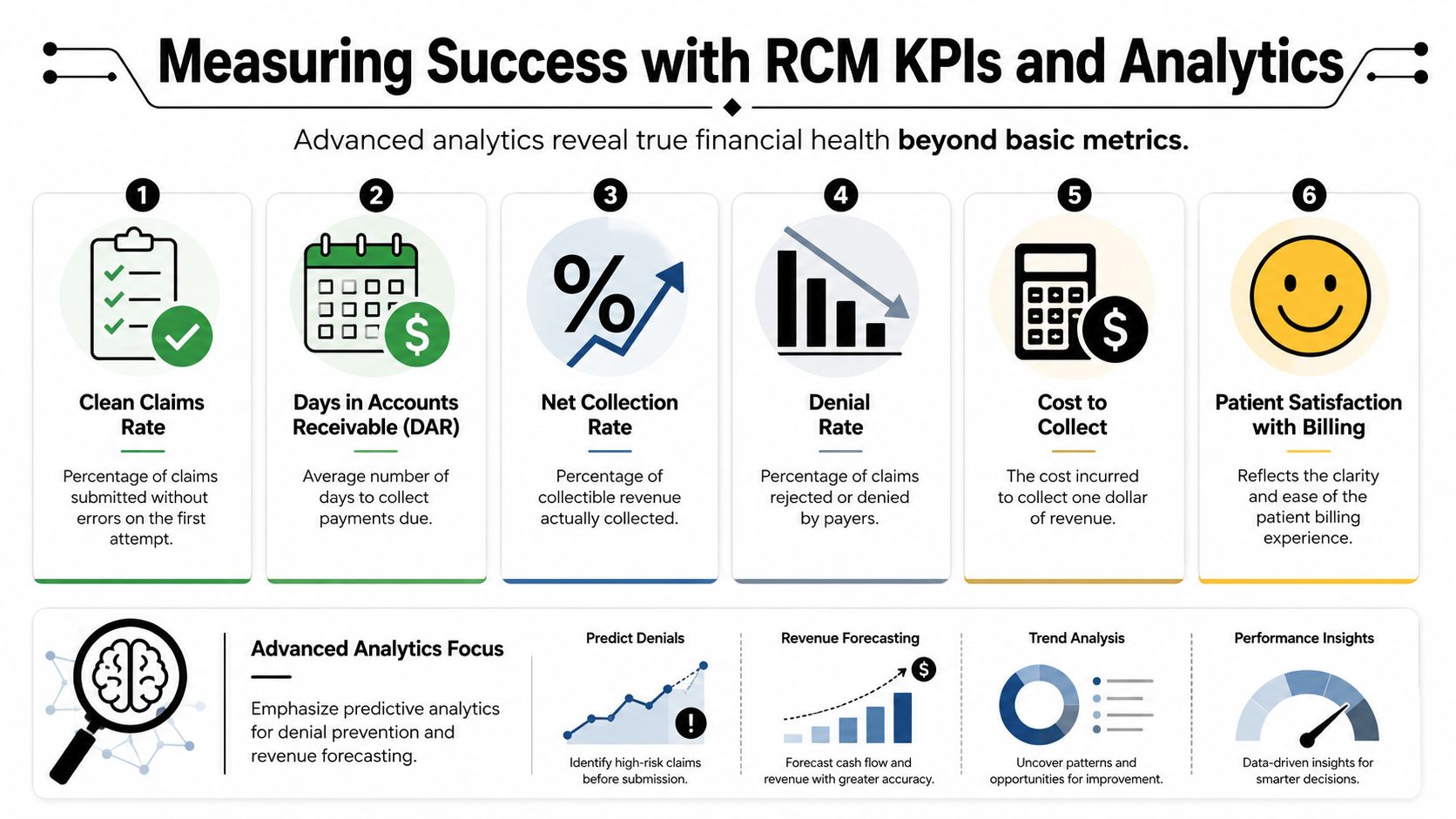
Modern platforms now use AI and machine learning to forecast reimbursement timing and predict claim denials by analyzing historical denial patterns and patient payment behavior, as described in this overview of AI-driven healthcare revenue cycle analytics. That matters because good analytics don't just explain the past. They shape front-end and mid-cycle behavior before bad claims go out the door.
Practices that want sharper visibility into these patterns usually need stronger healthcare revenue cycle analytics than what comes standard in many billing platforms.
The KPI set that actually matters
A practical scorecard should include a small set of metrics that connect operational quality to financial outcomes.
| KPI | Why it matters | How to read it |
|---|---|---|
| Clean claim rate | Shows whether claims leave the practice without preventable errors | A weakening trend usually points to intake, coding, or edit-rule issues |
| Days in A/R | Indicates how long cash is taking to convert | Rising days often trace back to denial rework or slow payer response |
| Net collection rate | Reflects how much collectible revenue the organization actually captures | If this softens, look for underpayments and unresolved balances |
| Denial rate | Identifies how often payers reject claims | Useful only when broken down by payer, reason, and specialty |
| Cost to collect | Tells you how much operational effort is required to recover revenue | Rising cost often means staff are chasing avoidable or poorly classified issues |
Predictive analytics changes the operating model
Many organizations still use analytics as an after-action reporting function. They review denial categories, hold a meeting, assign cleanup, and wait for the next month-end package. That approach is too slow for specialties facing frequent payer edits and reimbursement pressure.
Predictive analytics can improve decisions earlier by flagging:
- Likely denial triggers at intake
- Coding combinations that historically create payer friction
- Claims with higher reimbursement variance risk
- Patient balances that may require earlier outreach
- Payers whose adjudication behavior is shifting
That creates a very different management discipline. Leaders stop asking, “What went wrong last month?” and start asking, “Which claims should we intervene on before they become rework?”
The value of analytics isn't the dashboard. It's the operational decision the dashboard forces your team to make.
What weak KPI programs get wrong
Many organizations overload dashboards with activity metrics that don't change behavior. More workqueue volume doesn't mean more recovered revenue. More appeals filed doesn't mean the right appeals were filed. More claims submitted doesn't mean expected reimbursement was preserved.
A strong KPI program does three things well:
- It isolates root causes, not just outcomes.
- It segments by payer, specialty, and service line.
- It links reporting to action owners with clear follow-up.
If your analytics can't distinguish preventable denials from contractual underpayments, the reporting stack is incomplete.
Choosing Your RCM Delivery Model and Vendor
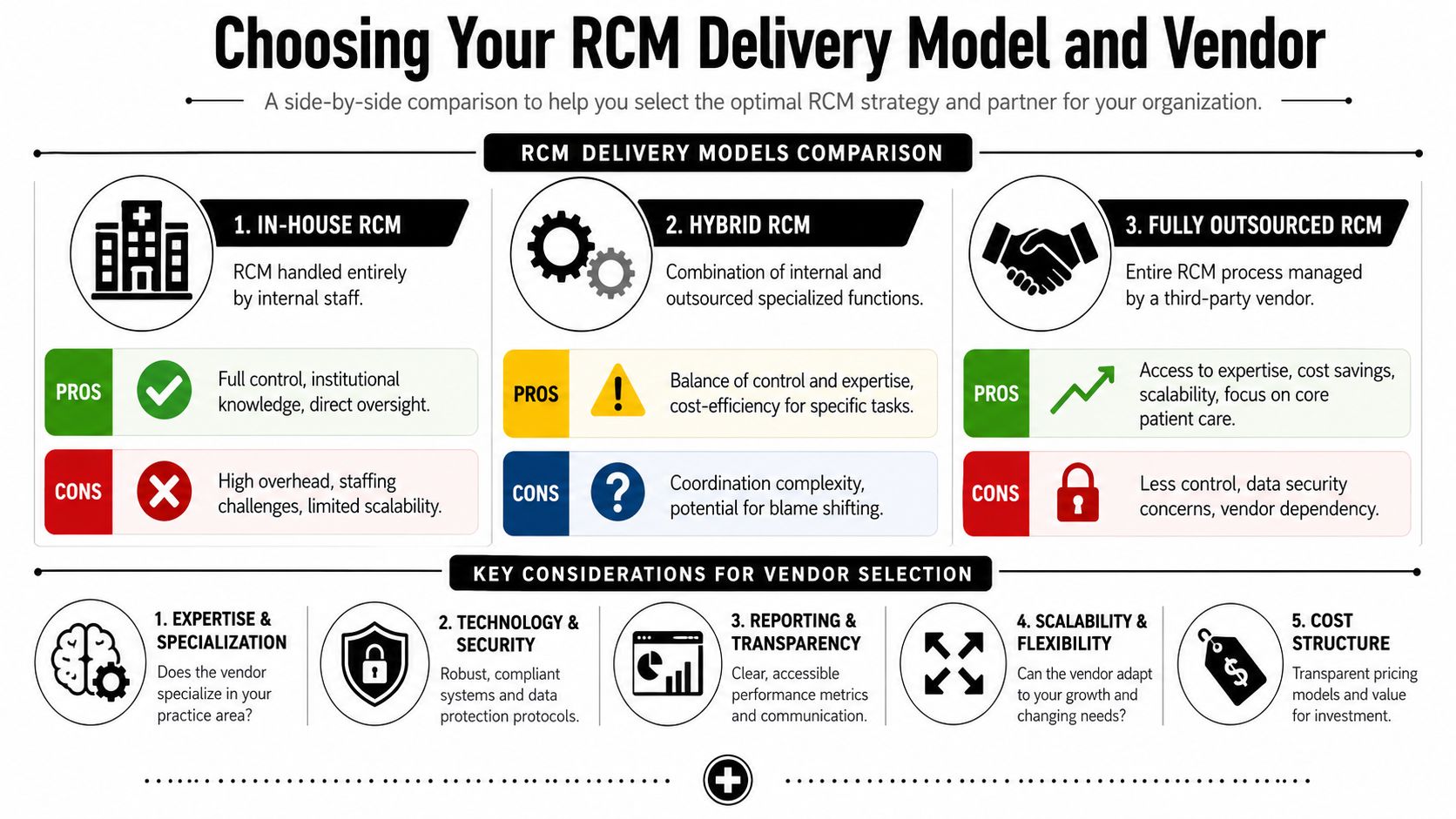
The delivery model matters as much as the software. Some organizations should keep more RCM in-house. Some should outsource heavily. Many specialty groups end up in a hybrid model because they want control over patient-facing workflows but need outside expertise for coding, denial recovery, underpayment analysis, or dispute work.
On the technology side, enterprise RCM stacks increasingly require support for HL7 FHIR, PostgreSQL or Node.js/.NET Core backends, and cloud infrastructure such as AWS or Azure to maintain interoperability among EHRs, clearinghouses, and payer portals, according to this review of revenue cycle management software architecture. That technical baseline matters because disconnected systems create manual reconciliation and missed payment variance review.
Comparing the three operating models
Here's the blunt version of the trade-off.
| Model | Works well when | Main risk |
|---|---|---|
| In-house | The practice has stable leadership, experienced billing staff, and enough volume to justify dedicated expertise | Knowledge gaps become expensive when payer rules shift |
| Hybrid | The organization wants control over some workflows but needs outside depth for complex functions | Accountability can get blurry if roles aren't explicit |
| Fully outsourced | The group needs scale, faster process maturity, or specialty expertise it can't recruit internally | The vendor can become a black box if reporting is weak |
In-house RCM
In-house teams usually know the physicians, documentation habits, and local payer environment better than anyone else. That's a real advantage. They can also work closely with front-desk and clinical staff to correct recurring issues at the source.
But the in-house model struggles when a specialty requires narrow coding expertise, high-volume denial prevention, contract-level variance analysis, or legal and operational alignment around underpayment disputes. Staffing is also fragile. One senior biller leaving can expose years of process shortcuts.
Hybrid RCM
Hybrid models often work best for specialty organizations with strong internal oversight. The practice keeps ownership of patient access, scheduling, or payment posting while outsourcing claim edits, coding review, denial follow-up, analytics, or dispute support.
This model succeeds when handoffs are precise. It fails when both sides assume the other one owns the exception path. If a payer repeatedly underpays a claim type, someone must have explicit responsibility to identify the variance, classify it, escalate it, and close the loop.
Fully outsourced RCM
A fully outsourced arrangement makes sense when the internal team is overstretched or the practice is expanding across locations, payers, or states. It can also make sense when the organization wants one accountable operating partner instead of several fragmented vendors.
Still, you should vet the partner hard. Ask whether the vendor only processes denials or whether it also manages underpayment recovery and downstream dispute execution. For example, RevGuard provides specialty-specific RCM tied to enforcement-driven IDR workflows under the No Surprises Act, which is materially different from a standard billing service that stops at appeals.
Teams evaluating outside partners can compare structures using this guide to revenue cycle management outsourcing.
Vendor questions that expose the real fit
Use a checklist that gets past the sales pitch.
- Specialty fit: Ask which specialties the team actively supports and how it handles payer rules unique to your procedures and contracts.
- Interoperability: Confirm how the platform exchanges data with your EHR, clearinghouse, and payer channels.
- Reporting depth: Require payer-level, location-level, and service-line-level visibility.
- Variance detection: Ask how underpayments are identified after payment posting.
- Escalation path: Clarify who owns appeals, arbitration support, and unresolved reimbursement disputes.
- Operational transparency: Insist on visible workqueues, aging logic, and issue classification, not just summary dashboards.
If a vendor can tell you how it submits claims but not how it enforces reimbursement after adjudication, you're only hearing half the operating model.
Implementation and The Final Frontier of Revenue Protection
The transition to a new RCM model usually fails for operational reasons, not technical ones. Teams underestimate cleanup work, migrate bad data, train too late, and assume the vendor or software will fix process defects automatically. It won't.
The implementation plan has to start with current-state diagnosis. Identify where claims leak value now. Intake errors, coding variation, posting delays, weak denial root-cause analysis, payer underpayment patterns, and unresolved patient balances all need to be mapped before anything changes. Otherwise, the practice just transfers broken workflows into a new system.
What a disciplined rollout looks like
A practical rollout usually includes a few essential elements:
- Data validation before migration: Bad payer tables, outdated fee logic, and inconsistent demographics create downstream noise immediately.
- Role clarity: Staff need to know who owns edits, who owns denials, who owns variance review, and who owns disputes.
- Training tied to actual workflows: Generic software demos don't prepare teams for specialty-specific exceptions.
- Parallel review after go-live: Early claims, remits, and patient statements should be checked aggressively for errors and reimbursement drift.
One common mistake is focusing only on implementation speed. Fast isn't the goal. Stable cash conversion is.
Where traditional RCM still stops short
Even a competent rollout can leave a major hole if the solution treats revenue protection as an upstream task only. Existing industry discussion often misses the critical gap between upstream RCM and downstream Independent Dispute Resolution under the No Surprises Act, leaving specialty providers without a unified strategy to convert underpayments into recoverable revenue, as noted in this analysis of RCM challenges and the RCM-to-IDR gap.
That gap matters because not every revenue loss starts as a denial. Some losses show up as reduced reimbursement on claims that were accepted and paid incorrectly. Traditional workflows often post the payment, label the account complete, and move on. The organization records revenue less than it expected and never forces resolution.
The sustainable model links prevention and enforcement
The future of healthcare revenue cycle management solutions isn't just cleaner claims. It's a closed loop between claim creation, adjudication review, underpayment detection, and formal enforcement when payer behavior warrants it.
That means the strongest operating model does all of the following:
- Prevents avoidable denials at intake and coding.
- Detects payment variances after adjudication.
- Separates administrative error from payer underpayment.
- Routes recoverable claims into an escalation path.
- Uses IDR or other formal mechanisms when appeals won't close the gap.
Denial prevention protects efficiency. IDR-ready underpayment recovery protects enterprise value.
Specialty groups that adopt that full-cycle mindset stop treating underpayments as unavoidable friction. They start treating them as recoverable assets.
If your organization needs a partner that connects specialty RCM operations with downstream underpayment enforcement, RevGuard is built for that exact gap. It combines specialty-specific revenue cycle management with IDR workflows under the No Surprises Act, helping practices move from cleaner claims to stronger reimbursement protection.