

Your clinicians are delivering care. Your scheduler is trying to keep authorizations straight. Your office manager is posting payments, chasing denials, and answering parent questions between everything else. Then cash slows down, aging grows, and nobody can tell you exactly where revenue is leaking.
That's the normal starting point for many ABA practices.
The problem isn't just that billing is hard. It's that ABA billing is structurally hard. The workflows are authorization-heavy, documentation-sensitive, and payer-specific. If your billing partner treats ABA like generic outpatient claims, you'll feel it in delayed cash, rework, and write-offs that shouldn't exist.
Why ABA Billing Is Uniquely Complex and Costly
A practice can deliver a full week of authorized care and still miss payroll timing because the revenue was lost upstream. The intake team entered the wrong plan. An authorization changed after a reassessment and no one updated the unit balance. Claims went out with valid CPT codes but the rendering setup did not match the payer file. Payment posted, but no one caught that the insurer shaved units or paid below contract.
That is why ABA billing creates outsized financial drag compared with general outpatient billing. The work is not limited to sending clean claims. It requires tight control over a chain of dependencies that starts before the first session and continues until every underpayment, denial, and recoupment is resolved.
Complexity Shows Up in the Hand-Offs
The highest-cost failures usually happen between teams, not inside one task.
Front office staff verify coverage, but they may not know the payer's current ABA rules. Clinical supervisors document medical necessity and session details, but payer edits often turn on administrative details such as credentialing status, place of service, modifiers, taxonomy, or authorization alignment. Billing staff can submit a technically clean claim that still has no chance of payment because the wrong servicing provider, unit count, or auth segment was attached.
One mistake rarely stays isolated. It turns into rework across scheduling, clinical ops, billing, and family communication. That rework has a real cost in payroll hours, delayed cash, and preventable write-offs.
Practical rule: In ABA, denied claims are usually the last visible symptom of an earlier process failure.
Why the Cost Runs Higher in ABA
ABA reimbursement depends on repeated accuracy across a long treatment arc. The same patient may have frequent authorization updates, multiple provider types, supervision requirements, coordination-of-benefits issues, and payer-specific rules that change mid-year. A billing team cannot treat those as one-time setup items.
I see the same pattern in struggling organizations. They focus on fixing the denial that showed up this week, but they do not repair the intake control, authorization workflow, documentation standard, or payment variance review that caused it. The claim gets appealed. The system stays broken. Revenue keeps leaking.
This is also where owners underestimate the downstream value of billing discipline. If a payer develops a pattern of underpaying, delaying, or denying on weak grounds, the practice needs a record that supports escalation. Clean enrollment files, authorization history, claim-level audit trails, appeal documentation, and contract variance reporting do more than improve first-pass payment. They create the factual foundation for stronger dispute enforcement later, including formal out-of-network payment disputes or other recovery actions when applicable.
Why Generic Billing Support Usually Fails
Practice owners usually try a predictable set of fixes first:
- Add an in-house biller. This helps with workload, but added headcount does not solve payer-rule interpretation, root-cause analysis, or contract underpayment review.
- Hire a general medical billing company. Claims may move faster, but faster submission does not help if auth controls, ABA coding logic, and denial strategy are weak.
- Push clinicians to document better. Better notes matter. They do not fix expired authorizations, enrollment mismatches, or payer payment errors.
Specialized ABA therapy billing services earn their keep when they operate as a revenue protection function. That means preventing avoidable denials, catching underpayments, tracing failure patterns back to the source, and building a documented position the practice can use when a payer's behavior stops being random and starts looking systematic.
Done well, billing support does not just collect what is already due. It gives the practice a tighter operating system for protecting revenue before it is lost.
Defining Modern ABA Therapy Billing Services
When most owners hear “billing service,” they think claims submission. That's too narrow. Modern ABA therapy billing services should manage the full chain of events that determine whether care turns into collectible revenue.
A real ABA billing partner starts before the first claim exists. It looks at payer setup, intake controls, authorization status, coding logic, payment posting, denial handling, and patient balance workflows as one connected system.
What the Service Actually Includes
At minimum, competent ABA therapy billing services should cover these operational functions:
- Eligibility and benefits verification: Confirming the active plan, covered services, and practical billing rules before treatment continues.
- Prior authorization management: Tracking approvals, units, dates, and changes so claims don't go out against expired or mismatched authorizations.
- ABA-specific coding review: Making sure billed services align with documentation, rendering provider details, and payer requirements.
- Claim scrubbing and submission: Catching errors before they become denials.
- Payment posting and reconciliation: Verifying what was paid, what was adjusted, and what still needs action.
- Denial follow-up and appeals: Pursuing recoverable revenue instead of closing claims.
- Reporting: Turning financial activity into usable management information.
What Makes ABA Different From Generic Medical Billing
The hard part isn't just the code set. It's the operational dependence on coordination.
ABA billing sits close to the clinic floor. Schedulers, BCBAs, RBTs, intake staff, and billers all affect whether a claim pays correctly. A generic biller may know how to transmit claims, but an ABA specialist knows where those claims break before transmission. That includes supervision-related requirements, session timing issues, payer-specific documentation expectations, and authorization utilization.
Here's the practical difference:
| Generic billing view | ABA specialist view |
|---|---|
| “Was the claim filed?” | “Was the claim supported by active auth, correct service data, and payer-specific logic?” |
| “Why did this deny?” | “What upstream workflow created this denial pattern?” |
| “Let's resubmit.” | “Let's stop this from recurring next week.” |
The best ABA billing teams act more like process engineers than clerks.
What Owners Should Expect
A modern billing partner shouldn't just tell you what denied. They should tell you why it denied, where the breakdown happened, who owns the correction, and how they'll prevent recurrence. If they can't explain that clearly, they're not doing revenue cycle management. They're doing transaction processing.
That difference is why some practices keep working harder while collections still feel unpredictable.
Navigating Common Billing and Payer Challenges
A payer recoups three weeks of claims because the authorization expired mid-month. Another payer pays the batch, but at the wrong rate, and nobody catches it until quarter-end. Meanwhile, a family changes plans after an employer switch, sessions continue, and the first clean claim never had a chance. That is how ABA revenue leaks. It happens through repeatable process failures that look small in isolation and expensive in aggregate.
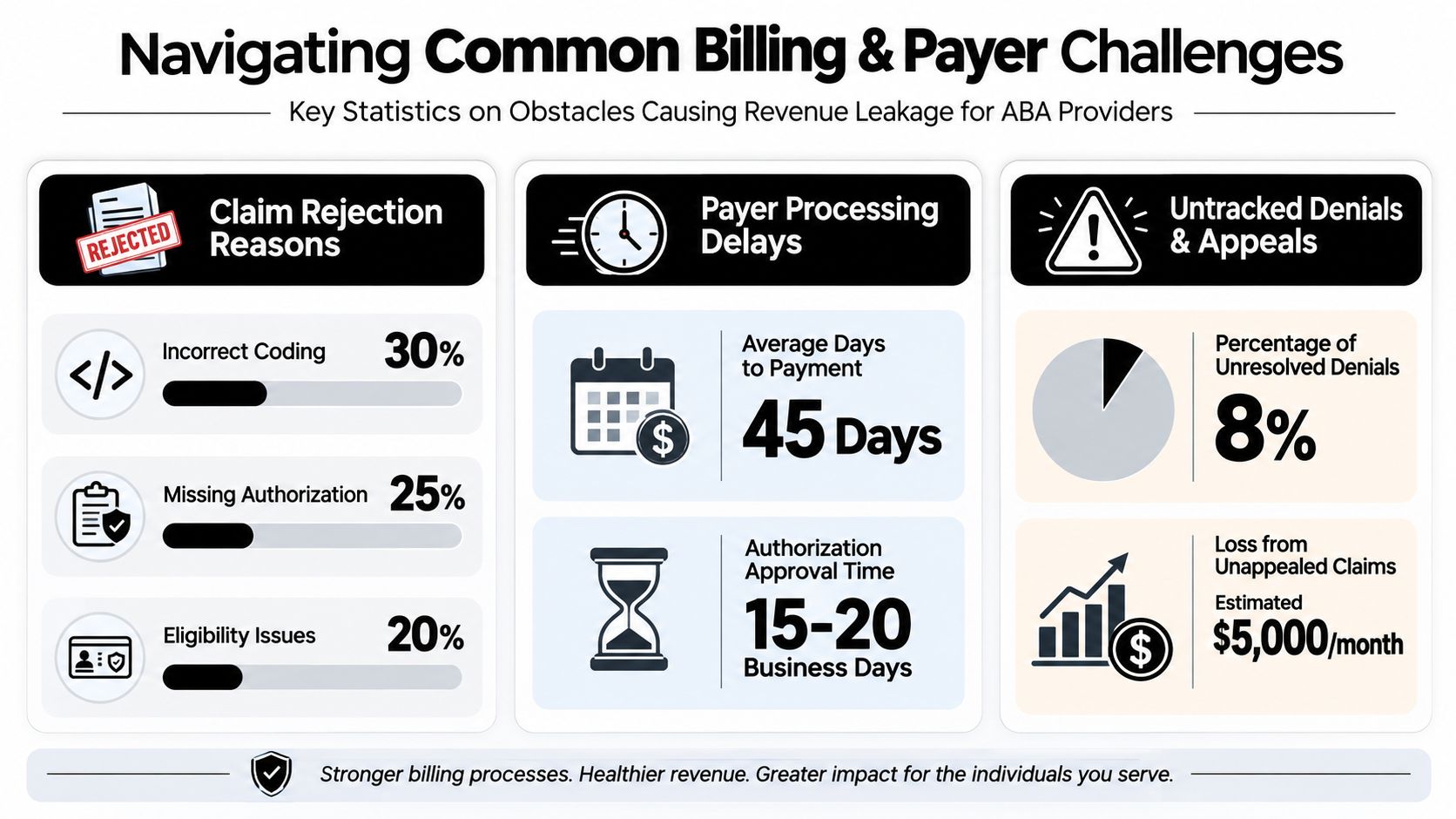
The benchmark is simple. A healthy ABA billing operation keeps first-pass resolution high, denials contained, and A/R from stretching into chronic follow-up work. As noted earlier, CARE RCM's ABA billing guide points to targets above 95% for first-pass resolution, under 5% for denials, and below 45 days in A/R. When a practice drifts past those marks, the problem usually sits upstream in intake, authorization control, documentation discipline, or payment reconciliation.
Authorization Failure Is the Main Leak
Prior authorization remains the biggest point of failure in ABA billing because it is tied directly to scheduled care. Dates change. Units run down faster than expected. Service combinations get approved differently than the clinical team anticipated. Payers issue partial approvals, then the schedule keeps running as if nothing changed.
Practices that track authorizations across spreadsheets, emails, and staff memory usually create two kinds of write-off risk. The first is straightforward denial. The second is worse. Services are delivered without collectible coverage, and the practice is left arguing medical necessity after the payer has already decided the service was unauthorized.
This is why strong billing partners treat auth management as revenue protection, not clerical maintenance. They monitor remaining units, compare scheduled hours to approved services, and escalate mismatches before the visit occurs.
Payer Rules Create Margin Variance
ABA owners often focus on whether a claim paid. The more important question is whether it paid correctly.
Payer rules differ by plan type, fee schedule, modifier expectation, documentation standard, and edit behavior. A coding issue that produces a short delay under one commercial payer can produce a hard denial under Medicaid managed care. An underpayment on a high-volume code may not stand out on a posting report, but over a month it can erase margin from an entire payer segment.
Earlier in the article, the CARE RCM guide noted wide reimbursement variation for common ABA services, including 97153. That kind of spread is not just a pricing issue. It creates a control issue. If the billing team does not reconcile expected allowed amounts against actual payment, underpayments get posted as if they were correct and payer behavior goes unchallenged.
Transition Risk Starts Before the First Denial
Coverage changes are one of the easiest ways to lose control of the revenue cycle. A family changes jobs. Medicaid eligibility shifts. The client moves across state lines. A secondary plan appears and nobody updates coordination of benefits correctly.
These are not registration events. They are high-risk revenue events.
The operational failure usually starts at the handoff. Intake updates the insurance. Clinical staff keep the schedule intact. Billing finds the change after claims reject or deny. By then, the practice is already working from behind. A disciplined billing service builds pre-service checks around these transitions, confirms active coverage, reviews authorization status, and resets payer-specific claim logic before charges accumulate.
The Problems Usually Arrive as a Cluster
In ABA, denials rarely come one at a time. One missed control triggers the next.
- Authorization drift: Approved units, dates, or service combinations no longer match delivered care.
- Coding mismatch: The billed code set does not align with documentation or payer policy.
- Eligibility instability: Coverage changes mid-cycle and the issue is found after claim submission.
- Underpayment posting: Payments are entered, but reduced reimbursements or non-covered lines are not escalated.
- Inconsistent appeals: Staff pursue some denials, ignore others, and create no payer-level pattern tracking.
That last point matters more than many owners realize. A denial should not be treated as a one-off clerical mistake if the same payer keeps using the same edit, downcoding logic, or authorization interpretation. At that stage, the practice needs a repeatable response. That includes root-cause correction upstream, disciplined appeal workflows, and, when the contract and facts support it, formal payment dispute strategies such as IDR or other out-of-network enforcement paths.
Well-run ABA billing services do more than fix rejected claims. They classify payer behavior, measure where cash is leaking, and build controls that prevent the same revenue loss next month. That is how billing turns from back-office cleanup into a system for protecting margin.
Mapping the End-to-End RCM Workflow
An ABA revenue cycle works when every handoff has an owner and every owner has a control. If a practice can't map the path from intake to final payment in plain language, it usually has hidden failure points.
The workflow below is what stable operations tend to have in common.
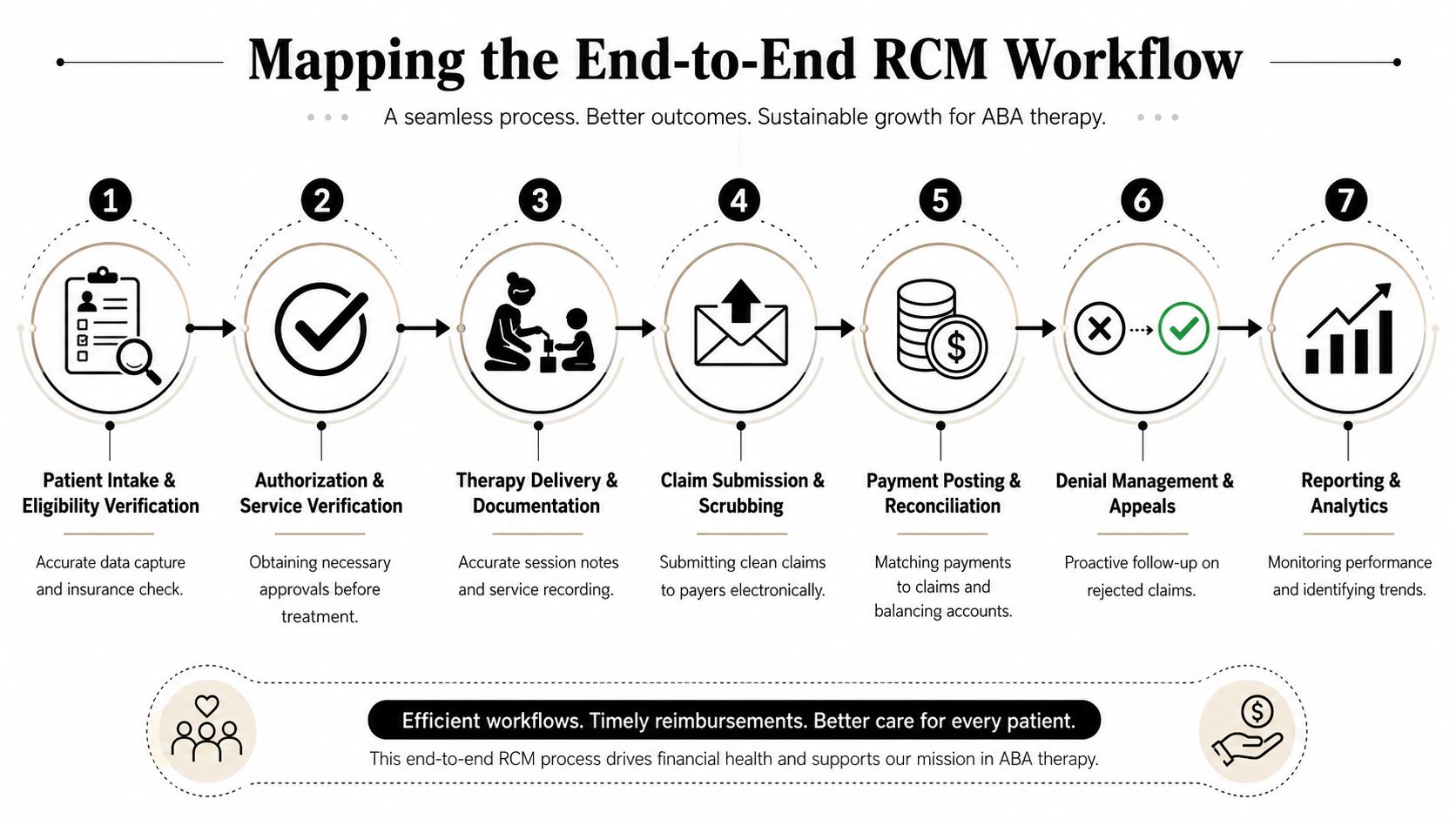
Step One Through Three
The first phase happens before the claim exists.
Patient intake and eligibility verification
Intake should capture clean demographic and insurance data. Eligibility verification should confirm active coverage and identify billing-sensitive details before services continue.Authorization and service verification
Many practices lose control at this point. Approved services, date ranges, and utilization need active monitoring, not a one-time check.Therapy delivery and documentation
Clinical teams should document care in a way that supports both treatment integrity and billing defensibility. Documentation that is clinically thoughtful but operationally inconsistent creates downstream friction.
Step Four Through Five
The middle of the cycle determines whether the claim reaches the payer in a recoverable form.
| Workflow point | What has to happen |
|---|---|
| Claim submission and scrubbing | Claims need review for payer edits, coding consistency, and missing data before submission |
| Payment posting and reconciliation | Payments must be matched accurately, and variances need investigation instead of passive posting |
A lot of owners assume the claim is the product. It isn't. The product is a claim that can survive payer scrutiny and then be reconciled correctly when money comes back.
Strong billing teams don't separate “billing work” from “clinical operations.” They build controls where those two worlds meet.
Step Six and Seven
The final phase is where mature ABA therapy billing services distinguish themselves from basic vendors.
Denial management and appeals
Denied claims need classification, ownership, follow-up deadlines, and escalation rules. “Refile and wait” isn't a denial strategy. It's delay disguised as work.
Reporting and analytics
A useful reporting layer doesn't dump raw aging reports on the owner. It answers practical management questions:
- Which payers are slowing cash?
- Which denial categories are rising?
- Which locations or teams need workflow correction?
- Which underpayments deserve escalation?
Where Most Practices Break the Chain
Breakdowns usually happen at handoff points:
- intake doesn't fully communicate benefit or policy changes to billing
- clinicians document services, but billing lacks the data structure needed to support the claim
- authorizations are tracked somewhere outside the scheduling workflow
- posted payments aren't reviewed against expected reimbursement behavior
When those handoffs are weak, the practice feels busy but financially uncertain. A structured billing partner should tighten those handoffs until the claim path is predictable.
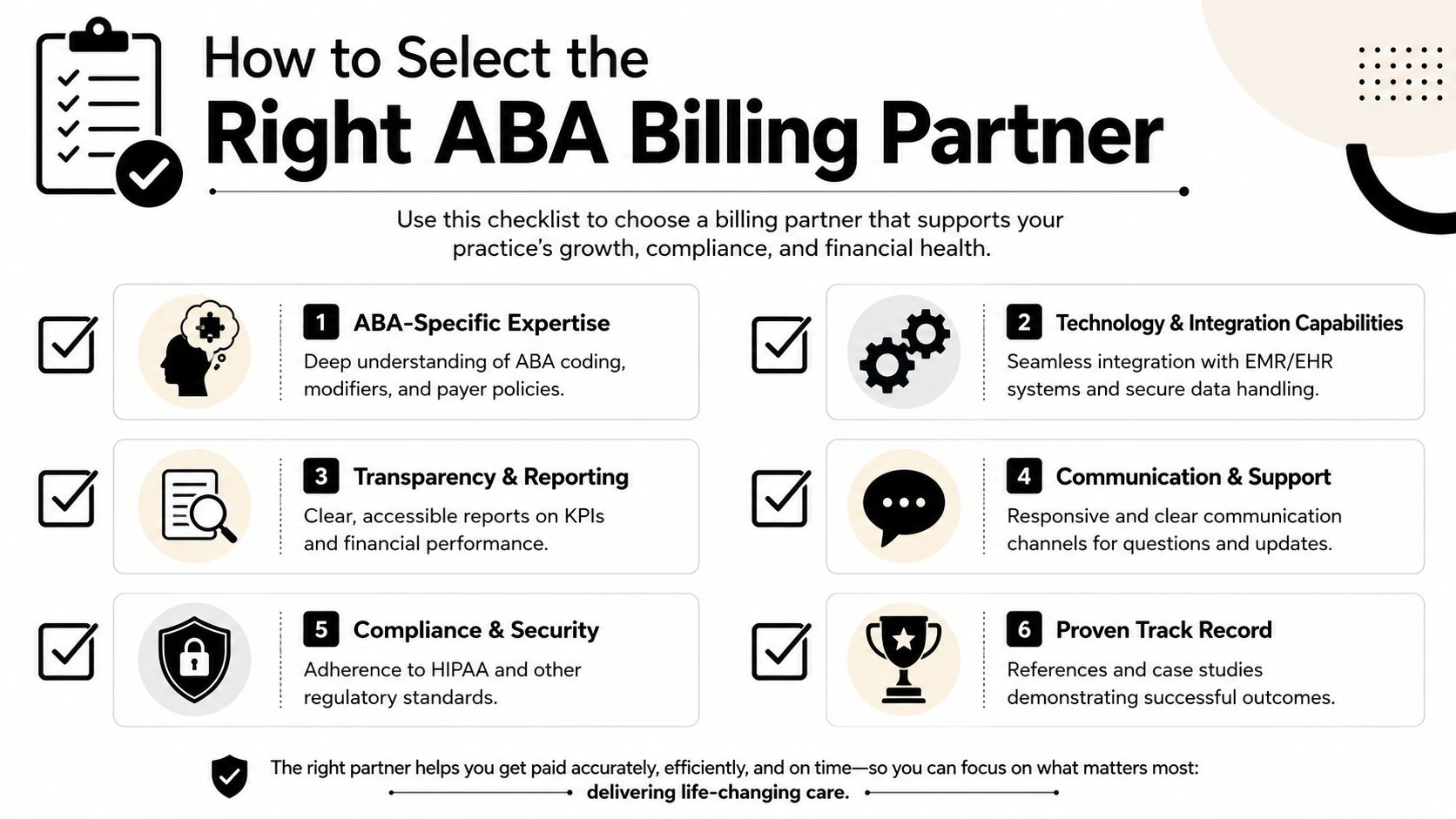
How to Select the Right ABA Billing Partner
A practice owner hires a low-fee billing company, collections look stable for 60 days, and then the leaks show up. Authorizations lapse without warning. Denials sit in aging. Payments post, but nobody checks whether the payer short-paid. The vendor looked affordable on paper. The practice still lost cash.
Owners often prioritize price when selecting a billing partner. Price matters, but fee percentage is a weak screening tool if the vendor cannot protect revenue across authorization tracking, claim submission, payment review, and escalation. In ABA, billing errors rarely stay isolated. One weak process upstream usually creates write-offs, delays, and rework downstream.
Questions That Actually Matter
A useful vendor conversation should sound like an operating review.
Ask questions like these:
- How do you track authorization status across active clients, and who is responsible for renewal follow-up? If ownership is unclear, denials will follow.
- How do you sort denials by payer behavior, root cause, and recovery path? A vendor that only talks about rejections is describing front-end claim edits, not denial management.
- Who reviews posted payments against contracted or expected reimbursement? Accurate posting without underpayment review still leaves money on the table.
- How do you coordinate with clinical, intake, and scheduling staff? ABA revenue breaks at handoff points, so the billing partner needs process discipline outside the billing office.
- What does implementation look like in the first 30 to 60 days? A serious partner can explain data migration, cleanup work, payer enrollment status, backlog handling, and who from your team will be involved.
A broader framework for evaluating vendors is outlined in this guide to choosing medical billing companies. In ABA, the standard needs to be higher because payer rules, authorizations, and documentation dependencies are tighter.
What Good Partnership Looks Like
The right partner should be able to explain your revenue cycle as a controlled system, not a set of disconnected tasks. That means they can show how intake quality affects claims, how authorization monitoring affects utilization, how payment posting feeds underpayment review, and how denial trends drive process correction.
Operational fluency matters.
A strong ABA billing partner understands CPT usage, modifiers, supervision and rendering requirements, payer-specific authorization rules, and the documentation patterns that support paid claims. They also know where the trade-offs are. Aggressive claim submission can raise first-pass volume while increasing preventable denials later. Tight edit rules can reduce denials while slowing throughput if they are poorly configured. Good partners manage both speed and accuracy.
Reporting should also be usable. Owners do not need another stack of raw reports. They need payer-level aging, denial categories, auth-at-risk cases, underpayment flags, and a short list of action items.
Communication structure is another test. If every issue disappears into a shared inbox, accountability is weak. You want named ownership, response expectations, and regular review meetings that focus on cash, not just task counts.
A billing partner should reduce revenue leakage and management burden at the same time.
Red Flags That Usually Predict Trouble
Watch for these signs during evaluation:
- They lead with software and dashboards but cannot explain workflow controls. Tools help, but process design gets claims paid.
- They describe denials as isolated mistakes instead of repeat payer behavior. That usually means they will chase problems one by one instead of building a prevention and recovery system.
- They post payments but do not review variances or partial payments. That gap erodes margin.
- They have broad medical billing experience but thin ABA depth. ABA billing depends on operational detail that generalist vendors often miss.
- They promise a smooth transition without discussing cleanup work. Every conversion has friction, especially if old AR, payer enrollment, or authorization records are messy.
Choose the partner that can identify where your revenue is leaking before they ask for the contract. The best billing relationships do more than submit claims. They protect cash upstream, recover it downstream, and give the practice a repeatable way to control payer behavior over time.
Advanced Denial Management and Dispute Strategies
Most ABA practices still treat denials as isolated mistakes. Fix the code, send the note, resubmit the claim, move on. That approach works for random clerical errors. It fails when denials reflect repeat payer behavior.
That's the core shift many practices need to make. Denials aren't always exceptions. Often, they're signals.
Build a Denial Taxonomy
A denial taxonomy is a structured way to sort payer responses into useful categories. Not just “denied,” but what kind of denial, under which payer, after which workflow event, and with what recovery path.
At a minimum, the taxonomy should separate:
- Authorization denials
- Eligibility denials
- Coding and modifier denials
- Documentation denials
- Medical necessity or utilization disputes
- Underpayments dressed up as partial processing
Once those categories exist, you can identify patterns. One payer may repeatedly deny after an authorization renewal point. Another may consistently process a service line at the wrong allowed amount. A third may delay reconsiderations until staff stop following up.
Weekly Review Beats Ad Hoc Follow-Up
The difference between reactive and strategic denial management is cadence. Clinics that implement weekly denial pattern reviews and systematic appeal workflows reduce denial rates from above 15% to below 8%, according to Pacemave's discussion of ABA denial patterns and appeal discipline.
That's why random appeal work doesn't hold up. Staff need a recurring review process that answers:
- Which denial categories increased this week?
- Which payer behavior appears repeatable?
- Which claims should be corrected and refiled?
- Which claims need formal appeal with evidence?
- Which payment issues may justify more aggressive dispute action?
For a broader framework, this overview of healthcare denial management is useful because it treats denials as operational data, not just claim status changes.
The appeal letter matters. The classification system behind the appeal matters more.
Enforcement Has a Place in Revenue Strategy
A mature billing operation doesn't stop at “can we resubmit this?” It asks whether payer conduct has created a recoverable dispute that should be escalated. That's where enforcement-driven thinking becomes valuable.
Not every ABA claim issue belongs in formal dispute channels. But many practices lose money because they never distinguish between a correctable internal error and a payer behavior problem. If the payer routinely delays, downcodes, or underpays in predictable ways, the billing strategy has to account for that.
What works
A disciplined approach usually includes:
- a denial taxonomy tied to root cause
- a documented appeal ladder
- evidence standards for each appeal type
- payer-specific tracking of repeat denial behavior
- clear escalation rules for high-value or recurring disputes
What doesn't
What fails is familiar:
- resubmitting the same claim without changing the evidentiary argument
- treating every denial like a staff error
- appealing without tracking payer-specific outcomes
- closing partial payments without variance analysis
The point isn't to fight every claim forever. It's to identify which claims represent recoverable revenue and pursue them with structure.
Monitoring Performance With Key KPIs and Dashboards
If your billing service sends activity reports but you still can't tell whether performance is improving, the reporting layer is failing. Owners need a small set of metrics tied to control, speed, and recoverability.
The most useful dashboard in ABA therapy billing services usually centers on a few core indicators rather than endless report tabs.
The KPIs That Matter Most
The benchmark metrics already discussed are the right starting point:
| KPI | Why it matters | What to watch for |
|---|---|---|
| First-pass resolution rate | Shows claim quality before rework | Decline suggests upstream process breakdown |
| Denial rate | Measures preventable friction | Rising trend means payer or workflow issues need classification |
| Days in A/R | Reflects cash velocity | Long aging often points to follow-up failure or unresolved denials |
The key is trend interpretation. A single bad week can happen. A sustained change means a process owner needs to intervene.
Here's what a useful reporting interface should support:

What a Strong Dashboard Should Show
A strong dashboard should make it easy to answer practical questions quickly.
- Payer segmentation: Which payer is driving denials, delays, or unexpected payment behavior?
- Aging by category: Are claims aging because they're unbilled, denied, in appeal, or partially paid?
- Authorization exposure: Which active clients are approaching risk because approvals need review?
- Variance visibility: Where are posted payments not matching expected reimbursement behavior?
- Team accountability: Which work queues are moving, and which are stalled?
A good reference point is this set of revenue cycle management metrics, especially if you're trying to decide what owners should see versus what your billing manager should see daily.
Use the Dashboard to Manage, Not Just Observe
The dashboard should trigger actions:
- retrain intake if eligibility-related issues rise
- audit auth tracking if denials cluster around renewals
- review payer policy logic if one plan's processing behavior changes
- escalate partial payments if reconciliation shows a consistent gap
Owners don't need more data. They need reporting that points directly to revenue-saving decisions.
If your billing partner can't turn performance data into clear next actions, you're getting reports without management value.
RevGuard helps providers treat revenue leakage as a solvable operational problem, not a background cost of doing business. If your practice is dealing with denials, underpayments, or inconsistent cash flow, RevGuard offers a revenue protection model that connects specialty RCM with enforcement-driven dispute strategy so more earned revenue gets collected.