
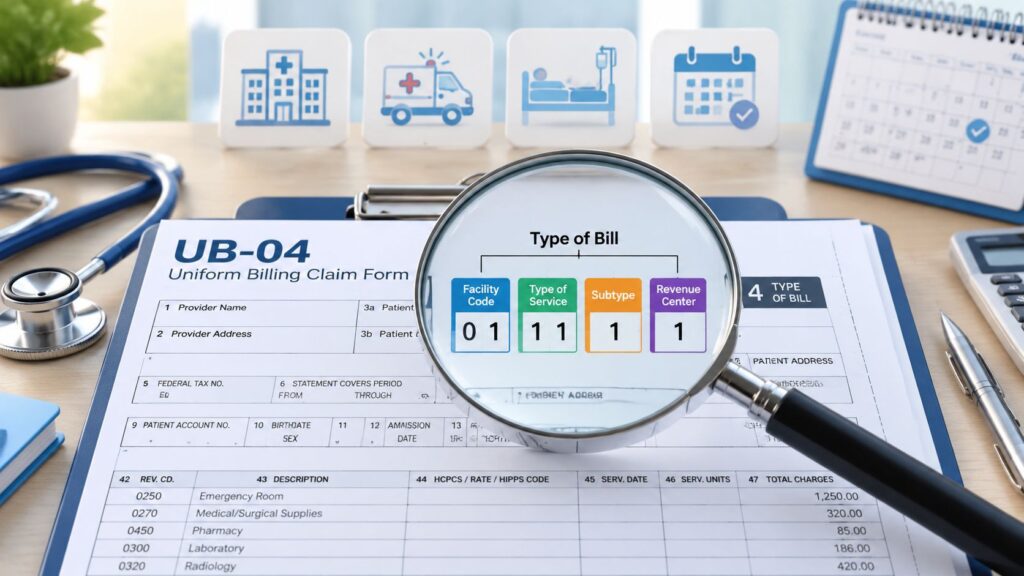
A surprising amount of institutional revenue gets delayed before a payer even reaches medical necessity or coding edits. Data shows 34% of institutional denials stem from Type of Bill errors, with frequency code mismatches as the top subcategory, according to Noridian's bill type guidance. That means a claim can fail because the bill type says the wrong kind of encounter, the wrong setting, or the wrong billing sequence.
That's why bill types on UB04 deserve more attention than they usually get. Many teams treat Form Locator 4 as a small field to complete near the end of the claim. In practice, it acts more like a routing instruction. It tells the payer what kind of institution is billing, what kind of care was provided, and whether the claim is the first, continuing, final, replacement, or voided version of that episode.
Confusion usually starts with simple-looking examples. A hospital outpatient visit and a hospital inpatient admission may share the same patient, same diagnosis family, and same payer, but they shouldn't be billed with the same bill type. The same problem shows up in specialty settings, where recurring services, return transports, or hybrid telehealth workflows create frequency mistakes that trigger avoidable denials.
If you need a broader primer on the form itself before focusing on bill types, this overview of what a UB-04 form is is a helpful companion. What follows here is narrower and more practical: how bill types on UB04 work, where teams get tripped up, and how to use that knowledge to reduce rework in daily revenue cycle operations.
Introduction to UB04 Bill Type Challenges
A denied institutional claim often looks like a coding problem when it first lands in the work queue. Then someone opens the claim and realizes the clinical coding may be fine. The actual issue sits in Form Locator 4.
Consider a common workflow breakdown. Registration identifies the patient correctly. Coding assigns the diagnosis and procedure details. Charges drop. The bill goes out. Then the payer reads the bill type and decides the claim doesn't match the setting or billing sequence expected for that service. The claim stalls, and the billing team has to trace the error backward across admission status, charge capture, and claim frequency logic.
That's why bill types on UB04 matter far beyond compliance. They affect cash timing, staff rework, appeal volume, and underpayment risk. A team can submit an otherwise complete claim and still miss payment because the bill type tells the payer's system to apply the wrong reimbursement pathway.
Where confusion starts
The field looks compact, but each digit carries a different job. One digit identifies the facility category. Another defines the care classification. Another controls the billing sequence. Staff members who know one part well often assume the other parts are obvious, and that's where mistakes creep in.
Practical rule: Treat the UB-04 bill type as an adjudication trigger, not a clerical field.
Why specialty providers feel this harder
Specialty organizations often work in edge cases. Air ambulance, intraoperative neuromonitoring support arrangements, emergency services, and telehealth-enabled facility encounters don't always fit the simple inpatient-versus-outpatient mindset. Frequency rules become more important when services span multiple touchpoints, corrections are needed, or a payer expects a different sequencing logic than the billing team used internally.
The result is familiar. Claims bounce for “wrong bill type,” downcode for setting mismatch, or require a replacement or void sequence that slows reimbursement even more.
Evolution of UB04 Form and Bill Types
Institutional billing didn't always run through the modern UB-04 structure. The UB-04 form, officially designated CMS-1450, replaced UB-92 in 2007, standardizing institutional claim processing for hospitals, ASCs, and critical access hospitals, as outlined in AHIMA's update on the UB-04 transition.
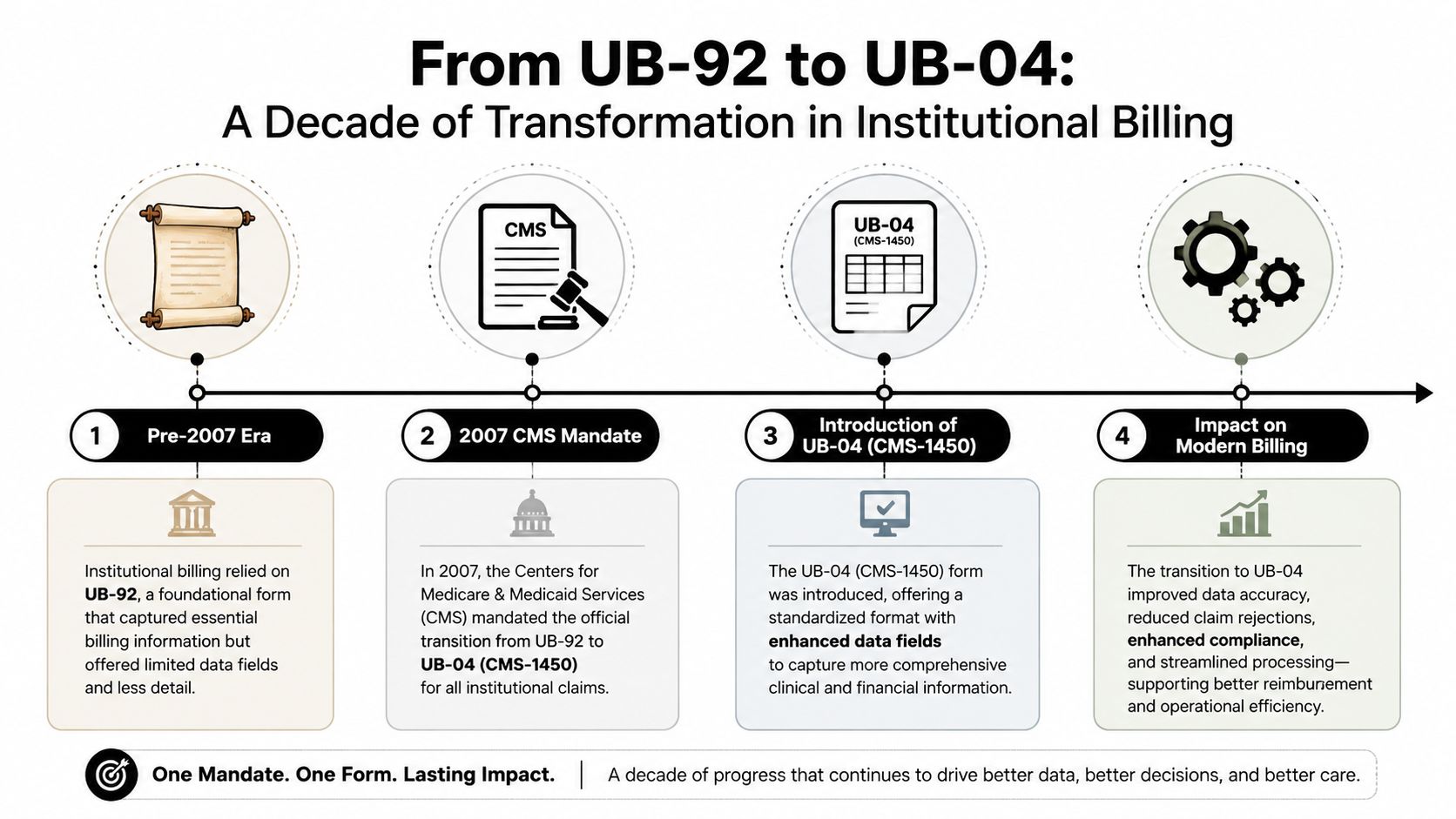
That change mattered because institutional claims needed a more reliable way to communicate not just who billed, but what kind of facility service the payer was being asked to adjudicate. Room and board, bundled facility services, outpatient facility encounters, and specialty institutional claims all needed consistent routing logic. The Type of Bill field became one of the core tools for that job.
Why CMS-1450 changed claim operations
Under the UB-04 framework, the bill type became a primary routing key for facility claims. It doesn't merely label the claim. It helps determine which payer logic applies when the claim enters adjudication.
That matters in practical terms:
- For inpatient stays: the payer can distinguish a full-stay claim from an interim bill.
- For corrections: the payer can identify whether the provider is replacing a prior claim or voiding it.
- For benefit logic: the bill type helps separate institutional care categories that trigger different reimbursement methods.
This is one reason the transition from UB-92 to UB-04 still affects modern RCM. Teams inherit payer edits, clearinghouse logic, and internal workflows built around this standardized structure.
How frequency logic became more important
The update also sharpened the role of frequency coding. A full stay can be billed one way. A long confinement with interim claims uses another sequence. A corrected claim uses another. That sequencing matters because the payer isn't just asking, “What service was this?” The payer is also asking, “Where in the billing lifecycle does this claim belong?”
A replacement claim and an original claim may describe the same patient encounter, but the payer won't process them the same way.
That distinction is especially important in large organizations where corrections are handled by a separate follow-up team. If the original error is fixed but the replacement or void sequence is wrong, the corrected claim can fail again.
Why the history still matters now
Many denials blamed on “system edits” are really structure problems. The form changed years ago, but the operational lesson is current: institutional billing works best when teams understand that bill type is not a background field. It's one of the first instructions a payer reads.
Breaking Down the Bill Type Structure
The easiest way to understand bill types on UB04 is to think of the code as a sorting label in a shipping center. The claim arrives with a compact set of instructions. The payer reads those instructions before deciding which lane the claim should enter.
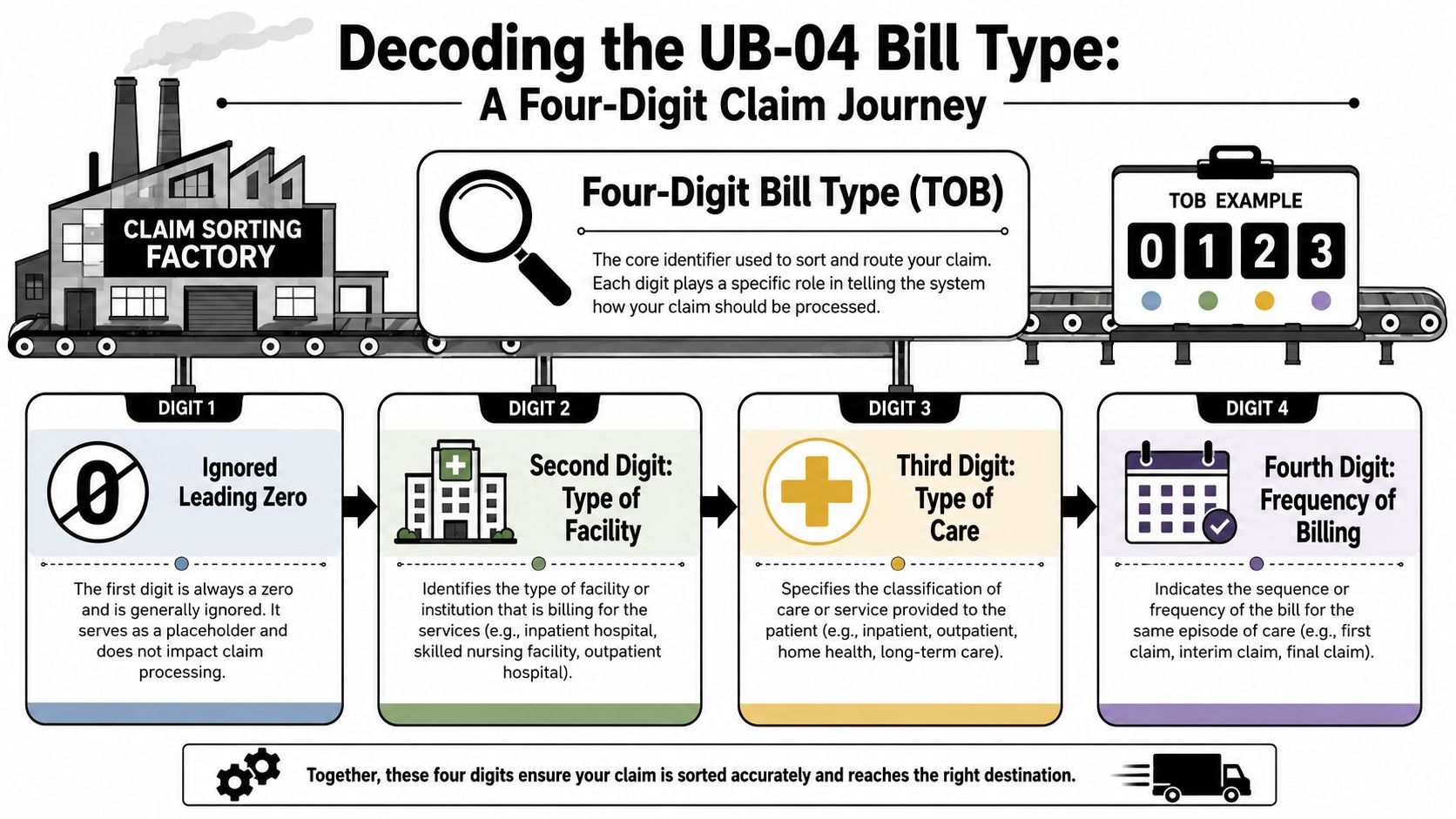
The UB-04 TOB is a mandatory four-digit alphanumeric code where the second digit defines facility type, the third digit care classification, and the fourth digit billing frequency, enabling instant routing for accurate reimbursement logic, according to this UB-04 billing explanation.
The leading zero
Form Locator 4 is shown as a four-digit code, but the first digit is a leading zero that CMS ignores. Many billers speak in three digits for that reason.
So when someone says 111, they're referring to the meaningful part of the bill type even though the form itself may present it as 0111.
The second digit identifies the facility
This is the facility-type digit. It tells the payer what kind of institutional provider submitted the claim.
Examples from the verified structure include:
- 1 = Hospital
- 2 = Skilled Nursing Facility
- 3 = Home Health
- 8 = Special Facility or Ambulatory Surgical Center
- 7 = Clinic appears in another verified explanation of facility examples
Many users overgeneralize. They know the service was outpatient and jump straight to the third digit. But the payer needs the facility context first. Outpatient care at a hospital and outpatient care at another institutional setting don't route the same way.
The third digit identifies the type of care
This digit answers a different question: what care setting or classification does the claim represent?
Verified examples include:
- 1 = Inpatient, including Medicare Part A
- 2 = Inpatient, Medicare Part B only
- 3 = Outpatient
This digit is often the most dangerous one to get wrong because it can contradict the actual service rendered. If your charges and dates tell an outpatient story but the bill type says inpatient, the payer may deny or downcode the claim based on that mismatch.
Use this quick check: If the clinical record, revenue codes, and admission status all point one direction, the third digit should point there too.
The fourth digit identifies billing frequency
This is the sequencing digit. It tells the payer whether this is the original bill for the episode, part of an interim series, the final interim bill, or a correction cycle.
Verified examples include:
- 1 = Admit through discharge
- 2 = Interim first claim
- 3 = Interim continuing
- 4 = Interim last claim
Replacement and void logic also depends on frequency coding in the broader UB-04 framework.
Putting the pieces together
A few examples make the structure easier to remember:
| Example | What it means |
|---|---|
| 111 | Hospital, inpatient, admit through discharge |
| 131 | Hospital, outpatient, original single claim |
| 881 | ASC or special facility, outpatient-style routing under the special facility category, original claim |
Think of the bill type as a sentence compressed into digits. First, who is billing. Second, what kind of care. Third, where this claim sits in the billing sequence. If any one of those parts is wrong, the payer may send the claim down the wrong path.
Common Bill Type Codes Across Care Settings
The fastest way to make bill types on UB04 practical is to compare them across settings. The code that fits one environment can be wrong in another, even if the patient experience seems similar on the surface.
Here's a simple reference table built from the verified bill type examples and the facility, care, and frequency logic described earlier.
Bill type code examples by setting
| Setting | TOB Codes | Description |
|---|---|---|
| Hospital inpatient | 111 | Hospital facility, inpatient care, admit-through-discharge claim |
| Hospital outpatient | 131 | Hospital facility, outpatient care, original claim for the encounter |
| Ambulatory Surgical Center | 881 | Special facility or ASC routing, original claim |
| Skilled Nursing Facility inpatient | 211 | Skilled Nursing Facility, inpatient classification, original full claim |
| Home Health original bill | 331 | Home Health facility, outpatient-style classification in the bill type structure, original claim |
| Clinic outpatient | 731 | Clinic facility example, outpatient classification, original claim |
| Interim hospital inpatient first bill | 112 | Hospital inpatient, interim first claim |
| Interim hospital inpatient continuing bill | 113 | Hospital inpatient, interim continuing claim |
| Interim hospital inpatient last bill | 114 | Hospital inpatient, interim last claim |
A few patterns stand out. The second digit changes with the facility, while the third digit changes with the care classification. The fourth digit changes when the billing sequence changes, even if the patient and service line stay the same.
The codes people mix up most often
Hospital teams commonly confuse 111 and 131 when the admission status changes after the initial encounter. An observation-to-inpatient conversion, same-day surgery, or ED visit tied to later admission can create internal handoff errors if registration and billing don't align on final status before claim creation.
ASC claims create a different kind of confusion. Staff may recognize that the service was outpatient surgery and assume a hospital outpatient bill type pattern applies. But the payer looks first at the facility category, which is why ASC routing requires the special-facility bill type structure rather than a hospital one.
Specialty scenarios need more than a cheat sheet
Some specialties sit in gray areas where a basic table isn't enough. Air ambulance and other emergency-linked services can involve episode sequencing questions that make the frequency digit especially important. In telehealth-enabled facility settings, the challenge isn't only which code is valid. It's whether the payer interprets the institutional claim as duplicative when a professional claim is also submitted.
That's where adjacent claim fields matter too. If your team is checking bill type but ignoring revenue line construction, review how revenue codes work on institutional claims because the payer reads those fields together.
The bill type tells the payer what lane to use. Revenue codes and service lines help prove the claim belongs there.
A practical way to use this table
Don't use a code table as a memory test. Use it as a validation tool at the point of claim creation:
- Match the facility category first.
- Confirm the care setting in the record.
- Verify whether this is the original, interim, replacement, or final sequence for that episode.
- Check whether the payer has special edits for that service line.
That process catches more errors than trying to memorize every common bill type by itself.
How Payers Use Bill Types in Claim Processing
A large share of institutional claim edits happen before a payer reviews the clinical story in detail. The Type of Bill field often drives that first routing decision, which is why a small TOB error can send an otherwise valid UB-04 into the wrong payment path.
Payer systems read bill type as processing logic, not as a label for human readers. The first digit group tells the system what kind of facility submitted the claim. The second tells it what care setting or bill classification to expect. The third tells it how to treat the claim in the episode sequence, such as original, interim, replacement, or void. If one part is off, the payer may apply the wrong edits before it ever evaluates supporting details.
A mail sorter is a useful comparison here. If the ZIP code is wrong, the package goes to the wrong distribution center even when the street address is correct. Bill type works the same way in adjudication.
Why mismatches trigger denials, rejects, and wrong payment logic
A bill type mismatch can break claim processing in more than one place. Intake edits may reject the claim outright. Adjudication rules may deny it after the system compares the TOB to revenue lines, provider type, and benefit design. In some cases, the payer pays the claim under the wrong methodology because the bill was routed into the wrong facility category.
DrChrono's UB-04 bill type guidance explains why these errors are often structural rather than cosmetic. If the bill type points to the wrong care classification, the payer usually will not “fix” that interpretation for the provider. The cleaner path is often a corrected claim, replacement bill, or full void and rebill, depending on the payer's rules.
That distinction matters in revenue cycle work. A diagnosis typo may support an appeal. A bill type error often requires rebuilding the claim in the correct lane first.
How payers apply bill type during claim routing
Payers usually use TOB in three decision layers.
- Benefit fit: Does this institutional claim type match the member's covered setting and the contract terms?
- Payment method: Should the claim price under inpatient, outpatient, SNF, home health, or another facility methodology?
- Claim sequence: Is the submission the first bill for the episode, an interim bill, a replacement, or a void?
Specialty-specific frequency rules make this more complicated than a general TOB table suggests. Home health, hospice, rehab, and other episodic settings can trigger payer edits when the frequency digit does not match the timing of the billing cycle. The code may look close enough to a human reviewer, but the payer's system processes sequence exactly.
Telehealth adds a second layer of ambiguity
Telehealth facility billing creates a common gray area because the payer may receive both an institutional claim and a professional claim tied to the same encounter. CMS continues to issue telehealth policy updates through its Medicare telehealth services guidance, but payer interpretation still varies on when a facility component is separately payable, especially for outpatient hospital workflows.
The practical problem is not whether the service occurred. The practical problem is whether the payer accepts the UB-04 as a bill for a distinct facility resource or treats it as duplicative of the CMS-1500. That question becomes more sensitive when the service falls into a No Surprises Act dispute pathway.
Why the No Surprises Act and IDR angle matters
A bill type error can weaken an Independent Dispute Resolution position even if the underlying care was appropriate. For example, suppose a hospital outpatient department furnishes a telehealth-enabled emergency follow-up service and submits a UB-04 for the facility component while the clinician submits the professional claim separately. If the institutional claim uses a bill type that points the payer toward the wrong outpatient logic or the wrong frequency sequence, the payer may characterize the facility charge as invalid or duplicative. Once that framing appears in the remittance and internal payer notes, the provider enters the payment dispute from a weaker starting point.
RCM teams should preserve documentation that shows why the facility component stands on its own. That usually includes the department where the service was scheduled, the resources the facility supplied, telehealth platform or room support if relevant, revenue code alignment, the original and corrected claim history, and contract or policy language showing that the institutional component is separately billable. In an IDR file, those records help establish that the dispute is about payment amount or payer interpretation, not about a structurally defective claim.
This is also where disciplined denial intake helps. A team that sorts a telehealth underpayment into a generic appeal bucket may miss the fact that the payer's objection started with claim structure. A tighter healthcare denial management workflow helps staff separate bill-type defects from medical necessity disputes and payment-amount disputes before deadlines start to compress.
What to verify before the claim leaves your shop
For telehealth, hybrid visits, and other services with both facility and professional components, review these points before submission:
- Facility component support: The record should show what the institution furnished beyond the practitioner's professional work.
- TOB alignment: The bill type should match the actual institutional setting and billing sequence.
- Claim pairing rules: Check payer policy for UB-04 and CMS-1500 combinations on the same date of service.
- Correction history: If this is a replacement or void, make sure the frequency digit and payer resubmission process match.
- Dispute file readiness: Keep the documentation needed to defend the facility charge if the payer reframes it as duplicative under No Surprises Act payment disputes.
Payers use bill type as an instruction set. When the TOB matches the service model, the claim enters the right processing lane. When it does not, payment problems often start before the payer reviews the rest of the claim.
Resolving Denials and RCM Best Practices
A bill type denial can send a clean clinical story into the wrong processing lane in seconds. The fastest path to payment starts with identifying whether the payer rejected the claim's structure, the billed service, or the payment amount.
Start with the denial pattern
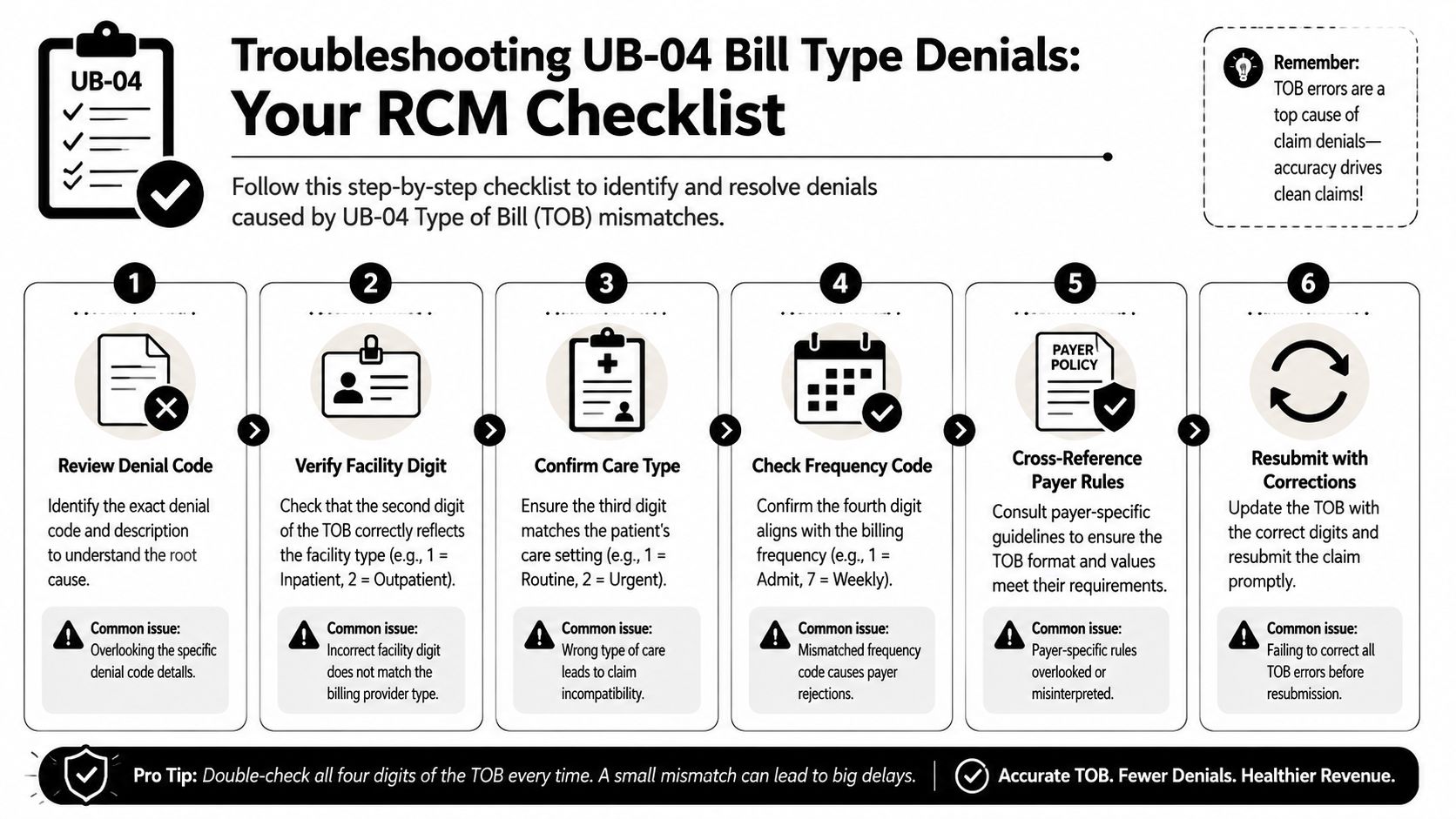
Read the denial reason like a routing label. If the payer cites invalid bill type, facility mismatch, incorrect frequency, or claim type conflict, send the account to a bill-type review queue first. That keeps staff from writing a medical necessity appeal for a claim that never passed the payer's structural edits.
Use a simple sequence:
- Confirm the facility digit. Does it match the billing entity that furnished the institutional service?
- Confirm the care digit. Does it reflect the proper setting or classification of care?
- Confirm the frequency digit. Does it match where the claim sits in the episode, such as original, interim, replacement, or void?
That order saves time. A wrong care classification can make the frequency review irrelevant, much like checking the tracking number before confirming the package went to the right carrier.
Know when correction beats appeal
Some denials need a corrected claim process, not an argument letter. If the bill type identifies the claim incorrectly at its core, the payer may treat the submission as the wrong claim rather than a slightly flawed version of the right one.
In practice, that often means a void and a new submission. Many Medicare Administrative Contractors and commercial plans require providers to cancel the prior claim and resubmit when the replacement changes core claim identity fields or when the payer's billing instructions do not allow simple field-level correction. CMS billing guidance and contractor reopening rules are a good reminder to check the payer's correction pathway before staff send a replacement claim that the system will reject again.
Operational advice: If the denial points to the claim's identity, rebuild the claim first, then decide whether any payment dispute remains.
This distinction matters even more in specialty workflows. An outpatient hospital telehealth encounter, a provider-based clinic visit, and a professional telehealth claim can involve overlapping dates of service with different billing forms and different payer edits. Under the No Surprises Act, payment disputes can later turn on whether the institutional claim was valid in the first place. A weak bill-type foundation makes IDR preparation harder because the payer can frame the issue as a defective claim rather than an underpayment.
Build denial handling around specialty risk
General denial buckets miss the patterns that drive rework. Emergency services, ASC billing, recurring therapy, oncology series billing, rehabilitation, and telehealth-supported facility services each create different frequency and resubmission problems.
A practical workflow should include:
- A specialty edit map: Match common service lines to the bill type and frequency problems they create most often.
- A telehealth review rule: Check whether the facility portion is separately billable, whether a professional claim is also expected, and whether the payer treats the encounter as duplicative.
- A correction decision tree: Show staff when to submit a replacement, when to void, and when to appeal an underpayment on a correctly structured claim.
- A payer-specific note set: Store instructions by scenario, not just by payer name, because one payer may handle inpatient corrections differently from outpatient or telehealth claims.
- A denial feedback loop: Send resolved bill-type denials back to claim-edit teams so the same setup error does not repeat next month.
Teams that want tighter handoffs between claim creation, denial triage, and follow-up can use a defined healthcare denial management workflow to separate structural UB-04 defects from coding disputes and payment disputes before filing deadlines get tighter.
When to escalate payment disputes
Correct the claim before you escalate the payment fight.
If the payer still underpays or rejects a properly corrected institutional claim, document the sequence carefully. Keep the original denial, the corrected submission history, payer correspondence, medical record support for the institutional component, and any policy language on hybrid or telehealth billing. That file becomes especially useful when a payer argues that the facility charge was bundled, duplicative, or outside its view of a valid institutional claim.
For No Surprises Act disputes, bill type accuracy supports the provider's position in a very practical way. It shows that the claim belongs in the institutional lane, that the billing sequence was handled correctly, and that the payment disagreement is about amount or policy interpretation, not basic claim validity.
Practical Tools and Key Takeaways
A strong UB-04 workflow doesn't depend on memorizing every code. It depends on giving staff tools they can use under pressure.
Start with a one-page bill type reference that lists the meaning of the second, third, and fourth digits separately. Add a specialty frequency cheat sheet for service lines that commonly involve return trips, recurring encounters, interim billing, or corrected submissions. Then build a claim review checklist that requires staff to compare the bill type against admission status, service setting, and payer-specific edits before release.
A sample internal toolkit might include:
- Annotated UB-04 examples: one hospital inpatient claim, one hospital outpatient claim, one ASC claim
- A frequency decision grid: original, interim first, interim continuing, interim last, replacement, void
- A telehealth overlay review form: confirming when a facility claim and professional claim can coexist without creating avoidable payer confusion
- A denial replay log: documenting which TOB mistakes recur by payer and service line
The key takeaway is simple. Bill types on UB04 work best when teams validate them as claim logic, not data entry. Match the facility first. Confirm the care classification next. Verify the billing sequence last. If a payer keeps resisting a properly structured institutional claim, document the issue early and preserve the record for formal payment dispute escalation.
RevGuard helps providers protect revenue when claims are denied, downcoded, or underpaid. If your organization needs support across specialty RCM, denial prevention, or No Surprises Act dispute strategy, visit RevGuard to learn more.