

A denial hits your work queue before coffee. The claim looked routine when it left the office. The procedure was performed, the note was signed, and the code selection seemed defensible. Then the payer asks for records, downcodes the service, or pays less than the documentation appears to support.
That moment is where many teams discover a hard truth. They don't really have a medical record audit process. They have a denial response habit.
For compliance officers, that distinction matters. A denial response starts after cash is delayed. A medical record audit starts earlier, while you still have a chance to catch missing documentation, unsupported codes, weak modifier use, or gaps in the evidence trail that will later matter in a dispute. It also creates a less discussed opportunity. The same review process that helps you defend against overpayment findings can also expose underpayments that would otherwise stay buried in the remittance stream.
Introduction to Medical Record Audits
A practice manager in a busy specialty group usually doesn't wake up thinking about audit trails, author identification, or minute-by-minute time documentation. They wake up thinking about schedules, staffing, and whether yesterday's claims dropped cleanly. Then a payer denies a case that the clinical team knows was more complex than the payment suggests.
When someone pulls the chart, the problem often isn't one dramatic error. It's a stack of small misses. The note may describe the service, but the time entry isn't precise enough. The record may support the diagnosis, but the author or timestamp is unclear. The chart may be clinically sound, yet the payer can't verify what happened, when it happened, or whether the billed level matches the documentation.
That's why medical record audits matter. They protect cash flow, support compliance, and help teams find the point where documentation, coding, and reimbursement drift apart.
Medical record audits work best when they answer two questions at the same time: “Can we defend this claim?” and “Did we get paid correctly for it?”
For compliance officers, the practical value is simple. A structured audit framework reduces avoidable denials, strengthens appeal files, and gives revenue cycle teams a repeatable way to identify records that are not just risky, but underpaid.
Understanding Key Concepts
A medical record audit is a structured review of clinical documentation, coding, and related claim support to see whether the record accurately reflects the care provided and supports the reimbursement requested. It functions similarly to quality control on a production line. One checkpoint looks for safety issues, another checks labeling accuracy, and another confirms the final package matches what was ordered.
In healthcare, those checkpoints usually fall into three categories. They overlap, but they are not the same.
The three audit types
Compliance audits ask whether the record meets legal, regulatory, and payer documentation requirements. This includes signatures, authorship, dates, retained records, and whether the documentation process itself can withstand outside review.
Billing and coding audits focus on whether the codes submitted match the documented service, with modifier use, code selection, medical necessity support, and payer edits being central to this assessment.
Clinical quality audits examine whether the record captures the patient story clearly enough to support care continuity, quality reporting, and medical decision-making.
A useful way to explain the difference to operational teams is this:
- Compliance checks whether the chart is valid and defensible.
- Coding checks whether the bill is accurate and supportable.
- Clinical quality checks whether the record communicates care completely.
Comparison of audit types
| Audit Type | Purpose | Primary Focus | Example Metric |
|---|---|---|---|
| Compliance | Reduce regulatory exposure | Signatures, dates, authorship, audit trail integrity | Presence of complete entry authentication |
| Billing and coding | Protect reimbursement accuracy | Code selection, modifiers, medical necessity support | Match between billed service and documented support |
| Clinical quality | Improve record completeness and care communication | Diagnoses, summaries, treatment narrative | Completeness of discharge or follow-up documentation |
Where people get confused
The most common confusion is assuming a medically sound chart is automatically a billable chart. It isn't. A clinician may deliver appropriate care and document it in narrative form, but if the note doesn't contain the elements a payer requires to validate the claim, payment risk remains.
That problem is especially sharp with time-based services. For those codes, audit success depends on exact duration documentation because CMS requires time to be reported in full one-minute increments, and the billed units must mathematically match the recorded minutes under a documented “no documentation, no payment” standard described in medical records documentation standards.
Practical rule: If a coder can't recreate the billed units from the note itself, the payer may treat the claim as unsupported even when the service occurred.
Why each type matters to revenue integrity
Compliance officers sometimes inherit audit programs built around fear. Don't trigger an external review. Don't fail a payer request. Don't create recoupment risk. Those concerns are real, but they're incomplete.
A better audit program treats the chart as both a compliance document and a payment document. That means asking:
- Was the service documented clearly enough to survive review?
- Was it coded to reflect the documented complexity or duration?
- Did the final payment align with what the record supports?
When teams separate those questions, they miss connections. When they audit them together, they start finding patterns that explain denials, downcodes, and hidden underpayments.
Regulatory Landscape and Compliance Implications
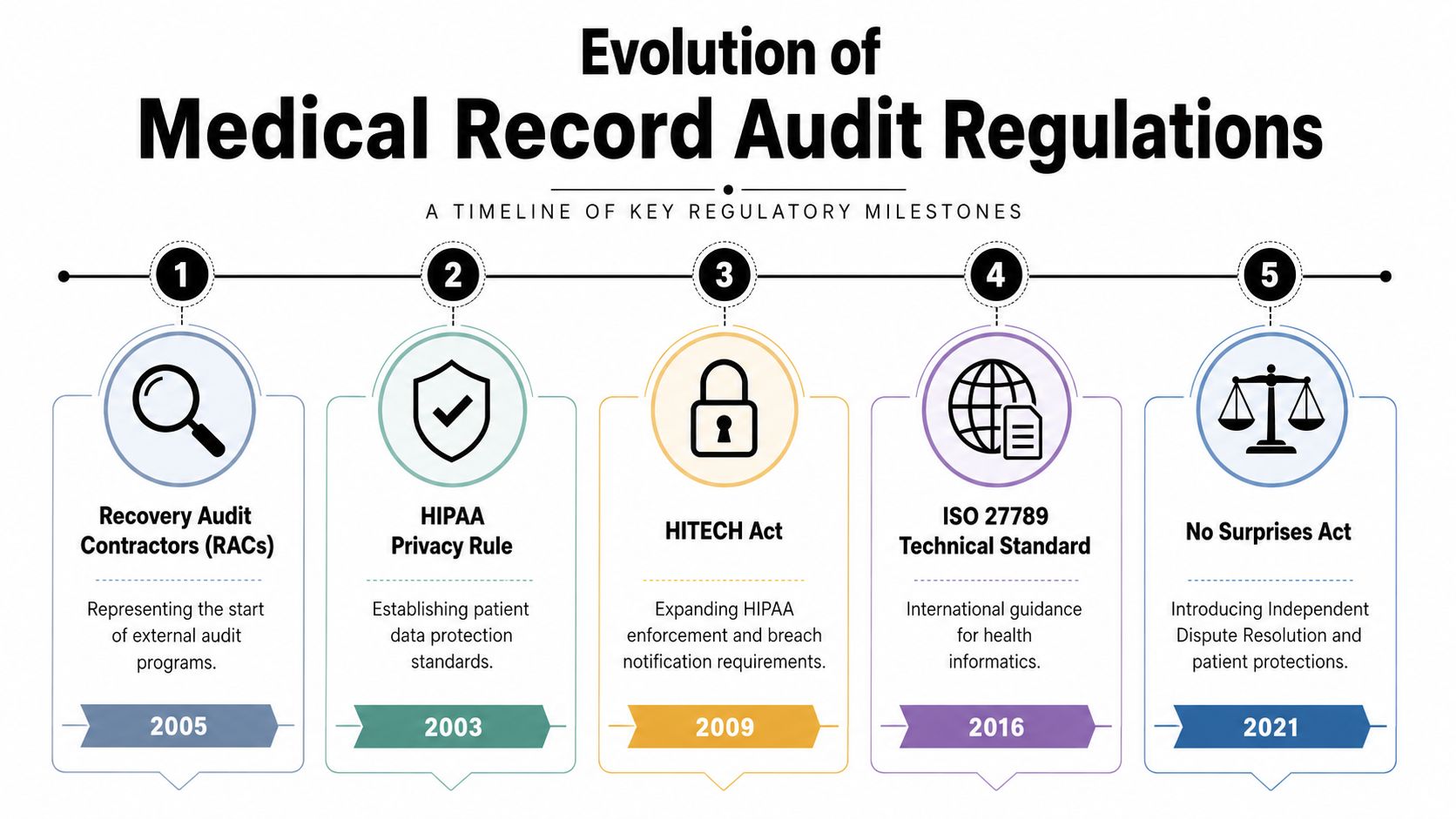
External scrutiny didn't become routine by accident. It grew as payers and government programs built more systematic ways to review claims and records at scale. For providers, that changed medical record audits from an occasional project into an operating requirement.
One marker of that shift was the reach of Recovery Audit Contractors. Approximately 87% of U.S. hospitals experienced RAC activity in the first quarter of 2012, according to Becker's coverage of hospital and RAC audit statistics. That level of activity showed providers that record review was no longer sporadic. It was embedded in the reimbursement environment.
Early programs focused attention on improper payments. Current compliance pressure is broader. It now includes whether your records can establish provenance, whether your EHR preserves a usable audit trail, and whether your documentation package can support disputes after payment.
Why audit trails matter
ISO 27789:2021 is important here because it ties EHR integrity to auditability. The standard requires EHR systems to generate immutable audit trails for read, create, update, and archive actions on personal health information, as described in the ISO 27789:2021 technical specification. In plain terms, a chart entry isn't just text on a screen. It has a history, and that history can matter when someone challenges the claim.
If your team can't show who entered what, when it was entered, and whether anything changed later, your defense gets weaker. That affects compliance reviews, payer disputes, and in some cases Independent Dispute Resolution.
The No Surprises Act changed the evidence question
The No Surprises Act also changed how some providers think about records. In disputes, the issue often isn't only whether the service was performed. The issue is whether the provider can assemble a clean, credible evidence file that links eligibility, documentation, coding, and payment position. Teams that want a concise overview of those dispute mechanics often start with a No Surprises Act summary.
Here are the compliance gaps that most often create trouble:
- Missing provenance: The record exists, but the system can't show a reliable entry history.
- Weak authentication: Notes contain clinical content, but authorship or signing details are unclear.
- Late repair attempts: Staff try to “fix” documentation during the audit window without understanding what the payer allows.
- Disconnected workflows: Compliance, HIM, coding, and denial teams all hold pieces of the story, but nobody assembles a unified record package.
A practical reading of the rules
Compliance officers don't need to turn every chart review into a legal seminar. They do need to recognize that regulatory standards now shape the technical quality of the record, not just its narrative quality.
A complete chart and a trustworthy chart are not always the same thing. Auditors look for both.
That's why the strongest medical record audits don't stop at “is the note there?” They ask whether the note is attributable, time-anchored, internally consistent, and preserved in a way that supports payment defense later.
Audit Planning and Sampling Strategies
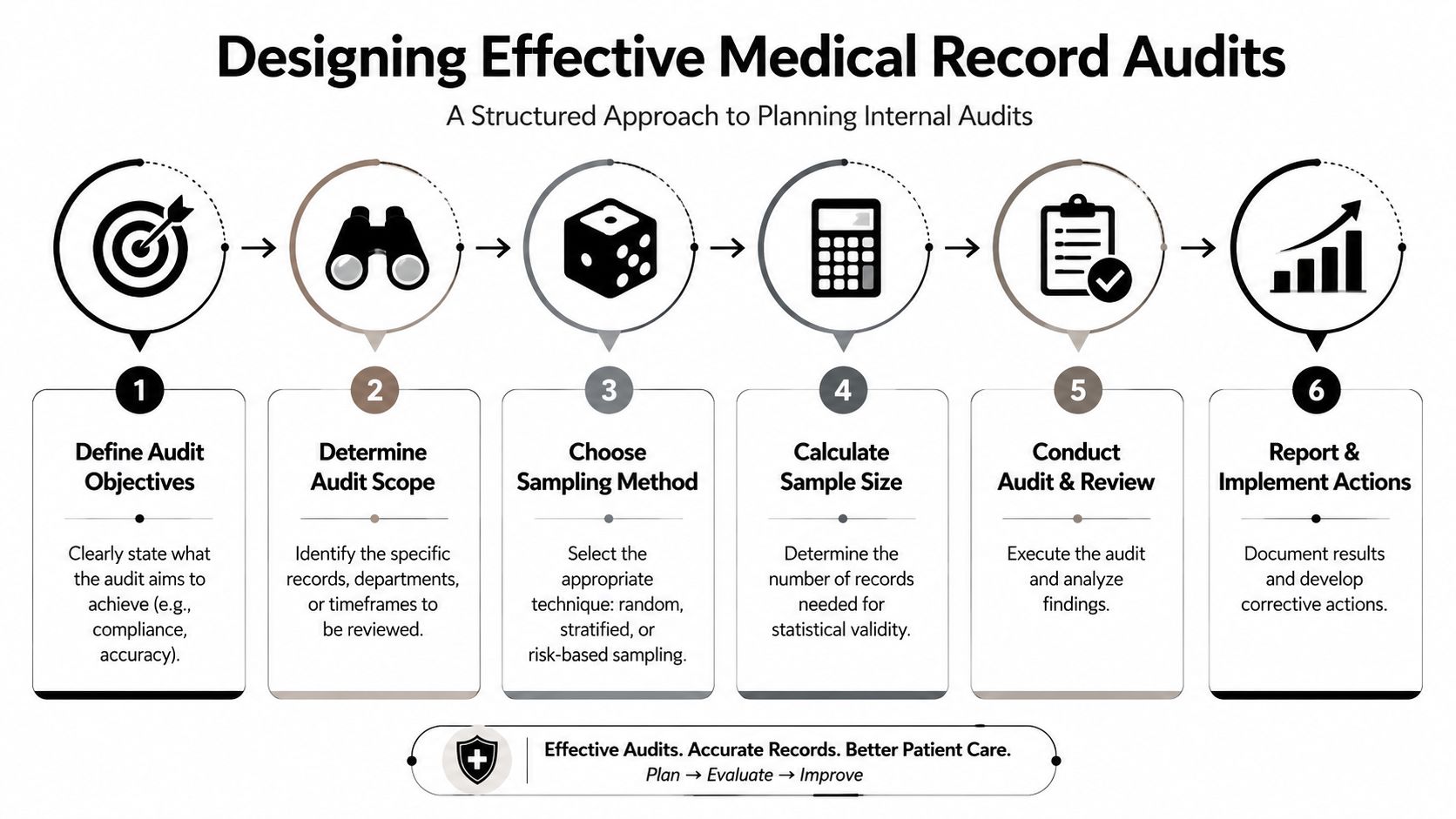
Most internal audits fail before the first chart is opened. The team starts with a broad goal like “check coding accuracy” and then pulls records without a defined question, a sample logic, or a plan for what action will follow.
A better approach is narrower and more operational. Start by deciding what you need the audit to reveal. Are you testing denial root causes, verifying code support, checking a specific payer pattern, or looking for underpayments tied to downcoded claims?
Build the audit around a concrete objective
An objective should be specific enough that two reviewers would pull the same type of chart. “Review orthopedic charts” is too loose. “Review denied orthopedic claims with modifier-related edits” is far more useful. So is “review paid anesthesia claims where documented time and billed units appear misaligned.”
Try writing the objective in this format:
- Population: Which claims or records are in scope
- Risk question: What error or opportunity you're testing
- Action path: What happens if the audit confirms the issue
That last part matters. If the answer is “we'll just monitor it,” you don't yet have an audit plan. You have a report idea.
Choose the right sample logic
Not every audit needs the same sampling method. The sample should match the risk you're testing.
Random sampling
Use this when you want a general picture of record quality across a broad population. It's useful for spotting baseline documentation performance or identifying surprise issues.
Stratified sampling
Use this when you already know the population has different risk layers. You might separate by payer, location, specialty, provider, or claim type. This helps when one subset may behave very differently from another.
Risk-based sampling
Use this when your data already points to likely failure points. This is often the most practical method for compliance and revenue work because it focuses limited review capacity on records most likely to produce findings.
Examples of risk flags include:
- Repeated payer edits: The same denial language appears across multiple claims.
- Code families with frequent downcoding: The payer pays, but at a lower level than expected.
- Time-based services: Claims rely on exact duration support.
- High-friction modifiers: The service is legitimate, but modifier support is often thin.
- Post-payment requests: Claims already attracted scrutiny once.
Size the sample to the decision
Many teams ask, “How many charts should we pull?” The honest answer is that the sample should be large enough to support a decision, not just a meeting. If you only need to confirm whether a narrow denial pattern is real, a focused review may be enough. If you want to change provider education, payer escalation strategy, or coding policy, you need a broader and more representative sample.
A practical internal template often includes:
- Audit objective
- Population definition
- Sampling method
- Inclusion and exclusion rules
- Review criteria
- Escalation thresholds
- Corrective action owner
Use payer behavior to shape the sample
This is where many medical record audits become more valuable. Instead of reviewing charts in isolation, pair record review with remittance and denial data. Look for claims that share a payer, code family, specialty, or edit reason. Then ask whether the payment issue reflects a record weakness, a coding choice, or a payer adjudication pattern.
Some of the best audit findings come from paid claims, not denied ones. A paid claim can still be underpaid, downcoded, or processed against a weaker interpretation of the record than the chart supports.
That approach gives compliance officers something more actionable than “documentation needs improvement.” It gives them a map of where to intervene, who to educate, and which claims deserve appeal or dispute review.
Key Metrics and Dashboard Best Practices
A dashboard should help your team decide what to do next. If it only confirms that denials exist, it's not doing enough. The best audit dashboards connect record findings to operational action.
Start with metrics that answer decisions
Teams often track too many measures and trust too few of them. For medical record audits, focus on metrics tied to review outcomes and follow-up workflows.
Core dashboard categories usually include:
- Documentation completeness: Are required elements present and authenticated?
- Coding support: Does the record support the billed code and modifier set?
- Denial pattern visibility: Which payers and claim types trigger repeated issues?
- Turnaround time: How quickly does the team complete reviews and corrections?
- Recovered revenue tracking: Which audit findings led to appeal, rebill, or dispute activity?
A dashboard doesn't need dozens of tiles. It needs clean signals. If a compliance officer can't glance at it and identify the next provider education topic, payer escalation point, or chart template issue, the design is too abstract.
Show trends, not snapshots
A single chart defect matters. A pattern matters more. Dashboards should group findings in ways that make behavior visible over time. That might mean trending by payer, provider group, service line, or denial reason.
For teams that want to compare internal findings against broader payer friction patterns, this overview of health insurance claim denial rates can help frame which categories deserve closer local monitoring.
Use views that answer questions like:
| Dashboard View | What it helps you see |
|---|---|
| Payer trend view | Whether one payer is repeatedly challenging the same record feature |
| Specialty view | Whether documentation issues cluster around one service line |
| Code family view | Whether downcoding or denials concentrate in a specific procedure set |
| Workflow view | Whether review backlogs are delaying appeal or correction activity |
Set thresholds that trigger action
Many organizations stop at display. They don't define what level of failure should trigger education, escalation, or policy change. That leaves teams staring at data without a response plan.
Useful threshold design is operational, not decorative:
- Education trigger: Repeat findings tied to one documentation habit.
- Template review trigger: The same chart element is missing across multiple providers.
- Coding review trigger: A payer repeatedly rejects one modifier or code family.
- Dispute trigger: Record support appears strong, but payment outcome remains weak.
Keep the dashboard readable for multiple audiences
Compliance officers, coders, revenue cycle leaders, and physicians don't read the same way. Build layered views. Executive users may want a small set of top-line indicators. Review staff need chart-level drilldown. Physicians often respond better to concise issue summaries tied to actual documentation behavior.
A dashboard should shorten the distance between a finding and a correction. If it creates another meeting instead, redesign it.
One more warning. Don't let “recovered revenue” become the only star on the screen. It's important, but if you don't pair it with documentation integrity and coding support, staff may chase dollars without fixing the conditions that created the leak.
Common Documentation and Coding Issues
Most denied or underpaid claims don't collapse because of exotic fraud indicators or obscure regulatory traps. They collapse because ordinary records contain ordinary omissions. The dangerous assumption is that these omissions are too small to matter.
They matter a great deal.
Audits have found that patient full names were missing in 17.6% of records, admission policies were absent in 21%, and discharge summaries were incomplete in 4.4% of audited cases, according to a medical record audit review published through Semantic Scholar. Those aren't cosmetic defects. They affect whether the record can support reimbursement and withstand review.
The small-gap problem
Compliance teams often hear some version of this: “The chart clearly shows what happened. Why would a payer deny over something minor?” Because the payer isn't reading the chart like a treating clinician. The payer is testing whether the billed claim is supportable under documentation rules.
A chart can be clinically understandable and still fail as claim evidence.
Here are the issues that repeatedly cause trouble.
Missing patient identifiers
If the chart isn't clearly tied to the right patient, the payer can question the reliability of the record package itself. This sounds basic because it is basic. It's also one of the easiest things to miss in templated or scanned documentation.
Incomplete summaries and care transitions
Discharge summaries, follow-up plans, and admission-related documentation often reveal whether the record tells a coherent story from start to finish. When those sections are thin or absent, the payer may see a weaker basis for the intensity or necessity of the billed service.
Modifier support that lives in people's heads
A coder may know why a modifier was used. The physician may know it too. If the chart doesn't make that reason visible, the claim stands on memory instead of record support. That's a fragile place to be during an audit.
Time-based documentation lapses
Often, many specialty groups lose ground. Time-based codes require exact duration support. Approximate wording, disconnected timestamps, or narrative references that don't mathematically support the billed units can trigger downcoding or denial. The problem is not usually that the service lacked time. It's that the record didn't preserve it in a billable form.
What a finding looks like in practice
Internal audit notes often sound less dramatic than the reimbursement consequences they create. Consider examples like these:
“Procedure documented. Start and stop times not stated. Units billed cannot be recreated from note.”
“Modifier appears clinically reasonable, but chart does not explicitly distinguish separate service components.”
“Late clarification attempted after payer request. Original entry does not support billed level on its face.”
None of those excerpts sound catastrophic. Yet each can shrink payment, block appeal success, or weaken the provider's position in a later dispute.
Challenge the assumption that denial prevention is enough
There's another misconception worth confronting. Teams often treat documentation review as a denial prevention exercise only. That mindset misses a second problem. The same weak chart element that causes a denial can also lead coders to choose a lower code than the service may have supported, or make staff reluctant to challenge an underpaid claim later.
That's why chart improvement and CDI work belong in the same conversation. A focused clinical documentation improvement process can help teams move from isolated chart corrections to repeatable documentation habits that support both compliance and reimbursement.
Coaching clinicians without drowning them in rules
Clinicians don't need a lecture on every payer bulletin. They need practical feedback tied to their workflow. The best coaching is concrete:
- Show the missing element: Don't say “documentation insufficient.” Point to the absent identifier, unclear author, or missing duration.
- Connect it to the claim: Explain how that gap affected code support, denial exposure, or payment outcome.
- Give a replacement habit: For example, document exact minutes in the note, not in a separate memory-based log.
- Use real excerpts: De-identified examples help clinicians see what “not enough” looks like.
Prioritize what causes the most downstream harm
If your team tries to fix every defect at once, nothing sticks. Start with issues that do one of three things:
| Priority issue | Why it rises to the top |
|---|---|
| Authentication and timestamps | They affect record validity and authorship |
| Time support for timed services | They directly affect billed units and payment support |
| Missing core narrative elements | They weaken medical necessity and continuity of care |
A clean audit result isn't created by asking clinicians to write more. It comes from helping them document the right details in the right place the first time.
Integrating RCM and IDR with RevGuard Approach
Many organizations separate their workflows in a way that creates avoidable revenue loss. Coding checks records before claim submission. Denials teams intervene after payment problems surface. Legal or dispute specialists get involved only when the file becomes serious enough to escalate. Each team does sensible work, but the handoffs are fragmented.
That structure treats medical record audits as defensive checkpoints. A stronger model treats them as connectors between reimbursement stages.
The reason is simple. A chart reviewed only for compliance may still leave money on the table. A claim reviewed only for payment may miss defects that later weaken appeal or arbitration. And an IDR file assembled without record-level forensic discipline may carry avoidable credibility problems.
The case for a unified workflow
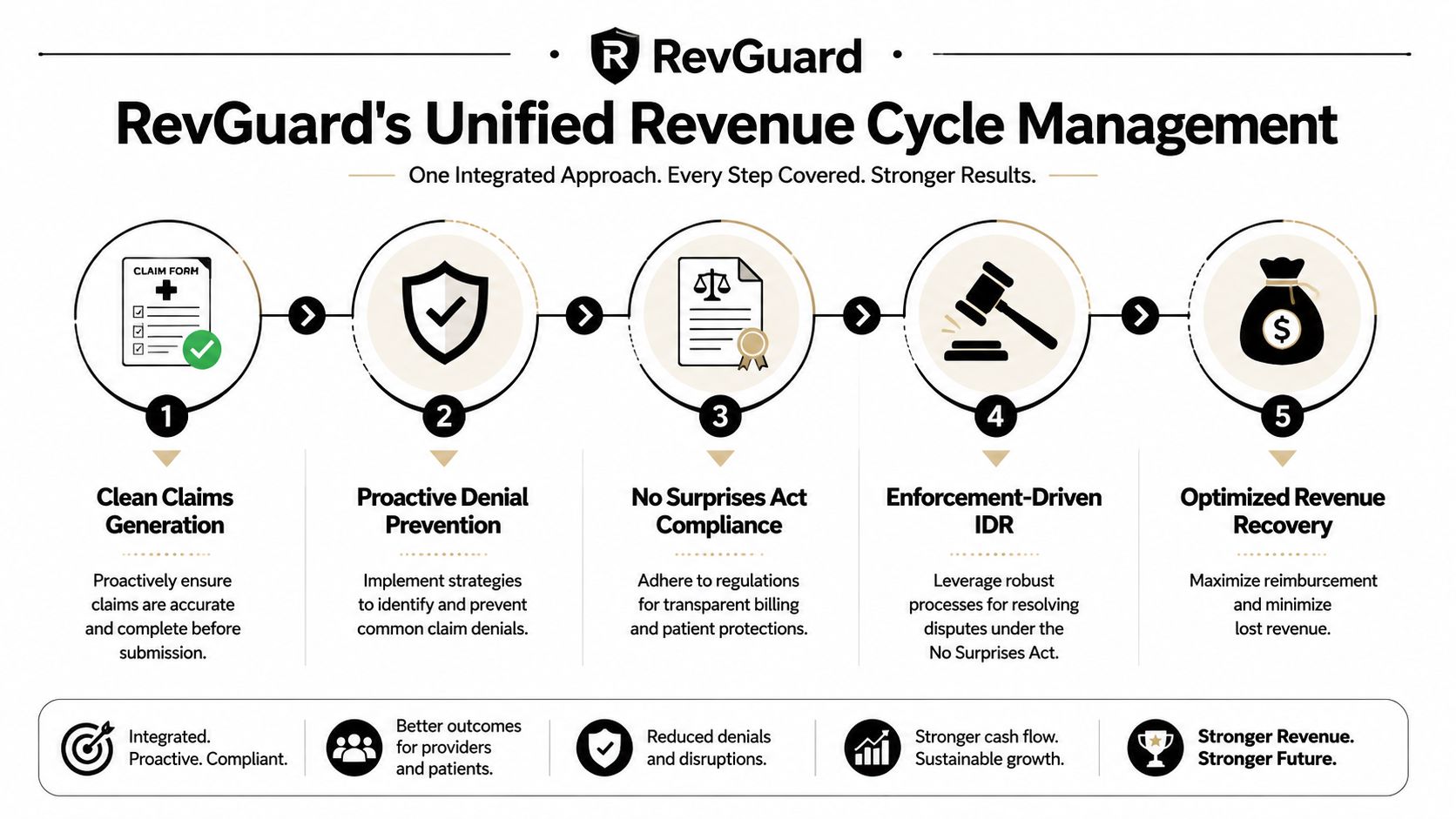
A unified approach connects five functions that often live apart:
- Eligibility and claim readiness
- Documentation and coding verification
- Denial prevention and payer response
- Underpayment detection
- Dispute assembly and outcome tracking
That sequence matters because underpayments rarely announce themselves clearly. Sometimes the payer pays a lower amount without explicitly denying the service. Sometimes the adjudication suggests a narrower interpretation of the chart than the provider believes is justified. Sometimes the service was coded conservatively because staff didn't trust the documentation enough to support a stronger position.
The audit file can answer those problems if it's built with both RCM and dispute use in mind.
What “audit to recovery” looks like
This workflow is easier to understand through operational questions:
Before claim submission
Ask whether the chart is complete enough to support the planned code set, modifier logic, and payer requirements. If not, route for correction while the record is still within ordinary workflow.
After payment
Compare the payment outcome to what the chart and claim support. If the payer downcoded, underpaid, or ignored documented complexity, flag the case for focused review rather than writing it off as “partially paid.”
During dispute preparation
Use the record package as evidence, not just as an attachment. That means validating chronology, authorship, time support, diagnosis logic, and consistency between the claim, note, and system history.
A practical checklist for compliance officers
Use a checklist that moves from validation to action:
- Eligibility confirmation: Was the patient and coverage status validated before service and preserved in the file?
- Coding support check: Do the codes and modifiers align with what the chart documents?
- Record integrity review: Are timestamps, authorship, and audit trail details clean enough for external review?
- Payment variance review: Did the payer reimburse in a way that matches documented support?
- Dispute readiness screen: If challenged, can the team assemble a coherent record package quickly?
Why underpayment review belongs inside the audit function
One of the more important gaps in common guidance is that audits are usually described as ways to defend against overpayment recoupments. The AMA material highlights that audits can identify payment deficiencies and opportunities for appropriate payment, and that perspective leaves room for a more proactive model focused on underpayments in addition to overpayment defense, as discussed in the AMA's reasons a practice should have a medical record audit.
That shift matters for specialties where complexity is real but documentation interpretation is constantly contested. If your audit team only asks, “Could we lose this money back?” it may never ask, “Did we fail to collect what the record supports?”
One operational model
Some firms build that connection directly into revenue operations. RevGuard is one example. It combines specialty-specific revenue cycle work with Independent Dispute Resolution workflows under the No Surprises Act, using audit-driven review to connect clean claim generation, denial prevention, and underpayment recovery. For compliance officers, the relevant point isn't the brand. It's the model. The audit doesn't end when the chart passes. It continues until the payment outcome is tested against the record.
If the medical record is strong enough to defend the claim, it may also be strong enough to challenge an underpayment. Teams should review for both.
An example internal template
A simple audit-to-IDR template might include these sections:
| Template section | What to capture |
|---|---|
| Claim summary | Service date, payer, billed codes, payment outcome |
| Record support | Key note elements, timing, diagnoses, modifier rationale |
| Integrity checks | Signatures, timestamps, author identification, audit trail status |
| Variance analysis | Where payer outcome differs from chart-supported expectation |
| Action path | Appeal, rebill, escalation, dispute, or education |
This kind of template helps compliance officers move beyond chart scoring. It links findings to collections behavior, payer negotiation posture, and dispute readiness. That is where medical record audits become revenue protection tools rather than isolated compliance exercises.
Conclusion and Next Steps
Medical record audits are often introduced as a shield. They help organizations defend against denials, recoupments, and compliance findings. That part is true, but it's only half the job.
A stronger audit program also acts like a searchlight. It exposes weak documentation habits, fragile coding assumptions, and payment variances that many teams normalize because nobody connects the chart to the remittance with enough discipline. When compliance, coding, and reimbursement teams share one audit language, they can do more than reduce risk. They can recover missed revenue and build records that stand up in formal disputes.
If you're setting priorities, keep the first cycle practical:
- Run a gap assessment on a narrow claim population with known friction.
- Define a sampling method that matches the risk you're testing.
- Track a small dashboard built around completeness, support, and payment variance.
- Train clinicians on the exact defects that are costing support.
- Pilot an audit-to-dispute workflow for claims that appear underpaid, not just denied.
Start with one payer pattern, one specialty, or one code family. The point isn't to build a perfect enterprise audit engine in a week. It's to create a repeatable review process that makes your records cleaner, your payment position clearer, and your follow-up actions faster.
If your team wants help connecting chart review, denial prevention, and underpayment recovery, RevGuard offers healthcare revenue protection services that link medical billing audits, specialty RCM workflows, and IDR support under the No Surprises Act.