

Data from the National Association of Insurance Commissioners shows that 28% of dual-coverage claims are initially billed to the wrong payer due to automated eligibility errors. For a specialty practice, that isn't a front-end nuisance. It's a revenue integrity problem that starts at registration and keeps draining margin all the way through follow-up, appeals, and patient balance resolution.
In anesthesia, orthopedics, imaging, and other specialty settings, dual coverage tends to sit inside the claims your team can least afford to mishandle. These accounts often involve higher-value services, compressed filing timelines, and payer behavior that shifts from simple denial to underpayment once the wrong plan is billed first. By the time staff discovers the sequencing error, the practice has already lost time, advantage, and clean documentation.
The practical issue in primary vs secondary insurance is simple. Payer order controls cash timing, denial risk, appeal posture, and in some cases whether a disputed underpayment becomes recoverable. Teams that treat coordination of benefits as a registration checkbox usually end up doing expensive rework later. Teams that treat it as a dispute-readiness function protect reimbursement earlier.
Why Getting Primary vs Secondary Insurance Wrong Costs You
Getting payer order wrong creates a chain reaction across the revenue cycle. The claim may reject at the clearinghouse, deny for COB, or pay off the wrong contract logic. By the time staff corrects the sequence, the practice has already added avoidable touches, extended days in A/R, and weakened the paper trail needed to challenge a short payment later.
Specialty practices absorb that damage faster because the dollars are larger and the filing risk is tighter. In anesthesia, orthopedics, pain, imaging, and surgical subspecialties, one misordered dual-coverage claim can turn a collectible balance into a stale account that needs rebilling, appeal work, and patient account cleanup. I have seen teams focus on the initial denial and miss the bigger problem. The wrong first adjudication often becomes the foundation for downstream underpayment.
That is why effective medical eligibility verification workflows need to do more than confirm active coverage. They need to capture COB status, validate payer order before claim submission, and preserve the documentation your billers will need if the account later moves into reconsideration, appeal, or payment dispute.
| Issue | What happens operationally | Why finance should care |
|---|---|---|
| Wrong payer billed first | Claim rejects, pends, or denies for COB | Cash is delayed and staff time shifts to rework instead of new production |
| Secondary billed without proper primary adjudication | Claim cannot process cleanly | Remaining reimbursement sits in A/R longer and can miss follow-up windows |
| Incorrect payer order on high-value specialty claims | EOB history starts with the wrong payer decision | Underpayment disputes are harder to prove and recover |
| Patient balance calculated too early | Statements go out before COB is resolved | Patient complaints rise and posted balances often need to be reversed |
The operational lesson is simple. COB is not a front-desk checkbox. It is an RCM control point.
If the first payer decision is wrong, every step after that gets more expensive. Posting is less reliable, secondary submission slows down, patient responsibility is misstated, and appeal staff spend time rebuilding a file that should have been correct on day one. For specialty groups trying to defend reimbursement aggressively, payer order is not just about getting paid first. It affects whether the practice can document underpayment cleanly enough to press the issue.
The Rules of the Road Understanding Coordination of Benefits
COB is the rule set that determines payer order when a patient has more than one active plan. Get that order wrong, and the claim file starts with bad adjudication history, bad patient liability, and bad posting logic. In specialty revenue cycle, that is how underpayments get buried.
Staff cannot set payer order based on the card the patient hands over first or the plan the patient says they want billed. The order is dictated by coverage rules, subscriber status, employment facts, and plan design.
| COB element | Primary payer | Secondary payer |
|---|---|---|
| Payment position | Pays first | Pays after primary adjudication |
| Claim responsibility | Processes as though it were the only coverage | Reviews the remaining balance after primary |
| Documentation needed | Standard claim submission | Primary EOB or equivalent adjudication data is typically required |
| Payment limit | Up to plan terms and coverage limits | Can cover remaining eligible amounts, but combined payments cannot exceed the bill |
The payer sequence is easier to grasp visually:
What the primary payer must do
The primary payer has first payment responsibility and adjudicates the claim under its own benefits and medical policy. The secondary payer does not step in until there is primary adjudication data to work from. Gusto explains that sequence clearly in its overview of primary and secondary health insurance.
That primary EOB is more than a billing formality. It becomes evidence. It shows allowed amounts, contractual reductions, denials, patient responsibility, and the reason codes your team may later need in a reconsideration or payment dispute. A disciplined EOB in medical billing process gives the secondary claim a clean starting point and gives your escalation team a cleaner record if reimbursement comes in short.
What the secondary payer can and cannot do
Secondary coverage reviews what remains after the first payer processes the claim. It may cover some deductible, coinsurance, copayment, or other eligible balance. It may also pay nothing, depending on plan terms, exclusions, coordination rules, and the primary payer's disposition.
That is where specialty practices get hurt. If staff assume the second plan will absorb everything left over, they post expected reimbursement too high, misstate patient balances, and miss the actual problem when the secondary pays less than expected. A denial by the primary can also change the secondary outcome. Some balances are patient responsibility. Others are recoverable only if the file shows the right adjudication sequence from the start.
Rules teams commonly misapply
The recurring failures are usually operational, not theoretical:
- Patient preference entered as payer order: Registration records the plan the patient uses most often instead of the actual COB sequence.
- Subscriber and dependent roles blurred together: The account is built without separating the patient's own coverage from coverage held through a spouse or parent.
- Employment facts left unverified: Medicare and employer-plan coordination gets set up from incomplete intake notes instead of confirmed active employment details.
- Plan rules treated as interchangeable: Commercial plans, government programs, and state-specific rules are handled as if one standard applies to every account.
I tell specialty groups to audit these errors by looking at remits, not just denials. Many COB failures do not end with a hard denial. They end with partial payment, bad crossover activity, or a patient balance that should never have gone out.
The fastest way to create a difficult underpayment case is to let registration guess at COB and force billing to reconstruct the payer order after adjudication.
Determining Payer Order in Specialty Scenarios
A dual-coverage claim can look clean at intake and still produce the wrong allowed amount, the wrong patient balance, and a preventable write-off if payer order is set incorrectly. Specialty practices feel that failure faster because the dollars are higher and the appeal path gets harder once the remits are out of sequence.
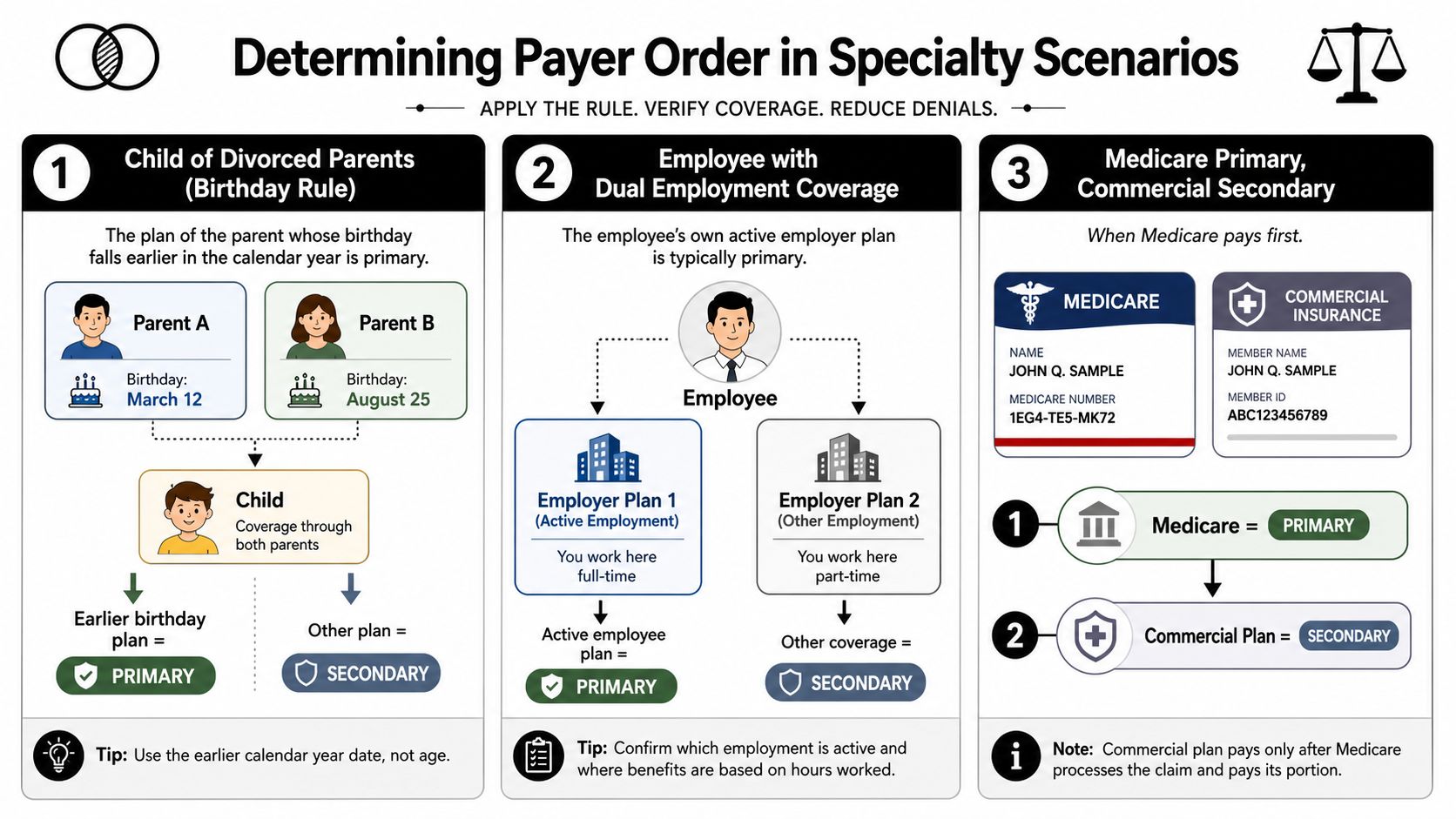
The goal is not just to identify which card goes first. The goal is to build a file that can survive payer scrutiny later, especially when underpayments turn into disputes. Specialty groups that treat COB as a registration task usually end up rebuilding the account during appeals. Groups that treat it as a reimbursement control point protect cash earlier.
Employer plan and Medicare
This scenario looks simple until the intake record is missing the facts that control payment. Payer order often depends on whether the patient is covered through active employment and whether the employer meets the applicable size threshold. If staff enters Medicare as primary, or assumes the group plan should lead without confirming employment status, the whole claim sequence can break.
The fix is procedural. Verify active employment. Verify employer size. Store both in the account notes or eligibility record before the claim drops.
On high-value specialty claims, I also want the first remit reviewed against the expected sequencing. If the primary payer processed in the wrong position, correct the hierarchy before the secondary submission and before patient statements go out. That step protects both reimbursement and the audit trail you need if the dispute later turns on the payer's allowed amount calculation and adjudication logic.
Child covered under two parents' plans
Dependent coverage creates some of the ugliest COB rework because eligibility often returns active under both plans. Teams then assume billing can sort it out after the fact. Billing usually inherits a denial, a pended claim, or a secondary rejection for missing primary adjudication.
The birthday rule is only part of the analysis. Specialty practices also need current household information, any court-ordered responsibility, and confirmation that both plans are still active for the date of service. Old subscriber records cause real damage here. If the patient changed custody arrangements, one parent changed employers, or the subscriber ID rolled over, the system may still route the claim using stale hierarchy data.
That error does not stay isolated to one claim. Once the wrong parent plan sits in primary position, every related charge can post incorrectly until someone forces a rebuild.
COBRA and a new employer plan
COBRA creates confusion because patients often describe it as their main insurance long after a new group health plan starts. Registration cannot rely on that description. The billing record needs the coverage effective dates and confirmation of any new employer-sponsored plan.
I see two recurring failures. The old plan remains first in the practice management system because it was used on the last visit. Or staff keeps both plans active but never updates the hierarchy, so claim routing follows historical data instead of current COB rules.
For specialty providers, that mistake has a direct revenue consequence. The claim may process under the wrong primary, and the secondary may later reduce or deny because the file lacks the correct first adjudication.
Medicaid, TRICARE, and other secondary positions
These accounts require clean sequencing and complete documentation. Secondary government-linked coverage often will not process correctly unless the file includes the exact primary adjudication details the payer expects. A card image is not enough. The account needs accurate subscriber information, the primary EOB or ERA record, and the claim built in the right order from the start.
Operations teams should standardize what must be attached or documented before secondary submission. If that package is incomplete, staff should stop the claim and fix the record before it goes out. Rework after denial costs more, takes longer, and weakens the practice's position if the underpayment later needs formal escalation.
The broader point is straightforward. In specialty RCM, payer order is not clerical cleanup. It determines whether the practice gets paid correctly, whether underpayments can be challenged effectively, and whether the claim file is strong enough to support escalation when a payer hides behind COB confusion.
The Financial Impact of COB Errors on Specialty Revenue
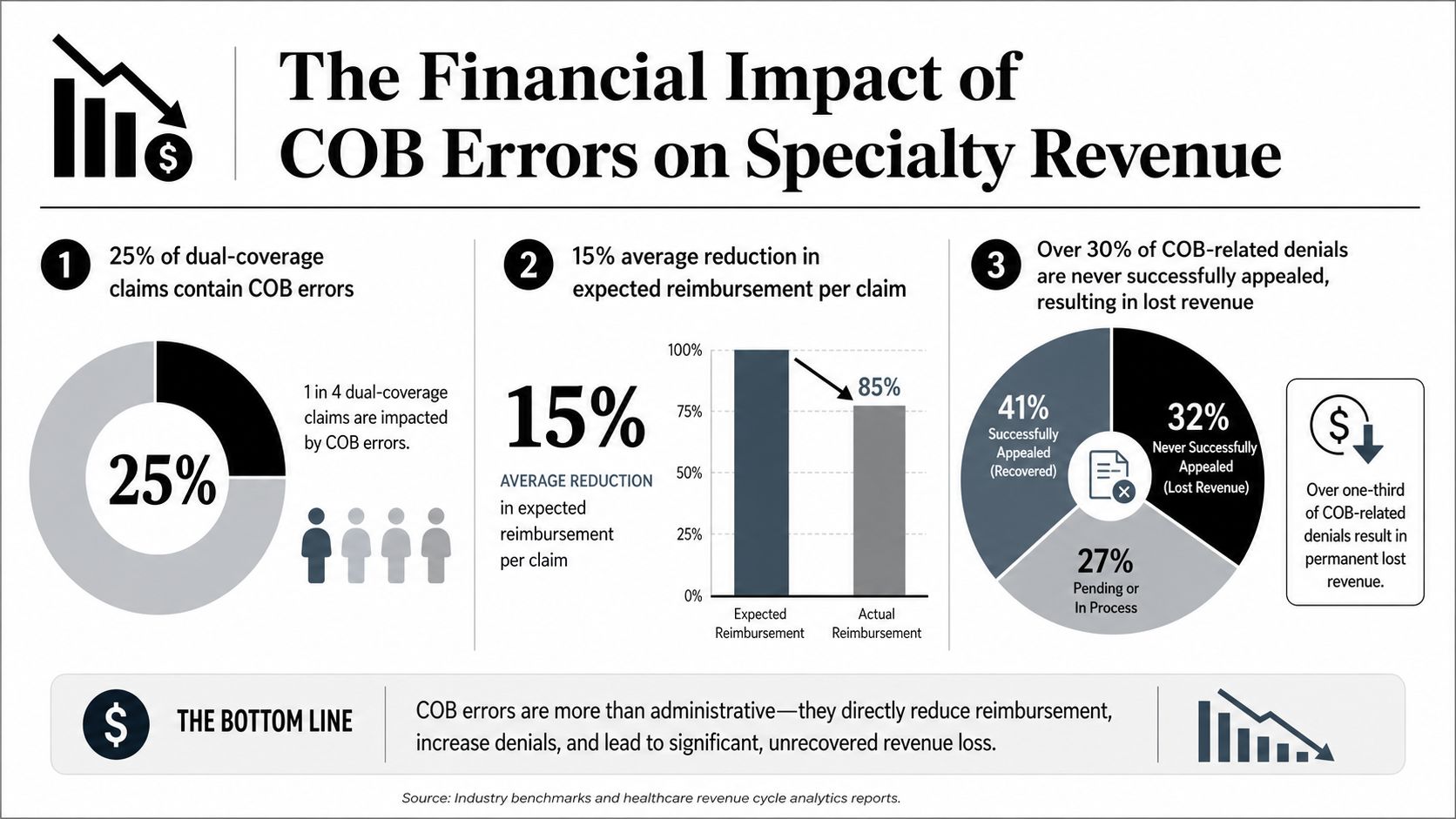
Dual-coverage claims carry a higher cost to collect. Analysts cited in this claims benchmarking analysis found that they require far more administrative touches, take longer to move through adjudication, and recover a smaller share of the remaining balance in high-dollar specialties than primary-only claims. For a specialty practice, that difference does not stay in billing operations. It shows up in cash flow, net collection rate, staff capacity, and the strength of any later underpayment dispute.
That is why COB mistakes are expensive even before a claim formally denies.
A wrong payer sequence can trigger a full rebill cycle, but the larger loss usually comes from what follows. Primary adjudicates on the wrong premise. Secondary processes against an incomplete or distorted record. Posting staff then inherit a balance that looks collectible but is not supported by correct coordination logic. By the time the account reaches follow-up, the practice is no longer fixing one error. It is trying to rebuild the claim history well enough to defend what should have been paid in the first place.
Where the money actually leaks
COB leakage usually comes from repeatable process failures, not one dramatic denial event.
- Incorrect initial routing: The claim goes to the wrong primary and starts the account in a payment path that has to be unwound later.
- Incomplete secondary submission support: The file lacks the primary EOB, accurate adjustment mapping, or subscriber details needed for clean secondary adjudication.
- Residual balance misclassification: Staff posts the leftover amount as if secondary responsibility were automatic, which inflates A/R and hides true collectability.
- Underpayment acceptance: The team accepts secondary reimbursement without testing whether the payer applied COB rules and contract logic correctly.
The fourth issue is where many specialty groups experience margin erosion. Once sequencing errors distort adjudication, your insurance allowed amount analysis gets harder to support because the reimbursement trail itself is compromised. That affects more than one account. It weakens trend reporting, contract variance review, and any effort to isolate systematic underpayment behavior by payer.
Why COB mistakes weaken your dispute position
Payers use COB confusion as cover. If the claim file shows inconsistent subscriber data, a missing primary adjudication record, or a balance that was posted without clean coordination support, the payer has an opening to frame the issue as provider error instead of underpayment.
That matters in specialty revenue cycle work, especially when high-dollar claims move into formal appeal, payment review, or IDR-related preparation. A dispute-ready file has to show more than the billed charge and the amount paid. It has to show that payer order was correct, submission sequence was correct, and the remaining balance was calculated from a clean adjudication chain. If that record is weak, the practice gives up ground before the reimbursement argument even starts.
Operational takeaway: Treat every dual-coverage claim as a future underpayment case file. If the documentation would not hold up in an external review, it is not ready to post, appeal, or escalate.
Building a Dispute-Ready Claims Workflow for Dual Coverage
The fix for primary vs secondary insurance problems is not more heroics from follow-up staff. It's a workflow that produces a defensible claim file before the first submission leaves the system.
A dispute-ready process starts at intake. Staff has to collect every active plan, identify the subscriber relationship, and ask what changed since the last visit. Dual coverage errors often come from stale assumptions, not missing cards. A patient changed jobs, aged into Medicare, moved to COBRA, or added dependent coverage. The account kept the old hierarchy and the claim inherited the mistake.
What clean dual-coverage intake looks like
Registration and eligibility staff should capture enough detail to support a payer-order decision, not just enough to populate a demographics screen.
That means documenting:
- Coverage source: Is the plan tied to active employment, retirement, dependency, or a government program?
- Subscriber relationship: Is the patient the subscriber, spouse, or dependent child?
- Effective timing: Did the coverage start recently or replace prior coverage?
- Supporting context: Is there employer-size information, Medicare status, or another fact that changes sequencing?
Front-end teams don't need to become COB attorneys. They do need to stop treating dual coverage as a generic “other insurance” field.
What billing must attach and preserve
Once primary adjudicates, the file must be complete enough for the secondary payer and strong enough for appeal if the account goes sideways. That usually means preserving the primary EOB, posting adjustments accurately, and carrying forward the adjudication details that explain what remains and why.
A strong dual-coverage file has three traits. It is internally consistent, it matches what the payers have on record, and it gives the next reviewer a clear sequence of events. If one of those pieces is missing, the account becomes vulnerable.
Here's the workflow I'd put in place for specialty claims:
- Verify both plans before date of service whenever possible. Don't wait for denial to confirm hierarchy.
- Lock payer order in the PM system before claim generation. Manual overrides after claim drop create conflicting records.
- Submit primary cleanly and monitor adjudication closely. Don't assume “processed” means “processed correctly.”
- Transmit secondary only after primary adjudication data is complete. Missing or mismatched EOB support leads to preventable failure.
- Preserve every COB touchpoint in the account notes. Appeals get stronger when the documentation trail is chronological and specific.
What doesn't work
Reactive cleanup is the most expensive model. It looks like this: submit fast, let denials identify the primary payer, rebill, then start reconstructing the chart and eligibility history during follow-up. That approach burns staff hours and produces thin appeal files.
It also teaches payers that your practice will accept friction as normal. Specialty groups can't afford that posture. If the claim may later require formal escalation, the RCM file should be built with that possibility in mind from day one.
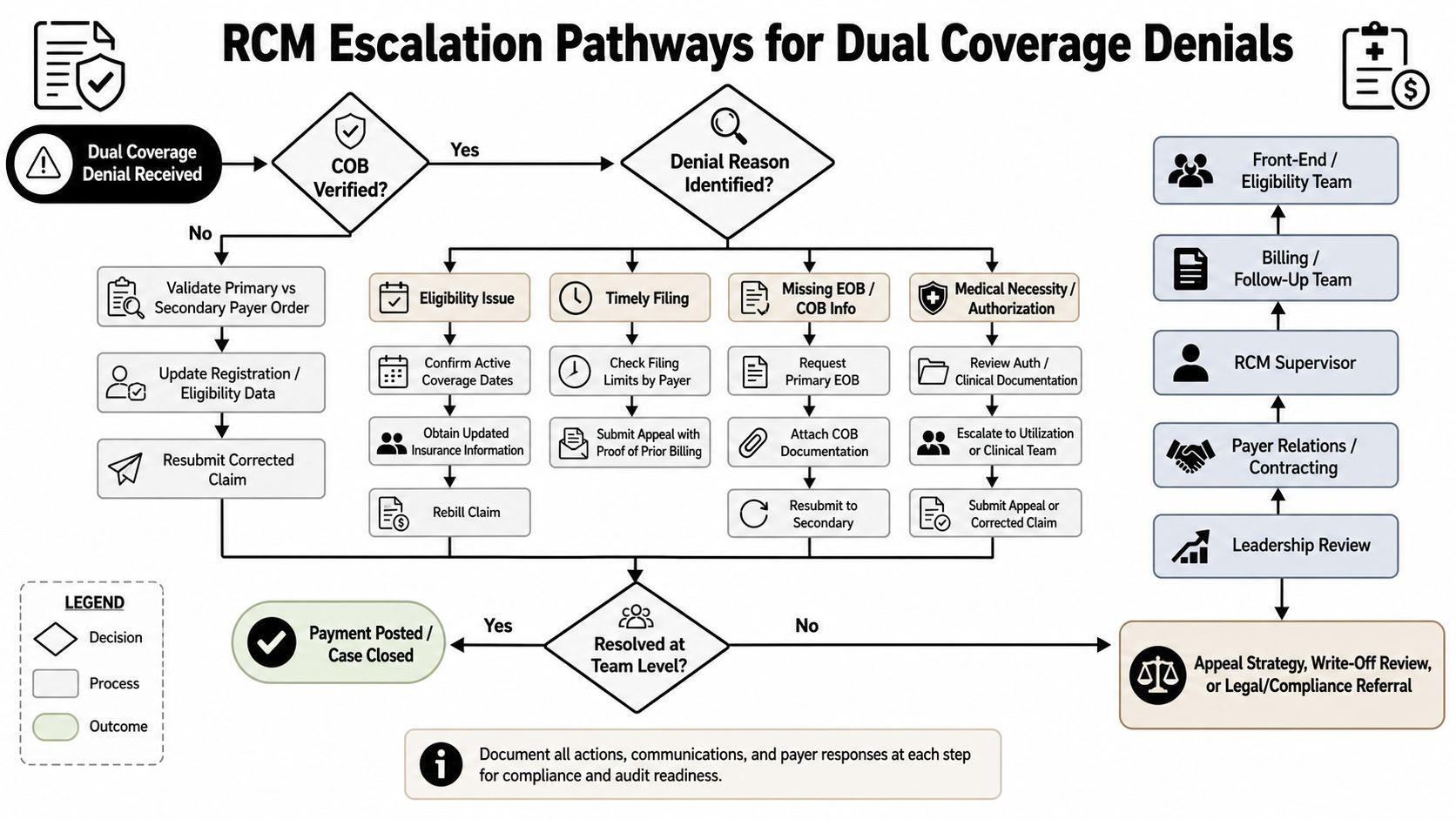
RCM Escalation Pathways for Dual Coverage Denials
Not every dual-coverage denial deserves the same response. Some should be corrected and rebilled immediately. Others signal a payer-side sequencing problem or a secondary underpayment that requires a formal challenge.
The first question is whether the denial came from your error or the payer's application of COB. If staff loaded the wrong subscriber, missed the primary EOB, or billed the wrong payer first, fix the claim fast and document the correction. Don't waste appeal time defending a bad submission.
If the file is clean and the payer still misapplies COB, escalate deliberately.
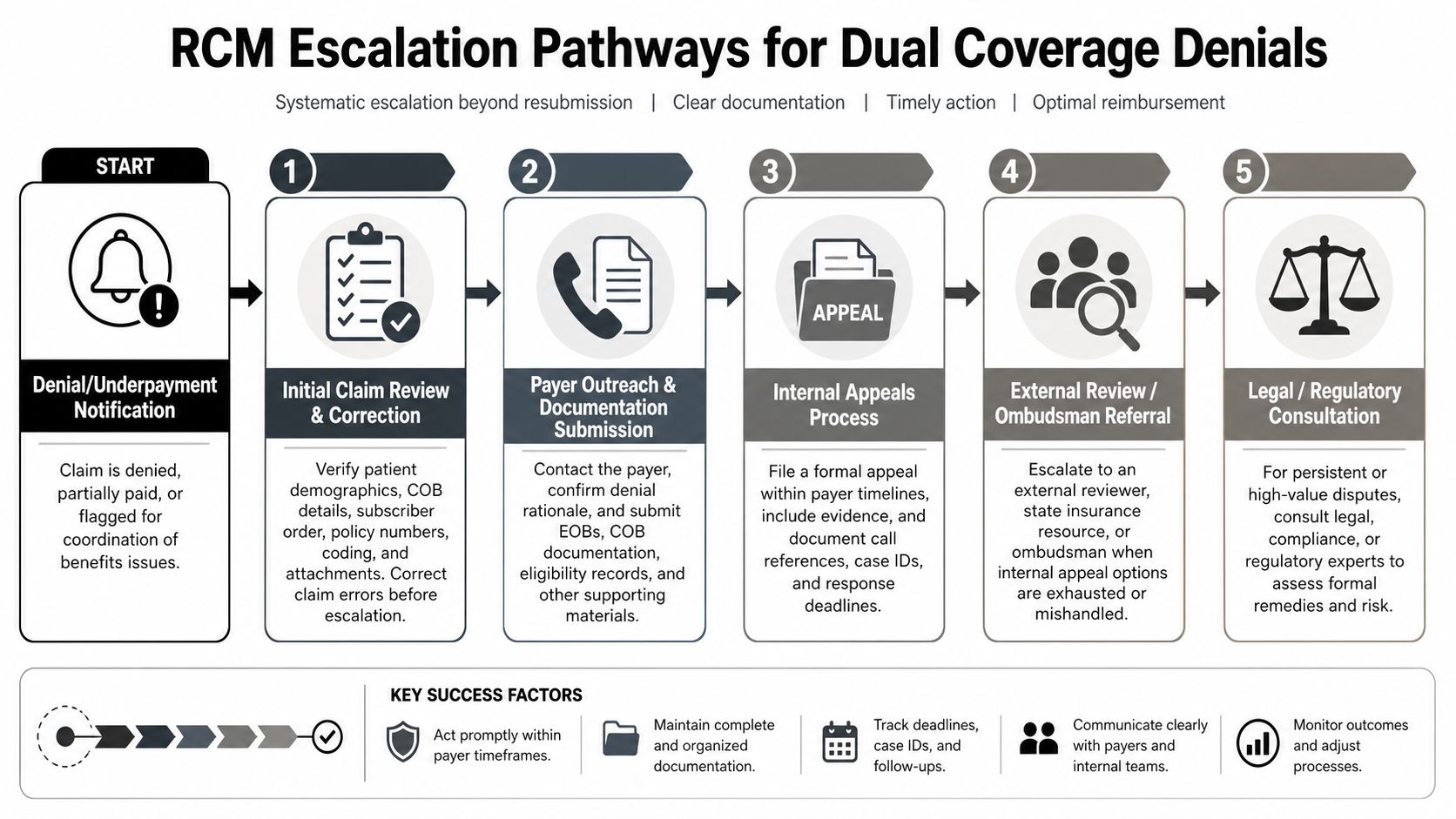
A practical escalation sequence
- Start with claim audit: Confirm payer order, subscriber data, and whether primary adjudication support was complete.
- Move to payer outreach: If the file is correct, contact the payer with the precise COB issue. Keep the conversation narrow and documented.
- File a formal appeal: State the adjudication sequence, attach the supporting record, and identify where the payer misapplied COB.
- Escalate to provider relations or a higher review lane: Use this when frontline claims staff cannot resolve a clear payer-side error.
- Assess dispute posture: If the claim sits inside a reimbursement framework that supports external challenge, preserve the file for that next step rather than writing it off.
When a denial becomes more than a rebill
The warning signs are familiar. The payer ignores the primary EOB trail, treats the wrong plan as primary despite corrected records, or downcodes the secondary claim based on a distorted reading of the first adjudication. At that point, the practice should stop treating the account as routine A/R follow-up.
A dual-coverage denial becomes strategically important when the problem is no longer missing data. It's payer behavior.
That's the point where escalation discipline matters. Every note, document, and corrected submission should support the same narrative. The provider followed COB rules. The payer didn't.
Frequently Asked Questions on Primary and Secondary Insurance
Can a secondary plan deny a claim because the primary denied it
Yes, depending on why the primary denied the claim. A denial for noncovered services, exhausted benefits, or plan exclusions can flow through to the secondary payer. A denial tied to bad payer order, missing primary adjudication, or other COB defects should trigger a closer review, not an automatic write-off.
Specialty practices lose money here because staff often treat the first denial as final. The better approach is to read the denial reason, verify payer sequence, and decide whether the secondary plan still has to process once the COB record is corrected. That distinction affects whether the account belongs in rebilling, appeal, or escalation.
Does secondary insurance always pay the deductible or coinsurance left by the primary plan
No. Secondary coverage may pay some, all, or none of the remaining patient responsibility. The result depends on the secondary plan's benefit design, coordination rules, fee schedule, and carve-outs.
For high-dollar specialty claims, staff should avoid promising that the second plan will absorb the balance. That assumption creates patient complaints and delays collection activity when the secondary payer applies its own limits.
Can the patient choose which insurance is primary
No. Payer order is set by COB rules, not patient preference. The card handed over at registration may influence how the account is entered, but it does not change financial liability between plans.
That is why front-end intake matters. If registration captures the wrong subscriber, misses an employment status change, or fails to identify dependent coverage correctly, the billing team inherits a preventable denial cycle.
Are AI-driven downcodes a real concern on secondary claims
Yes. Secondary claims are increasingly vulnerable to automated repricing and edits that mirror the primary EOB too closely. That can produce underpayments when the secondary payer fails to evaluate the residual balance under its own policy terms.
Industry groups and federal guidance have both raised concerns about COB-related claim handling, including how denied or missequenced claims are reviewed and how automation affects adjudication quality, as noted earlier in the article. For specialty providers, the practical test is simple. If the secondary payment looks formulaic, inconsistent with contract terms, or disconnected from the primary adjudication record, audit it before posting contractuals.
What is the most common operational mistake in primary vs secondary insurance
Teams rely on eligibility output without validating the underlying COB facts. Eligibility tools are useful, but they do not replace a manual check when coverage changed recently, the patient has multiple active plans, or the claim value justifies extra review.
I see the biggest losses on accounts that looked clean at intake and were wrong in one small field. Wrong subscriber. Wrong birthday. Wrong employment indicator. Those errors do not stay small for long. They turn into payer-order denials, delayed secondary billing, preventable underpayments, and weaker dispute files if the practice later has to challenge the reimbursement.
Specialty practices need more than basic definitions. They need correct payer sequencing, disciplined documentation, and a claims file that can survive appeal or external payment challenge. RevGuard helps providers connect specialty RCM work with enforcement-driven dispute strategy, so dual-coverage claims are built for scrutiny and escalated effectively when payment breaks down.