

An 11.8% initial claim denial rate means too many specialty practices are still treating denials like back-office noise instead of what they are: a direct assault on cash flow, staffing capacity, and compliance posture, according to MedCare MSO's denial management overview. If you run anesthesia, orthopedics, GI, dermatology, radiology, or any high-complexity specialty, you already know the operational truth. A denied or downcoded claim rarely dies once. It gets touched, reviewed, appealed, delayed, underpaid, and sometimes abandoned.
That's why denial management software matters. But most buyers still evaluate it the wrong way. They ask whether it flags errors, routes tasks, and shows dashboards. Those things matter, but they're baseline. Ultimately, the question is whether the platform helps your team recover revenue from specialty-specific denial patterns and whether it can carry clean denial intelligence into an NSA-compliant IDR workflow when a payer moves from denial to underpayment.
Generic denial prevention is no longer enough. You need a system that helps your team decide what to fix, what to appeal, what to escalate, and what to stop wasting time on.
Why Denial Management Software Is Now Essential
Nearly 15% of hospitals and health systems reported more than $100 million in denied claims in 2022, according to the 2023 State of Claims survey from Experian Health. That level of preventable AR friction should end the debate. Denials are no longer a billing nuisance. They are a material threat to cash flow, staffing efficiency, and payer compliance.
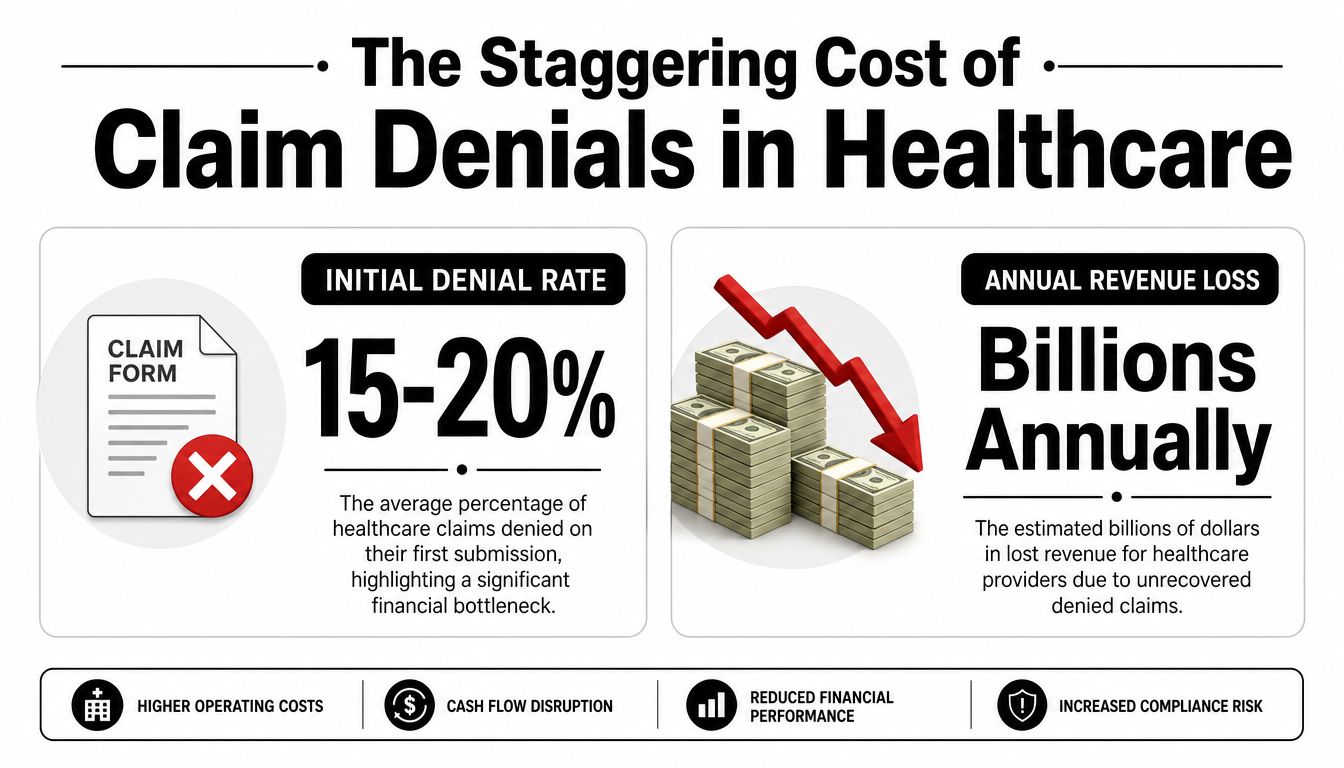
Specialty practices feel that pressure first and harder. Anesthesia groups see medical necessity and authorization disputes. Orthopedics gets hit on implants, modifiers, and post-op bundling edits. GI deals with frequency and documentation denials. Radiology fights coding edits, place-of-service mismatches, and downcoding. These are not random write-offs. They are recurring payer behaviors that expose weak controls in the revenue cycle.
Software matters because manual follow-up does not scale against patterned denials. If denials are rising and your only answer is to work them harder, you do not have a collections strategy. You have a labor problem. More staff touches, more portal checks, and more appeal letters will not fix a payer trend your team cannot see early, sort correctly, or escalate with evidence.
The financial loss also extends beyond the denied claim itself.
- Staff hours get consumed by rework that should have been prevented or prioritized.
- Appeals age out because records, auth details, and clinical support are scattered across systems.
- High-value claims get mixed with low-value noise because no one ranks denials by recovery yield.
- Underpayments slip past the team when a payer shifts from outright denial to partial reimbursement.
- NSA and IDR deadlines get missed when denial data never makes it into a dispute-ready workflow.
That last point gets ignored too often. For many specialty groups, the denial process and the IDR process are connected parts of the same revenue recovery system. A payer may deny, reprice, or underpay the same out-of-network claim under different labels. If your denial platform cannot track those patterns and preserve the documentation trail needed for NSA-compliant escalation, you are not managing denials. You are accepting avoidable revenue loss.
The right platform gives your team control over three things that determine yield: which denials to fix upstream, which claims to appeal fast, and which payer behaviors belong in a formal dispute path. That is why denial management software now belongs in the core RCM stack for specialty practices, not in a wish list for later.
Defining Denial Management Software
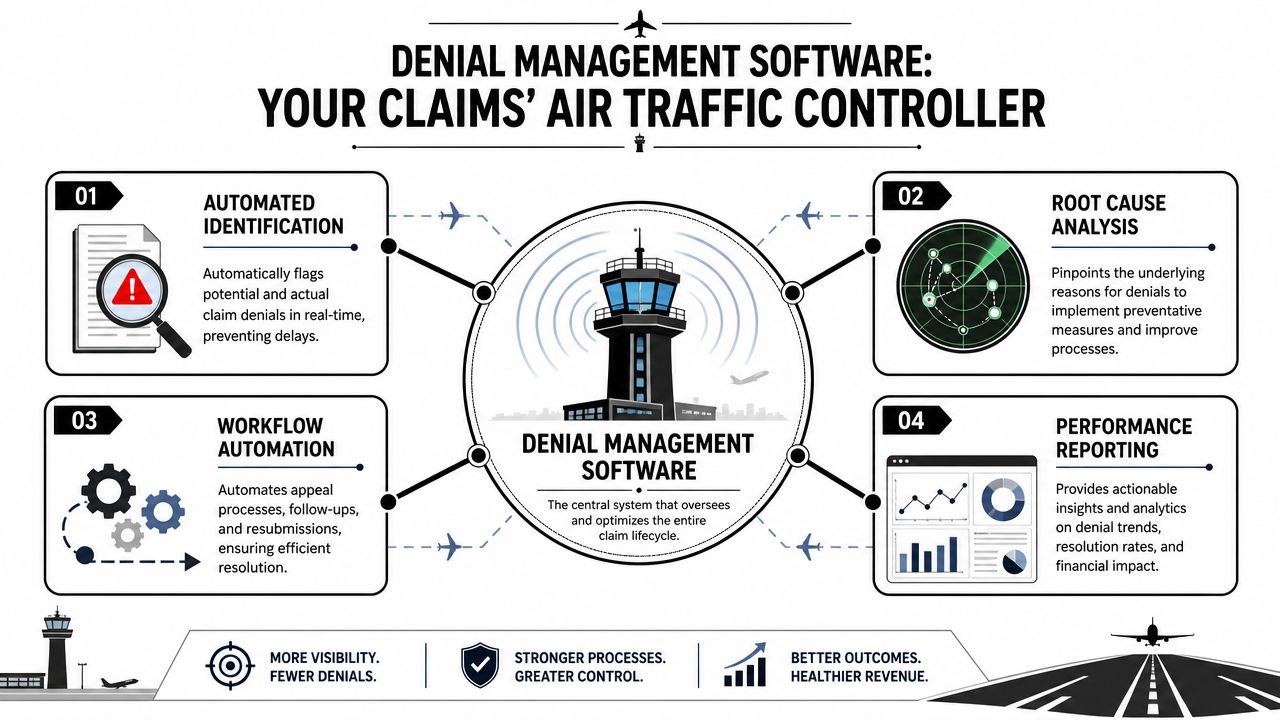
Most billing systems tell you that a claim was denied. Denial management software tells you what happened, why it happened, what to do next, and whether the claim is worth pursuing.
The simplest way to think about it is this: it's an air traffic control system for claims. Your EHR, practice management platform, billing software, and clearinghouse all send information through the revenue cycle. Denial management software sits in the middle and watches for risk, conflict, delay, and patterns that would otherwise stay buried in work queues.
What it does that ordinary billing software doesn't
A basic billing platform is built to submit claims, post payments, and record statuses. Useful, but limited.
Denial management software goes further:
- It identifies patterns. Not just single denials, but repeat denial reasons by payer, procedure, code set, facility, and workflow stage.
- It organizes action. Instead of dumping everything into a general follow-up bucket, it routes claims by denial type and recovery potential.
- It supports prevention. The platform can catch issues before submission when data, coding, eligibility, or documentation doesn't align.
- It supports recovery. The better platforms help your team build an appeal path, not just acknowledge failure.
Where it fits in your RCM stack
Think of your revenue cycle in layers.
| Layer | Primary role | Limitation without denial management software |
|---|---|---|
| EHR | Captures clinical documentation | Doesn't manage payer denial strategy |
| Billing or PM system | Submits claims and posts remits | Usually weak on denial analytics and prioritization |
| Clearinghouse | Checks transaction flow | Doesn't tell you which denials are strategically recoverable |
| Denial management software | Detects, categorizes, routes, and analyzes denial activity | Requires integration and disciplined use |
That's why denial management software isn't just another reporting tool. It becomes the operating layer for denied claims and underpayments.
A claim status code is not a strategy. Software becomes valuable only when it helps your team decide the next financially rational move.
What a specialty practice should expect
If you're evaluating a platform, don't ask whether it “tracks denials.” Every vendor says yes.
Ask whether it can separate administrative denials from policy-based disputes, whether it supports payer-specific logic, whether it can hand off evidence cleanly to appeal or arbitration workflows, and whether your staff can use it without building a shadow process in Excel. If the answer is no, it's not denial management software in any meaningful operational sense. It's a dashboard.
Key Features That Drive Revenue Recovery
The best denial management software doesn't win on interface polish. It wins on cash recovery logic.
According to MD Clarity's analysis of denial management software, AI-driven predictive analytics can estimate a claim's propensity to pay, and when that's paired with pre-submission scrubbing, organizations can see a 15–25% reduction in first-pass denial rates because 60–70% of denials stem from preventable administrative errors. That's the benchmark that matters. Prevention has to reduce rework, and recovery has to focus staff effort where money is collectible.
Pre-submission scrubbing
This is your first line of defense, but don't reduce it to “spell-check for claims.” Good scrubbing checks claims against payer logic, documentation alignment, eligibility data, and coding consistency before the claim leaves your system.
For specialty practices, that matters because the denial often starts long before the denial code appears. It starts when authorization data doesn't line up with the billed service, when documentation doesn't support the payer's interpretation of medical necessity, or when the claim carries coding combinations that trigger a policy edit.
If your current workflow submits first and cleans up later, you're paying your team to process avoidable failure.
Appeals workflow automation
Manual appeals break down for one reason: every claim looks urgent once it's denied. That's false. Some claims are fixable immediately. Some require a targeted payer argument. Some are structurally weak and shouldn't consume senior staff time.
Your platform should automate the boring work so your team can do the judgment work:
- Task routing by denial category so the right staff member handles the right issue
- Document collection prompts tied to denial reason
- Status follow-up workflows that don't rely on memory
- Appeal package assembly that reduces rework
A specialty practice with lean staff should value automation for one reason. It protects skilled labor from being wasted on clerical repetition.
Payer behavior analytics
Denial management software transforms from an administrative tool into a strategic weapon.
You need visibility into how each payer behaves by denial type, code family, service line, and underpayment pattern. That lets you answer questions that matter: Which payer repeatedly reclassifies similar cases? Which denials should be appealed as a matter of policy? Which ones point to front-end process failures inside your own team?
If you're also modernizing upstream workflows, medical billing automation for specialty practices can complement denial management by reducing the data-entry and handoff failures that feed preventable denials in the first place.
Don't measure a denial platform by how many denials it displays. Measure it by whether it changes staff behavior and payer recovery outcomes.
KPI dashboards that matter
A good dashboard shouldn't drown your team in vanity metrics. It should answer four operational questions fast:
- Where are denials entering the cycle?
- Which claims deserve immediate recovery effort?
- Which payer patterns are recurring?
- Which root causes are internal and fixable?
If the dashboard can't help a manager reassign work by financial priority before lunch, it's reporting, not management.
Why Generic Software Fails Specialty Providers
Generic denial management software works best for generic denial patterns. That's exactly why it breaks down in complex specialties.
The problem isn't that these platforms do nothing. The problem is that they stop at broad error detection while your denials are being driven by specialty-specific payer behavior. Air ambulance, IONM, orthopedics, anesthesia, and other high-value specialties don't lose revenue only because of missing fields or obvious coding mistakes. They lose revenue because payers apply policy edits, medical necessity standards, bundling logic, and reimbursement interpretations in highly specific ways.
Specialty denials require specialty logic
The sharpest example comes from air ambulance. According to the referenced specialty denial discussion, these providers can face denial rates of 40–60% tied to payer-specific medical necessity criteria. The same source notes that generic software often fails to distinguish between recoverable and systemic denials, causing teams to waste 20–30% of their time on low-yield appeals.
That's the operational failure. Not every denial belongs in the same queue.
A generic platform may flag an issue. It may even categorize it correctly at a surface level. But if it can't tell your team whether a denial is an administrative fix, a policy dispute, a documentation build, or an eventual IDR candidate, then it forces humans to make every high-value decision manually.
What this looks like in practice
Consider how specialty practices work through denials:
- Air ambulance teams confront medical necessity denials that hinge on payer-specific criteria, not generic claim edits.
- Orthopedic groups often run into bundling disputes and policy interpretation battles that require a structured appeal position, not a corrected claim.
- Hospital-based specialties may see the same payer repeat underpayment tactics across similar procedures, which means the issue belongs in a pattern library, not a one-off bucket.
A specialty denial isn't just a rejected claim. It's often a repeat payer tactic with a known path to appeal, escalation, or abandonment.
Why one-size-fits-all systems waste money
Generic software usually creates three forms of waste.
First, it pushes too much work into manual expert review. Second, it treats high-value denials and low-value denials as operational equals. Third, it gives managers broad trend charts without the underlying specialty logic needed to assign the next action correctly.
Specialty providers should reject any platform that can't support denial patterning by service line and payer policy behavior. If your denials are specialty-specific, your software needs to be specialty-specific too. Otherwise, your most expensive claims still depend on tribal knowledge.
Connecting Denials to IDR and NSA Compliance
A flagged denial is not recovered revenue. It's only a signal.
That's where most denial management software falls short. It catches the underpayment or denial, marks the claim, and leaves the rest to your staff. For complex specialties, that gap is where cash dies. Someone still has to gather documentation, identify whether the dispute belongs in appeal or arbitration, package evidence, and move the case into an NSA-compliant process without losing time.
According to CGM's denial management discussion, 68% of underpayments stem from downcoded claims and contribute to a $19B annual revenue leakage gap, while manual workflows can delay recoveries by 6–9 months when flagged issues aren't escalated into IDR. That's the clearest argument against siloed systems. If your denial platform ends at identification, it stops before the money comes back.
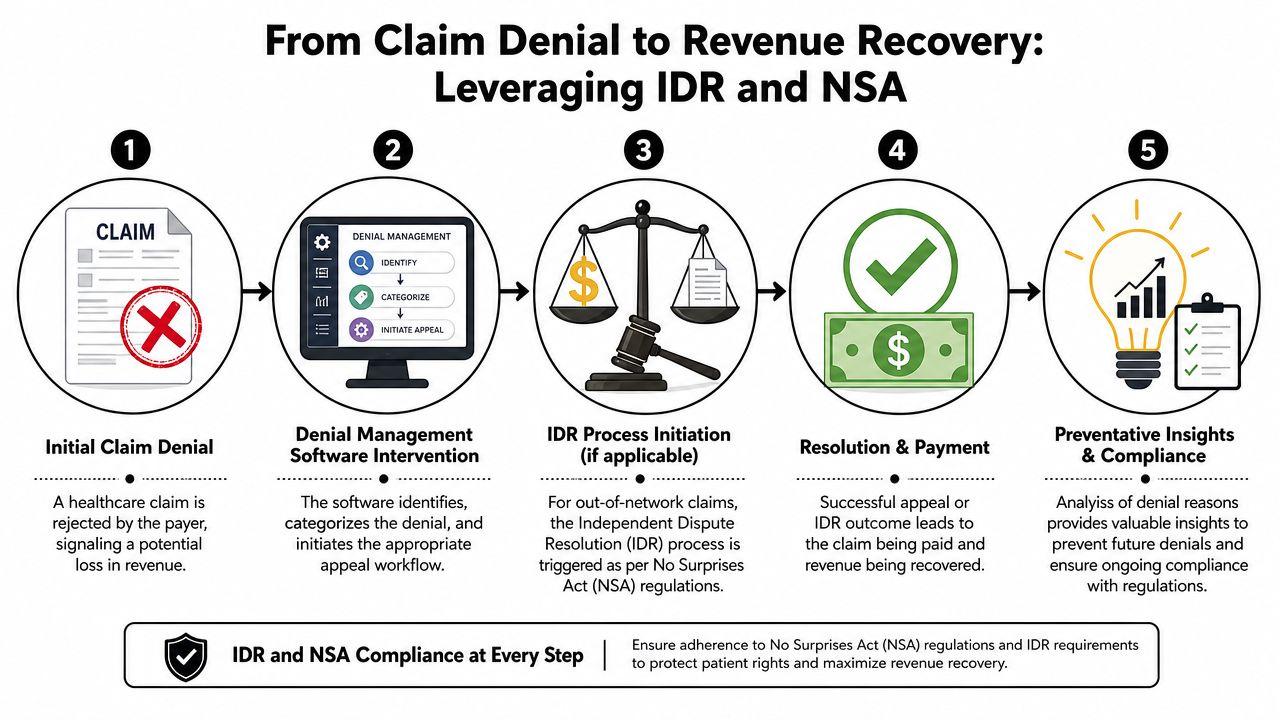
Denial management and IDR should be one workflow
Many practices still separate these functions:
| Workflow area | What happens in weak systems | What should happen |
|---|---|---|
| Denial detection | Claim is tagged and assigned | Claim is tagged, classified, and evaluated for appeal versus IDR readiness |
| Evidence gathering | Staff pull records manually | Documentation requirements are triggered by denial type |
| Escalation | Team decides late, often after delay | Escalation rules push eligible disputes toward arbitration workflow quickly |
| Compliance | NSA steps sit outside core RCM process | Compliance checkpoints are embedded in the recovery path |
This separation is expensive because payer behavior doesn't respect your org chart. A denial, partial payment, or downcode may all be part of the same reimbursement problem. Your software should reflect that reality.
What integrated recovery actually looks like
The right platform should help your team do four things well:
- Classify the issue correctly. Not every claim belongs in the same appeal route.
- Assemble evidence quickly. Clinical support, claim history, payer correspondence, and reimbursement logic should be organized early.
- Protect compliance. Teams need a structured process aligned with No Surprises Act requirements, not ad hoc judgment.
- Preserve recovery velocity. Time kills disputed revenue.
If you need a plain-language refresher on the legal framework behind these workflows, this No Surprises Act summary for providers is useful context before evaluating vendor claims about IDR support.
The practical standard is simple. If your denial software can identify a probable underpayment but cannot move that case toward an IDR-ready package, the platform is incomplete.
One recommendation most practices resist
Stop treating underpayments as a separate department's problem. In specialty revenue cycle, denials, downcodes, and NSA disputes are connected events. The cleaner your handoff between detection and dispute resolution, the less revenue leaks out between teams.
This is also the right place to name one category of vendor that's closer to the right model. Some firms, including RevGuard, explicitly link specialty-focused RCM workflows with IDR processes so denial intelligence can feed downstream dispute handling. That's materially different from denial-only platforms that stop at work-queue management.
Choosing and Implementing Your Denial Platform
Most software demos are designed to impress a revenue cycle executive for an hour. They are not designed to show you where implementation will fail in month three.
A strong buying process has to expose three things quickly. First, whether the platform understands your specialty. Second, whether it can connect denial workflows to appeals and IDR. Third, whether your team will use it without building a parallel process outside the system.
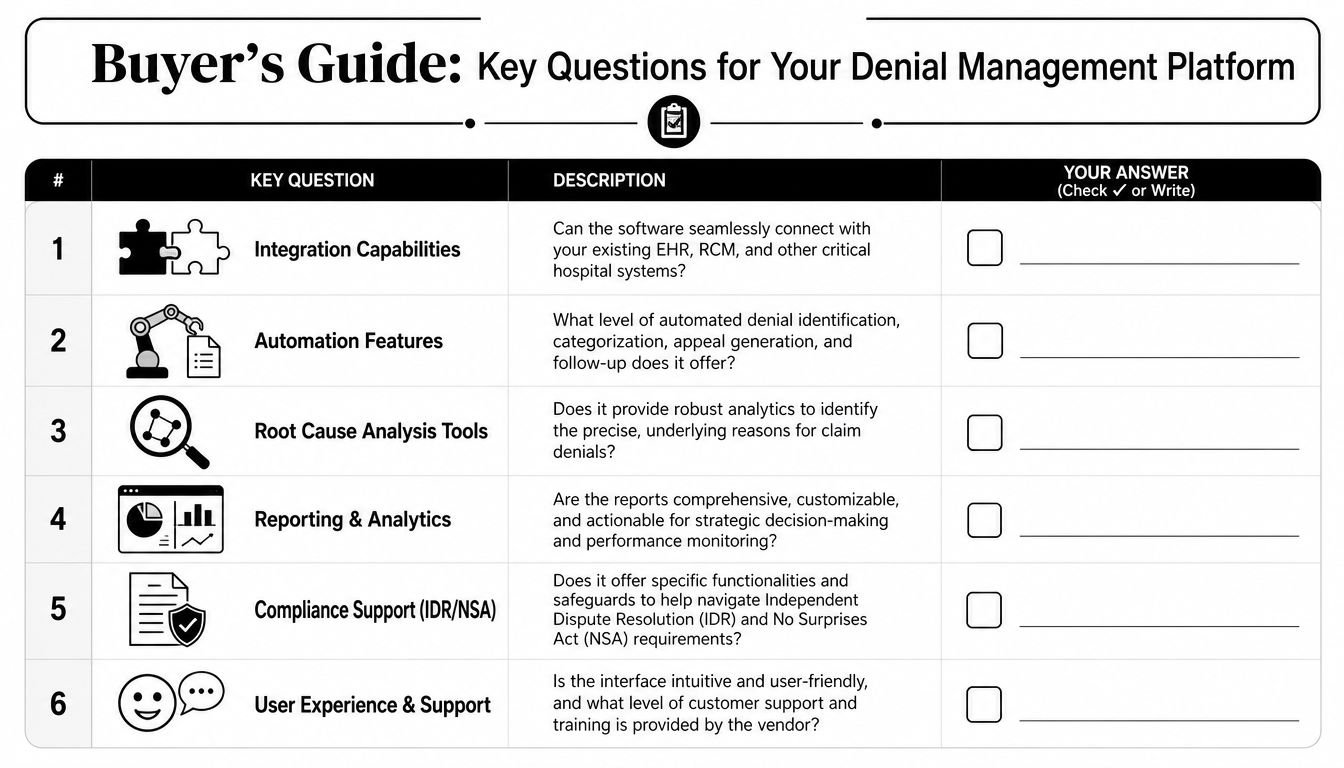
Questions that expose weak vendors
Ask direct questions. Don't let the sales team hide behind generic language.
- Specialty logic: Can the platform distinguish administrative denials from policy-based denials in your specialty workflows?
- Appeal pathing: Does it route claims differently based on denial recoverability, or does everything land in the same bucket?
- Evidence handling: Can staff build appeal-ready and dispute-ready documentation inside the workflow?
- IDR readiness: Does the platform support escalation into NSA-related dispute processes, or does it stop at flagging the issue?
- Operational fit: Will billers, coders, and managers all work from the same queue logic?
If a vendor answers these with feature lists instead of workflow examples, keep pushing.
What implementation should actually include
Implementation isn't a data import. It's a process redesign.
Use a phased approach:
- Map current denial categories by specialty, payer, and root cause.
- Connect upstream systems so eligibility, coding, and claims data flow cleanly.
- Define routing rules for administrative fixes, formal appeals, and arbitration candidates.
- Train by role so each team uses the platform for decisions, not just status tracking.
- Audit early output to catch bad queues, broken integrations, and reporting noise.
A denial platform should also fit into the rest of your collections and recovery stack. For practices trying to tighten bad debt workflows alongside payer recovery, tools in the category of medical collections software for healthcare organizations may need to align with your denial process so staff don't chase patients while payer liability is still unresolved.
Red flags during rollout
Here are the warning signs I'd take seriously:
- Everyone still exports to spreadsheets after training.
- Managers can't see next-action categories without manual sorting.
- Appeals depend on one expert user who knows the payer quirks.
- Underpayments are visible but not routed toward structured escalation.
- Front-end teams never see denial feedback from downstream patterns.
Buy the platform only if you're willing to change workflow discipline. Bad process inside better software is still bad process.
Future-Proofing Your Revenue Cycle
Healthcare organizations aren't buying denial management software because it's trendy. They're buying it because the reimbursement environment has become structurally hostile to manual recovery.
The macro signal is already there. The global healthcare denial management market was valued at USD 14.98 billion in 2024 and is projected to reach USD 30.17 billion by 2030 at a 12.19% CAGR, according to MarkNtel Advisors' healthcare denial management market forecast. That projection matters because it reflects a system-wide shift toward automated, integrated platforms as a core part of modern RCM.
The new benchmark is integration
The old model was simple. Submit claims, work denials, write off some losses, and move on. That model doesn't hold up when denials are patterned, underpayments are deliberate, and compliance requirements shape recovery strategy.
The new benchmark is tighter:
- front-end error prevention
- specialty-specific denial intelligence
- disciplined appeal workflows
- clear separation of recoverable versus systemic disputes
- structured handoff into compliant downstream recovery
Practices that build around this model will protect margin better than practices that keep adding staff to chase avoidable rework.
What to do next
If you lead a specialty practice, ask one hard question this quarter: does your current denial workflow recover money, or does it mostly document loss?
That's the decision point. If your platform stops at identifying problems, it's behind the market. If it can't connect payer behavior, specialty logic, and downstream dispute resolution, it's already obsolete for the environment you're operating in.
The right denial management software doesn't just lower noise in the billing office. It protects reimbursement value across the full claim lifecycle. That's the standard for 2026 and beyond.
RevGuard helps specialty providers connect denial management, payer-specific appeal workflows, and NSA-compliant IDR into one revenue protection model. If your team needs a clearer way to separate recoverable claims from systemic denials, reduce manual rework, and pursue underpayments with a structured compliance process, review RevGuard and compare its workflow approach against your current stack.