

In a 2026 report, IDR awards exceeded the qualified payment amount in 87% of determinations over a six-month period, according to HFMA's reporting on No Surprises Act IDR data. That result changes how revenue cycle teams should view the QPA. It's not a payment ceiling, and it isn't a reliable forecast of what an arbitrator will award. It's the payer's benchmark, the number that frames the dispute, and the reference point providers must either validate or rebut with disciplined evidence.
For specialty practices, the practical question isn't only, “What is the QPA?” The more important question is, “What can we prove about this claim that makes an above-QPA award credible?” That requires clean service matching, geographic accuracy, clinical documentation, offer discipline, and a workflow that starts before a claim reaches arbitration.
Why the Qualified Payment Amount Anchors Every Dispute
The qualified payment amount frames the dispute around the payer's benchmark, giving both sides a defined reference point to validate or rebut. For most surprise-billing cases, the QPA generally represents the median contracted rate on January 31, 2019, for the same or similar item or service in the same geographic region, with annual inflation adjustments based on CPI-U. CMS's QPA methodology applies this framework to items and services furnished during 2022 and later.
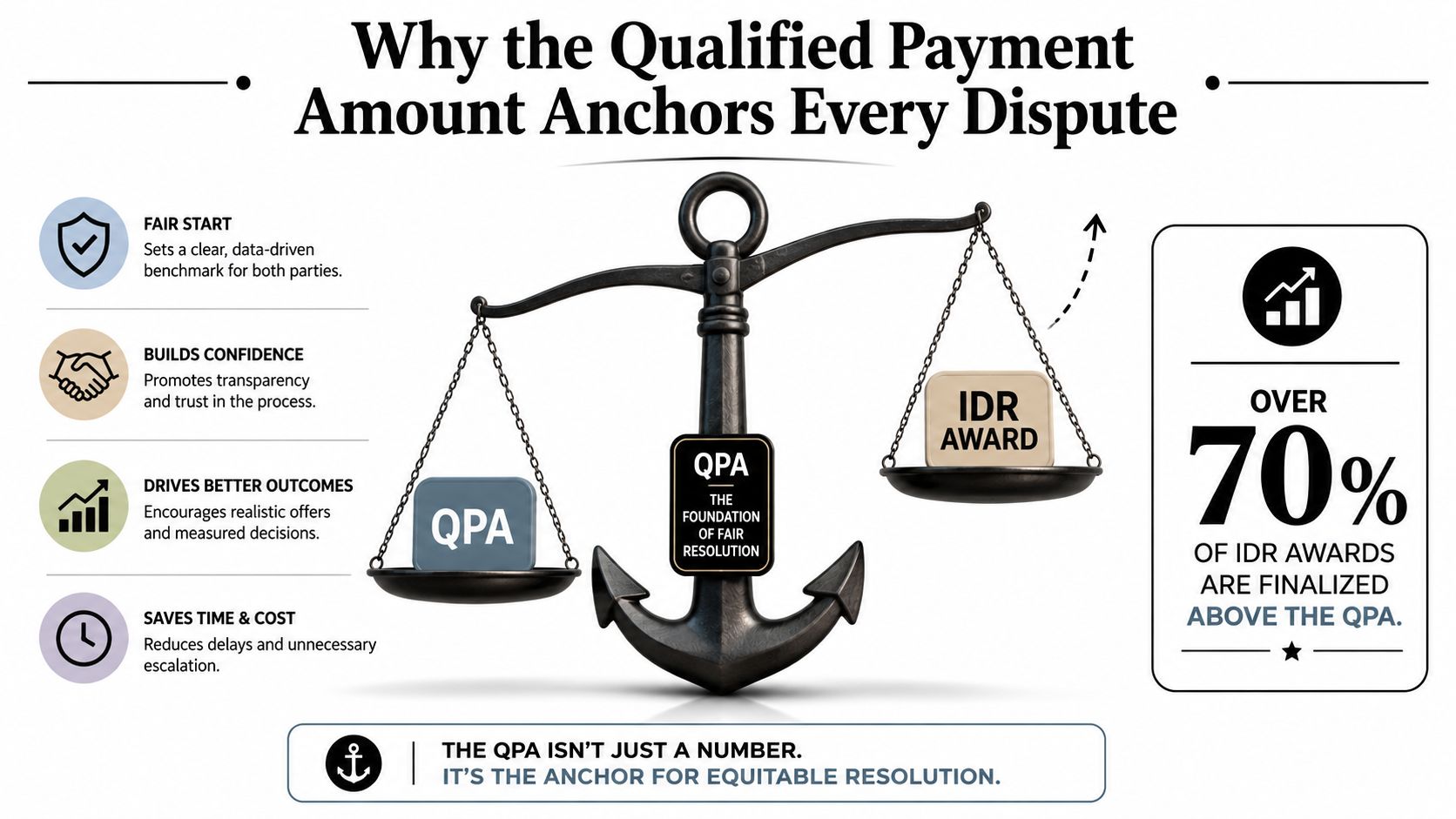
The historical design controls the starting point. The benchmark uses the payer's contracted-rate history at a fixed date, rather than a provider's billed charge, customary charge, or newly negotiated market rate. That creates consistency across disputes, while leaving room for a mismatch between the historical median and the complexity, scarcity, or risk of a specialty service today.
The QPA is an anchor, not a ceiling
The QPA shapes the case from the initial payment through open negotiation and, when required, independent dispute resolution. It can affect the insurer's offer, the provider's counterposition, and the arbitrator's view of whether either proposed amount is reasonable.
A low QPA does not establish that a claim lacks value. Nor does a payer's disclosure settle whether the underlying calculation is accurate. Providers should test the code family, service category, geographic region, and other claim inputs before deciding how much evidence the dispute requires.
That audit is often the first point at which a specialty practice gains or loses ground. A provider that accepts the disclosed figure without checking its construction may spend the IDR fee defending a number built from the wrong comparison set.
The QPA remains a core IDR reference point. CMS IDR guidance describes it as the insurer's indexed 2019 median in-network rate and explains that arbitrators consider it alongside limited additional circumstances, including provider training, experience, and outcome measures.
Why the benchmark can distort specialty valuation
A payer with a large historical network may produce a materially different median from one with a narrower network or a different contracting strategy. Specialty practices face particular risk when that historical contract set fails to represent the expertise, acuity, or resource intensity of the disputed service.
Practical rule: Audit the QPA first, then build the evidence needed to move the decision above it.
Providers can review the broader framework in this No Surprises Act summary. At the claim level, the working file should connect the billed service to accurate coding, geography, clinical complexity, provider qualifications, and a defensible offer. The QPA establishes procedural gravity. The record determines whether the service deserves greater payment.
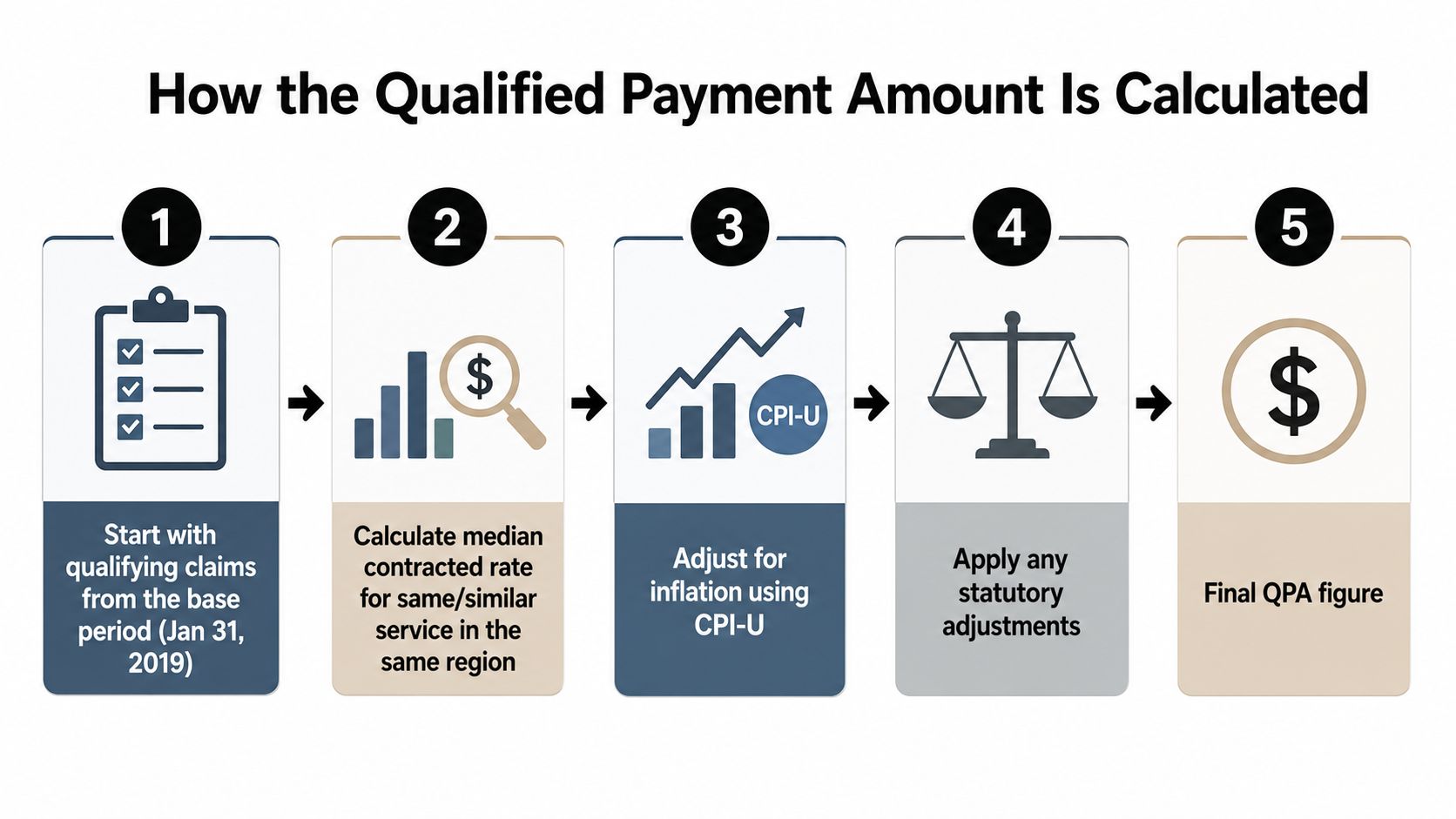
How the Qualified Payment Amount Is Calculated
A QPA is only as reliable as the rate set behind it. Providers reviewing the figure should reconstruct the payer's calculation instead of comparing it with a preferred fee schedule and treating the difference as proof of an error.
Identify the historical rate set
The first review point is whether the payer used qualifying contracted rates tied to the January 31, 2019 benchmark date. The QPA generally starts with the median contracted rate for the same or similar item or service in the same geographic region, then receives a CPI-U inflation update. Because the calculation is historical, current contracts alone cannot establish the figure.
The comparison category also needs testing. A similar-looking code may not belong in the same QPA group if the payer sorted services by specialty, code family, place of service, or clinical characteristics. Compare the billed code, modifiers, service description, provider specialty, and site of service as one record.
Apply the inflation update
After establishing the 2019 median, the payer applies the cumulative CPI-U adjustment for the applicable service year. For 2022, the calculation uses the January 31, 2019 median and cumulative CPI-U increases through 2021, consistent with the official QPA calculation methodology. The reported 2022 adjustment factor of 1.0648523983 represents approximately a 6.49% increase from the 2019 base.
A hypothetical makes the arithmetic clear. A validated 2019 median contracted rate of $1,000 would produce a 2022 QPA of approximately $1,064.85. For a 2022 service, a payer's validated 2019 median of $850 would produce a QPA of approximately $905.12. These examples show the formula, not the correct QPA for a particular claim.
Test the inputs before arguing the award
A dispute-ready review should record:
- Code matching: Confirm the CPT or HCPCS code, modifiers, and same-or-similar service category.
- Geographic assignment: Verify that the payer used the correct geographic region.
- Contract population: Request the contracted rates included and assess whether the median reflects the relevant specialty and service type.
- Inflation factor: Check that the payer used the factor for the correct service year.
- Disclosure consistency: Reconcile the QPA explanation with the remittance, initial payment, and other claim documents.
The QPA is not the same as an insurance allowed amount. An allowed amount may describe the plan's payment basis during ordinary claims processing, while the QPA serves a defined role under the No Surprises Act. Keeping the benchmarks separate prevents an IDR submission from relying on the wrong payment comparison.
Enforcement Discretion and the Moving QPA Target
Federal regulators extended enforcement discretion regarding the 2021 QPA methodology through at least February 1, 2026, and possibly August 1, 2026, as described in the California Medical Association's regulatory update. For revenue cycle teams, that means the QPA remains a calculation to audit, not a settled benchmark to accept automatically.
A payer may still rely on an older approach while litigation and regulatory review continue. Before treating an underpayment as an IDR opportunity, determine which methodology produced the QPA, whether the payer disclosed the inputs, and whether those inputs connect to the disputed service. The practical gap is significant: the QPA may look precise in the remittance, while the underlying rate population or adjustment method remains unclear.
Ask for the calculation record early
Capture every QPA-related disclosure during the initial payment review. Store the payer's explanation with the claim, rather than placing it in a separate regulatory folder that an IDR analyst may never receive. A dispute-ready request and review package should identify:
- The service code and modifiers used in the calculation.
- The geographic region applied.
- The historical contracting period and rate population.
- The inflation adjustment used for the service year.
- How the payer handled insufficient or mixed contracted-rate data.
A vague QPA statement does not establish an error. It does establish a documentation gap. That gap can support a provider argument that the payer's figure lacks a reliable connection to the service, especially when the provider pairs the missing detail with claim-specific evidence and a clear payment position.
Frame uncertainty carefully
Do not claim that every older-method QPA is invalid. That argument can exceed the available evidence and weaken stronger, claim-specific points. Identify the methodology, describe the unresolved regulatory posture, and show how the calculation affects the proposed payment.
A moving benchmark demands a stable audit trail. Preserve the payer's version of the calculation before arguing about its result.
The strongest response to uncertainty is operational. Maintain methodology-specific review notes, update payer rules as guidance changes, and treat static QPA calculators as screening tools rather than substitutes for claim-level verification. A provider that can pinpoint where the payer's method differs from the applicable framework enters open negotiation and IDR with a more credible record. That record is often more persuasive than a general objection that the QPA is too low.
QPA Versus Other No Surprises Act Benchmarks
The QPA is only one figure in the No Surprises Act payment sequence. Confusion usually arises because several amounts appear on the same claim, but each serves a different function. Patient cost-sharing, the insurer's initial payment, the provider's requested amount, and the final IDR determination shouldn't be treated as interchangeable.
| Benchmark | Purpose | Calculation Basis | When It Applies |
|---|---|---|---|
| Qualified payment amount | Provides a federal reference point for surprise-billing payment disputes and patient cost-sharing analysis | Generally the median contracted rate for the same or similar service in the same region as of January 31, 2019, adjusted by CPI-U | During initial payment review and IDR |
| Initial payment amount | Represents the plan or issuer's first payment offer for the out-of-network service | Determined by the plan or issuer under its claims and NSA processes | After claim adjudication and before or during open negotiation |
| Recognized amount | Supports cost-sharing calculations for covered out-of-network emergency and certain other services | Depends on the applicable federal or state recognition rules | When determining the patient's in-network cost-sharing responsibility |
| Provider offer | States the amount the provider asks the IDR entity to select | Provider's proposed payment, supported by claim, clinical, market, and provider-specific evidence | During open negotiation and IDR |
| Payer offer | States the amount the plan or issuer asks the IDR entity to select | Payer's proposed payment, usually presented with its QPA and supporting rationale | During open negotiation and IDR |
| IDR determination | Resolves the payment dispute | Arbitrator evaluates the parties' offers, the QPA, and permitted additional circumstances | At the end of the federal IDR process |
Follow the claim through its lifecycle
The initial payment tells the provider what the payer is willing to pay without escalation. The QPA tells the parties how the payer's historical median compares with that initial payment. A substantial gap can justify deeper review, but it doesn't automatically establish that the provider will win in arbitration.
Patient cost-sharing follows a separate logic. A patient may owe cost-sharing based on the applicable recognized amount or QPA-related rules even when the eventual provider-payer payment is higher after IDR. The provider's recovery from the plan and the patient's financial responsibility are related, but they aren't the same calculation.
Use the comparison to decide what to investigate
A useful internal review asks three questions:
- Is the initial payment below the disclosed QPA? If so, verify whether the payer has applied the correct benchmark and whether the discrepancy reflects a processing issue.
- Is the initial payment near the QPA but still below a defensible service value? Focus on evidence about complexity, training, experience, outcomes, and market circumstances.
- Is the provider's proposed amount disconnected from the record? Rework the offer before filing. An aggressive number without a clear evidentiary bridge can damage credibility.
The QPA is therefore a procedural reference, while the offers are advocacy positions and the IDR determination is the adjudicated result. Strong teams track every amount separately, preserve the source document for each figure, and avoid allowing the payer's QPA to replace a complete valuation analysis.
Why Most IDR Awards Exceed the QPA
Provider awards often rise above the QPA because the benchmark is only one part of the IDR record. HFMA's coverage of provider IDR results reports that awards exceeded the QPA in 87% of determinations over a six-month period. CMS-linked reporting also found that 462,973 of 532,548 disputes in Q4 2025 produced payment determinations above the proposed QPA.
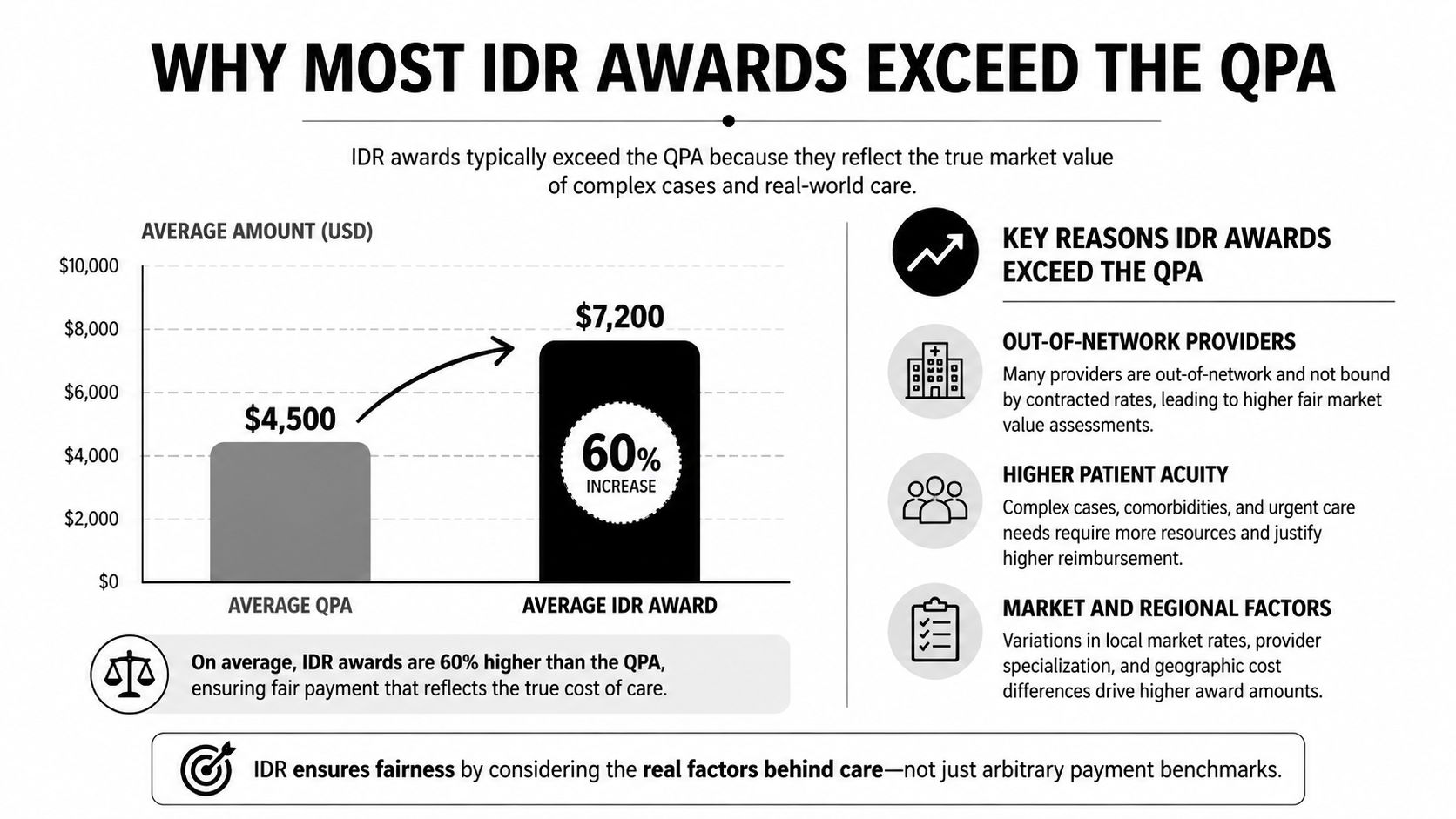
Those results do not make the QPA irrelevant. They show the operational gap between a theoretical benchmark and the payment argument supported by a claim-specific record. Providers win above the QPA when they identify the benchmark's limits and document the service circumstances an arbitrator can consider.
Payers start with an anchor
A payer's initial offer frequently tracks the QPA and presents it as though it settles the service's value. That position is harder to challenge when the provider submits broad statements about fairness. It becomes less persuasive when the provider documents a service mismatch, unusual complexity, specialized training, or a reason the historical median does not reflect the work performed.
The billing code may be identical across claims, while the resources and judgment required are not. Clinical acuity, technical difficulty, provider qualifications, and documented outcomes can give an arbitrator a concrete basis for selecting an amount above the QPA.
Arbitrators need a traceable record
An arbitrator does not need the longest narrative. The filing needs a clear connection between the proposed amount and the permitted additional circumstances:
- Training and experience: Identify relevant qualifications and explain their connection to the disputed service.
- Clinical complexity: Tie the patient's condition, procedural difficulty, and resource demands to the claim.
- Outcomes: Provide documented measures that are understandable and connected to the provider or service line.
- Market context: Describe specialty access, availability, and contracting conditions with claim-relevant support.
- Offer logic: Show how the evidence produces the proposed amount instead of presenting an unsupported demand.
The QPA sets a reference point. The record determines whether the payment moves beyond it.
The practical workflow is straightforward. Challenge the QPA when its inputs or service match are wrong. When the inputs appear defensible, spend filing time on evidence that explains why this claim differs from the median. Preserve the source for every figure, separate the benchmark from the offer, and make each asserted circumstance traceable to a document an arbitrator can evaluate.
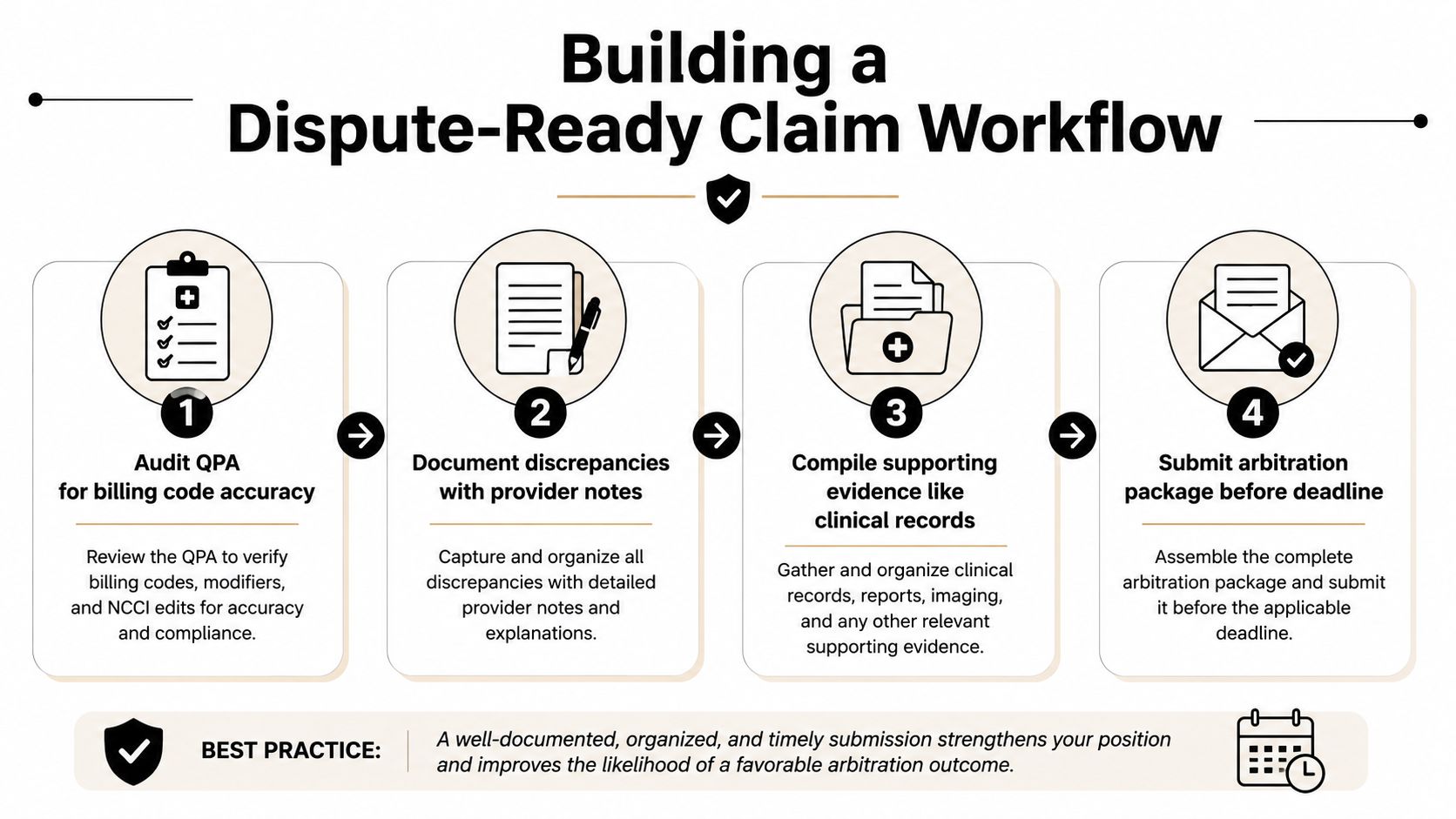
Building a Dispute-Ready Claim Workflow
An IDR case is easier to win when the provider builds it during ordinary revenue cycle work. Waiting until the filing deadline to reconstruct the claim usually produces missing records, generic clinical summaries, and an offer that lacks a defensible rationale.
Capture the claim facts at submission
Start with clean data. Store the payer, plan, member information, service code, modifiers, place of service, provider specialty, service date, remittance, and QPA disclosure in one claim record. If the payer later changes its explanation, the team can compare versions instead of relying on memory or scattered email attachments.
The first audit should answer whether the payer matched the service and region correctly. A coding mismatch may be more persuasive than a generalized argument about fair market value because it attacks the foundation of the QPA itself.
Build the evidence while the details are available
Clinical documentation should support the specific additional circumstances an arbitrator can consider. Don't upload a large chart without an index or explanation. Extract the relevant operative, anesthesia, consultation, or treatment details and connect each item to the provider's offer.
A practical evidence file can include:
- Claim records: Claim form, remittance, initial payment, QPA disclosure, and open negotiation communications.
- Clinical support: Relevant notes that establish acuity, complexity, unusual risk, or service intensity.
- Provider credentials: Training, experience, board status, specialty qualifications, and outcome information relevant to the disputed service.
- Calculation audit: Code mapping, geographic analysis, payer methodology notes, and any identified discrepancy.
- Offer memorandum: A concise explanation of the requested amount and how the evidence supports it.
Control the deadline and the narrative
The team must track the open negotiation window and the IDR filing deadline as hard operational dates. A compelling case filed late is not a compelling case. Assign ownership to a named employee or vendor, use a status field for each milestone, and require a final compliance check before submission.
The federal IDR workflow should be treated as a case-management process, not a last-stage appeal. Case software, spreadsheets, or specialized services can all work if they preserve the same core information and create an auditable record.
Before filing, ask:
- Did we verify the QPA inputs?
- Did we distinguish a calculation dispute from a valuation dispute?
- Did we connect every major argument to evidence in the file?
- Is the offer reasonable enough to withstand scrutiny?
- Are all deadlines, notices, and submission requirements documented?
The workflow works when billing, coding, clinical operations, contracting, and IDR staff share the same claim record. It fails when each team owns one fragment and no one owns the final argument.
Strategic Takeaways for Specialty Practices
QPA review belongs in daily revenue cycle operations. The QPA reflects historical contracting data, payer methodology, service classification, and geography. Practices cannot control every input, but they can audit those inputs and preserve a claim record that supports a different valuation.
Three priorities deserve consistent ownership.
First, verify the QPA during payment posting. Begin when the remittance and QPA disclosure arrive, rather than waiting for an IDR vendor to request documents. Payer-specific audit rules can flag unusual code mappings, geographic assignments, and gaps between the QPA and initial payment.
Second, build evidence around the disputed service. A generic provider biography rarely explains the value of a difficult anesthesia case, complex orthopedic procedure, or specialized diagnostic service. Use clinical facts, provider qualifications, and outcome measures in a concise narrative tied to that claim.
Third, connect RCM with IDR operations. Accurate coding, complete documentation, clean eligibility records, and timely payment posting produce stronger arbitration files. Feed IDR results back into payer rules, coding audits, contracting decisions, and specialty reimbursement analysis.
For practices with substantial out-of-network volume, leadership should track more than IDR case counts. Review why cases qualify, where QPA discrepancies arise, which evidence is repeatedly missing, and whether payer behavior changes after disciplined disputes. That review turns individual arbitration files into operational intelligence.
The QPA serves as a procedural anchor; it does not cap what a defensible valuation can achieve. Accepting it without verification leaves payer contract data unchallenged, while challenging every case without support consumes staff time and filing costs. The workable strategy is selective escalation, accurate audits, credible offers, and a repeatable record that defends the requested amount.
RevGuard connects specialty-specific revenue cycle management with No Surprises Act IDR support, including QPA tracking, claim review, evidence development, filing, and payment follow-through. Visit RevGuard to evaluate a workflow linking upstream claim quality with downstream dispute execution.