

A hand osteoarthritis claim can look clinically obvious and still fail at the billing level. The provider documents “arthritis in the hand,” the coder selects a familiar parent category, and the payer returns the claim for missing laterality or an unsupported anatomic site. By the time the practice identifies the problem, the clinical note, code choice, and procedure linkage may all need review.
For teams searching osteoarthritis in hands ICD 10 guidance, the difficult part isn't finding an arthritis category. It's matching the diagnosis to the exact hand site, laterality, and disease pattern documented by the clinician. The most consequential distinction is often the one many quick references skip: thumb base osteoarthritis belongs in the M18 family, while other primary hand osteoarthritis generally belongs in M19.04-.
Why Hand Osteoarthritis Coding Causes So Many Denials
A typical denial starts with a short assessment: “right hand OA.” The claim goes out with a broad hand osteoarthritis category, but the payer's edit expects a billable code that identifies the right hand. In another case, the note describes thumb base pain while the claim uses an M19.04- code intended for other hand joints. Both claims may reflect a genuine diagnosis, yet neither clearly supports the selected code.
The underlying problem is a mismatch between clinical shorthand and ICD-10-CM specificity. Older ICD-9 concepts grouped generalized hand osteoarthrosis more broadly. ICD-10-CM separates primary hand osteoarthritis by laterality and separates first carpometacarpal joint disease into the M18 family, as documented in the ICD-10-CM hand osteoarthritis code reference.
Why the rework is expensive
Every rejected claim creates work beyond changing a code. A biller must determine whether the diagnosis was wrong, the documentation was incomplete, or the payer applied an edit that requires an appeal. Staff may need to send a query, wait for a provider response, correct the claim, and monitor the resubmission.
Hand OA creates particular friction because “hand” can refer to several clinically distinct areas:
- Finger joints, such as interphalangeal joints, generally point toward the M19.04- family when the condition is primary osteoarthritis of the hand.
- Thumb base disease, involving the first carpometacarpal joint, points toward M18.-.
- A generalized descriptor, such as “bilateral hand arthritis,” may fail to establish the exact code choice even when both sides are affected.
Practical rule: A diagnosis can be medically reasonable and still be too vague for claim adjudication.
The revenue-cycle response should combine prebill edits with targeted denial follow-up. Practices can also use a structured healthcare denial management workflow to track whether failures originate in provider documentation, code selection, claim construction, or payer processing. That classification matters because repeated correction without fixing the source only moves the same denial downstream.
Understanding the M19.04 Code Family and Laterality Requirements
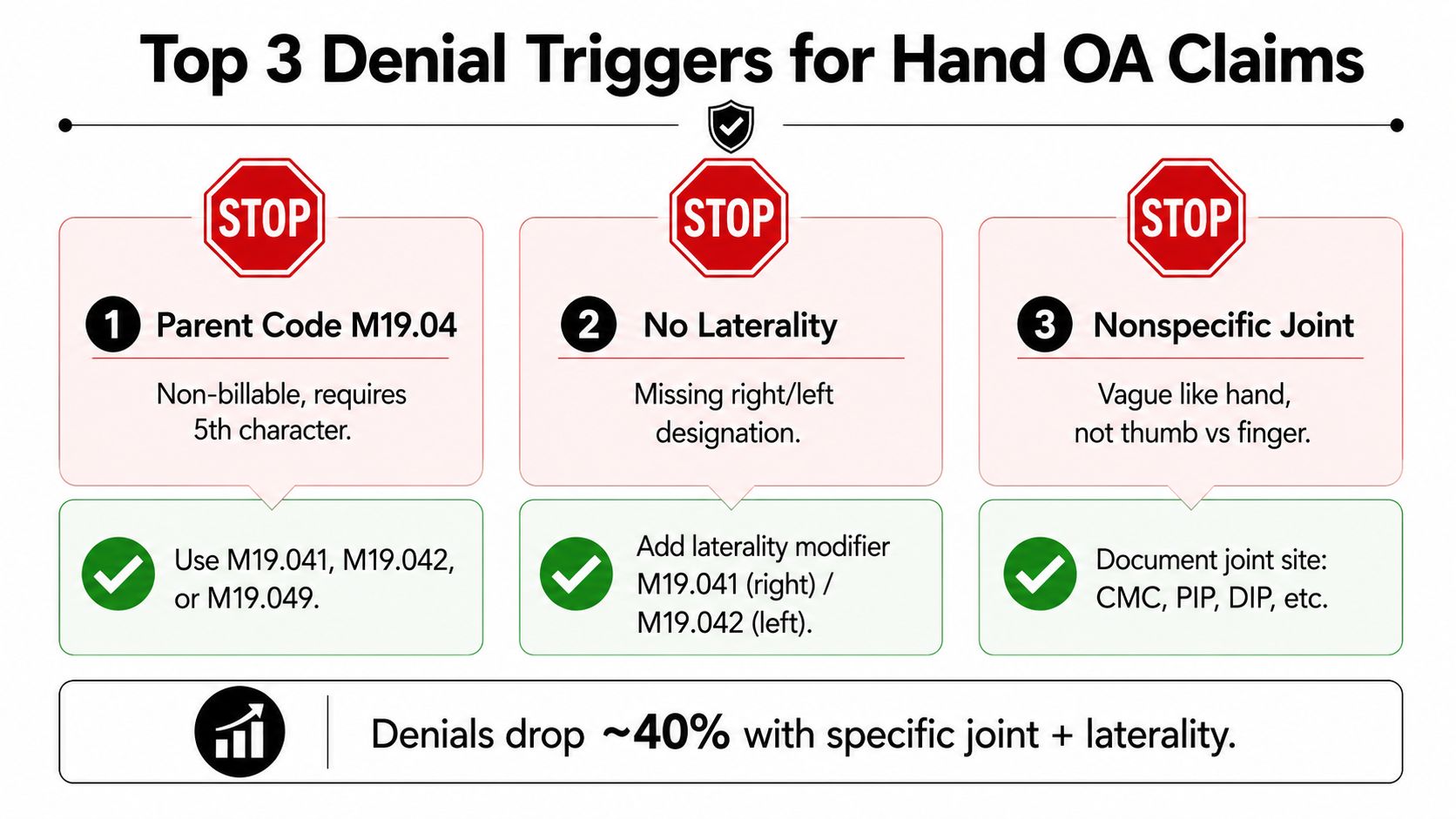
The M19.04 category identifies primary osteoarthritis of the hand, but the parent category doesn't provide the laterality required for the more specific claim code. The available hand-specific choices are M19.041 for the right hand, M19.042 for the left hand, and M19.049 for an unspecified hand, as shown in the M19.04 code listing.
The practical distinction is simple. Use the right-hand code when the provider documents right-hand involvement, the left-hand code when the note supports the left hand, and the unspecified code only when the record doesn't establish a side. A coder shouldn't infer laterality from the procedure side, an imaging label, or a prior encounter if the current documentation doesn't support that inference.
Code reference
| ICD-10 Code | Description | Billable Status | When to Use |
|---|---|---|---|
| M19.04 | Primary osteoarthritis, hand | Parent category, not the most specific claim choice | Use as a category reference, not as the final laterality-specific selection |
| M19.041 | Primary osteoarthritis, right hand | Specific billable code | Use when the provider documents primary OA of the right hand |
| M19.042 | Primary osteoarthritis, left hand | Specific billable code | Use when the provider documents primary OA of the left hand |
| M19.049 | Primary osteoarthritis, unspecified hand | Specific unspecified-side option | Use only when the documentation truly doesn't identify right or left |
If both hands are affected, the record should identify bilateral involvement clearly. The M19.04 family provides separate right and left codes rather than relying on a single bilateral code in the listed hand-specific options. In a bilateral case, assign M19.041 and M19.042 when the documentation supports primary osteoarthritis in both hands, subject to the payer's claim-line and reporting rules.
What “unspecified” really means
Unspecified isn't a substitute for an incomplete workflow. It may be appropriate when the available clinical record omits the side, but it becomes a preventable denial trigger when the physician clearly evaluated one hand and the coder failed to capture it.
Before final submission, compare the assessment, exam, imaging references, procedure site, and diagnosis pointer. The ICD-10 coding guidelines for RCM teams can support a consistent internal review process, but the provider's note remains the foundation for defensible code assignment.
Thumb Base vs Finger Joints The Critical M18 vs M19.04 Distinction
The first carpometacarpal joint sits at the base of the thumb, where the thumb metacarpal meets the wrist-side trapezium. That location is not interchangeable with the finger joints. Primary osteoarthritis of the first CMC joint belongs to M18.-, while other primary hand osteoarthritis uses M19.04-. The official code structure separates these anatomic sites, including M18.11 for unilateral primary osteoarthritis of the first carpometacarpal joint, right hand (CMS code-set reference).
The documentation must identify the site, not merely the symptom. “Thumb pain” doesn't automatically establish first CMC OA, and “hand arthritis” doesn't tell the coder whether the thumb base or finger joints are involved.
Compare the documentation signals
| Clinical documentation | Coding direction | Why it matters |
|---|---|---|
| “Primary OA of the first CMC joint, right hand” | M18 family, with the documented laterality and pattern | Names the thumb base joint directly |
| “Primary OA of the DIP and PIP joints of the right index and middle fingers” | M19.041 | Identifies non-CMC hand joints and the right side |
| “Hand arthritis” | Query or clarification | Doesn't establish the joint site, laterality, or OA type |
A note supporting M18 coding might state: “Imaging and examination support primary osteoarthritis of the right first carpometacarpal joint, with pain at the thumb base and reduced pinch function.” A note supporting M19.04 coding could state: “Primary osteoarthritis affects the right index and middle finger interphalangeal joints; the first CMC joint is not the treated site.”
Why payers scrutinize the split
Payers use diagnosis specificity to test whether the billed service matches the documented anatomy. A thumb-base injection, splint, or surgical evaluation paired with a nonspecific finger-joint code can create a medical-necessity question. The reverse mismatch can also prompt an audit because M18 and M19.04 describe different joint locations.
The fix isn't to select the code that sounds closest. It's to make the clinician's assessment explicit enough that the code follows the anatomy. If the note supports both thumb-base and finger-joint disease, document each site separately and code the conditions according to the confirmed diagnosis and payer reporting requirements.
ICD-9 to ICD-10 Crosswalk How Hand OA Coding Evolved
A legacy problem list may still say “hand OA,” while the claim now requires the note to identify what that diagnosis covers. The older ICD-9 concept 715.04 described osteoarthrosis or generalized hand disease and could support a broad hand diagnosis. Crosswalk material maps it to several ICD-10-CM options, including M19.04, M19.041, M19.042, and M19.049, as shown in the ICD-10 hand osteoarthritis crosswalk reference.
That mapping is not a one-to-one code conversion. It exposes the hidden work behind the transition: the practice must resolve laterality, joint location, and the distinction between finger-joint disease and thumb-base disease. A legacy template that carries “hand OA” forward can therefore produce a code that is technically related but does not support the service billed.
The operational change
ICD-10-CM became required for claims with dates of service on or after October 1, 2015. Practices that kept templates built around a generalized hand diagnosis often followed the same error path:
- The provider records a broad diagnosis.
- The coder chooses a parent category or unspecified-side option.
- A claim edit identifies missing specificity.
- Staff query the chart after the visit instead of capturing the detail during it.
The crosswalk helps explain the history. It does not authorize a legacy coding habit. The claim must follow the current note and the current ICD-10-CM hierarchy. In practice, that means checking whether the documented anatomy supports M19.04 or points to the separate M18 family for thumb-base disease.
Update the workflow, not just the codebook
Revise orthopedic templates, train coders on the M18 versus M19.04 split, and add a pre-release edit for unspecified laterality. The edit should also confirm whether the note identifies the first CMC joint or another hand-joint site.
The transition changed not only terminology but also what the clinical note must prove.
Documentation Requirements That Support Clean Claims
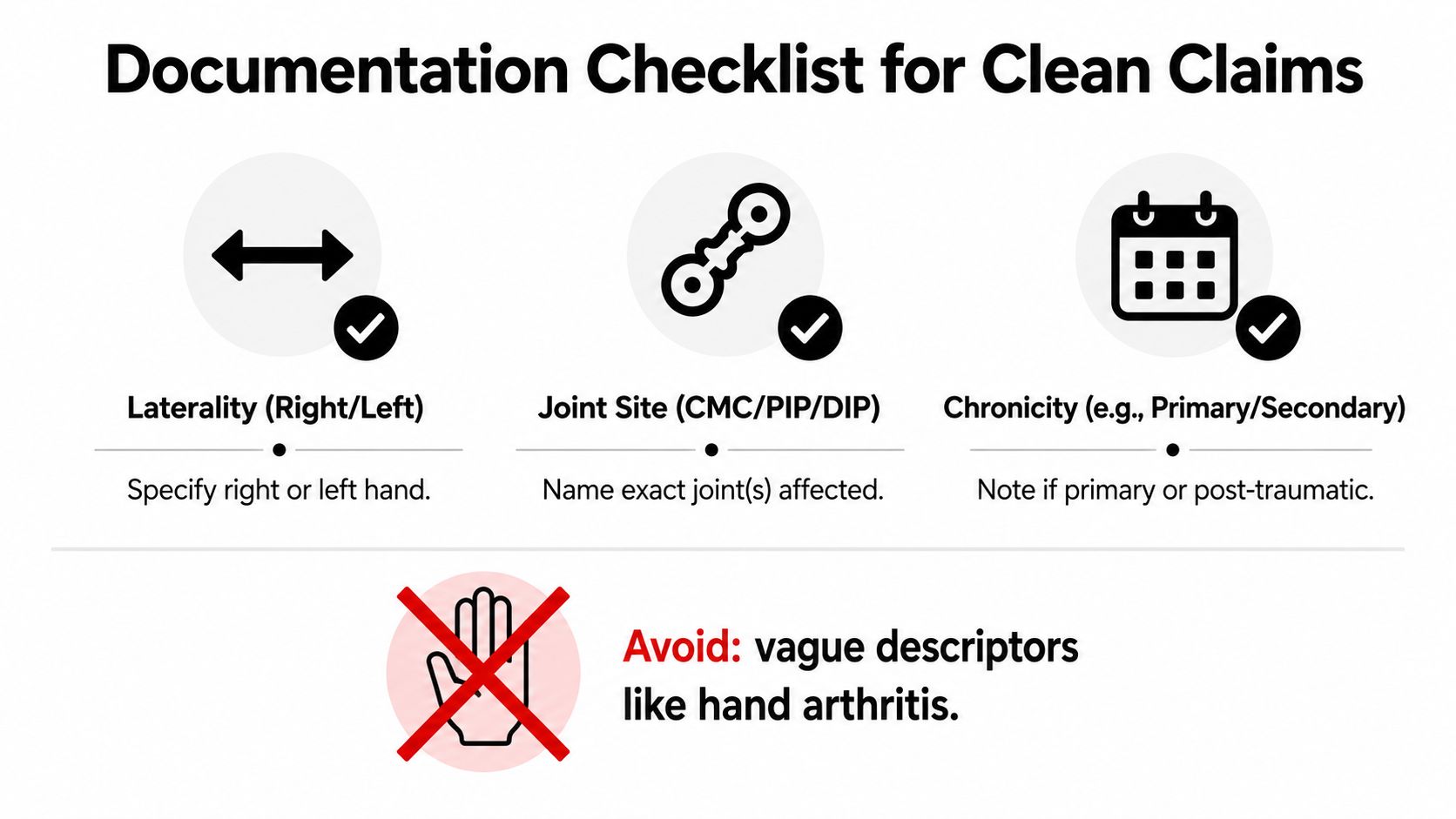
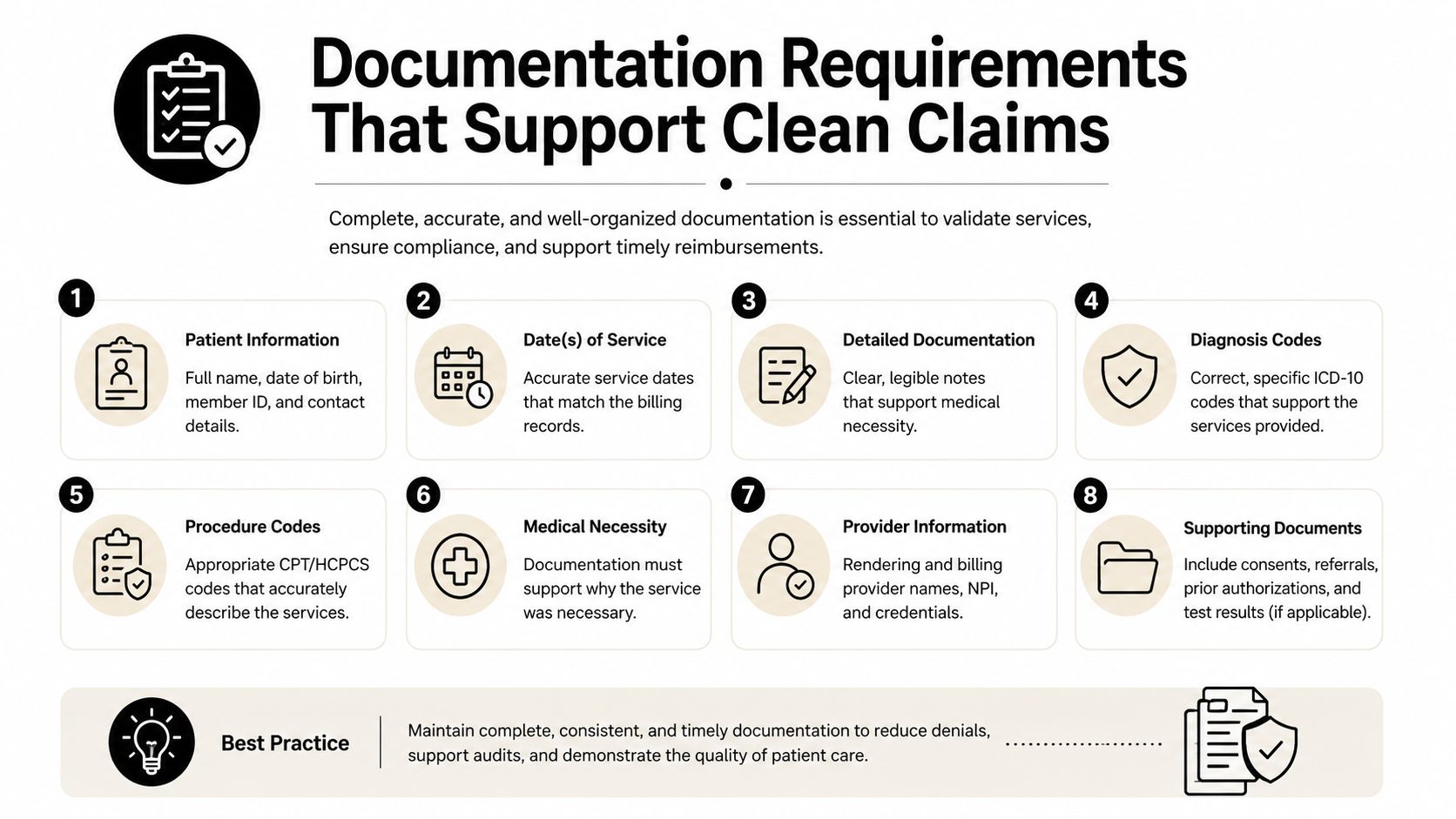
A clean hand OA claim begins before coding. The physician's assessment should identify laterality, exact joint site, and disease type in language that a coder can translate without guessing. “Bilateral hand OA” is better than “arthritis,” but it still may not distinguish the thumb base from finger joints or establish whether the condition is primary, secondary, or post-traumatic.
Capture the elements that change code selection
Use a compact documentation prompt in the orthopedic note:
- Laterality: State right, left, or bilateral involvement. If only one side is treated, identify that side directly.
- Joint site: Name first CMC, PIP, DIP, MCP, wrist-hand complex, or another documented location.
- Disease pattern: Specify primary, secondary, or post-traumatic osteoarthritis when clinically established.
- Clinical support: Record relevant examination findings, imaging interpretation, pain, stiffness, reduced motion, weakness, or functional limitation when they support the encounter.
- Treatment relationship: Identify which joint is being treated, especially when multiple hand sites appear in the history.
The final item prevents a common problem. A patient may have thumb base OA and finger joint OA, but the procedure note may address only one of those sites. The diagnosis pointer should reflect the treated condition rather than every diagnosis found in the chart.
Use templates that help clinicians, not templates that create clutter
A practical assessment template can offer selectable prompts:
“Primary osteoarthritis of the [right/left] [first CMC/finger joint], involving [named joint or digits]. The treated site today is [site].”
For a bilateral presentation, the clinician can document each side in the same assessment, then identify the side or site addressed during the encounter. This approach adds precision without requiring a long narrative.
Clinical documentation improvement works best when it addresses recurring ambiguity rather than asking providers to write more about everything. A focused clinical documentation improvement workflow can use denial data to identify which prompts physicians miss most often, then place those prompts where they naturally occur in the examination and assessment.
Common Denial Triggers and How to Prevent Them
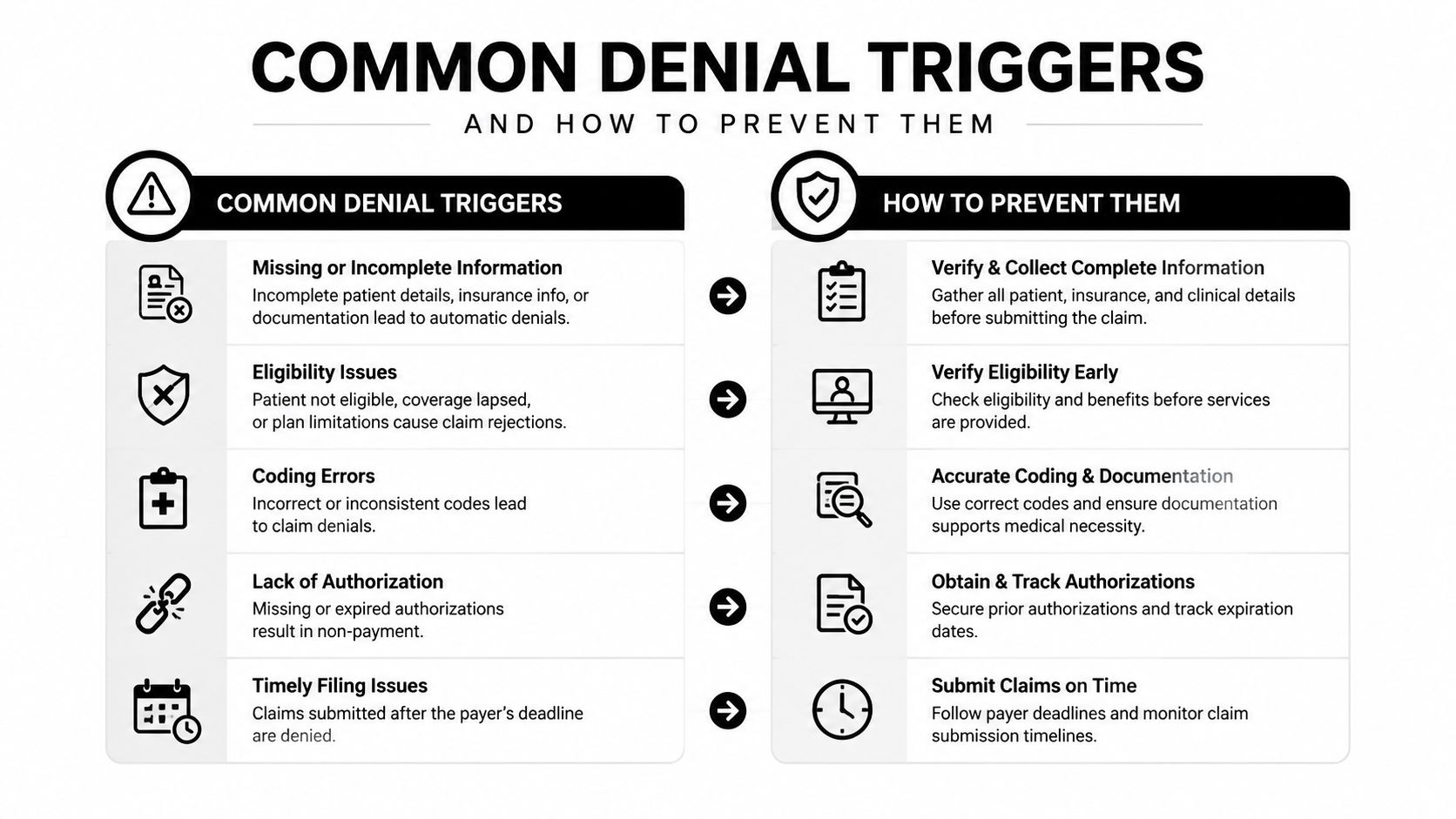
The assumption that “hand OA” is enough is responsible for many avoidable claim problems. In an audited orthopedic workflow, the same three failure patterns recur: the parent code is submitted, the thumb base is confused with other hand joints, or the record doesn't establish laterality and site.
Parent-code submission
Problem: The claim uses M19.04 as though it were the final diagnosis.
Why the payer questions it: The parent category doesn't identify right, left, or unspecified hand. Claims requiring the highest available specificity need a more detailed selection.
Prebill fix: Configure the encoder or claim scrubber to flag M19.04 when a more specific code is required. The coder should return to the note and select M19.041, M19.042, or M19.049 based on the documented side.
M18 and M19.04 confusion
Problem: The provider documents first CMC disease, but the coder assigns an M19.04- code, or the record describes finger joints while the claim uses M18.-.
Why the payer questions it: These code families describe different anatomic sites. A procedure or medical-necessity narrative tied to one site may not support the other.
Prebill fix: Compare the diagnosis wording with the procedure site. Require explicit first CMC language for M18 selection, and require named non-CMC hand joints when using M19.04-.
Missing laterality or anatomic detail
Problem: The note says “hand arthritis,” or it says “bilateral hand OA” without identifying the affected joints.
Why the payer questions it: The coder can't reliably determine whether to report a right-side code, left-side code, both side-specific codes, or a different anatomic family.
Prebill fix: Query the provider before submission. Use M19.049 only when the chart lacks laterality after reasonable review. It shouldn't be the default for a busy clinic or a shortcut around an incomplete assessment.
A useful audit report groups denials by trigger rather than by payer alone. If most failures involve the parent code, fix the encoder edit. If they involve M18 versus M19.04, revise the orthopedic template and educate clinicians on first CMC terminology.
Real-World Coding Scenarios and Correct Approaches
Scenario one thumb base disease
The patient reports pain at the base of the right thumb, difficulty with pinch, and tenderness over the first carpometacarpal joint. The orthopedic assessment states: “Primary osteoarthritis of the first carpometacarpal joint, right hand,” and the treatment note identifies the right thumb base as the treated site.
The correct direction is the M18 family, with a code such as M18.11 when the documented diagnosis matches unilateral primary OA of the right first CMC joint. The code choice follows the anatomy, not only the fact that the affected area is part of the hand. The CMS ICD-10-CM code-set material supports the separation of first CMC disease from other hand osteoarthritis categories.
A common error is assigning M19.041 because the note says “right hand.” Another is using an unspecified M18 option when the assessment clearly identifies the right side. The correction is a focused diagnosis statement that names the first CMC joint, laterality, and primary disease pattern.
Scenario two bilateral finger-joint OA
The patient has pain and stiffness in multiple finger joints on both hands. The physician documents primary osteoarthritis affecting the right index and middle finger interphalangeal joints and the corresponding left-hand joints, with no indication that the first CMC joint is the treated site.
The appropriate M19.04- approach is M19.041 for the right hand and M19.042 for the left hand, assuming the record supports primary hand OA on both sides. This is more defensible than using M19.049 because the documentation establishes laterality.
The coder should also ensure that the assessment doesn't accidentally describe a different disease pattern. If the OA is linked to a prior injury or another condition, the provider must document that relationship so the coder can evaluate the applicable primary, secondary, or post-traumatic category. Don't use the bilateral presentation as a reason to erase the individual side-specific evidence.
Connecting Coding Accuracy to Revenue Protection
Hand OA coding affects more than the diagnosis field. It influences whether the payer can connect the service to the documented condition, whether the claim survives an automated edit, and whether an appeal packet presents a coherent clinical narrative. A precise claim gives the payer fewer reasons to question the relationship between the hand site, the treatment, and the medical record.
The strongest revenue-cycle process aligns four records:
- The assessment identifies the disease type, laterality, and joint.
- The examination or imaging reference supports the documented anatomy.
- The procedure note names the site treated.
- The claim line uses the most specific supported diagnosis and points the service to it.
Turn denials into workflow evidence
Start with a targeted audit of hand OA claims. Pull denied and corrected claims, then classify each issue as parent-code use, M18 versus M19.04 misclassification, missing laterality, unspecified coding, or documentation inconsistency. Review the same categories in paid claims as well, because a paid claim can still reveal weak documentation or future audit exposure.
Next, build corrective controls around the source of failure:
- Coding edit: Flag M19.04 when a more specific code is supported.
- Documentation prompt: Add first CMC and laterality choices to the orthopedic assessment template.
- Coder review: Compare the diagnosis with the procedure site before release.
- Appeal packet: Include the relevant assessment, examination, imaging reference, and procedure documentation in a logical order.
- Feedback loop: Share denial examples with physicians using concise, site-specific queries.
RevGuard offers specialty RCM support that includes coding, claim submission, denial management, appeals, and workflow optimization, with an operating model that connects revenue-cycle work to dispute resolution when payer payment issues continue. For orthopedic practices auditing hand OA leakage, the team can evaluate the documentation-to-code path and help build controls around recurring denial patterns.
Visit RevGuard to discuss an orthopedic revenue-cycle review focused on hand osteoarthritis coding, laterality gaps, M18 versus M19.04 errors, and denial prevention. Bring a sample of corrected or denied claims, and ask for a workflow assessment that connects documentation fixes to cleaner submissions and stronger payer follow-up.