
The most practical measure of ICD-10-CM quality isn't whether a code exists. It's whether the claim survives payer scrutiny after the coder applies the rules, and the world evidence shows that coded data can be only moderately reliable even when the rules are followed. In one 2024 systematic review of ICD-10 external-cause injury codes, mean sensitivity was 61.6% and mean specificity was 91.6%, with positive predictive value at 74.9% and negative predictive value at 80.2% across 9 injury categories, based on 16 studies for sensitivity and 12 studies for specificity (PMC review). That's why icd 10 coding guidelines belong in the revenue-protection stack, not in a binder on a shelf.
Why ICD-10 Coding Guidelines Drive Denial Rates
Coding errors don't just create messy data. They change claim outcomes, force rework, and give payers an easy opening to deny, downcode, or delay payment. CMS' own ICD-10-CM page shows the code set is updated regularly, including 42 new diagnosis codes implemented on April 1, 2023 and 3 diagnosis codes for COVID-19 vaccination status effective April 1, 2022 (CMS ICD-10-CM updates). When the code set moves, the risk moves with it.
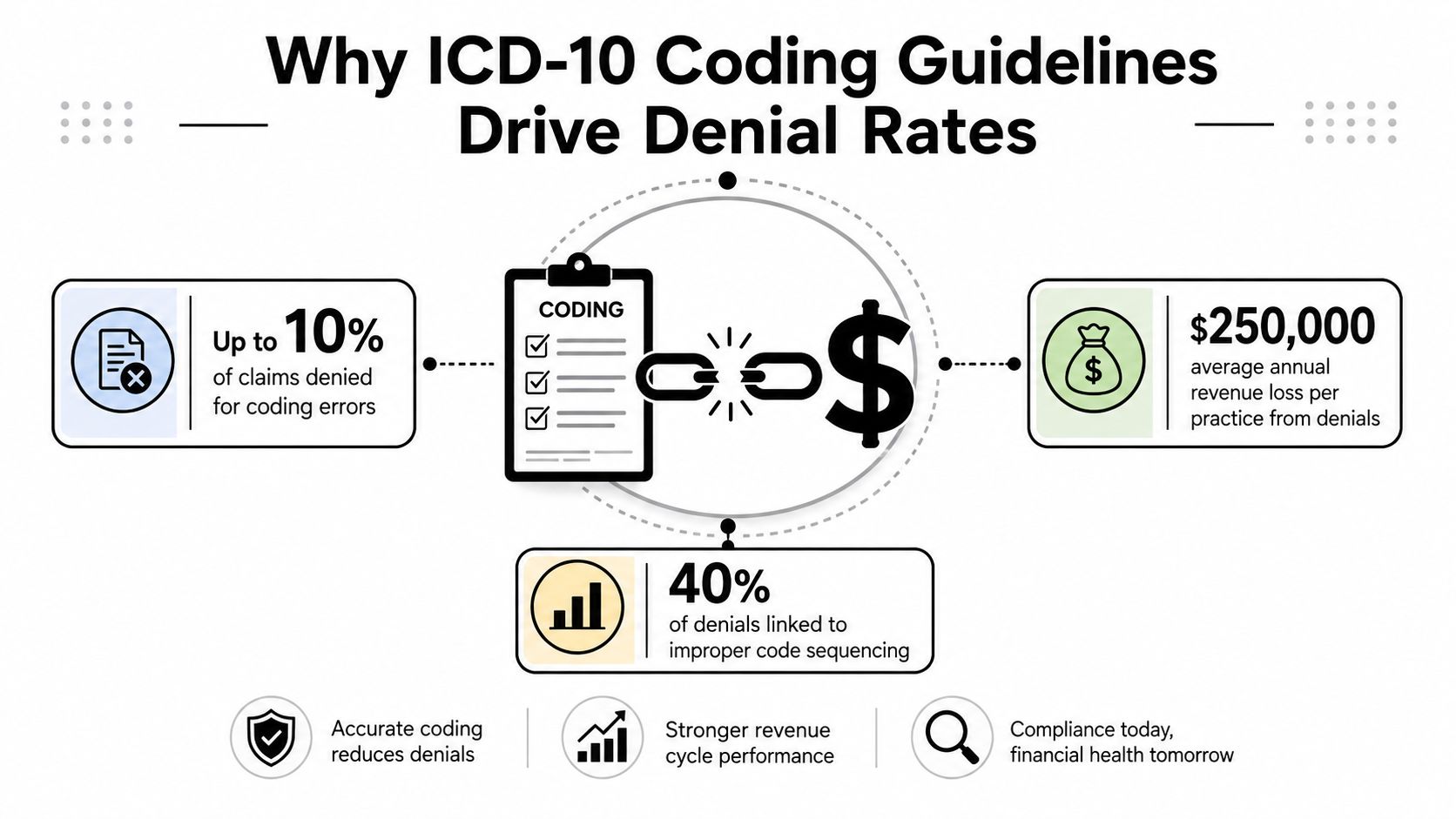
Denials start with workflow shortcuts
The biggest problem I see in specialty audits is not that coders don't know the rules. It's that teams skip the rules under pressure, then try to clean things up after a denial lands. CMS and NCHS state that coders should begin in the Alphabetic Index and verify in the Tabular List, because the guideline set adds sequencing and instructional detail beyond the code list itself (CDC/CMS coding guidelines).
That workflow matters because claims are judged on specificity, sequencing, and whether the documentation supports the diagnosis submitted. In practice, that means a coder who is rushing through an orthopedic, gastroenterology, or anesthesia encounter isn't just risking a typo, they're risking the entire revenue cycle outcome for that claim.
Practical rule: if a claim keeps getting denied for the same family of codes, treat that as a workflow defect, not a one-off coding mistake.
The revenue impact is broader than a single resubmission. Denials feed audit risk, create internal friction between coding and billing, and weaken the factual record if the practice later has to defend an underpayment through payer appeals or Independent Dispute Resolution. That's why strong guideline literacy isn't administrative overhead, it's a cash-flow defense layer. For organizations building formal compliance programs, RevGuard's coding compliance framework fits this exact use case because it ties correct ICD-10-CM usage to documentation, audits, and medical necessity review.
The Alphabetic Index and Tabular List Workflow
One of the fastest ways to turn a clean diagnosis into a denial is to stop at the first code you find. The working process stays simple: start with the documented diagnosis or reason for the visit, look it up in the Alphabetic Index, and verify the result in the Tabular List before the claim leaves your queue. The Tabular List is where the notes, exclusions, laterality rules, and chapter-specific instructions live, and those details often control whether the code supports the billed service (CDC/CMS coding guidelines).
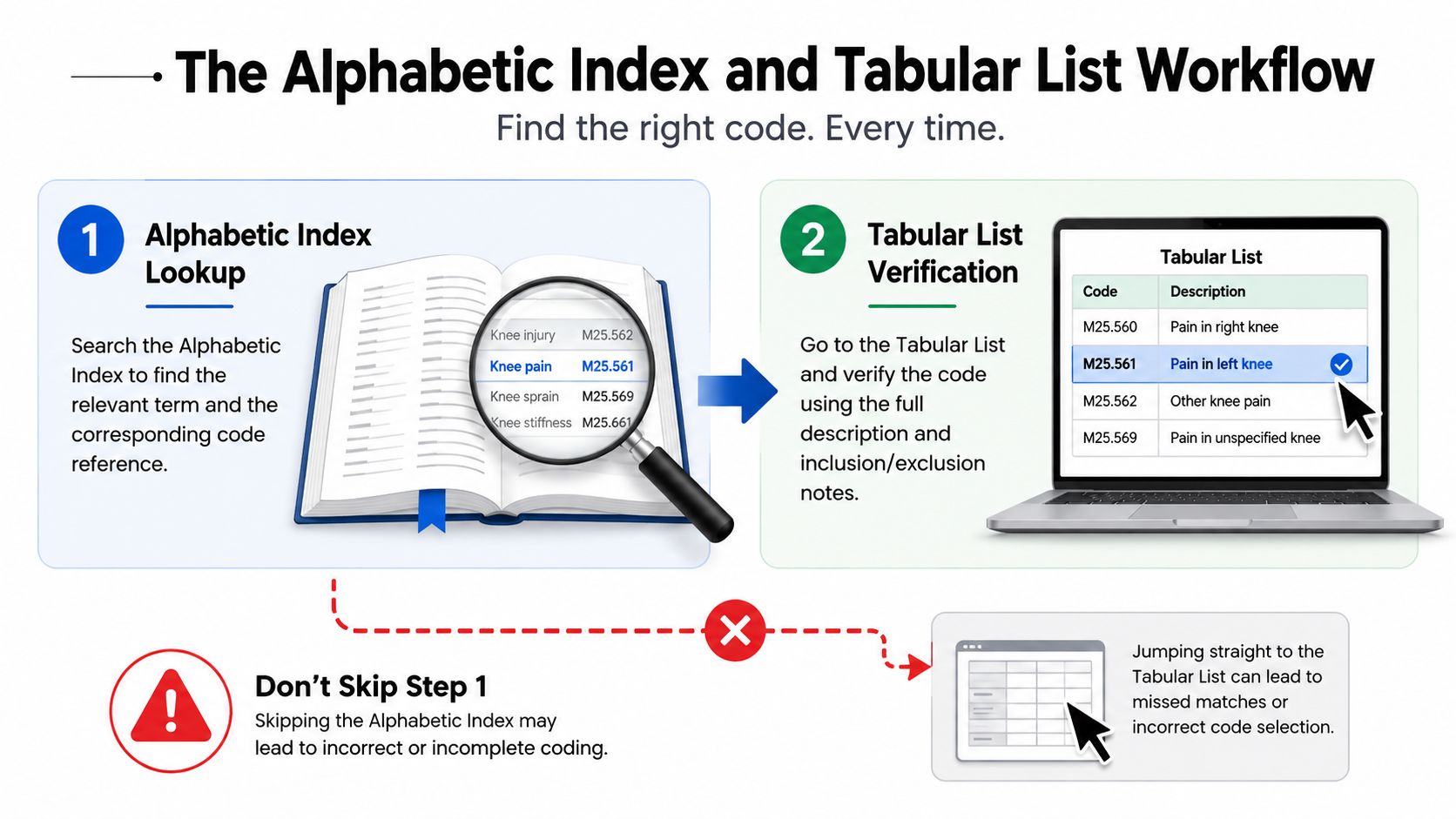
What the two-step check catches
A coder who jumps straight to a code search can miss an instruction that changes the claim. Laterality is the obvious example, but the bigger operational risk is missing a code first note, a use additional code instruction, or a chapter-specific sequencing rule that changes which diagnosis has to lead the claim. Those are not formatting details. They decide whether the payer sees a clean submission or an unsupported code set.
That problem shows up in specialty work every day. An orthopedic fracture tied to osteoporosis may look straightforward in the index, yet the Tabular List can require the underlying condition and the manifestation to be sequenced correctly, or it can point to a more specific combination than the first lookup suggests. In gastroenterology, the same issue comes up when the documented reason for care is broad but the chart supports a narrower diagnosis, such as the code selection questions that come up with GI bleeding. If the coder stops at the index, the claim may look close while still missing the instruction that matters.
A repeatable habit that prevents misses
The cleanest teams I've audited use a tight sequence:
- Read the note in the chart first. The diagnosis, history, and encounter reason have to drive the lookup.
- Find the candidate code in the Alphabetic Index. Use it as a starting point, not a final answer.
- Verify the Tabular List entry. Confirm notes, exclusions, laterality, and sequencing.
- Check whether another code must come first. Many denial-prone claims break down here.
- Submit only after the coded story matches the documented story.
That habit is repetitive on purpose, and that is why it holds up under production pressure. It cuts avoidable rework, protects specialty groups that need fast adjudication, and gives the practice a better record if a denial later turns into an appeal or dispute.
Sequencing Rules and Etiology Manifestation Conventions
ICD-10 doesn't just name diagnoses, it encodes relationships. The WHO manual uses the dagger/asterisk model, where the underlying disease is marked with a dagger and the manifestation is marked with an asterisk, and the underlying condition has to lead the coding chain rather than the manifestation standing alone (WHO ICD-10 manual). That principle is why sequencing errors so often show up as denials, downcodes, or medical necessity edits.
Cause first, effect second
In claim language, the etiology is the cause and the manifestation is the effect. If the effect is submitted without the cause, the claim is incomplete. If the wrong diagnosis is placed first, the payer may treat the service as unsupported or insufficiently specific.
That shows up in specialty practice more than is often admitted. In orthopedics, a fracture related to an underlying condition has to be coded with the relationship made explicit. In anesthesia, a documented comorbidity can affect how the record is sequenced and how the medical necessity story is read by the payer. In gastroenterology, the same principle applies when the patient's chronic condition changes why the procedure was medically reasonable in the first place.
The sequence has to tell the causal story cleanly. If the chart doesn't let a reviewer trace the cause to the effect, expect friction.
The practical fix is documentation, not heroics at the coding desk. Physicians need to state the underlying disease, the associated manifestation, and any relationship between them in plain clinical language. Coders then translate that chain into the claim using the primary diagnosis first and any required secondary codes in the proper order.
What not to do
Avoid treating manifestation codes as stand-alone shortcuts. That mistake looks minor in the EMR, but it creates a denial pattern that can follow a practice across specialties. It also weakens appeal files, because the claim history itself suggests the team didn't document or sequence the clinical story correctly.
RevGuard's GI bleed coding resource is a good example of why this matters in procedure-driven specialties, where the code order has to match the clinical picture and the reimbursement rationale. The lesson is the same across service lines, sequence the cause, then the effect, then verify that the chart supports both.
Common Coding Pitfalls That Trigger Claim Denials
The denials I see most often usually start with documentation that was technically usable, but not usable enough. The coder can only code what the note supports, so the fix often sits with the physician template, the operative note, or the charge capture workflow.
Unspecified laterality in orthopedics
A patient comes in for a shoulder or knee issue, the note names the joint, but it never states left, right, or bilateral. The coder picks the closest code available, the payer sees a less specific claim than the documentation should support, and the claim gets kicked back or downcoded. The fix is simple but not optional, physicians need to document laterality every time the anatomy is side-specific.
Missing combination coding in chronic disease care
A chronic disease visit may mention multiple related conditions, but the claim only carries one piece of the picture. That happens when the coder treats each diagnosis as separate instead of checking whether ICD-10-CM offers a more specific combination code. The denial isn't always dramatic, sometimes the payer just pays less because the submitted code didn't capture the documented complexity.
Post-procedural complication written too loosely
This one is costly because it looks credible on the chart but weak on the claim. A post-op note that says “pain,” “infection concern,” or “complication” without enough specificity can leave the coder guessing between a complication code, a symptom code, or a follow-up code. The payer then sees a diagnosis that doesn't tightly support the billed service, and the denial is often framed as insufficient specificity.
The documentation fix is the same across all three scenarios, though the wording changes by specialty:
- Name the side, site, and encounter type. Don't leave coders to infer laterality or episode of care.
- State the causal link. If one diagnosis depends on another, write it that way.
- Document the complication plainly. If a post-procedure issue exists, define it instead of using a generic label.
- Support the code with the operative or assessment note. The charge screen can't rescue a vague chart.
These are the errors that turn into internal rework, payer abrasion, and appeal fatigue. They're also the easiest to prevent once physicians see the exact language coders need.
Social Determinants of Health Z-Codes and Revenue Impact
Coding that stops at the disease label misses part of the revenue story. ICD-10-CM also includes Z55–Z65 for social determinants of health, including housing, food, transportation, and literacy factors. A review of this area notes that the SDOH section is underused and that these codes represent less than 1% of the nearly 70,000 ICD-10-CM codes, even though they capture real barriers that affect outcomes (SDOH review). When the chart leaves out the barrier, the claim and the care plan both look less complete than they are.
When the codes help and when they create risk
The rule is straightforward. Assign SDOH codes only when the documentation specifies an associated problem or risk factor. CMS has also continued to expand practical guidance with newer codes such as Z58.6, Z59.82, and Z55.6, which shows this area is still changing rather than fixed in place.
That creates a real revenue and compliance trade-off. Used correctly, these codes strengthen record completeness and can support more accurate care management. Used loosely, they invite audit scrutiny because they suggest a social barrier the note does not support.
What practices should standardize
The strongest groups do not leave SDOH coding to memory. They build prompts into intake, nursing triage, and provider assessment templates so the issue is documented once and coded consistently. Without that structure, the social barrier may come up in conversation but never make it into the structured note, and coders are left without support.
Practices also need a clear rule for who documents the supporting facts and when the code belongs in billing or reporting. If the team never trains around that boundary, coders either overcode and draw scrutiny or undercode and miss relevant context. Both outcomes affect reimbursement, reporting, and the quality of downstream analytics.
Managing Annual Code Set Updates Without Disruption
ICD-10-CM changes every year, which means the coding playbook has to stay alive. CMS published the FY 2025 ICD-10-CM Official Guidelines effective October 1, 2024, and a 2026 update summary reported 487 new codes, 28 deletions, and 38 revised titles in that cycle (FY 2025 CMS guidelines). That level of churn is enough to break a practice that treats coding education as a one-time event.
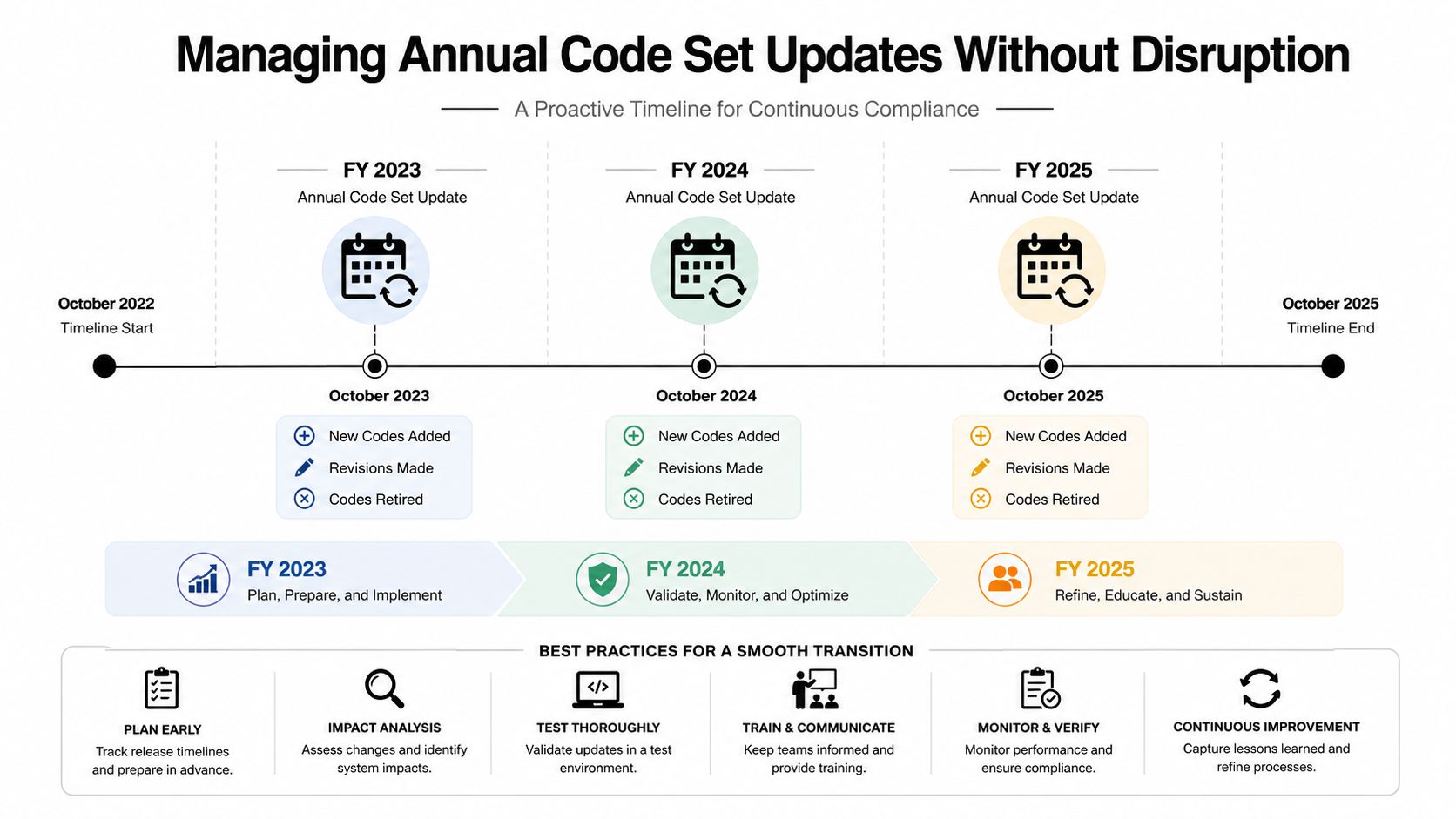
The cadence that keeps teams current
Annual updates work best when they're managed like a maintenance process, not a training day. A practical cadence looks like this:
- Track CMS releases as soon as they post. Don't wait for a vendor summary to tell you what changed.
- Review the codes that map to your highest-volume specialties first. Orthopedics, anesthesia, gastroenterology, dermatology, and cardiology usually feel small changes fastest.
- Update payer-facing templates before the effective date. If the claim form, superbill, or EMR favorite lists lag behind, coders will reuse old habits.
- Brief physicians on wording changes that affect specificity. A short note can prevent weeks of claim friction.
The reason this matters is simple. If the code set changes but your documentation habits don't, denials creep in through old defaults. Those denials often look random on the surface, but they're usually traceable to a stale template, an outdated code favorite, or a missing note in the Tabular List.
Treat the guideline set like a live control
The most resilient practices assign ownership for updates instead of hoping everyone notices the change. That can sit with the lead coder, the compliance officer, or the RCM manager, but it has to live somewhere. A living code set needs a living review process.
Building an Audit Checklist and IDR Readiness Framework
Coding audits shouldn't be punitive. They should answer one question, did the claim leave the office with enough specificity, proper sequencing, and documentation support to survive payer scrutiny? If the answer is no, the audit has to show exactly where the breakdown happened so the fix can be repeated, not just apologized for.
For a structured review, RevGuard's medical record audits are an example of how practices can pair chart review with denial analysis and capture the failure point before it becomes a pattern.
A checklist that catches the expensive misses
Use a short, hard checklist on every high-risk specialty claim:
- Sequencing: Does the first-listed diagnosis reflect the documented primary condition?
- Specificity: Does the code match laterality, encounter type, and severity when the note supports it?
- Combination logic: Did the coder check whether one code captures the full clinical picture better than several partial ones?
- Manifestation rules: If the chart shows a cause and effect relationship, are both coded in the right order?
- SDOH support: If a Z-code appears, is the associated documentation in the chart?
That checklist works because it turns abstract guideline knowledge into repeatable evidence. It also gives billing teams a cleaner story when a payer downcodes or denies a claim. The appeal file can point to the note, the code rationale, and the audit trail without reconstructing the logic after the fact.
IDR readiness starts before the denial
For practices exposed to No Surprises Act disputes, clean coding matters long before arbitration. If the claim is documented cleanly, the dispute package is stronger because the record already shows why the service was supported and how the code was selected. If the claim is vague, the dispute team has to spend time defending gaps that should have been fixed upstream.
That's the revenue protection system. Good coding lowers avoidable denials, better audits expose weak points early, and a clean record gives your team a stronger position when the payer still won't pay correctly.
If your specialty group is tired of chasing the same coding denials every month, RevGuard can help tighten the link between documentation, ICD-10-CM accuracy, and dispute-ready claims. Visit RevGuard to see how its revenue protection workflow can support coding compliance, audits, and downstream IDR readiness.