

39 prior authorizations per physician per week, plus about 13 hours of staff time, is what the average practice is dealing with in 2024, and 31% of physicians say those requests are often or always denied. For many groups, the prior authorization process is the gate that decides whether a claim gets paid cleanly, gets denied, or turns into avoidable rework.
You're probably seeing the same pattern right now. A clinician orders a procedure, the team scrambles for payer rules, the patient waits, and the work that should have protected revenue turns into a stack of follow-up calls and status checks. That's not an admin nuisance. It's a front-end revenue-integrity failure.
What the Prior Authorization Process Really Means for Your Practice
A specialty practice rarely feels the prior authorization process as a neat, isolated task. It shows up as a delay in the schedule, a pending order in the workqueue, a patient asking why treatment hasn't started, and a billing team wondering whether the eventual claim will even match what the payer approved.
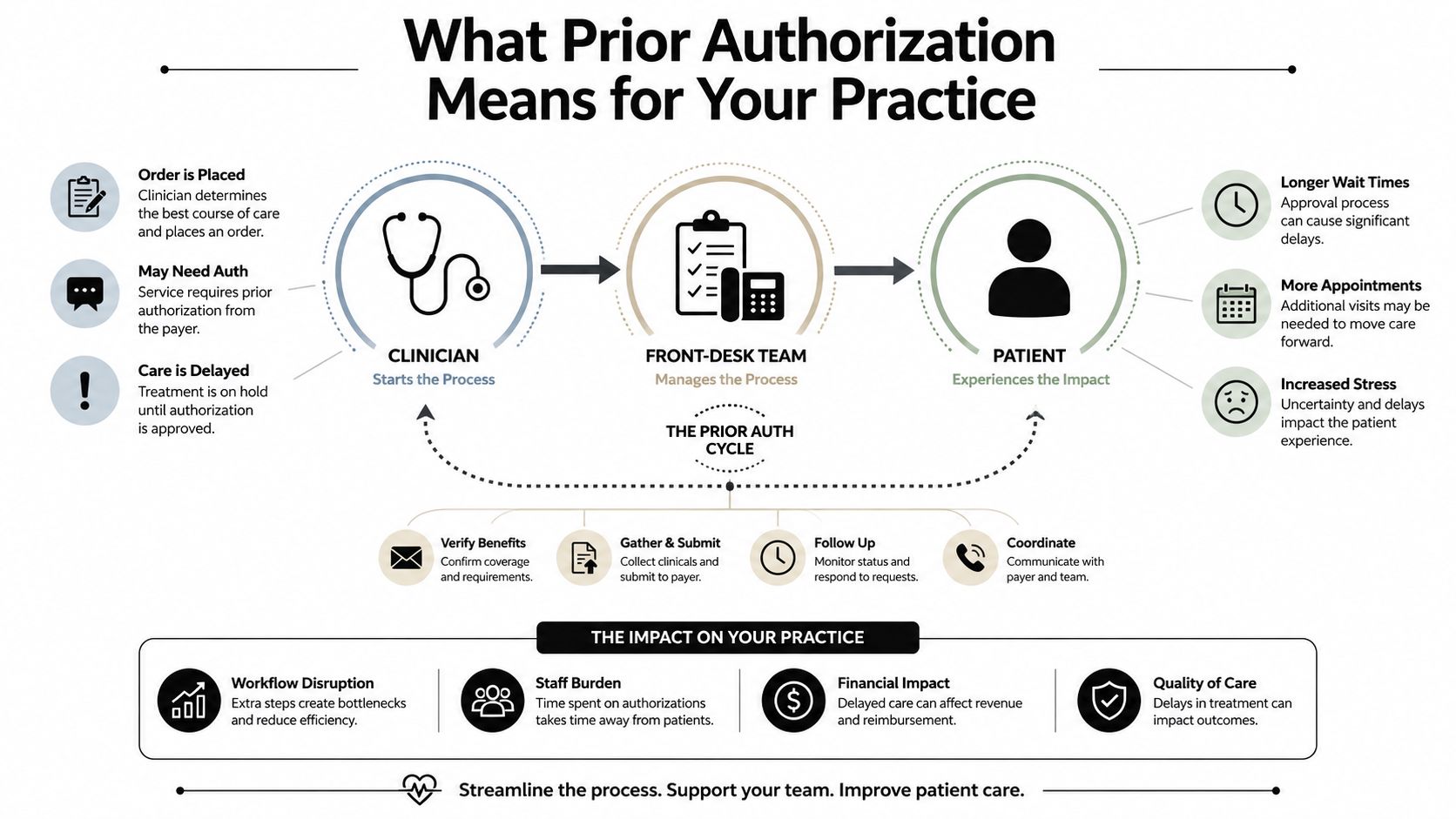
At its simplest, prior authorization is the pre-service utilization gate. The payer reviews the planned service before care is rendered and decides whether it's covered, medically necessary, and payable under the approved terms. Under CMS workflow rules, that decision is tied to documentation and code logic, which means the approval isn't just about clinical intent, it's about whether the submitted data and the bill will line up later for payment integrity. See the CMS guidance on how prior authorization functions as an upstream coverage and claim-integrity checkpoint in Medicare and other payer workflows, and how mismatch creates downstream denial risk CMS prior authorization guidance.
That's why I don't treat PA as “paperwork.” I treat it as a control point. If the authorization doesn't match the service, the patient's diagnosis, the units, the date range, and the payer's policy, the claim is exposed before it ever hits adjudication.
Practical rule: if the authorization file can't be matched to the billed service in seconds, your team is carrying hidden denial risk.
This is also why eligibility verification and prior auth belong in the same front-end motion. RevGuard's medical eligibility verification workflow reflects the same operational logic, coverage checks and authorization checks need to happen together, not in separate silos after the order is already moving.
If you run an ASC, imaging center, or specialty group, the right question isn't whether PA is annoying. The right question is whether your process protects cash before the claim is created. If it doesn't, you're leaving reimbursement to chance.
Mapping the End to End Workflow Step by Step
The cleanest prior authorization process starts at order capture, not after the patient is already scheduled. The clinician orders the service, and the front-end team immediately checks whether the plan requires approval, whether the benefit applies, and whether the requested service falls within the payer's rules. That first handoff breaks most often when the order is incomplete or the benefit data isn't verified against the current plan.
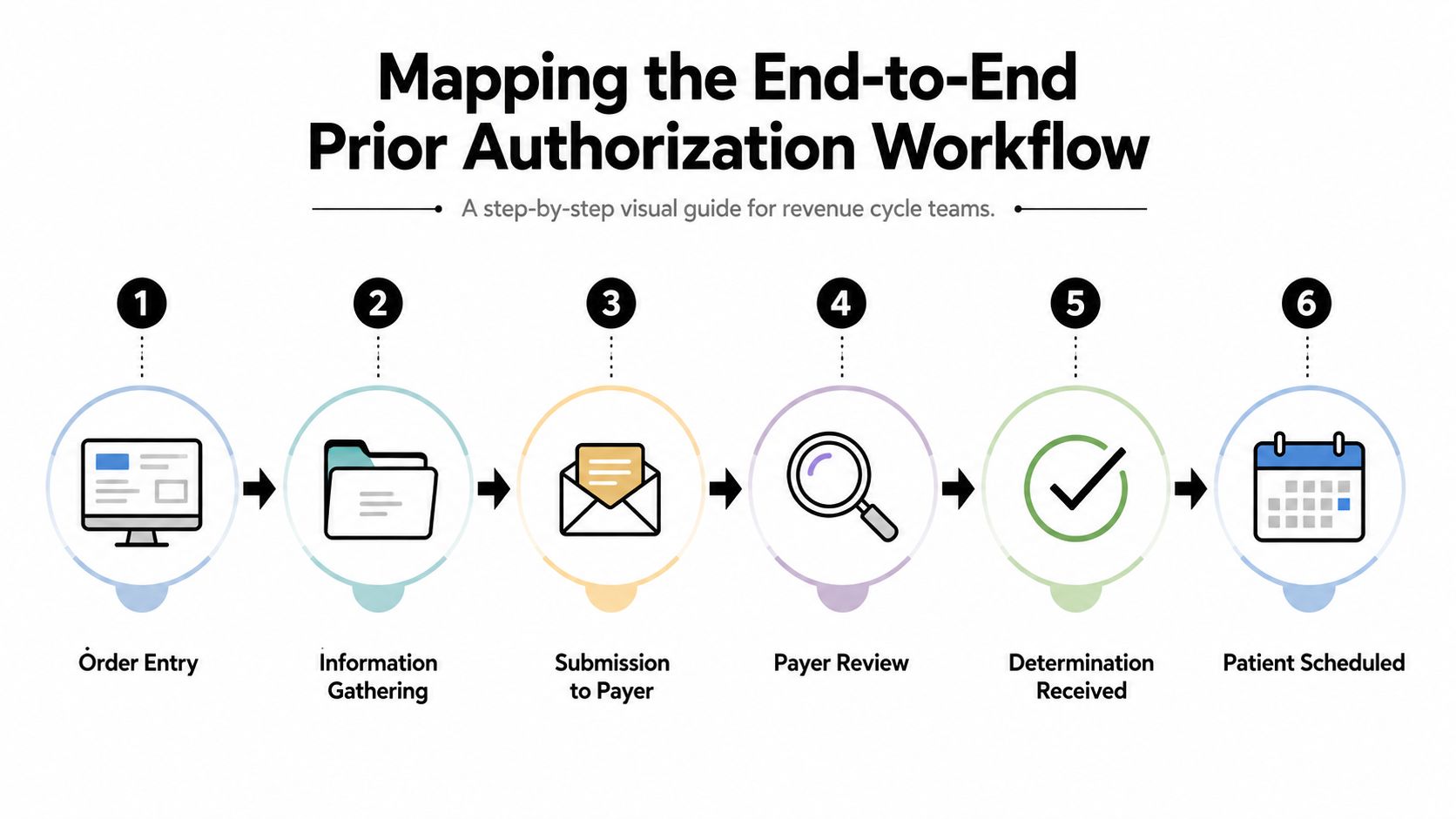
Order intake and rule lookup
The team has to know which payer owns the rule set. That sounds basic, but it's where a lot of work falls apart because plan-specific requirements aren't stored in one clean place. The wrong assumption at intake turns into a missing attachment, a wrong code family, or a submission that never had a chance.
Documentation assembly and submission
Next comes the packet. Clinical notes, diagnosis logic, procedure codes, units, date ranges, and any supporting records need to travel together. If the office submits through portal, fax, phone, or electronic prior auth, the requirement is the same, the payer needs a complete, readable decision packet. When the submission is weak, the request pends, clarifications multiply, and the clock starts working against your schedule.
Review, determination, and claim matching
Payers adjudicate the request and send approval, denial, or a request for more information. Once the determination comes back, your team should capture the reference number immediately and match it to the downstream claim exactly. That is the step many practices skip, and it's the one that creates a mess later when the claim is ready but the authorization details no longer align.
The workflow matters because authorization and claim adjudication are linked. RevGuard's claim adjudication process reflects the downstream reality, if the approval data and the billed claim don't match, payment risk moves straight into denials or post-service rework.
Keep the authorization file as if it's part of the claim file, because functionally, it is.
For standard requests, turnaround can take days. Urgent requests can come back within 72 business hours or less depending on the payer and completeness of the submission, so the first packet has to be right the first time. That's where teams win or lose time.
The Real Burden on Practices and the Numbers Behind It
The prior authorization process isn't just consuming staff energy, it's consuming capacity that should be tied to patient flow and cash conversion. The AMA data is blunt, in 2024 the average medical practice completed 39 prior authorizations per physician per week, and physicians plus staff spent about 13 hours weekly on the process. That's not a side task. That's a major operational load AMA workload reporting.
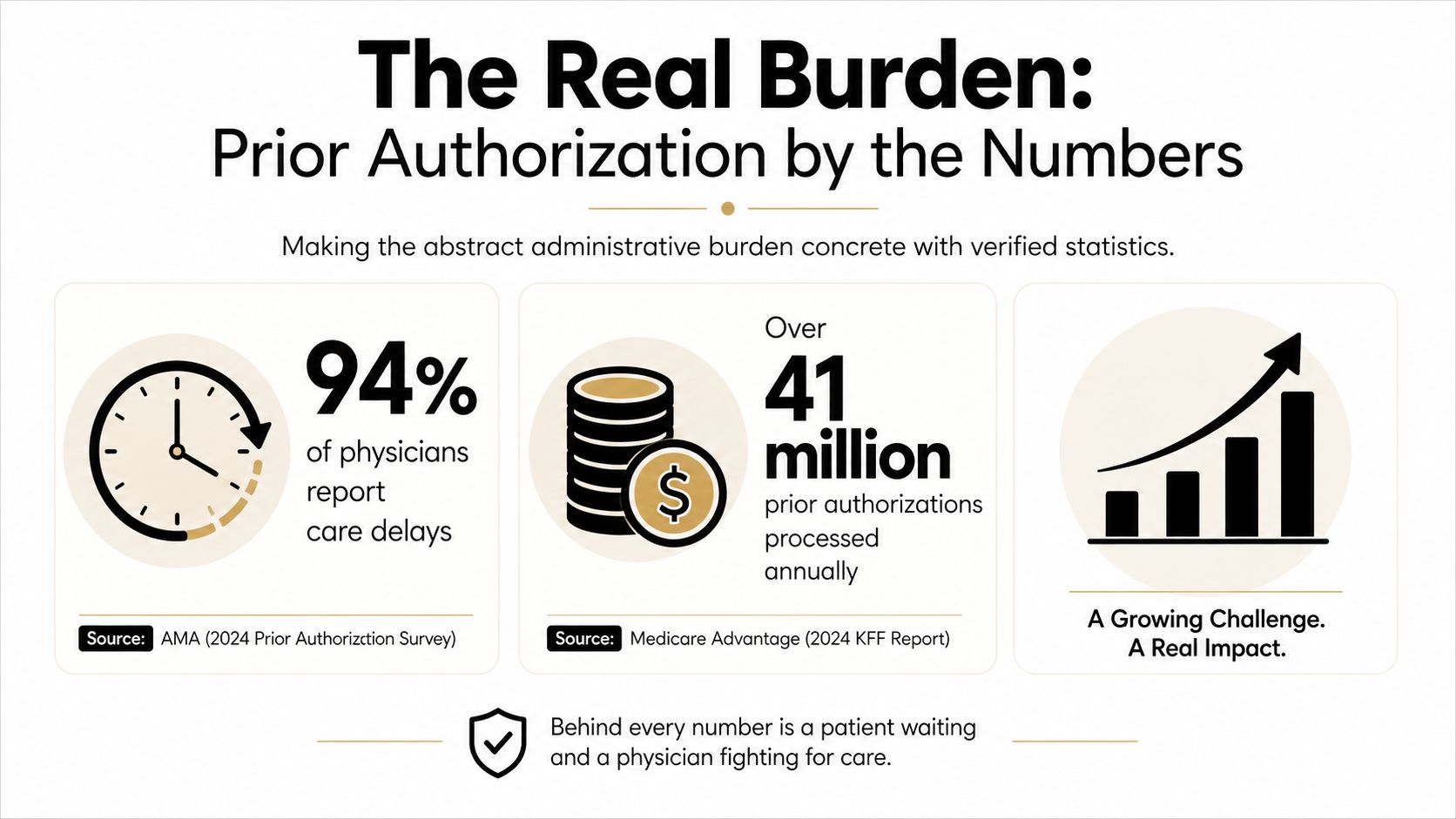
Labor cost isn't the only cost
Those hours don't disappear. They come out of scheduling, charge capture, coding support, collections follow-up, and patient communication. In a specialty practice, that means slower throughput and more fragile handoffs, especially when the same staff member is juggling benefit checks, scans of clinical notes, and payer calls. The problem is not just lost time, it's lost focus.
Payer outcomes aren't uniform
Medicare Advantage shows how big the volume is and how uneven the outcomes can be. In 2024, insurers received nearly 53 million prior authorization requests, up from 49.8 million in 2023, which equals 1.7 requests per enrollee on average. Of those 2024 requests, 4.1 million were fully or partially denied, a 7.7% denial rate, while appealed denials were partially or fully overturned 80.7% of the time KFF Medicare Advantage data.
Traditional Medicare tells a different story. KFF reported fewer than 150,000 denied requests in 2024, but that represented a 22.9% denial share. That gap matters because it shows how much outcomes vary by payer segment, and why a one-size-fits-all workflow fails.
For ASCs and multi-site specialty groups, the business case is simple. Every bad authorization creates a labor problem first, then a scheduling problem, then a cash problem. If the front end is weak, the denial shows up later as avoidable rework.
Documentation and Submission Checklist That Works
The teams that get authorizations approved consistently do not rely on memory. They use a strict packet standard and run every request through the same checklist before submission. That matters because prior authorization is an upstream revenue-integrity control point. If the packet is sloppy, the denial risk moves straight into scheduling, claims, and appeals.
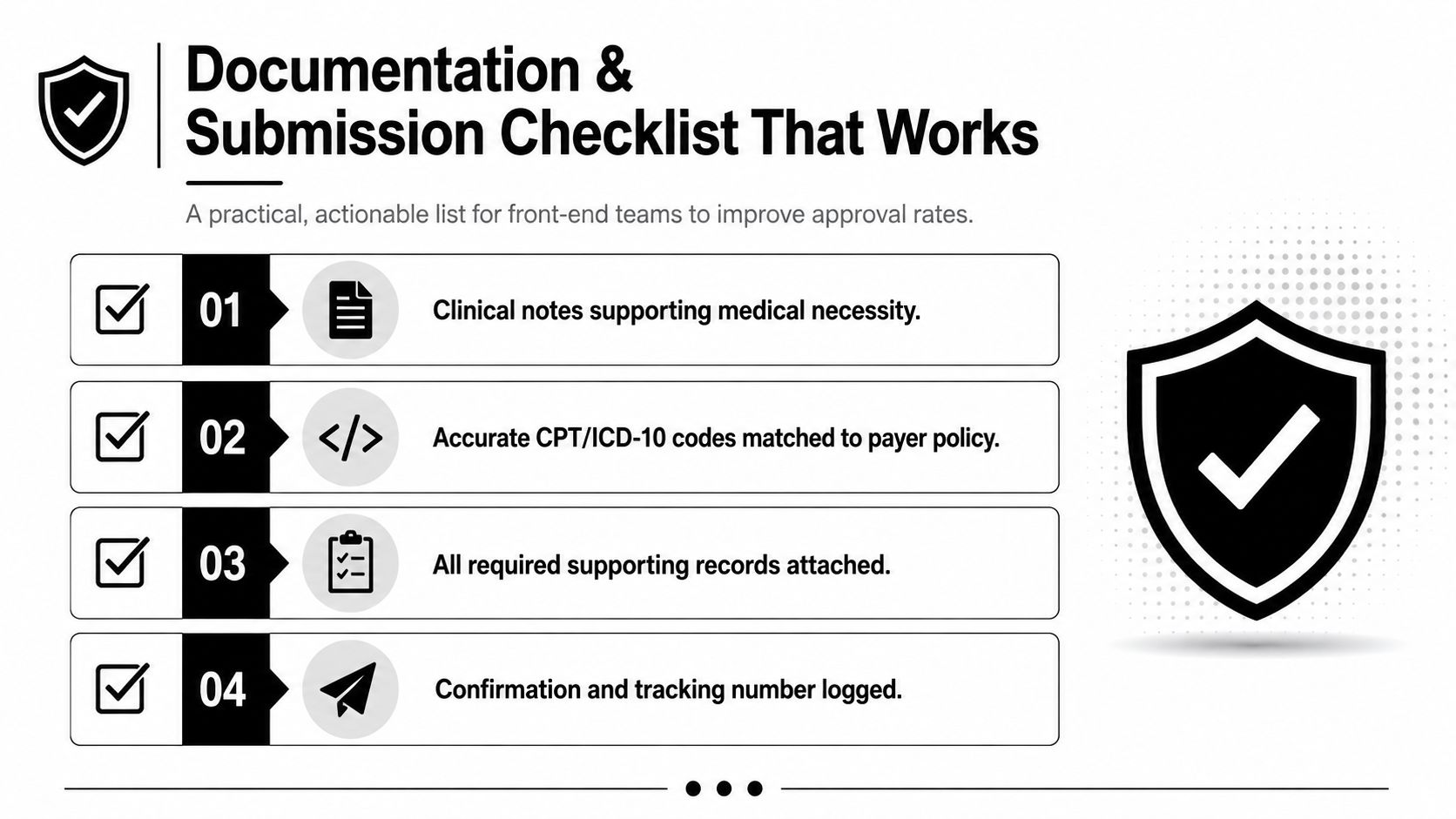
The packet has to prove medical necessity and code fit
The clinical note has to support why the service is needed. The CPT or HCPCS code has to match the requested service, and the ICD-10 diagnosis has to make the medical necessity obvious to a payer reviewer. If those pieces do not line up, the request may still get processed, but it will not get processed in a way that protects payment.
- Clinical notes first: make sure the chart supports the service being requested, not just the diagnosis.
- Code alignment next: verify CPT or HCPCS codes against payer policy before you submit.
- Attachments last, but not optional: include the records the payer is most likely to ask for anyway.
Plan applicability and timing control the outcome
Benefit verification is not just about whether the patient is covered. It is about whether the plan applies to the service, whether the authorization window is open, and whether units or date ranges are likely to create a mismatch later. If the approval window expires before the procedure date, the authorization is functionally useless.
Peer-to-peer preparation matters too. If you know a reviewer may push back, send the strongest clinical summary up front and have the physician ready with the facts that matter most. That is not overkill. It protects the schedule and cuts down on downstream denial work.
The last step is the one teams miss under pressure, capture the authorization reference number and tie it to the claim record immediately. If that number is not stored where billing can see it, the approval may exist and still fail to protect payment. That is why RevGuard's revenue-cycle model matters for operations that care about clean handoffs, because approval data only helps if it can be used downstream.
Why Authorizations Fail Even When Care Is Clinically Appropriate
Clinically appropriate care still gets denied because payer review is not built around your intent, it's built around their rules. The biggest failure mode is fragmented policy. Different plans want different forms, different documentation depth, different code logic, and different timing, and that fragmentation creates predictable errors even in experienced offices.
The other common cause is weak administrative data. Missing identifiers, wrong member details, incomplete attachments, and mismatched service codes can sink a request before anyone even evaluates the clinical rationale. That's why the best teams stop treating PA as a form-filling exercise and start treating it as a data-quality function.
The system fails more often than the clinician
Neutral policy and industry sources point to the same structural issues, fragmented payer rules, nonstandard requirements, incomplete documentation, and limited technical automation operational causes of prior auth failure. Those are workflow problems, not personal failures. If your process depends on one experienced employee remembering every plan's quirks, the process is brittle by design.
There's also a timing problem. Even when the request is eventually approved, delays at the front end push the rest of the revenue cycle back. The clinic gets squeezed, the patient waits, and your team is forced into a cycle of clarification calls and rework that should have been prevented upstream.
Denials are often a symptom of bad handoffs, not bad medicine.
That matters because the fix isn't to yell at staff to “be more careful.” The fix is to standardize the intake, encode payer rules, and make submission completeness the default. If you don't do that, the same errors will keep coming back in different forms.
Automation, Interoperability, and RCM Best Practices
Manual prior authorization survives because the data is still locked inside disconnected systems. The fix is structured exchange, not more phone calls. HL7 Da Vinci PAS standardizes electronic prior-auth exchange, and that matters because a payer cannot make a fast decision from unstructured notes buried in a fax queue HL7 Da Vinci PAS implementation guide.
Build the workflow around machine-readable data
A modern prior authorization process should pull the right fields from the EHR, the coverage system, and the scheduling workqueue before the request ever goes out. That means patient coverage, requesting provider identifiers, diagnosis codes, service codes, and supporting attachments. If the systems cannot exchange those fields cleanly, staff end up rebuilding the record by hand.
Structured submission packets cut down on pends and clarification loops. They also make it easier to match payer-specific rules to the exact CPT or HCPCS code, unit count, and date range that the claim will later use. That is where the operational value sits, less rework before submission and fewer mismatches after the service is rendered.
Put escalation and status control on rails
A strong operation does three things every time. It tracks the status of every request, escalates peer-to-peer reviews quickly, and logs the authorization number where billing can use it. If you cannot answer what is pending, what is approved, and what is at risk in real time, the workflow is too loose.
- Use payer-specific rulesets: do not submit from memory.
- Automate status checks: manual phone calls should not be your tracking system.
- Bind auth to claim creation: the approval has to follow the service into billing.
CMS and industry stakeholders are pushing electronic prior authorization further into the health tech stack, and the operational logic is sound. The closer the process gets to structured data exchange, the fewer chances there are for human error. If you need a practical benchmark, compare your workflow against the standards in the electronic prior authorization and revenue-cycle metrics documentation and close the gaps that show up at intake, not after denial.
The Patient Impact Most Providers Underestimate
Prior authorization delay doesn't stay inside the practice. It changes what patients do next, especially when the therapy is time-sensitive or expensive to pursue. Some patients wait, some give up, and some delay care long enough that the eventual clinical and financial cost is higher than if the request had been handled cleanly the first time.
The equity angle matters more than most leaders admit. Independent and professional sources note concern that prior authorization can worsen disparities for poor and minority patients, including people of color, LGBTQ+ patients, rural patients, and other medically underserved groups health equity concerns around prior authorization.
Uneven access becomes a reputation issue
The cited study in that source found prior authorization requirements for HIV PrEP were most common in the U.S. South, and in one sample 37% of Asian patients faced prior authorization versus 20.1% of Black patients, 17.9% of Hispanic patients, and 23.1% of white patients. Those numbers are a reminder that PA isn't only an operational issue, it can also shape who gets access, when they get access, and how reliable your systems look to the people depending on them.
If you run a specialty practice, that has direct reputational consequences. Patients don't care that the payer wrote the rule. They care that your office delayed their treatment or gave them three different answers.
The practical response is to design the workflow so underserved patients aren't the ones who absorb the most friction. That means tighter intake, faster escalation, clearer communication, and fewer unclear handoffs when the case is clinically urgent. Good operations aren't just more efficient, they're more equitable.
KPIs to Track and How Denials Connect to Downstream Recovery
If you don't measure the prior authorization process, you're guessing. The scorecard should be simple enough to review weekly and strict enough to expose where the workflow is leaking.
The KPIs that actually matter
| KPI | What It Measures | Target Band | Primary Lever |
|---|---|---|---|
| Clean submission rate | Requests sent without payer follow-up | High and stable | Intake checklist and documentation quality |
| First-pass determination rate | Requests approved without clarification | High and stable | Rule mapping and packet completeness |
| Turnaround time by request type | Speed from submission to decision | Short and predictable | Routing, escalation, and automation |
| Denial rate by payer | Where approvals break down | Low and trending down | Payer-specific policy control |
| Overturn rate on appeal | How often denials are reversed | High when appeals are needed | Evidence quality and denial analysis |
| Net days to cash | Speed from service to payment | Downward over time | Upstream clean auth and claim match |
Weekly review beats monthly surprise
Hold a short review every week with operations, billing, and authorization staff in the same room. Look at the denials by payer, the submissions that pended, the cases that needed peer-to-peer, and the approvals that didn't match the claim. If the same failure shows up twice, it's a process problem, not an exception.
The downstream link matters too. When payers delay, downcode, or underpay after authorization, those claims can move into Independent Dispute Resolution under the No Surprises Act. RevGuard's model is built around that reality, combining RCM and enforcement-driven IDR so underpayments can be packaged with dispute-ready evidence instead of being written off as unavoidable leakage. That linkage is the point, clean PA work strengthens the case later if a payer still pays incorrectly.
The revenue lesson is straightforward. A clean authorization doesn't just protect the front end, it improves the odds that the claim, appeal, or dispute file will survive later scrutiny.
If you want a team that treats prior authorization as a revenue-integrity control point, not a paperwork chore, talk to RevGuard. They work on the full revenue lifecycle, from eligibility and authorization through final payment, and they build the documentation discipline that helps specialty groups reduce denials and protect cash flow.