

Out-of-network means the doctor, hospital, or other provider doesn't have a contract with the patient's insurance plan, so there's no pre-negotiated rate in place. In practical terms, that changes both pricing and patient liability, and it's why a bill that looked manageable at the time of service can turn into a much bigger problem later.
A specialty practice leader usually sees this issue from the other side of the desk. The patient is shocked, the payer says the claim wasn't handled the way the plan required, and the practice is left deciding whether the revenue is collectible, appealable, or headed for dispute.
The Emergency Room Scenario That Changes Everything
A patient rolls into the nearest ER with chest pain, gets stabilized, imaging is ordered, and the episode feels straightforward from the clinical side. Then the bill arrives weeks later, and the patient realizes the hospital or one of the treating professionals wasn't in the plan's network. What looked like a covered emergency suddenly becomes a lesson in how out-of-network billing works when the patient had no time to shop for care.
That surprise isn't just a patient experience issue. It reflects a billing relationship in which the provider has no contract with the insurer, so the insurer never agreed in advance to a negotiated price. In-network providers accept discounted, pre-set rates, but out-of-network providers can charge the full amount and the patient may face higher out-of-pocket costs or even no coverage, depending on the plan. That distinction is foundational because it affects pricing power, claim behavior, and the possibility of balance billing, where the patient can be billed for the difference between the provider's charge and the insurer's payment.
The practical meaning for providers
For a specialty group, the issue is that out-of-network status changes the point of negotiation in the entire revenue cycle. A claim that would have moved cleanly through a contract rate now sits in a gray zone where reimbursement depends on the plan design, the documentation, and whether the episode is protected under federal billing rules.
Practical rule: if the patient had no realistic choice of provider, treat the episode as a compliance-sensitive billing event, not a routine self-pay balance.
That's why the phrase what does out of network mean matters less as a dictionary definition than as a revenue question. It tells you whether the claim is governed by a network agreement, whether the patient can be balance billed, and whether your team needs to route the account through a different collection and dispute workflow. For background on how patients commonly try to resolve a surprise bill, see this medical bill dispute guide.
How Often Out-of-Network Billing Occurs
A specialty practice can do everything right on scheduling and still end up with an out-of-network claim. That is the day-to-day reality behind the billing data. In one large study of 27,883,040 privately insured people using 2008 to 2016 claims data, the share of total spending occurring out of network fell only modestly, from 7.0% in 2008 to 2010 to 6.1% in 2014 to 2016, an adjusted decline of 0.10 percentage points per year (PMC study on out-of-network spending).
That slow decline matters because it shows the problem did not disappear as coverage expanded or as more employers bought managed plans. Out-of-network billing stayed embedded across years and plan designs, which means specialty groups cannot treat it as a rare contracting anomaly. It is a recurring reimbursement pattern that shows up in ordinary claims flow.
Where surprise bills show up inside in-network care
The more operationally important finding is that out-of-network billing often appears inside episodes that look in network at the point of care. In an analysis of 347,356 surgical episodes, 20.5% of episodes had an out-of-network bill even when the primary surgeon and facility were in network (PMC study on out-of-network spending). That is the part many revenue cycle teams miss. The main facility can be contracted, yet an ancillary professional can still shift the claim into a separate out-of-network path.
In large employer health plans, almost 18% of inpatient admissions included at least one out-of-network claim, and 7.7% of outpatient service days did as well (PMC study on out-of-network spending). For anesthesia, radiology, pathology, assistant surgery, and similar specialties, that is more than a coverage footnote. It changes claim acceptance, payment timing, and the odds that denial or underpayment work will begin after the service is already complete.
Why specialty practices should care
For specialty leaders, the practical lesson is straightforward. Out-of-network exposure is not limited to patients who intentionally go elsewhere. It often develops inside otherwise in-network episodes, which means a practice can schedule correctly and still receive a claim that falls outside the cleanest reimbursement path.
That is why episode integrity matters more than provider status alone. If one member of the care team is out of network, the financial effect can spill into the entire encounter, and the practice may need to route the account through a different collections and appeal workflow. Patients often respond by challenging the bill, and a clear explanation of the dispute path matters, including a medical bill dispute guide.
What Patients Pay When Care Is Out of Network
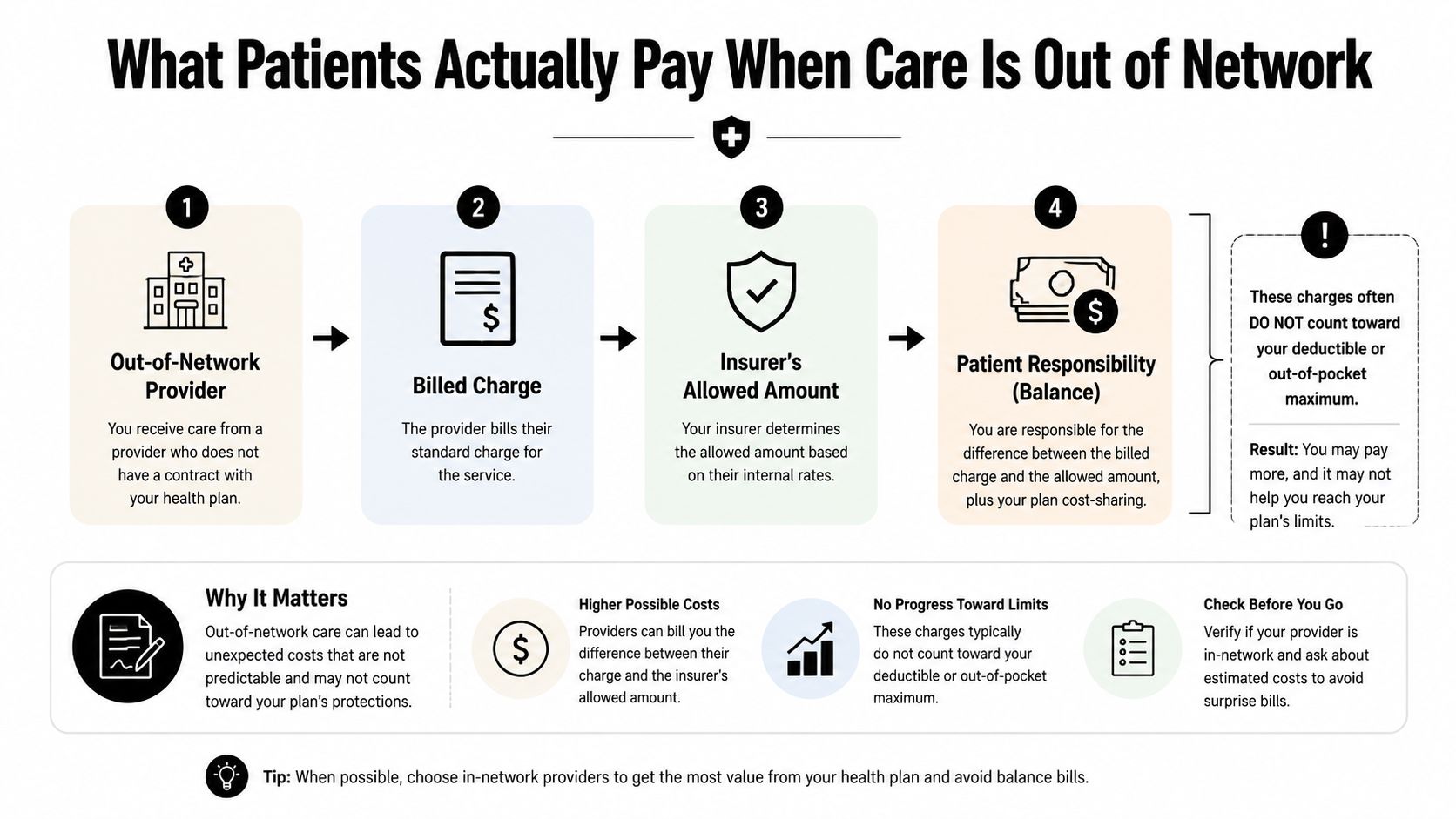
The first mistake most explainers make is stopping at “it costs more.” That is true, but it does not tell the patient what happens once the claim is processed. In consumer-facing explanations, out-of-network charges often do not count toward deductibles or out-of-pocket maximums, and the patient may need to pay upfront and seek reimbursement later, but those details are often left vague or skipped entirely (consumer explanation of out-of-network billing mechanics).
That lack of clarity matters because a patient can have out-of-network benefits and still face substantial residual liability. A plan may reimburse only part of the billed amount, and the patient is left with the gap. In PPO-style coverage, that can create a confusing mix of benefit availability and financial exposure, which is one reason patients resist out-of-network invoices even when the practice followed its side of the process. When the balance becomes disputed, patients often need a clear path to challenge the bill, including a medical bill dispute guide.
What the patient sees on the bill
The mechanics usually look like this.
- The provider bills the full charge: the practice sends the claim at its billed amount rather than a contracted rate.
- The plan applies its own allowed amount: reimbursement may be based on the insurer's internal pricing logic rather than the provider's charge.
- The patient gets the remainder: if the insurer pays less than the bill, the balance can land on the patient unless a protection applies.
- The patient may have to do the paperwork: some plans require the member to submit for reimbursement after paying upfront (consumer explanation of out-of-network billing mechanics).
For providers, the operational lesson is straightforward. When patients do not understand the billing sequence, collections friction rises quickly. Clear, plain-language financial counseling before service, when possible, reduces the “I never expected this” reaction that often turns into a long accounts receivable tail.
Patients usually do not object to paying for care they chose. They object to not understanding why the plan paid so little and why the balance is still theirs.
That is why the best front-end workflow is not a generic reminder to “check benefits.” It is a direct conversation about network status, reimbursement limits, and what the member may owe after the payer processes the claim.
Emergency Care Versus Scheduled Out-of-Network Services
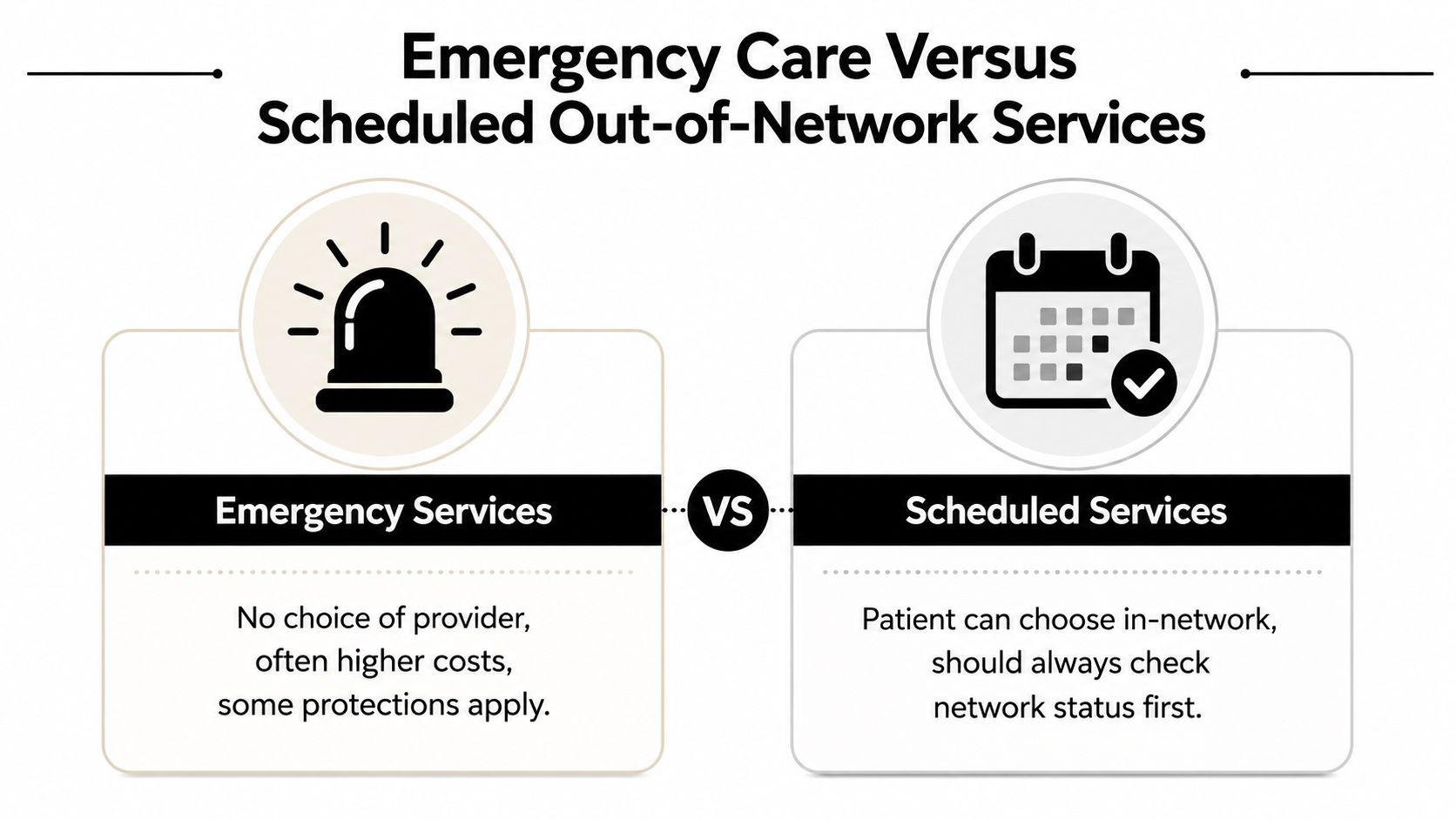
Emergency and scheduled encounters can both involve out-of-network billing, but they don't carry the same rights or billing options. In an emergency, the patient has no real provider choice, so the law treats the episode differently. In a scheduled case, the patient usually can choose the site, the specialist, and sometimes the timing, which means advance benefit checks and consent documents become part of the revenue strategy.
That difference shows up clearly in plan design. Consumer guidance notes that true emergency treatment is always covered as in network, even if the hospital or provider is out of network, while non-urgent care should be checked in advance to avoid surprise costs (consumer explanation of in-network versus out-of-network care). For providers, that means an emergency intubation at an in-network hospital and an elective orthopedic procedure at an out-of-network ASC are not operationally similar events, even if both touch out-of-network billing.
The documentation burden changes
In emergency anesthesia, the record should show that the patient couldn't choose the provider and that the service arose from an urgent clinical need. In elective surgery, the practice has a different burden. It needs clean scheduling, network verification, and often explicit patient acknowledgment of the financial terms before the case starts.
The No Surprises Act also changes what can be billed in some situations. It prohibits balance billing in emergencies and in certain situations where an out-of-network provider works at an in-network facility, and it protects the patient's cost share at the in-network level in those cases (managed care and NSA overview). That means the revenue conversation is no longer “can we bill whatever we want.” It's “what is the allowable path to collect legally and accurately?”
For specialty groups, that distinction affects every downstream choice. Emergency cases call for compliance review and claim classification. Scheduled cases call for eligibility verification, informed consent, and a tighter pre-service financial workflow.
Regulatory Protections Under the No Surprises Act
A clean out-of-network claim can still get paid, but the path changes the moment the case falls under the No Surprises Act. For patients, the law blocks balance billing in emergency settings and in certain out-of-network situations at in-network facilities. For specialty practices, that means the reimbursement fight shifts away from the patient and into the payer process. In those protected cases, the patient owes only the in-network cost-sharing amount, as outlined in the No Surprises Act overview.
That shift matters operationally. A practice still has a claim to pursue, but the argument now has to be supported through the Independent Dispute Resolution process when the payer and provider cannot agree on value.
How IDR changes the money flow
IDR gives specialty groups a formal route to challenge underpayment without sending the patient into the middle of the dispute. Each side submits an offer to a certified arbitrator, and the arbitrator selects one based on the qualifying payment amount and other factors allowed by the statute. That structure is very different from old balance billing, where the patient carried the dispute even when the service itself was protected.
The practical takeaway is straightforward. Strong documentation gives the claim a better chance of surviving payer pushback. Weak documentation leaves the practice with less support when the file reaches arbitration or post-service review.
Operational insight: under the No Surprises Act, the real question for providers is whether the documentation can substantiate the claim amount.
Protected claims still require careful handling because the law does not treat every out-of-network scenario the same way. Some claims fall under emergency protections, some involve ancillary providers at in-network facilities, and some depend on notice and consent rules. For a concise legal refresher, the No Surprises Act summary is a useful reference for teams building billing rules around real cases, not theory.
Common Revenue Leakage Points and How to Prevent Them
Most revenue leakage starts before the claim is submitted. The first failure point is incomplete eligibility work. A team may confirm active coverage but never verify the patient's out-of-network benefit level or prior authorization rules, which means the case is scheduled on assumptions instead of facts. The fix is simple in principle, harder in execution, and essential for specialty practices that see mixed network status across service lines.
Another failure point is credentialing. A provider may be clinically able to perform the service but still trigger technical denials because the payer file is incomplete or out of sync. Even without a contract, payer-facing data has to be accurate, current, and internally consistent. If the credentialing record is messy, the claim inherits that mess.
Build the front end to protect the back end
A clean claims workflow usually needs four discipline points.
- Verify benefits in detail. Confirm active coverage, network status, any out-of-network benefits, prior authorization requirements, and the patient's likely financial responsibility before service.
- Keep credentialing current. Make sure taxonomy, identifiers, addresses, and rendering relationships match the payer's records, even when the case itself is out of network.
- Code to the record. Match diagnosis, procedure, and modifier logic to the documentation, because sloppy coding invites downcoding or denial.
- Track dispute deadlines. If the claim is headed for IDR, the filing clock matters, and missed timing can make a valid underpayment unrecoverable.
These are not abstract best practices. They're the difference between a clean file that can survive payer scrutiny and an account that gets pushed into write-off or patient collections. Specialty groups often underestimate how much money leaks because the claim is technically payable but operationally fragile.
The discipline here is boring but effective. Verify early, document thoroughly, and treat the dispute path as part of the revenue cycle instead of an afterthought.
How RevGuard Integrates RCM and IDR for Revenue Protection
The strongest out-of-network strategy ties operations to enforcement. RevGuard's model does that by linking specialty-specific revenue cycle management with IDR under the No Surprises Act, so the same team logic that cleans the claim upstream also supports the dispute downstream. The operational sequence runs from eligibility verification and coding through payer negotiations, patient collections, and final payment, with dispute-ready files built in from the start. For a closer look at that workflow, see how RCM and IDR work together.
That structure matters because the payer problem is rarely isolated. A claim may be delayed, downcoded, or underpaid for reasons that are partly technical and partly strategic. If the team only reacts after denial, it's already late in the process.
What the integrated model changes
An integrated RCM and IDR workflow does three practical things. It reduces avoidable denials by tightening the front end. It creates a stronger evidence file when a claim needs enforcement. And it gives leadership visibility into payer behavior instead of forcing everyone to guess which plans are consistently underpaying.
The analytics layer is where that becomes operational. Transparent dashboards and payer-behavior intelligence simplify the management conversation, especially for group leaders who need to compare specialties, sites of care, and recurring underpayment patterns without drowning in claim-level noise.
For provider groups, ASCs, hospitals, and multi-state platforms, the point isn't to fight every claim forever. It's to stop revenue leakage at both ends, before it becomes a write-off problem or a patient collection problem. In specialties like anesthesia, orthopedics, cardiology, dermatology, gastroenterology, radiology, oncology, and air ambulance, that separation between routine billing and enforceable recovery can materially change how much of the encounter value gets collected.
If your team is dealing with out-of-network denials, surprise balance bills, or underpaid specialty claims, RevGuard can help you connect eligibility, billing, and IDR into one revenue protection workflow. Visit RevGuard to see how its RCM and enforcement model is built for the payer realities specialty practices face every day.