
You can have a clean claims workflow, a decent denial rate, and still watch reimbursement leak out in quiet ways. A payer downcodes a high-acuity case, the underpayment sits in limbo, the appeal packet is missing one document, and no one connects the dots until the same pattern shows up across dozens of claims. At that point, compliance risk isn't a policy problem, it's a revenue problem, a documentation problem, and a dispute problem all at once.
What Compliance Risk Means for Healthcare Revenue
A specialty group usually feels compliance failure in the claims file, not in a boardroom. An anesthesia claim comes back lower than expected. An IONM case gets challenged on medical necessity. An appeal stalls because the file cannot hold up under scrutiny. The payer's action looks like a reimbursement issue on the surface, but the exposure is broader, because weak documentation, inconsistent coding, and thin case files make later payment defense harder.
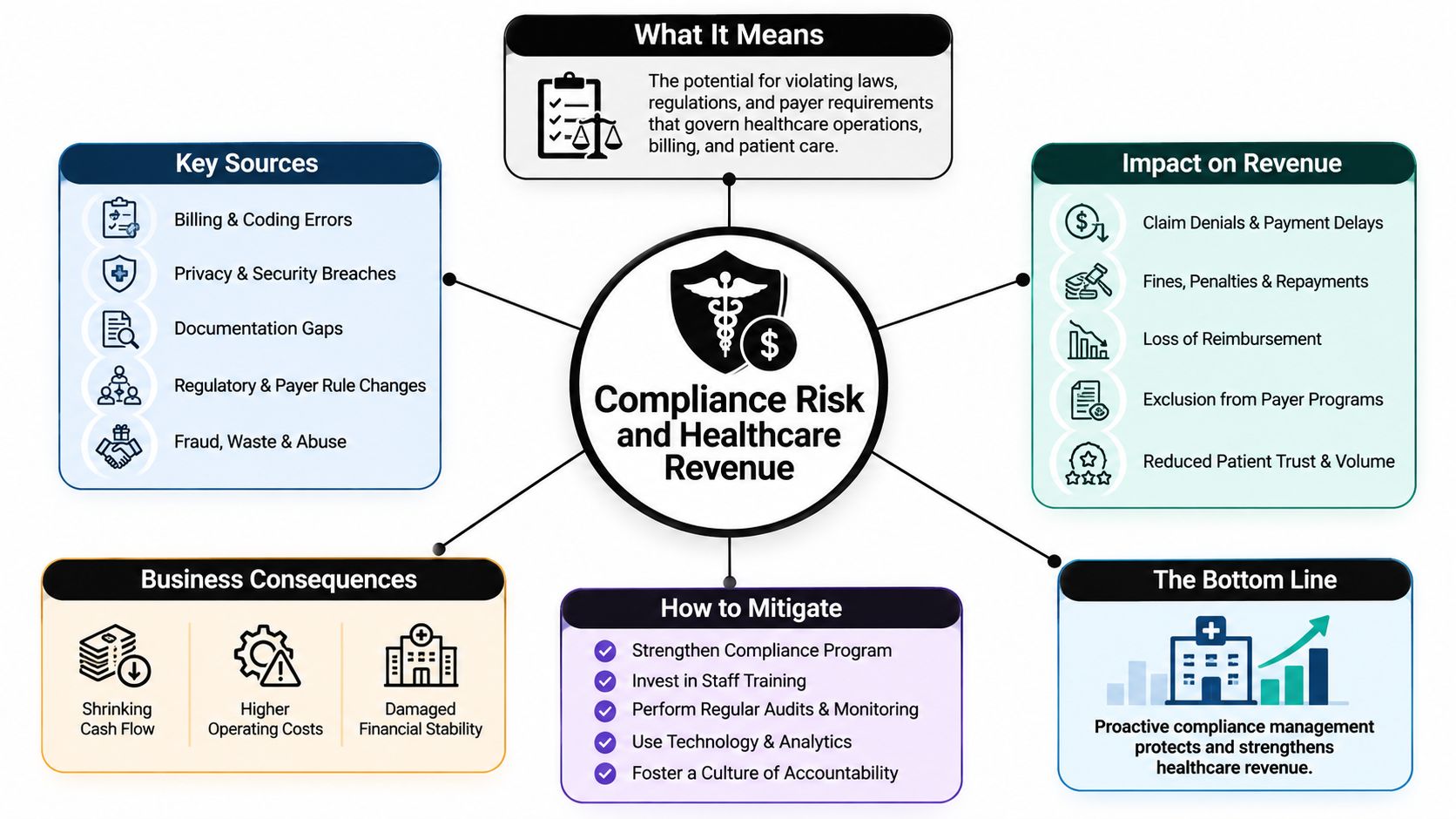
Compliance risk and financial risk diverge in practice
Financial risk shows up as a denial, an underpayment, or a delayed payment. Compliance risk shows up when the process that should have protected the claim breaks down, for example when documentation does not support the billed service, when credentialing is stale, or when the appeal packet cannot prove the claim was built correctly. In healthcare revenue, those two risks are hard to separate because one creates the other.
That is why this work cannot sit only in legal review or only in billing. It has to sit where coding, credentialing, contract interpretation, and dispute readiness overlap. The team that ignores compliance often ends up fighting the same payer twice, once on payment and once on the record.
The revenue effect is usually cumulative
One bad case is annoying. A repeat pattern is material. If a payer consistently downcodes a specialty's time-based work, the problem is not just that a few claims came in short, it is that the documentation and control environment may be weak enough to let the pattern continue.
Practical rule: if a payer issue keeps reappearing, treat it as a control failure until proven otherwise.
That mindset matters because compliance risk management in revenue cycle work is about preserving the integrity of each claim, each contract interpretation, and each dispute file. When those three pieces line up, underpayments are easier to challenge and reimbursement is easier to defend. When they do not, the organization absorbs avoidable leakage and starts negotiating from a weaker position. If you want the policy context that shaped this shift, the No Surprises Act summary from RevGuard is a useful reference point.
Regulatory Drivers Shaping Compliance Risk Today
The No Surprises Act changed how provider groups handle payment disputes, but the bigger shift is operational. Payers now work inside a more structured dispute process, while providers have to prove eligibility, coding accuracy, and documentation strength before a case even reaches arbitration. For a concise policy reference, the No Surprises Act summary from RevGuard is useful background, and the operational lesson is clearer, payer behavior now creates trackable revenue risk.
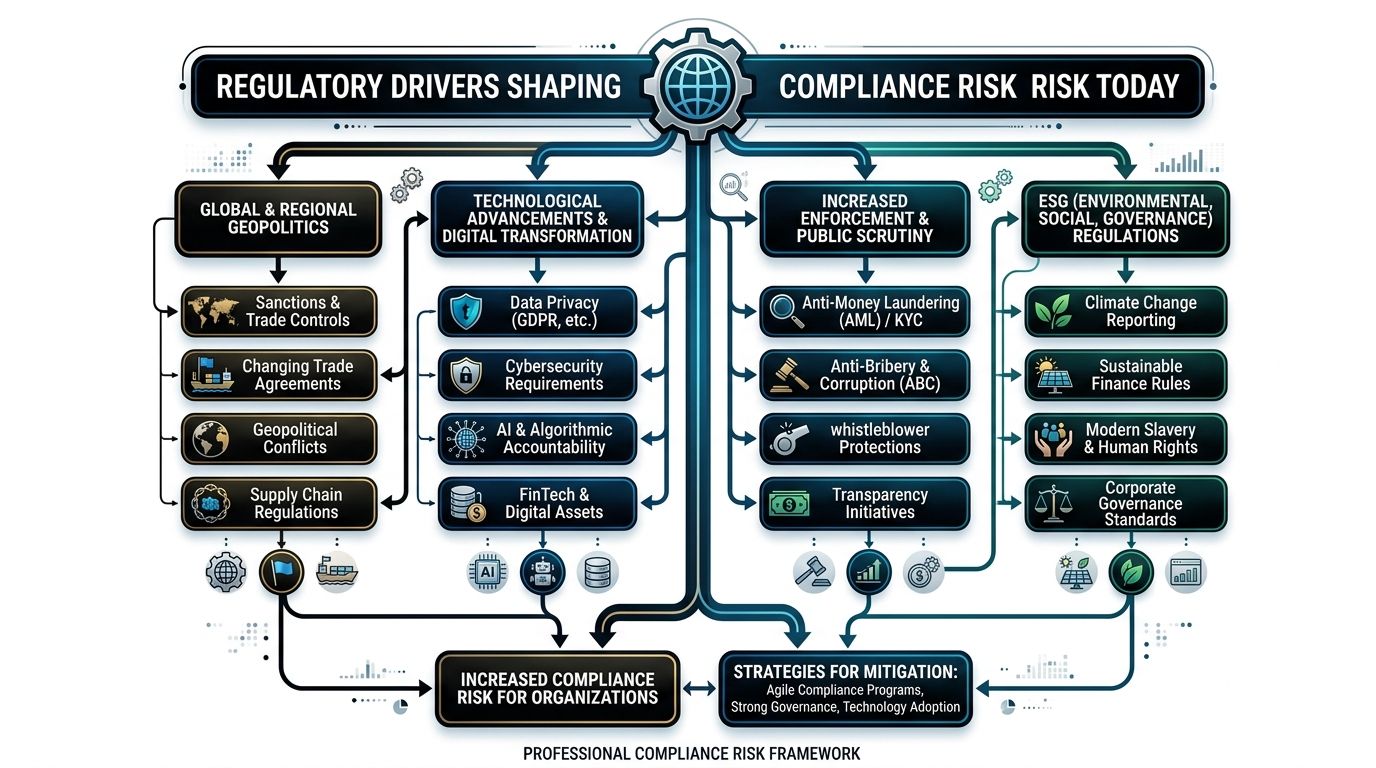
Start with payer behavior, not just the statute
A statute tells you what should happen. The payer tells you what happens. That gap matters when commercial plans, Medicare Advantage plans, third-party administrators, and self-funded arrangements all use different review habits, different documentation standards, and different delay tactics.
High-acuity specialties feel this first. A payer may challenge medical necessity, ask for narrower coding support, or treat a routine underpayment as a documentation defect. None of that is random. It becomes a recurring pattern that a revenue team can map, track, and answer with stronger controls upstream.
Audit pressure has become routine
Repeated audits are now part of the operating environment, not an exception. Secureframe's 2026 compilation reports that 58% of organizations conducted 4 or more audits in 2025, and 35% of enterprises conducted more than 6 audits on average, while 56% of risk and compliance professionals said their organization had at least one compliance issue in the past 3 years and 36% had more than one, with privacy or cybersecurity breaches cited by 28% as the most common issue in 2025, according to Secureframe's 2026 compliance statistics. In healthcare, that same audit mindset shows up in payer review behavior.
The pressure is structural, not episodic
Healthcare organizations are also dealing with a control gap. RiskWatch's 2026 statistics report says the average cost of non-compliance is $14.82 million, compared with $5.47 million for maintaining compliance, making non-compliance 2.71x more expensive, and only 37% of organizations have a complete, formal enterprise risk management process while 80.9% still rely primarily on manual workflows and spreadsheets, according to RiskWatch's compliance and risk statistics. In practical terms, that is the kind of environment where payer disputes slip through the cracks and turn into repeated revenue losses.
Memorizing every rule is less useful than building a control system that can absorb payer behavior without guessing. If your process cannot show who reviewed the claim, why the service met coverage criteria, and how the dispute decision was made, the payer has an easy path to underpay or delay.
A Closed-Loop Framework for Assessing and Mitigating Risk
A useful compliance program doesn't start with a policy binder. It starts with a loop. Identify the obligation, assess the risk, analyze the root cause, choose treatment, implement controls, then monitor the result and feed the lesson back into the next cycle. The European Commission and OECD both frame compliance risk management as continuous, which is the right model for revenue cycle work because payer behavior changes faster than annual policy review can keep up with.
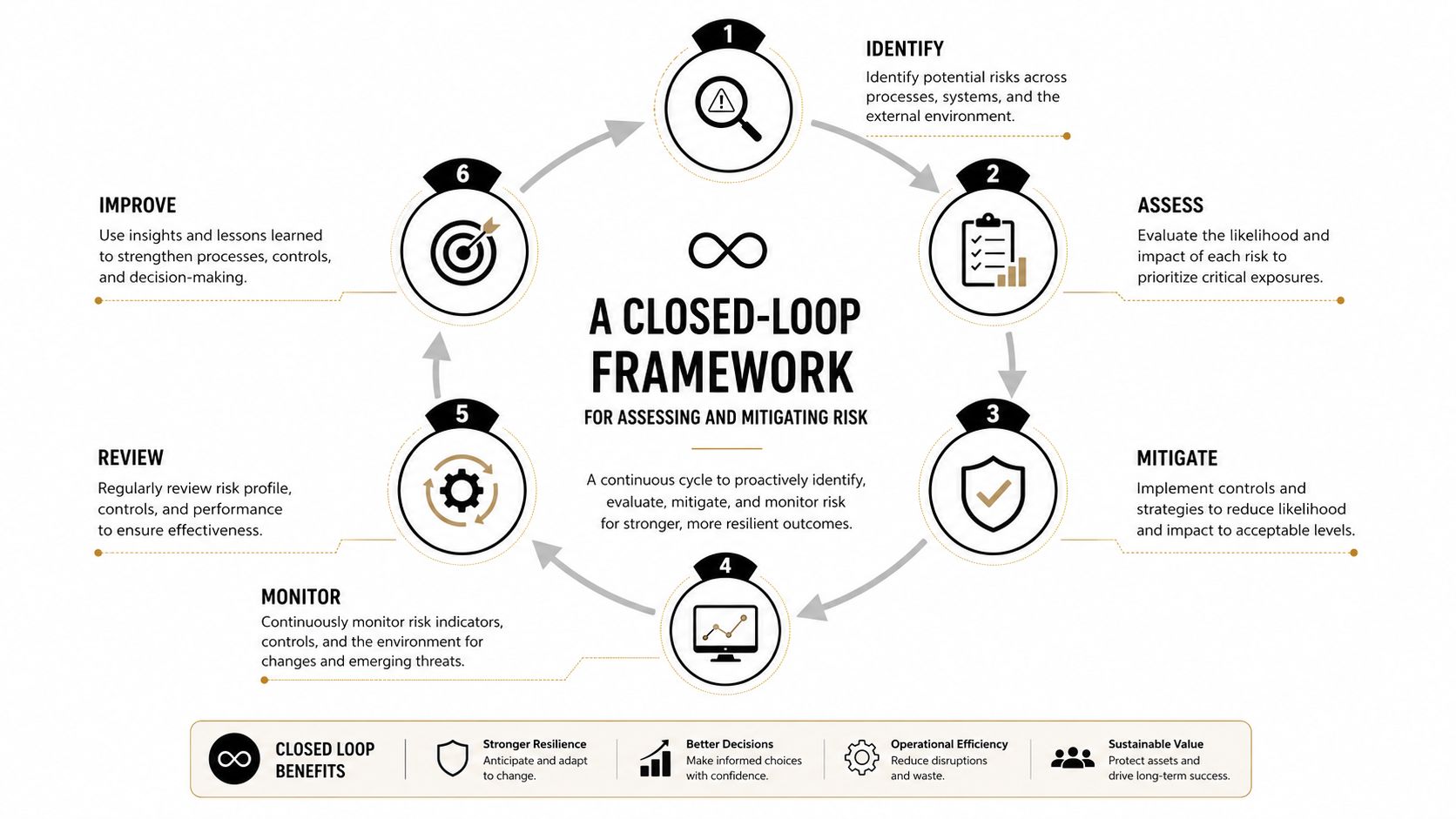
Identification has to reflect actual claim behavior
In healthcare revenue, identification means more than listing laws and contract terms. It means building a payer-behavior matrix that shows where denials, downcoding, documentation demands, and delayed payments cluster by plan, service line, and CPT family. The information should come from the claims stream, not from memory.
That makes the work operational. A specialty practice that sees recurring friction around time-based services should treat those claims differently from low-friction services. The obligation is not abstract, it's the actual set of requirements needed to defend payment for a specific service on a specific contract.
Assessment should rank by business impact, not just legal concern
The right question is not only whether something is noncompliant. It's whether the issue is likely to stop cash, create an appeal burden, or damage the organization's position in IDR. A denial-by-carrier heat map does that better than a generic risk register because it shows where dollars and control failures intersect.
Root-cause analysis belongs in operations
If a payer keeps raising the same objection, don't stop at the denial language. Look at the coder, the credentialing file, the claim edit, the note template, and the contract clause mapping. Root-cause analysis should tell you whether the problem is training, workflow design, documentation, or payer behavior.
A control is only good if it changes the next claim.
That's why treatment has to be specific. A documented edit, a claim scrub rule, a credentialing refresh, or a contract clause library can all be valid treatments, but only if they're tied to the failure pattern you see.
Monitoring closes the loop
Monitoring means exception queues, escalation triggers, and post-dispute review. The Federal Reserve's guidance on compliance risk management highlights a broader issue many firms still miss, risk scoring is only useful when it drives action. In healthcare revenue, that means the monitoring layer should feed work queues, arbitration prep, and management reporting, not sit in a spreadsheet no one reads.
If the loop is working, each denial makes the next claim stronger. If it's not, the organization keeps paying for the same mistake in different forms.
KPIs and Dashboards That Actually Predict Failure
Most dashboards are historical. They tell you what happened, not what's about to fail. Compliance risk management needs a sharper set of indicators, especially in revenue cycle work where the same issue can show up first as a coding problem, then as a denial, then as an IDR loss.
For a broader analytics orientation, the RevGuard revenue cycle analytics overview is a useful starting point, but the KPI design still needs to be deliberate. The goal is to build a dashboard that a CFO, compliance lead, and operations manager can all use without translation.
Core Compliance Risk KPIs for Healthcare Revenue
| KPI | What it measures | Escalation threshold | Owner |
|---|---|---|---|
| Denial rate by payer and CPT family | Where payer friction concentrates in the claim stream | A repeating pattern across the same payer or code family | RCM manager |
| Underpayment recovery rate via IDR | How often disputed underpayments are converted into recoverable revenue | A falling recovery pattern after clean case submission | IDR lead |
| Overturn rate at each arbitration stage | Whether evidence quality holds up through dispute steps | Weak performance at one stage in the same case type | Compliance officer |
| Days to file IDR | Speed from denial or underpayment to case filing | Missed internal filing window or repeated delay | Appeals coordinator |
| Documentation deficiency rate | How often claims need rework because the record is incomplete | A sustained rise in chart or note deficiencies | Coding lead |
| Credentialing lag | How long provider status or enrollment gaps remain unresolved | Any lag that blocks clean billing or dispute standing | Credentialing manager |
Predictive metrics beat pretty dashboards
Descriptive dashboards show volume. Diagnostic dashboards show cause. Predictive dashboards show where the next failure is likely to appear. The IMF's tax-administration analytics framework describes compliance monitoring through patterns such as on-time, late, and nonpayment behavior, plus automated underreporting detection and risk segmentation by behavior, which is a good model for revenue cycle teams that need exception queues and model-based alerts rather than static monthly reports, according to the IMF's analytics framework.
That translates cleanly to healthcare. If a payer repeatedly downcodes a certain service family, the system should flag it before the next batch goes out. If a claim is missing a key documentation element, the queue should stop it before denial. If a credentialing issue can block arbitration standing, the alert should fire before filing, not after.
Ownership has to be explicit
Every KPI needs one named owner. Otherwise the dashboard becomes a reporting artifact instead of a management tool. The owner doesn't need to do every task, but they do need authority to escalate, correct, and close the loop.
The best compliance dashboards don't ask, “What happened?” They ask, “What's breaking, who owns it, and what changes tomorrow's workflow?”
Connecting Compliance Controls to IDR and RCM Workflows
The biggest mistake in healthcare revenue is running compliance, RCM, and IDR as separate programs. That separation looks tidy on an org chart and messy in practice. If eligibility verification, coding, credentialing, and contract mapping are weak, the claim may be dead before the dispute team ever sees it.
Build the claim so it can survive the dispute
Upstream controls are not administrative chores. They determine whether a claim is dispute-ready. Eligibility verification tells you whether the service belongs in the expected payment path. Coding accuracy affects whether the claim gets downcoded or challenged. Credentialing currency determines whether the provider even has a defensible standing position.
That's why the first review on any denied or underpaid claim should ask two questions. Is this a compliance failure, a payer behavior issue, or both. And if it reaches dispute, do we have the evidence to carry it through.
Triage should separate root cause from recovery path
A clean triage model sorts each case into one of three lanes. The first is a provider-side issue that needs correction before rebilling or appeal. The second is a payer-side issue that should go straight into the dispute workflow. The third is a mixed case where the organization has to fix the documentation and still challenge the underpayment.
That distinction matters because the arbitration posture changes. If the claim was weakly built, the team may need to correct and supplement before filing. If the payer is using the same objection pattern across multiple cases, the dispute file should preserve that pattern so the IDR narrative is consistent.
Operational rule: don't file an IDR case until the upstream record can explain the service without hand-holding.
Feedback from disputes should change the front end
Arbitrated outcomes are not just a recovery event. They're evidence about where the control environment failed or held up. If one type of claim keeps losing because the chart lacks a core support element, that problem belongs in the coding and documentation workflow, not just in appeals.
A compliance plus RCM plus IDR stack outperforms any one piece alone. RCM gives you clean intake, compliance gives you defensible controls, and IDR gives you a structured way to recover money when the payer still underpays. When those functions share data, the organization can reduce leakage upstream and recover more effectively downstream.
Real-World Patterns Across High-Risk Specialties
Specialties don't all fail the same way. Payers look for different weaknesses depending on service type, contract structure, and documentation habit. That's why a generic compliance playbook usually disappoints the people who need it most.
IONM and anesthesia need stronger coding and necessity proof
In intraoperative neuromonitoring and anesthesia, the recurring problem is often a mix of time-based coding disputes and medical necessity challenges. The payer may downcode, question whether the service was separately payable, or argue that the documentation doesn't support the level billed. That creates two losses at once, an underpayment today and a weaker defense file tomorrow.
The control that helps most is tight note discipline tied to claim edits. If the service line depends on timing, provider presence, or procedure context, those details have to be captured in a form the payer can't easily dismiss. For a related revenue-cycle lens in another specialty setting, RevGuard's oncology revenue cycle management page shows how specialty-specific workflows matter when documentation and reimbursement pressures overlap.
Air ambulance and emergency services need eligibility and dispute discipline
Air ambulance and emergency service providers face a different mix. Balance billing restrictions and IDR eligibility checks make a small process error expensive because the dispute path itself can be compromised. If the case file is built without confirming the right eligibility conditions, the team can spend time on a claim that isn't positioned to recover cleanly.
The control here is earlier triage. The billing team needs to know, before filing, whether the claim belongs in the dispute track, what evidence will support the case, and whether the record shows the service was billed correctly. In this setting, compliance risk management is not about extra paperwork, it's about keeping bad cases from consuming recovery effort.
The common thread across specialties is simple. Payers exploit weak points in documentation, classification, and process. The practices that recover better are the ones that connect front-end controls to back-end dispute logic instead of treating them as separate departments.
Practical Checklist for Building a Compliance Risk Program
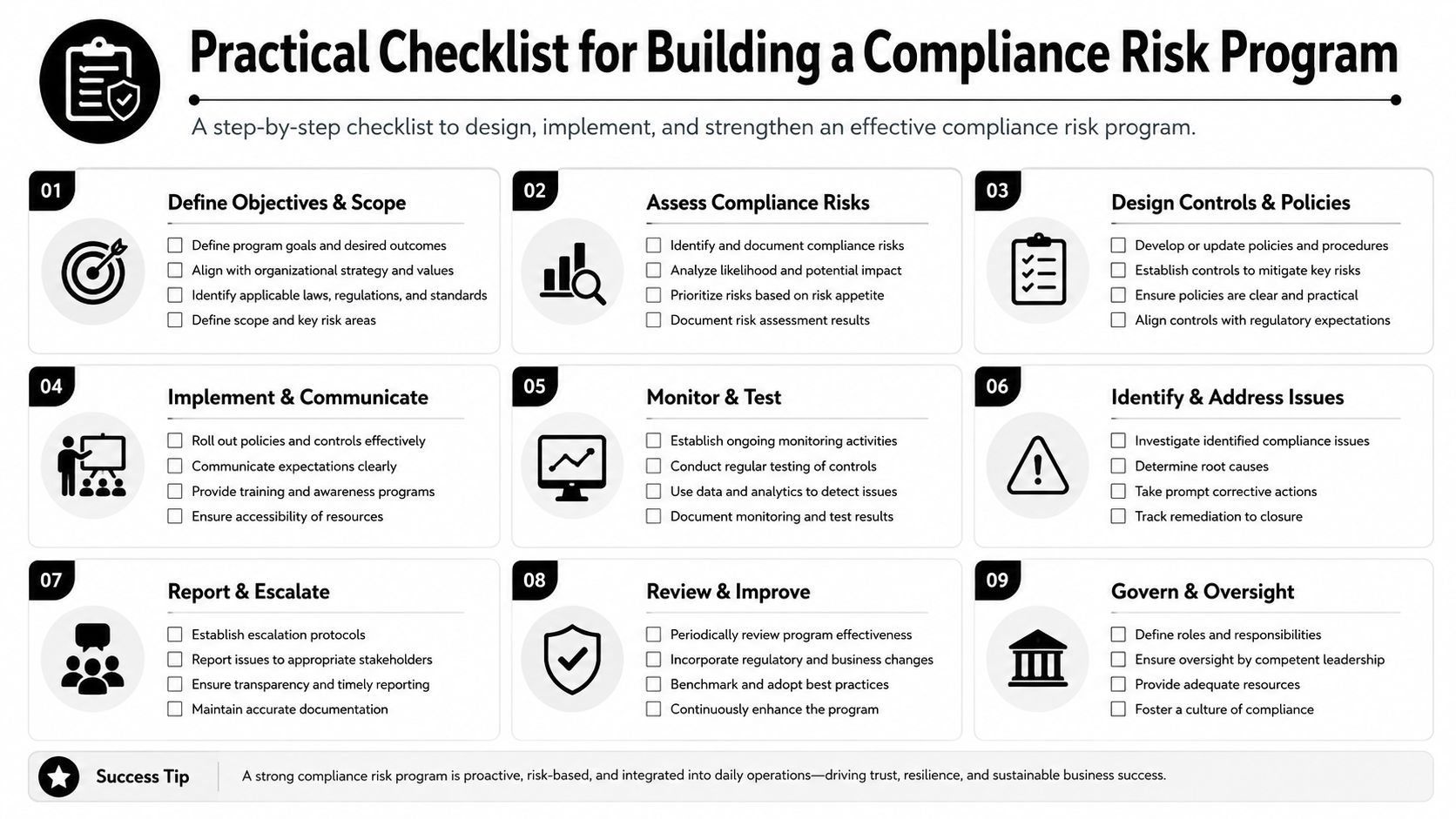
Quick wins for the next working session
- Compliance lead, build a payer-behavior heat map: Use denial, downcode, and appeal patterns to show where the exposure sits. This turns compliance from theory into a management tool.
- RCM manager, tag denials by cause and payer: Separate documentation issues from payer behavior so the team stops treating every denial as the same problem.
- Billing manager, add an IDR eligibility filter: Confirm the case belongs in the dispute track before staff spend time assembling a dead file.
- Coding lead, review deficiency patterns: Repeated missing elements usually point to a training or template issue, not an isolated error.
Structural changes that protect revenue
- Credentialing manager, tighten cadence: Stale enrollment or provider status can break billing and dispute standing, so this control needs a real owner.
- Contracting lead, maintain a clause library: If the team can't find the relevant payer language quickly, it will miss a key advantage in both appeals and arbitration.
- Compliance officer, require a feedback loop from disputes: Use overturned and lost cases to correct upstream documentation, coding, and review rules.
- Operations director, standardize escalation triggers: Define what starts a formal review, who signs off, and when a claim moves to appeal or IDR.
A good 30-day plan starts with the heat map, denial tagging, and eligibility checks. By 60 days, the organization should have escalation rules and a working clause library. By 90 days, disputes should be feeding changes back into coding, credentialing, and appeal prep so the same failure doesn't keep costing cash.
RevGuard works at the point where compliance risk becomes revenue risk, combining specialty-focused RCM with NSA-driven IDR workflows, analytics, and dispute-ready case management. If your team needs tighter claim controls, cleaner arbitration files, and a clearer view of payer behavior, visit RevGuard and see how those pieces fit together in one operating model.