
You know the claim before the denial even posts. The surgeon's note is clean, the OR log makes sense, and yet the payer comes back with a mismatch, a downcode, or an adjustment that doesn't fit the work that was done. In a lot of hospitals, that starts with one line on the UB-04, Rev Code 360, and one question no one wants to answer twice, did the facility side of the surgery get coded to the right room and the right resources?
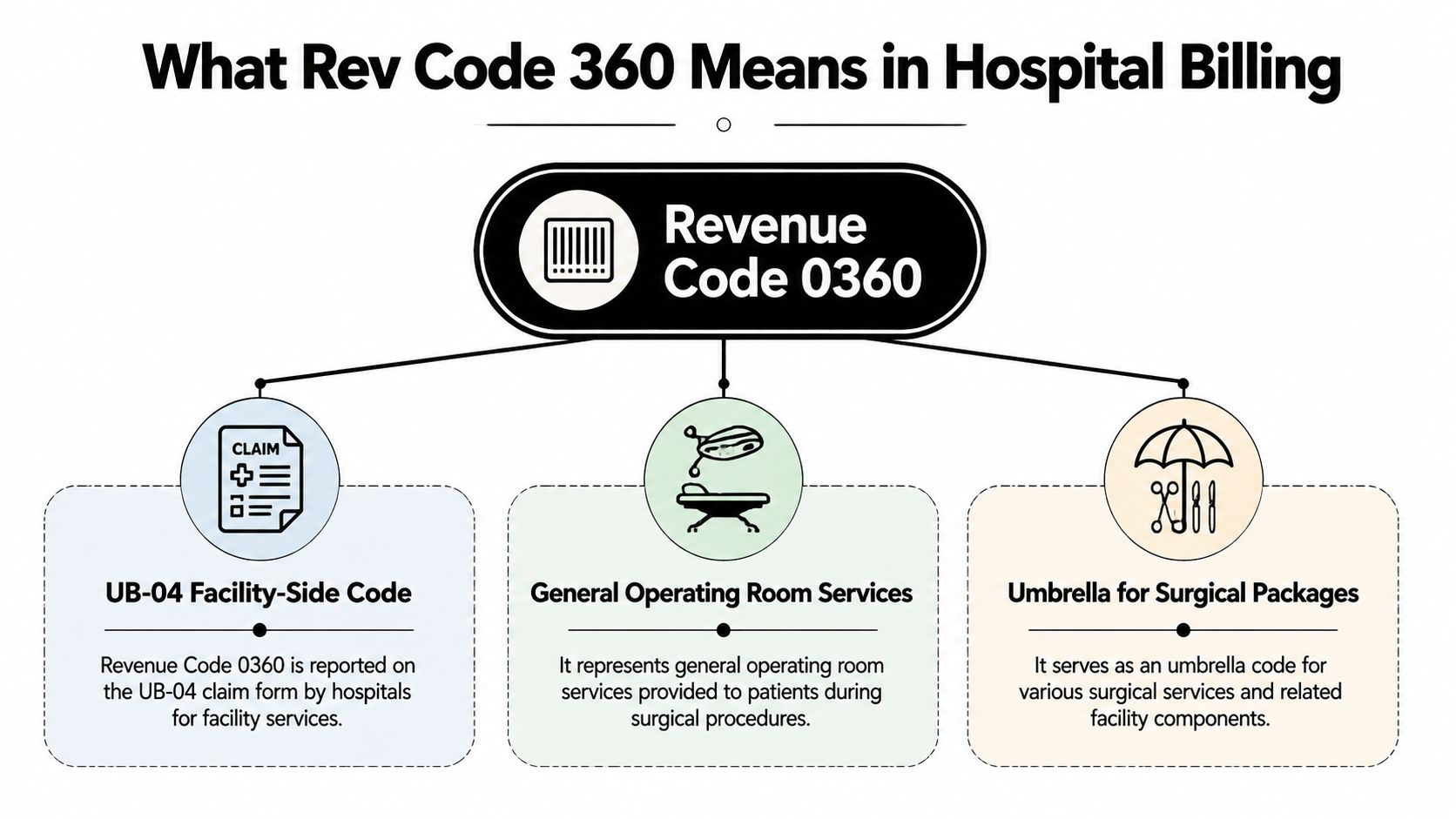
Rev Code 360 sits at the center of that problem because it is the hospital's facility-side code for general operating room services. It's not the surgeon's bill, and it's not a vague bucket for “anything surgical.” It is the UB-04 general classification used when the surgery happened in the main operating room and no more specific OR code applies, and revenue codes themselves are four-digit numerical codes where the first digit sets the broad category and the last three add detail, which is why 0360 belongs in the 03xx operating room family Noridian revenue code guidance.
What Rev Code 360 Means in Hospital Billing
A lot of claims break because someone treats the revenue code like a formality. It isn't. Rev Code 360 is the accounting anchor that tells the payer the hospital used a main operating room, and that the charge line should reflect the facility's resources, not the physician's professional service.
The clean definition RCM teams need
The simplest way to read 0360 is this, the hospital is saying, “this surgery used the main OR.” That means the line should capture facility resources such as OR time, nursing labor, surgical equipment, lights, and supplies, while the physician's work continues to live on the professional side with the CPT or HCPCS code. The distinction matters because facility billing and professional billing solve different problems on the same encounter.
Revenue code 0360 is the standard hospital billing code for Operating Room services in the UB-04 revenue code system, and it is the general classification when a surgery occurred in the main operating room and no more specific OR code applies Noridian revenue code guidance. If you want the broader framework for how these codes are organized, the revenue-code structure is outlined in this overview of rev codes.
Why the distinction changes payment
Payers don't evaluate the room code in isolation. They compare the revenue code to the CPT or HCPCS procedure, the place of service, and the units billed, then decide whether the facility setting makes sense. If the room type is wrong, the payer may see the wrong site of service, and that can distort the logic that drives payment.
Practical rule: if the procedure really occurred in a main OR, the 0360 line should look like a main OR line. If it happened in a minor room, recovery area, or ancillary space, 0360 is the wrong bucket and the claim will usually tell on itself.
That's why 0360 has to be treated as a claim-building decision, not a coding habit. Once the facility side is mapped correctly, the rest of the institutional claim has a chance to adjudicate cleanly.
How to Bill Rev Code 360 on the UB-04 Claim Form
A rev code 360 line should survive a payer review without anyone having to guess what happened in the room. On the UB-04, the revenue code field, the procedure data, and the supporting record have to tell the same story. A good claim also has to line up with a guide to the UB-04 form so the facility side is built the way the form expects. If those pieces do not agree, the edit engine usually finds the mismatch before a human ever opens the file.
Build the line from the facility side
Start with the revenue code, then confirm the procedure code on that line is the correct CPT or HCPCS code for the service performed. The revenue code identifies the hospital resource, while the procedure code identifies what was done. That distinction matters because a clean procedure code can still fail if the facility setting does not match the code family.
Use the place-of-service detail the way your payer expects it, and do not let a generic facility label stand in for actual OR documentation. If the claim needs condition codes, value codes, or remarks to explain a special circumstance, those fields should support the line. They should not be used to cover a misclassified room charge after the fact.
Read the claim like an auditor
A solid UB-04 line should answer four questions quickly.
- Where did it happen? The claim should show the main operating room, not a vague procedural area.
- What was done? The CPT or HCPCS code should match the surgery and the billed units.
- What was used? The facility charge should reflect OR resources, not unrelated ancillary activity.
- Can the chart prove it? The operative record, nursing flow, and anesthesia documentation should all point the same way.
Commercial pricing can still vary sharply even when the claim is built correctly. One June 2026 rate schedule showed a national average reimbursement of $2,556.23 for BCBS, $20,041.11 for UnitedHealthcare, $5,343.50 for Aetna, and $1,459.42 for Cigna for code 0360 RI Medicaid provider manual hospital revenue codes. That spread is why the billing team has to know the contract terms behind the line, not just the code itself.
A claim can be technically complete and still be financially wrong if the payer's fee logic does not match the chargemaster assumptions.
Common Payer Denials and Underpayments for Rev Code 360
A 0360 line can fail in three different ways. The payer may reject the room code, reduce it because the setting does not match the procedure, or pay it at a lower level than the chargemaster expected. In practice, those problems often start with the same file and split into different outcomes during adjudication.
Mismatched room and procedure logic
The first failure pattern is a mismatch between the revenue code and the procedure code. If the edit engine sees a CPT that points to a minor or low-intensity procedure, but the claim shows 0360, it can flag the line because the room code points to a main OR setting. The same thing happens when units, modifiers, or place-of-service details do not line up.
Denials often look confusing to the front-end coder and obvious to the payer. The line says one thing, the chart says another, and the adjudicator takes the safer path.
Medical necessity challenges
The second pattern is a medical-necessity challenge, usually because the operative record does not show why the surgery needed a main OR. That does not always mean the procedure was inappropriate. It often means the documentation did not prove the intensity, resources, or setting that 0360 implies.
Underpayment from payer-specific pricing
The third pattern is the quiet one, underpayment that never shows up as a denial. A payer can process the claim and still pay below expectation when the contract logic does not match how the chargemaster was built. As noted earlier, payer reimbursement for the same code can vary sharply, which is why the billing team has to check the contract behind the line, not just the code itself.
| Payer | Average Reimbursement |
|---|---|
| BCBS | $2,556.23 |
| UnitedHealthcare | $20,041.11 |
| Aetna | $5,343.50 |
| Cigna | $1,459.42 |
For a practical billing team, the diagnostic question is simple. Did the payer deny the line, reduce the allowed amount, or pay according to a contract model that no one in the work queue expected? Once that answer is clear, the fix belongs in coding, documentation, contract review, or appeal work.
Documentation and Charge-Master Governance for Rev Code 360
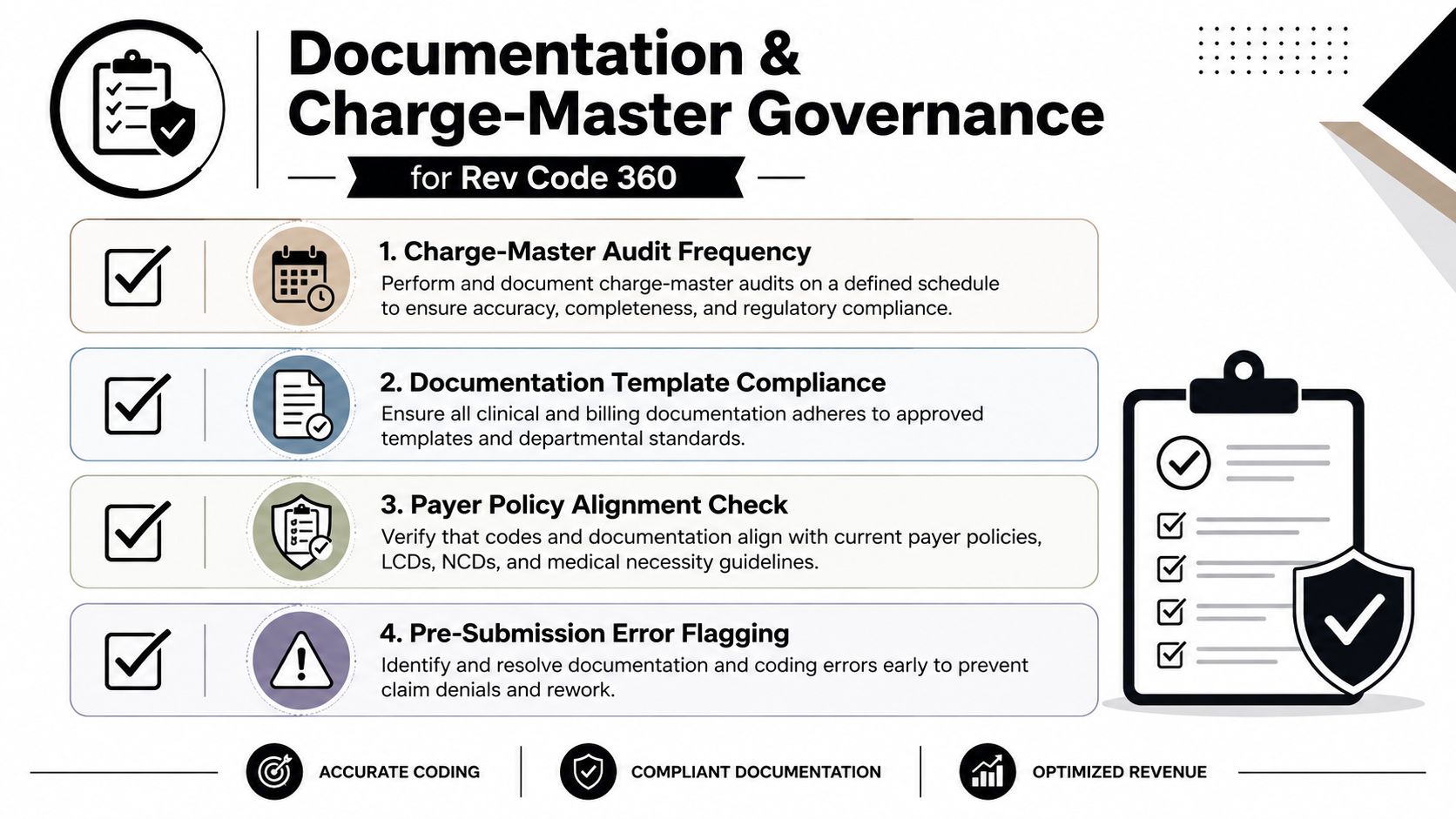
The best 0360 denials are the ones that never reach the payer. That starts with charge-master governance, because a bad facility bucket creates a bad claim before anyone touches the edit workqueue. For high-volume surgical service lines, that's where the primary control lives.
Keep the charge bucket honest
The 0360 charge bucket should map only to services that occurred in the main operating room. That sounds basic, but spillover from minor procedure rooms, recovery, and other ancillary spaces is one of the fastest ways to poison the line. Once the wrong bucket becomes routine, the revenue cycle team spends months untangling problems that started at charge capture.
Build the file that can defend the code
The documentation set should be tight enough to prove the setting, the resource use, and the medical necessity of the procedure. The cleanest files usually include:
- Operative reports that confirm the main OR was used.
- Anesthesia records that align with the surgical timeline.
- Nursing flow sheets that show room activity and support the resource use.
- Supply logs that match the facility charge entry.
If those documents don't agree, the payer can question the room code even when the surgery itself is undisputed.
Audit for spillover before the payer does
Charge-master governance turns into a compliance process. An OR line that absorbs unrelated ancillary charges can trigger scrutiny, and the fix may not stop at rebilling. Payers can recoup when they decide the room code was used too broadly, especially if the line appears to have bundled activity that never belonged in the main OR bucket.
Field note: the fastest way to reduce 0360 noise is to audit for room-type drift, not just coder error. Most of the damage starts upstream, in how the charge is dropped into the system.
A practical audit checklist is straightforward, confirm the case happened in the main OR, confirm the charge bucket matches that location, confirm the documentation supports the room and the procedure, and confirm no minor-room or recovery activity leaked into the facility line. That's the difference between a claim that survives payer review and one that gets picked apart later.
Real-World Claim Walkthrough and Example Scenarios
A clean 0360 claim usually fails for the same reason over and over, one line doesn't match the rest of the file. When I review these cases, I start with the charge and then walk the line backward through the chart until the contradiction shows itself. The best teams do the same thing before submission.
A clean claim path
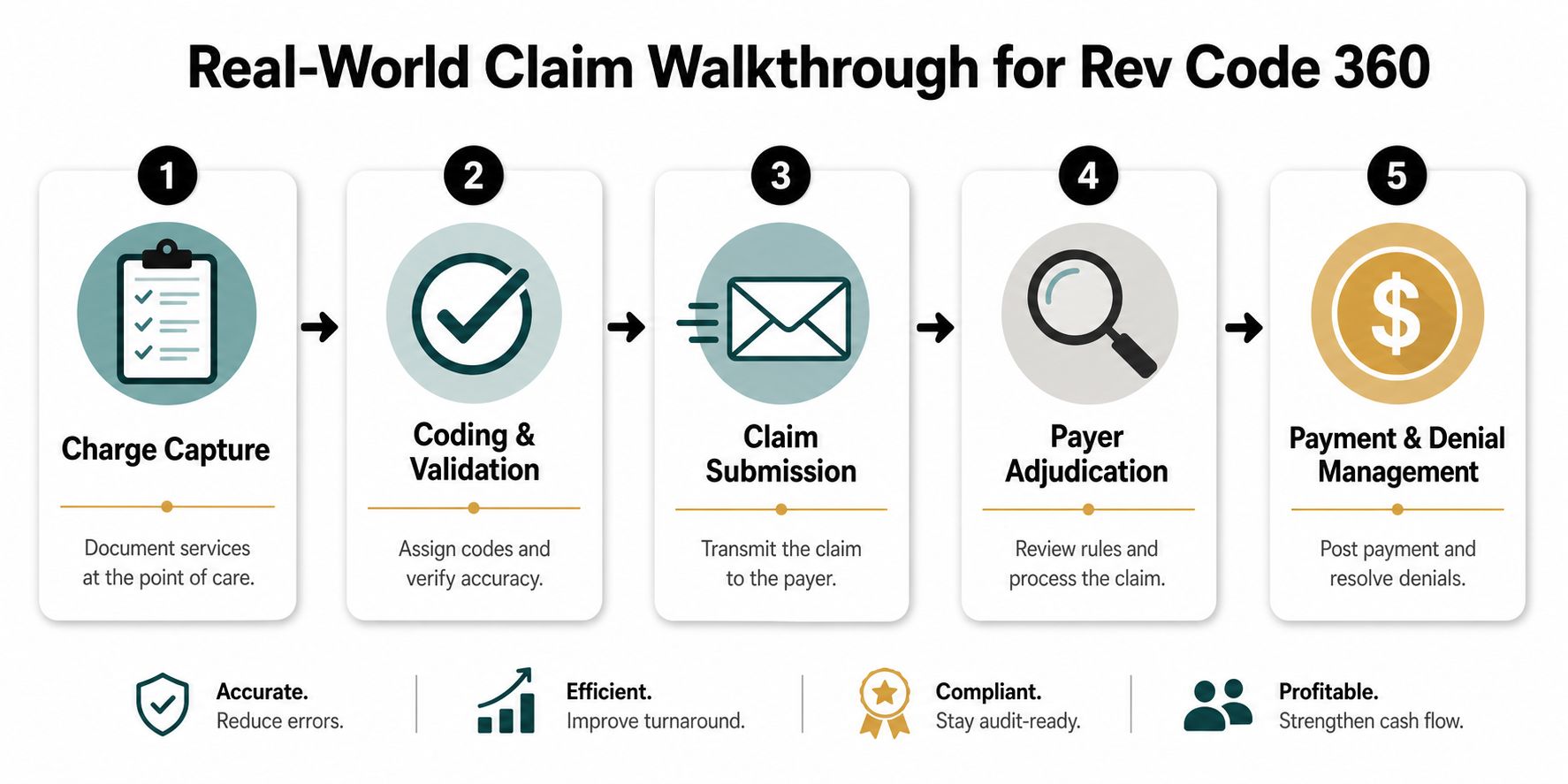
A representative surgical claim should move through charge capture, coding validation, submission, adjudication, and payment without the facility line raising questions. In that clean version, the operative note confirms the main OR, the facility charge lands in 0360, the procedure code matches the surgical service, and the chart supports the timing and setting. The payer may still price the claim according to its own contract logic, but the file itself doesn't invite a denial.
That's the standard to aim for, a claim where the hospital side and the professional side each say the same thing. If the facility resources were OR-level, the 0360 line should prove it. If they weren't, the charge should never have been built that way.
A claim that breaks on a small detail
The failure scenario is usually quieter. A minor procedure room charge gets bucketed into 0360 because the patient was in a surgical workflow and nobody stopped to check the exact location. The claim looks surgical, but the room description doesn't line up with the main OR classification, and the payer's edit engine catches the mismatch.
When that happens, the best repair isn't a generic appeal letter. It's a correction that resets the room type, fixes the supporting documentation, and makes the charge match the actual site of service. If the case belongs in the main OR, then the chart has to show it. If it doesn't, the denial is telling you the claim was built on the wrong premise.
The cleanest appeals are the ones that start with a corrected file, not a defensive argument.
If you want a claim-level framework for better first-pass coding discipline, the same logic that keeps inpatient files accurate also applies here, review the record in order, validate the room, then release the line only when the chart and the charge agree.
Reducing Rev Code 360 Denials with Integrated RCM and IDR
The hospitals that handle 0360 well don't treat denials as a separate department problem. They connect front-end RCM discipline to downstream dispute enforcement, because the same claim that needs cleaner capture on day one may need pressure on day thirty or sixty if the payer still underpays. That's the practical advantage of integrating revenue integrity with dispute work.

Use one operating model from capture to challenge
The strongest workflow starts with eligibility verification, charge capture, claims submission, denial management, underpayment recovery, and payment posting, all in one controlled loop. That makes it easier to spot the exact point where a Rev Code 360 claim starts drifting away from contract reality. It also gives analysts a consistent way to see which payers are repeatedly pushing the same facility-side problems.
For organizations that need both cleanup and enforcement, how RCM and IDR work together is the right mental model. When the claim is built cleanly and the payer still delays, downcodes, or underpays, the dispute process has a much better file to work with.
Treat payer behavior as data, not noise
Analytic dashboards matter because they turn repeated 0360 issues into a pattern you can act on. If one payer consistently misreads the room code, or one specialty keeps leaking charges from ancillary spaces into the main OR bucket, the fix should be targeted. That can mean a contract review, a charge-master correction, a documentation tweak, or a formal dispute strategy.
RevGuard is one option in that workflow, because it combines RCM controls with IDR enforcement under the No Surprises Act framework, while also supporting claim-level recovery and payer-behavior analysis. The value isn't in a slogan, it's in keeping the facility line aligned from capture through enforcement so less revenue leaks out of the process.
For hospitals, ASCs, and multi-state provider groups, that integrated posture is what closes the loop. Clean the claim early, defend it hard later, and don't let a room code become an unchallenged source of leakage.
If your team keeps seeing avoidable 0360 denials, underpayments, or room-code disputes, start by tightening the claim at the source and then pressure-test how you pursue recoveries after the payer response. Visit RevGuard to see how an integrated RCM and IDR workflow can help your organization protect facility revenue tied to operating room services.