
You can get a practice ready to schedule patients, open the portal, and still be stuck in limbo because no payer has assigned an effective date yet. That gap is where a lot of specialty groups, ASCs, and multi-site platforms lose momentum, because the work isn't just paperwork, it's the gate that decides whether you can bill in-network or whether every visit has to sit out-of-network or on hold.
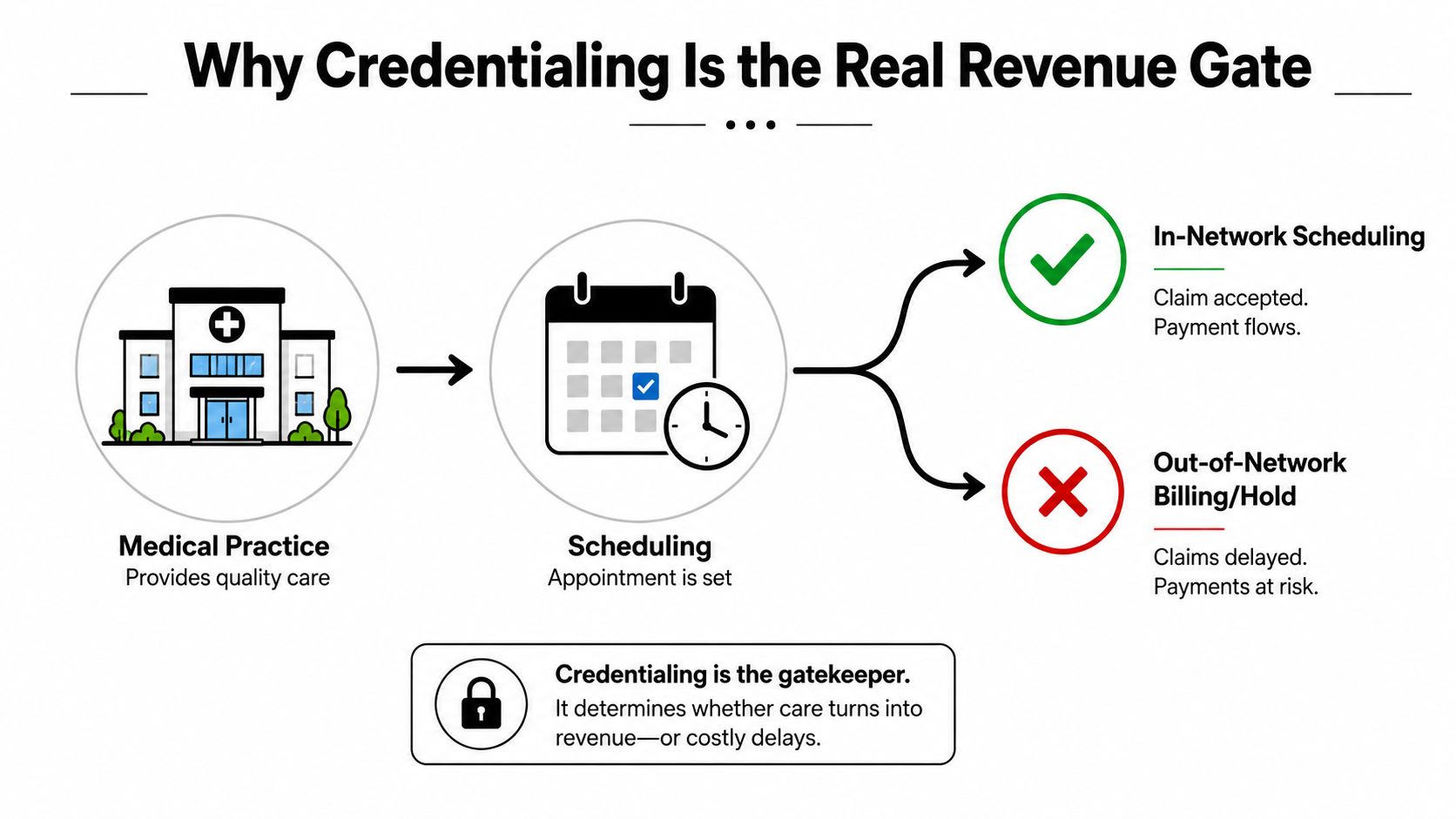
Why Credentialing Is the Revenue Gate
A new specialty group can finish onboarding, announce its launch, and start filling the calendar, then discover that the first payer still has not issued an effective date. Until that date lands, services cannot be billed as in-network, and the cash flow strain starts immediately. The work may look administrative from the outside, but in practice it decides whether contracted reimbursement is available at all.
Credentialing is the gate because it comes before contracted revenue, not after it. Payer-facing guidance makes that sequencing plain, since the application has to move through primary source verification, committee review, contracting, and participation approval before billing can begin. That matters for any practice that depends on commercial reimbursement, and it matters even more when multiple sites or specialties are involved, because each payer may still want a separate application even if CAQH is used as the shared source of truth. For groups trying to understand how payer files map to organizational setup, a Type 2 NPI is part of that upstream identity work, not a billing afterthought.
Practical rule: if the payer has not issued the effective date, the claim history you are building is not in-network history yet.
The biggest controllable revenue leak is the gap between submission and approval. That gap does more than slow cash. It forces teams into scheduling trade-offs, especially when patients expect to use benefits right away, and it can push new locations into months of avoidable out-of-network exposure while the file sits in review.
Credentialing also is not a one-time event. CAQH re-attestation keeps coming back on a recurring cycle, so the work never really disappears. That is the operational mindset shift most guides skip, and it is the one that keeps a practice from treating enrollment like a box to check once and forget.
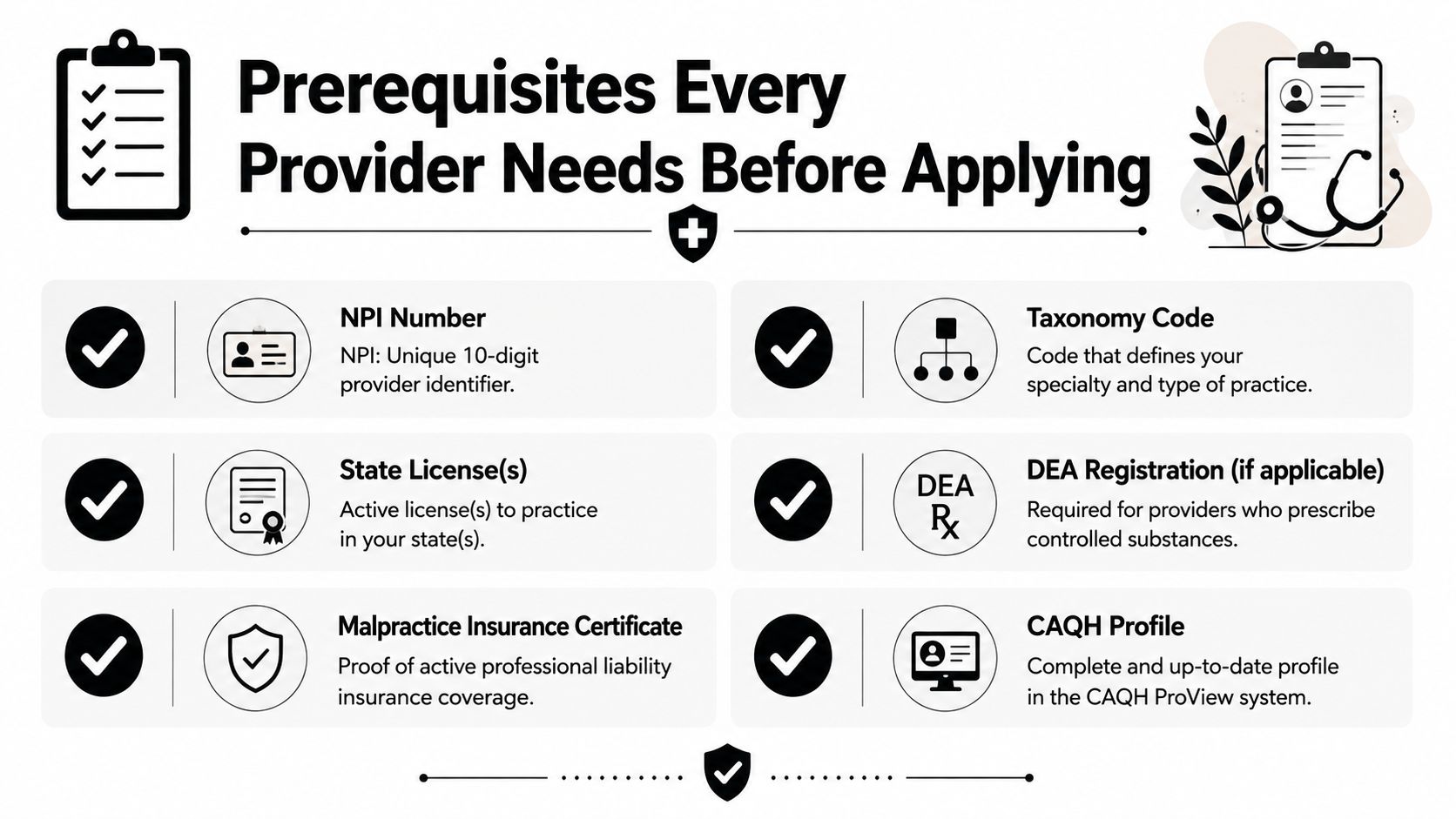
Prerequisites Every Provider Needs Before Applying
A clean credentialing file starts before any payer portal opens. The provider has to have the core identity pieces aligned, then the supporting documents that insurers verify on their own. When those details do not match, the file usually does not fail in a dramatic way. It sits while a reviewer tries to reconcile the mismatch, and that is where weeks can disappear.
Start with identity and licensing
The application file should be built around the provider's NPI, current state license(s), and the correct taxonomy information for the service being billed. If DEA registration applies to the specialty, it needs to be current as well. Malpractice coverage, a valid W-9, and a complete work history belong in the same pre-submission review, because payers compare the application against multiple records and do not assume the information will line up by itself (WCHSB credentialing guidance).
License expiration dates are a common trap. So are malpractice gaps, mismatched practice addresses, and missing hospital-privilege documentation when the payer expects it. Those issues do more than create paperwork churn. They trigger committee holds because the payer reviewer is trying to validate every field against outside records, and anything that looks incomplete or inconsistent slows the file down.
For groups that are building from a solo setup into a multi-provider structure, the organizational identifier matters too. A Type 2 NPI guide helps explain why the group identifier and the individual provider record have to be aligned before enrollment moves smoothly.
Keep CAQH tight and current
CAQH ProView is the central credential repository for many commercial payers, but it does not replace the payer's own review. The insurer still makes its own decision, and the profile has to stay active through recurring attestation. A stale profile creates the same kind of delay as a missing license page, because the file cannot move until someone updates the record and the payer accepts it.
A useful internal habit is a pre-submission audit that checks names, addresses, NPI, license numbers, malpractice dates, and work history against the actual source documents. Small inconsistencies are what create the long delays that feel random from the practice side but look obvious to the payer reviewer. The teams that keep turnaround tighter are usually the ones that treat credentialing as a controlled intake process, not a stack of forms to fill out from memory.
Checklist to run before submission: verify every document against the application line by line, not just by memory. The memory version is usually what causes the rework.
Submitting Payer Applications the Right Way
The cleanest payer submission starts with restraint. A practice does not need to apply to every plan on day one just because every network looks like possible volume. The better approach is to choose the payer mix that matches actual referral patterns and service area, then submit files that are complete, internally consistent, and watched until the payer closes the loop. That saves more time than pushing weak applications into every open door.
Commercial carriers still rely on CAQH in many workflows, but CAQH is only one piece of the file. The payer still runs its own review, still routes the application through committee or delegated review, and still issues its own participation decision before billing can start. Providers usually begin by finding the insurer's provider enrollment path, completing the required forms, and confirming that participation has been approved before any in-network claims go out. Medicare and Medicaid sit on separate tracks and should be treated that way from the start.
Submit by payer type, not by habit
Commercial plans often pull from CAQH, but the insurer still validates the application and sets the effective date on its own terms. Medicare runs through PECOS and follows federal enrollment and revalidation rules. Medicaid is state-specific, so one state's portal, fee schedule, and correction process may look nothing like the next. The workflow stays the same: submit, monitor, and answer requests quickly.
The fastest way to lose time is to let a payer request sit unanswered for a week. Enrollment staff will move when they have what they need, and they will stop the file when they are waiting on you.
Payer Enrollment Channels at a Glance
| Payer Type | Primary Portal | Data Source | Typical Validation Gate |
|---|---|---|---|
| Commercial carrier | Payer-specific provider portal | CAQH ProView plus payer application | Credentialing committee review |
| Medicare | PECOS | Medicare enrollment record | Federal enrollment approval and revalidation |
| Medicaid | State Medicaid portal | State-specific enrollment data | State review and program-specific validation |
A clean payer submission process also depends on response speed. Missing fields, mismatched addresses, and expired documents are the kinds of issues that stop a file after it is already in motion. The practical habit is simple, keep one owner watching the portal and the inbox every few days until the payer returns a decision or a fix request. If a plan routes applications through a committee, the file can sit even when everything looks complete, and that is where practices lose revenue while the work appears “in progress” on the surface.
Realistic Timelines and Where Delays Happen
Credentialing rarely moves in a straight line. One file can sail through data review and then sit untouched because a payer committee only meets on a set cycle, while another stalls later because contracting has not caught up with the approval. The delay is usually not one missing form. It is the handoff between people, systems, and internal review points.
Data verification is usually the cleanest part if the application was prepared well. Primary source verification still takes time because the payer is checking licenses, education, malpractice coverage, and work history against outside records. After that, the file waits for committee review, and that is where specialty groups and multi-site practices often lose days because the payer's internal meeting schedule does not align with the pace of the application.
Where each phase slips
Contracting creates a second bottleneck that gets overlooked. A payer may finish credentialing review, then move the file into contract drafting, fee schedule review, and signature routing. Approval without an executed agreement does not create billable in-network status, and billing cannot start until the effective date is issued and the contract is fully in place (Verisys process overview).
That separation matters in day-to-day operations. Credentialing and contracting do not always advance together, and the billing team may still be waiting for the participation record to update after the payer says the provider is approved. A practice that only tracks the application date and approval date misses the part that determines when claims can go out cleanly.
Track the file like a revenue project
A working tracker should show submission date, last status update, payer contact, follow-up cadence, and any open request that is still blocking movement. If a file sits without movement, the team should know who touched it last and whether the payer asked for more information. That kind of visibility keeps the work from disappearing into an inbox while revenue waits on a decision.
For multi-site or multi-state groups, contract review often adds extra calendar time because legal, operations, and billing all need to sign off on the terms. Specialty practices also feel committee delays more sharply because the payer may spend longer evaluating whether the service mix fits the network's current needs. I have seen clean files pause because the payer wanted to revisit fee language, network alignment, or committee notes before issuing a final agreement.
Closed panels create a separate problem once the file reaches the payer. A provider can be fully credentialed and still have no usable path into the network, which is why some groups end up pursuing a single case agreement for a specific patient while they keep the broader enrollment process alive. The operational lesson is simple. Credentialing is only one step in the revenue chain, and the slowest handoff often shows up after the review work looks finished.
Closed Panels and How to Get On Them Anyway
The most frustrating answer in credentialing is still “we're not accepting new providers.” A closed panel doesn't mean the application was bad, it means the payer has decided the local network is full for now. Most guides stop there, but that's exactly where the strategy begins.
The first move is to verify whether the plan is open in your geography before you spend time on a full submission. That sounds obvious, but a lot of wasted effort comes from assuming every network is taking providers somewhere in the service area. More nuanced guidance points out that providers may need to research open plans, send a letter of interest, or pursue a credentialing appeal if the network is restricted (Credentialing.com closed panel guidance).
Make the letter of interest about network value
A useful letter of interest isn't a generic request to join. It explains the access gap you fill, the referral patterns you already see, and the geographic problem your practice solves. That matters most for specialty groups and multi-state platforms, where access and cash flow can hinge on getting the right plan to recognize the need.
If the payer says no, a single case agreement may still be an option for a specific patient. That route is especially relevant when the patient has no realistic in-network alternative and the service is medically necessary. A practical overview of that process is covered in RevGuard's single case agreement guide.
Document every call, email, and portal message. Closed-panel appeals are much easier to support when the practice can show sustained, organized effort.
When the panel stays closed, the decision becomes operational. Some groups continue with out-of-network billing, while others build a waitlist and revisit the payer later. The key is not to confuse a closed panel with a dead end. It's a constraint, and constraints can still be managed.
In-House Versus Outsourced Credentialing Operations
The right operating model comes down to scale, not ideology. A solo practice with a narrow payer mix can usually keep credentialing in-house with a part-time coordinator. A multi-state platform with several specialties and steady onboarding pressure usually cannot, at least not without building up process debt that shows up later in cash flow and payer complaints.
The decision starts with four variables, payer count, provider count, state footprint, and specialty complexity. The fifth variable is the cost of delay, because a slow credentialing cycle does more than create admin work, it suppresses in-network revenue while the file sits pending. Leaders should use that lens before deciding whether to build the workflow internally or hand it off.
What in-house really requires
An in-house operation needs a dedicated owner, a payer contact database, a status dashboard, and a recurring audit cadence. It also needs someone who can catch mismatched addresses, missing attachments, and stale CAQH data before those issues turn into committee holds or avoidable resubmissions. Without that discipline, “in-house” turns into a stack of partial follow-ups and unclear ownership.
It also needs political cover inside the practice. Credentialing gets treated like admin until a delayed approval blocks an employed surgeon, an ASC, or a new market rollout from billing in-network.
Outsourcing makes sense when file volume or complexity outgrows internal bandwidth. That is especially true when multiple states, payers, and provider types are in play at the same time. If the practice cannot reliably tell who is pending, who is approved, and who is due for revalidation, the workflow has already moved beyond casual ownership.
In-House Versus Outsourced at a Glance
| Situation | In-House Fit | Outsourced Fit |
|---|---|---|
| Solo practice, few payers | Often workable | Usually unnecessary |
| Multi-provider specialty group | Possible with strong ops owner | Often practical |
| Multi-state platform | Hard to sustain cleanly | Usually a stronger fit |
| Frequent onboarding | Requires mature systems | Easier to scale |
The trade-off is control versus capacity. In-house teams usually know the clinicians, the local payer quirks, and the billing downstream better. Outsourced teams usually bring tighter process discipline, more coverage when someone is out, and less risk that enrollment work gets buried under clinic operations.
A managed credentialing partner such as RevGuard's medical credentialing service can also be worth considering when the practice wants tighter coordination with revenue cycle workflows. RevGuard, for example, combines credentialing with broader revenue protection work, including payer enrollment, CAQH management, and downstream reimbursement controls. That model fits better when credentialing is part of a larger collections problem, not the only operational issue on the table.
Keeping Credentialing Current and Connecting It to Revenue
A credentialed file can still go stale. CAQH re-attestation comes back roughly every four months, license renewals need tracking, and payer revalidation triggers can arrive without much warning. A lapse in any of those can put in-network status at risk, even if the original approval looked solid.
The revenue impact shows up downstream. A profile that's out of date can lead to claim denials that look clinical or billing-related when the underlying issue is administrative. That's why credentialing has to sit upstream of eligibility verification, clean claim submission, denial management, and collections, not beside them (MedTrainer credentialing overview).
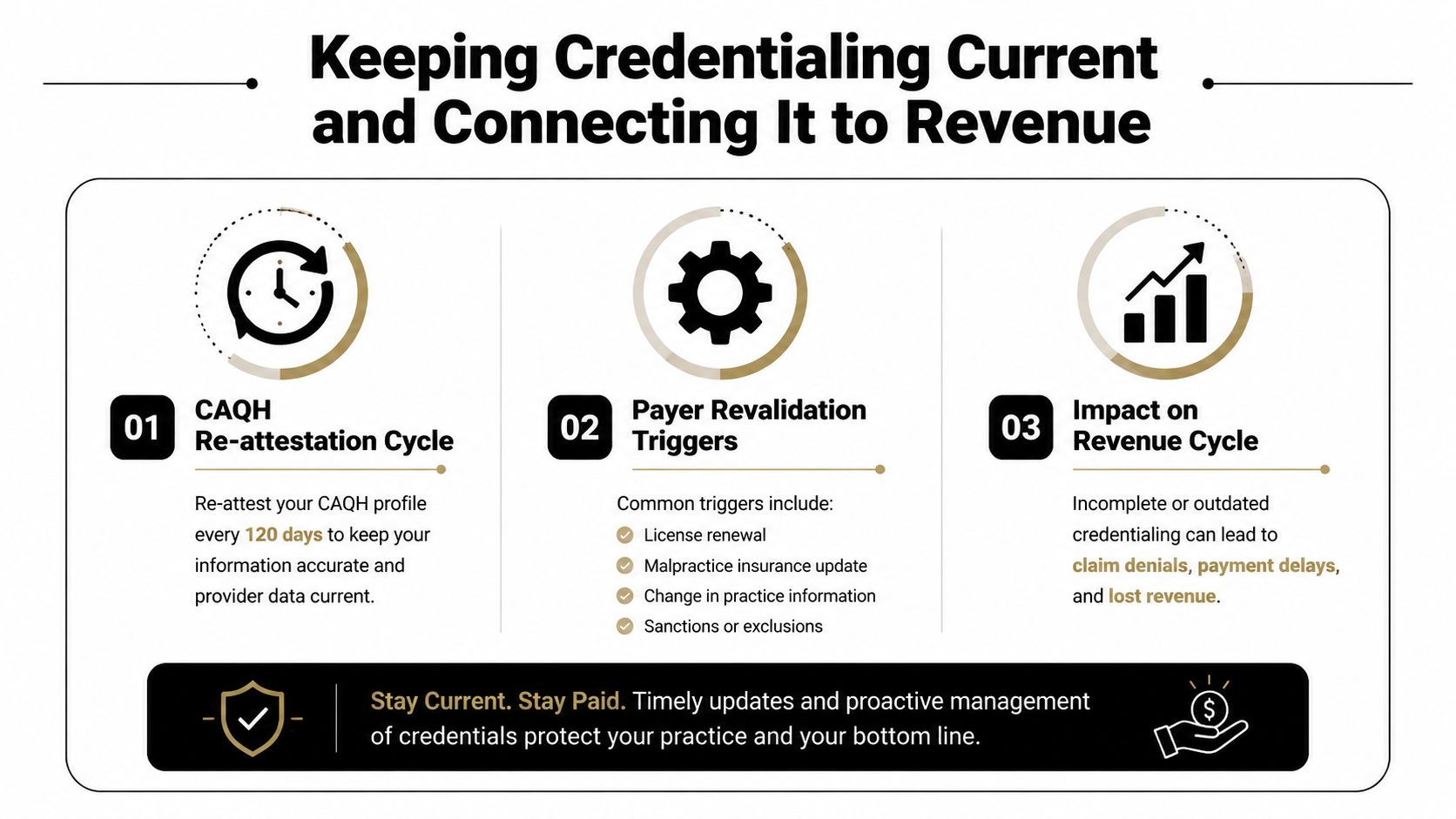
A workable maintenance routine is simple. Track re-attestation dates, watch license expirations, log payer notices, and keep the billing team aware of any status change before claims go out. If a contract is active but the credential file isn't current, the practice can still lose clean reimbursement on work already performed.
What happens if you miss re-attestation? The practical answer is that the profile can lapse, and reactivation becomes a new administrative problem. Can you backdate an effective date? Not safely enough to count on it. The better play is to keep the maintenance loop tight so the revenue cycle doesn't have to absorb an avoidable delay.
RevGuard works with specialty practices, ASCs, hospitals, and multi-state platforms that need credentialing to stay connected to reimbursement, not sit isolated from it. If your team is managing payer enrollment, CAQH upkeep, or revenue leakage from slow approvals, visit RevGuard to see how its credentialing and revenue protection workflows fit into the broader collections cycle.