

A Type 2 NPI is the 10-digit National Provider Identifier assigned to a healthcare organization, not an individual provider. It's the identifier that sits on the billing side of the claim, so the payer knows which legal entity should receive reimbursement.
If you've ever had a clean encounter generate a denial, a rework note, or a payment that landed under the wrong group, the problem may not have been clinical at all. It was likely an identifier mismatch, and the Type 2 NPI is often the hinge point.
The Claim That Bounced and the NPI Question Behind It
A practice manager sees the same pattern over and over. The visit was documented correctly, the rendering clinician was credentialed, the charge passed scrub, and the claim still came back underpaid or misrouted. The front end looked fine, but the payer attached the payment to the wrong billing entity or couldn't reconcile the organizational record cleanly enough to release payment.
That's where the Type 2 NPI starts to matter in daily revenue work. It's the organizational identifier that sits behind the billing address and legal entity on institutional and group claims, and it is the piece that tells the payer, “Pay this organization, not just the individual who performed the service.”
Practical rule: when a denial smells like a payer can't match the group, the contract, and the tax record, look at the Type 2 NPI before you chase clinical documentation.
For specialty groups, the issue gets expensive fast. A mismatch between the billing entity and the rendering clinician can create avoidable rework, especially when claims crosswalk to the organization's tax records and taxonomy. That's why billing teams, credentialing teams, and contract analysts should treat the Type 2 NPI as part of revenue integrity, not as back-office paperwork. If your clearinghouse edits are clean but the claim still bounces, start by checking whether the billing entity itself is the problem, not just the claim format. A useful reference point for that front end of the claim flow is the clearinghouse process in medical billing, which is where many of these downstream data mismatches first surface: clearinghouse workflow in medical billing.
Defining a Type 2 NPI in Plain Language
What the identifier actually is
A Type 2 NPI is the National Provider Identifier assigned to a healthcare organization, not an individual. CMS describes it as a 10-digit standard identifier issued through the National Plan and Provider Enumeration System (NPPES), and it can belong to organizations such as hospitals, nursing homes, and physician groups. CMS also notes that organizations can have multiple NPIs when different entities or subparts need separate identities. CMS NPI fact sheet
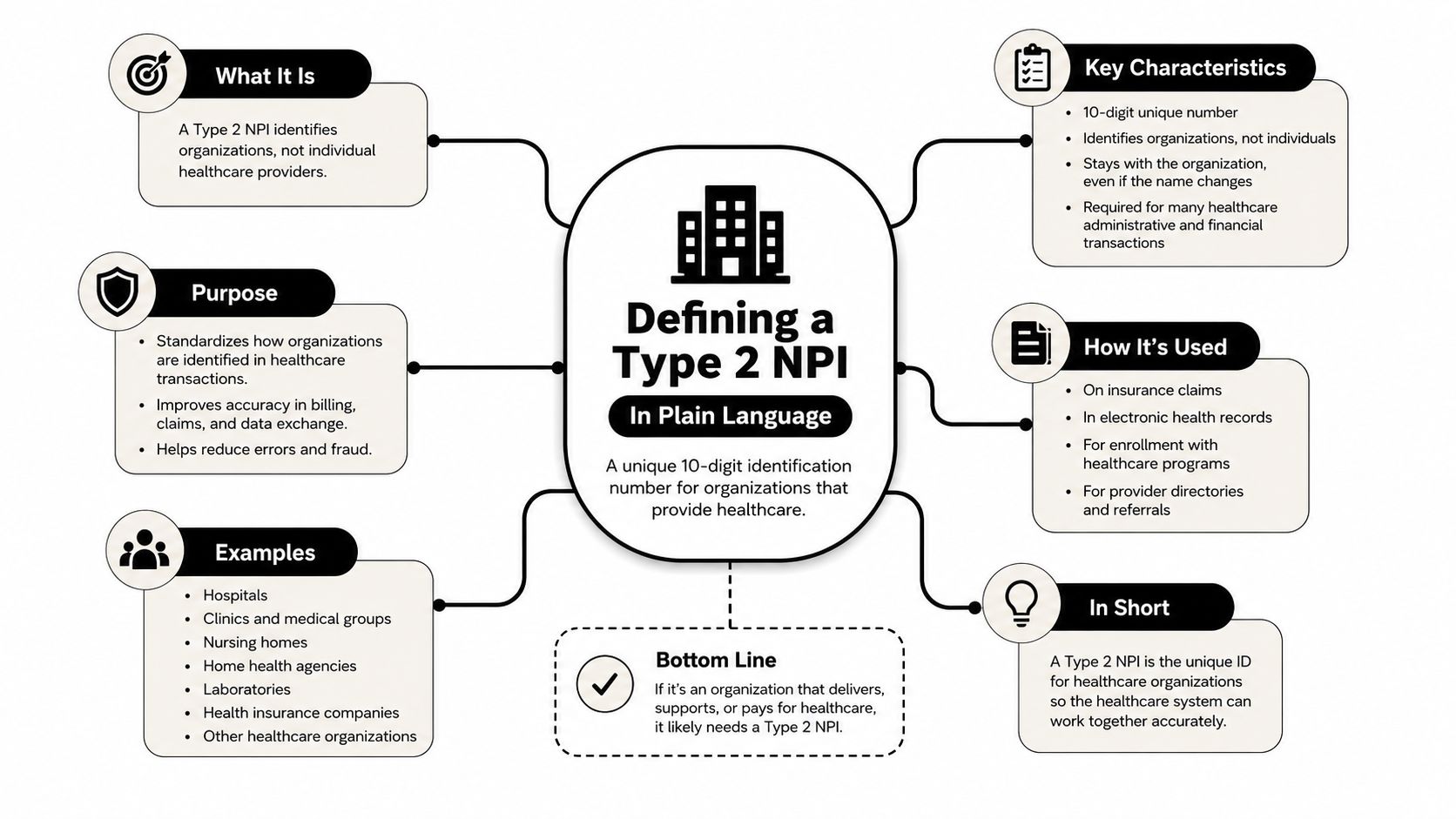
An organizational nameplate within the national registry. The Type 2 NPI doesn't describe the clinician who touched the patient, it identifies the entity that bills, contracts, and receives payment. That's why it belongs to the legal and billing structure of the practice, not to the licensed professional's personal identity.
A clean NPI setup doesn't just help with filing. It determines whether the payer can reliably match the claim to the right organization, address, taxonomy, and payment path.
Who should have one
Hospitals, group practices, nursing facilities, clinics, and other organizations that bill in their own name are the obvious examples. In multi-site or multi-specialty environments, one organization may need more than one Type 2 NPI if different subparts function as separate billing or enrollment entities. That's common when the operational structure of the business doesn't match the way payers want the claim data segmented.
The practical test is simple. If the organization is the one that gets paid, the Type 2 NPI belongs to that entity. If the clinician is the one being identified as the person who furnished the service, that's the Type 1 side of the house. The difference sounds basic, but it's one of the most common places where registration data, W-9 details, and payer files drift apart.
Type 1 vs Type 2 NPI and Why the Distinction Matters
The distinction matters because the two NPIs answer two different questions. Type 1 identifies the individual clinician. Type 2 identifies the organizational billing entity. CMS notes that Type 2 NPIs separate the billing entity from the rendering clinician, and that separation improves payer data matching and reduces routing ambiguity when claims are crosswalked to the organization's tax ID and taxonomy. Accountable HQ on Type 2 NPI
| Criterion | Type 1 NPI | Type 2 NPI |
|---|---|---|
| Who holds it | An individual clinician | A healthcare organization |
| What it identifies | The person who rendered the service | The entity that bills and receives payment |
| Operational role | Rendering provider identity | Billing provider identity |
| Claim behavior | Travels with the clinician record | Travels with the organizational claim record |
| Common risk if misused | Wrong clinician attribution | Payment routed to the wrong entity |
The mistake I see most often is a team dropping the clinician's Type 1 NPI into the organizational billing field because it “looks right” on the face of the claim. That may get a claim out the door, but it often fails the deeper payer match against the organization's tax ID, taxonomy, or contract file. For group practices and hospital-based specialties, that mismatch can turn into denials, delayed reimbursement, or a claim that pays under the wrong entity and creates cleanup work later.
The safest mental model is this. Type 1 says who treated the patient. Type 2 says who gets paid. Those two answers often belong to different records, and payers expect them to line up correctly on the same transaction.
Why a Type 2 NPI Matters Across the Revenue Cycle
It affects more than claim submission
The Type 2 NPI influences the entire revenue path, not just the final claim form. Eligibility, credentialing, prior authorization, submission, remittance, denial work, and payment recovery all depend on whether the payer can recognize the organization as the right billing entity. If the identifier on file doesn't match the contract structure, the payer may treat the claim as if it belongs to a different provider group or a different subpart.
That's why revenue cycle teams should treat NPI governance as an operational control. A clean organizational NPI supports payer data matching, helps keep enrollment records aligned, and reduces the chance that a claim is kicked back because the payer can't reconcile the legal entity to the active billing record. For a deeper look at the front-end verification work that often exposes these mismatches, see the eligibility workflow overview at medical eligibility verification.
Where the failures show up
The most common failures aren't dramatic. They're the quiet ones that stretch days or weeks of cash flow. A contract exists, but the payer file points to an older address. A specialty group bills under one Type 2 NPI, but the credentialing roster still shows another. A subpart bills independently, yet the payer only knows the parent entity. Each of those problems can produce denials, underpayments, or manual review.
Where teams should watch
- Eligibility and registration: Confirm the organization name, address, and tax alignment before the claim ever starts.
- Credentialing and enrollment: Make sure the Type 2 NPI on payer rosters matches the active organizational structure.
- Claims editing: Verify that billing and rendering identifiers are paired correctly.
- Remittance review: Watch for payments that post to the wrong entity or fail to match the expected contract.
- Denial management: Separate true medical denials from identifier-driven routing errors.
- Recovery work: If the claim paid incorrectly, use the NPI trail to support reprocessing or dispute work.
The practical takeaway is simple. The Type 2 NPI is the connective tissue between who you are on paper and who the payer is paying. When that paper trail is loose, cash leakage follows.
Applying for and Managing a Type 2 NPI
How organizations get enumerated
A healthcare organization applies for a Type 2 NPI through NPPES and chooses the entity information that matches the legal billing structure. That includes the organization name, address, and taxonomy. The taxonomy matters because it helps describe the type of entity the payer is dealing with, and the NPI record needs to stay consistent with the organization's operating reality. For a credentialing-oriented view of how these files should line up, the provider credentialing process guide is a useful operational reference: provider credentialing process.
If the organization has subparts that bill independently, those subparts may need their own Type 2 NPIs. That is where many systems drift. A parent hospital or master practice file may look correct, but a department, location, or specialty division may need its own enumeration so claims don't blur together at adjudication.
What has to stay current
The NPI itself doesn't change, but the data around it can. Address changes, tax changes, mergers, new service lines, and restructures all force a recheck of the organizational record. Payers compare the NPI against the tax ID, roster data, and enrollment files they already have on hand, so stale information creates friction even when the claim format is technically valid.
A practical workflow is to audit the NPPES record first, then compare it to the W-9 on file, the payer roster, and the billing system's master provider record. If the organization has grown into separate locations or service lines, verify whether each one needs its own Type 2 NPI or whether they should still roll up under the same billing entity. The answer depends on how the payer contract, tax setup, and operational ownership are structured.
Operational truth: most NPI problems aren't application problems. They're governance problems caused by growth, acquisitions, or sloppy maintenance after the original setup.
Real-World Examples for Specialty Practices and Provider Groups
An IONM group often runs into this when the rendering professionals and the billing entity are not the same legal structure. The clinicians may each hold Type 1 NPIs, but the group's billing should flow through the organization's Type 2 NPI. If the claims land under a personal clinician identifier instead, payers may misroute reimbursement or question the entity relationship, especially when the group works across hospitals or service lines.
An ASC faces a different split. The facility claim and the surgeon's professional claim are not the same transaction, and the ASC needs its own organizational identity on the facility side. If the wrong Type 2 NPI is used, the payer may process facility charges as though they came from a different entity, which can create underpayment or a claim trail that is hard to unwind.
Air ambulance organizations often have multiple operating bases and tight billing discipline across sites. The mistake there is assuming one identifier can stand in for every location without checking whether the business structure supports that. A PE-backed multi-state platform sees the same issue at larger scale, because regional subparts can require distinct enrollment and billing identities. If the parent NPI is used everywhere, the payer may not match the claim cleanly to the enrolled entity.
Hospital-based specialty groups run into another version of the same problem. The professional service may roll up under one Type 2 NPI, but the reporting and payment path can break when a sub-specialty, location, or ownership layer is left out of the setup. That's where disputes become more than back-end cleanup, because the payer's record no longer reflects the way the organization operates.
Common Pitfalls and Misconceptions That Drain Revenue
The biggest misconception is that a Type 2 NPI is a one-time setup item. In practice, it needs ongoing oversight because organizations change, payers change their files, and billing structures evolve after acquisitions or service-line expansion.
The errors that keep showing up
- Using a Type 1 NPI in the billing field: This confuses the payer about which entity should receive payment and often leads to routing issues.
- Keeping an acquired group's old NPI structure: If taxonomy, address, or legal entity data weren't revalidated after the transaction, the payer file can fall out of sync fast.
- Letting payer records drift from NPPES: Even a correct NPI can cause trouble if the payer's version of the organization no longer matches the active record.
- Skipping subpart NPIs where they're needed: Independent sites or divisions that bill separately can't always live under a single umbrella record.
- Ignoring Medicaid roster alignment: State programs may have their own enrollment expectations, and a mismatch there can stop payment just as easily as a commercial payer issue.
Each of those mistakes can create denials, recoupment risk, or an underpayment that only becomes visible when someone reconciles remittance to contract terms. In specialty settings, that often means a slow leak instead of a clean rejection, which is harder to catch and easier to normalize.
The fix isn't complicated, but it does need discipline. NPI hygiene belongs in the same conversation as payer enrollment, contract maintenance, and payment variance review. If the organizational identity is wrong, every downstream process has to work harder to compensate.
Putting It Together With a Practical NPI Audit Plan
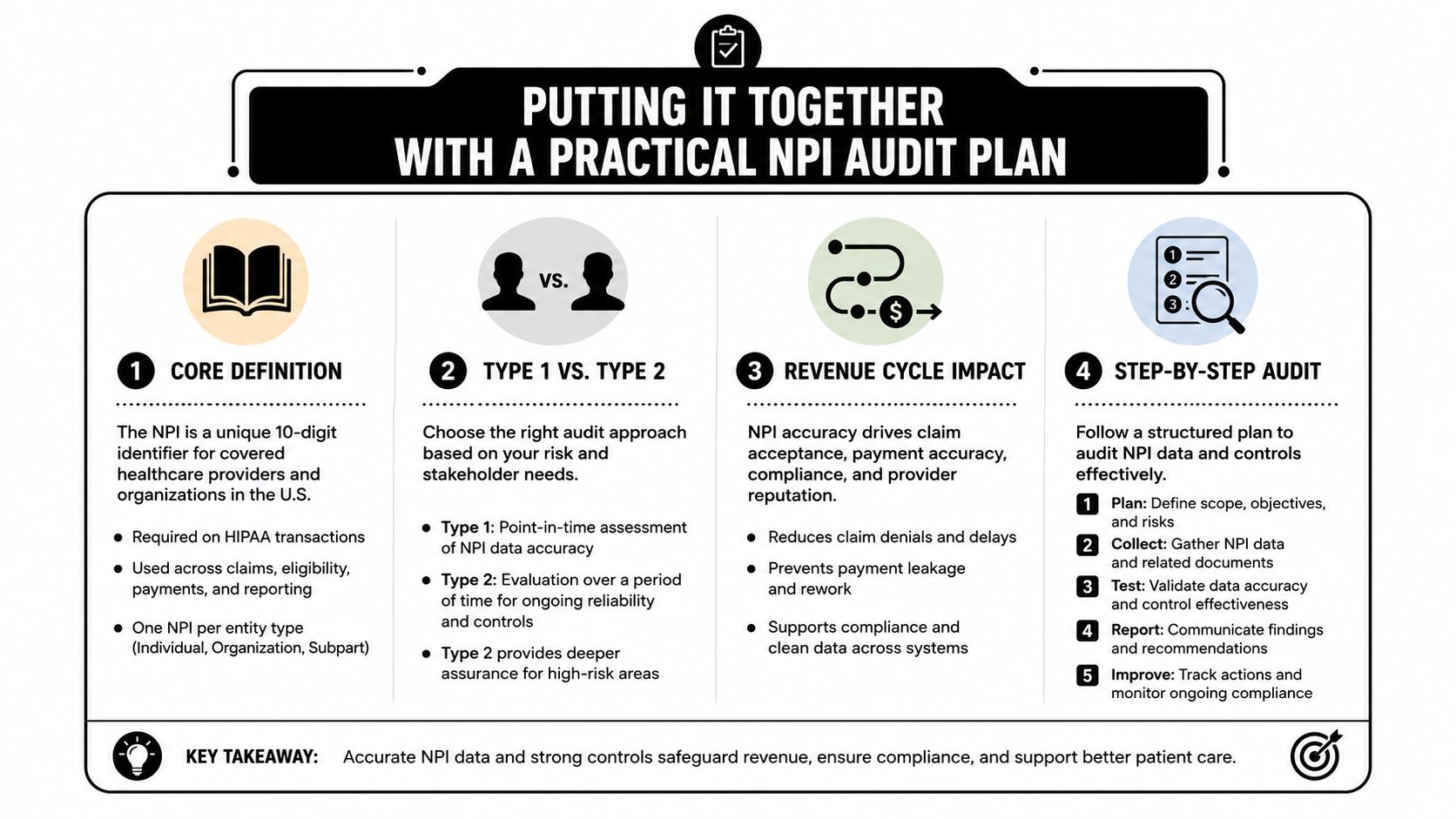
Start with the active NPPES record and confirm that the Type 2 NPI, legal name, address, and taxonomy still match the organization you're billing under today. Then compare that record to the W-9, payer rosters, and internal provider master files, because the claim only routes cleanly when those sources tell the same story.
Pull a sample of recent claims across your highest-volume specialties and check whether the billing entity and rendering clinician are paired correctly. If the organization has subsidiaries, newly acquired groups, or independently billing subparts, verify that each one has the right organizational setup and that no site is borrowing an NPI that belongs to a different legal entity.
If you find underpayments tied to identifier mismatch, route the issue to credentialing and reimbursement recovery together. In multi-state and specialty platforms, that's where the revenue loss becomes visible, and that's also where identifier discipline keeps you from repeating the same mistake in the next claim cycle.
If your team is wrestling with denials, underpayments, or payer disputes that start with the wrong organizational record, RevGuard helps connect the revenue cycle back to the identifiers that control payment. Visit RevGuard to see how a specialty-focused revenue protection workflow can help you tighten NPI governance, reduce claim leakage, and recover money that should've been paid correctly the first time.