

CPT 90750 is the product code for the recombinant zoster vaccine, Shingrix, and it's billed per dose with an administration code such as 90471 plus diagnosis Z23. If a shingles claim is missing any one of those pieces, it's usually the part that gets denied, delayed, or underpaid.
That's the challenge most billing teams run into after a claim that looked clean in the EHR comes back with a payer edit. The vaccine itself is simple, but the claim is not, because product, administration, and diagnosis are three separate billing decisions, and payers don't merge them for you. A correct shingles workflow also has to survive payer variation, legacy coding confusion, and the fact that the vaccine is delivered as a series, not a one-time event. Eligibility review before the patient gets to the chair helps, and a strong first pass starts with a verified benefit check like medical eligibility verification.
The Coding Problem Behind Every Shingles Vaccine Claim
A shingles vaccine encounter can look routine and still fail for a very ordinary reason. The front desk confirms the patient, the nurse gives the injection, the note gets signed, and then the claim stalls because one field was built for the vaccine, one for the administration, and one for the reason the patient was there. If those three items do not line up, the payer often treats the claim as incomplete rather than late.
Why the claim is really three decisions
For herpes zoster vaccine CPT code billing, the first decision is the vaccine product, not the shot itself. The second is the administration service, which is separate from the product. The third is the diagnosis, which tells the payer why this encounter belongs in the immunization bucket instead of another clinical category.
Practical rule: never assume the vaccine code alone will pay the visit. The product line tells the payer what was used, but the administration line and diagnosis code tell the payer what service happened and why.
That is why most clean claims are built as a small bundle, not a single CPT entry. In practice, the payer wants to see 90750 for the vaccine product, an administration code such as 90471 or the plan's equivalent, and Z23 for the immunization encounter. If the diagnosis points to an active disease state while the service was preventive vaccination, or if the administration line is missing, the claim can fall apart even when the shot was given correctly. Eligibility review before the patient gets to the chair reduces that risk, and a strong first pass starts with a verified benefit check like medical eligibility verification.
What usually breaks first
The failure point varies by practice, but the pattern is consistent. Some claims miss the administration code, some misroute the diagnosis, and some carry a legacy vaccine code that no longer belongs in current workflows. Coverage problems can make matters worse, because the claim may be coded correctly and still deny if the benefit path is wrong. Billing teams have to think in terms of claim structure, not just code lookup.
The safest operating model is to audit shingles vaccine claims the same way every time, product first, administration second, diagnosis third. Once that order is locked, denials become easier to isolate and fix.
Anatomy of a Complete Zoster Vaccine Claim Line
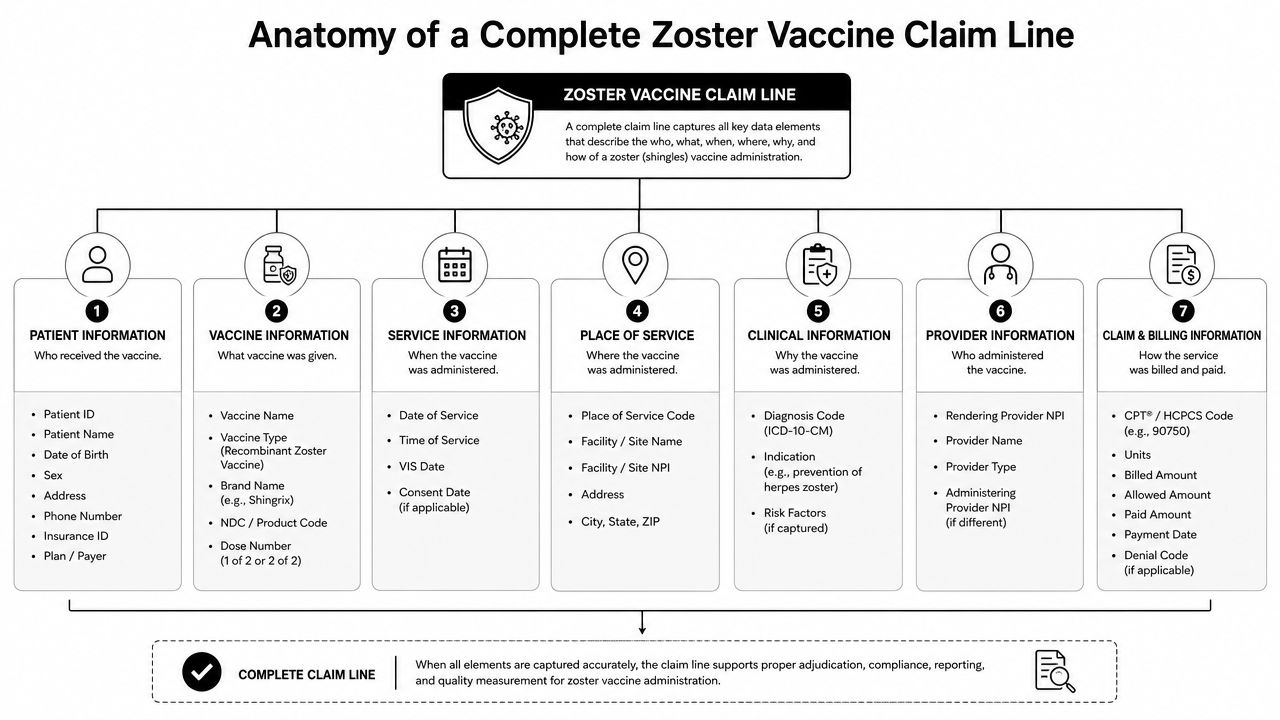
A shingles vaccine claim line looks simple on the screen, but the payer evaluates several pieces at once. The product code identifies the vaccine itself, the administration code pays for the act of giving it, and the diagnosis connects the service to preventive immunization. If any one of those pieces is wrong or missing, the claim may still process, but the payment result can change.
The product code sits at the center
90750 is the CPT product code for the recombinant zoster vaccine, Shingrix. It identifies the vaccine product itself, which is different from the administration service. The product line can only stand on its own if the vaccine was supplied and administered, and the chart still has to support the encounter with the right dose, route, and site.
The payer reads that line as what was given. It does not tell the payer who administered it, when the injection occurred, or whether the visit had any other billable component. That is why the record has to support the line with clear documentation, not just a code entry.
Administration and diagnosis are separate decisions
The administration service is usually reported with 90471 or the payer's equivalent, while Z23 is the usual diagnosis for immunization billing. If the claim only carries 90750, the product is documented but the work is not. If it carries 90471 without the product code, the payer sees an injection but not the vaccine itself. If Z23 is missing, the claim can read like a treatment visit instead of a preventive immunization encounter.
Clean vaccine claims are plain on purpose. They show the vaccine, the injection service, and the preventive diagnosis without making the reviewer guess.
The best audit check is the same one a payer applies. Confirm what was given, what service was performed, and why the claim belongs under preventive immunization. If those three points are visible in the claim and the chart, the line is much easier to defend when payment is questioned.
Why 90750 Replaced 90736 and What That Means for Billing
Legacy shingles references still create confusion in billing offices, especially when older training materials or archived claims show 90736. That code belongs to the older live vaccine, Zostavax, while 90750 is the current billing code for Shingrix and the policy timeline notes that Zostavax was no longer sold in the U.S. starting July 1, 2020, and was considered unavailable for use by November 18, 2020. For current production workflows, that distinction isn't academic, it's claim integrity.
Legacy code, current workflow
If a biller reaches for 90736 on a modern shingles claim, the problem is usually not clinical confusion. It's workflow contamination from an older template, an outdated cheat sheet, or a stale superbill. That can lead to denials, mismatch edits, or unnecessary follow-up when the payer's system no longer expects the live-vaccine code in active use.
The right operational move is simple. Keep 90736 in historical records, appeals involving older dates of service, or claim research. Keep 90750 in live billing workflows. That separation protects both charge capture and audit trail quality.
What to watch for in denials
A denial that mentions a legacy vaccine issue often points to one of two problems. The first is a claim built with the wrong product code. The second is an internal system that still auto-populates old data when staff search by “shingles vaccine” instead of the exact product name. In both cases, the fix is operational, not just coding-related.
The broader lesson is that current herpes zoster vaccine billing should center on recombinant vaccination. The older live vaccine no longer belongs in normal first-pass billing logic, and any form, template, or rule engine that still defaults to it needs to be corrected before it sends another claim.
Coding the Two-Dose Series Correctly
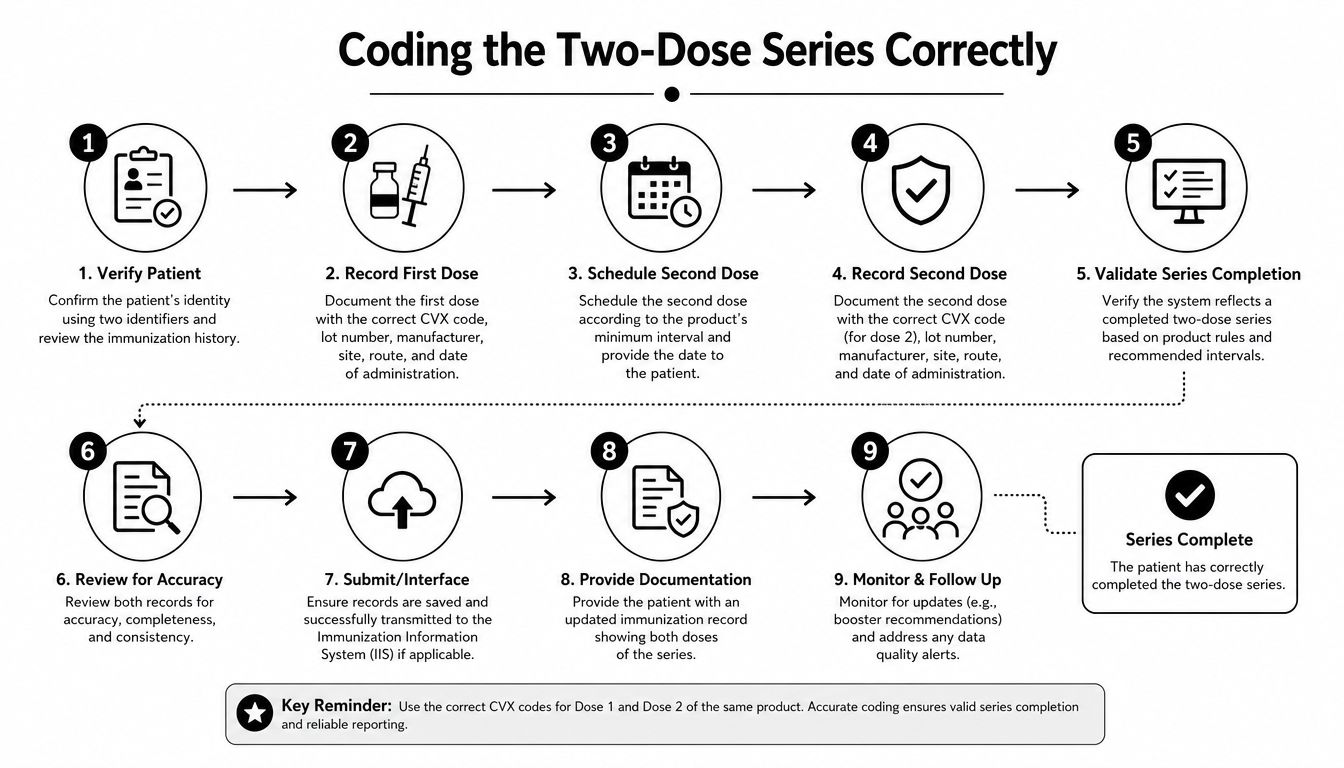
The recombinant shingles vaccine tied to 90750 is not a one-and-done event. It's a 2-dose series, with CDC guidance calling for two doses in adults 50 years and older separated by 2–6 months. The same 2-dose series is also recommended for adults 19 years and older who are or will be immunodeficient or immunosuppressed with the second dose sometimes given 1–2 months after the first to complete the series sooner.
Bill each dose as its own encounter
The cleanest way to code the series is to treat each dose as a separate service date. That means one unit of 90750 on the first encounter and one unit of 90750 on the second encounter, with the associated administration code and diagnosis supporting each date of service. Trying to force two units onto one date when only one injection was given is the kind of error that causes a frequency edit or a documentation mismatch.
This also affects how staff think about follow-up scheduling. The chart should clearly show that the patient returned for the next dose, rather than implying the entire vaccine series was delivered at once. Payers and quality systems don't like ambiguity on sequence-based services.
Document completion, not just delivery
A dose recorded without a series tracker can leave the second shot invisible to downstream review. That's where claims teams get burned, because the first dose pays cleanly and the second dose never gets revisited, or the patient comes back and the system has no easy way to confirm what's due. Series completion tracking matters now for both reimbursement and reporting, especially where incomplete dosing can show up as a quality problem.
The live-vaccine era taught billing teams to think in single-shot terms. That's no longer enough. For Shingrix, the claim needs to reflect that dose one and dose two are linked, but billed separately, with enough documentation to prove the sequence without making the payer guess.
ICD-10 Codes That Pair With Shingles Vaccine Billing
For a routine shingles vaccination visit, Z23 is the diagnosis code that usually belongs on the claim. It tells the payer the encounter was for immunization, which fits the preventive vaccine workflow and supports the administration line tied to the shot. When the chart is clean, Z23 is usually enough for the vaccine visit itself.
When Z23 stands alone
If the patient comes in only to receive the vaccine, the diagnosis should stay focused on the immunization encounter. That keeps the claim aligned with the service provided and prevents the payer from reading the line as treatment for active disease. In those cases, adding more diagnosis codes often muddies the record rather than helping it.
When disease codes belong on the same day
A different diagnosis pattern applies if the clinician is also managing active herpes zoster or postherpetic neuralgia on the same date. In that setting, a B02-family diagnosis may be appropriate for the disease-related service, while the vaccination itself can still be billed under the immunization encounter when the documentation supports both services. The key is that the diagnosis field has to match the chart, not a billing shortcut.
Separate the preventive service from the active problem. If the note doesn't clearly support both, the payer may treat the claim as mismatched rather than multi-purpose.
Screening-type diagnoses can come up in broader preventive care workflows, but the vaccine line still needs a clear immunization context. The safest practice is to let the medical record drive the diagnosis pointer, then make sure the vaccine line points to the code that explains the visit. That keeps the claim defensible if it gets selected for review.
Modifiers That Actually Get Applied to Vaccine Claims
Modifiers matter on vaccine claims because the payer wants to know whether the immunization was the only service, part of a broader visit, or repeated in a way that changes adjudication. The most common ones in shingles vaccine billing are 25, 59, 76, and GC, but they don't all do the same job.
Modifier 25 when the E/M was separately identifiable
If the patient sees the clinician for a separate problem and also receives the vaccine, modifier 25 may be necessary on the E/M line when the service is significant and separately identifiable. That's the kind of same-day visit where the payer needs to understand that the evaluation wasn't just a pretext to give the shot. Blue Cross NC's reimbursement guidance explicitly ties modifier 25 to a separately identifiable E/M service and also notes that vaccine administration codes are separately reimbursable when applicable.
Modifier 59, 76, and GC in the right context
Modifier 59 is more about unbundling when another procedure would otherwise cause a payer edit. It's not a default vaccine modifier, so it should only appear when the documentation supports distinct services. Modifier 76 helps when the same procedure is repeated by the same clinician, which can matter in repeat-dose logic or corrected administration scenarios. Modifier GC belongs in teaching-physician situations when the service is performed under the required supervision and documentation rules.
A practical claim pattern might look like this, depending on the encounter:
- 90750 for the vaccine product.
- 90471 for administration.
- Z23 for the immunization encounter.
- 25 on the E/M line if a separate office visit was performed.
- GC only when the teaching-physician framework applies.
The biggest mistake is spraying modifiers onto every claim line just because a denial happened once. Payers usually respond better to disciplined modifier use than to overcorrected claim noise.
Mapping CPT 90750 to NDC and CVX Codes
A vaccine claim rarely lives in CPT alone. The billing line identifies the service, but the product details often need an NDC on the claim and a CVX code for registry or immunization system reporting. That's why vaccine workflows work best when billing, inventory, and public-health reporting all pull from the same source of truth.
| CPT | Product | Typical NDC Format | CVX Code | Dose Series |
|---|---|---|---|---|
| 90750 | Shingrix recombinant zoster vaccine | 11-digit NDC format from vial or carton, often entered as 5-4-2 or 5-3-2 | 187 | 2-dose series |
Why the product identifiers matter
The CPT code answers the billing question. The NDC answers the supply question. The CVX code answers the immunization registry question. If the product line is entered with the wrong package identifier, the claim can still look “coded,” but the product traceability breaks down.
A point-of-service workflow helps most here. Staff should pull the NDC from the actual vial or carton used, then verify the format rules before the claim goes out. That avoids the common problem of billing a vaccine line with a correct CPT code but an unusable product identifier.
The larger operational benefit is consistency. When the same vaccine is identified the same way in the charge ticket, the inventory log, and the registry feed, staff spend less time reconciling mismatches later.
Common Denial Reasons and How to Resolve Them
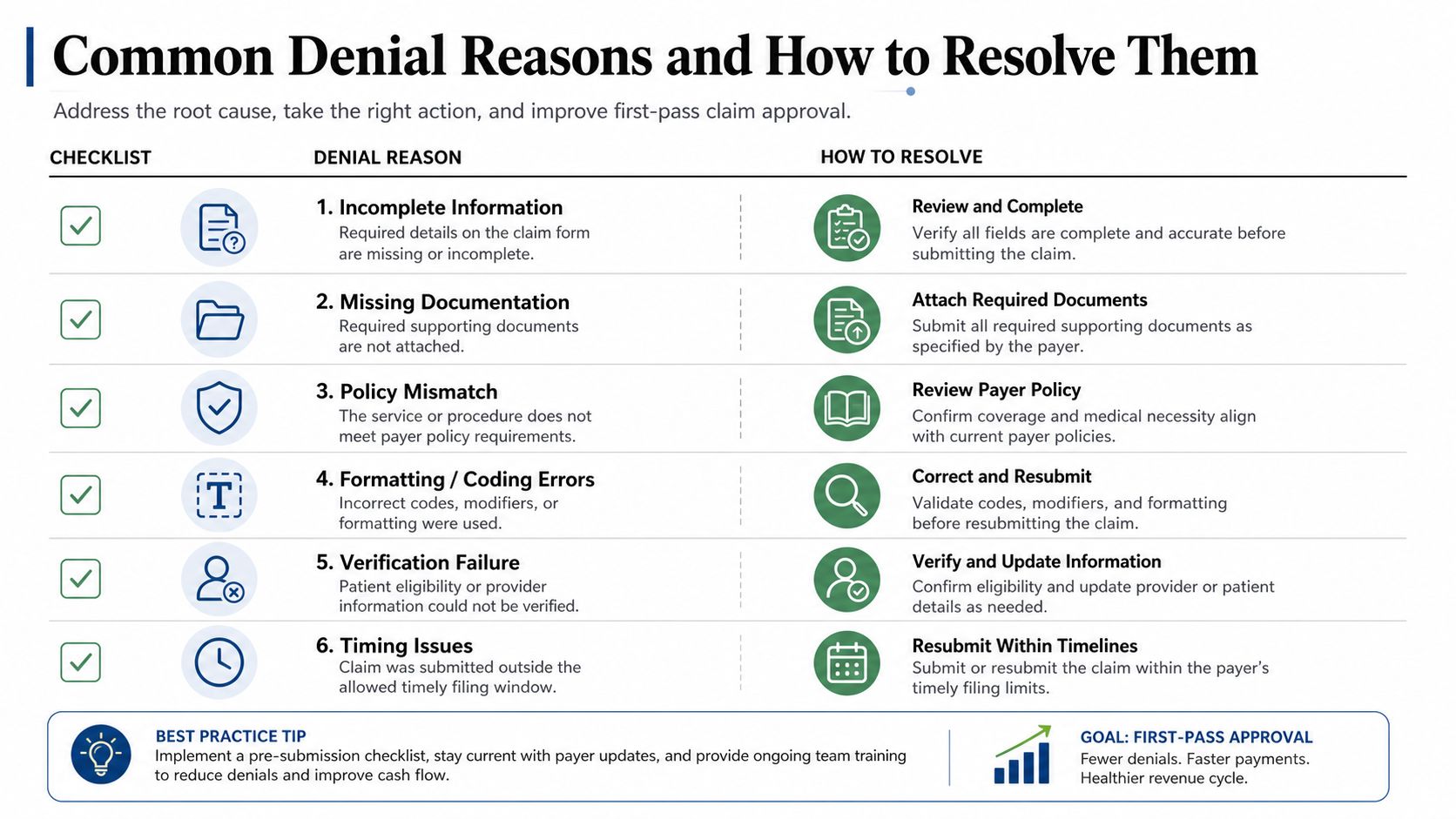
The most common shingles vaccine denials usually fall into a few predictable buckets. Once you know the pattern, you can correct the claim instead of writing it off. The trick is to separate the clearinghouse fix from the payer appeal from the operational fix, because each one solves a different problem.
The denials that show up most often
Benefit routing problems are a big one. Some vaccine services sit under one coverage path while others route differently, so a claim can be coded correctly and still land in the wrong benefit bucket. Missing or incorrect NDC is another common cause, especially when the product line is right but the package details are incomplete.
Frequency edits can happen when the second dose is billed too early or the series history isn't visible to the payer. Diagnosis-pointer mismatches show up when the vaccine line points to the wrong diagnosis or when the immunization encounter isn't clearly documented. Place-of-service errors can also cause trouble if the vaccine is administered in a setting the plan doesn't process the same way as the physician office.
How to respond without wasting time
Start with the claim itself. Recheck the product code, administration code, diagnosis, and NDC together before you resubmit. If the issue is coverage routing, fix the eligibility workflow so the next patient doesn't get the same denial. If the issue is series timing, tighten your dose-tracking logic so staff can see when the next shot is due.
The operational pattern is simple. The first response should be correction, not escalation. If the payer still won't move after a clean resubmission and the documentation is solid, then the claim has become a dispute rather than a coding error.
Documentation Practices That Survive an Audit
The chart has to support the claim line, not just the vaccine event. Auditors look for details that prove the right product was used, the right route was taken, and the right clinician documented the encounter. If those details are missing, even a correctly coded claim can be vulnerable.
What should be in the note
At minimum, the record should show the vaccine lot number, manufacturer, expiration date, anatomical site, route of administration, date and time, ordering provider, and administering clinician. If the patient declined or deferred vaccination, that refusal or deferral should also be documented. These details are what make the claim defendable if the payer asks how the service was delivered.
The strongest templates capture the data at the bedside or injection station, not after the fact. That matters because staff tend to remember the vaccination event, but they don't always remember the product-level details once the schedule gets busy.
A few EHR templates fail in predictable ways. They store the vaccine name but not the lot number, or they capture the administration note without tying it to the ordering provider. Those gaps are the kind that look minor until an audit or an appeal needs to prove the claim was right all along.
For practices trying to tighten chart standards, clinical documentation improvement is the right lens. The goal isn't more text, it's the specific data elements that support payment and withstand review.
When Denials Become Disputes, Appeals, or IDR
Not every shingles vaccine denial should go to a formal dispute. Some are plain rework, some need a payer appeal, and some only become worth escalating when the coverage path or payment decision won't move despite clean documentation. That's especially true when benefit routing gets messy between medical and pharmacy handling or when the payer underpays after accepting the claim.
The escalation ladder
Start with clearinghouse rework if the issue is technical. Move to a written appeal when the claim was submitted correctly but the payer still denied or underpaid it. If the denial turns on payer interpretation or a payment conflict that isn't resolved by ordinary appeals, that's when formal dispute handling becomes relevant. For eligible claims, the final step can be Independent Dispute Resolution under the No Surprises Act, which sits outside routine claim correction.
The important distinction is that IDR isn't for basic coding mistakes. It's for situations where the claim is already built correctly and the fight is about payment, routing, or enforceable adjudication. That's why clean documentation and correct billing matter so much before escalation. The better the upstream claim, the stronger the downstream dispute package.
If your process gets to that point, No Surprises Act guidance is worth keeping close because the evidence package has to show the payer's decision, the billed service, and why the amount in dispute belongs in a formal track rather than another round of routine follow-up.
Quick Reference Cheat Sheet for Daily Use
The fastest way to keep shingles vaccine claims clean is to use the same checklist every time.
- Product code: 90750 for Shingrix, not 90736 for current billing.
- Administration: report the injection service separately, commonly 90471 or the payer's equivalent.
- Diagnosis: Z23 for the immunization encounter unless the visit includes an active disease service.
- Series logic: bill one unit per dose, on separate service dates, and track the second dose as a completion item.
- Modifier use: add 25 only when there's a separately identifiable E/M visit, and use GC only when teaching-physician rules apply.
- Product detail: capture the NDC from the vial or carton and keep the inventory record aligned.
- Audit proof: document lot number, manufacturer, expiration, route, site, date, time, and administering clinician.
If the claim looks simple, verify it twice anyway. Vaccine denials usually come from a missing detail, not a hard coding problem.
A useful daily habit is to review the charge before it drops into batch billing. That one pause catches most of the avoidable edits, especially the old-code issue, the missing administration line, and the wrong diagnosis pointer. Keep the series tracker visible, because the second dose is where a lot of otherwise good workflows lose revenue.
If you want a billing partner that treats shingles vaccine claims as a revenue-cycle problem, not just a code lookup, RevGuard can help you tighten charge capture, prevent denials, and escalate underpayments when payer behavior won't correct itself. Visit RevGuard to see how its RCM and IDR workflow can support cleaner vaccine claims and more recoverable revenue.