
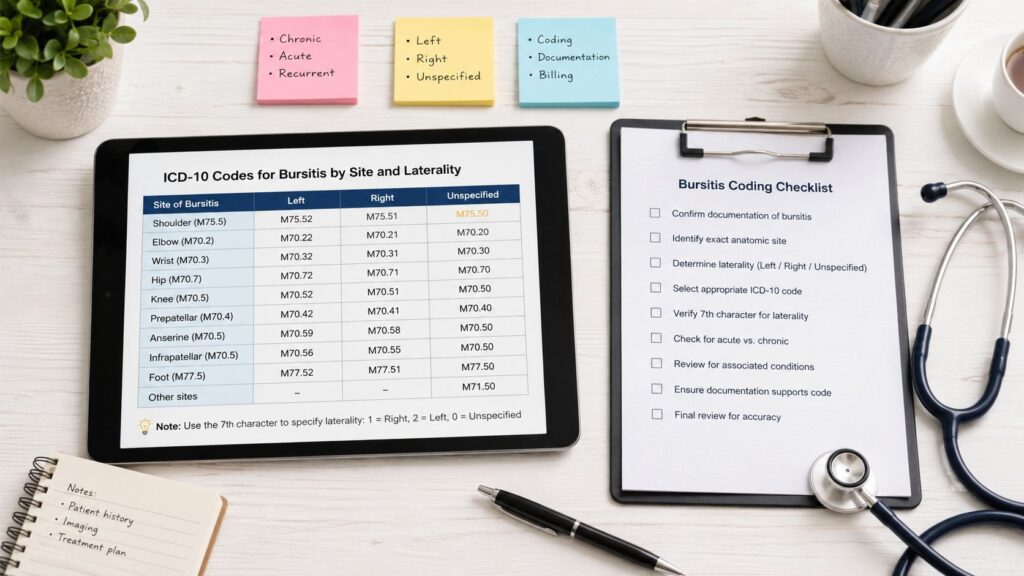
You're reviewing a chart that just says “bursitis,” the claim is waiting to go out, and the coder has to decide whether that one word is enough to survive payer edits. In practice, bursitis ICD 10 isn't a lookup exercise, it's a documentation test, because the code choice lives or dies on whether the note names the site, the side, and sometimes the activity behind it.
That's why the clean-claim problem starts long before adjudication. If the encounter only supports a vague code, the biller is forced into M71.9 or a similar fallback, and the claim becomes vulnerable to rejection, downcoding, or a documentation request that could've been avoided with a sharper note. Practices that want fewer reversals have to treat the diagnosis line as revenue-cycle work, not just clinical shorthand.
Why Bursitis Claims Get Denied Before the Patient Leaves
A common denial starts in a perfectly ordinary exam room. The clinician documents “bursitis”, the claim team sends M71.9, and the payer comes back asking why the anatomical site isn't documented or why the diagnosis doesn't match a more specific code family. That sequence is frustrating because the denial didn't begin on the payer side, it began when the note stopped short of what the code set needs.
The problem gets worse when staff assume all bursitis codes behave the same way. They don't. ICD-10-CM splits bursitis across different families and body sites, so a vague note pushes the claim into a weaker position from the start, even before the payer reviews medical necessity. If your workflow only checks the diagnosis label and not the documentation behind it, you'll keep reworking the same type of claim.
Practical rule: if the note doesn't name the bursa or the joint, don't expect the claim to defend itself.
That's why a denial-management workflow matters at the front end, not just after a remittance comes back. A tighter documentation review, paired with a coding review, prevents the same avoidable edits from cycling through the office queue. For teams trying to reduce rework, the fix is upstream, not after submission, and that's the same logic that underpins denial workflow management in healthcare.
The broader takeaway is simple. Bursitis can look minor on paper, but the claim can still fail if the note is thin. When the chart says too little, the payer has room to question the code, and the practice loses time explaining what should've been explicit the first time.
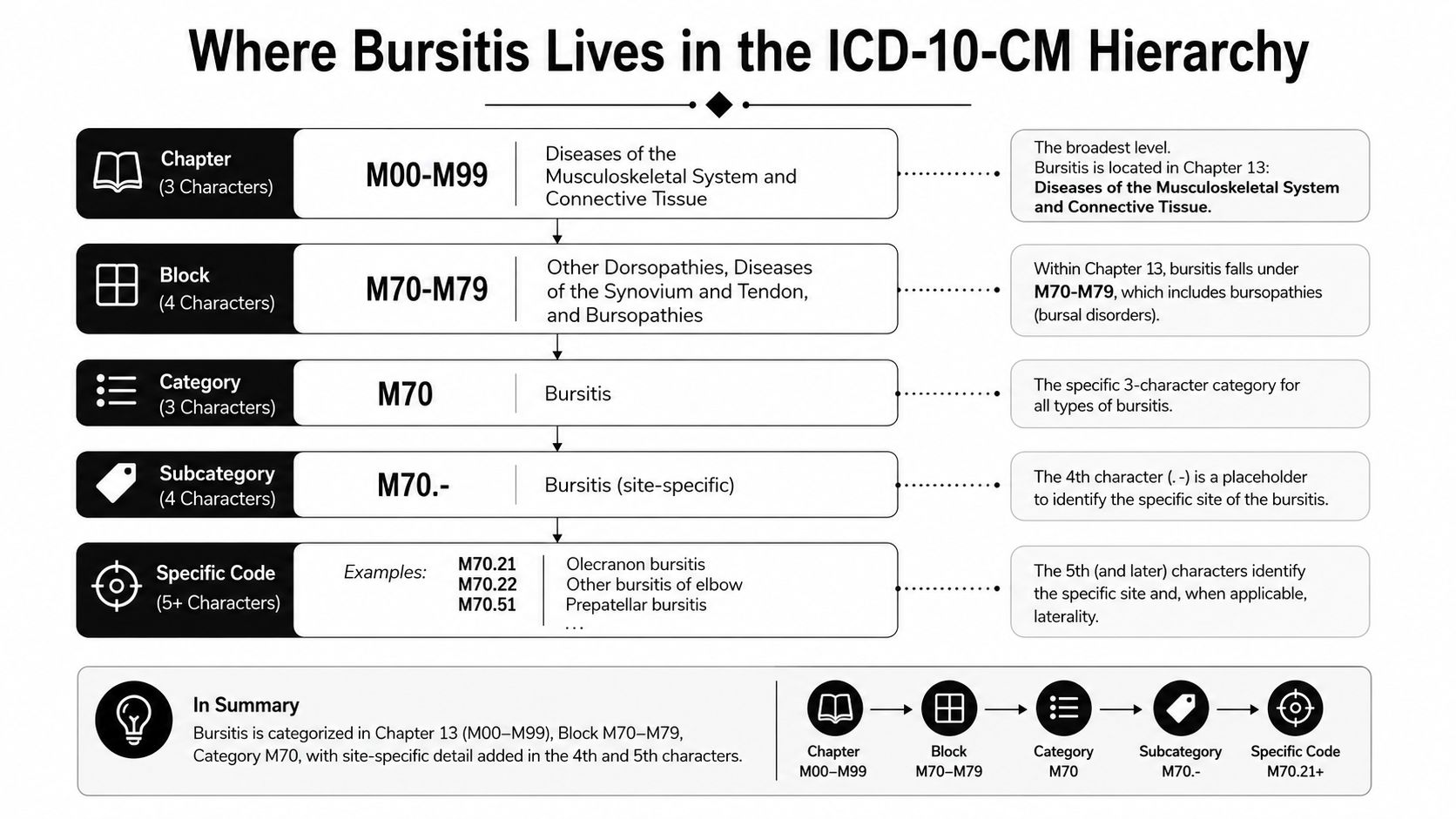
Where Bursitis Lives in the ICD-10-CM Hierarchy
ICD-10 places bursitis in Chapter XIII, the musculoskeletal and connective tissue diseases section, under the soft-tissue-disorder block M70-M79. That matters because coders often search as if there were one universal bursitis code, when the system breaks the diagnosis apart by location and clinical pattern.
The hierarchy is site-driven. In the M70 group, bursitis-related codes explicitly include olecranon bursitis (M70.2), other bursitis of elbow (M70.3), trochanteric bursitis (M70.6), and other bursitis of hip (M70.7), which shows that ICD-10 distinguishes by anatomic site rather than using one generic bucket. That's the first decision point: identify which body region the note supports before opening the code search.
What that means at the desk
If the documentation points to the hip, the coder should be looking in the hip-related bursitis family. If it points to the elbow, the elbow-related entries matter more than a generic bursitis label. If the note never names the site at all, then the code choice becomes a documentation problem, not a memory problem.
The right code family usually appears once the chart answers one question, where is the bursa?
That's why the family name matters as much as the code number. A coder who knows the hierarchy can tell, in seconds, whether the record is headed toward a site-specific code or whether it's stuck at an unspecified level because the clinician didn't write enough.
Site-Specific Bursitis Codes and Their Laterality Variants
| Site | Code Family | Right | Left | Unspecified |
|---|---|---|---|---|
| Shoulder | M75.5 | Use laterality-specific shoulder documentation when the payer workflow requires it | Use laterality-specific shoulder documentation when the payer workflow requires it | Use only when the chart truly does not identify the shoulder side |
| Elbow | M70.2, M70.3 | Laterality-specific elbow documentation may be required in operational workflows | Laterality-specific elbow documentation may be required in operational workflows | Use only when the record does not identify the elbow side |
| Hip | M70.6, M70.7 | M70.61 for right trochanteric bursitis in coding references | M70.62 for left trochanteric bursitis in coding references | Use only when laterality cannot be determined |
| Knee | Knee-related bursitis family, including pes anserine patterns | Use right-sided documentation when supported | Use left-sided documentation when supported | Use only if side is undocumented |
| Ankle and foot | Ankle and foot-related bursitis family | Use right-sided documentation when supported | Use left-sided documentation when supported | Use only if side is undocumented |
| Other or unspecified bursitis | M71.5, M71.9 | Not typically the first choice when the site is documented | Not typically the first choice when the site is documented | M71.9 when the bursa location is not documented |
The important part isn't memorizing every line in the table. It's seeing how often the code family changes once the note becomes more precise. For hip cases, operational coding references also point to M70.61 and M70.62, which is why laterality has to be visible in the chart before the claim leaves the office.
Shoulder cases are similar in one respect, the documentation has to say more than “painful bursa.” Elbow cases do too, especially when the note uses a broad phrase like “bursitis” without identifying the exact anatomic site. When that happens, staff often default to an unspecified code because it feels safer, but that choice is only safe if the site isn't documented.
The cleanest habit is to read the note from the code's point of view. If the record names the joint or bursa, choose the site-specific path. If the record names the side, capture it. If it doesn't, stop and query before sending the claim.
Choosing Between Site-Specific Codes and M71.9
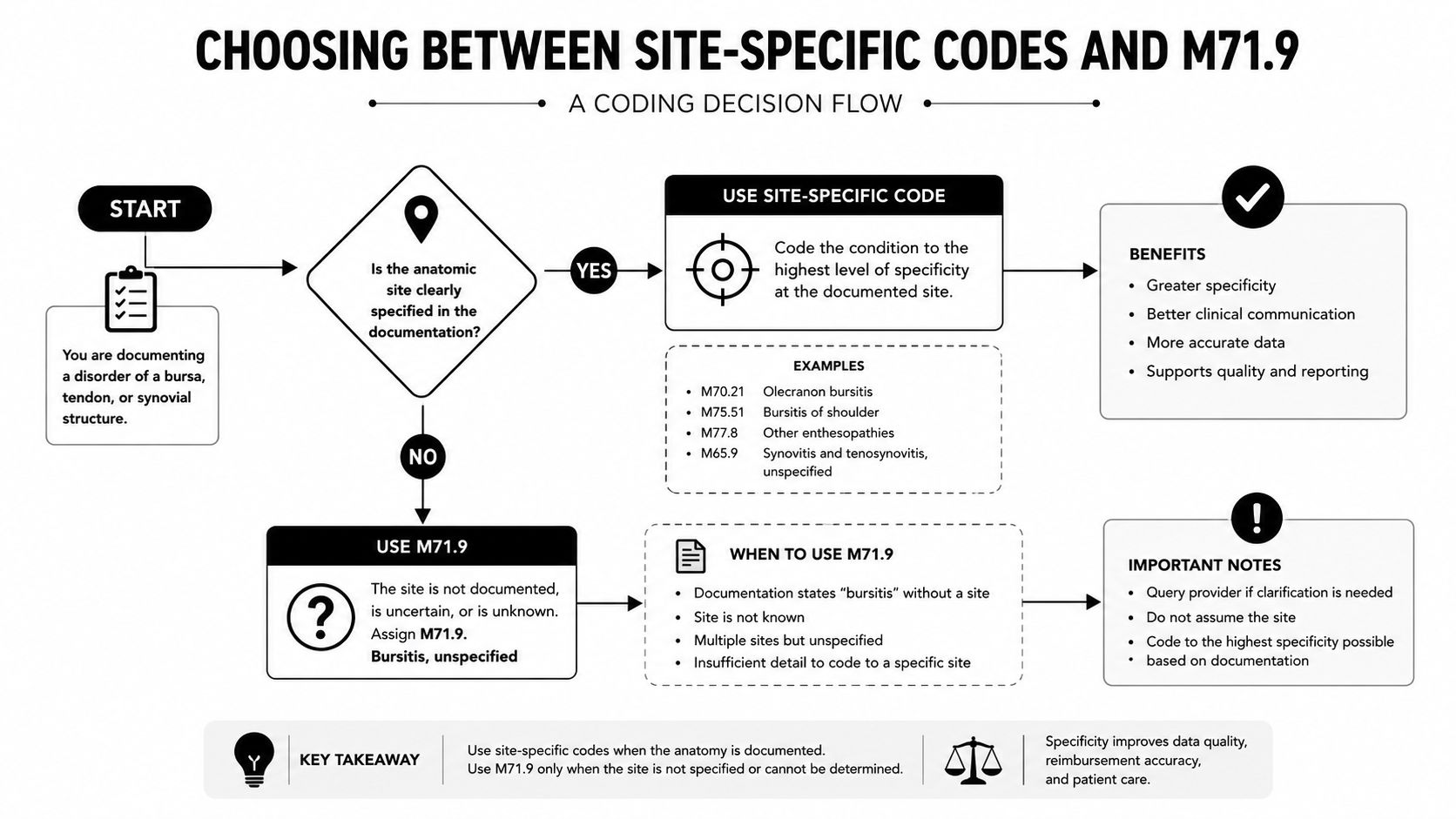
The decision rule is straightforward once you strip away the guesswork. If the site is documented, you should move toward a site-specific code family. If laterality is documented, capture that too, because operational coding workflows for hip bursitis already treat right and left as separate variants in practice. If neither is documented, then M71.9 becomes the fallback, but only because the chart didn't give you enough to do better.
The part most public references gloss over is the documentation threshold. M71.9 is not a convenience code for busy days, it's the code for a record that doesn't identify the location of the affected bursa. That's why coders should resist using it because it's fast.
A simple chart review sequence
- Does the note name the bursa or joint? If yes, use the site-specific path.
- Does the note name right or left? If yes, capture laterality in the claim workflow.
- Does the note identify the activity or cause? If yes, consider whether the external cause code belongs in the claim set.
- Does the note still leave the site unclear? If yes, query the provider before defaulting to unspecified.
Coding rule: unspecified should be a documentation outcome, not a first pass.
That matters because the payer sees a vague record as a weaker claim, not as an honest shortcut. The cleaner the documentation trail, the less likely the claim is to be read as incomplete, and the easier it is for the coder to defend the selected code family when questions come back.
Documentation Requirements That Pass Payer Review
Strong bursitis documentation doesn't have to be long, but it does have to be specific. For shoulder, elbow, hip, knee, and ankle or foot cases, the note should identify the anatomic bursa, the side, the acuity or chronicity, and the suspected cause when that cause is part of the encounter. It should also show whether another musculoskeletal diagnosis is driving the visit.
A good note reads like a claim defense because it answers the payer's likely questions before they ask them. A weak note leaves the coder to infer what the clinician meant, and inference is where denials start. The clearest records use the same language the code set needs, not just the language the patient used at intake.
For teams trying to tighten their charting templates, clinical documentation improvement in orthopedic and ASC workflows usually pays off faster than chasing individual denials after submission. The point isn't to write more, it's to write the right details once.
What each site should show
- Shoulder bursitis: Name the shoulder structure or bursa, state right or left, and note whether the problem is acute, chronic, or recurrent.
- Elbow bursitis: Identify the elbow bursa or olecranon area, specify laterality, and document whether trauma, pressure, or repetitive use is relevant.
- Hip bursitis: State trochanteric or other hip bursitis, include laterality, and note whether walking, standing, or another activity worsens it.
- Knee bursitis: Identify the specific knee region, such as pes anserine, and show whether the pain is linked to overuse, kneeling, or another trigger.
- Ankle or foot bursitis: Name the affected location clearly and document whether the issue is localized to one side or remains nonlocalized.
A failed snippet is usually short and vague. “Patient has bursitis” won't hold up well when the code choice depends on location and side. A stronger version might read, “Right trochanteric bursitis with lateral hip pain worsened by walking, exam shows focal tenderness over the bursa, conservative care discussed.”
That difference looks small in the chart and huge on the claim. The first line forces the coder to guess. The second line gives the payer enough clinical context to understand why the selected code fits.
Common Miscoding Patterns That Trigger Denials
The most common error is also the easiest to fix, defaulting to M71.9 when the note names the site. That mistake tells the payer the chart wasn't used fully, and it can trigger a rejection or a request for clearer documentation. The correction is simple, match the code to the documented anatomy instead of reaching for the fastest fallback. For broader compliance habits, teams should fold these patterns into their coding compliance program.
The second mistake is choosing the wrong family altogether. A shoulder code used for elbow symptoms, or a hip code used for a knee complaint, tells the payer the claim wasn't reviewed against the note. Even when the diagnosis sounds close, the anatomy still has to line up.
Five denial-prone patterns
- Unspecified when the site is known: Fix by querying the provider and moving to a site-specific code.
- Wrong code family: Fix by checking the documented anatomy against the code set, not the symptom label.
- Missing laterality: Fix by capturing right or left in the note and the claim workflow.
- Missing external cause when relevant: Fix by adding the activity code when the chart supports it.
- Unbundled diagnosis logic: Fix by ensuring bursitis isn't separated from the primary musculoskeletal picture when the payer expects a single, coherent diagnosis story.
The external cause code issue matters most when the activity causing the disorder is part of the record. If the clinician clearly ties the bursitis to a relevant activity, leaving that out weakens the claim narrative. If the activity isn't documented, don't force it, but do ask whether the note supports it.
The underlying pattern across all five errors is identical. The coder is attempting to salvage a weak chart after the fact. This approach is slower, riskier, and more difficult to defend than addressing the issue while the provider can still clarify it.
Linking Clean Coding to Revenue Protection and Disputes
Good bursitis coding protects revenue because it reduces the payer's room to argue that the claim was vague or unsupported. When a record uses an unspecified code without a genuine documentation gap, it can invite downcoding or partial payment behavior that takes more time to unwind than it would've taken to fix the note first.
That's why coding discipline and payment defense belong in the same conversation. A clean claim starts with the right site, the right side, and the right diagnosis family, so if a payer still underpays, the practice has a stronger paper trail to dispute the decision. In a dispute setting, vague documentation weakens the case before the first file is opened.
The best operational habit is to think in layers. First, make the claim accurate. Second, make the documentation clear enough that a payer can't reasonably say the code was unsupported. Third, preserve that record so any underpayment or downcode can be challenged with confidence.
When bursitis coding is treated this way, it stops being a small admin task and becomes part of broader revenue protection. That's the right mindset for orthopedics, ASCs, pain practices, and outpatient centers that don't want to keep giving back avoidable dollars through preventable coding weakness.
Daily RCM Checklist for Bursitis Coding
- Verify the site: Don't release the claim until the note names the affected bursa or joint.
- Verify laterality: Right, left, or unspecified should be visible in the chart.
- Match the family: Confirm the selected ICD-10 family fits the documented anatomy.
- Check for cause language: Add the external cause code only when the note supports it.
- Scrub M71.9 cases: Query any unspecified bursitis before submission.
- Review payer edits: Flag recurring denials tied to the same location or laterality issue.
- Keep the note and code aligned: If they don't tell the same story, stop and fix the claim.
Treating Bursitis Coding as Upstream Revenue Protection
Bursitis claims don't usually fail because anyone forgot the disease exists. They fail because the note didn't say enough, or the claim team accepted too little specificity on the way out. The fix is a tighter habit, not a bigger backlog.
When clinicians name the site, coders capture the right family, and the billing team checks laterality before submission, the practice stops leaking time on avoidable rework. That's the standard worth building into Monday morning workflows.
If your team wants cleaner bursitis ICD 10 claims and fewer payer fights over site specificity, RevGuard can help you tighten documentation, coding review, and denial defense across orthopedics and ASC workflows. Visit RevGuard to see how a dispute-ready revenue cycle process supports cleaner claims from the start and stronger recoveries when payers still underpay.