

You're staring at a BCBS denial that should've been routine. The therapy note is signed, the codes look right, the patient showed up, and yet the claim is delayed, downcoded, or denied by an affiliate that seems to follow its own playbook. That's the reality for many practices handling Blue Cross Blue Shield psychologist billing, because the payer looks unified from the outside, but it's really a federation of separate affiliates with different rules, directories, and network mechanics.
The cleanest claims usually aren't the ones with the most clinical detail. They're the ones that match the right affiliate, the right credentialing file, the right code set, and the right documentation standard before the claim ever leaves the practice management system. When those pieces line up, payment tends to be far more predictable. When they don't, revenue leakage starts upstream and compounds fast.
Why BCBS Psychologist Claims Get Stuck
A psychologist can submit what looks like a solid claim and still get trapped in payer limbo. The most common reason isn't a single dramatic error. It's a stack of small mismatches, affiliate rules, and workflow gaps that only show up after the claim hits adjudication.
The problem starts before the claim exists
Blue Cross Blue Shield behavioral-health access is routed through member support systems, not one universal national rulebook. Blue Cross Blue Shield of Massachusetts says members do not need a primary care provider referral to see a covered mental health professional, and Blue Cross Blue Shield of Michigan points members to its behavioral health support page and app for care-finding, which shows how access is organized through insurer navigation rather than one shared network structure. The practical lesson is simple, member access and provider billing don't always move in lockstep.
Practical rule: if the member's affiliate isn't identified correctly, everything downstream gets riskier, from eligibility to reimbursement to appeal language.
That's why the same psychologist can see smooth payment on one BCBS claim and a messy denial on another. The affiliate, the network type, and the plan design all matter, and they don't behave like a single national contract.
Small upstream errors create large downstream losses
The failure pattern is usually boring. A claim is billed under the wrong network expectation, the credentialing record doesn't match the rendering provider file, or the note supports therapy but not the exact code chosen. Once that happens, the payer has room to question medical necessity, documentation, or contractual status.
The claim then gets handled as a billing exception instead of a routine transaction. That slows cash, increases staff touches, and makes every correction more expensive than it should have been. It's not a coding problem alone. It's a system problem.
The better model is to think in layers, affiliate verification, credentialing status, clean documentation, and appeal readiness. If any one of those layers is weak, the claim can still fail even when the clinical service was appropriate.
Credentialing with Blue Cross Blue Shield Affiliates
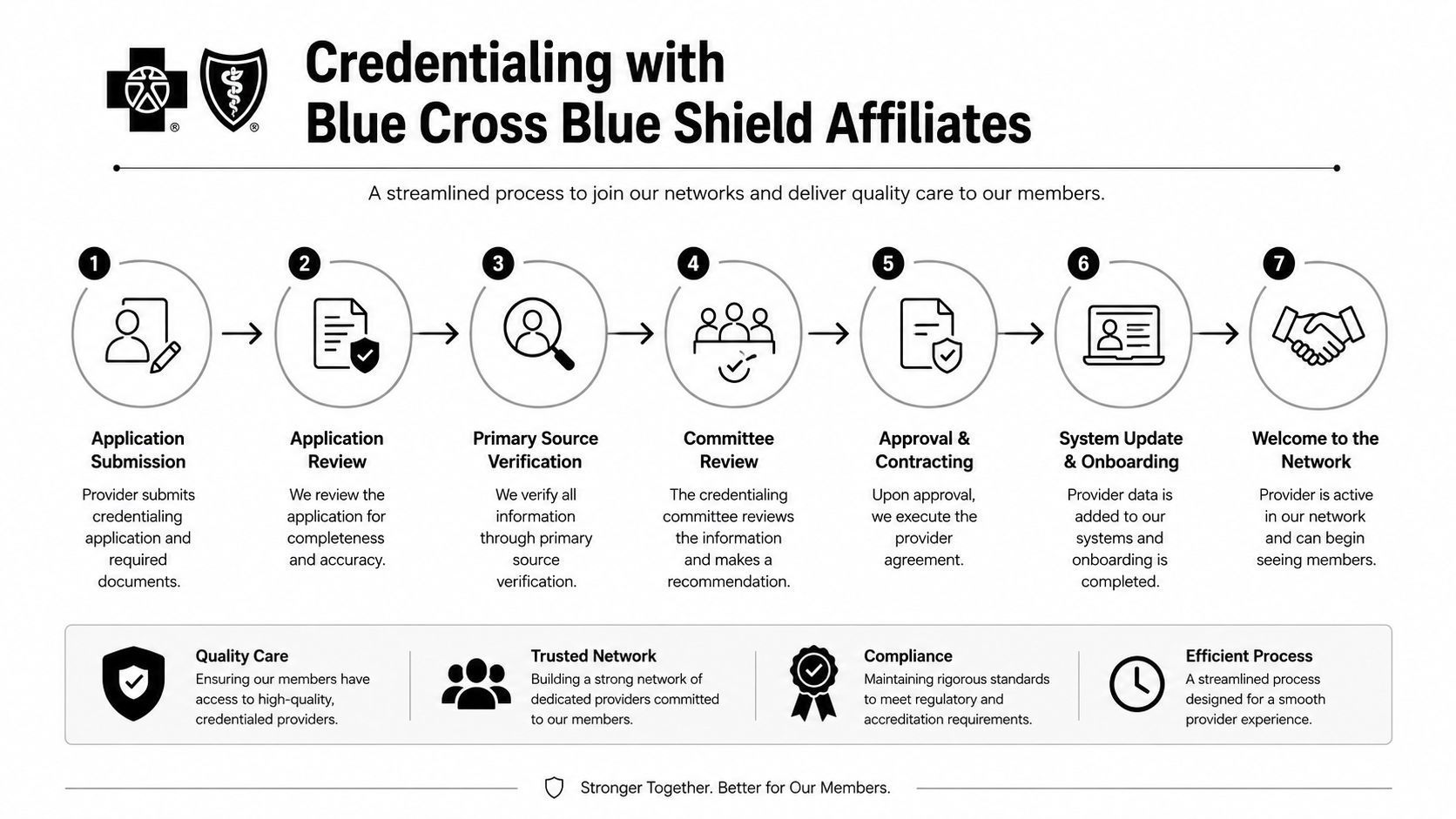
BCBS credentialing only works if you treat it as affiliate-specific work, not national enrollment. BCBS is a federation of independent affiliates, so the first task is identifying the member's specific state affiliate, then verifying the plan's outpatient mental and behavioral health benefits and network rules through that affiliate's directory or member services line. That matters because coverage and billing can differ by affiliate and by network status, which is exactly why one practice can't copy another practice's setup and expect the same result Blue Cross Blue Shield behavioral health guidance.
Start with the member's affiliate, not your assumption
A psychologist's billing team should never assume that a “BCBS patient” means one plan logic. The payer identity has to be narrowed to the actual affiliate first. Once that's clear, the practice can check whether the psychologist is in-network, pending, or out-of-network for that affiliate.
That step changes everything. It determines whether the claim should be billed as contracted, whether a deductible or coinsurance structure applies, and whether the practice needs to prepare for greater documentation scrutiny. The wrong assumption here is expensive.
Clean credentialing files matter more than most practices admit
Incomplete or inconsistent enrollment files are a common reason claims stall later. CAQH profiles need to be current, taxonomies need to match the clinician's actual specialty, and the rendering provider record needs to align with the billing entity. If the credentialing file says one thing and the claim says another, the payer doesn't have to resolve the conflict in your favor.
A good internal checklist should include the following:
- Verify affiliate identification first. Use the specific state affiliate before asking whether the psychologist is covered.
- Match the rendering provider to the credentialed record. Names, NPIs, and practice locations have to line up.
- Keep CAQH current. Stale attestations can slow revalidation and create avoidable gaps.
- Confirm network status before the first visit. Don't wait for a denial to discover the clinician was never loaded correctly.
- Document the benefit pathway. Keep the affiliate directory or member services confirmation with the eligibility record.
For a practical enrollment workflow, practices often keep a separate internal reference for payer setup and revalidation steps like the one outlined in this credentialing process guide. That kind of process discipline matters because credentialing isn't just administrative hygiene. It's reimbursement protection.
Network status affects the payment path
A credentialed psychologist doesn't automatically get paid the same way across all BCBS claims. In-network contracts usually create the cleanest reimbursement path, while out-of-network claims trigger more patient responsibility and more payer review. If the practice doesn't know which lane the visit belongs in, billing errors are almost guaranteed.
The smartest teams verify credentialing before scheduling volume. That avoids retroactive cleanup, patient confusion, and the kind of appeal work that could've been prevented with one tighter front-end verification step.
Submitting Clean Psychologist Claims
A BCBS psychologist claim is easiest to pay when the file is clean before it ever reaches the payer. The claim has to match the note, the coding has to fit the visit length, and the documentation has to show why the service was appropriate. For outpatient psychotherapy, CPT 90837 is commonly used for 60-minute individual therapy, with in-network reimbursement estimates often cited around $100 to $220 per session for psychologists, depending on the affiliate, credential, market, and contract terms provider-facing reimbursement guidance. A separate provider resource places 90834 at roughly $85 to $150 and 90832 at roughly $60 to $120 in-network in 2026, which shows how session length and code selection shape the payment corridor BCBS therapy reimbursement overview.
Match the code to the note
A clean claim starts with service length that supports the CPT code. If the note describes a brief check-in but the claim uses a long psychotherapy code, the mismatch invites review. If the treatment plan is vague, the payer may question whether the service was medically necessary or whether the note supports ongoing therapy.
That is why “close enough” billing fails. The claim has to tell the same story as the chart, and the chart has to tell the same story as the code.
The note doesn't need to be decorative. It needs to prove the billed service happened and why it was appropriate.
Common BCBS Psychologist CPT Codes and Reimbursement Ranges
| CPT Code | Session Length | In-Network Reimbursement Range |
|---|---|---|
| 90837 | 60-minute psychotherapy | Roughly $100 to $220 |
| 90834 | 45-minute psychotherapy | Roughly $85 to $150 |
| 90832 | 30-minute psychotherapy | Roughly $60 to $120 |
These ranges are not guaranteed fees. They are useful reference points for contract review, internal forecasting, and denial triage, because the allowed amount still depends on the affiliate, the contract, and the plan design.
Documentation gaps trigger the most avoidable denials
Missing start and stop times, vague subjective notes, and treatment plans that never change are common weak spots. Psychotherapy claims are especially vulnerable when the documentation reads like a template rather than a clinical record. If the payer cannot see how the service aligns with the diagnosis and treatment trajectory, the claim is easier to deny or underpay.
The strongest claims teams train clinicians to document with billing in mind without turning the note into a billing artifact. That means keeping the note clinically meaningful, but also explicit enough for audit and appeal use. Eligibility verification should happen before the visit, not after the denial, and a structured workflow like medical eligibility verification helps reduce the back-and-forth that hurts cash flow.
Cost sharing changes the patient balance, not just the payer logic
BCBS plans do not all behave the same after submission. In-network copays can often fall between $15 and $80 per session, and BCBS coverage can range from 50% to 100% after deductibles or copays, depending on plan design and contract terms. Another resource notes common cost-sharing patterns like copays around $20 to $60, coinsurance of roughly 10% to 30% after deductible, and some plans requiring full self-pay until the deductible is met provider reimbursement overview.
Those figures are not a reason to guess. They are a reason to verify every plan before the first visit and make sure the patient estimate matches the coverage reality.
Avoiding the Most Common BCBS Denials
BCBS denials usually follow patterns, which means they're preventable more often than teams think. The most expensive mistake is treating each denial like a one-off event instead of a repeatable failure mode. Once the pattern is visible, the fix becomes operational rather than emotional.
Eligibility, authorization, and plan design are the first traps
The first red flag is eligibility drift. A patient may appear active in a scheduling system but have different behavioral-health rules under the actual affiliate plan. The second trap is plan design, especially high-deductible structures that shift more cost to the patient before the payer begins contributing normally.
A clean front-end workflow should check coverage before the appointment, not after the claim rejects. Many practices use a 48-hour verification window because it gives staff time to catch terminations, benefit changes, and network mismatches before the patient is already in the chair.
Practical rule: if the eligibility response doesn't specifically confirm outpatient behavioral health, don't assume the claim will process cleanly.
Documentation and coding errors drive repeat denials
The next cluster is pure claim quality. Wrong CPT code, missing rendering provider detail, wrong place-of-service logic, or notes that don't substantiate the level of service. In psychotherapy, those errors are often subtle enough that staff miss them until the denial comes back.
A denial log helps here. Not just a list of rejected claims, but a structured record of payer reason codes, error type, fix, and outcome. That log shows whether the practice has a coding issue, a credentialing issue, or an affiliate-specific rule issue.
A tight denial workflow reduces rework
Denied claims need triage, not panic. The team should decide quickly whether the issue is correctable, appealable, or both. If the denial came from bad eligibility data, fix the data and resubmit. If the payer rejected the clinical basis of the service, move into appeal prep with the chart and the plan language ready.
The appeal path gets more efficient when the practice can identify the underlying trend instead of chasing each denial separately. That's why denial management systems matter. They keep the team from repeating the same mistake across dozens of claims. A structured workflow like healthcare denial management becomes especially useful when BCBS behavior varies by affiliate.
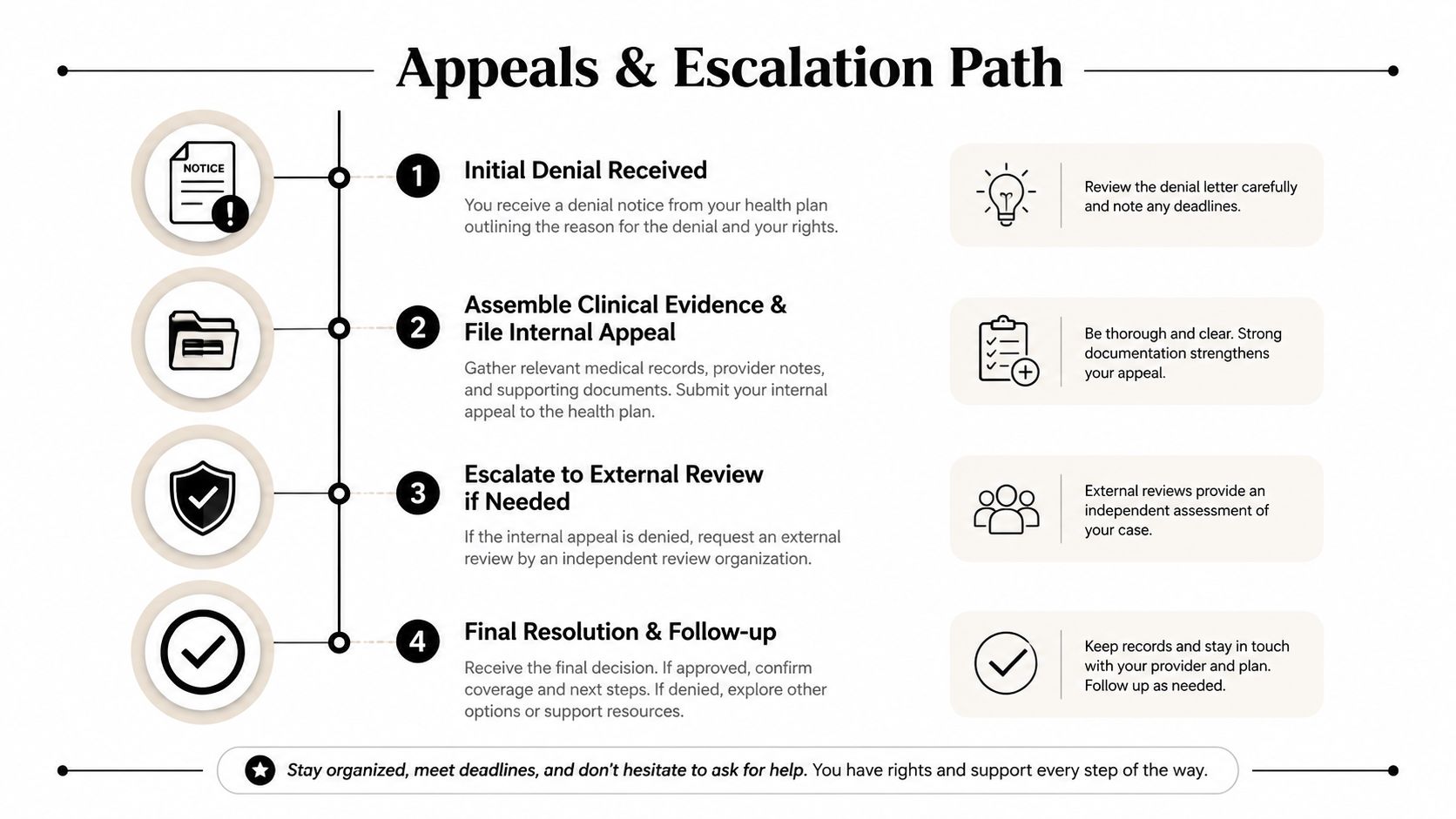
Executing Appeals and Escalation Paths
A BCBS denial or underpayment is rarely fixed by repeating that the psychologist provided appropriate care. The appeal has to answer the payer's stated reason directly, using the denial code, the chart, and the plan language that supports the service billed. If the response does not address the exact issue, the file usually gets treated as a generic reconsideration request and stalls.
Build the appeal around the denial reason
Start by isolating why the claim failed. If the problem is documentation, attach the specific notes, treatment plan, and a short clarification that makes the service easy for the reviewer to follow. If the problem is coding or network status, include the credentialing trail and the billing rationale, not a templated letter that could apply to any specialty.
Strong appeals stay tight, organized, and evidence-heavy. They do not drift into clinical philosophy. They connect the service rendered to the plan rules and to the paperwork already on file.
Appeal principle: the payer should not have to infer the answer. Put it on the first page.
Use escalation when the internal path stalls
Some claims need a second layer of pressure. Formal escalation matters for out-of-network or underpaid claims that fall under the No Surprises Act framework. The Independent Dispute Resolution process gives practices a structured path when ordinary follow-up does not resolve the issue, as long as the claim fits the applicable rules.
Escalation works best when the file is already clean. Eligibility proof, billing records, denial letters, clinical support, and timeline tracking should all sit in one place. If those pieces are scattered, the practice burns time rebuilding the file instead of pushing the case forward.
Treat every unresolved denial as evidence for the next step, not as a lost payment. Each round of review should make the packet stronger, because repeated submissions often show exactly where the payer's decision is weakest.
Keep deadlines and proof in one place
Missed deadlines kill more appeals than weak facts do. Every denial response should be logged with the date received, the response window, the submission method, and the evidence attached. If the team cannot show when the appeal was filed and what was included, the case gets harder to defend.
That administrative discipline matters as much as the clinical argument. Payers respond more predictably when the record is complete, organized, and easy to audit. For stubborn cases, a dispute-ready workflow can turn the denial process into a controlled escalation path instead of an endless back-and-forth.
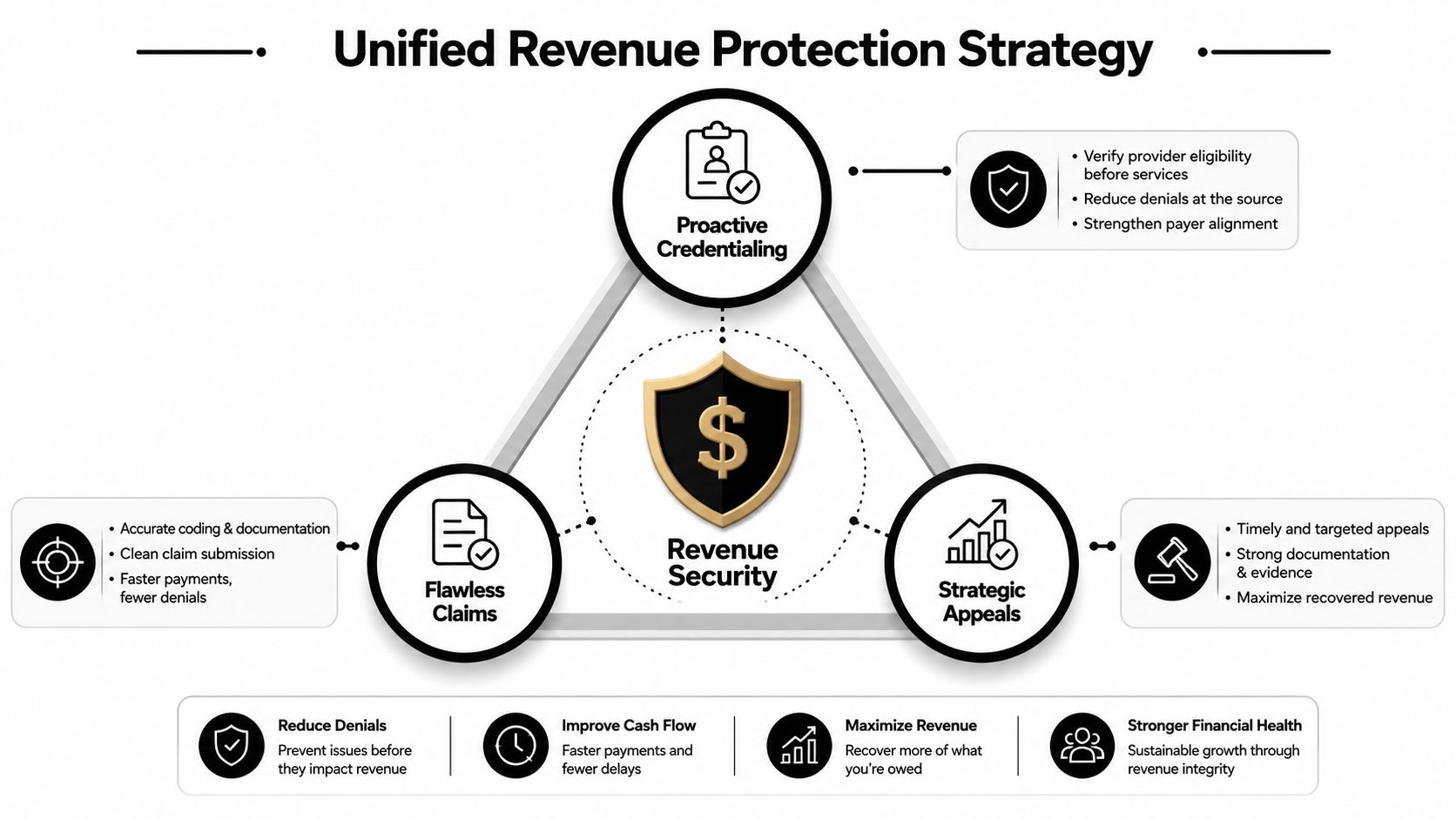
Building a Long-Term Revenue Protection Strategy
Credentialing, clean claims, and appeals work best when they're treated as one system. If a practice only fixes denials after they happen, it spends too much time reacting and not enough time protecting margin. The better model is to use the claim lifecycle as a feedback loop.
Make payer behavior visible
BCBS affiliates don't behave identically, so practices need tracking that shows where friction starts. A clean claim rate, denial categories, and aging balances all reveal whether the issue is front-end verification, coding quality, or post-adjudication follow-up. Without those signals, the team is guessing.
That data should be reviewed by affiliate, by clinician, and by payer behavior pattern. One affiliate may be easy on eligibility but strict on documentation. Another may be the opposite. The practice needs that visibility to decide where to tighten process and where to negotiate.
Tie operations to contract value
If the claim pipeline is messy, contract negotiation becomes weak too. Payers don't reward poor submission hygiene with better terms. They reward clear, durable performance, and they expect providers to prove their case.
This is why operations and finance can't stay separate. Credentialing records need to support the payment path. Claims need to be readable by the payer. Appeals need to be evidence-rich. When all three are aligned, the practice protects revenue instead of leaking it.
Use a disciplined dashboard, not gut feel
A long-term strategy should keep the team focused on a small number of practical indicators:
- Clean claim performance: Are first-pass submissions moving through without rework?
- Denial concentration: Are the same payer reasons recurring?
- A/R aging: Are claims collecting on time or drifting into follow-up queues?
- Affiliate variance: Is one BCBS affiliate creating more friction than others?
- Appeal yield: Are disputed claims recovering, or just consuming staff time?
Those measures turn payer management into an operating system. They also make staffing decisions and workflow changes easier to defend, because the team can point to actual claim behavior instead of anecdotes.
The most resilient practices don't wait for a denial wave to expose weak spots. They keep credentialing current, claims clean, and appeals ready so BCBS reimbursement stays predictable even when affiliate rules differ.
If your practice is dealing with BCBS denials, underpayments, or credentialing gaps, start by auditing one affiliate, one code set, and one appeal file end to end. Then tighten the workflow where the claim first goes off track. For help building a dispute-ready revenue process that protects psychologist payments from credentialing through escalation, contact RevGuard.