
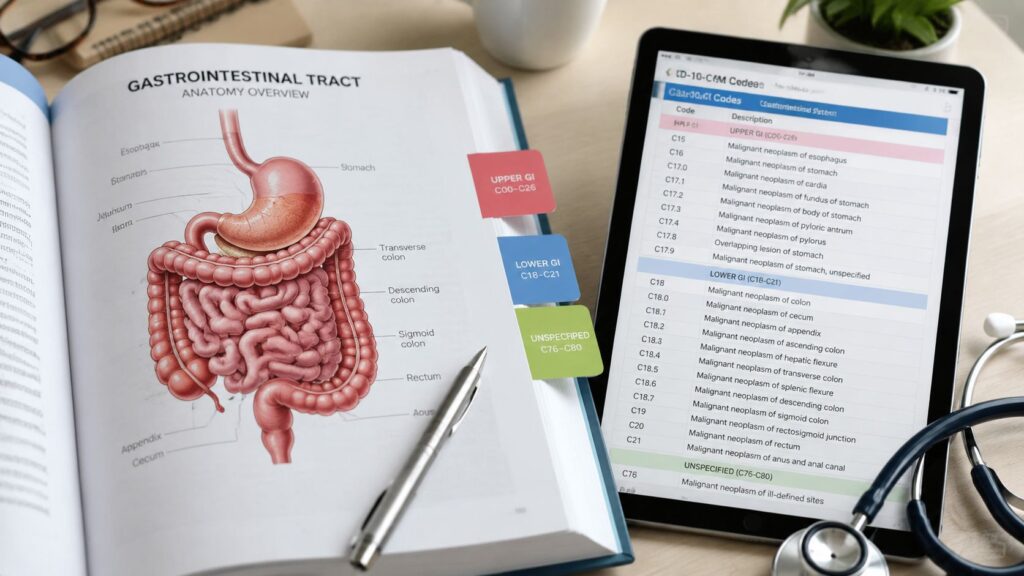
You're in the week that exposes every weak spot in GI billing. The endoscopy note says bleeding, the ED note says melena, the inpatient H&P says GI hemorrhage, and billing still needs one clean diagnosis line that won't get kicked back. If your team keeps defaulting to K92.2 and hoping the rest sorts itself out, that's exactly where denials, undercoding, and messy analytics start.
What This GI Bleed Coding Reference Actually Solves
A gastroenterology practice doesn't need another shallow list of codes. It needs a working reference that tells the coder which diagnosis belongs on the claim, what the physician has to document, and where the payer is likely to push back.
The icd 10 code for gi bleed question is only simple if the chart is vague. Once the source is known, ICD-10-CM expects you to move off the umbrella code and into the anatomical family that fits the record. That's the difference between a claim that looks defensible and one that looks lazy.
Practical rule: if the note names the source, code the source. If it doesn't, K92.2 is the fallback, not the finish line.
That matters because the same presentation can land in different buckets depending on what the provider documents. Upper source, lower source, variceal bleeding, ulcer-related bleeding, rectal bleeding, prior history, and posthemorrhagic anemia are not interchangeable. A practice manager who treats them as interchangeable ends up with avoidable queries and avoidable denials.
This guide is built for the part of the work that moves reimbursement. It helps your team decide which code to assign, what language the physician needs to add, and how to defend the claim when payer edits or medical-necessity reviews hit. It also keeps the conversation grounded in the code families that map to real documentation, not generic “GI bleed” language that leaves money on the table.
Why ICD-10 Has No Single Universal GI Bleed Code
ICD-10-CM is built around location and specificity, not just the fact that bleeding happened. That's why there isn't one universal code that covers every GI bleed cleanly. The system expects you to identify the source whenever the chart supports it.
The standard umbrella code is K92.2, gastrointestinal hemorrhage, unspecified. That code exists for situations where the record confirms bleeding but doesn't yet identify where it's coming from. Once the source is known, the code should usually move to a more specific option.
The code family follows anatomy and etiology
For upper GI bleeding, the code set includes K25.0 for gastric ulcer with hemorrhage, K92.0 for hematemesis, and variceal bleeding codes such as I85.0. For lower GI bleeding, the family includes K92.1 for melena, K62.5 for hemorrhage of anus and rectum, and other source-specific options when the chart supports them. The point is simple, the code should match the documented source, not the symptom alone. See the code family example in the ICD-10 reference table for gastrointestinal hemorrhage and related bleeding codes. ICD-10-CM GI hemorrhage code family reference
| Anatomical Group | Representative Codes | When Used |
|---|---|---|
| Upper GI source | K25.0, K92.0, I85.0 | When the note identifies stomach, esophagus, or hematemesis-related bleeding |
| Lower GI source | K92.1, K62.5 | When the chart identifies melena, rectal bleeding, or anorectal source |
| Unspecified source | K92.2 | When bleeding is confirmed but the source isn't documented yet |
The operational takeaway is blunt. Documentation specificity drives coding specificity, and coding specificity drives claim accuracy. If your clinicians write “GI bleed” without source, the coders are forced into an unspecified bucket that may not reflect the clinical picture.
Why this matters to revenue and analytics
Specific coding isn't only a billing preference. It affects whether your encounter data can support quality reporting, denial analysis, and downstream trend review. A practice that stays in unspecified territory too long makes its own data less useful.
That's also why payer scrutiny increases when records bounce between vague ED language and more detailed procedure notes. The payer sees inconsistency. The coder sees incomplete documentation. The claim absorbs the problem.
Upper GI Bleed Codes and Their Documentation Cues
Upper GI bleeding should not be coded like a generic stomach problem. The chart has to show where the blood is coming from, and the code should reflect that source. If the note only says “bleeding” and never names the lesion, K92.2 may be all you've got for the moment. If the provider documents an ulcer, hematemesis, or varices, use the specific code.
Match the code to the lesion, not the symptom
K25.0 is for a gastric ulcer with hemorrhage. Use it when endoscopy or clear provider documentation identifies a bleeding gastric ulcer. K26.0 does the same job for a duodenal ulcer with hemorrhage. K27.0 fits peptic ulcer, site unspecified, with hemorrhage, when the ulcer is known but the exact site isn't.
K28.0 is for gastrojejunal ulcer with hemorrhage. Don't use it unless the record supports that anatomy. K92.0, hematemesis, belongs when the provider documents vomiting blood. It's a symptom-oriented code, so it's useful when the chart confirms upper bleeding but the source is still under evaluation.
The note needs the site, the bleeding status, and the lesion type. Without all three, you're coding from guesswork.
Variceal bleeding needs even tighter documentation. I85.0 is the bleeding varices code, and I85.1 is the nonbleeding varices counterpart. If the chart says varices are present but there's no bleeding, don't force a hemorrhage code onto the claim. If the chart says actively bleeding varices, document that clearly, because those claims are easy for payers to question when the note is sloppy.
What the provider has to say in the chart
The most defensible notes name the source in plain language. Endoscopy findings should identify the lesion, the bleeding status, and whether there's active hemorrhage or recent stigmata. “Upper GI bleed” alone is not enough when the report already gives you a gastric ulcer, duodenal ulcer, or variceal source.
A clean workflow is to have coders flag any note that stops at hematemesis or melena without a source. That's where a documentation query prevents a bad claim. It's also where your CDI and coding team should stop treating “bleeding” as a complete diagnosis.
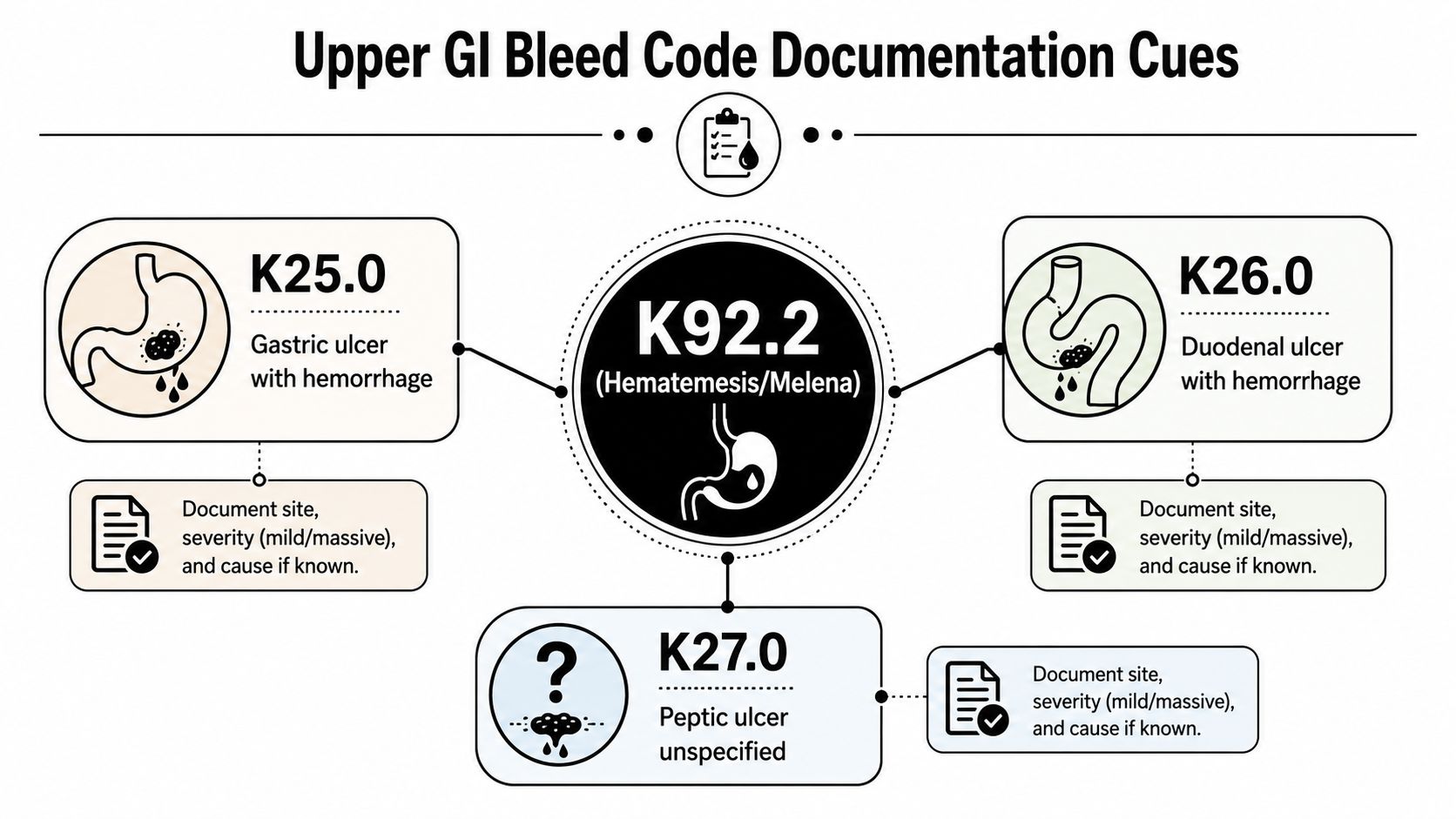
The smartest teams build a source-first habit into the note review. If the provider confirms the lesion, the coder should move off nonspecific language fast. That single step prevents a lot of cleanup later. See the clinical documentation workflow example in this documentation improvement resource.
Lower GI Bleed Codes and Their Documentation Cues
Lower GI bleeding claims fail for one of two reasons. The source is too vague, or the team codes the symptom when the chart already names the lesion. Either way, the payer gets a weak record and the practice gets a headache.
Use the most specific lower source available
K55.21 is the code for angiodysplasia of the colon with hemorrhage. Use it when colonoscopy or another diagnostic study identifies colonic angiodysplasia as the bleeding source. K57.31 is the classic diverticular bleeding code for diverticulosis of large intestine with hemorrhage. K57.33 is for diverticulitis of large intestine with hemorrhage, which is a different clinical picture and should not be treated like simple diverticular bleeding.
K62.5, hemorrhage of anus and rectum, belongs when the record supports a rectal or anorectal source. Don't force it onto hemorrhoid cases if the chart supports a more specific hemorrhoid code. Don't use it for a bleed that's clearly above the rectosigmoid area just because the patient passed bright red blood.
Rule of thumb: bright red blood is a symptom, not a code. The source decides the code.
Don't blur small-bowel and large-bowel bleeding
The mistake I see most often is source drift. An ED note says lower GI bleed, the colonoscopy shows diverticulosis, and the discharge summary still sits on K92.2 because nobody cleaned up the final diagnosis. That's sloppy coding, and payers notice it.
If the source is in the colon, code the colon source. If the record only supports rectal bleeding, keep it at the anorectal level. If the provider documents a lower bleed but hasn't localized it yet, K92.2 is acceptable as an interim code, but it should not stay there once the workup is complete.
What the documentation has to prove
Your note should identify the lesion, the location, and the bleeding status. Colonoscopy language matters here. So does capsule endoscopy or any other diagnostic evidence that narrows the source. If the chart says “bleeding from diverticula in the sigmoid colon,” the code should reflect that specificity.
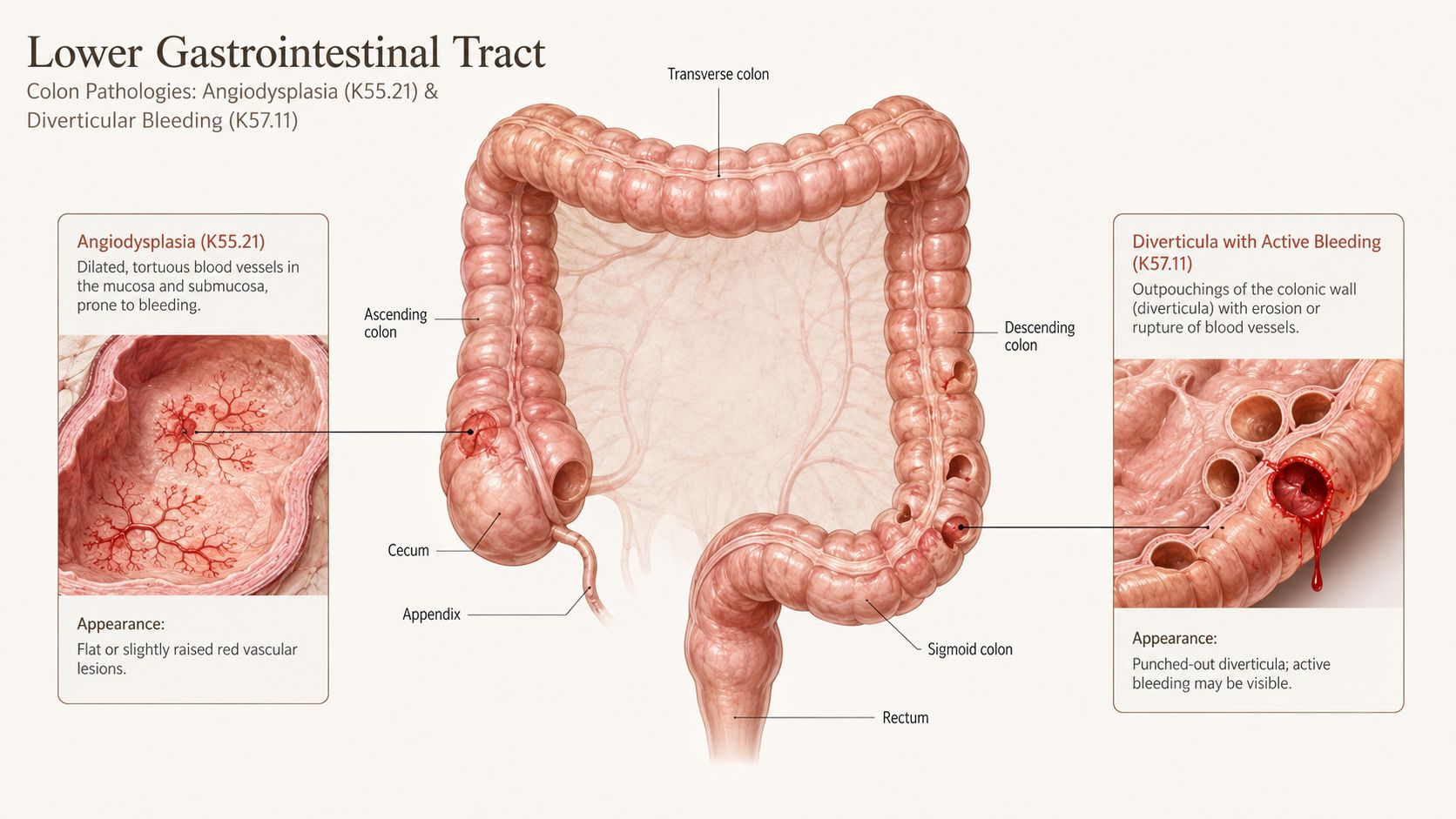
The cleanest lower GI claims come from notes that don't make the coder interpret the source. Put the source in the note, and the code follows naturally. Leave it vague, and the payer has room to deny, downcode, or query.
Frequently Missed Codes for History, Anemia, and Post-Procedure Context
This is the part most quick-reference pages skip, and it's where practices lose accuracy. A bleed that's over is not the same as an active bleed. A bleed with anemia is not the same as a bleed without consequences. A post-procedure hemorrhage is not the same as a spontaneous GI bleed.
When the bleed is no longer active
If the chart documents a history of GI bleed rather than an active event, Z87.19 can be appropriate. That's the right move when the provider is talking about a resolved problem in the past, not a current hemorrhage. Using an active bleed code in that situation overstates the current encounter.
D62, acute posthemorrhagic anemia, deserves attention whenever the chart supports it. If the provider documents anemia related to the bleed, code it with the underlying cause as documented. That pairing matters because anemia changes the clinical picture and often the resource use tied to the encounter. History of gastrointestinal bleed coding guidance
Post-procedure bleeding needs its own logic
Bleeding after a GI procedure is not automatically the same as a standard GI bleed. Codes such as K91.61 and K91.62 exist for hemorrhage tied to the digestive system after a procedure. Use them when the documentation clearly supports an intraoperative or postprocedural hemorrhage, not when the patient happens to have bleeding and a recent procedure in the chart.
What to do with partial documentation
If the note only supports hematemesis or melena without a confirmed source, don't overspecify. Use the symptom-based or unspecified code that matches the documentation level, then query for more detail if the report or procedure note can support it. That's the safer move than inventing a source the chart doesn't prove.
A practice that codes resolved bleeding like active bleeding creates messes in both billing and quality data. A practice that codes post-procedure bleeding as routine GI hemorrhage does the same thing. The fix is simple, but it has to be enforced: active, resolved, historical, and postprocedural bleeding are not the same diagnosis family.
How Well ICD-10 Codes Actually Identify GI Bleeds
Claims data is useful, but it's not the same as truth. That's the core problem with GI bleed reporting built only on ICD-10 codes. The codes are reliable when they're present, but they still miss a meaningful share of real events.
In one hospitalized-patient study, an ICD-10 algorithm achieved 61.3% sensitivity, 99.6% specificity, 90.0% PPV, and 98.0% NPV for GI bleeding. In a separate study of 656 anticoagulated encounters, only 26 (4.0%) had chart-confirmed GI bleeding, and the overall ICD-10 code performance was 81% sensitivity, 98% specificity, 64% PPV, and 99% NPV. The same study found sensitivity was higher for upper than lower GI bleeding, 86% vs. 50%. Validation data for ICD-10 GI bleed coding performance
What those numbers mean in practice
High specificity and high negative predictive value mean the codes are strong at ruling out bleeding when the bleed code isn't there. That's good for some workflows. It does not mean claims data fully captures the true burden of bleeding.
The lower sensitivity tells you where the risk sits. If your reporting depends only on claims, you will undercount some true events. That affects quality benchmarking, denial trend analysis, and any operational report that uses code counts as a proxy for clinical volume.
Bottom line: ICD-10 GI bleed coding is good at confirming what's coded, but it can still miss cases that live only in the chart.
Why upper and lower bleeds behave differently
The upper bleed data performed better than the lower bleed data in the study above. That's exactly why practices shouldn't assume a single coding workflow fits every bleed. Lower GI events are more likely to get lost in vague chart language, evolving workups, or symptom-only documentation that never gets cleaned up before claim submission.
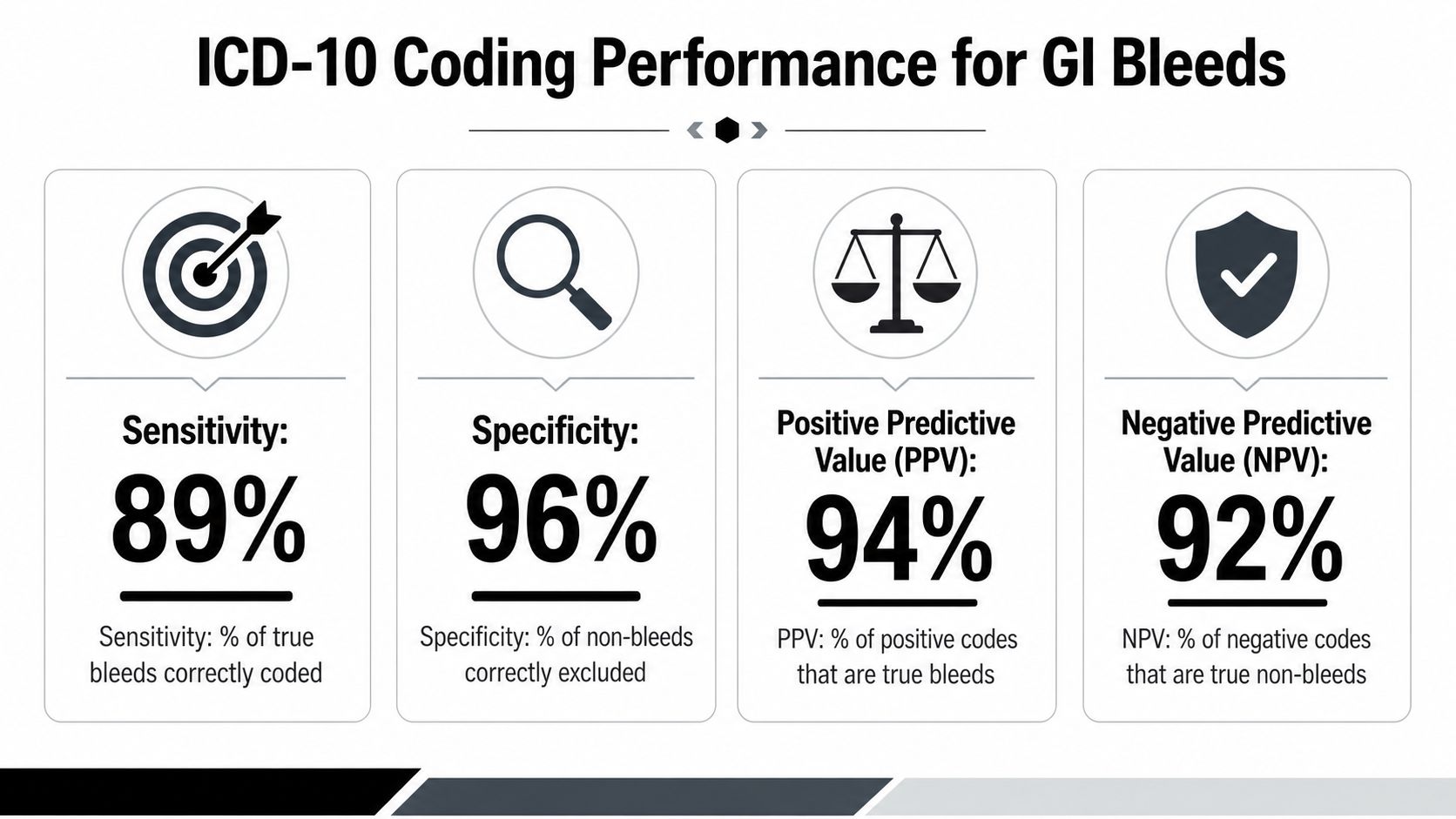
If your practice uses claims alone to count bleeds, track denials, or judge procedure demand, you're probably undercounting reality. Pair the claim data with chart review whenever the numbers matter. That's the only way to avoid building dashboards that look precise but miss real cases.
Common Payer Denial Triggers for GI Bleed Claims
GI bleed claims get denied for boring reasons, and those reasons repeat. The problem is usually not that the patient didn't bleed. The problem is that the chart didn't prove enough, the code was too vague, or the diagnosis sequence didn't match the clinical story.
The denial patterns I'd expect first
Unspecified coding when specificity exists is the easiest denial target. If the colonoscopy shows diverticular hemorrhage and the claim still uses K92.2, the payer has a clean argument that the diagnosis wasn't coded to the chart. The same issue shows up when a provider documents hematemesis, melena, ulcer bleeding, or varices and the claim never leaves the generic bucket.
Missing secondary diagnoses are the next problem. If the chart supports D62 and the claim omits it, the payer may see an incomplete severity picture. That can affect medical necessity, case complexity, and how the encounter is adjudicated.
How the payer reads the record
Payers also look for consistency across the ED note, the inpatient note, and the procedure report. If one note says upper GI bleed, another says lower GI bleed, and the procedure note names a specific lesion, the inconsistency creates a validation problem. The claim may not fail immediately, but it becomes easier to challenge.
The best way to reduce those hits is to stop treating the diagnosis line as a formality. The code has to match the source, the sequence has to reflect the underlying condition when documented, and the secondary codes have to support the severity picture. A sloppy claim invites review.
What denials usually sound like
You'll see language that says the record doesn't support the billed diagnosis, that the documentation lacks specificity, or that medical necessity wasn't established for the procedure. In gastroenterology, that often happens when the note says “GI bleed” but never identifies whether the bleed was upper, lower, historical, or postprocedural. The payer isn't guessing for you.
Use the same discipline in your billing workflow that you expect in the procedure room. Clean up the diagnosis before claim drop, and a lot of denials never happen. The gastroenterology billing playbook is worth having on the desk if your team is tightening this workflow.
RCM and Dispute-Readiness Tactics for GI Bleed Coding
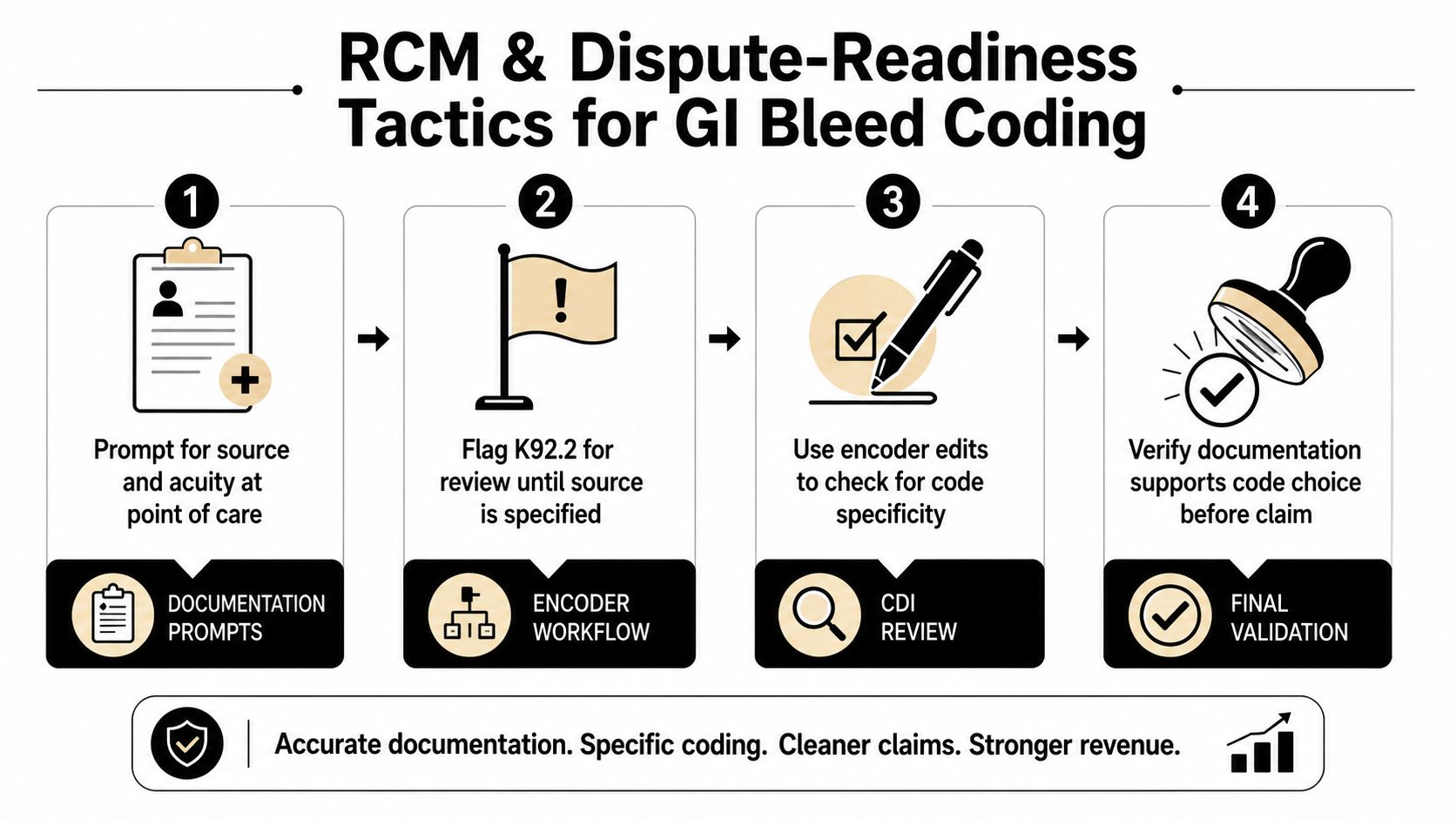
A GI bleed claim should be built to survive payer review before it ever leaves the practice. That means the documentation has to support the code, the code has to match the source, and the team has to catch weak claims before they turn into denials.
Build the workflow around specificity
Start with a documentation prompt that forces the source and acuity into the note. If the provider says “GI bleed” without source, that's a query opportunity, not a finished diagnosis. Then hold K92.2 for review until the source is specified.
Operational standard: no source, no final code if the chart can reasonably support more detail.
Use edits before the claim drops
Encoder edits should flag nonspecific bleeding codes whenever the record contains ulcer, variceal, rectal, diverticular, or postprocedural language. That's not overkill. It's basic claim protection. If your workflow lets a vague bleed code sail through when the source is obvious, the denial is self-inflicted.
Make disputes easier before they happen
Tag GI bleed denials by reason and payer, then look for patterns. If one plan keeps challenging unspecified bleeding, your frontline team needs stronger queries. If another plan downplays anemia pairing, your coders need a stricter review of D62 linkage. If the issue is source inconsistency, the answer is tighter cross-note reconciliation.
That's how you turn coding into revenue protection instead of cleanup work. Clean the claim upstream, and the dispute volume drops. When a payer still underpays, your chart packet has to show the source, the acuity, and the sequenced diagnoses without forcing the reviewer to connect the dots. The coding compliance framework belongs in any practice that wants fewer avoidable fights.
Quick Reference Table for GI Bleed Codes
Keep this table handy. It's the version I'd want a coder to open during claim review, because it separates the common bleed codes by what the chart says.
| Code | Label | When to Use |
|---|---|---|
| K92.2 | Gastrointestinal hemorrhage, unspecified | Use only when bleeding is confirmed but the source isn't documented |
| K25.0 | Gastric ulcer with hemorrhage | Use when the chart identifies a bleeding gastric ulcer |
| K26.0 | Duodenal ulcer with hemorrhage | Use when the chart identifies a bleeding duodenal ulcer |
| K27.0 | Peptic ulcer, site unspecified, with hemorrhage | Use when the ulcer is known but the exact site isn't stated |
| K28.0 | Gastrojejunal ulcer with hemorrhage | Use when the record supports a gastrojejunal ulcer source |
| K92.0 | Hematemesis | Use when the provider documents vomiting blood |
| K92.1 | Melena | Use when the chart documents melena or blood in stool consistent with that code |
| K55.21 | Angiodysplasia of colon with hemorrhage | Use when colon source is documented as angiodysplasia |
| K57.31 | Diverticulosis of large intestine with hemorrhage | Use when diverticular hemorrhage is documented |
| K57.33 | Diverticulitis of large intestine with hemorrhage | Use when diverticulitis with bleeding is documented |
| K62.5 | Hemorrhage of anus and rectum | Use when the anorectal source is documented |
| I85.0 | Esophageal varices with bleeding | Use when bleeding varices are documented |
| Z87.19 | Personal history of other diseases of the digestive system | Use when the bleed is resolved and the chart documents history, not active bleeding |
| D62 | Acute posthemorrhagic anemia | Use when anemia is documented as a result of the bleed |
If your practice manager wants one rule to enforce, make it this. Code the source, not the phrase “GI bleed.” That single standard reduces queries, strengthens claim defense, and keeps your analytics from understating true bleed volume.
A CTA for RevGuard.