

Clean claims alone do not protect ASC revenue. That's the polite myth billing teams tell themselves right before a payer trims the line, packages the implant, or forces the center to chase underpayment for months.
The core job of billing for ambulatory surgery centers is defense in depth. You need eligibility, coding, packaging logic, contract discipline, and a dispute path that can recover money when the payer still underpays. If your workflow stops at “submit clean claims,” you're leaving margin to chance, and ASCs don't have that luxury.
Why ASC Billing Is a Different Game in 2026
ASC billing is not just smaller hospital billing. It's a different economic model with different failure points, and the payer knows it. Medicare paid $5.2 billion for ASC services in 2019, then about $6.8 billion by 2023, while MedPAC reported roughly 6,300 ASCs serving 3.4 million fee-for-service beneficiaries that year, with procedure volume per beneficiary up 5.7% in 2023 after years of steady growth in spending per beneficiary (MedPAC payment basics).
That growth matters because every payer behavior that chips away at a claim now hits a larger base. Silent downcoding, packaging disputes, implant carve-out denials, and delayed payment all land harder in a center that runs on narrow facility margins. A clean claim is the floor, not the win.
Treat claims and disputes as one system
If you separate RCM from appeals, you create two half-working processes. The front end focuses on getting the claim out, the back end focuses on fixing what should've been caught before submission, and nobody owns the full revenue outcome. That's how ASCs get stuck with underpayments that never get reversed.
Practical rule: every payer denial should feed back into coding, eligibility, or contract logic. If it doesn't change upstream behavior, you're just paying staff to move paper.
The smarter model is simple. Build the claim to survive payer edits, then build the dispute process to recover the cases that still get squeezed. That's the only way to make revenue protection continuous instead of reactive.
The ASC Payment Structure Compared to HOPDs
The payment gap between ASCs and hospital outpatient departments shapes every billing decision you make. The ASC Association says that in 2003, Medicare paid ASCs 83% of the HOPD amount for the same services, but today ASCs receive only 53% of comparable HOPD payments, a gap it ties to more than $2.3 billion in annual Medicare savings. That site-of-care difference is the engine behind ASC migration. According to the ASC Association's discussion of payment disparities, the lower ASC rate is not a side issue. It is the main reason the same clinical work produces very different margin outcomes depending on where it is billed (ASC Association payment disparities).
That gap also explains why facility-fee capture matters so much. A hospital outpatient department can absorb some slippage through scale and broader reimbursement patterns. An ASC cannot. One missed modifier, one wrong place-of-service field, or one blocked implant line hits the bottom line directly, because there is no hospital cost structure hiding the mistake.
Why commercial payers care about the site of care
Commercial payers care about the site of care because lower-cost settings change the math. A commercial-claims review cited by the ASC Association says ASCs reduce U.S. health-care costs by more than $38 billion per year, with more than $5 billion of that savings flowing directly to patients through lower deductibles and coinsurance (ASC Association payment disparities). Blue Cross Blue Shield also found that HOPD common-procedure prices were sometimes five times more expensive than ASC or office settings, and HOPD prices rose 27% from 2017 to 2022 versus 11% for ASCs over the same period (ASC Association payment disparities).
That is why payer contracts cannot sit in a drawer like static paperwork. If the site-of-service differential is the economic engine, then contract terms decide how much of that value stays in your center and how much leaks out through underpayment, packaging fights, and sloppy reimbursement language.
The practical takeaway for facility billing
ASCs should obsess over facility-fee capture, site-of-service coding, payer-specific reimbursement rules, and the revenue-code structure that drives how charges land on the claim. If your charge master and claim edits do not line up, you invite denials, packaging, and avoidable discounting. Use revenue code structure as part of that control set, because sloppy charge mapping is where clean clinical work turns into bad reimbursement.
If you still think like a physician office, you miss the economics. If you think like a hospital, you overbuild process and still miss the details that protect ASC margin.
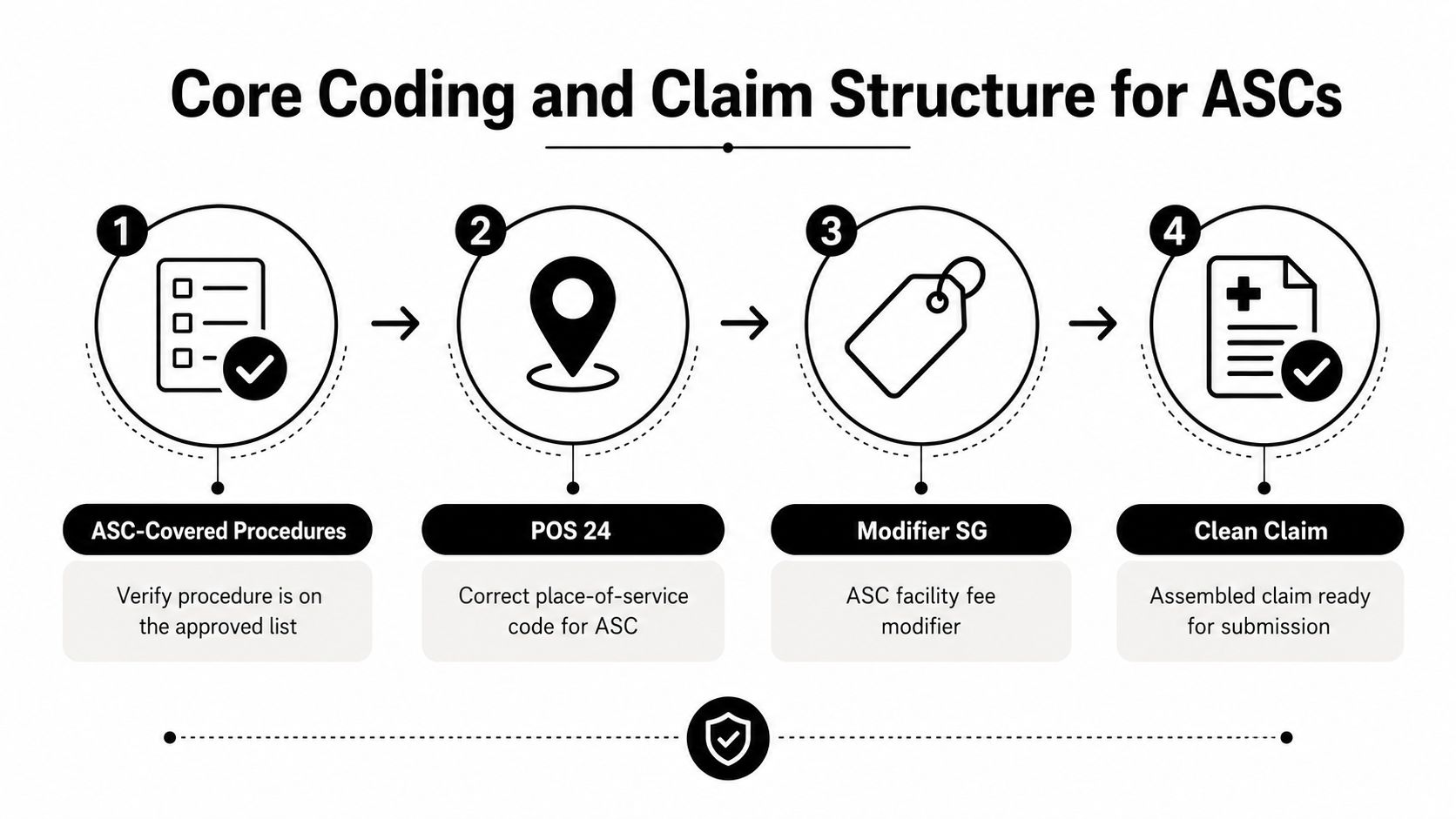
Core Coding and Claim Structure for ASCs
ASC claims live or die on structure. The operative case has to be on the ASC-covered procedures list, the claim has to reflect the correct place of service, and the facility identifier has to match the center, not the surgeon. Washington's ASC billing guide also requires POS 24, modifier SG, and billing all surgeries from the same operative session on the same claim, which is the kind of operational rule that keeps claims moving instead of getting bounced (Washington ASC billing guide).
The point isn't just compliance. It's claim integrity. If the code structure doesn't match the payer's edit logic, the payer will package, deny, or reduce payment and move on.
The rules that get ASCs paid
Start with the procedure itself. If the CPT or HCPCS code isn't eligible for ASC payment, the rest of the claim math doesn't matter. Then align the claim fields with the setting, POS 24 for the ASC, modifier SG for the facility fee structure, and the correct facility NPI.
Related services can also get swept into the facility payment. The billing guide notes that services performed within 72 hours of a scheduled ASC procedure may be bundled into the facility claim rather than billed separately (Washington ASC billing guide). That's why pre-service review matters. If the center doesn't check packaging rules before the case, it's already behind.
Direct rule: don't let the scheduler, the coder, and the biller operate as separate kingdoms. ASC payment breaks when handoffs are sloppy.
A blunt orthopedics example
Take a same-day orthopedic case with an implant. If the operative note supports the procedure but the implant line is miscoded, the claim can still look “clean” and still underpay. If the payer packages the supply or rejects the carve-out because the documentation doesn't match, the facility eats the cost.
That's the trap. Technical correctness on one field doesn't save a claim that's structurally wrong. For ASC billing, structure is the revenue.
What rev codes are and why they matter
Walking an ASC Claim From Eligibility to Payment
A high-cost implant case usually starts failing before the patient ever reaches the OR. The scheduler verifies the case date, the authorization team checks coverage, and the biller should be looking for whether the implant is separately payable or bundled under payer policy. If those checks happen after surgery, the center has already taken on avoidable risk.
The cleanest way to see the workflow is to follow one orthopedic implant case end to end. The patient is scheduled, benefits are verified under the facility NPI, prior authorization is confirmed against the actual planned procedure and implant line, and the operative note is paired with implant stickers and charge capture before the claim leaves the building.

Where money gets lost
The first leak is usually eligibility. If the center verifies the surgeon's professional coverage but not the ASC facility benefit, the claim can be dead on arrival. The second leak is authorization, especially when the approval is tied to a procedure code but not to the implant or device class the center used.
The third leak is documentation. The operative note must support the coded procedure, and the implant documentation must be present and reconciled before billing. That's not optional housekeeping. It's what prevents the payer from saying the implant was never validated or that the service was not approved as billed.
What the remittance should tell you
Once the payer responds, the remittance advice becomes a diagnostic tool, not a file to archive. If the center sees repeated packaging reductions, modifier-related cuts, or unexplained underpayments on the same payer, the problem is not random. The contract language, claim structure, or pre-bill review is broken.
RevGuard's ASC-focused RCM and dispute workflow is one option for centers that want eligibility, claim construction, and underpayment recovery handled as one revenue path, not separate silos. The key is the operating model, not the vendor label.
Top ASC Denial Reasons and How to Prevent Them
Denials are not just paperwork noise. They're a map of where your workflow is weak. The biggest money losers are authorization and medical necessity denials, packaging and modifier denials, credentialing and POS errors, and payer-driven downcoding that the team doesn't challenge fast enough.
The fix is not to work denials harder. The fix is to stop creating them.
Rank the denial by revenue impact, not by inbox noise
Authorization failures hurt first because they can make the service unrecoverable or force a painful appeal with thin odds. Packaging and modifier denials are next because they usually signal that the claim was coded correctly in a general sense but incorrectly for the payer's logic. Credentialing and POS errors are lower on the sophistication scale, but they're still completely preventable, which makes them unacceptable.
The right response differs by denial type. Authorization denials need the approval record, the medical necessity support, and the exact code mapping. Packaging disputes need the operative report, the charge detail, and proof that the item should not have been bundled. Credentialing and POS denials need enrollment verification and claim correction, not a long appeal essay.
What to build into the workflow
Every ASC should maintain a denial log that ties the payer's reason code to the upstream control failure. If a modifier denial repeats, the coder review has failed. If an implant line keeps getting cut, the charge capture process is weak. If the same payer keeps downcoding similar cases, contract review belongs in the conversation.
The temptation is to treat denials as a cleanup queue. Don't. They're quality data. If you never feed them back into the front end, you'll keep paying for the same mistake three different ways.
Using the No Surprises Act and IDR to Recover ASC Underpayments
The No Surprises Act changes the game when the payer won't pay fairly. The law gives providers a structured Independent Dispute Resolution path for eligible out-of-network emergency and certain nonemergency services, and the ASC should use it when a payer's final determination leaves real money on the table rather than wasting months on repetitive appeals. RevGuard's summary of the process is a useful operational reference for teams that need the mechanics in one place (No Surprises Act summary).
The mistake most ASC teams make is waiting too long or filing without a real evidence packet. IDR is not a casual escalation. It works when the claim is eligible, the timeline is observed, and the supporting file is built like you expect it to be read by someone who has never seen the chart before.
What belongs in the IDR packet
At minimum, the file needs the payer's final offer, the contract terms if there is a contract basis to cite, the medical necessity documentation, and the qualifying payment amount analysis. If the claim was already underpaid because the upstream RCM process missed a packaging issue or failed to document an implant correctly, the packet has to answer that cleanly.
The operational discipline matters more than the narrative. Submit the dispute on time, include only the documents that support the payment position, and don't try to drown the arbitrator in filler. Good IDR packets read like enforcement files, not apology letters.
Use IDR as a backstop, not a substitute
IDR should pressure the upstream process to improve. If the same service line keeps needing dispute resolution, then the front-end claim build is weak or the payer contract isn't being monitored closely enough. The point is not to become good at arbitration for its own sake, it's to make underpayment expensive enough that the payer stops repeating it.
That's why ASC billing and IDR belong in the same operating conversation. One protects the claim before submission. The other recovers value when the payer still chooses the wrong number.
ASC Revenue Cycle KPIs That Actually Predict Cash
Most ASC dashboards are vanity reports. They tell you claims went out, denials came in, and A/R exists, which is true but not useful. A real dashboard tells you where cash is leaking and whether your recovery process is compensating for it.
The metrics that matter are clean claim rate, first-pass yield on authorizations, denial overturn rate, days in A/R by payer, implant line-item denial rate, and IDR yield per initiated case. If those numbers don't move together, you have a process problem, not a volume problem.
Build the dashboard around cash flow, not activity
| KPI | Target for ASC | What it exposes |
|---|---|---|
| Clean claim rate | High enough to avoid rework | Coding and edit accuracy |
| First-pass yield on authorizations | Consistent approval before the case | Scheduling and benefits controls |
| Denial overturn rate | Rising over time | Appeal quality and root cause tracking |
| Days in A/R by payer | No payer should drift without review | Contract friction and remittance lag |
| Implant line-item denial rate | Low and stable | Charge capture and device billing discipline |
| IDR yield per initiated case | Positive enough to justify escalation | Whether dispute work is recovering underpayments |
The point of the table is blunt. If clean claims are high but cash is still slow, the payer may be underpaying or dragging remittance. If authorizations are strong but implant denials keep appearing, your claim structure is wrong. If IDR yield is weak, you're escalating the wrong cases or submitting weak evidence.
For a practical metrics framework, RevGuard's revenue cycle metrics overview is a decent starting point for defining what belongs on a true collection dashboard (revenue cycle management metrics).
Read the metrics together
Insight comes from combining RCM and dispute performance. If your front end is working but your back end is quiet, you may be leaving recoverable underpayments untouched. If your back end is busy every month, your front end is probably leaking cases into avoidable denials.
That's the operating truth. Cash doesn't care whether the problem lived in scheduling, coding, contracting, or arbitration. It only cares that you lost it.
Hardening Your ASC Billing Operation Over the Next 90 Days
Treat the billing office and the dispute function as one revenue pipeline. Separate vendors, separate managers, and separate KPIs are how ASCs drift into inconsistency. You need one owner who can see claim creation, denial patterns, and underpayment recovery in the same frame.
Start with three controls. First, build a payer-by-payer authorization matrix and review it quarterly. Second, run an implant and device line-item audit on the top 20 CPT codes that carry the most revenue exposure. Third, bake a standing IDR-readiness checklist into the appeal workflow so every eligible underpayment can move fast.
Operational rule: if the payer changes its behavior, your matrix has to change too. Static policy binders don't protect live revenue.
In the first 30 days, assign ownership. The scheduler owns eligibility checks. The coder owns procedure-to-documentation matching. The billing lead owns modifier logic and packaging review. By day 60, you should be testing payer-specific denial patterns against the claim edits. By day 90, you should know which payers require disputes, not just appeals, to recover value.
If your center is still losing implant revenue, seeing repeated underpayments on the same payers, or sending cases to appeal without a documented evidence packet, it's time to bring in specialty RCM and IDR support. That's not overhead. It's margin protection.
If your ASC is still treating billing and disputes as separate workstreams, you're leaking revenue in both directions. RevGuard helps ASCs tighten claim construction, track payer behavior, and push eligible underpayments into an enforcement-ready workflow. Visit RevGuard if you want a team that treats ASC reimbursement as one continuous revenue system, not a pile of disconnected tasks.