

What Third-Party Billers Actually Do in Healthcare
Imagine a practice's billing operation as an airport baggage system: each claim is a suitcase, every payer is a destination, and the third-party biller is the ground crew routing, tagging, and managing handoffs. That analogy captures why these vendors touch so many moving parts—and why a mistake at one checkpoint ripples downstream.
What day-to-day work looks like:
- Eligibility Checks — Confirm coverage and benefits before service to cut down on upfront denials and surprise patient balances.
- Charge Capture — Make sure every service rendered gets recorded. Missed charges mean lost revenue, plain and simple.
- Medical Coding — Turn clinical notes into CPT and ICD codes. Specialty coding errors are a frequent cause of denials and recoupments.
- Claim Submission — Format and transmit claims to payers. Clean claims come back faster with fewer edits.
- Payment Posting — Reconcile remits from payers and flag underpayments immediately.
- Denial Follow-Up — Research, appeal, and refile rejected claims to recover what's owed.
- Patient Balance Calls — Handle collections without trashing the patient experience.
Vendors run the spectrum from light-touch coding review to fully outsourced revenue operations that cover credentialing, payer contracting, and real-time reporting. A light-touch vendor might only audit coding before submission. A fully outsourced partner runs credentialing, negotiates payer contracts, and delivers dashboards tracking days in A/R and first-pass clean claim rate.
Vendor Models and Practical Impact
Different models shift how responsibilities and risk get divided between you and the vendor.
- Hybrid Model — The vendor owns denial management or A/R while the provider keeps registration and scheduling.
- Full Outsource — The vendor runs end-to-end RCM and commits to SLAs on net collection rate.
- Embedded Support — The vendor supplies specialty coding experts to augment in-house staff.
"The bill is the game tape. The clearer the tape, the better your ruling." Solid documentation and audit trails matter enormously when disputes come up or regulators knock.
Real-world examples bring this into focus. A dermatology group with heavy outpatient volume benefits most from faster claim turnaround and automated patient balance workflows. An air ambulance provider needs razor-sharp coding and dispute-ready claims because underpayments are common and the No Surprises Act creates IDR exposure.
How This Changes Daily Workflows
Outsourcing reshapes the rhythm of daily work. Pre-service checks become a shared gate. Coding reviews move earlier in the cycle. Denial workflows turn evidence-driven to support disputes. That's exactly why dependable vendors offer structured dashboards and documented audit trails.
- KPI Focus — Track first-pass yield, denial rate by payer, and net collection rate.
- Compliance Guardrais — Role-based access, chart audit sampling, and documented coding standards reduce False Claims and recoupment risk.
- Transition Risks — Credentialing gaps or vague ownership cause denials. Contracts need to assign responsibility clearly.
Here's the bottom line: third-party billers aren't clerks shuffling paperwork. They're financial operations partners whose processes dictate how fast and how completely a specialty practice gets paid. Choosing the right model, demanding dispute-ready documentation, and monitoring focused KPIs are the practical controls that turn outsourcing into measurable revenue protection.
How Third Party Billing Fits Into the Revenue Cycle
Third party billers slot into the revenue cycle at several handoff points, connecting what happens clinically with what gets paid. Depending on the vendor model, they might handle pre-registration, eligibility verification, coding, claim submission, payment posting, denial management, and patient balance collections — or just a few of those pieces.
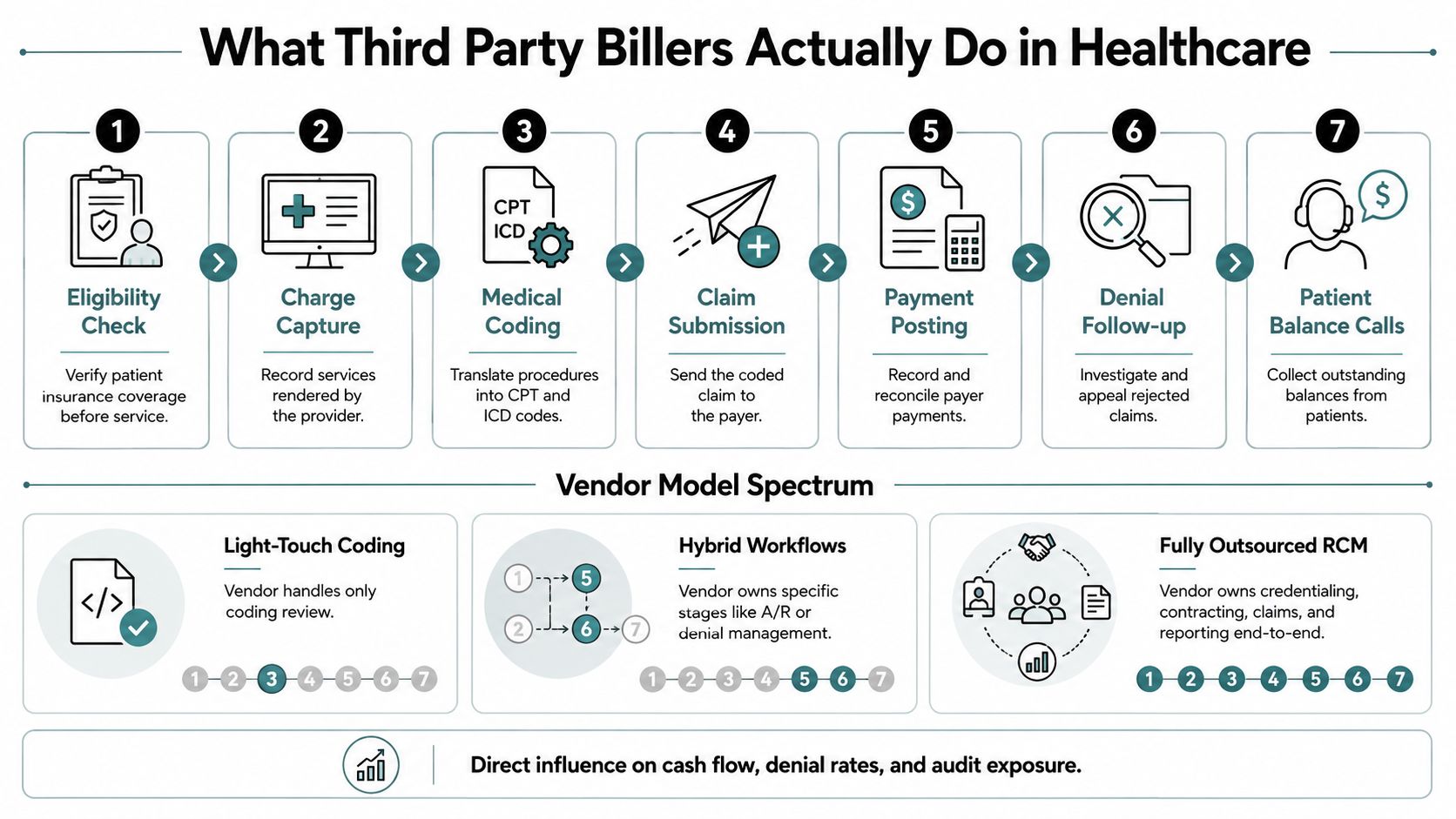
The infographic above walks through the seven-step billing workflow and maps out where different vendor models operate — showing exactly where value gets added and where risk creeps in.
Here's what stands out: early-stage work like eligibility checks and charge capture tends to prevent denials later on. Meanwhile, back-end functions — chasing denied claims, calling patients about balances — directly shape how fast cash hits the bank. The deeper a vendor goes, the more it shifts both the operational load and the financial results.
How Handoffs Change With Different Vendor Models
An in-house team keeps most touchpoints under its own roof. That preserves control, sure, but it also limits what's possible when claim volumes jump unexpectedly. A hybrid model splits the difference: a vendor takes over specific workflows like A/R follow-up or coding while the practice keeps front-end registration in-house. Full outsourcing hands the entire revenue cycle — including reporting — to the vendor.
- Hybrid setups often deliver quick wins because the vendor applies focused expertise to whatever bottleneck hurts most.
- Full outsourcing can produce bigger improvements in days in A/R and net collection rate, but only if the contract has teeth — solid SLAs and clear accountability.
- Keeping registration in-house helps avoid credentialing gaps, though it won't protect a practice if payer mix shifts overnight.
When vendor dashboards replace gut feelings with real-time KPIs, that's when a third party stops being a vendor and becomes a genuine performance layer.
Practical Triggers That Push Practices Toward Outsourcing
Certain scenarios make outsourcing feel less like a choice and more like a necessity. Rapid growth, launching new service lines, expanding into new states, or watching payer mix change on a dime — these are the usual suspects. Take a group adding an ambulatory surgery center. Suddenly they need credentialing and payer contracting support yesterday. That's a textbook prompt to bring in outside help.
- Growth at speed strains existing staff and billing errors climb with it.
- New service lines mean unfamiliar codes and documentation requirements nobody's seen before.
- Operating across state lines means juggling different payer rules and registration processes simultaneously.
These situations rarely stay theoretical. They show up as rising denial rates or slower remits — measurable problems a good vendor can actually fix.
Analytics Role And Operational Visibility
When a vendor brings real analytics to the table, leadership finally sees what's actually happening: first-pass clean claim rates, denial reasons broken down by payer, collections per visit. That kind of visibility shifts decision-making from "let's wait and see" to targeted action.
- Lock down which KPIs matter within the first 30 days.
- Demand dashboard access and weekly exception reports — no exceptions.
- Run payer-level pilots before committing to a full transition.
Treating third party billers as both operational partners and a reporting engine changes the equation entirely. It turns outsourcing from a cost play into a strategic move that protects cash flow and lowers audit exposure.
What Specialty Practices Actually Gain From Outsourcing Billing
Handing off billing to a specialized third-party team works a lot like bringing in a master mechanic for a high-performance engine — the work is precise, the results are measurable, and everything centers on performance gains rather than just keeping the lights on.
When specialty practices evaluate whether outsourced billing is paying off, they tend to look at four tangible metrics. There's the cost-to-collect figure, which drops as manual processes get automated and cash posts faster. There's claim turnaround speed, which directly shrinks days in A/R and frees up operating cash. There's the write-off rate, which falls when coders who know high-acuity documentation inside and out catch things a generalist would miss. And then there's dispute readiness — claims built to withstand payer pushback and survive Independent Dispute Resolution when it comes to that.
Consider a dermatology group juggling hundreds of low-complexity visits every week. For them, the biggest win comes from automating patient balance workflows and accelerating claim resubmission, which slashes the hours front-desk staff spend chasing routine follow-ups. On the other side of the spectrum, an ambulatory surgery center (ASC) sees the real payoff when a billing partner tightens up coding accuracy for bundled services and navigates payer-specific edits that would otherwise generate a string of denials.
Where the Operational Improvements Show Up
Faster claim cycle time — Expert billers build coding checks into the front end of the process, so claims that used to sit in review for days now move to remittance in hours. That compresses cash lag and makes revenue forecasting far less of a guessing game.
Lower denial and write-off rates — Specialty coding knowledge eliminates the common denial triggers tied to modifier misuse, global periods, and the airway and transport coding specifics that air ambulance operations deal with regularly.
Higher net collection per case — When claims are assembled with dispute-ready documentation from the start, underpayments turn into recoverable revenue instead of losses that get buried in the books.
"Tie billing to dispute-ready evidence so claims are structured from day one to survive payer pushback and arbitration."
How This Plays Out in Practice
Dermatology practice — The bottleneck is high visit volume with razor-thin margins on each encounter. The benefit: automated patient posting and better first-pass clean claim rates give front-desk staff their time back so they can focus on patients instead of paperwork.
ASC or anesthesia group — The bottleneck is complex coding logic and layered payer edits. The benefit: dedicated specialty coders and denial teams cut down the endless back-and-forth of appeals while pulling days in A/R downward.
Air ambulance or IONM — The bottleneck is chronic underpayments combined with real exposure to IDR proceedings. The benefit: dispute-ready submissions and thorough evidence collection meaningfully boost arbitration outcomes.
Tactical Advantages That Deserve Attention
Evidence-first workflow — Billing that captures the clinical record, transport logs, or anesthesia sheets in a format that supports future disputes, not just the initial claim.
Vendor analytics — Dashboards that surface payer behavior patterns so you can run targeted pilots aimed at fixing the worst offenders first.
Scalable staffing — A partner absorbs seasonal volume spikes without forcing you through expensive hiring and layoff cycles.
When you're evaluating a billing partnership, ask vendors to deliver on these specifics:
- Measured first-pass clean claim rate improvements within 60 days
- Denial reason breakdowns organized by payer and by CPT code
- Documented chain-of-evidence practices for IDR
Read also: Learn more about Revenue Cycle Management Outsourcing in our guide at https://revguard.co/revenue-cycle-management-outsourcing/
No Surprises Act Compliance and the Dispute Connection

The No Surprises Act reshaped payment dynamics across several specialties, and third-party billers now find themselves at the center of both routine claims processing and federal dispute resolution. Surprise billing regulations cover emergency services, specific out-of-network scenarios, and air ambulance transports. That means providers need claims that satisfy standard coding requirements and hold up under arbitration scrutiny.
Billers have to gather evidence, timestamp every item, and connect clinical documentation directly to billed line items. Think of it as the game tape that Independent Dispute Resolution (IDR) referees review when deciding cases.
Consider an anesthesia claim missing a documented start time or a link to the operative note. It's like submitting a blurred replay — the arbitrator has less to work with and is less likely to rule in the provider's favor. On the other hand, a well-documented anesthesia or air transport submission with a clear chain of care and demonstrated necessity wins more recoveries.
How Documentation Affects IDR Outcomes
- Evidence Chain
- Clinical notes matched to CPT codes and units with timestamps demonstrate contemporaneous care.
- Transport logs or anesthesia records corroborate intensity and duration.
- Payer remittance advice and prior negotiation history establish disputed amounts.
Clean, dispute-ready claims consistently outperform sloppy ones in arbitration because arbiters prioritize clarity and traceability above all else.
A practical playbook for billers includes standardized templates, mandatory fields during charge capture, and automated attachments that tie supporting documents to claims before submission. These workflow adjustments reduce the likelihood that a claim gets rejected or weakened during IDR.
Integration With Specialty RCM and Dispute Workflows
Third-party billers should treat IDR readiness as a standard part of revenue cycle management, not something bolted on after the fact. That means integrated workflows where coding review, evidence assembly, and payer negotiation happen as coordinated steps — with automated alerts when a claim meets IDR thresholds. This kind of orchestration cuts down on manual handoffs and keeps the game tape intact.
- Benefits to providers
- Higher arbitration win rates when evidence is complete and organized.
- Faster resolution because documentation is structured for reviewer consumption.
- Lower long-term write-offs since fewer disputes fail on technicalities.
Practical Implications by Specialty
Anesthesia and IONM groups need precise timing and intraoperative correlation. Air ambulance claims require dispatch records and detailed transport logs. Emergency departments must document medical necessity clearly against surprise-billing statutes. In each scenario, the biller's processes determine whether underpaid revenue becomes recoverable or stays lost.
Read also: Learn more about No Surprises Act mechanics and Independent Dispute Resolution in our summary of the No Surprises Act.
Common Pitfalls and Compliance Risks With Third-Party Billers
Outsourcing your billing operation moves the workload off your plate. But here's the uncomfortable truth: it doesn't move the legal risk.
When a biller submits a faulty claim, regulators don't point fingers at the vendor. They come to you. That's a distinction too many provider organizations learn the hard way.
Where Things Actually Go Wrong
Coding errors sit at the top of the list. A pattern of miscoded visits, unbundled services, or unsupported modifier use can trigger recoupment demands and, in serious cases, False Claims Act investigations. The red flags that attract scrutiny aren't subtle—sudden spikes in high-level evaluation and management codes, modifier 25 attached to nearly every procedure, or documentation that never quite supports the level billed. If your billing patterns would look suspicious to an outside reviewer, they probably are.
Credentialing breakdowns cause a different kind of damage. When a vendor drops the ball on provider enrollments or mismatches NPIs to payer contracts, claims either get denied outright or paid and then clawed back months later. The result is a nasty combination of post-payment audit exposure and unpredictable revenue swings.
Then there's the audit nightmare nobody talks about until it's too late. If your vendor can't show you who coded a claim, who reviewed it, and which clinical note supports each charge, you're at a serious disadvantage during payer audits and Independent Dispute Resolution proceedings. Auditors don't take your word for it. They want a paper trail.
Relying on a single vendor without a backup plan is another gamble. Staffing turnover, system outages, or even a civil enforcement action against the company can leave you scrambling to file claims or respond to payer inquiries. Revenue doesn't pause because your vendor is having a rough quarter.
And finally, security. Every connection between your patient data and a third party is a potential HIPAA exposure point. Weak role-based access, missing multi-factor authentication, or an absent breach response plan aren't just technical shortcomings—they're findings waiting to happen.
Think of it this way: hiring a third-party biller is a bit like a physician supervising nurse practitioners. You delegate the tasks, but the supervising provider still carries the license and the liability.
Early Warning Signs To Watch For
- Denials climbing for the same payer or CPT code family without explanation
- More frequent payer recoupment letters than your historical baseline
- Claims submitted with missing or inconsistent documentation attachments
- Inability to trace a specific claim back to the coder or chart reviewer who handled it
What Strong Oversight Actually Looks Like
- Regular external chart reviews with percent-sampled audits, not just internal spot checks
- Written coding standards that reflect your specialty's specific documentation nuances
- Role-based access controls and MFA on every EHR and billing system the vendor touches
- Detailed audit trails capturing every edit, user ID, and timestamp
Key insight: Outsourcing changes who executes compliance controls but not who is responsible for them.
Contract Guardrails That Actually Protect You
- Require documented coding policies that map directly to your clinical templates and specialty rules—not generic boilerplate.
- Insist on monthly exportable audit logs and retain the right to conduct independent chart audits at your discretion.
- Define SLA metrics for first-pass clean claim rate, denial resolution turnaround, and remediation timelines with real consequences for missing them.
- Include clear indemnity and remediation clauses that cover both willful misbilling and data breach scenarios.
- Mandate evidence-retention timelines long enough to support IDR proceedings and government audits, which can stretch years beyond the original date of service.
A Practical Vetting Checklist
- Request three client references from the same specialty and ask for their denial trend reports, not just testimonials.
- Walk through the vendor's credentialing workflow and get their average time-to-enroll per payer.
- Require proof of current HIPAA controls and penetration testing completed within the last 12 months.
- Insist on a written transition plan that includes data escrow provisions and a detailed runbook for vendor switchovers.
These layered controls do real work. Tight coding practices reduce the chance of recoupment demands. Solid credentialing prevents denials that should never have happened. Clear audit trails and documentation provenance give you a fighting position in disputes. And contractual teeth keep your vendor's incentives aligned with yours.
The goal isn't to build a fortress—it's to catch problems while they're still small enough to fix. The practices that catch red flags early and course-correct are the ones that avoid repayment letters later.
How to Vet a Third Party Biller and Structure the Contract

Choosing a third party biller isn't a quick vendor swap — it's a multi-year financial commitment that demands a repeatable evaluation playbook. The goal is simple: map every must-have due diligence item to real-world proof so you're never making decisions on gut feel alone.
Start with the core capability checks that actually matter for specialty practices. You want documented experience in your specific specialty, sample denial trend reports, and a live walkthrough of their software stack and interface connections. Don't skip the security side either — ask for SOC 2 reports, penetration test summaries, and a clear picture of their HIPAA controls. Get their disaster-recovery RTO and RPO numbers in writing, and ask to see a current runbook for how they handle outages.
Then move into operational depth with references and hard evidence. Request three active clients in the same specialty and ask for redacted KPI exports showing first-pass clean claim rate, average days in A/R, and denial recovery percentages. Before you scale anything, run a short pilot on one payer to confirm they can actually deliver what they're promising.
Vetting is about evidence, not promises.
Once you've gathered that evidence, translate it directly into contract clauses that shift risk where it belongs. Push for SLA targets on first-pass yield, denial resolution timeframes, and days in A/R — with real financial remedies baked in for misses. Denial management ownership needs to be spelled out in plain language: who handles appeals, when escalations kick in, and which party absorbs write-offs when the vendor makes the error.
Pricing models and transition economics deserve their own section. Compare percentage-of-collections against flat-fee tiers, and demand transparent fee statements with worked examples showing net collections under common payer scenarios. Build in a cap on pass-through fees and require quarterly reconciliations so nothing hides in the fine print.
Vendor Evaluation Scorecard for Third Party Billers
A side-by-side scorecard keeps your evaluation objective when you're comparing shortlisted vendors. Use the framework below to score each candidate against the same criteria, then set a minimum bar that eliminates anyone who can't meet your baseline.
| Evaluation Criterion | What to Ask For | Minimum Acceptable Bar |
|---|---|---|
| Specialty Experience | Documented client list and case studies in your specialty | At least 3 active clients in the same specialty |
| Security Posture | SOC 2 Type II report, pen test summary, HIPAA controls documentation | Current SOC 2 report with no material findings |
| KPI Proof | Redacted exports showing first-pass yield, days in A/R, denial recovery | First-pass clean claim rate above 90% |
| Transition Readiness | Detailed onboarding plan, data migration approach, timeline | Transition plan with milestones and rollback options |
| Dispute Capabilities | IDR evidence assembly process, track record with payers | Documented process with at least 2 successful IDR outcomes |
Score each vendor against these five areas, and don't move forward with anyone who falls short on more than one criterion. The scorecard isn't just a formality — it's your defense against choosing a vendor who looks great in a pitch deck but can't perform in practice.
Contracting Steps That Protect You
Once you've selected a vendor, the contract needs to lock in the commitments they made during evaluation. Here's where to focus:
- Require exportable audit logs and formal audit rights so you can verify performance independently.
- Insert data escrow provisions and a detailed transition runbook in case you need to move to another vendor.
- Add indemnity clauses for willful misbilling and specific breach response timelines with defined penalties.
Quick Contract Checklist
Before you sign, run through these items to make sure nothing critical slipped through:
- SLA metrics with financial remedies for misses
- Clear ownership of credentialing and payer enrollment responsibilities
- Evidence-retention periods that align with IDR windows
- Exit and transition fees that are capped and time-boxed
The 90-Day Reality Check
Post-go-live KPIs will tell you within 90 days whether this partnership is working. Track weekly first-pass yield, denial reasons broken down by CPT code, A/R aging buckets, and collections per visit. If the numbers aren't moving the way they promised, trigger the remediation steps you built into the contract — don't wait for a quarterly business review to address a problem that's bleeding revenue today.
Read also: Learn more about evaluating medical billing companies in our guide at https://revguard.co/medical-billing-companies/
Next Steps For Provider Organizations Considering Outsourcing
Before signing anything, get a firm grip on your current RCM metrics. You need to know exactly where you stand so you can measure what the outsourcing partner actually improves—and by how much.
Establish Your Baseline KPIs in the First 30 Days
Nail down these specific metrics right out of the gate:
- First-pass clean claim rate, broken down by payer.
- Days in A/R categorized by aging bucket and service line.
- Denial rate alongside the top three denial reasons and their financial impact.
These figures give you a concrete baseline to compare against during a pilot and when evaluating different vendors.
Run a Focused 30-60-90 Pilot
Don't hand over the keys to the whole kingdom on day one. A short, structured pilot reveals integration gaps before you are locked in.
- Pick one payer or a high-volume specialty line where the pain points are obvious.
- Define exactly what the vendor owns—whether that is coding, denial appeals, or IDR evidence collection.
- Set weekly checkpoints and demand exportable KPI reports.
Model Cost and ROI Realistically
Before you scale up, run the numbers honestly. Optimism does not pay the bills.
- Build a net collections projection that factors in vendor fees, transition costs, and the expected drop in write-offs.
- Use conservative estimates for denial recovery and IDR wins; always plan for the downside.
- Make the vendor provide worked examples in the contract showing exactly how their fees impact your net cash.
Phase in Dispute and IDR Workflows
Billing and dispute resolution should not operate in silos. Integrate them from the start.
- Implement evidence-first templates and automated attachments during charge capture so IDR readiness becomes second nature.
- Set escalation rules for when an underpayment crosses IDR thresholds.
- Train a joint team—both vendor and internal staff—on evidence preservation and timestamping.
Hold the Vendor Accountable With a 90-Day Review
Set a strict review schedule to ensure they deliver on their promises.
- Week 4: Confirm connectivity and data flows are solid.
- Week 8: Validate first-pass yield and payment posting accuracy.
- Week 12: Conduct a formal KPI review and decide whether to move forward with a full transition or demand remediation.
Must-Have Contract Elements
Protect yourself with clear contractual guardrails.
- SLA targets for first-pass clean claim rate and denial-resolution timelines.
- Exportable audit logs and explicit audit rights.
- Clear ownership of credentialing—and who fixes it if things go wrong.
- Data escrow and a transition runbook.
Keep remediation triggers simple and enforceable. If revenue protection goals aren't met, you need the ability to pivot quickly.
Following this roadmap transforms outsourcing from a theoretical gamble into a measurable project. You will protect your cash flow while building a dispute-ready operation.
If you are looking for a partner that blends specialty RCM with IDR-driven revenue protection, check out RevGuard.