

The biggest mistake in medical billing denial management is treating denials like a cleanup queue. That mindset keeps teams busy, but it doesn't protect cash. Across U.S. healthcare, about 77% of denials are administrative rather than clinical, and the rework cost per denied claim can run from $25 to $181, which means the expensive problem is often upstream defects, not the appeal itself. MDR Revenue Group's denial management guidance makes the point plainly, if you keep fixing the same front-end errors after submission, you're paying twice for the same mistake.
The better model is defect prevention plus payer-behavior control. If your team only works denials after they hit the queue, you're running a labor-intensive recovery operation, not a revenue protection program. The organizations that do this well push eligibility, authorization, demographic, and coding checks before submission, then feed denial data back into those checks so the same errors don't keep coming back. Top-performing practices can hold denial rates below 5% when they combine automated pre-bill scrubbing with tight feedback loops between coding and clinical teams, according to the same source.
That's the right reframe for 2026. Denials aren't just a back-office workflow problem, they're a defect-and-behavior problem. If you don't separate preventable defects from payer behavior, you'll waste time on the wrong claims and leave real money unchallenged.
Why Most Denial Programs Fix the Wrong Problem
Most denial programs are built around motion, not margin. Teams measure how fast claims get touched, how full the work queue looks, and how many appeals get sent out, then assume the program is healthy if the dashboard stays active. That's backwards. A busy denial team can still be a weak denial team if the same front-end defects keep generating the same claim losses.
Stop treating every denial as the same problem
The first split that matters is simple, preventable defects versus payer behavior. Eligibility errors, prior-authorization misses, demographic mistakes, and coding mismatches should be stopped before the claim leaves your system. If those issues keep reaching the payer, you're paying a rework tax on avoidable work, and the rework cost stacks up fast when the claim has to be investigated, corrected, resubmitted, and tracked again.
The second split is just as important, billing error versus coverage dispute. A denial caused by missing information belongs in prevention. A denial caused by a payer pattern, a policy interpretation dispute, or a repeated downcode belongs in escalation logic. If your staff files every denial through the same generic workflow, they'll miss the point of the denial and the fix will stay superficial.
Practical rule: if the same denial reason keeps recurring under the same payer contract, treat it as a system defect until proven otherwise.
Leadership teams get misled when they track activity instead of leakage. A large queue is not proof of control. A shrinking queue is not proof of recovery. The only meaningful question is whether your process is reducing repeat defects and forcing payers to pay what the contract and documentation support.
What Medical Billing Denial Management Actually Is
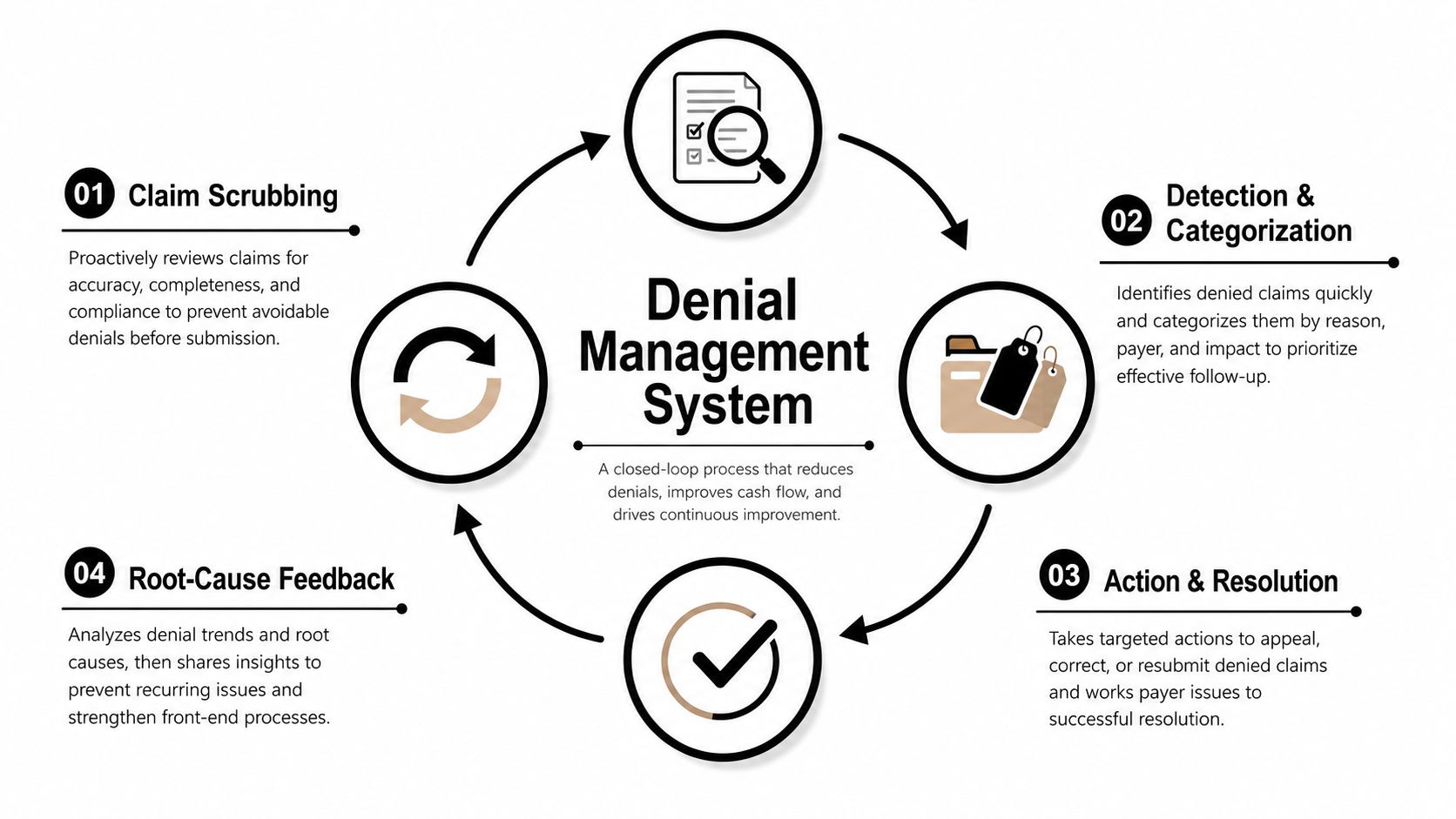
Medical billing denial management is a closed-loop system, not a single task. It starts before submission, moves through adjudication and follow-up, then feeds root-cause findings back into claim creation so the same defect doesn't recur. It works like a manufacturing line, the goal isn't to inspect every finished product harder, it's to catch flaws early enough that the line doesn't keep producing the same bad units.
Use the same vocabulary across billing, coding, and leadership
A soft denial is a claim that isn't paid as expected but can often be corrected or appealed with the right documentation or classification. A hard denial is the type that's much harder to reverse, often because the coverage, policy, or contract position is already baked into the payer's response. The important point isn't the label itself, it's who owns the next move.
A preventable denial should trigger an upstream fix. That might mean new edits, tighter eligibility rules, better scheduling questions, or coder review before claim release. A payer-behavior denial should trigger trend analysis, payer-specific appeal language, and contract-aware escalation. If your reporting doesn't separate those buckets, your staff will mix operational cleanup with payer policy disputes and the data will become useless.
Treat denial work like a feedback loop
A denial queue without feedback is just expensive recycling. The workflow is detection, categorization, action, and prevention. When a claim is denied, the remittance detail should tell you not just what failed, but which team owns the correction and whether the fix belongs in the front end, the middle of the revenue cycle, or the payer escalation path.
If a denial doesn't change the process that created it, the same defect will come back under a different claim number.
The practical payoff is clarity. Billing, coding, clinical operations, and payer follow-up can't work from different definitions of the same denial. Once everyone uses the same language, you can stop arguing about symptoms and start fixing the source.
The Root Causes That Actually Drive Denials in 2026
The leading denial drivers are still the ones that receive the least investment, eligibility, prior authorization, demographic accuracy, and coding consistency. That lines up with the fact that about 77% of denials are administrative rather than clinical in the data cited earlier from MDR Revenue Group. In plain terms, most of your denial leakage starts before the payer ever reviews medical necessity in depth.
Why payer-specific patterns matter more than generic root-cause lists
The mistake I see most often is a denial report that lists reasons without context. That kind of report tells you what happened, but not where it's concentrated. The better question is which payer, which service line, and which staff handoff keeps producing the same reason code. Current guidance emphasizes tracking payer-specific denial trends because a generic appeal process misses the root cause, especially when one payer contract drives a disproportionate share of the pain. AHIMA-aligned guidance in the AMBCI denial prevention overview points in that direction.
A smart denial review separates the fixed problems from the repeat offenders. If the denial sits in eligibility or authorization, don't waste senior appeal time on it. Fix the intake question, the scheduling checklist, or the pre-service verification rule. If the denial keeps coming from the same payer with the same service or modifier issue, that's a contract or edit problem, not a one-off clerical mistake.
Read the remittance data like an operator
Your remittance advice should tell a story. Look at the reason code, the service line, the payer, the diagnosis pattern, and whether the same failure shows up after correction. If one payer repeatedly denies a specific specialty service, treat that as a process map, not a random noise pattern.
| Denial signal | What it usually means | Best response |
|---|---|---|
| Same reason code, same payer | Repeat payer pattern | Build a payer-specific edit or appeal path |
| Same reason code, different staff member | Training or workflow gap | Fix intake or coding steps |
| Different reason codes on the same service | Upstream defect chain | Review scheduling, auth, and coding handoffs |
The break-even point for investment is usually upstream. Every time you stop a preventable denial before submission, you remove a rework cycle, a follow-up cycle, and often a delayed cash cycle. That's the point most billing dashboards never show.
The End-to-End Denial Workflow That Actually Works
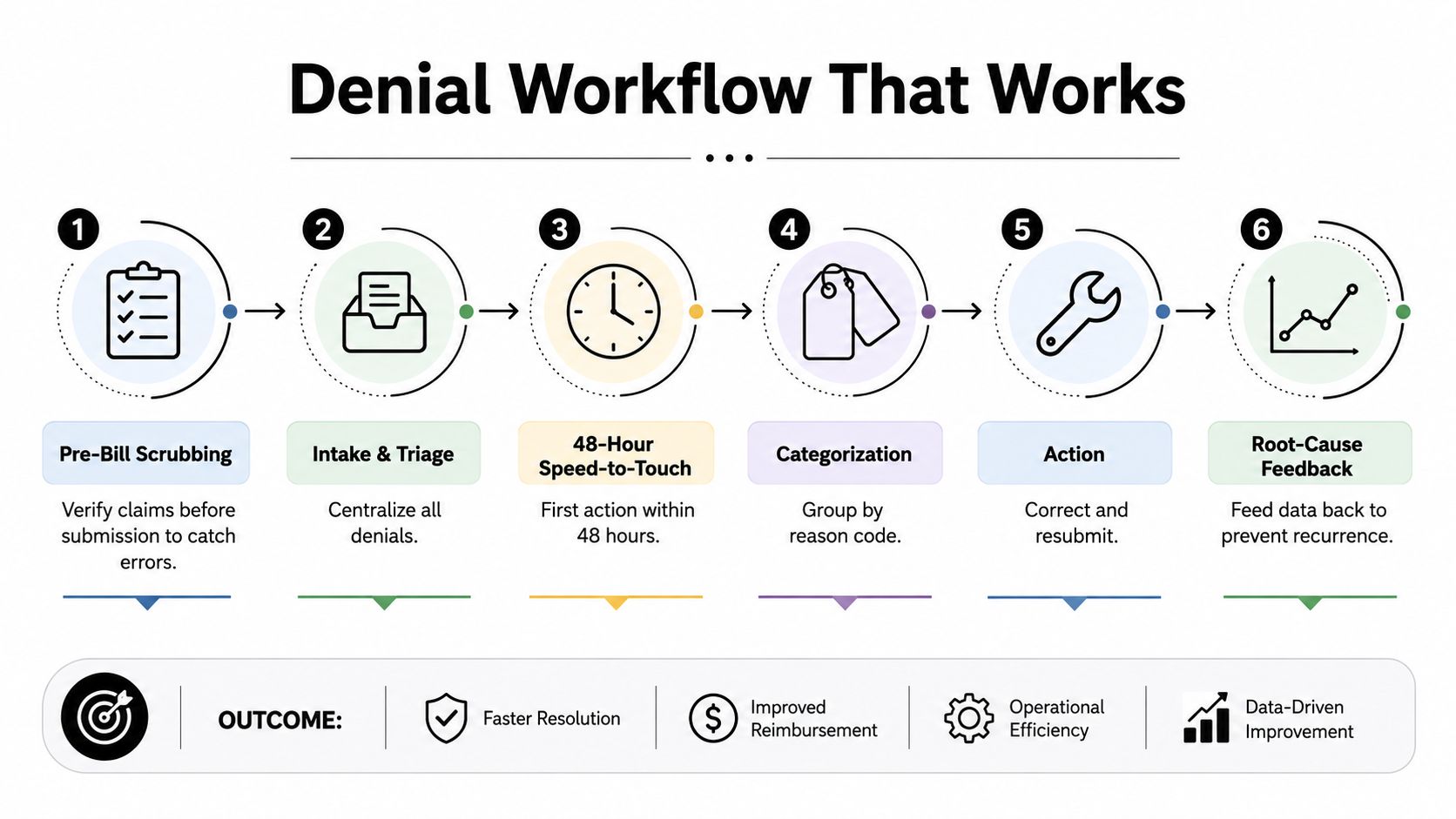
The workflow that works is disciplined and boring in the right places. It starts with claim scrubbing, moves into intake and triage, forces a first action within 48 hours of receipt, then routes the claim to the right owner with a reason code and next review date logged. Physician Side Gigs' denial management guidance is clear that denial recovery degrades fast when claims sit unworked.
Put automation on the front end, not the back end
Automation belongs where rules are stable. Eligibility checks, demographic edits, coding edits, and basic authorization validation should all happen before the claim leaves the system. That's where software saves labor and stops the easiest defects from ever becoming denials.
Human work belongs where judgment matters. Clinical validation, unusual documentation gaps, payer-specific escalation, and appeal narrative development still need a person who can read the chart, understand the payer's posture, and decide whether correction, rebill, or appeal is the right move. If you automate judgment, you'll just scale the wrong decision faster.
Use speed-to-touch as a real operational standard
A denial that sits untouched becomes harder to recover. Build a rule that every denial gets reviewed, categorized, and assigned an initial action within 48 hours. That doesn't mean every appeal is filed in 48 hours, it means the claim must be triaged, owned, and moved into the correct lane quickly.
The queue design matters. One queue for intake, one for coding review, one for appeals, and one for root-cause feedback keeps work from blending together. A clean handoff between those queues is what stops a denial from stalling in limbo.
You can pair that workflow with denial management software, but software doesn't fix bad ownership. RevGuard's denial management software is one option for teams that want cleaner routing and more structured follow-up, but the process still has to be designed correctly first.
Make feedback mandatory
Every resolved denial should produce one of three outcomes, an edit change, a training change, or a payer escalation note. If none of those happens, the workflow is incomplete. The resolution queue has to feed the front-end edits, or the same denial pattern will keep coming back under a new claim number.
Building an Appeals Function That Wins
An appeals function should not be a dumping ground for every denied claim. It should be a sorting engine. The claims that deserve appeal are the ones with complete documentation, payer-specific support, and a realistic chance of overturning. Expert guidance says complete-documentation appeals can win at 40% to 70%+ when they're built and followed correctly, according to Physician Side Gigs' denial management article.
Segment the queue by payer, reason code, and documentation strength
Appeals fail when teams treat them as generic letters with a signature line. That's lazy work. Build separate workstreams for payer type, denial reason, and documentation completeness, then assign the right staff to each one.
- Strong documentation, wrong payer response: escalate with a targeted appeal and supporting records.
- Missing documentation, fixable record gap: query the clinical team before filing.
- Policy-based denial with weak support: consider rebill, correction, or write-off depending on contract terms.
- Repeated payer pattern with solid documentation: preserve the case for contract escalation and payer follow-up.
The language in the appeal needs to match the denial reason. A coding mismatch needs code-level specificity. A medical necessity denial needs documentation that answers the payer's stated concern, not a recycled cover letter. A clean appeal is one that reads like it was built for that exact denial, because it was.
Operational rule: if your appeal template can be reused without changing the facts, it's probably too generic.
Don't appeal work that can't earn its keep
The labor cost matters. If the claim is too small, too weak, or too poorly documented to justify another hour of staff time, stop forcing it into the appeal lane. That doesn't mean writing it off casually, it means using a decision rule so senior staff spend time where the odds are real.
The highest performers usually protect their appeal queue from clutter. They don't let low-value denials crowd out the claims with real recovery potential. That discipline is what makes the function profitable instead of performative.
When Denials Become IDR Disputes Under the No Surprises Act
Some underpayments don't belong in the standard denial queue. They belong in Independent Dispute Resolution under the No Surprises Act. That matters because federal dispute volume remains operationally significant, with entities submitting 148,436 new disputes through the federal IDR portal in the first quarter of 2025, as reported in CGM's denial management article on No Surprises Act focus areas.
Know when to stop chasing a claim and start building a dispute
The handoff rule should be blunt. If the payer's issue is a standard claims defect, work it inside normal denial management. If the payer has paid, but the payment reflects a pattern that's better handled through the NSA dispute path, move it out of the routine queue and into formal arbitration prep. That shift is especially relevant in anesthesia, air ambulance, ED-adjacent services, and multi-state specialty platforms.
The packaging has to serve both purposes, clean billing and dispute readiness. That means the claim file needs to be organized enough for claim follow-up and strong enough to stand as evidence in a dispute. If you have to rebuild the record later, you're already behind.
Make payer behavior part of the revenue model
A lot of denial teams are underpowered. They know how to resubmit. They know how to appeal. They don't always know how to escalate a payer behavior issue into a formal dispute track. That gap leaves money on the table when underpayment is systemic, not accidental.
The operational fix is simple. The denial team and the IDR team need a shared evidence standard, a clear handoff trigger, and a common view of which payer patterns should bypass routine follow-up. If those pieces aren't aligned, your claims staff will keep treating a dispute as if it were just another denial.
RevGuard's No Surprises Act summary is useful if you need a straight explanation of how this dispute lane fits into revenue recovery. The point isn't to create more process, it's to stop leaving payer behavior unchallenged when the claim is already clean.
Specialty-Focused Denial Playbooks That Beat Generic Templates
Generic denial templates fall apart in specialty billing because the failure pattern changes by service line. An anesthesia denial doesn't behave like a dermatology denial, and an air ambulance underpayment doesn't belong in the same playbook as an orthopedic modifier problem. If you run one template across all of them, you'll keep missing the highest-dollar issues.
Build around the denial pattern, not the department name
| Specialty | Top denial reason | Highest-leverage fix | Owner |
|---|---|---|---|
| Anesthesia | Modifiers or time reporting mismatch | Pre-bill coding edits tied to anesthesia rules | Coding lead |
| Orthopedics | Authorization or documentation mismatch | Scheduling checks before procedure date | Front-end team |
| Gastroenterology | Medical necessity or coverage policy mismatch | Payer-specific policy lookup and chart review | Coder plus clinical reviewer |
| Dermatology | Procedure-level coding inconsistency | Specialty edit rules and coder education | Billing manager |
| IONM | Payer policy and documentation gaps | Procedure-specific appeal packet | Appeals specialist |
| Air ambulance | Payer behavior and underpayment disputes | Escalation to NSA dispute path when appropriate | Revenue integrity lead |
| Multi-state platforms | Inconsistent payer handling across locations | Centralized denial analytics with local execution | RCM director |
The table works because it forces one question, who owns the fix? A denial playbook without ownership is just a document. A denial playbook with ownership becomes a control system.
Specialty logic beats generic training
High-dollar specialties need denial rules that reflect real payer behavior. Modifier misuse, auth failures, place-of-service edits, and downcoding don't show up evenly across a broad medical group. They cluster by payer contract and by procedure family, which is why the response has to be specific.
That's also why staff training should be narrow. Teach the front desk the eligibility and authorization questions they need. Teach coders the exact service-specific edits they see every week. Teach appeals staff which payer arguments keep winning. Broad training decks look polished, but they don't move cash.
RevGuard's revenue cycle and analytics resources fit this specialty model because the job is to see denial behavior by payer and service line, then act on it. That's the level where specialty billing either protects margin or leaks it.
The KPI Scorecard That Predicts Cash, Not Just Activity
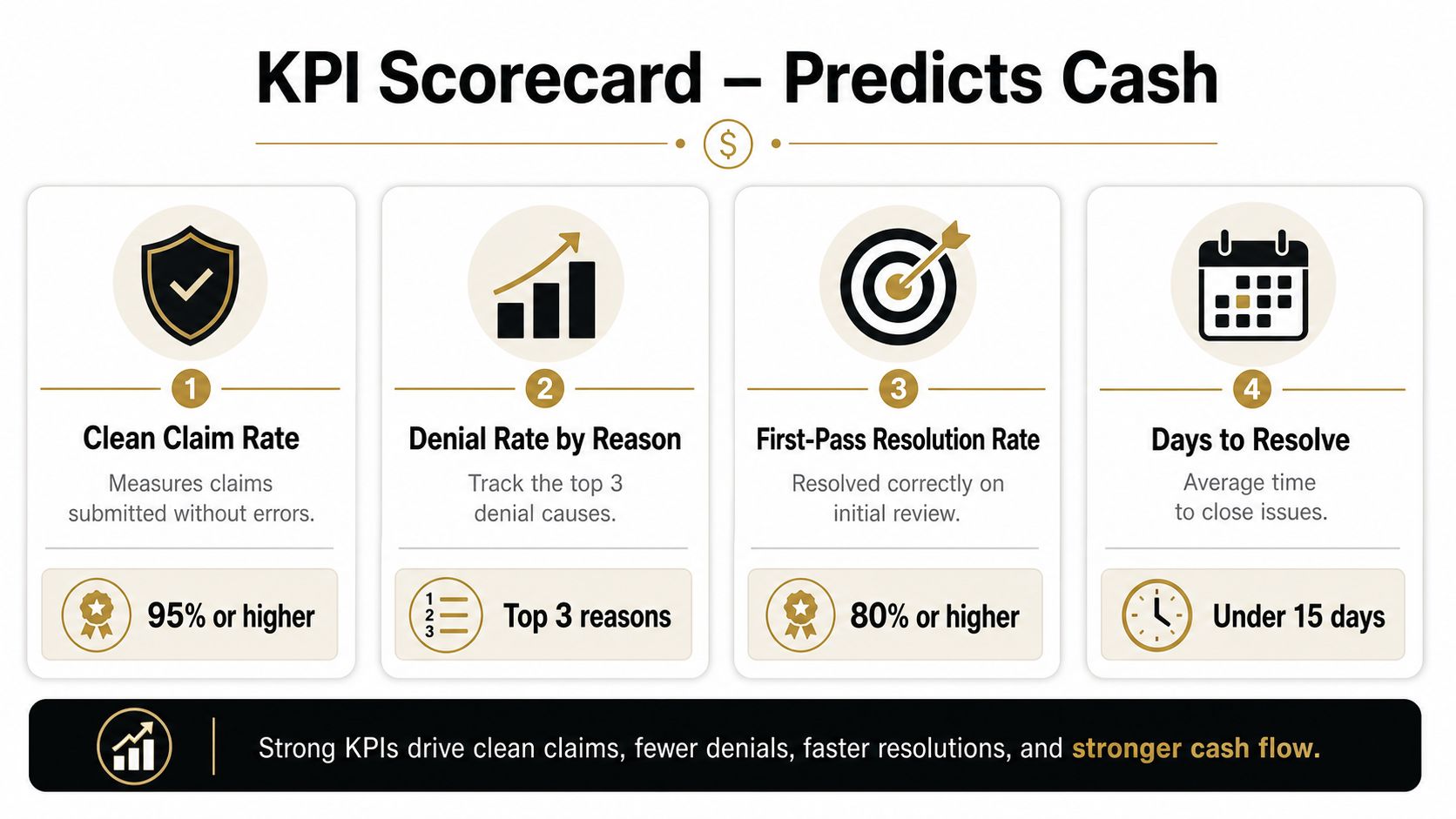
A denial dashboard should answer one question, are we protecting cash or just generating work? The scorecard that matters is short. Track clean claim rate, denial rate by reason, speed-to-touch, and net recovery rate. Everything else is secondary unless it changes one of those four numbers.
Use metrics that change behavior
Clean claim rate tells you whether the front end is doing its job. Denial rate by reason shows where the defects cluster. Speed-to-touch tells you whether the team is controlling aging. Net recovery rate tells you whether appeals and escalations are converting into cash.
Vanity metrics do the opposite. Queue size can look impressive while cash is stuck. Touch count can spike while recoveries fall. If leadership wants a real read on performance, these activity measures should never outrank the metrics that tie directly to payment.
Build the dashboard around payer behavior
The best dashboards don't just count denials, they expose payer patterns. If one payer keeps generating the same reason code, that needs its own line on the scorecard. If a specialty service keeps getting underpaid, that needs to show up as a separate trend, not disappear inside a blended average.
Review the scorecard on a fixed cadence and use it to force action. If the denial reason changes, the edit rules change. If recovery stalls, the appeal criteria change. If a payer keeps behaving badly, escalate it into contract or dispute strategy instead of letting it live forever in a work queue.
Roll the program out in phases
Start with front-end edits and denial categorization. Then lock down the 48-hour triage rule. After that, tighten the appeals segmentation and the payer-behavior dashboard. The sequence matters because you can't analyze what you can't categorize, and you can't fix what you haven't isolated.
If you're handing this to your CFO, keep the message plain. Denial management is not about processing more work. It's about removing avoidable defects, winning the appeals that matter, and escalating payer behavior when the claim is already clean.
If your denial program still treats every denial as a billing problem, it's time to rebuild the logic underneath it. RevGuard works on the full path from upstream claim control to NSA dispute strategy, so specialty teams can reduce avoidable denials and escalate the ones that really belong in arbitration. Visit RevGuard to see how their approach fits your denial workflow, payer behavior analytics, and dispute recovery process.