

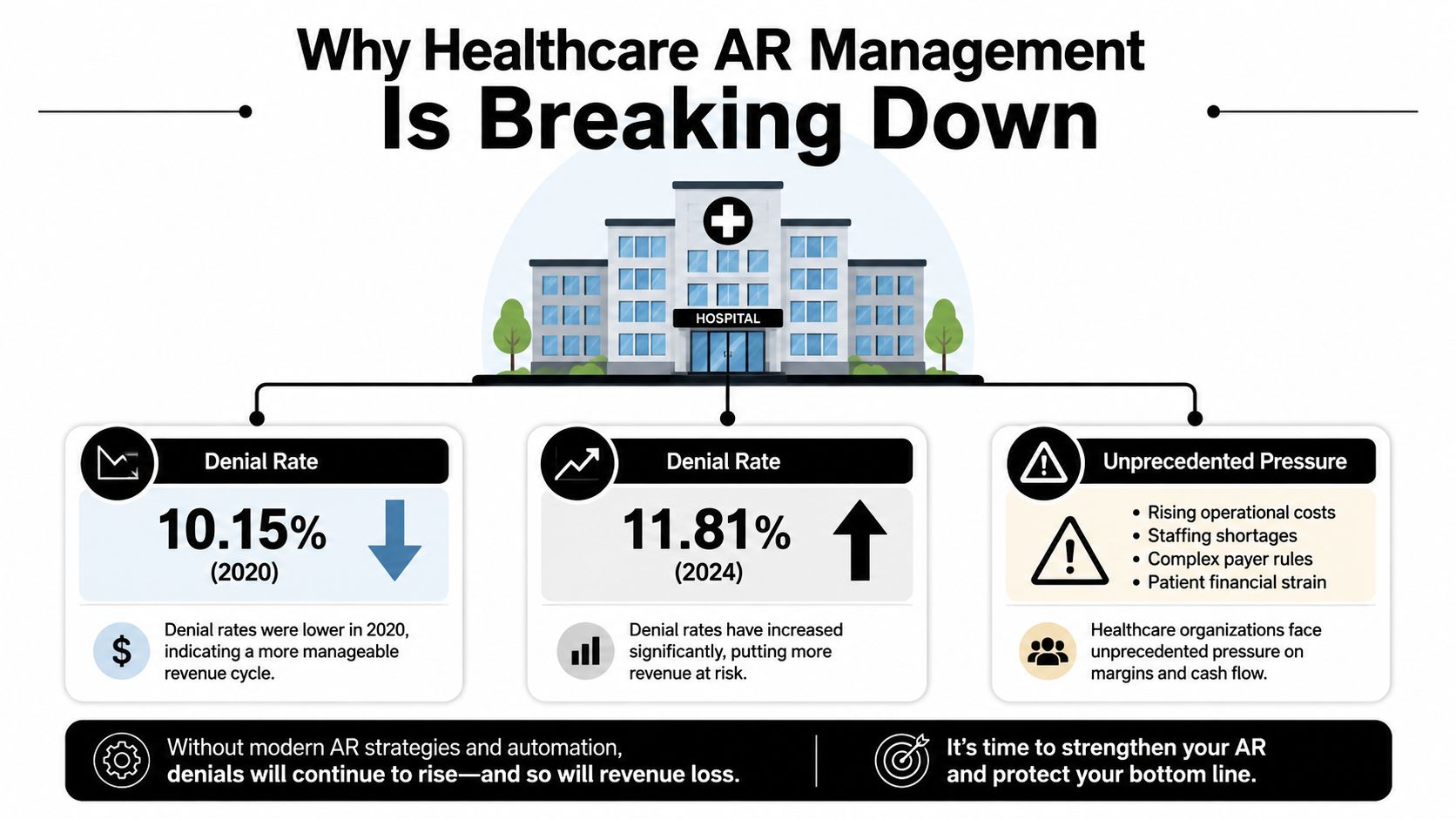
Healthcare claim denial rates rose from 10.15% in 2020 to 11.81% in 2024, according to industry reporting summarized in the Optum 2024 Revenue Cycle Denials Index. That shift changes the accounts receivable management problem. Specialty practices aren't dealing only with slow collections after billing. They're carrying upstream registration, eligibility, authorization, documentation, coding, and contract problems into the back end, where each error becomes rework, an appeal, an underpayment, or an aging balance.
A strong AR operation therefore has two jobs. It must convert clean claims into timely payment, and it must create enough evidence to challenge payer behavior when reimbursement is delayed, reduced, or denied. Under the No Surprises Act, that second responsibility includes knowing when a dispute may belong in Independent Dispute Resolution, and preparing the claim so the enforcement process has something reliable to evaluate.
Why Healthcare AR Management Is Breaking Down
Initial denial rates increased from 10.15% in 2020 to 11.81% in 2024, according to the Optum 2024 Revenue Cycle Denials Index. The percentage matters, but the operational lesson matters more: specialty practices are sending upstream defects into AR, then asking collectors to solve registration, authorization, documentation, coding, and payer-contract problems after the claim has already failed.
A denial is not an unpaid claim waiting for follow-up. It uses staff capacity, delays adjudication, creates new documentation work, and can move the balance into an older aging category. Eligibility errors, missing authorization, inaccurate demographics, coding inconsistencies, and incomplete clinical support all create rework that a follow-up team cannot remove efficiently.
Why traditional follow-up falls short
Many departments still assign work by aging bucket and payer queue. Those categories help organize production, but they do not identify why the same defect keeps entering the system. A collector may resubmit a claim, call the payer, or file an appeal while authorization and documentation problems continue upstream.
Payer behavior adds another layer. Downcoding, payment variance, medical-necessity reviews, and additional-record requests can leave balances that look closed in the system but remain financially incomplete. Without expected-versus-actual payment checks, underpayments can disappear into contractual adjustments or routine write-offs.
Under the No Surprises Act, weak upstream claim evidence can also limit the practice's position in Independent Dispute Resolution or arbitration. IDR is not a substitute for clean documentation. The record must support the service, the parties involved, the reimbursement basis, and the amount being disputed. A practice that treats AR as collection activity alone may miss the enforcement opportunity created by a payer underpayment.
Practical rule: Measure more than cash collected. Track what registration, clinical documentation, coding, billing, posting, and payer escalation prevent or recover.
AR must become revenue protection
Revenue-cycle ownership must be distributed. Registration owns data quality. Authorization staff own payer prerequisites. Providers and coders own documentation integrity. Billing owns claim accuracy. AR owns prioritization, appeals, variance recovery, and escalation. Leadership owns the feedback loop that converts recurring denial and underpayment patterns into process changes.
The strongest departments connect those responsibilities to IDR readiness. They preserve the evidence needed to challenge payer decisions while fixing the upstream conditions that create avoidable disputes. That link between claim quality and enforcement is where specialty practices can protect both cash flow and reimbursement integrity.
The End-to-End AR Workflow Explained
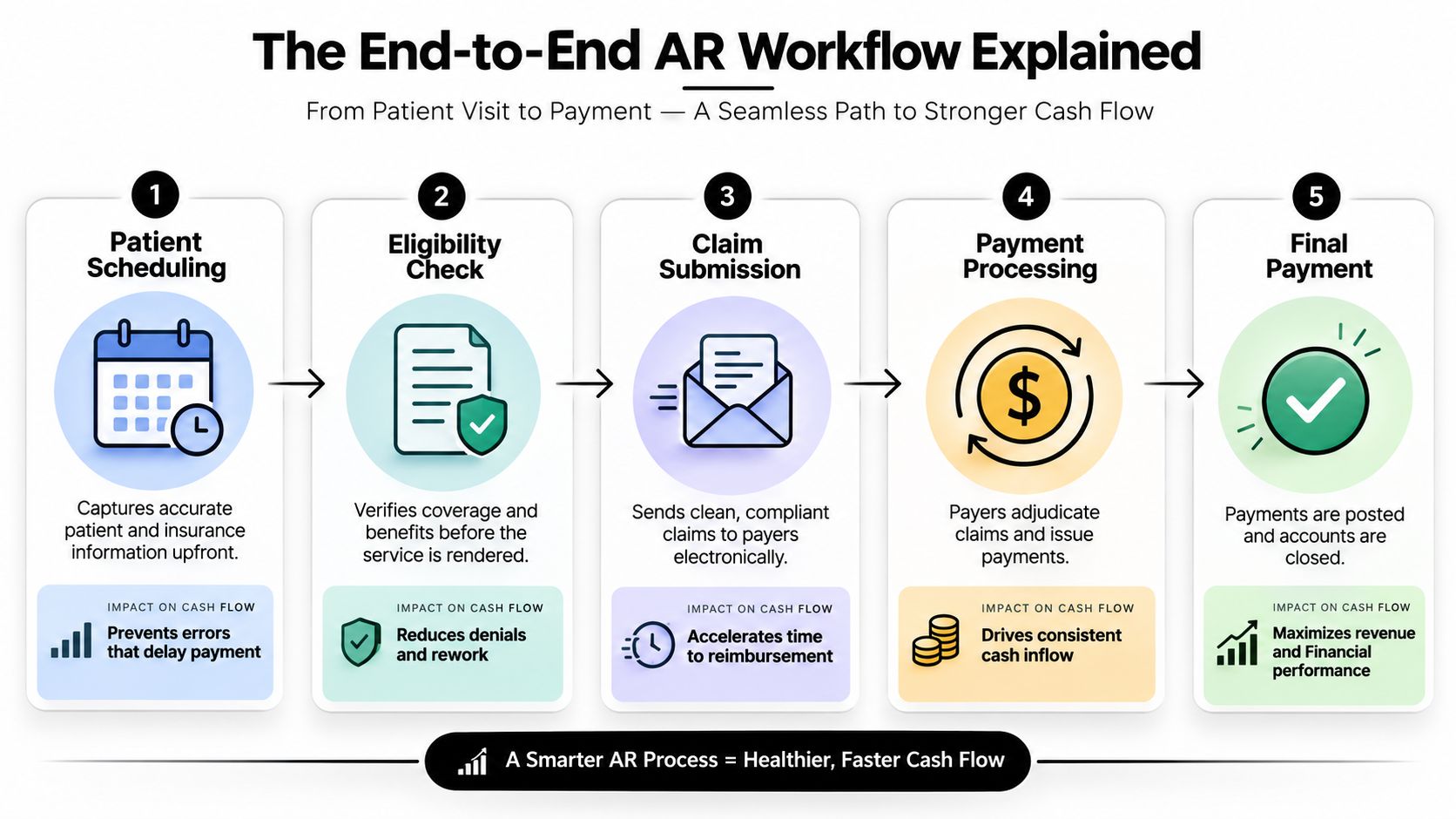
Accounts receivable management begins before a claim exists. A patient scheduled with the wrong payer, an incomplete authorization record, or an incorrectly selected place of service can create a balance that billing staff won't be able to repair cleanly.
Start with patient and payer facts
At scheduling and registration, verify the patient identity, insurance details, network status, referral requirements, and service location. Eligibility isn't a one-time administrative checkbox. Coverage can differ by date, provider, facility, service, and benefit category, so the result must be stored in a way that the billing team can review later.
Authorization deserves the same discipline. Record the approved service, date range, units or visits where relevant, rendering provider, and authorization identifier. A phone note that can't be connected to the claim won't help much during an appeal.
Build a claim that can survive review
Clinical documentation, coding, modifiers, provider credentials, and payer-specific edits must align. In anesthesia, that can include time-based documentation and medical direction requirements. In orthopedics, the claim may require careful handling of bundled surgical services and implant-related reimbursement. In gastroenterology, procedure coding and pathology relationships need to support the billed service without relying on assumptions.
Claim scrubbing works best when it catches specific, known failure modes. It shouldn't become a blunt edit layer that delays clean claims or creates unnecessary manual review. Each edit needs an owner, a resolution path, and a way to determine whether the same issue is recurring.
Manage the response, not just the submission
Once a claim is submitted, the workflow moves through acceptance, adjudication, payment posting, denial classification, appeal, and patient balance resolution. Rejections require rapid correction because they may never enter the payer's adjudication process. Denials require a reason-specific response, not a generic resubmission.
Payment posting should identify both missing payments and amounts that differ from the contracted expectation. A denial or underpayment queue without dollar prioritization encourages staff to work the easiest accounts instead of the accounts with the greatest recovery potential.
Close the loop
Every resolved account should produce information. Classify the root cause, identify the responsible workflow stage, document the payer response, and feed the finding back to the appropriate team. If a practice sees repeated eligibility failures from one registration location, more collector effort won't fix the problem. A targeted registration correction will.
Key Performance Indicators and Industry Benchmarks
A useful AR dashboard connects speed, quality, recoverability, and payer behavior. No single measure explains cash performance. DSO can fall after difficult balances are written off even as denials and underpayment leakage increase. Review metrics together, then segment them by payer, specialty, location, provider, service line, and aging category.
Days sales outstanding, or DSO, measures how long receivables remain outstanding before collection. The standard formula is Accounts Receivable ÷ Total Credit Sales × Number of Days, also expressed as Average Accounts Receivable ÷ Net Revenue × 365 days, as explained by Investopedia's DSO reference. Lower DSO usually means faster cash conversion. Higher DSO leaves more working capital tied up in unpaid claims and balances.
Track the measures as a connected set:
- Days in AR: Shows the age and volume of outstanding receivables, provided aging definitions remain consistent.
- Initial denial rate: Measures denied claims as a share of claim volume. Pair it with denial dollars and write-offs because frequency alone can hide financial impact.
- Denial write-off rate: Shows the portion of net patient service revenue lost through denial-related write-offs.
- Clean claim rate: Indicates how often claims pass initial submission without preventable correction or rejection.
- Net collection rate: Compares collectible reimbursement with actual collections after appropriate contractual adjustments.
- Payment variance: Identifies differences between expected and posted reimbursement, including systematic underpayments.
Denial rate, denial write-offs, and denial dollars answer different questions. Rate shows how often denials occur, write-offs show what the practice permanently gives up, and dollar measures show where limited staff time can recover the most cash. A specialty practice should report all three rather than allowing a low-volume, high-dollar payer problem to disappear inside an overall percentage.
The NACM collections benchmarking material provides a historical example in which statistical scoring used to prioritize collections reduced DSO by 6 points. The same benchmarking work notes that electronics, construction, and heavy machinery can average 80 to 90 days in receivables. That comparison reinforces the need to set targets against comparable operations, payer mix, and service lines.
AR Performance Benchmarks by Practice Type
| Metric | High-Performing | Average | Underperforming |
|---|---|---|---|
| DSO | Consistently improving against internal baseline | Stable but sensitive to payer or service mix | Rising over successive reporting periods |
| Days in AR | Current and recent balances dominate | Noticeable aging concentration | Large unresolved older-balance segment |
| Denial rate | Root causes are identified and corrected | Denials are worked but recurring causes remain | Denials grow faster than prevention efforts |
| Denial write-off rate | Write-offs are reviewed by cause and dollar value | Periodic review with incomplete ownership | Write-offs conceal unresolved process or payer issues |
| Clean claim rate | Front-end and billing edits prevent repeat defects | Quality varies by location or specialty | Frequent rejections, corrections, and resubmissions |
| Net collection rate | Contractual expectations and variances are monitored | Collections are reported without full variance detail | Underpayments and avoidable adjustments remain unchallenged |
For definitions and reporting considerations, review this guide to revenue cycle management metrics. The most useful benchmark is a transparent internal baseline that shows whether a payer, provider, or workflow is improving, and whether cleaner upstream claims are producing stronger downstream payment and arbitration outcomes under the No Surprises Act.
Technology and Automation Realities
Automation won't rescue an AR department that feeds bad data into a faster workflow. In a 2025 survey, 80% of finance leaders rated AR automation as important, high priority, or critical, yet only 39% were implementing solutions and 14% had deployed AI, according to the AR Automation Survey Report. The gap reflects implementation difficulty, not a lack of interest.
Healthcare organizations often have multiple practice-management systems, clearinghouses, payer portals, coding workflows, and payment files. If identifiers don't match or status data arrives late, an automation tool may create duplicate work, misclassify denials, or send staff after accounts that have already changed state.
Automate repeatable decisions first
The strongest early candidates are processes with clear inputs and predictable outputs:
- Eligibility verification: Run checks before service and flag coverage conflicts for human resolution.
- Claim scrubbing: Apply specialty and payer edits before submission, while routing exceptions to accountable owners.
- Denial categorization: Map payer messages into consistent root-cause categories instead of leaving staff to interpret free text.
- Worklist prioritization: Rank accounts by recoverable value, aging, payer response, and escalation urgency.
- Payment posting: Match remittance information to claims, then route exceptions for review.
- Patient communication: Deliver clear balances and payment options without replacing sensitive conversations that require judgment.
The right technology removes repetitive navigation and data entry. It doesn't decide whether clinical documentation supports an appeal, whether a payer's position conflicts with a contract, or whether a case is ready for IDR without human oversight.
Test the workflow before buying the promise
Require vendors to demonstrate the actual exception path. Ask how the system handles partial payments, corrected claims, payer-specific denial codes, missing remittance details, authorization mismatches, and accounts that move between insurance and patient responsibility. Review integration ownership, audit trails, role permissions, and how staff can override an automated decision.
A practical technology assessment should start with process mapping and data validation, then use a contained rollout with defined acceptance criteria. Teams evaluating healthcare workflow automation should connect the tool to a specific operational bottleneck, such as delayed eligibility review or inconsistent denial routing, rather than launching automation as an abstract modernization project.
Payer Behavior Strategies and No Surprises Act Enforcement
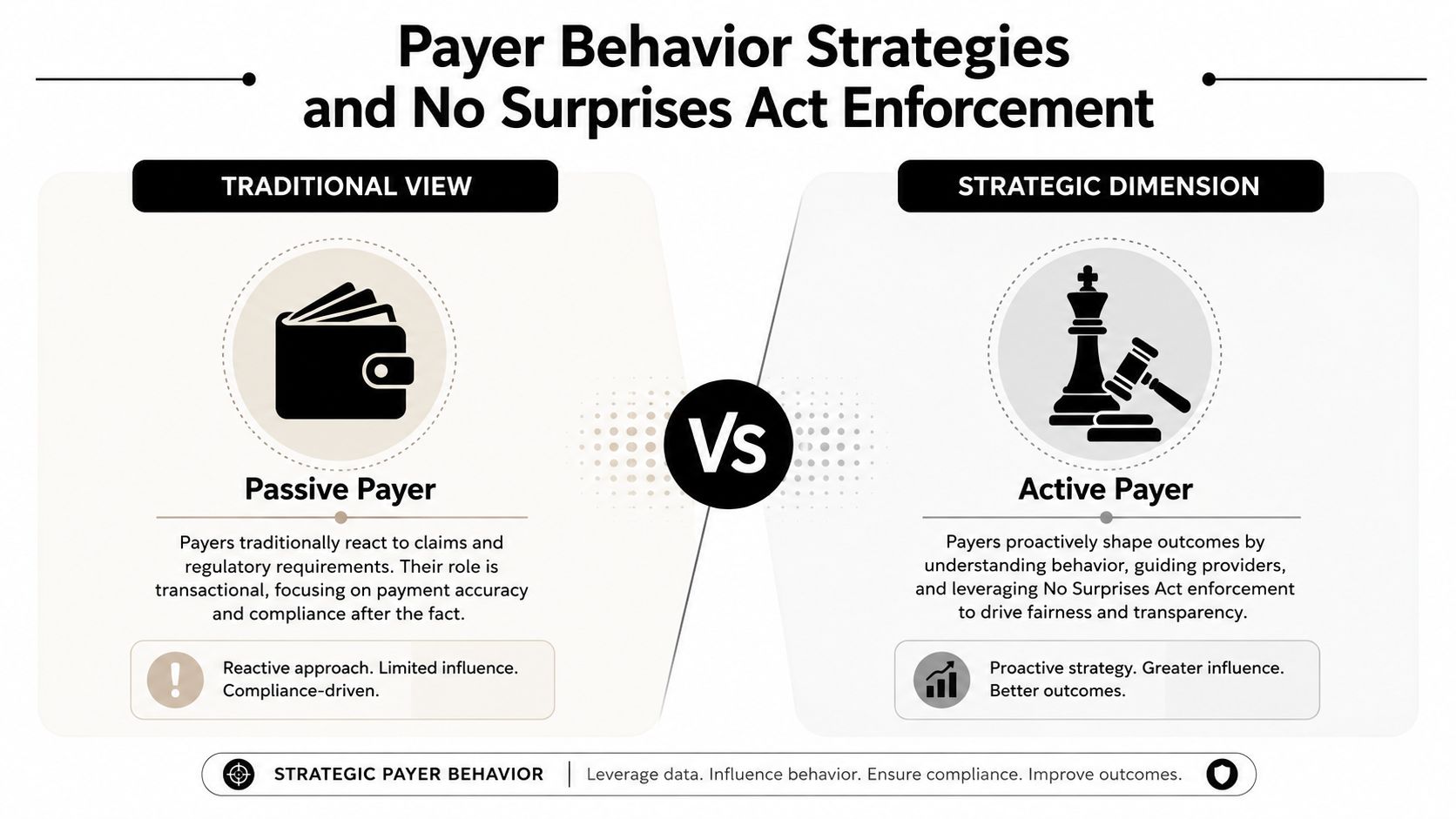
Payers aren't passive processors in a modern AR strategy. Their edits, documentation requests, reimbursement offers, network determinations, and response timing create patterns that provider organizations must track and address.
The No Surprises Act adds an enforcement path for eligible disputes, but IDR isn't a substitute for clean claims. An arbitration case depends on accurate service information, credible documentation, a defensible payment history, and compliance with the applicable process. If the original claim lacks the facts needed to explain the service, the practice has weakened its position before the dispute begins.
Turn payer activity into intelligence
Track payer behavior at the level where action is possible. A useful payer profile includes denial categories, underpayment patterns, average response behavior, recurring requests for records, coding disputes, authorization outcomes, and payment variance by service type. Separate genuine clinical or coding defects from patterns that appear after a claim meets the payer's stated requirements.
For specialty practices, the most valuable signal may not be the denial rate alone. It may be a recurring reduction in reimbursement for a specific code family, a consistent challenge to a documented service component, or a repeated delay after complete records are submitted. Those patterns should reach contracting, compliance, clinical documentation, and executive teams, not remain inside an AR work queue.
Make every disputed claim evidence-ready
A dispute-ready file should connect the patient and service facts to the billed work. Preserve eligibility and authorization records, operative or procedural documentation, coding support, claim history, remittance details, correspondence, contract terms, and payment comparisons. Maintain a clear timeline so an internal reviewer or IDR entity can understand what happened without reconstructing the case from disconnected systems.
The No Surprises Act summary can help teams orient their compliance work, but practices should also define internal eligibility screening, notice requirements, documentation standards, deadlines, and approval controls. IDR should be treated as a managed recovery channel, not an improvised last appeal.
A claim that is clean enough to bill isn't necessarily strong enough to arbitrate. Build for both outcomes at the front end.
Use enforcement selectively
Not every balance belongs in IDR. Screen for eligibility, expected recovery, documentation strength, payer history, administrative requirements, and the cost of pursuing the case. A disciplined process prevents staff from sending weak disputes into an expensive workflow while preserving strong cases that traditional follow-up would otherwise close at an avoidable loss.
Specialty-Specific Action Plans
Generic AR advice breaks down because specialty claims fail for different reasons. The first priority is to identify the service-specific fact that determines payment, then protect that fact through registration, documentation, coding, submission, and escalation.
Anesthesia
Verify the facility, payer, provider relationship, authorization requirements, and scheduling details before service. Require documentation that supports time-based billing, relevant modifiers, and medical direction rules. During follow-up, separate time disputes from eligibility, bundling, and network issues so appeals use the right evidence.
Orthopedics
Create an edit library for surgical bundling, global-period issues, assistant-surgeon rules, laterality, and implant-related carve-outs. Compare posted payment with the expected contract or case arrangement before closing the account. High-value surgical underpayments should move to a variance review queue rather than a routine adjustment queue.
Gastroenterology
Link procedure documentation, coding, anesthesia where applicable, pathology add-ons, and facility information before submission. Review payer-specific edits for multiple procedures and modifier use. When a denial cites medical necessity or documentation, the appeal should map the billed service directly to the clinical record, not merely restate the original claim.
Air ambulance and emergency services
Capture dispatch facts, medical necessity documentation, transport details, origin and destination, provider credentials, and payer communications in one record. Out-of-network and emergency-service disputes require early screening for applicable No Surprises Act pathways and careful control of deadlines. Staff should distinguish an eligibility problem from a payment dispute before choosing an appeal or IDR route.
Multi-specialty platforms
Standardize definitions, work queues, denial categories, and reporting across sites, but don't force every specialty into identical edits. A common dashboard can show DSO, denial dollars, payment variance, and aging, while specialty workgroups own the operational rules. For organizations using an external partner, RevGuard provides healthcare RCM services that include eligibility verification, claims submission, payment posting, denial management, underpayment recovery, AR follow-up, and reporting.
A useful prioritization method ranks each initiative by recoverable value, recurrence, implementation effort, and enforcement relevance. Fix the defect that produces repeated high-value leakage before optimizing a low-impact administrative convenience.
Building Your AR Improvement Roadmap
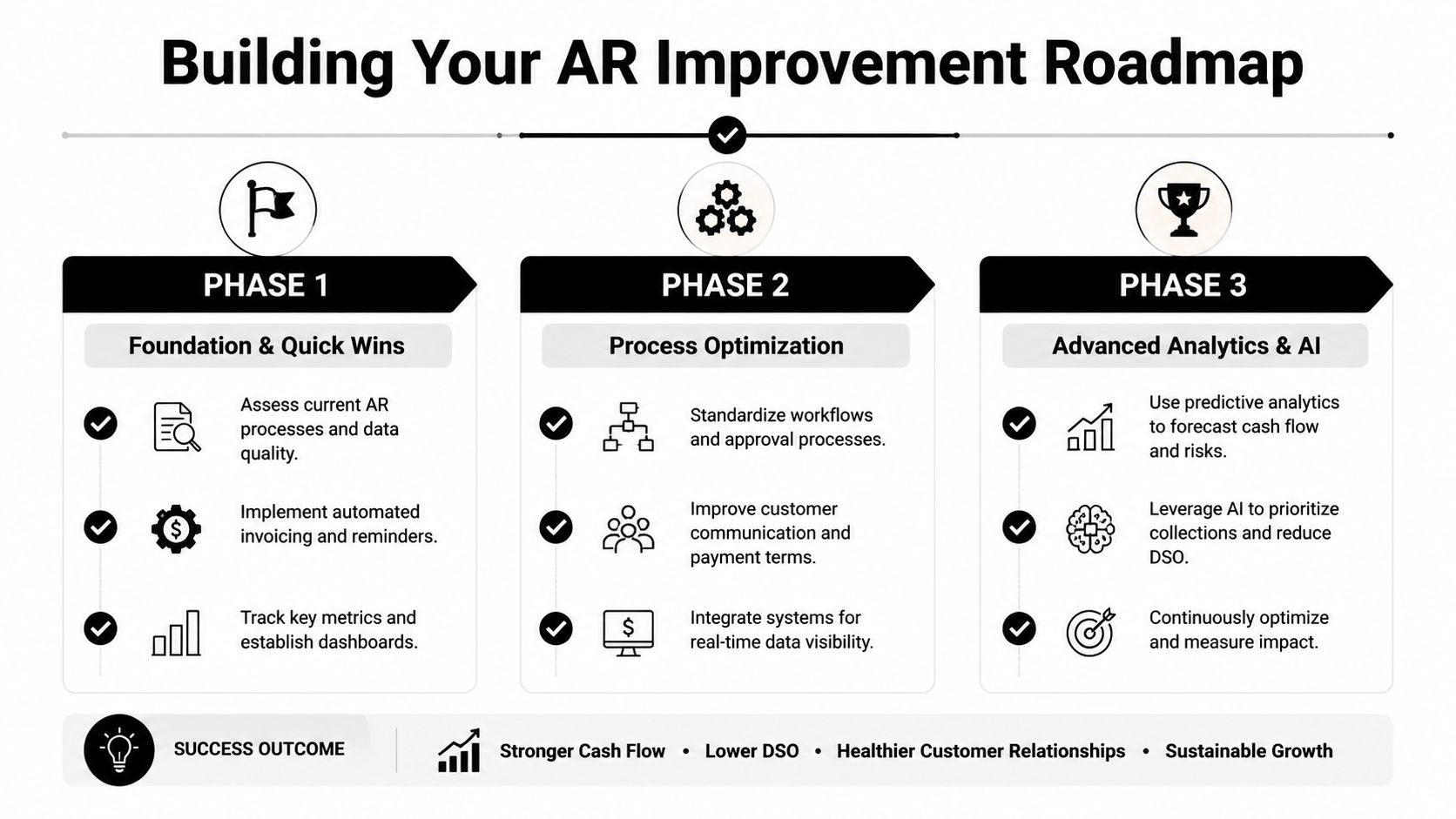
A sustainable roadmap starts with control, not software. Establish one baseline for DSO, days in AR, denial categories, denial write-offs, clean claim performance, net collections, and payment variance. Then assign every major failure pattern to a named owner.
Phase 1 focuses on foundation and quick wins
- Classify denials consistently: Create payer and specialty-specific root-cause categories.
- Prioritize recoverable balances: Work high-value, time-sensitive, and dispute-ready accounts first.
- Review payment variance: Identify underpayments before routine closeout hides them.
Phase 2 repairs the operating model
Redesign handoffs between scheduling, authorization, clinical documentation, coding, billing, posting, and AR. Introduce targeted edits, staff training, escalation rules, and dashboards that show whether upstream corrections reduce downstream work.
Phase 3 adds intelligence and enforcement
Use predictive prioritization only after data definitions are stable. Build payer-behavior reporting, formal IDR screening, evidence assembly, and executive review into the same revenue protection program. Success means more than faster collections. It means fewer preventable denials, fewer hidden underpayments, stronger dispute files, and clearer accountability across the full claim lifecycle.
RevGuard connects specialty-specific revenue cycle management with underpayment recovery and No Surprises Act IDR preparation, helping provider organizations address claim quality before payment and payer enforcement after it. Visit RevGuard to evaluate how an integrated AR and dispute strategy can support cleaner claims, stronger payer responses, and more disciplined cash recovery.