

Hospitals lose about 3% to 5% of net revenue every year through revenue leakage. In healthcare, revenue leakage is earned but uncollected revenue caused by denials, underpayments, eligibility gaps, coding failures, and contract variance.
That loss is recurring, not a one-time billing mistake. A claim can pass through registration, coding, submission, and adjudication, then still produce less payment than the provider earned under its contract or applicable reimbursement rules. The problem is particularly serious for specialty providers, where complex coding, out-of-network services, payer edits, and post-payment disputes create gaps that ordinary clean-claim reporting won't reveal.
The financial consequence is larger than the leakage rate suggests. The HFMA analysis of hospital revenue leakage notes that U.S. hospitals continue to lose 3% to 5% of net revenue annually, an amount representing tens of billions of dollars nationally. It also reports an aggregate operating margin of 5.2% across U.S. hospitals after the COVID-19 pandemic. Leakage can therefore absorb a substantial share of the profit a provider worked to generate.
For specialty practices, the central question isn't just, “Why was this claim denied?” It's, “Where did the expected reimbursement diverge from the money ultimately collected, and why did the system fail to identify that difference?”
What Revenue Leakage Means in Healthcare
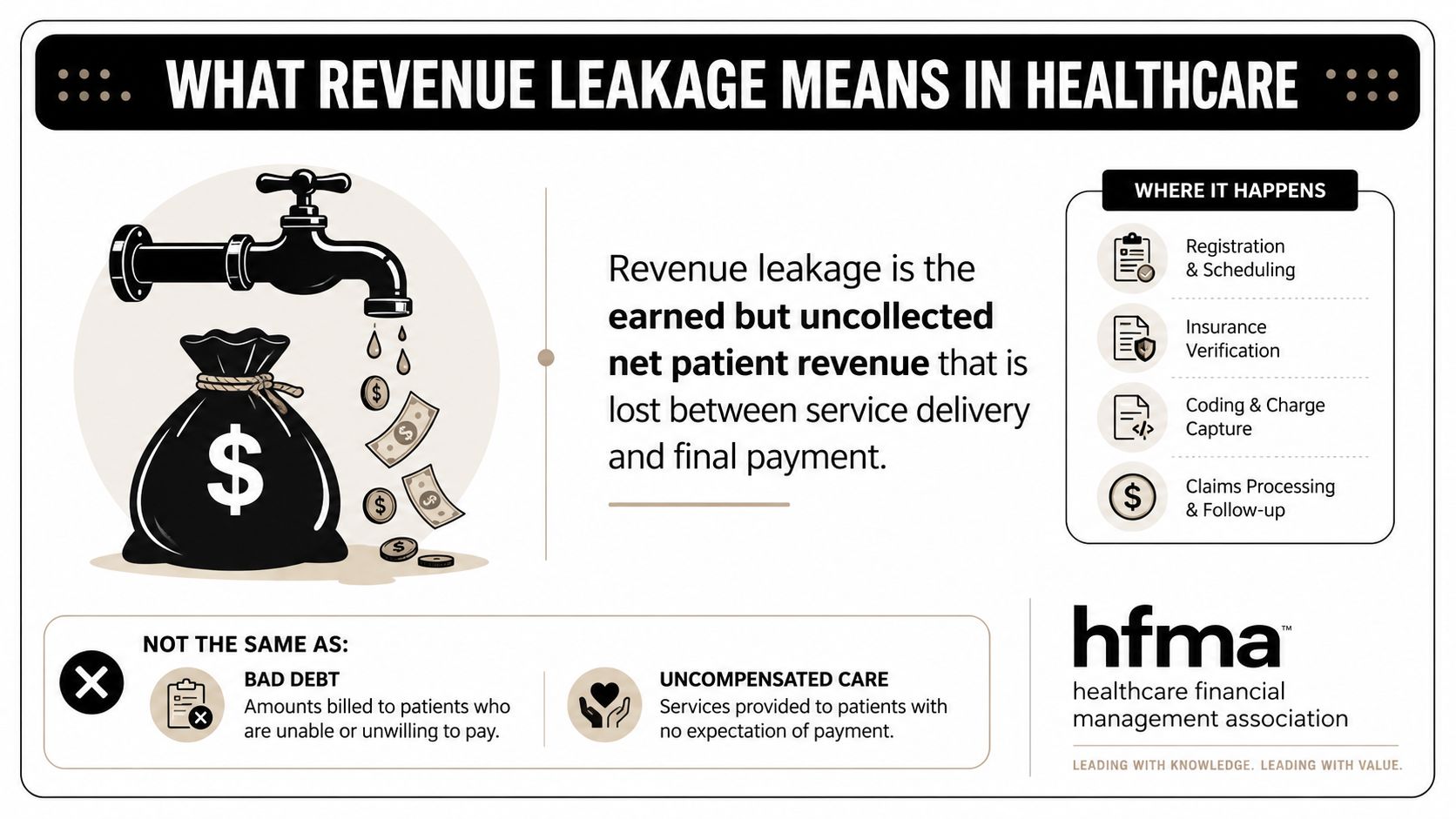
Revenue leakage is net patient revenue a provider has earned by delivering a covered service but hasn't fully collected by the time the payment cycle closes. The gap can appear before claim submission, during adjudication, or after the payer marks the account as paid. It differs from bad debt and uncompensated care because leakage concerns revenue that should have been captured under the applicable coverage, documentation, contract, or dispute framework.
The scale provides the clearest definition. HFMA reports that hospitals lose 3% to 5% of net revenue annually through leakage, despite substantial investment in electronic health records and billing systems. For a provider with significant patient revenue, even the lower end of that range can represent millions that never reach the operating account. The issue affects margin directly because the organization has already incurred the clinical and administrative cost of delivering the service.
Where the loss enters the cycle
Revenue leakage is structural because several teams and systems influence the final payment:
- Registration and eligibility: Staff may record expired coverage, miss a required authorization, or attach the wrong payer information.
- Coding and documentation: The clinical record may support reimbursement that the submitted codes, modifiers, or documentation don't capture.
- Denials: A valid service may be rejected for clinical, administrative, or payer-policy reasons and never recovered.
- Underpayments and contract variance: A payer may issue a payment below the expected allowable, while standard workflows treat the claim as resolved.
- Post-adjudication activity: Recoupments, silent adjustments, and disputed out-of-network payments can reduce the final amount after the claim appears complete.
Practical rule: A claim status of “paid” doesn't prove that the provider received the revenue it earned.
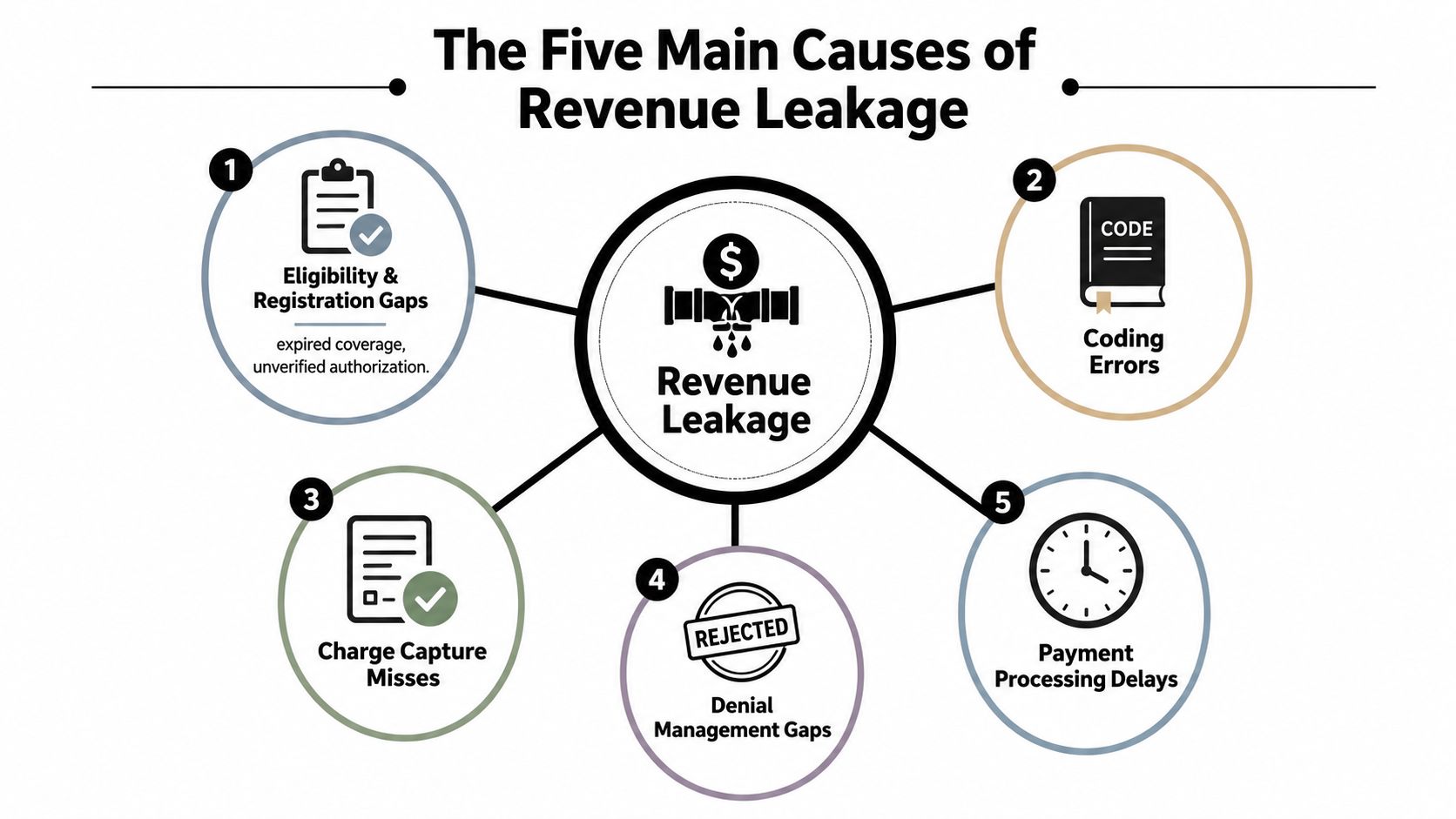
The HFMA discussion of the problem supports treating leakage as a margin-control issue, not a narrow billing-department nuisance. The mental map is simple: inspect eligibility, coding, denials, underpayments, and post-payment variance. Those five channels explain why a clean submission metric can coexist with weak contract yield and declining cash realization.
The Five Main Causes of Revenue Leakage
Revenue leakage usually begins before the account reaches a denial queue. Each failure point changes the expected reimbursement, and the next workflow may not have enough context to correct it.
Eligibility and registration gaps
An expired policy, incorrect member identifier, or missing authorization can trigger a retroactive denial after the provider has delivered care. The front-end team may have captured demographic information accurately while still failing to validate the coverage conditions attached to the service. The resulting loss isn't necessarily visible until the payer reverses responsibility or refuses the claim.
Coding and documentation errors
Coding determines how the payer interprets the service. An unspecified diagnosis, an omitted modifier, incomplete procedure detail, or documentation that doesn't support the submitted level can suppress legitimate reimbursement. These defects can create a formal denial, but they can also produce a lower allowed amount without a clear exception in the billing work queue.
Denials and underpayments
A denial blocks or reduces payment through an adjudication decision. An underpayment is different, because the payer sends money, closes the balance, and may leave the provider with no obvious recovery task. The healthcare underpayment explanation from Revecore describes this blind spot: underpayments often occur after payment, when the account is marked to zero even though reimbursement falls below the contracted or expected amount.
Contract variance
Contract variance appears when the payment doesn't match the negotiated fee schedule, reimbursement methodology, carve-out, or service-specific term. A payer can apply an incorrect rate without generating a traditional denial code. Unless the provider compares the remittance against the governing contract, the variance can be accepted as final.
Post-adjudication leakage
Recoupments, silent adjustments, delayed corrections, and disputes involving out-of-network claims can reduce revenue after initial adjudication. The No Surprises Act information from CMS is relevant because the law took effect on January 1, 2022 and established an Independent Dispute Resolution process for certain out-of-network payment disputes.
A provider can review its medical billing audit process to test these points across the full account lifecycle. The important diagnostic conclusion is that claim status alone isn't enough. Teams need upstream data, contract intelligence, remittance detail, and post-payment controls.
Denials Versus Underpayments and Why Both Leak Cash
Denials and underpayments create different operational problems, so providers shouldn't measure them through the same workflow. A denial normally produces a reason code, an account task, and a visible position in an appeal or follow-up queue. An underpayment can produce none of those signals.
The distinction matters after adjudication. The payer may issue a remittance, apply the payment, and reduce the account balance to zero. If the practice doesn't compare the remittance against the contracted expectation, the payment exits the recovery process even when the payer reimbursed less than required.
| Dimension | Denials | Underpayments |
|---|---|---|
| Visibility | Usually visible through a denial code or work queue | Often hidden inside a completed payment |
| Control point | Claim submission, adjudication, and appeal | Remittance reconciliation and contract comparison |
| Typical workflow | Review, correct, appeal, or rebill | Identify variance, validate terms, and pursue recovery |
| Primary risk | The provider never receives payment | The provider accepts incomplete payment as final |
| Required evidence | Claim record, clinical documentation, and payer reason | Contract, fee schedule, remit detail, and payment history |
A denial-management program that stops at adjudication can recover obvious losses while leaving paid claims untouched. That creates a false sense of control. The team sees fewer open denials, but it doesn't know whether the payer paid the contracted amount.
A paid claim is an accounting event. It isn't necessarily a revenue-assurance event.
For anesthesia, imaging, or other high-complexity services, the same claim may fail in two ways. One submission may be rejected outright because of an administrative edit. Another may adjudicate successfully but reimburse below the expected rate because of a contract or coding interpretation. Only a process that reconciles both claim outcomes against the expected payment can identify the full shortfall.
The practical priority is to connect denial management with post-payment variance detection. Denials remain important, but underpayment review is often the higher-impact frontier because the workflow has already declared success before anyone verifies the amount.
The Financial Scale of Revenue Leakage Today
Revenue leakage is large enough to affect operating performance, not merely billing productivity. A 2025 analysis summarized by Revecore reported more than $48.4 billion in combined net revenue leakage from denials and bad debt, up from $38.6 billion the prior year. The reported increase was roughly 25%. These figures shift the management question from correcting isolated billing errors to controlling recurring variance across payer rules, workflows, and payment decisions.
The impact differs by provider type. A hospital-wide benchmark does not translate directly to a specialty practice, where a concentrated mix of anesthesia, imaging, emergency, or other complex services can make payer interpretation and post-payment review especially material. The HFMA analysis also frames commercial-payer underpayments as a separate source of loss. Providers Get Paid reports a commercial-payer underpayment range of 1% to 3% of net patient revenue in many organizations.
What the benchmark ranges reveal
| Metric | Benchmark | Source |
|---|---|---|
| Annual hospital net revenue leakage | 3% to 5% of net revenue | HFMA analysis |
| Aggregate U.S. hospital operating margin after the pandemic | 5.2% | HFMA analysis |
| Combined leakage from denials and bad debt | More than $48.4 billion | 2025 Revecore analysis |
| Prior-year combined leakage benchmark | $38.6 billion | 2025 Revecore analysis |
| Reported year-over-year increase | Roughly 25% | 2025 Revecore analysis |
| Commercial-payer underpayment range in many organizations | 1% to 3% of net patient revenue | Providers Get Paid |
The financial mechanism matters. Upstream eligibility, authorization, coding, and documentation failures can create denials, while payer edits, contract application, and remittance handling can reduce payment on claims that appear successful. Those unresolved variances can later require evidence and escalation through the No Surprises Act's Independent Dispute Resolution process. Revenue leakage therefore reflects payer behavior and enforcement exposure as well as provider billing performance. Detection must connect claim outcomes, expected reimbursement, and dispute records before earned revenue becomes permanently uncollected.
How to Detect and Measure Leakage in Your Practice
Detection starts with a measurement model that follows the money from service delivery through final payment. A clean-claim rate shows whether submissions pass initial edits, but it doesn't show whether the payer applied the correct contract terms. Net days in accounts receivable show timing, but they don't isolate silent short-payments.
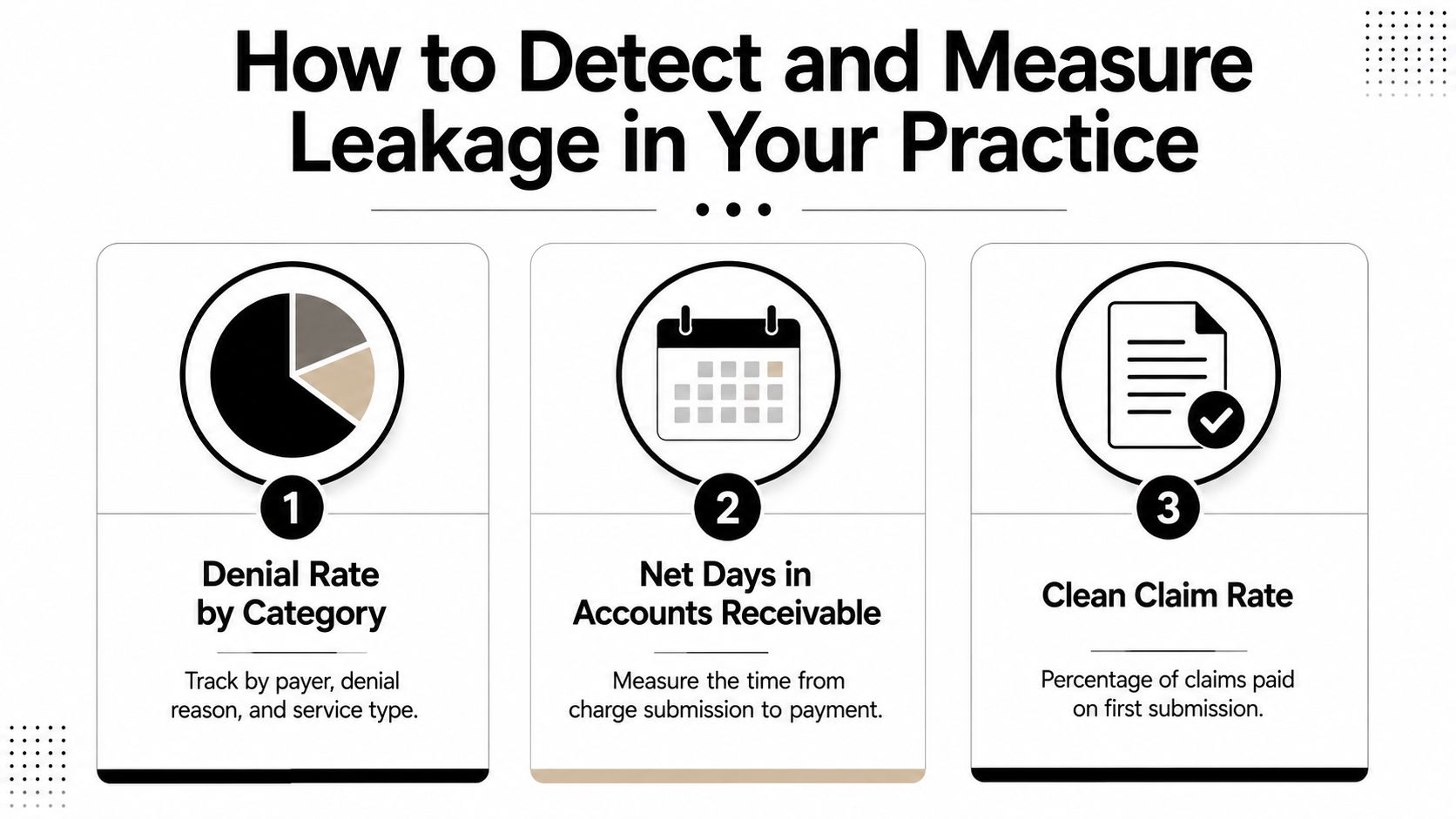
Use a core set of KPIs, then assign every metric to an operational owner:
- Denial rate by category: Segment results by payer, reason, service type, and responsible workflow. A single aggregate rate hides whether eligibility, coding, authorization, or medical-necessity issues drive the loss.
- Net days in accounts receivable: Track the time from charge submission to payment, then separate delays caused by denials from delays caused by payer processing or unresolved variance.
- Clean claim rate: Measure first-pass payment performance, but pair it with contract yield so a clean claim isn't treated as proof of complete reimbursement.
- Underpayment variance rate: Compare expected and actual payment at the claim and line-item level.
- Contract yield: Monitor the amount collected against the amount the governing payer terms require.
Audit the payment, not just the claim
Remit-level reconciliation compares the payer's explanation of payment with the applicable fee schedule, contract language, modifiers, carve-outs, and patient responsibility. It can flag a claim that paid without producing the expected reimbursement. Contract modeling then determines whether the variance reflects a legitimate adjustment or a recoverable shortfall.
Charge-capture audits examine whether performed services reached the claim. Eligibility and authorization logs show whether front-end staff completed the required verification and whether the record supports the submitted payer path. Manual sampling can identify patterns, but continuous analytics gives teams a broader view across payers, providers, locations, and service lines.
The healthcare revenue-cycle analytics approach from RevGuard reflects this broader measurement need. The name of the platform matters less than the control design: each KPI must lead to a queue, an owner, a deadline, and a documented remediation action.
Specialty-Specific Leakage Scenarios You Should Know
The leakage pattern changes with the specialty's reimbursement logic. Anesthesia practices manage time units, modifiers, and facility relationships. Air ambulance providers manage complex out-of-network reimbursement and disputes. Imaging centers must distinguish professional and technical components, while ASCs depend on contract terms that may treat high-volume procedures differently.
The examples below are operational scenarios, not claims of measured losses. Their purpose is to show which signal a provider should monitor.
| Specialty | Common Leakage Pattern | Typical Dollar Impact | Detection Signal |
|---|---|---|---|
| Anesthesia | Time units, modifier conflicts, or documentation gaps reduce or block payment | Varies by claim and contract | Paid units differ from documented units, or payment falls below the expected schedule |
| Air ambulance | Systematic out-of-network underpayment or denial creates a dispute candidate | Varies by transport and payer | Payment variance against expected reimbursement, paired with an eligible dispute record |
| Imaging | Technical-component carve-outs, contrast pricing, or coding differences reduce reimbursement | Varies by procedure and contract | Line-level payment differs from the technical or contrast term |
| Ambulatory surgery centers | Contract exclusions or incomplete fee schedules omit high-volume CPT reimbursement | Varies by procedure mix | Performed CPT codes appear in clinical or charge data but lack expected payment |
| Hospital-based specialties | Status-of-care disputes produce denials or reduced reimbursement | Varies by service and adjudication | Denial reason, place-of-service pattern, or payment variance clusters by facility |
Read the signal across systems
An anesthesia group shouldn't rely only on a denial report to find time-unit leakage. It should compare documented units, submitted units, adjudicated units, and paid units. An imaging center needs a similar line-level comparison for professional fees, technical components, and contrast-related terms.
Air ambulance providers face a further downstream issue. The No Surprises Act resource from CMS explains the federal framework for certain out-of-network services, while the Revecore discussion of underpayments shows why a paid claim can still require review. The detection signal is therefore both financial and procedural: the payment must be below expectation, and the dispute must fit the applicable requirements.
A specialty provider can have strong submission discipline and still lose value when the payer's final action isn't reconciled to the service record and reimbursement terms. That is why specialty-specific analytics outperform a generic denial dashboard.
How Integrated RCM and IDR Plug the Leak
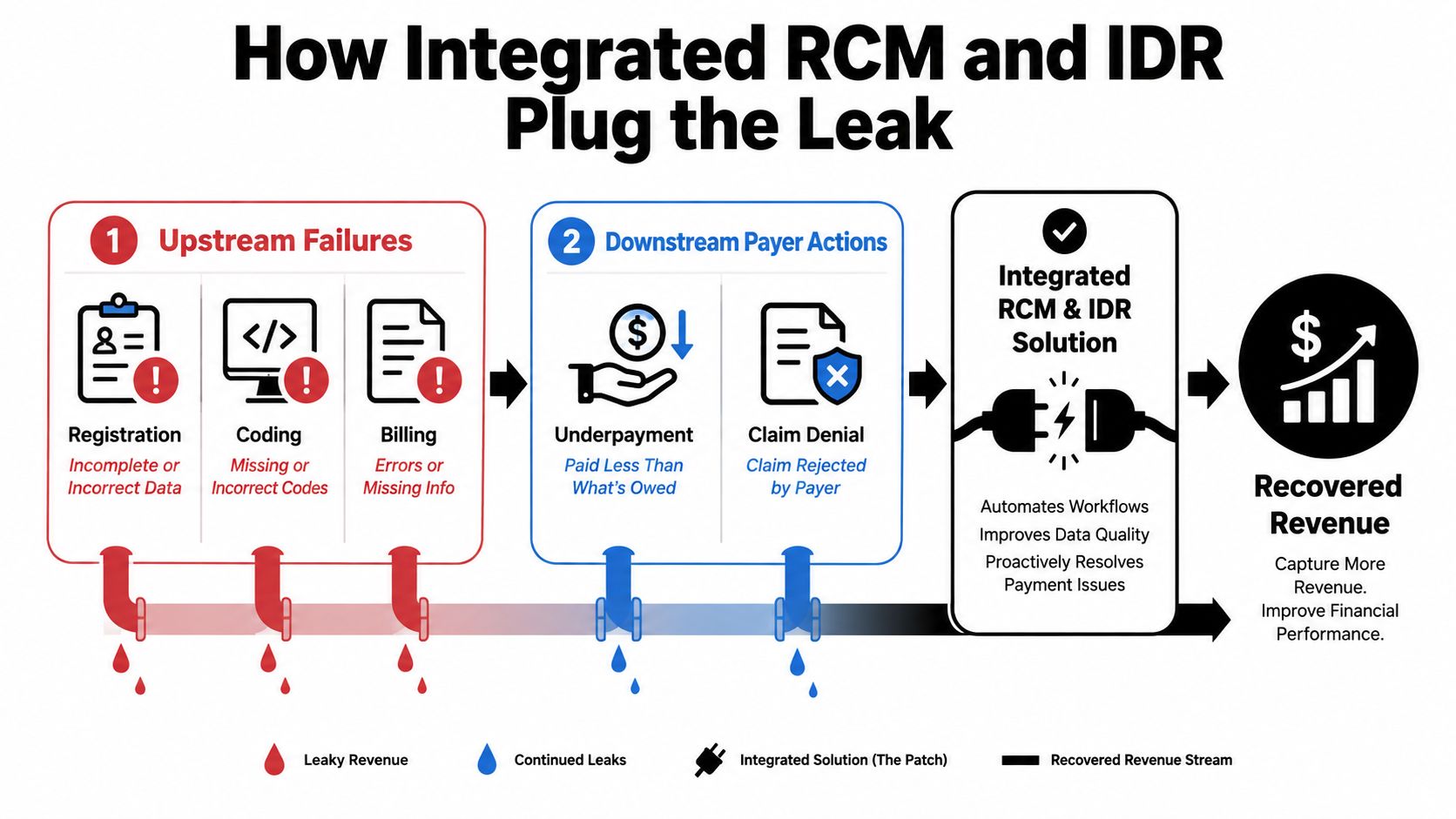
Revenue leakage has two connected stages. Upstream RCM failures weaken the claim before submission, while downstream payer actions reduce or delay payment after adjudication. Treating those stages as separate projects creates a recurring problem: the provider may improve claim quality without recovering short-paid claims, or pursue disputes without fixing the documentation and eligibility defects that make future claims vulnerable.
An integrated model connects the workflows:
- Registration and eligibility verification establish coverage, authorization, and payer identity.
- Coding, documentation, and credentialing controls align the service record with the claim.
- Claim editing and denial management address preventable defects before and after submission.
- Payment variance analytics compare remittances with contracts and expected reimbursement.
- IDR operations evaluate eligible out-of-network disputes, assemble evidence, and pursue the applicable process.
A dispute becomes a control loop
Consider an out-of-network claim that pays below the provider's expected amount. A connected workflow identifies the variance during payment reconciliation, checks whether the claim falls within the No Surprises Act framework, and preserves the documentation needed for negotiation and Independent Dispute Resolution. If the case proceeds, the organization can connect the outcome to the payer, service type, reimbursement logic, and future payment model.
The No Surprises Act IDR overview from CMS provides the regulatory context for qualifying disputes. The operational insight is broader: IDR shouldn't be treated as a one-off recovery exercise. Each disputed claim can reveal a payer behavior pattern, a contract interpretation issue, or an upstream documentation weakness.
Control principle: Use IDR to recover eligible underpayments, then use the evidence from those cases to improve the next claim.
RevGuard offers an integrated RCM and IDR model that manages revenue-cycle activities from eligibility and coding through final payment, while supporting dispute preparation and enforcement for qualifying underpayments. Providers evaluating Independent Dispute Resolution support should ask whether the service links upstream claim controls to downstream payment intelligence, rather than operating as an isolated arbitration function.
Practical Next Steps to Protect Your Revenue
A provider doesn't need to redesign the entire revenue cycle before finding its first actionable variance. Start with payment visibility, then tighten preventable upstream defects, and finally build a repeatable dispute-readiness process.
The first 30 days
Begin with a baseline. Pull remittance data, expected payment terms, denial categories, service records, and payer information into a reviewable dataset. Prioritize high-volume and high-complexity services, because a small variance repeated across those claims can matter more than a large isolated error.
Assign owners for:
- Payment reconciliation: Compare paid amounts with contract expectations and document recoverable variances.
- Denial classification: Separate eligibility, authorization, coding, clinical, and payer-policy causes.
- Front-end verification: Confirm that eligibility and authorization evidence is retained with the account.
- Executive reporting: Present leakage as a financial measure, not only as an operational queue count.
Days 31 through 60
Load current payer fee schedules and reimbursement terms into a variance process. Test common modifiers, carve-outs, bundled services, out-of-network payments, and specialty-specific payment rules. At the same time, add claim edits for recurring eligibility, coding, documentation, and credentialing defects.
Don't use the clean-claim rate as the sole success measure. Pair it with denial trends, contract yield, underpayment variance, and the time from payment receipt to variance identification.
Days 61 through 90
Build IDR readiness into daily operations. Screen disputed out-of-network claims against the applicable No Surprises Act requirements, preserve good-faith negotiation records, organize supporting documentation, and maintain an initiation calendar for eligible disputes. The process should also record payer responses and outcomes so future payment modeling reflects actual behavior.
Choose one accountable executive owner for leakage reduction and one composite KPI for monthly governance. The exact formula can vary by organization, but it should combine preventable denials, unresolved underpayments, contract variance, and recovered revenue. A single owner prevents the issue from disappearing between registration, coding, billing, finance, and legal teams.
RevGuard helps specialty providers connect eligibility, coding, claims management, payment variance analysis, and No Surprises Act dispute workflows. Visit RevGuard to evaluate a revenue-protection model that turns hidden underpayments and denials into measurable recovery and prevention work.