

A specialty practice can submit a claim that looks complete, medically supported, and correctly formatted, then watch it stall in a payer portal. The denial may arrive weeks later with a reason that traces back to an eligibility change, an authorization detail, a coding mismatch, or documentation the billing team couldn't see at submission.
That pattern creates more than extra work. It delays payment, consumes staff time, complicates appeals, and can turn a clinically valid service into unrecovered revenue. Revenue cycle management automation addresses these gaps by connecting the work that happens before a claim, at submission, and after the payer responds.
Introduction to Revenue Cycle Management Automation Today
Manual revenue cycle management depends on people moving information between systems, checking payer rules, reviewing clinical documentation, tracking claim status, and deciding which denials deserve attention first. That model becomes fragile when a practice handles complex services across multiple payers, locations, providers, and specialty-specific coding requirements.
Automation changes the operating model. Instead of treating billing as a sequence of isolated tasks, it creates checkpoints throughout the revenue cycle. A system can verify coverage before a procedure, flag missing authorization information, identify coding inconsistencies, route exceptions to a specialist, and preserve the documentation needed for follow-up.
The market context explains why this shift is accelerating. One 2026 industry estimate valued the global healthcare revenue cycle management market at USD 171.58 billion in 2025 and projected it to reach USD 521.0 billion by 2035, with an 11.72% compound annual growth rate from 2026 to 2035, according to SNS Insider's healthcare revenue cycle management market forecast. Other estimates in the same market discussion place the category at different values and timelines, but they point in the same direction. RCM automation is becoming part of a core financial infrastructure layer.
Adoption remains uneven. A 2026 trends report found that 59% of respondents had not yet implemented AI or automation in the revenue cycle, while 42% were exploring it, as reported in Guidehouse's revenue cycle trends report. That combination describes the situation many specialty groups face: interest is high, but the path from pilot to reliable reimbursement recovery isn't obvious.
The practical question isn't whether automation can reduce repetitive work. It can. The harder question is whether it improves payer response, denial recovery, underpayment detection, and dispute readiness. Those outcomes require a connected workflow, not a collection of disconnected bots.
How Revenue Cycle Management Automation Works
Think of the revenue cycle as an assembly line. A patient encounter enters at one end, passes through data and quality checkpoints, and exits as a posted payment or a recovery task. If an early checkpoint misses a problem, the next station inherits it, often with less time and fewer options to fix it.
Manual processes rely on staff members to perform many of those checks separately. Automated workflows apply rules, retrieve information, compare records, and route exceptions as events occur.
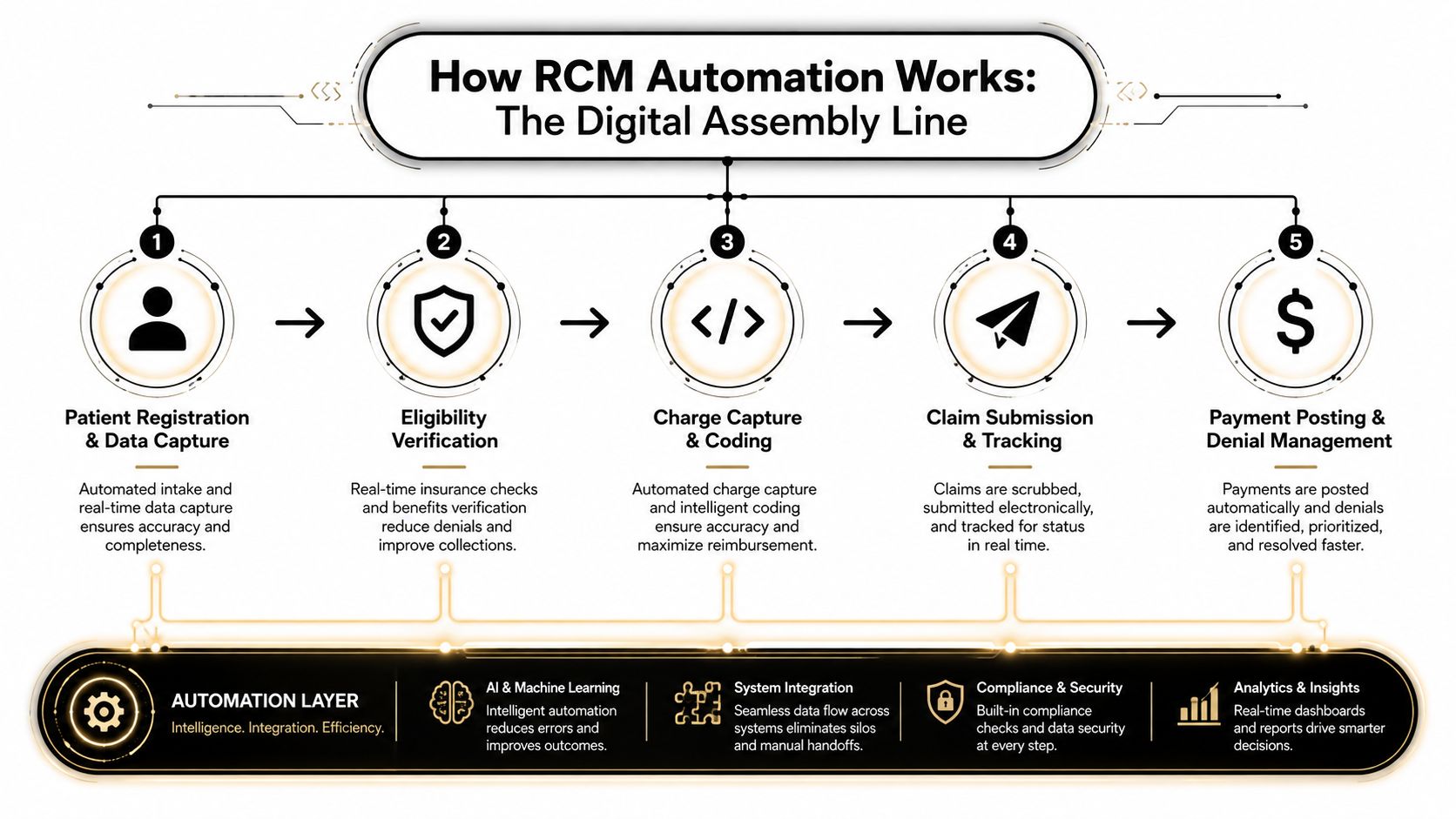
The five operating checkpoints
-
Patient registration and data capture: The workflow gathers demographics, insurance details, provider information, clinical documentation, and encounter data. Automation can standardize required fields and identify incomplete records before billing staff begin claim preparation.
-
Eligibility and benefits verification: The system checks coverage and benefit details against available payer information. It can flag inactive coverage, benefit limitations, or records that need human confirmation.
-
Charge capture and coding: Documentation is compared with charges and codes. Rules-based edits handle clear conditions, while AI-assisted review can highlight ambiguous or incomplete cases for a qualified reviewer.
-
Claim submission and tracking: The workflow performs readiness checks, routes the claim, records acknowledgments, and monitors status. Staff no longer need to treat every payer portal as a separate manual queue.
-
Payment posting and denial management: Remittance information is matched to claims, payments are reconciled, and denials are categorized. The system can prioritize work based on financial value, appeal potential, payer behavior, and filing requirements.
Practical rule: Automation should move a decision to the earliest reliable checkpoint, not merely process the same error faster.
The main technologies have different jobs. Rules engines apply explicit conditions, such as missing fields or payer-specific edits. Robotic process automation, or RPA, performs repetitive actions across systems. AI-assisted review identifies patterns in documentation, coding, and denial reasons. Analytics turns transaction history into operating intelligence.
Organizations often start with one workflow and expand as data quality and governance improve. A specialty group may begin with eligibility and authorization tracking, then connect coding review, claim submission, remittance matching, and denial work. Healthcare workflow automation resources provide a useful reference point for thinking about those connected handoffs.
Core Components That Power Automated Revenue Cycles
An automated revenue cycle works because its components exchange information. Eligibility findings should influence authorization work. Authorization status should inform claim readiness. Coding edits should affect submission. Remittance results should feed denial prevention.
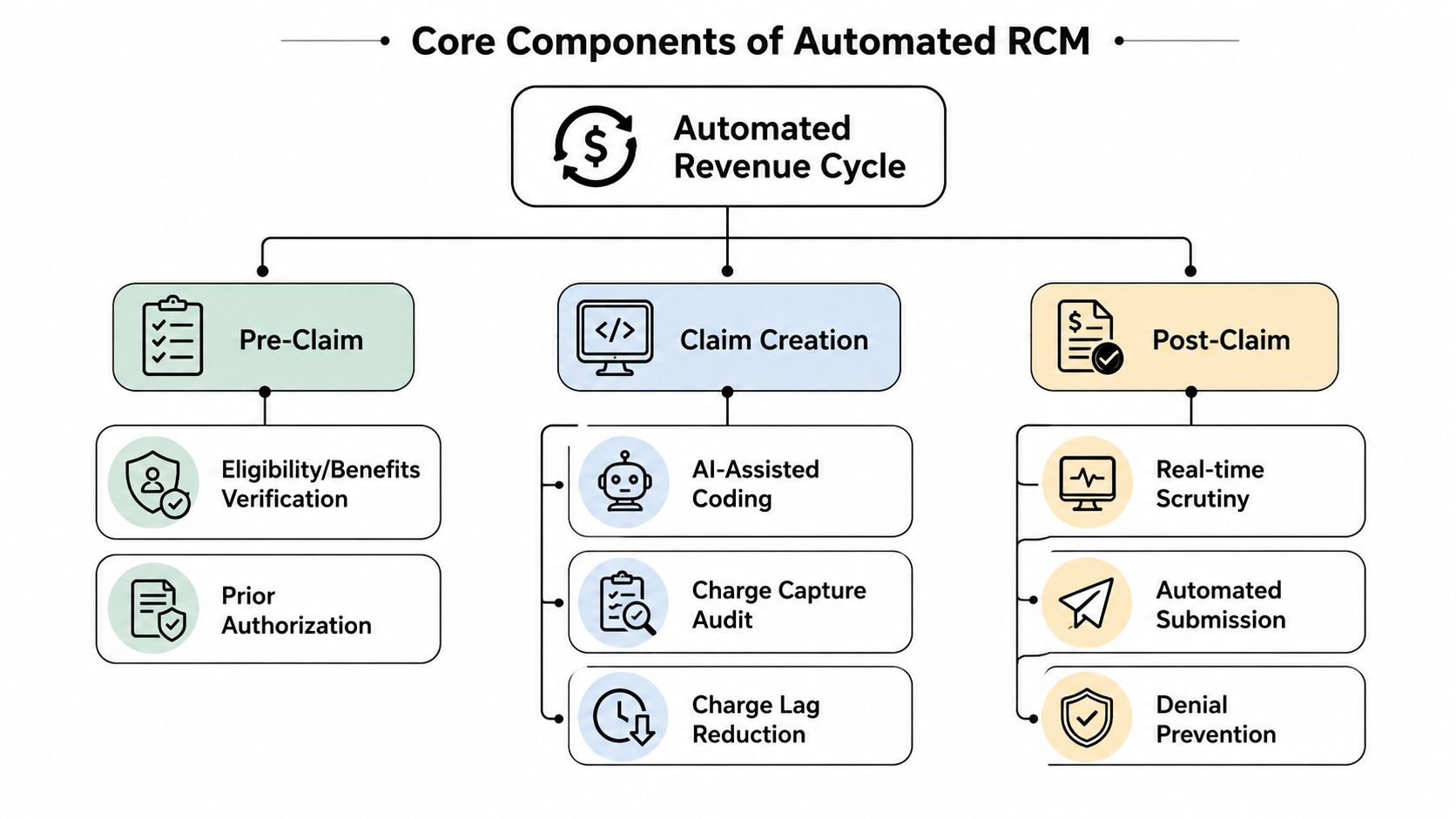
Pre-claim controls
Eligibility and benefits verification checks whether the patient's coverage is active and whether the planned service aligns with known benefit conditions. An automated workflow can run checks near scheduling, refresh information before service, and route discrepancies before the encounter reaches charge capture.
Prior authorization requires more than a yes-or-no status. The workflow needs to track required documentation, payer-specific forms, clinical criteria, submission dates, follow-up activity, and approval conditions. When those details remain in email threads or spreadsheets, staff can miss changes and deadlines. An integrated workflow creates a visible record tied to the encounter.
Claim creation controls
Coding assistance compares the clinical record with proposed diagnosis and procedure codes. It can identify mismatched modifiers, missing supporting documentation, or conflicts between the service performed and the claim structure. Human coders still need to resolve cases that require clinical judgment, but they can spend less time searching for routine issues.
Charge capture audits address a different leakage point. They compare scheduled services, clinical notes, orders, and posted charges to find encounters that appear incomplete. For anesthesia, imaging, oncology, or emergency transport, this comparison can be especially useful because the final claim may depend on details spread across several records.
Post-claim controls
Claims scrubbing checks whether the claim satisfies known formatting, coding, and payer requirements before transmission. Submission automation then records acknowledgments and status changes, creating a traceable history rather than a single “sent” event.
Denial management should begin before the denial. Predictive tools can group risks by payer, service, provider, code combination, authorization condition, or documentation pattern. After a denial, the workflow can assemble relevant records, assign ownership, monitor appeal timing, and identify whether the payer's response signals a recurring process problem.
Patient collections also benefit from connected workflows. Clear statements, consistent balance information, payment options, and escalation rules reduce avoidable confusion. The objective isn't to automate every patient interaction. It's to ensure that staff see the right account context before contacting the patient.
For organizations that need deeper visibility across these stages, healthcare revenue cycle analytics can help connect operational events with financial outcomes.
Why Automation Changes IDR and No Surprises Act Outcomes
A clean claim and a recoverable claim aren't always the same thing. The first answers, “Can the payer process this submission?” The second asks, “Can the provider prove the amount owed, challenge an underpayment, and present a complete record in a dispute?”
That distinction matters under the No Surprises Act. Independent Dispute Resolution, or IDR, depends on timely action, accurate claim information, supporting documentation, and a coherent explanation of why the reimbursement position is justified. Automation can strengthen that process by preserving evidence while the encounter is still active, rather than asking a recovery team to reconstruct the case after payment fails.
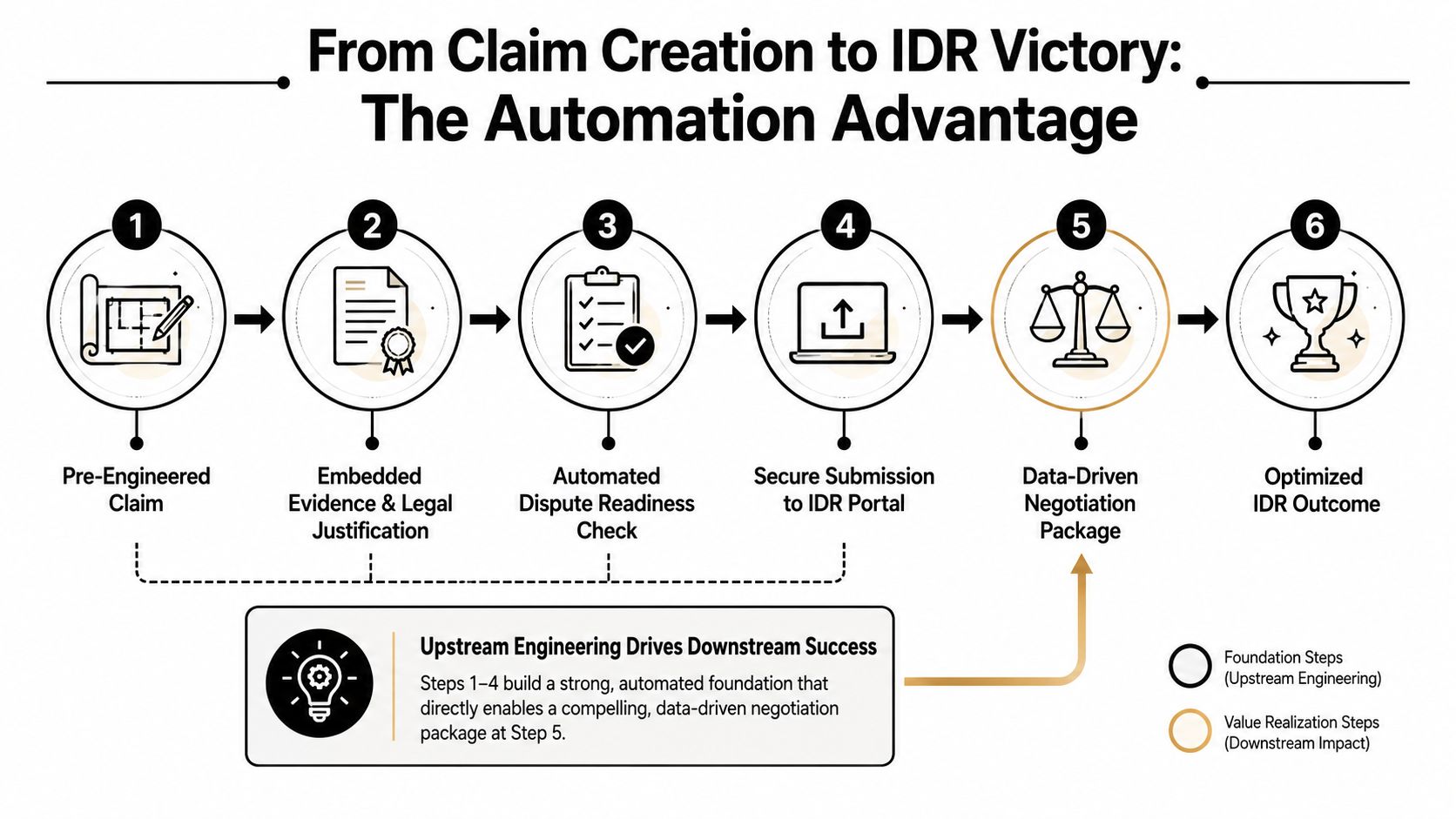
From transaction processing to payer intelligence
A dispute-ready workflow can connect:
- Encounter facts: Service details, provider credentials, location, timing, and clinical context.
- Claim evidence: Codes, modifiers, billed amounts, payer responses, remittance details, and correspondence.
- Compliance checks: Required notices, submission conditions, deadlines, and documentation completeness.
- Payer behavior: Repeated downcoding, delayed responses, recurring denial language, and underpayment patterns.
- Dispute preparation: A structured package that supports negotiation or IDR submission.
The value comes from the chain. If a system only submits claims faster, it may increase the volume of claims that enter a payer's existing denial and underpayment process. If it captures the evidence needed for enforcement, it gives the recovery team a stronger starting point.
Why upstream engineering affects downstream recovery
Consider an out-of-network specialty service. The payment arrives below expectation. A manual team must locate the original claim, confirm the service facts, find the payer correspondence, collect supporting records, determine whether the case qualifies, and assemble a submission. Missing information can make the case uneconomical or weaken the presentation.
An automated process can create a dispute-readiness record during claim formation. It can flag missing documentation, retain payer communications, classify the response, and route a potential case based on financial and legal criteria. The system doesn't replace legal or clinical judgment. It gives those professionals a complete, organized file.
The No Surprises Act summary provides context for the regulatory framework. The operational lesson is more specific: IDR readiness should be treated as a design requirement for the revenue cycle, not a rescue activity after every underpayment.
Implementation Roadmap and Common Pitfalls to Avoid
Successful automation starts with process clarity. A practice that can't explain how an encounter moves from scheduling to payment posting will struggle to configure reliable automation around it.
Establish a baseline before selecting tools
Map the current workflow by specialty, payer, location, and system. Document where staff re-enter data, where approvals wait, where payer responses arrive, and where exceptions disappear from view. Separate clean claims, denied claims, underpayments, patient balances, and unresolved accounts so the organization can see different forms of leakage.
Choose measures that connect activity to money. Useful categories include denial rate, first-pass resolution, aging by payer, time to payment, cost to collect, underpayment recovery, appeal cycle time, and dispute readiness. The baseline doesn't need to be perfect. It needs to be consistent enough to compare the pilot with the prior process.
Prioritize the workflow with the clearest control point
Don't automate everything at once. Select a process with repetitive work, reliable source data, and a visible failure mode. Eligibility verification, authorization tracking, claim edits, remittance matching, and denial classification can each be reasonable starting points, depending on the practice.
A good first workflow has a clear owner and an exception path. If the system can't decide, it should route the case to a named role with the evidence needed to act.
Integrate, test, and govern
Connect the automation layer to the EHR, practice management system, clearinghouse, payer portals, document repositories, and payment systems where appropriate. Test both normal transactions and edge cases, including corrected claims, duplicate encounters, changing coverage, missing records, and conflicting payer responses.
Governance checkpoint: Every automated decision needs an audit trail, a confidence boundary, and a human escalation route.
Common mistakes include:
- Automating a broken process: Speeding up duplicate data entry doesn't remove the underlying duplication.
- Ignoring payer variation: A general rule may fail when a payer applies a different authorization or documentation condition.
- Measuring clicks instead of recovery: Fewer manual touches matter only if payment quality, timeliness, or recovery improves.
- Leaving staff out of the design: Coders, billers, clinical reviewers, and collectors know where exceptions occur.
- Scaling before learning: A workflow that works for one specialty may require different rules for another.
Pilot with a defined population, review results with frontline staff, adjust rules, and expand in controlled stages. Keep a change log so the organization knows which configuration change affected which outcome.
Specialty Use Cases and Measurable Results in Action
A specialty practice doesn't experience automation as an abstract technology project. It experiences it through specific encounters, payer responses, and work queues.
An anesthesia group may connect scheduled procedures, operative records, time documentation, modifiers, and payer edits. Before automation, staff might discover missing time or modifier details only after a rejection or denial. After implementation, the workflow can flag incomplete records before submission and route the exception to the right reviewer. The meaningful measures are first-pass acceptance, denial categories, charge lag, and recovered underpayments.
Air ambulance providers face a different operating environment. The encounter can involve urgent transport, multiple records, complex provider and location details, and intense payer scrutiny. Automation can organize the event timeline, match documentation to the claim, track payer communications, and preserve the record for potential dispute work. Success means fewer unresolved cases falling outside follow-up, stronger documentation continuity, and better visibility into payer behavior.
Imaging centers often manage high volumes and recurring code combinations. A connected workflow can compare orders, reports, charges, and claims, then identify records that need review before transmission. Teams can monitor first-pass resolution, work per encounter, denial causes, and the time required to resolve exceptions.
Oncology illustrates why clinical context matters. A radiation-oncology implementation described in a 2026 benchmark reduced prior-authorization denials by a 65.4% mean, from 314 cases, or 7.6%, to 63 cases, or 2.6%, across 6,551 cases, and reduced median authorization time by 34%, according to the published AI revenue cycle management benchmark. The result supports a specific design principle: authorization automation works best when it moves checks upstream into specialty workflow execution.
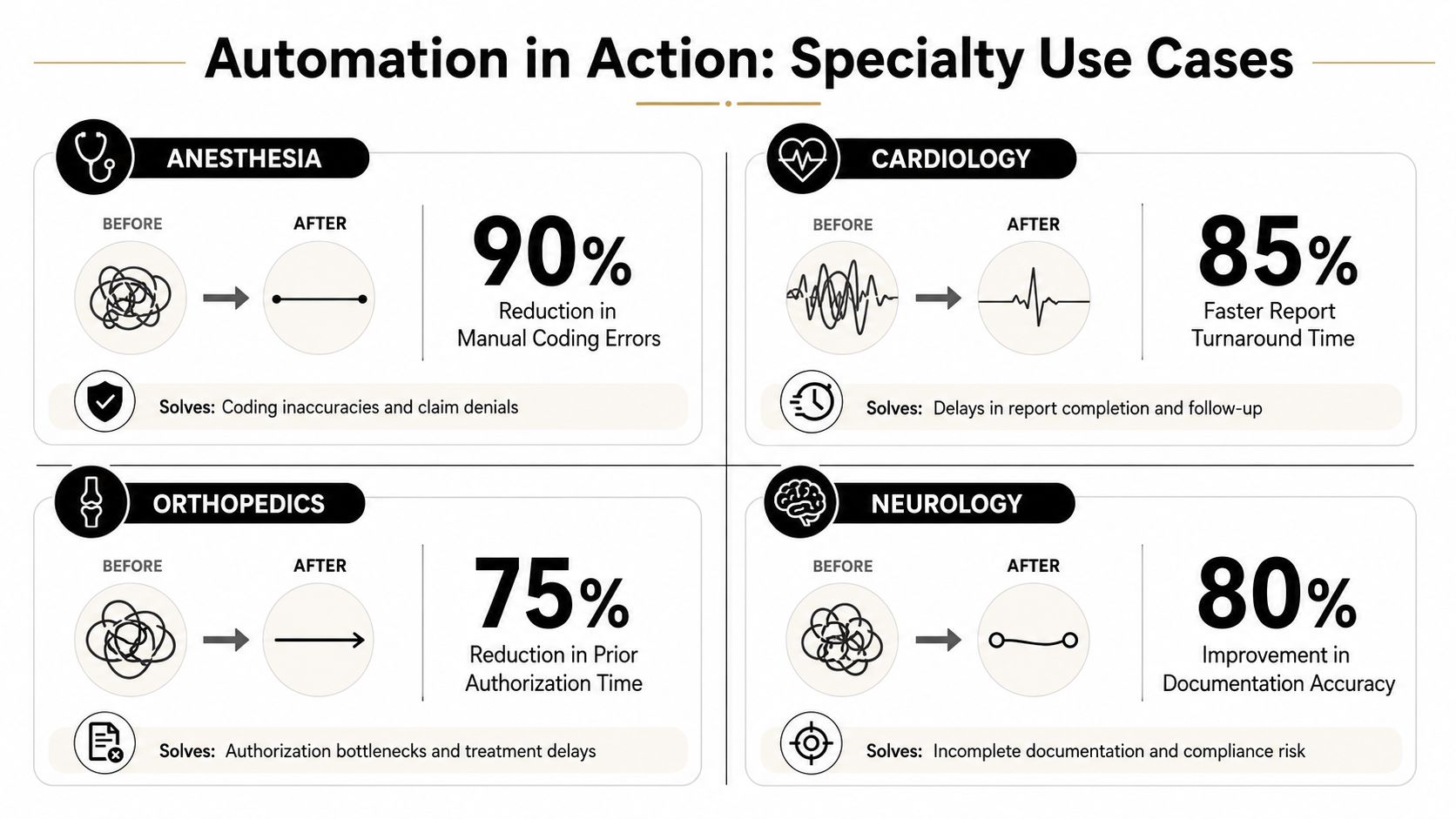
Broader evidence synthesis associates mature automation, combining rules-based edits, RPA, analytics-assisted review, eligibility verification, integrated authorization, and explainable logging, with denial reductions of 17% to 35%, first-pass acceptance gains of 20 to 30 percentage points, cost-to-collect decreases of 25% to 60%, and net revenue gains of 2% to 5%, as reported in an independent RCM automation evidence synthesis. Those figures describe implementation evidence, not a guaranteed result for every organization.
Choosing the Right Automation Partner and Next Steps
A vendor should earn consideration through specialty modeling and exception routing, not a feature checklist. Ask how the platform handles service-specific documentation, payer variation, audit history, and the path from claim submission to recovered payment. A useful partner should show how each handoff works when a claim leaves the normal route.
Evaluate six areas:
- Specialty capability: Can the partner model the coding, authorization, documentation, and billing requirements of your services?
- Integration depth: Does it connect with the systems your team already uses, or send staff to another isolated queue?
- Payer intelligence: Can it identify recurring denial, downcoding, delay, and underpayment patterns by payer and service?
- Transparency: Can leaders see why a claim was flagged, what action followed, and who approved an exception?
- Compliance posture: Does the workflow protect sensitive information and preserve a defensible record for review?
- IDR linkage: Can the system carry encounter, coding, payment, and communication evidence into dispute preparation and enforcement workflows?
The ROI discussion should cover more than reduced labor. Track first-pass resolution, denial recovery, underpayment identification, payment timing, cost to collect, appeal productivity, and the share of eligible cases that reach a complete dispute file. These measures connect automation to payer behavior. A faster work queue has limited value if the claim still lacks the evidence needed for recovery.
Adoption data shows why disciplined evaluation matters. One benchmark summary reported that 63% of healthcare organizations were using AI or automation in at least one revenue cycle workflow, 27% had deployed it at scale across multiple functions, and only 15% reported positive ROI, according to Guidehouse's benchmark summary. Broad deployment alone does not demonstrate financial success.
Denials may continue rising when automation ends at claim creation. One industry analysis reported that 41% of providers had at least one in ten claims denied, with denial rates increasing each year since 2022, as discussed in Becker's Hospital Review's analysis of automation and denials. Measure whether the system changes payer response economics, including the quality and speed of recovery, rather than only how quickly staff move work between queues.
RevGuard integrates specialty-specific RCM with enforcement-driven IDR workflows, including eligibility, coding, claims, payment posting, denials, underpayment recovery, and dispute evidence preparation. To assess whether your current revenue cycle can support this approach, visit RevGuard and request a workflow review focused on denial recovery, payer behavior, and IDR readiness.