
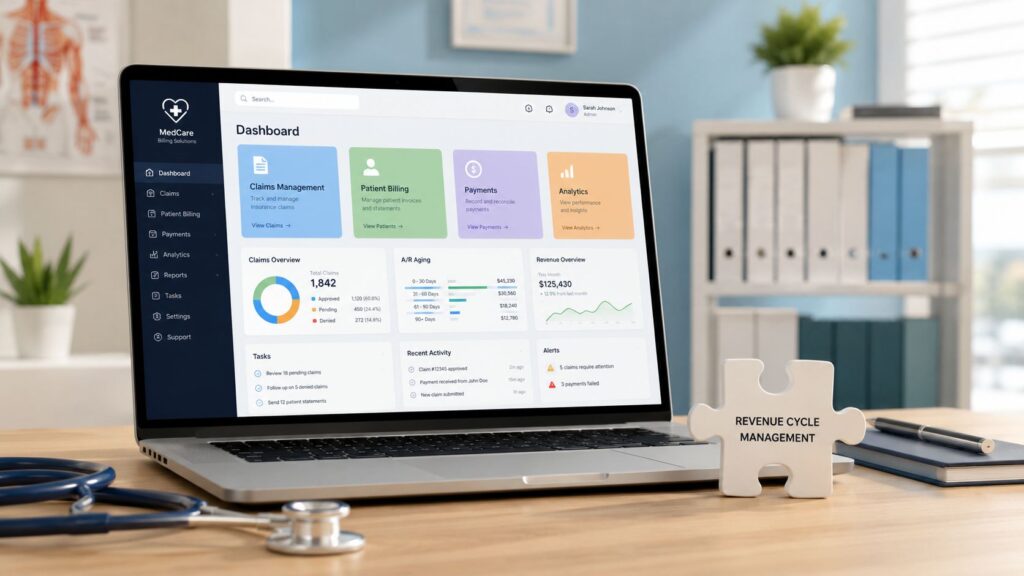
You can have clean claims in the queue and still watch cash leak out the back end. That's the daily reality for specialty groups right now, payer edits get tighter, denials come back with thin explanations, and underpayments hide inside work you already thought was finished. Medical billing software has to do more than move charges from one screen to another, it has to help a practice defend revenue when the payer's behavior is the problem.
The market tells the same story from a different angle. The global medical billing software market was estimated at USD 16.34 billion in 2023 and is projected to reach USD 32.18 billion by 2030, with a 10.2% CAGR from 2024 to 2030, and North America held 39.4% of global revenue in 2023, with the U.S. holding the largest share in that region, which shows where the operational pain has been most concentrated historically (Grand View Research). In practice, that growth isn't about prettier billing screens. It's about systems that can survive payer complexity, specialty workflows, and dispute-heavy revenue cycles.
Why Medical Billing Software Matters for Specialty Practices
A specialty practice can do a lot right and still get squeezed. Claims can be scrubbed, submitted, and posted cleanly, then denials start climbing because the payer edits weren't the same as last month, the documentation bundle wasn't complete, or the payer underpaid on a technically valid claim. That's why medical billing software stopped being an invoicing utility and became the operational core of revenue cycle management.
The shift from billing tool to revenue control layer
For specialty groups, the software sits between clinical documentation, coding, payer rules, and payment reconciliation. It has to turn encounters into coded claims, move eligibility and clinical data across systems, and keep enough traceability to prove what happened later if a claim is challenged. Standards-based interoperability matters here, especially HL7 v2, FHIR R4, and ANSI X12 EDI, because billing software has to speak to EHRs and payers without creating manual re-entry points that invite mistakes (Leanware).
That's the part many teams underestimate. They buy for claims submission, then discover the failure point is downstream. If the platform can't support specialty workflows, denial management becomes a labor sink instead of a recovery function.
Practical rule: if a platform only helps your team send claims, it's not enough for a specialty practice. It has to help your staff understand why money didn't come back the first time.
Why the market pressure changes the buying decision
The 2026 benchmark data makes the pressure visible. 48% of medical billing firms said they generated under USD 250,000 in annual revenue in 2025, up from 28% in 2023, while the share with USD 1 million or more fell from 32% to 9% over the same period. The same report found 54% expected gross margins of 10% or below in 2025 and 46% reported rising denial rates (Tebra benchmark report). That's not a feature story. That's a warning that denial control and revenue protection are now central purchasing criteria.
Specialty leaders should treat billing software like infrastructure. If it can't support payer-specific logic, clean handoffs, and audit-ready workflow history, it will eventually become another source of leakage. And once leakage starts, the fix is rarely one setting or one team, it's usually the system design.
Core Modules and Features of Medical Billing Software
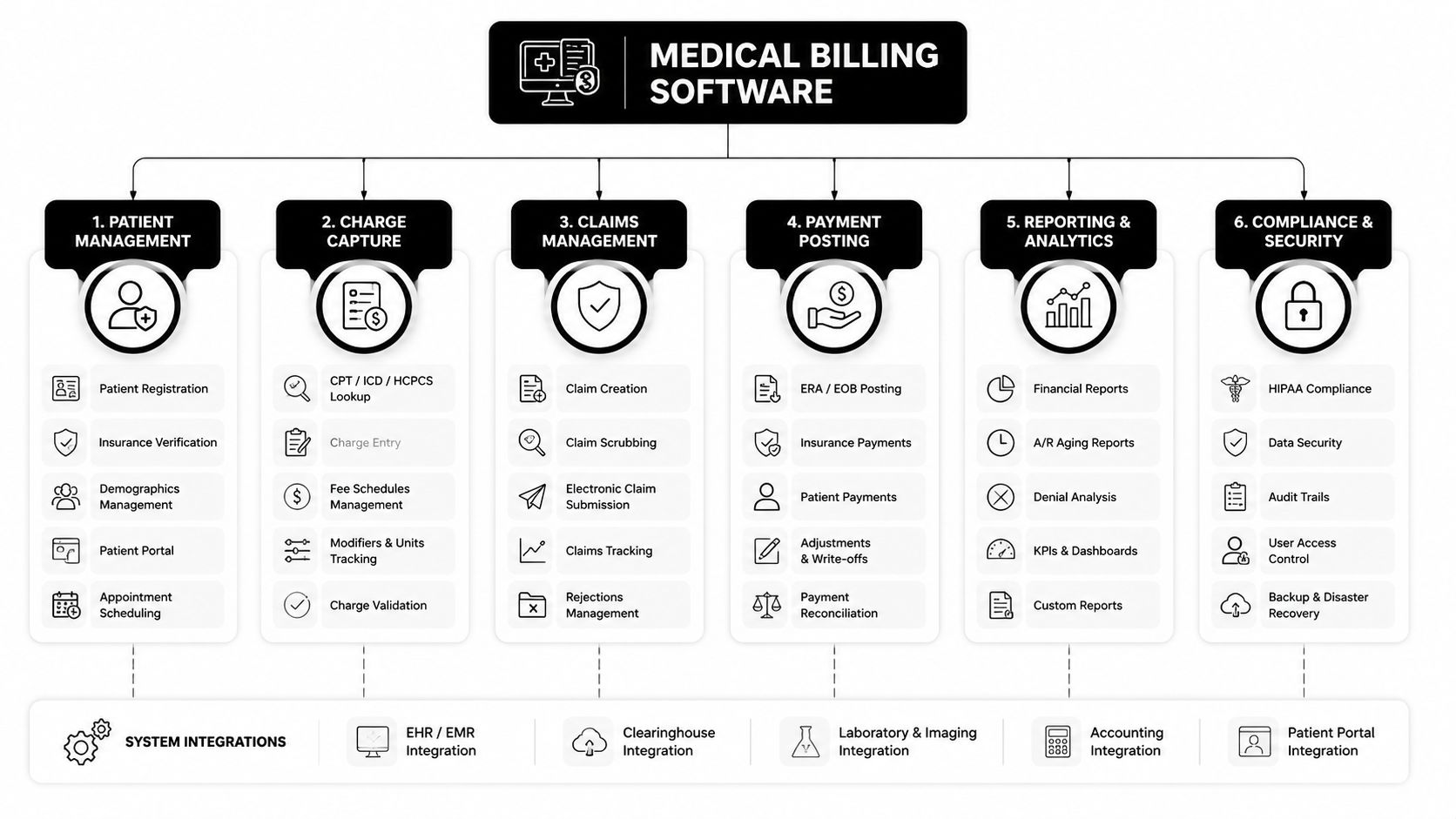
Good medical billing software isn't one monolith. It's a set of modules that move work through the revenue cycle with as little manual friction as possible. The best systems separate eligibility, coding, submission, denial follow-up, and payment posting, because that modular design lowers integration risk and lets each specialty tune the workflow to its own payer mix and claim patterns (Leanware).
The modules that actually matter
Claim creation starts with the encounter. The system should convert clinical and charge data into a billable claim without forcing staff to rekey information that already exists elsewhere. That's where the interface layer matters, because one missing modifier or diagnosis mapping can create a denial that never should've happened.
Claim scrubbing is the next gate. A scrubber should catch missing data, payer-format issues, and obvious coding mismatches before the claim leaves the building. It won't solve every denial, but it should reduce self-inflicted rework.
Submission and remittance depend on clean EDI handling, especially 837 claim submission and 835 payment posting. A weak platform turns those into a manual reconciliation job. A stronger one posts payments, maps adjustments, and preserves the claim trail so the team can trace underpayments later.
Denial management is where many platforms stop being useful. You want reason-code visibility, appeal tracking, payer-specific work queues, and version history on the claim file. Without that, denials become a pile of tickets instead of a recoverable cash stream.
Patient billing needs the same discipline. Statements, balances, and payment plans should sit in the same revenue logic as payer billing, not in a disconnected module that staff touch only after insurance is finished.
For teams comparing platforms, the architecture matters as much as the feature list. Modular systems are easier to extend, easier to audit, and usually easier to keep stable when the payer environment shifts. This automation overview is a useful reference point if you're mapping how claim flow should work across the full revenue cycle.
Specialty-Specific Needs in Medical Billing
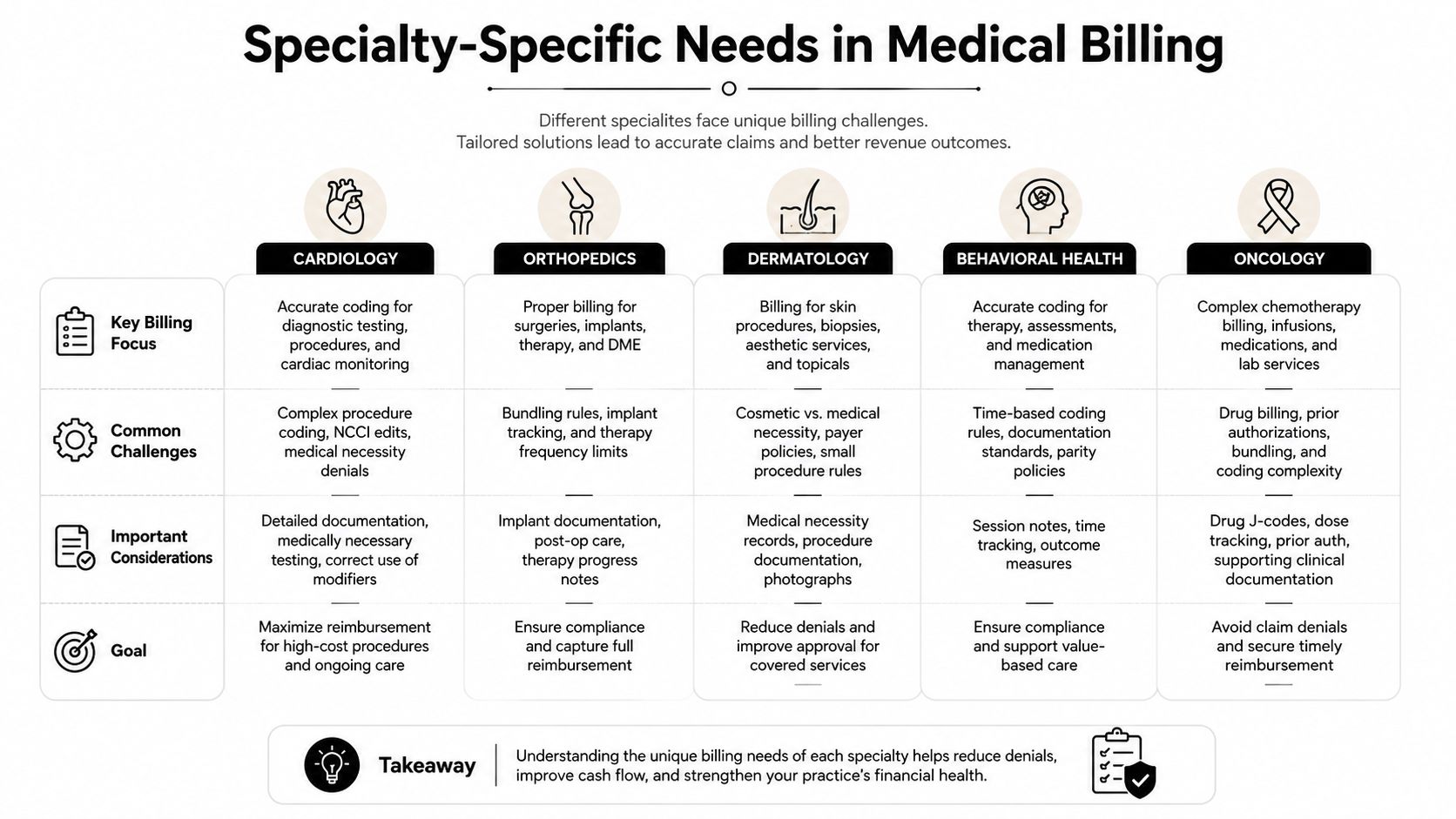
Generic billing tools often look fine in a demo because the demo uses clean, simple claims. Real specialty practices don't live in that demo. They deal with higher documentation sensitivity, more payer variation, and workflow exceptions that make one-size-fits-all billing software feel brittle very quickly.
Why specialty workflows break generic systems
Anesthesia needs clean pre-bill movement and accurate time logic. Ambulatory surgery centers need tighter facility and professional claim coordination. Imaging groups live or die on correct ordering, authorization, and technical-professional separation. Air ambulance teams often face intense dispute pressure because the payer's problem isn't just a missing field, it's disagreement over medical necessity, network status, or payment methodology.
The important point is that each of these workflows has a different failure mode. A generic platform usually assumes the failure is staff error. In specialty billing, the failure is often rule conflict, payer behavior, or a missing upstream handoff from clinical operations. That's why independent industry guidance emphasizes baseline denial and clean-claim benchmarking, payer-specific rules engines, and multi-specialty workflow support instead of generic billing features (AdvancedMD guidance).
Operational reality: the best billing system for a specialty group is the one that matches the practice's primary leak, not the one with the longest feature list.
What to look for by specialty
High-denial specialties need rule engines that can apply payer logic before submission and route exceptions to the right work queue. If staff can't see recurring denial patterns, they end up fixing the same issue one claim at a time.
Complex-coded specialties need coding support that reflects specialty documentation, not just broad CPT familiarity. The software should help coders and billers find missing details before the claim leaves.
Dispute-heavy services need appeals support, claim history, and evidence capture. The tool should preserve artifacts so staff can reconstruct what was submitted and why.
Multi-specialty groups need shared infrastructure with specialty-specific configurations. A platform that treats every workflow the same usually forces the hardest specialty to adapt to the software, which is the wrong direction.
Specialty-specific software isn't about vanity customization. It's about reducing leakage that starts in the handoff between clinical work, coding, and payer rules. If the platform can't adapt to that handoff, it will create more work than it removes.
Compliance and No Surprises Act Implications
Compliance in billing software isn't a checkbox. It's the structure that decides whether your team can prove what happened when a payer disputes a claim. The No Surprises Act and Independent Dispute Resolution workflows raised the stakes because now the practice needs cleaner claim records, stronger evidence handling, and tighter access control across the entire reimbursement path.
Dispute-ready systems beat generic record storage
A dispute-ready platform needs more than a PDF attachment field. It should preserve claim versions, timestamps, access history, and submission artifacts so staff can reconstruct the exact state of the claim when the payer challenged it. That traceability matters because underpayment disputes and appeals often hinge on small details that disappear in a loosely managed system.
Security controls are part of that evidence story. Technical guidance consistently calls for AES-256 encryption at rest, TLS 1.2 or higher in transit, role-based access control with least privilege, immutable audit logs, automatic session timeouts, and multifactor authentication for administrative users (EngineerBabu). It also notes that third-party services touching PHI need a signed Business Associate Agreement, and cloud deployments must use HIPAA-eligible service configurations.
That's why I think of compliance as a control plane, not a policy binder. If the system can't show who touched a claim, what changed, and when it changed, the team is negotiating without a reliable record.
Why NSA workflows need software discipline
The No Surprises Act created a more formal dispute environment for out-of-network billing. Specialty groups dealing with air ambulance, anesthesia, and other high-friction services need software that can store the claim narrative, preserve supporting documentation, and keep staff from losing time to scattered message threads. This NSA summary is a useful reference if your team is mapping how dispute handling should connect to the billing workflow.
Good compliance support looks like this:
- Role-based access: only the right staff can change claims or view sensitive data.
- Immutable logs: the system records PHI access and claim edits without silent overwrites.
- Versioned claim files: staff can retrieve earlier claim states during an appeal.
- Secure history: payer messages, attachments, and submission timestamps stay tied to the claim.
If your software can't support that level of traceability, it's weak in the exact places that matter most when a payer delays, downcodes, or denies a clean claim.
Integration with Full RCM Workflows and Analytics
Medical billing software gets more valuable when it stops acting like a silo. The strongest platforms connect eligibility verification, coding, claim status, payment posting, and reporting so each step informs the next. When that flow is broken, staff spend their day copying data between systems and guessing where revenue disappeared.
Compare systems by data flow, not by feature count
A platform that only handles claims can still leave a practice blind. You want to know whether eligibility checks feed directly into billing workflows, whether coding issues route back to the right team, and whether remittance data posts cleanly enough to support follow-up. That's the difference between a software stack that creates work and one that removes it.
Analytics matter for the same reason. Dashboards should show denial trends, payer performance, claim backlog, and payment status in a way managers can act on. Good reporting doesn't just describe the past, it helps teams decide where the next hour of staff time belongs.
Use the dashboard to change behavior, not to decorate a meeting. If the data doesn't change who reviews what this afternoon, the reporting layer is too shallow.
Integration depth is the real vendor test
If you're comparing vendors, ask how they handle your current EHR, clearinghouse, and payment posting flow. Ask what breaks during implementation, what gets migrated automatically, and what still requires manual cleanup. That question matters because many buyer guides celebrate features but ignore transition risk, even though one source notes that most billing platform transitions take 60 to 120 days (US Tech Automations).
Use analytics to support payer conversations too. The system should help you spot repeat denial reasons, recurring underpayments, and specialty-specific bottlenecks so contract and operations teams can stop arguing from anecdotes. This analytics overview fits well if you're building a reporting strategy around payer behavior rather than raw volume.
The strongest integration isn't the one with the most logos on a slide. It's the one that leaves staff with fewer handoffs, fewer duplicate entries, and a clearer path from charge capture to collected cash.
Vendor Selection Checklist for Specialty Practices
Choosing medical billing software gets easier when you stop asking, “What features does it have?” and start asking, “What failure does it fix?” A specialty practice with denial pressure does not need the same system as a small clinic with simple claims and stable payer behavior. The tool should match the practice's primary pain point, payer mix, and existing EHR instead of forcing the team into a generic workflow.
What to test before you sign
Specialty fit should come first. If the vendor can't explain how it handles your specialty's billing exceptions, keep moving.
Integration depth should be verified, not assumed. Ask how claims, eligibility, remittance, and reporting move between systems.
Implementation scope should be explicit. You want to know what staff training is required, what data needs migration, and what the first 60 to 120 days will look like in operational terms.
Total cost of ownership includes more than the subscription fee. Ask about onboarding, add-ons, support model, and any workflow gaps that still need manual labor.
Denial workflow should be visible in the demo. If the platform can't show how it tracks, groups, and resolves rejections, it's not built for specialty revenue pressure.
Buying rule: choose the system that reduces the biggest revenue leak first. Everything else is secondary.
Vendor Selection Criteria
| Criteria | Questions to Ask | Red Flags |
|---|---|---|
| Specialty support | Does the platform support our specialty workflows without heavy customization? | Generic demos, vague specialty claims |
| Integration depth | How does it connect with our EHR, clearinghouse, and payment posting flow? | Manual exports, duplicate data entry |
| Denial management | Can we track, group, and resolve denials by payer and reason code? | No real work queues, weak appeal history |
| Implementation | What does rollout look like, and what staff time is required? | Unclear migration steps, hidden training burden |
| Analytics | Can managers see payer behavior, backlog, and underpayment patterns clearly? | Pretty dashboards with little operational value |
| Total cost | What costs are included, and what's extra? | Surprise fees, add-ons for basic functions |
If you want one practical shortcut, ask for a walkthrough of a denied claim from first denial to final resolution. The better systems make that path obvious. The weaker ones make it feel like a scavenger hunt.
Implementation Roadmap and ROI Strategy
There's a bad assumption in software buying that the most complete platform is always the safest choice. In billing, that's often wrong. A modular system that fits your current workflow can be safer than an all-in-one suite that forces a big-bang transition and disrupts cash flow before anyone is fully trained.
Start with the least disruptive rollout
The cleanest implementations usually begin with the failure mode that hurts most. If denials are the top issue, start there. If payment posting is the bottleneck, fix that first. If the problem is specialty claim routing, roll out around that specialty instead of flipping every workflow at once.
Training needs to be specific, not generic. Front-office staff need to know how their data entry affects downstream claims. Billers need to understand where the software catches errors and where it doesn't. Supervisors need reporting that shows whether the new process is improving recovery.
Measure ROI like an operator
Don't judge the rollout by launch day. Judge it by fewer manual touches, cleaner denial handling, and a clearer path from submission to payment. The 2026 industry data already shows how tight margins have become, with more firms operating under low revenue and low gross margin pressure (Tebra benchmark report). In that environment, software has to protect revenue, not just organize it.
A phased rollout also reduces the risk of breaking established workflows. That matters in specialties where one missed handoff can create a claim problem that takes weeks to unwind. The goal is steady operational control, not a dramatic launch story.
A useful ROI lens looks like this:
- fewer claims needing manual correction,
- faster denial resolution,
- better visibility into underpayments,
- less staff time lost to rework,
- more consistent claim history for appeals.
If a vendor can't connect those outcomes to the implementation plan, the system is probably too shallow for a specialty practice.
If your team is dealing with specialty denials, underpayments, or No Surprises Act disputes, RevGuard builds specialty-specific RCM and dispute-ready workflows around those problems. Visit RevGuard to see how its billing and IDR approach is designed to protect revenue across complex payer environments.