

The denial hit the inbox, the EOBs are stacked on the desk, and somebody in the billing office is already asking whether this one is worth fighting. That's the right moment to slow down, because most appeals don't fail at submission, they fail upstream, in the chart, in the timestamps, and in the way the record was built before the denial ever arrived. In appeal process steps, the essential work starts before the letter goes out.
When the clock is running, the temptation is to draft a polished narrative and hope the payer reads it generously. That's not how review usually works. Appellate bodies and reviewers generally act on the record that already exists, so a thin chart, a missing attachment, or a late file can cap the outcome before the first sentence is read.
The working rule is simple. An appeal is an evidence-chain exercise, not a letter-writing exercise. If the chain is weak, the appeal becomes theater.
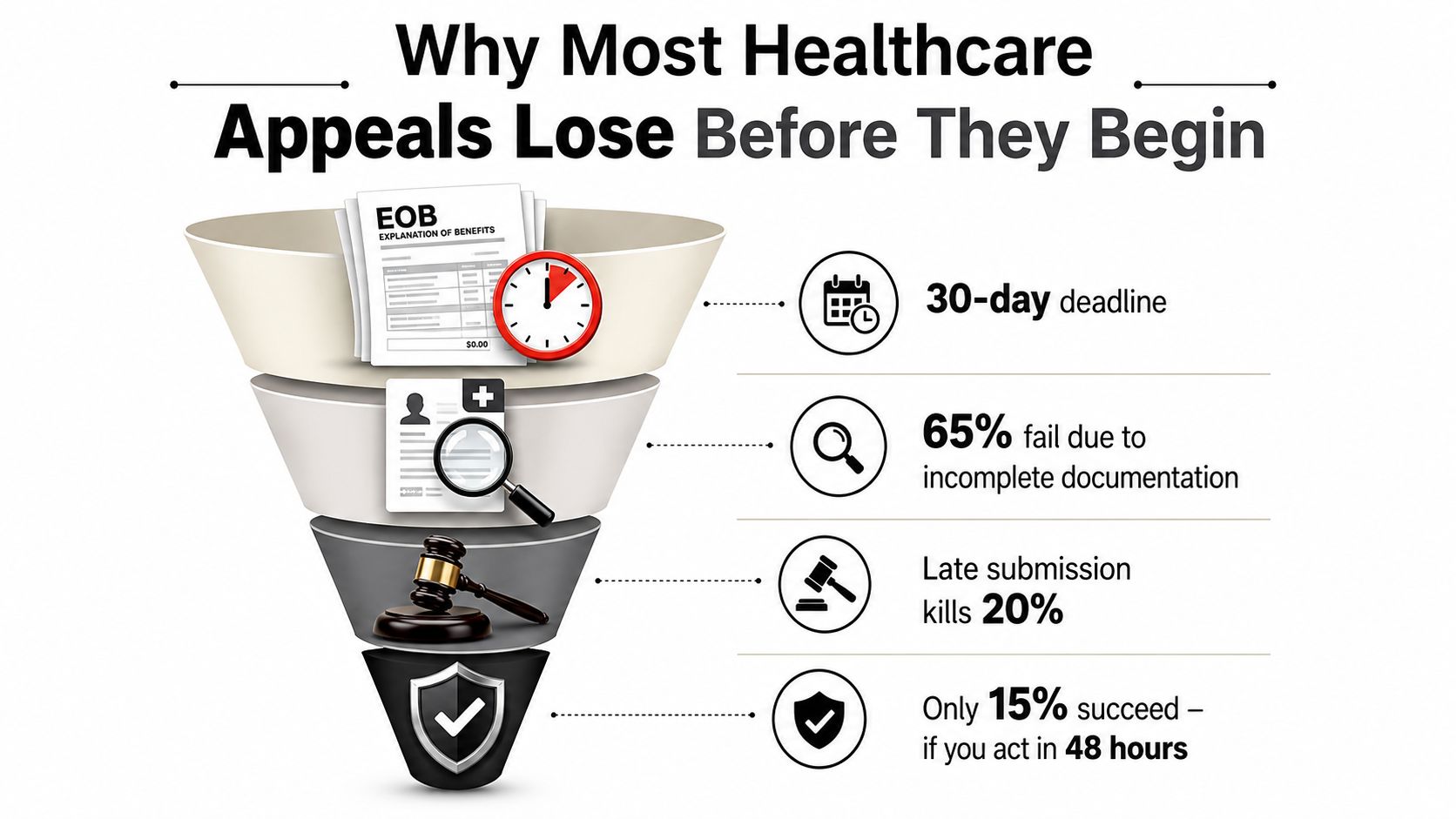
Why Most Healthcare Appeals Lose Before They Begin
A denial feels like a paperwork problem, but the deeper issue is usually documentation quality. In many systems, the appeal only works with what the reviewer can already see, which means the chart, the coding trail, and the policy references have to be clean before the denial lands. That's why appeal process steps should be treated as an upstream discipline, not a response tactic.
The chart is the case
If the operative note, physician attestation, or coding crosswalk doesn't make the claim defensible on first read, the appeal starts from a deficit. The reviewer isn't there to reconstruct intent. They're there to test whether the file supports the billed service, the diagnosis, and the timing.
A lot of template-letter workflows miss that point completely. They produce a polished paragraph, attach a few PDFs, and hope volume will compensate for missing substance. It usually doesn't.
Practical rule: if a denial can't be answered with a specific chart artifact, the appeal is already behind.
That's also why specialty groups with disciplined documentation habits tend to outperform ad hoc teams. They don't wait for denial to start assembling the record. They build claims as if every case could be appealed tomorrow.
What the reviewer actually sees first
The first thing on the desk is rarely your best argument. It's the denial reason, the dates, the policy language, and the attachment list. If those pieces don't line up, the rest of the packet gets a shallow read. The reviewer's job is to decide whether the file is complete enough to move forward.
That's the operational meaning of appeal process steps in healthcare. You're not just asking for reconsideration. You're proving, through documentation, that the original adjudication missed something material.
For teams trying to tighten that upstream discipline, denial management workflows usually matter more than writing style. Clean intake, clean coding, and clean evidence beat clever phrasing every time.
Triaging the Denial Within 48 Hours
The first two days after a denial are where recoverable revenue is either protected or lost. The priority isn't writing the final appeal. It's sorting the denial into the right lane fast enough to preserve the filing window and decide whether the case deserves full effort. In practical terms, this means separating denials by reason, recoverability, and evidence strength before anyone starts drafting.
Sort the denial by family, not by emotion
A medical necessity denial needs a different response than a timely filing denial. Coding errors need different proof than eligibility disputes. Prior auth misses often turn on whether the file shows authorization was requested, granted, or improperly documented. If those families get lumped together, the team wastes time on arguments that won't move the payer.
A simple triage sheet works better than debate. Use three columns, denial reason, missing evidence, and appeal lane. Then add a quick internal score for recoverability and speed, because some appeals are worth immediate escalation while others are better written off or corrected at the claim level.
Here's the decision habit that pays off:
- Timely filing issues: verify the deadline first, because a late filing window can kill the right to appeal entirely.
- Medical necessity denials: confirm the chart supports the diagnosis and the service level before drafting anything.
- Coding denials: compare the billed code, modifier, and documentation against the operative note or encounter note.
- Eligibility and coverage denials: check whether the file proves active coverage on the date of service.
- Prior authorization denials: pull the auth number, date range, and service match before you argue the merits.
Work the clock, not just the chart
The deadline matters as much as the reason. In appeal systems, those filing windows can be short, and missing them can eliminate the right to review altogether. That's why the 48-hour sprint should focus on deadline tracking, record capture, and a first-pass fit test for appealability.
Empirically, the middle stages are the slow part. In a Bureau of Justice Statistics study of criminal appeals in state court, record preparation took a median 69 days and the appellant's briefing and full submission took a median 81 days (Bureau of Justice Statistics study). That legal data isn't a medical billing manual, but the operational lesson carries over. Once a case drifts, it drifts for a long time.

A strong triage process keeps the team from overinvesting in weak denials and underinvesting in strong ones. That's the difference between a backlog and a controlled appeals queue.
Building the Evidence Packet That Wins Reviews
Once the denial is triaged, the packet has to be built around one question, what exactly would persuade the reviewer to reverse? That answer changes by claim, but the structure doesn't. The best packets are claim-specific, organized for fast review, and anchored in artifacts that already live in the chart or the billing record.
Put the right documents in the right order
Start with the core clinical proof. For many specialties, that means operative notes, procedure notes, progress notes, and any medical necessity letter that explains why the service was clinically required. Then add the billing layer, coding crosswalks, modifier support, and payer policy excerpts that show the claim aligns with the plan's own language.
A reviewer shouldn't have to hunt through a narrative to find the point. Put the denial reason, the counterevidence, and the policy support in the same order they'll likely read it. That means the packet opens with the denial letter, then the exact rebuttal evidence, then the backup material.
The first page should make the case obvious. If the reviewer has to read three pages to understand why you're appealing, the packet is too loose.
Documentation quality also means preserving timestamps. Save portal screenshots, fax confirmation pages, delivery receipts, and EHR snapshots of the relevant entries before anything gets overwritten. Those artifacts matter later if the case reaches a second-level appeal or arbitration.
Don't let template language hollow out the packet
Template letters are convenient, but they often flatten the case into generic prose. That's one reason some structured appeal programs outperform informal handling, with one industry write-up citing 60 to 67% overturn rates for structured processes versus about 25% without a formal process, while incomplete documentation was associated with denials of appeal reinstatement in 75% of cases and template or generic letters with 30% lower success (industry write-up on structured appeal strategy). Those figures are specific to the cited write-up, but the direction is clear, structure and completeness matter.
The packet should do one job at a time:
- Prove the service happened with chart records and dated notes.
- Prove the service was necessary with clinician explanation and diagnosis support.
- Prove the code was right with coding logic and crosswalks.
- Prove the payer policy was met with exact policy excerpts.
- Prove the submission was timely with timestamps and confirmation records.
If the file already contains those items before denial, the appeal becomes much easier to assemble. If it doesn't, the appeal is usually weaker no matter how polished the narrative sounds.
Drafting and Submitting the First and Second Level Appeal
The first-level appeal should read like a precise rebuttal, not a plea. Open with the denial reason in plain language, answer it with the exact evidence that rebuts it, then close with a specific request for reversal or reprocessing. If the payer's denial cited a policy excerpt, quote back the relevant section only if the chart supports it.
Keep the structure tight
A useful first-level appeal has four blocks. The opening identifies the claim, date of service, and denial reason. The clinical block explains why the service met the standard of care. The policy block ties the chart to the payer's own rules. The closing asks for a specific adjudication, not a vague reconsideration.
That structure matters because it makes human review easier. Reviewers move faster when they can match each argument to one piece of evidence. If the letter wanders, they tend to default to the denial.
For common denial types, the language should change with the defect. Downcoding needs a code-specific explanation. Modifier disputes need a documentation bridge. Medical necessity appeals need clinical support, not frustration. Timely filing appeals need proof of submission timing, not a re-argument of the service itself.
The second level is about changing the frame
The second-level appeal should not repeat the first letter. It needs to add something new, a stronger record extract, a corrected coding explanation, a clinician statement, or a policy interpretation that answers the payer's stated reason for denial. If the first denial hinged on a narrow policy excerpt, the second-level packet should show why that excerpt doesn't apply, or why another section does.
In many organizations, peer-to-peer review sits between the first and second level. peer-to-peer review workflows are useful when a treating clinician can clarify the record directly and reduce the chance that a documentation gap gets mistaken for a lack of medical necessity.
Submission discipline matters just as much as drafting. Use the payer portal when it provides a clear audit trail, and keep certified mail or fax confirmation when it doesn't. Log the date sent, the channel used, the recipient, and the confirmation number. Those details become critical if the file later needs external review or arbitration.
Practical rule: if you can't prove the appeal was filed, you don't really have an appeal.
Escalating to External Review and IDR Arbitration
Once the internal path is exhausted, the next move depends on the payer type, the plan, and the dispute itself. Some cases go to state external review. Others move to an independent review organization. For out-of-network specialty claims, the federal Independent Dispute Resolution, or IDR, pathway under the No Surprises Act can be a significant advantage.
External review and IDR are not the same thing
External review is the broad term for a neutral body looking at the payer's decision. IDR is narrower, and it matters most when the dispute involves qualifying out-of-network claims under the No Surprises Act. The decision tree should start with the plan type and the billing context, not with whichever portal is easiest to find.
| Trigger | External Review | IDR Arbitration |
|---|---|---|
| Internal appeal has been exhausted on a standard coverage dispute | Common path for many plan disputes | Usually not the first fit |
| Out-of-network surprise billing dispute under the No Surprises Act | May not be the main route | Primary federal escalation path |
| Need for neutral reassessment of the payer's denial | Yes | Yes, when NSA eligibility applies |
| Review body | State or federally assigned review body | Certified IDR entity |
The No Surprises Act pathway has operational rules that make timeliness and clean documentation essential. The initiation window is short, and the certified IDR entity expects a complete packet, not a loose collection of correspondence. For specialty groups, that means the arbitration strategy has to be built while the claim is still fresh.
What actually drives the arbitration file
The arbitration file should explain the dispute, the service date, the disputed amount, the payer's position, and the provider's counterposition with supporting documentation. In practice, that means the claim story, the coding basis, and the payment rationale have to be consistent from the first appeal through the final submission.
RevGuard's independent dispute resolution workflow sits at that intersection. It connects RCM work, denial handling, and NSA-compliant arbitration into one operational lane, which is useful when claims need to move from underpayment detection to formal dispute without losing the evidence trail.
The strategic point is simple. External review handles a broader class of denials. IDR handles a specialized class of payment disputes where the arbitration mechanics matter as much as the claim merits. If the team mixes those paths together, it can waste time filing the wrong packet to the wrong body.
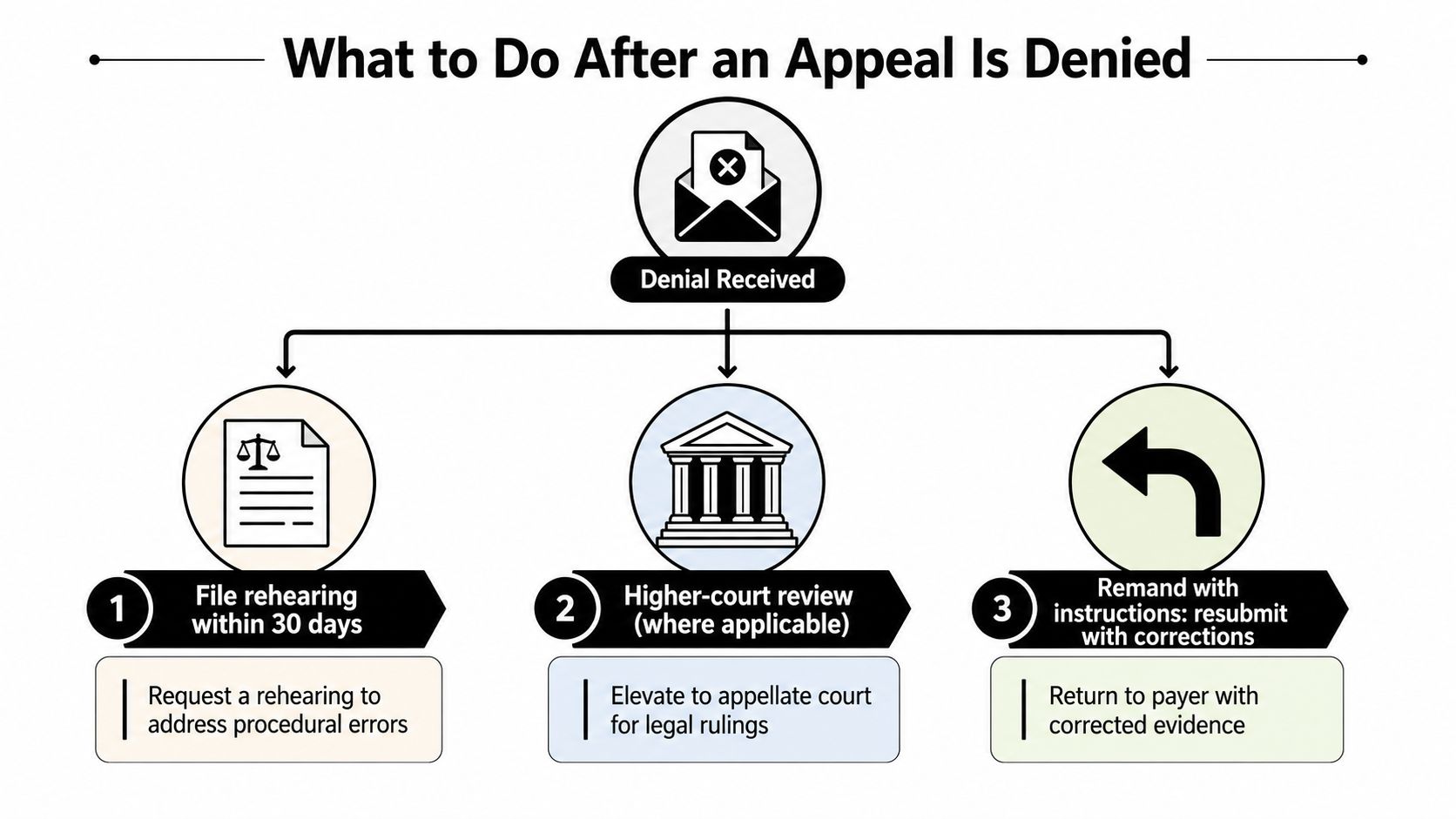
What to Do After an Appeal Is Denied
A denial of the appeal is not always the end. Sometimes it means the record needs a correction. Sometimes it means the issue belongs in a higher review layer. Sometimes it means the letter contains the exact language needed to support a remand or corrected refile. The mistake is treating every adverse decision as final when the decision tree still has branches.
Read the denial for the next move
Some denial letters point to a procedural defect that can be fixed. Others preserve the door to rehearing or higher-court review where that exists. California's court guide explicitly includes steps after the appellate decision, including rehearing or review by a higher court, while Washington Law Help notes that a court can uphold, change, or remand only parts of a decision (California court guide).
That matters in healthcare too. If the denial says a document was missing, the right answer may be corrected refile or resubmission, not a full rewrite. If the denial turns on an interpretation of policy language, the next move may be escalation rather than resubmission.
The operational habit that separates strong teams from reactive ones is denials-of-appeals logging. Track the reason cited, the evidence missing, the policy excerpt used, and the path chosen next. That log becomes the playbook for the next case.
Use the denial to sharpen the next filing
A denied appeal should produce a more exact record, not just more frustration. If the issue was fixable, correct it and refile within the relevant window. If the issue wasn't fixable at the same level, escalate with a cleaner packet and a more precise argument.
This is the part most guides leave out. The system isn't linear. It branches. Teams that understand the branching paths stop treating denial as a dead end and start treating it as a diagnostic signal.
Tracking the KPIs That Actually Predict Recovery
An appeals program without metrics is just an inbox with extra steps. The right dashboard shows whether the team is filing quickly, documenting cleanly, and recovering money from the denial families that matter most. It also exposes payer behavior patterns that should feed back into coding, credentialing, and contract operations.
The most useful quarterly KPIs are overturn rate by denial family, days from denial to first appeal, evidence-packet completeness score, IDR win rate by payer, and recovered dollars per appeal. Those numbers don't just measure performance, they show where the process is breaking.
A practical dashboard usually has three layers. The first is operational, dates, deadlines, and queue age. The second is quality, documentation completeness and denial family mix. The third is financial, recovered dollars and dispute yield by payer. If one layer moves the wrong way, the others usually follow.
Track the denial patterns, not just the wins. The patterns tell you where the next recoverable dollar is hiding.
That's where payer-behavior intelligence matters. Repeated downcoding, eligibility drift, or underpayment trends should flow back into claim setup, credentialing, and appeal prioritization. The teams that recover the most revenue usually treat denials as a data product, not a paperwork backlog.
If your appeal workflow still starts at the denial letter, you're already late. RevGuard helps specialty practices, hospitals, ASCs, and other provider groups connect denial management, appeals handling, and IDR strategy into one operational process. Visit RevGuard if you want a cleaner way to build dispute-ready claims and push weak denials into a more controlled escalation path.