

The first clue usually shows up months late. A payer remits a claim as paid in full, the posting team closes it, and only after a contract review or an IDR packet does the underpayment surface, buried under clean-looking balances and too many other priorities. In specialty RCM, that's the moment everyone remembers that remittance processing isn't clerical work, it's revenue protection.
The scale makes the stakes hard to ignore. Remittances to low- and middle-income countries reached $656 billion in 2023, and worldwide remittances hit $818 billion in 2023, according to the Federal Reserve and World Bank context on global flows, which are now large enough to sit alongside major external financing channels Federal Reserve global remittances analysis. Healthcare doesn't move consumer remittances, but it lives inside the same reality, high-volume payment movement, fragmented data, and constant pressure to reconcile what was billed, what was allowed, and what was paid.
Why Remittance Processing Is Your Revenue Integrity Backbone
A specialty practice doesn't usually discover its biggest losses on the first denial. It finds them after someone reviews a stack of closed claims and notices a payer pattern, a downcoded E/M level, a bundled service that should've been challenged, or a recoupment sitting in a batch no one tied back to the original overpayment. That's why remittance processing belongs in revenue integrity, not in a back-office bucket labeled data entry.
Remittance advice is the payer's adjudication story
An ERA or paper EOB is more than a receipt. It explains the payer's version of the claim, payment amount, contractual reduction, denial reason, and sometimes later recoupment logic. If your team posts the cash and moves on, you've accepted the payer's story without checking whether it matches the contract, the coding, or the patient's benefits.
The operational problem is simple. A claim can look resolved in the ledger while the underlying issue sits in a remark code, an adjustment code, or a secondary bill that never fired. That's why well-run teams treat every remittance as evidence, not just a posting instruction.
Practical rule: if a remittance closes a claim but doesn't explain the adjustment, don't let it disappear into auto-posting.
What good posting changes downstream
Accurate remittance handling tightens the rest of the workflow. Clean posting improves denial follow-up, secondary billing, patient responsibility capture, and appeal timing. It also gives you the documentation trail you need when a payer says the reduction was contractual and your contract language says otherwise.
That matters even more in dispute-heavy specialties. In anesthesia, orthopedics, air ambulance, gastroenterology, and other complex lines, the difference between a legitimate write-off and an avoidable loss is often visible in the remittance before it's visible anywhere else. Practices that review those signals quickly protect cash flow, while practices that wait for month-end reconciliation usually chase revenue they should've already captured.
Understanding ERA and 835 Transaction Workflows
Electronic remittance advice, or ERA, is the digital version of the payer's payment explanation. In practice, it's usually delivered through the ANSI X12 835 transaction set, which translates payer adjudication into machine-readable data that your practice management system can post or route for review. The reason this matters is straightforward, the file isn't just payment information, it's the operational bridge between adjudication and cash application.
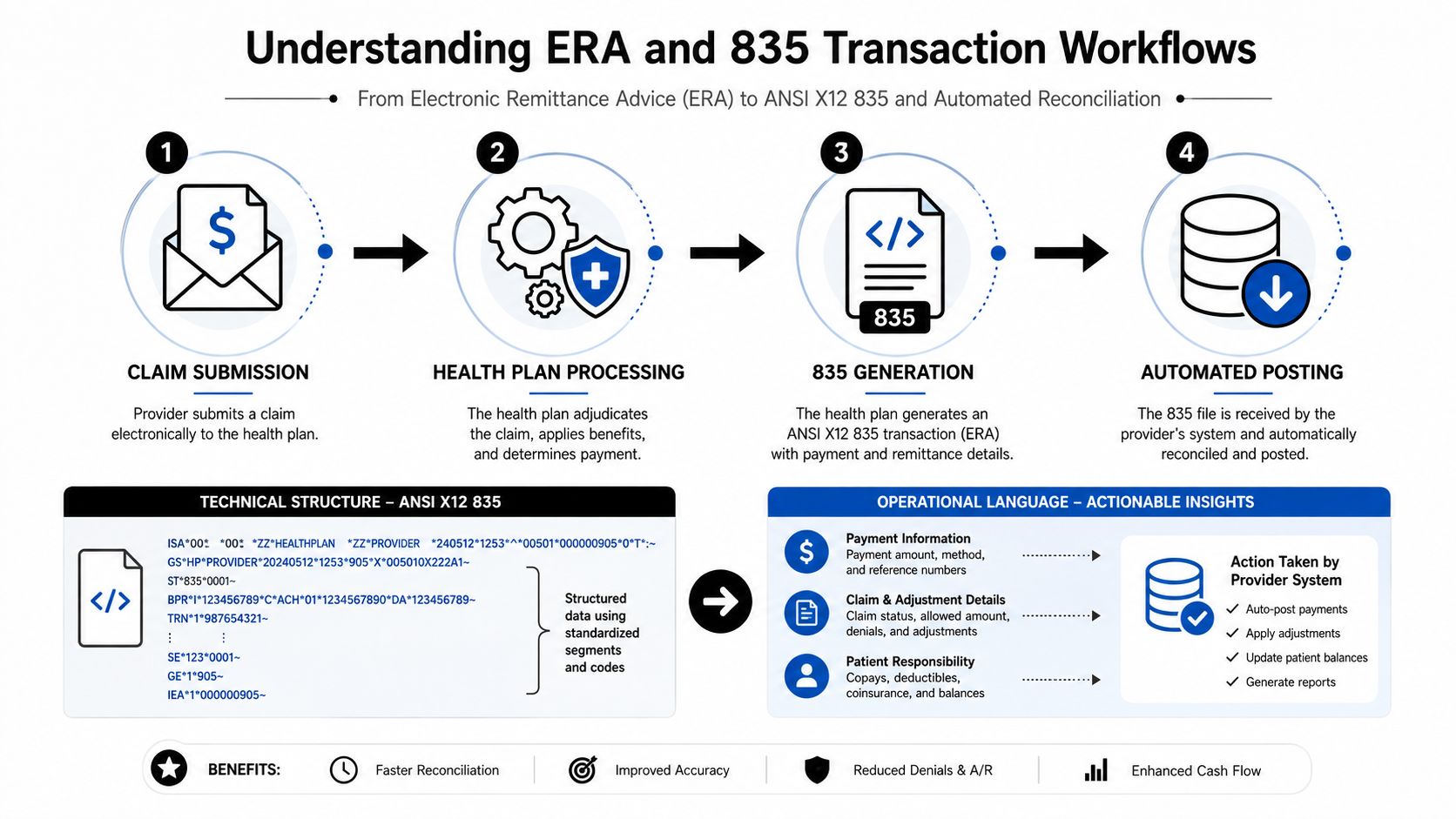
The raw file usually carries several layers of detail. You'll see payer and payee identification, claim-level outcomes, service-line adjustments, and PLB, or provider-level adjustments, which can include things like interest, recoupments, or other non-claim-specific movements. If staff only sees the translated screen in the billing system, they can miss what the file is telling them about payer behavior.
How the data moves from payer to posting queue
Most modern workflows start when the payer sends the ERA through a clearinghouse into the practice management system or RCM platform. Some systems auto-post clean claims and route exceptions to workqueues. Others force a manual touch on almost everything, which slows cash application and increases the chance that a small, repeated payer issue gets buried under daily volume.
The technical language matters less than the operational result. A well-formed 835 makes it easier to match payment references, invoice identifiers, and adjustments without reconstructing the story from free text or scanned documents. That's why richer structured messaging reduces exception handling, a point that lines up with broader remittance data practices in payments processing clearinghouse integration overview.
Enrollment and transmission problems usually show up as silence
When ERA enrollment is incomplete, the problem often isn't dramatic. Claims just stop flowing into the posting queue, or the team gets paper EOBs for one payer while another payer's files never arrive at all. The cleanest fix is administrative discipline, confirm enrollment, verify payer IDs, test the transmission path, and make sure someone owns failed file alerts.
A good ERA workflow also includes a fallback plan. If the system can't ingest the file, someone should know whether the issue is payer-side, clearinghouse-side, or system mapping inside the practice. Without that, claims sit in limbo while the A/R team assumes payment is still “in process.”
Mastering Payment Posting and Reconciliation
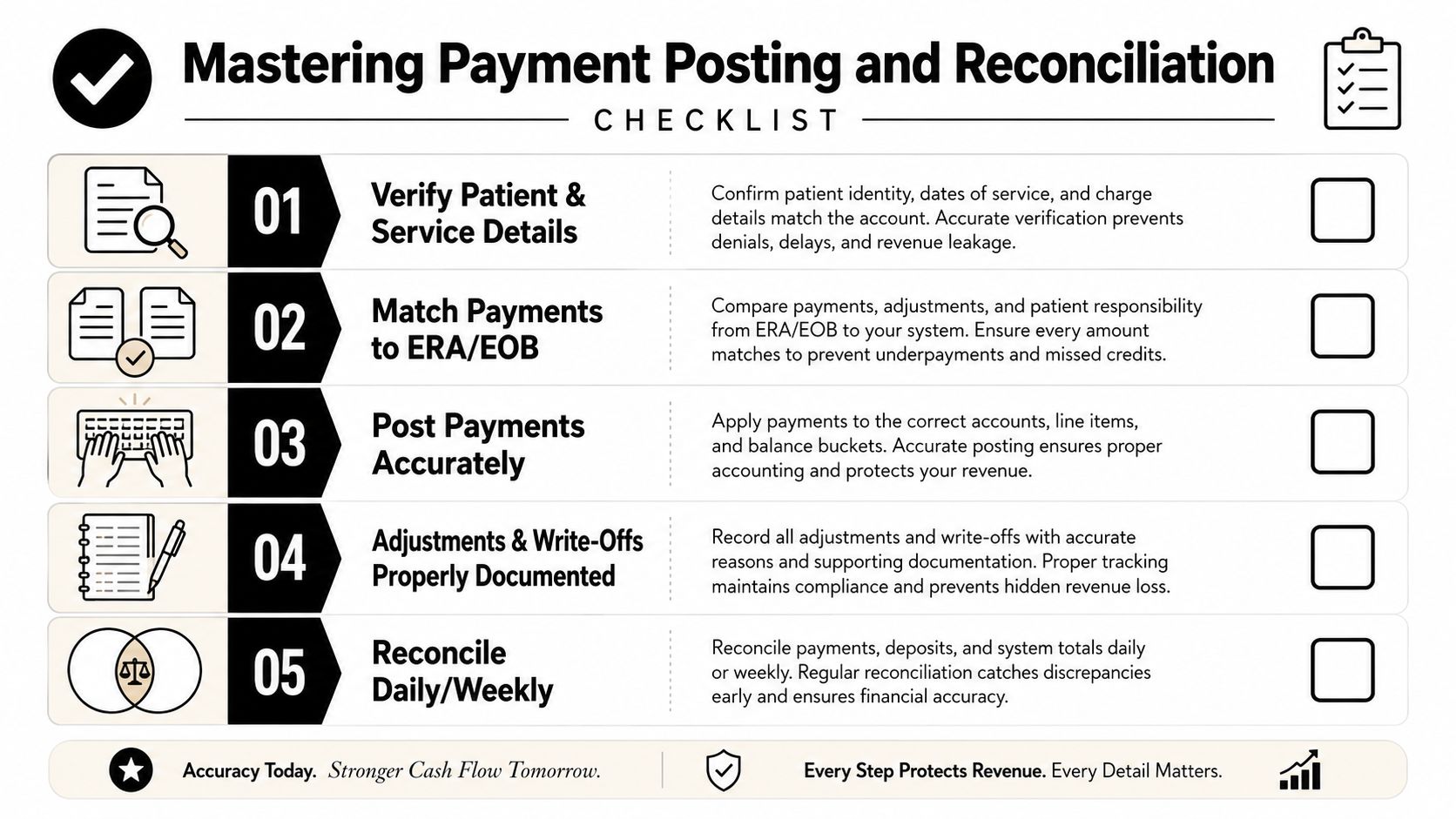
Posting is where revenue either becomes real or gets misclassified. The job isn't just entering money into the system, it's matching what the payer did against what the claim should have produced, then deciding whether each reduction belongs in contractual write-off, patient responsibility, or appeal.
Read the adjustment language before you classify the money
The most important habit is still the simplest one, read the CARC and RARC together. CARCs explain why the payer adjusted the claim, while RARCs add context, clarification, or warnings that can change the posting decision. If your team lumps every reduction into the same write-off bucket, the denial team loses the evidence it needs to challenge non-contractual underpayments later.
Contractual adjustments should post cleanly because they reflect the agreement. Non-contractual reductions need a second look because they may indicate missing authorization, coding edits, medical necessity issues, benefit problems, or payer error. Once those categories blur together, your margin gets distorted and your denials analytics become much less useful.
Operational standard: contractual write-offs should be easy to audit. If they aren't, the posting rules are too loose.
Reconciliation is a control, not a cleanup task
Daily or weekly reconciliation catches what the posting screen hides. Batch balancing should confirm that the ERA, the cash deposit, and the ledger all agree. Zero-pay remittances deserve review because they often carry denial reasons or downstream billing triggers even though no money moved.
This is also where recoupments can slip through unrelated batches. A payer may offset a prior overpayment against a current claim, and if your team doesn't trace the offset back to the original account, the practice never sees the true net effect. That is how “small” posting misses become month-end write-downs.
For deeper remittance context, many teams pair internal posting controls with an EOB review process and then tie the outcome back to appeal or payment follow-up, which is why some practices use a dedicated explanation-of-benefits workflow like the one described in EOB handling in medical billing.
A practical reconciliation habit set
- Verify patient and service details first. If the DOS, provider, or member data is off, every later step gets harder.
- Match cash to the ERA and the EOB. Don't rely on one source when two are available.
- Document write-offs precisely. If you can't explain the reduction later, you probably shouldn't post it as final.
- Reconcile on a fixed cadence. Fast posting helps, but controlled posting protects the books.
Common Remittance Errors and Denial Patterns to Catch
Auto-posting is useful, but it doesn't make human review optional. The most expensive misses are usually the ones that look routine on the screen, then turn into lost revenue because nobody asks whether the adjustment makes sense in context.
What slips through automated workflows
Duplicate payments posted without offset can create false credit balances. Bundled services can be denied as inclusive when the claim supports separate reimbursement. Downcoded E/M levels often get accepted without challenge because the remittance looks tidy, even when the documentation supports a higher level of service. Timely filing denials can also be accepted too quickly when the underlying issue was an internal lag, not a payer deadline.
Those errors cluster in high-value specialties. Anesthesia, orthopedics, and air ambulance claims tend to attract closer payer scrutiny, and that means even a small posting mistake can multiply across large volumes or high-dollar claims. The fix isn't more manual work everywhere, it's a sharper exception queue.
Build an exception queue around payer behavior
An exception queue should catch patterns, not just obvious mistakes. If the same payer repeatedly reduces a code family, the system should flag it. If a recoupment appears in a batch that doesn't match the original claim, someone should have to reconcile it before the credit balance gets cleared.
The point is to separate normal noise from repeatable payer behavior. That gives managers a way to distinguish one-off claim issues from contract-level problems, and it gives appeals staff a cleaner record when they need to challenge a denial or underpayment.
| Adjustment Category | Common CARCs | Typical Impact | Recommended Action |
|---|---|---|---|
| Contractual reduction | Payer-specific contractual edits | Expected write-down | Post to contractual adjustment only if contract supports it |
| Medical necessity denial | Medical necessity-related CARCs | Lost or delayed payment | Review clinical documentation and appeal if supported |
| Bundling or inclusive service edit | Bundling-related CARCs | Partial payment or no separate reimbursement | Check code combinations and modifier support |
| Timely filing denial | Filing limit-related CARCs | Full claim loss if not corrected | Confirm internal submission timing and resubmit if appropriate |
| Recoupment or offset | PLB-related or recovery adjustments | Cash pulled from current remittance | Trace to original account and validate the payer's basis |
Root cause beats symptom chasing
A clean denial log should answer three questions. Did the issue start with registration, coding, or submission? Did the payer process the claim correctly? Did posting expose a contract problem that needs escalation?
If those questions stay unanswered, the team keeps reworking downstream symptoms while the upstream issue keeps producing the same remittance pattern. That's expensive, and it's avoidable.
KPIs That Actually Measure Remittance Health
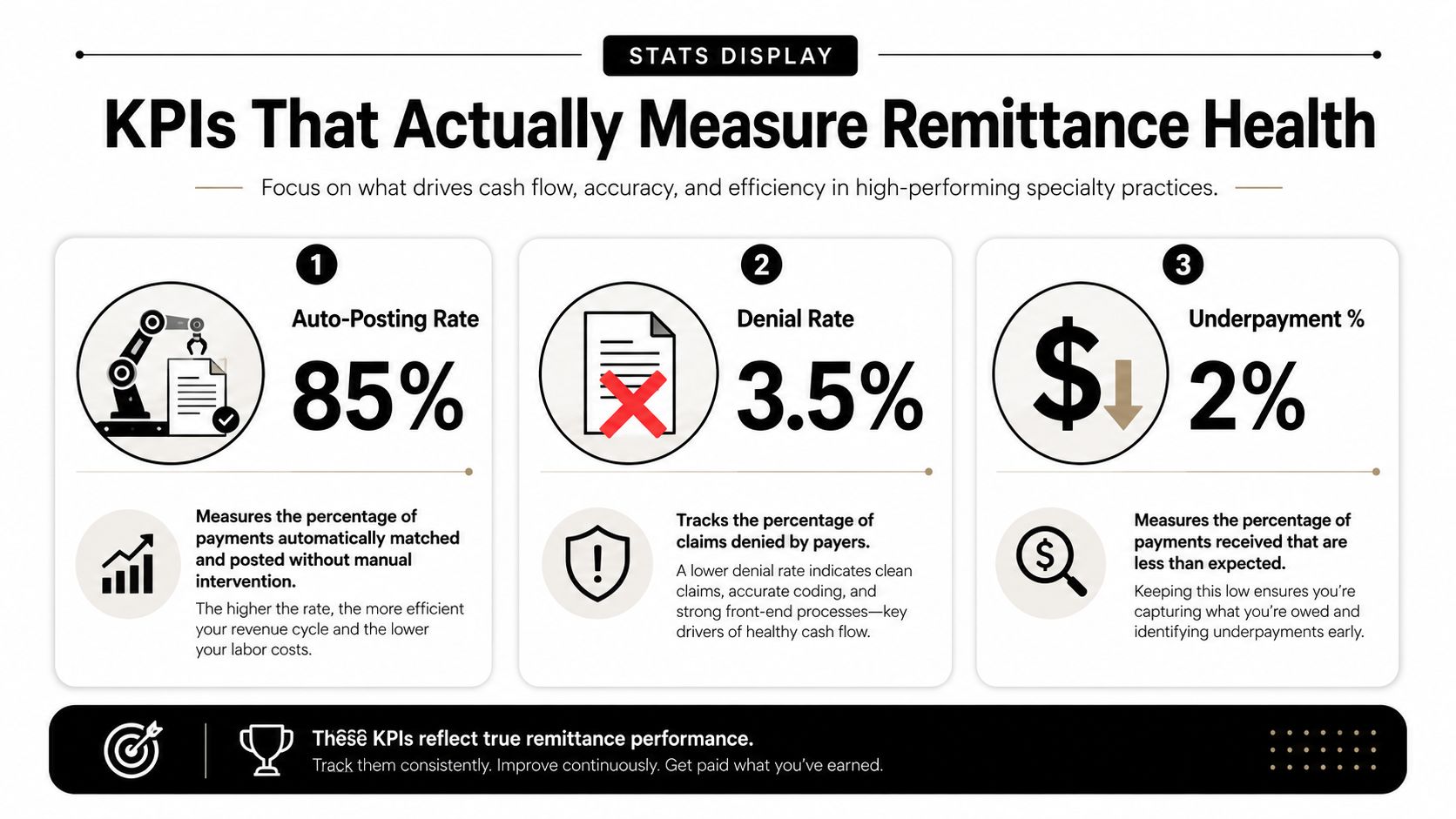
A lot of dashboards look busy while hiding the wrong problem. Days in A/R can improve even when remittance leakage is getting worse, especially if underpayments are being posted as final and denials are being worked slowly. The better metrics are the ones that show whether cash is being captured accurately and promptly.
Compare operational KPIs instead of leaning on vanity metrics
Start with net collection rate by payer. That tells you which contracts are performing and which ones need review. Then look at auto-post exception rate, because a high exception rate usually means the files, the mappings, or the payer behavior are too messy for straight-through processing.
Underpayment detection rate is even more revealing. If your team never finds underpayments, the workstream isn't magically perfect, it may just be under-reviewing remittances. Denial rate by root cause also matters because it shows whether the same intake, coding, or payer issue keeps recurring.
Speed matters, but only when accuracy stays intact
Average days to post after ERA receipt should be short enough to protect appeal windows and preserve visibility into cash flow. At the same time, posting faster with weak controls can make the ledger look healthier than it is. The right balance is fast ingestion, structured exception handling, and disciplined review of anything that doesn't fit the expected pattern.
That's why monthly trend reviews are more useful than a single scorecard snapshot. If one payer starts producing more exception items or a specialty line shows more denied service levels, the trend deserves immediate investigation. If the issue is isolated, it may only need a process tweak.
Set targets by complexity, not by wishful thinking
A multi-specialty platform with different payer mixes should not benchmark itself the same way a single-location practice does. High-complexity claims need more review time, and that's normal. The primary goal is to know which metrics justify a workflow change and which ones just reflect the inherent complexity of the specialty.
Practical rule: measure what exposes leakage, not what flatters the dashboard.
Automation and Integration Best Practices for Scale
Automation works best when it removes repetitive touchpoints, not judgment. The strongest remittance workflows use integration to move clean files quickly, then push the messy ones into a queue where experienced staff can decide what to do next.
Configure auto-posting with guardrails
Auto-posting should not be all or nothing. The system needs rules for small-dollar variances, CARC-to-action mapping, and payer-specific exceptions so that harmless differences don't create unnecessary manual work. It also needs clear routing for anything that looks like a recoupment, a denial with an unfamiliar code pattern, or a claim that posted without a usable explanation.
That's especially important in multi-location groups and PE-backed platforms. After acquisitions, different practices often bring different clearinghouses, different posting rules, and different levels of staff experience. If the integration layer isn't standardized, the organization gets inconsistent cash application and unreliable reporting.
Let automation do the routing, not the reasoning
The best systems ingest ERA files, attach them to the right claim, and then sort the work into buckets. Clean payments can post automatically. Unclear reductions can go to a workqueue. Secondary claim generation can be triggered when the first payer finishes its adjudication, which saves time and reduces missed follow-up.
What automation shouldn't do is decide every borderline adjustment on its own. A payer that repeatedly underpays a procedure family needs a human review path, because the right answer may be contract language, not faster posting. The same is true when the remittance and the claim tell different stories.
Integration quality shows up in daily operations
Good integrations make reconciliation easier across the whole revenue cycle. Teams see fewer gaps between the clearinghouse, the practice management system, and the RCM platform. They also spend less time hunting for missing files, duplicated records, or claims that were paid but never matched to the right encounter.
The win is bandwidth. When routine work is stable, staff can focus on denial recovery, payer trend analysis, and account-specific exceptions that change cash flow.
Building Dispute-Ready Claims for No Surprises Act IDR
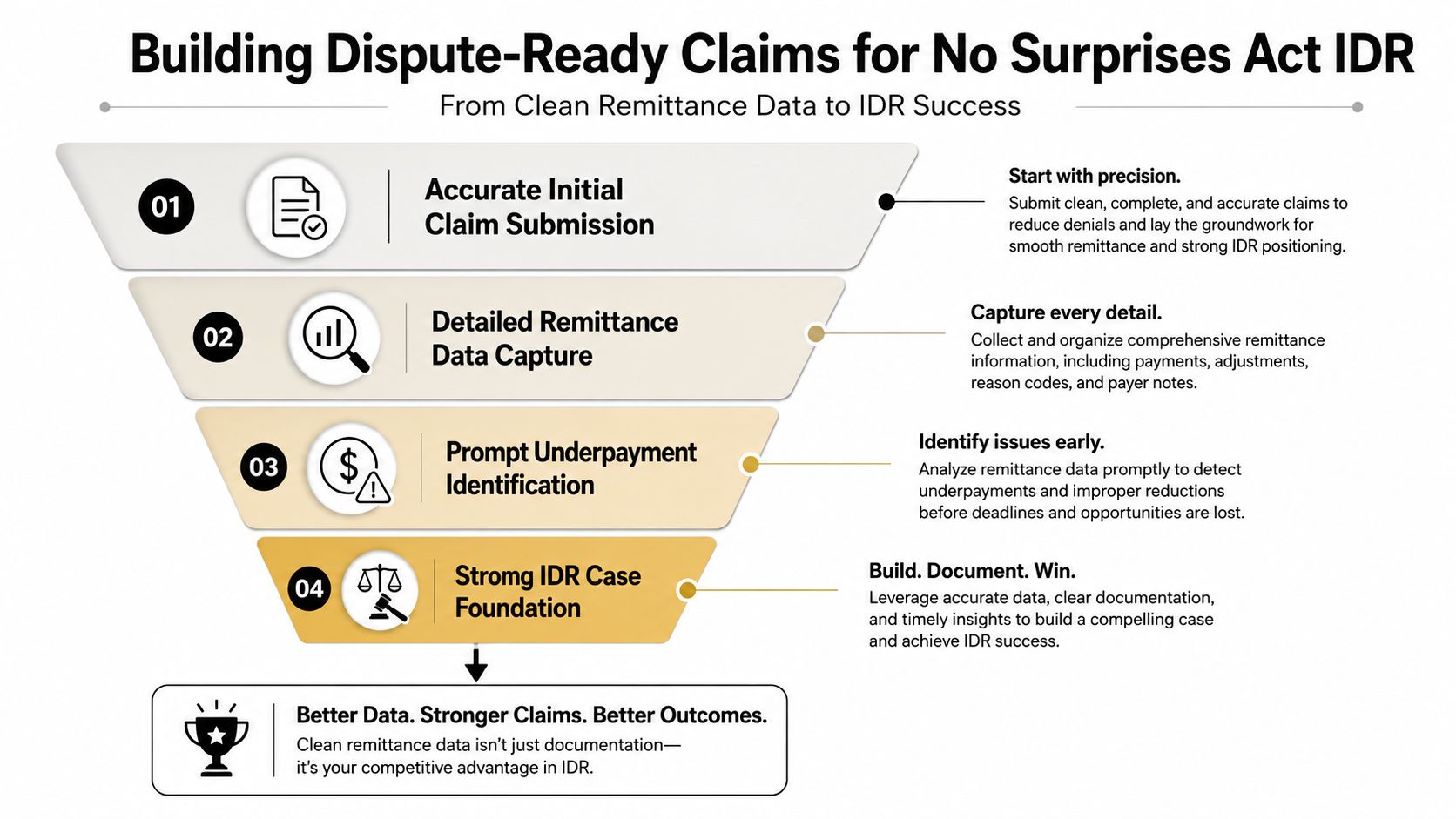
Under the No Surprises Act, remittance quality can decide whether an underpayment becomes recoverable revenue or a write-off. The reason is simple, independent dispute resolution depends on clean documentation of what was billed, what was paid, and how the payer arrived at the amount it remitted.
Clean posting creates the evidence trail
If the remittance is posted incorrectly, the case gets weaker before it starts. Accurate capture of payer reductions, adjustment codes, and recoupments helps show whether the amount paid fits the contract or whether it was reduced without support. That is exactly the kind of evidence a dispute-ready file needs.
The same is true for qualifying payment amount work and good-faith documentation. Those records only help if the remittance data underneath them is precise enough to show what happened. Once a claim is accepted as final without review, the practice often loses the ability to reconstruct a strong arbitration position later.
Treat every underpayment as potential case material
The best operators don't wait until they're already preparing an IDR package to think about documentation. They post remittances with the assumption that the claim may need to be defended. That changes who reviews the file, how fast exceptions get escalated, and how carefully the payer's adjudication logic gets preserved.
A practical NSA workflow starts with structured remittance capture, then moves into issue identification, then into evidence assembly. If the posting team misses the original underpayment or misclassifies the adjustment, the arbitration file becomes weaker and the recovery path gets longer. For teams aligning billing, appeals, and arbitration, the broader No Surprises Act framework is summarized in this NSA overview.
The payoff is structural, not cosmetic
Linking remittance processing to IDR doesn't mean every claim becomes a dispute. It means the practice is ready when the payer's number doesn't match the contract, and it can prove that mismatch without rebuilding the file from scratch. That's the difference between absorbing payer behavior and challenging it with evidence.
If your remittance workflow still depends on manual detective work, it's time to tighten the link between posting, denial follow-up, and dispute readiness. RevGuard helps specialty practices build cleaner revenue cycle control, surface underpayments earlier, and create NSA-ready claim evidence without turning your team into a spreadsheet factory. Visit RevGuard to see how a more disciplined remittance process can protect cash flow and strengthen your IDR position.