

20% of in-network claims were denied in 2023, 36% of out-of-network claims were denied, and fewer than 1% of denied claims were appealed. That means insurance claim disputes aren't rare edge cases, they're a structural part of reimbursement, and most of the money that slips away does so because no one pushes the file far enough. KFF's 2023 claims denial and appeals analysis
Anesthesia, cardiology, orthopedics, and air ambulance teams all know the same pattern. A clean claim comes out of billing, the payer trims it, the underpayment lands in accounts receivable, and three months later someone realizes the file never got touched again.

When a Single Denied Claim Costs More Than You Think
A multi-state anesthesia group can do everything right on submission and still lose money on one claim because nobody closes the loop. The coder enters the services correctly, the claim clears the front-end edits, then the payer downcodes it by three levels. The payment lands too low, the difference gets buried in the A/R bucket, and the practice absorbs the loss because the denial work queue is already full.
That is how insurance claim disputes usually hurt revenue. The problem is rarely one dramatic event. It is the accumulation of small misses where the organization treats each payer action like a one-off instead of a repeatable pattern. If a team does not trend denials, underpayments, and partial payments by reason, the same leakage keeps showing up under different labels.
Practical rule: if a denial or downcode is not assigned to a named owner and a due date, it is already drifting toward write-off.
The broader reimbursement picture makes that failure expensive. Insurers reported 471 million claims in 2023, with 86 million in-network claims denied and an average in-network denial rate of 20%. Out-of-network claims were denied at 36%, and fewer than 1% of denied claims were appealed, while 56% of appeals were upheld, which shows how much money is sitting inside files that never get challenged properly.
What Insurance Claim Disputes Actually Are in Healthcare
In healthcare, a dispute starts when the provider and payer disagree on coverage, medical necessity, coding, or payment amount. A denial is the payer's decision. A dispute is the provider's active response to that decision, whether that response is an internal appeal, a corrected submission, or a formal escalation.
That distinction matters because many teams talk about denials as if the letter itself is the problem. It isn't. The key issue is whether the provider can prove the claim belongs in a different outcome category. If the file is weak, the payer's first decision tends to stand.
The three technical failure modes show up again and again. Coverage interpretation means the payer reads the policy differently than the provider does. Liability or quantum disagreement means the payer accepts that something is owed, but not at the amount billed. Insufficient documentation means the claim may be valid in principle, but the file doesn't support it well enough to win on review. Allied Public Adjusters on insurance disputes
Why the evidence standard decides the outcome
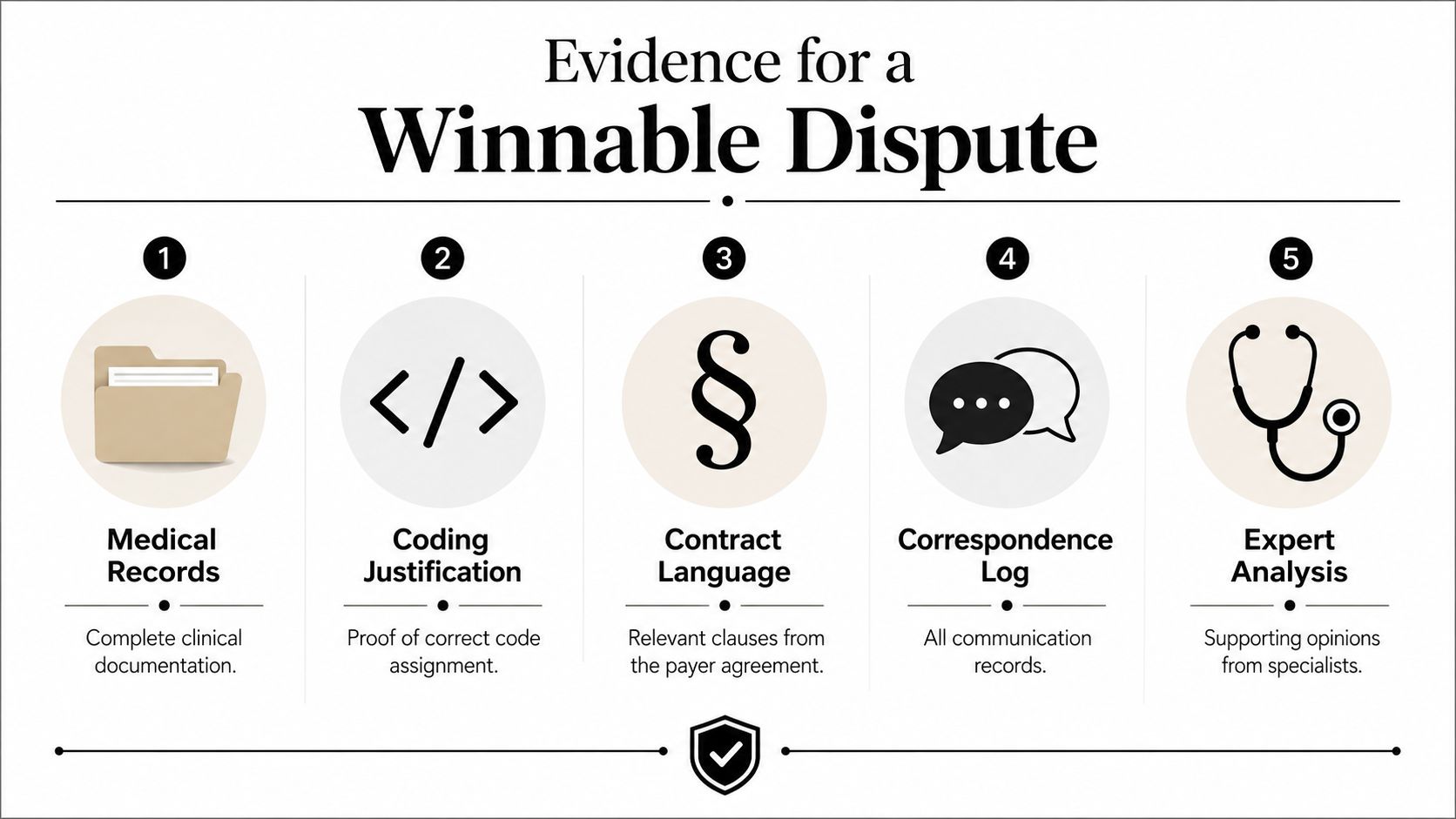
A dispute file has to prove the story behind the charge. That usually means medical records, coding rationale, contract language, correspondence logs, and any independent documentation that supports the provider's position. When those pieces are thin or inconsistent, the payer doesn't need to prove much to hold the line.
A dispute is rarely lost on the biggest issue. It's usually lost on the missing page, the unclear modifier, or the note that never got attached.
The operational lesson is simple. A provider doesn't win by being upset about the denial. A provider wins by building a file that survives scrutiny from someone who was never involved in the original service.
The Four Common Causes of Healthcare Claim Disputes
Denials that start as paperwork problems
Denials often begin with a simple mismatch between what the payer expects and what the claim file contains. In a specialty practice, that can mean missing authorization language, a policy exclusion that wasn't checked early, or a coding issue that turns into a rejection before the merits of the case are ever reviewed. The denial is the visible event, but the root cause is usually upstream.
Underpayments that never get challenged
Underpayment is the quietest kind of dispute because the claim looks “paid.” An air ambulance claim can be reimbursed at a level that doesn't reflect the actual service, especially when the payer applies its own fee schedule or trims the billed amount without a meaningful explanation. If the payment posting process doesn't flag the variance, the revenue loss becomes permanent.
Downcoding that rewrites the service
Downcoding is where the payer accepts the encounter but recasts it at a lower level. A cardiology group might submit a complex procedure and receive payment as if a simpler service was performed. That's not just a pricing issue, it's a documentation and coding dispute, because the record has to support why the higher-level code was the right one.
Delays that weaken leverage
Delay isn't passive. It changes the balance of power. The longer a claim sits unresolved, the harder it becomes to reconstruct the file, locate the right clinical support, and keep the issue alive inside the organization. By the time the denial turns into a backlog item, the team often has less detail, less urgency, and less influence than it had on day one.
The common thread is that delays and process friction drive a lot of the conflict. The best dispute is the one that never forms because the claim was made dispute-ready before the payer got it.
The Legal and Contractual Framework Governing Disputes
Insurance disputes in healthcare sit inside three overlapping systems, payer contracts, federal regulation, and patient-protection rules. The contract controls many of the day-to-day reimbursement arguments. Federal rules shape what payers can do. The No Surprises Act creates a formal path for certain out-of-network disputes, and its Independent Dispute Resolution, or IDR, process is where unresolved cases can move for a neutral decision. RevGuard's No Surprises Act summary
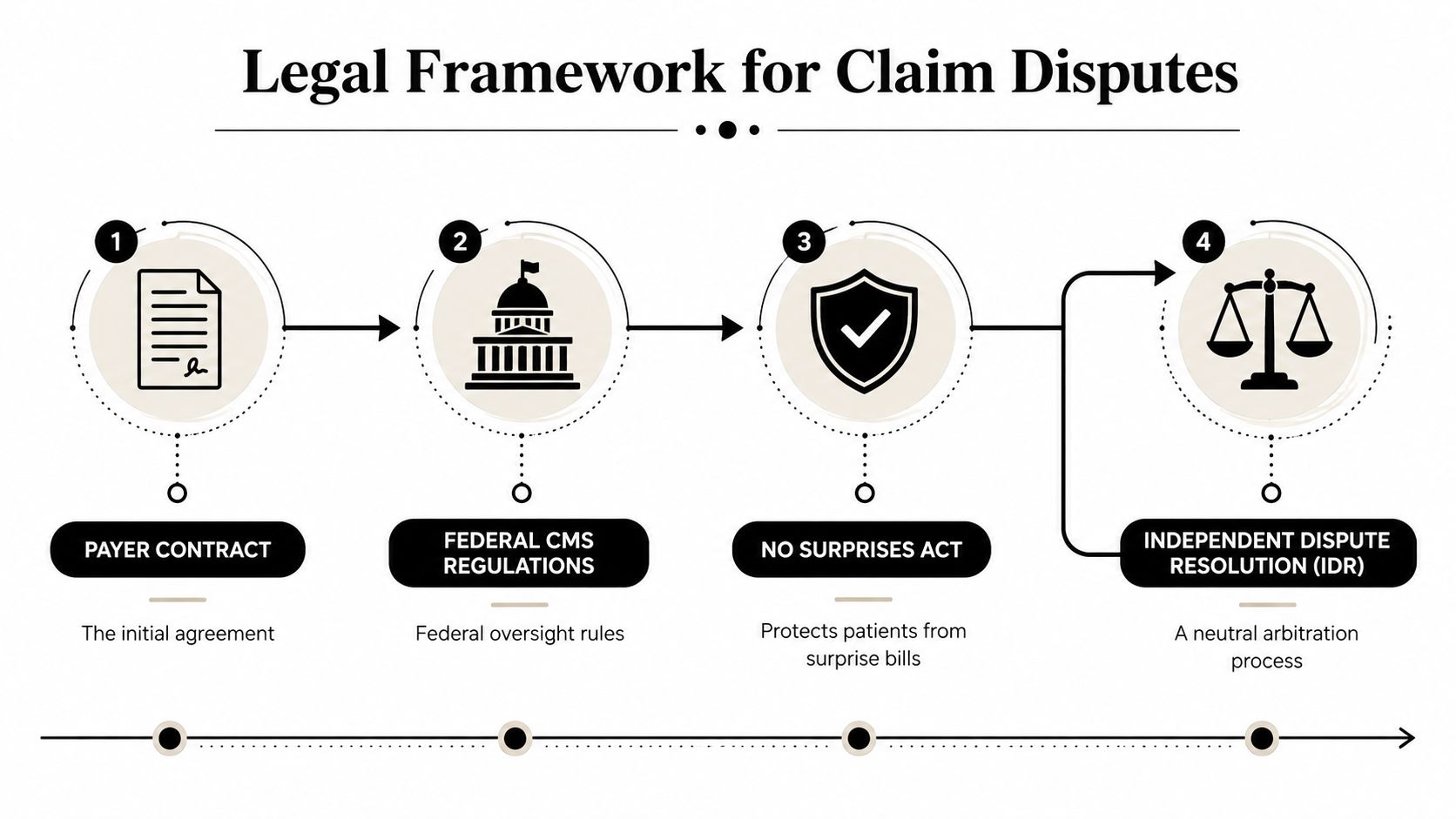
The volume alone shows why this matters. The U.S. Government Accountability Office reported nearly 490,000 disputes submitted from April 2022 through June 2023, and about 61% remained unresolved as of June 2023. The same review said that volume was much larger than the agencies overseeing the process expected. GAO review of IDR backlog
That backlog tells revenue teams something important. IDR isn't a theoretical backup plan. It's a real enforcement path that can get crowded fast, which means the quality of the file, the timing of escalation, and the decision to stay internal or go external all matter more than many teams assume.
What happens before IDR
Most disputes should still start inside the payer relationship. Internal review, corrected documentation, and contract-based appeal rights often resolve claims faster than formal arbitration. But when the payer's position doesn't move, or when the file supports a stronger recovery position than the payer is offering, escalation becomes the only serious option.
Why the rules matter operationally
The legal framework doesn't just define rights. It defines workflow. If the claim team doesn't know which disputes belong in internal appeal, which ones need stronger documentation, and which ones should be prepared for IDR from the beginning, they waste time on the wrong path.
The Stepwise Provider Dispute and Appeal Workflow
The first decision point is internal. If the denial or underpayment is based on a correctable issue, the provider should fix the file and resubmit or appeal with better support. That can be a missing record, a modifier question, or a coding mismatch that becomes clear once the payer's explanation is compared with the chart. If the claim is still weak after that review, escalation just adds noise.
| Dispute Stage Timelines and Outcomes | ||
|---|---|---|
| Stage | Typical Duration | Resolution Rate |
| Internal appeal | Varies by payer and contract | Depends on documentation quality |
| Payer-level review | Varies by payer process | Depends on issue type |
| External appeal | Varies by applicable rule set | Depends on the evidence trail |
| IDR | Governed by the formal arbitration process | Determined by the submitted case record |
Once internal review fails, payer-level review becomes a test of documentation discipline. A file needs to look complete, not just persuasive. The claim should include clinical notes, coding justification, the contract language that supports the argument, and a clean correspondence history that shows the provider gave the payer a fair chance to resolve the issue.
Escalate when the dispute is about interpretation or value, not when the file still has avoidable gaps.
External appeal is the right move when the provider has exhausted the payer's internal channels and still has a defensible position. That's often where teams lose momentum, because they confuse administrative fatigue with strategic judgment. A claim doesn't deserve more effort just because it's frustrating. It deserves more effort when the economics and evidence justify it.
IDR is the final formal step for the disputes that belong there. The strongest files arrive with a complete narrative, tight documentation, and a clean reason for why the provider's valuation is more credible than the payer's. The weakest files arrive late, incomplete, and impossible to defend.
Evidence, Documentation, and KPIs That Drive Decisions
A winnable dispute starts with the file, not the argument. The core packet should include medical records, coding justification, contract language, correspondence logs, and expert analysis where the service or valuation requires it. If the claim sits in a specialty where the payer expects extra scrutiny, the supporting record has to be even cleaner.
What makes a file dispute-ready
A dispute-ready file is complete before anyone argues about it. The notes line up with the code, the contract language is easy to find, and the correspondence trail shows exactly when the payer was notified and what it asked for. If a reviewer has to hunt for the answer, the claim is already vulnerable.
The practical metrics matter just as much as the paperwork. Teams should track dispute resolution time, appeal success rate, IDR win rate, and revenue recovery per case. Those numbers tell the organization whether it's worth escalating, whether a payer habitually fights certain services, and whether a claim type should be redesigned upstream instead of appealed downstream.
The first notice of loss principle applies here too. Claims analytics guidance stresses that early intake errors spread through the full lifecycle and weaken confidence in later decisions, so standardized capture and cross-system consistency are operationally critical. Claims data analysis guidance
If the intake is wrong, every downstream appeal has to work harder to repair it.
That's why the EOB matters as a data object, not just a payment notice. The explanation of benefits should be read for denial logic, pattern recognition, and repeat payer behavior, not only for the bottom-line amount. RevGuard's EOB guide gives a useful frame for teams that want to turn payment documents into working intelligence.
Preventing Disputes Through RCM Integration and Analytics
The cleanest dispute strategy is prevention. When Revenue Cycle Management and dispute enforcement operate together, the organization catches problems earlier, builds better files, and stops treating appeals as disconnected admin work. That shift matters because the fastest way to lose money is to discover the error after the claim has already been paid wrong.
The most practical fixes are operational. Standardize claim intake so front-end errors don't propagate, build payer-behavior dashboards that show repeat bottlenecks, and track disputes by reason code and turnaround time so the team can see where the same problem keeps coming back. Claims analytics isn't about more reports. It's about making the next decision better than the last one.
The goal isn't more appeals. The goal is fewer avoidable disputes and stronger recoveries on the ones that remain.
One useful model is to flag claims before they become disputes. If a payer repeatedly downcodes a service, the workflow should trigger review before submission or immediately after remittance, not after the balance has aged out. That's the difference between a revenue protection system and a collections bucket.
For teams looking at analytics infrastructure, RevGuard's healthcare revenue cycle analytics approach is one example of how dispute patterns can be tied back to operational signals. The useful test is simple, does the system help you catch the reason a claim will be disputed before the payer writes the first denial?
If your organization is still handling every denial as an isolated event, audit the pipeline now. Identify the three most common failure points, tighten the intake and documentation path, and set a clear rule for when to resolve internally and when to escalate. Then visit RevGuard to see how a dispute-ready revenue cycle can turn more underpayments into recoverable reimbursement.