

Prior authorization denials aren't rare friction, they're a routine feature of managed care. In a federal review of Medicaid managed care, plans denied one out of every eight prior authorization requests, an average denial rate of 12.5%. The spread was even more telling, from 2% to 41% across plans, with 12 plans above 25% (HHS OIG review).
That kind of variation changes the conversation. If denials swing that widely by payer and plan design, then the job isn't just “handle the claim.” The job is to build a process that prevents avoidable denials, catches weak ones quickly, and moves the recoverable cases into appeal or formal dispute without wasting time.
Understanding Modern Payer Denial Systems
A payer's denial pattern shows how much operational risk sits inside the revenue cycle. The federal Medicaid managed care review showed denial rates ranging from 2% to 41%, which means two practices can submit similar requests and get very different outcomes depending on plan behavior, contract design, and documentation standards. That variation is a workflow problem as much as a payer problem. It changes cash flow, staff time, and the amount of work needed to recover revenue.
Denials Are a System, Not a Surprise
The practical mistake is treating each denial as an isolated exception. In Medicare Advantage, insurers made more than 50 million prior authorization determinations in 2023 and fully or partially denied 3.2 million requests, or 6.4% of all requests, with denials rising to 4.1 million and 7.7% in 2024 (KFF and CMS-based analysis; KFF 2024 Medicare Advantage analysis). That scale matters because it shows denial management is not a side task. It is recurring revenue protection work, and it needs the same discipline as charge capture and claim submission.
Practical rule: If a payer denies repeatedly, assume the process is designed that way until your data proves otherwise.
The other signal is what happens after denial. In Medicare Advantage, only 11.7% of denied requests were appealed in 2023, yet 81.7% of appealed denials were partially or fully overturned. Many denials never get tested, and many that do get challenged do not survive review. For a practice manager, that creates two clear financial paths. Prevent what can be prevented in the front end, then move defensible cases into appeal or formal dispute quickly enough to protect the balance sheet.
A clean revenue cycle and a strong dispute workflow are connected. If intake, documentation, and authorization checks are weak, you create avoidable denials. If appeal triage and escalation rules are weak, you leave recoverable dollars on the table. The same operational discipline that reduces denials also improves the success rate of the cases you choose to fight.
The Anatomy of a Prior Authorization Denial
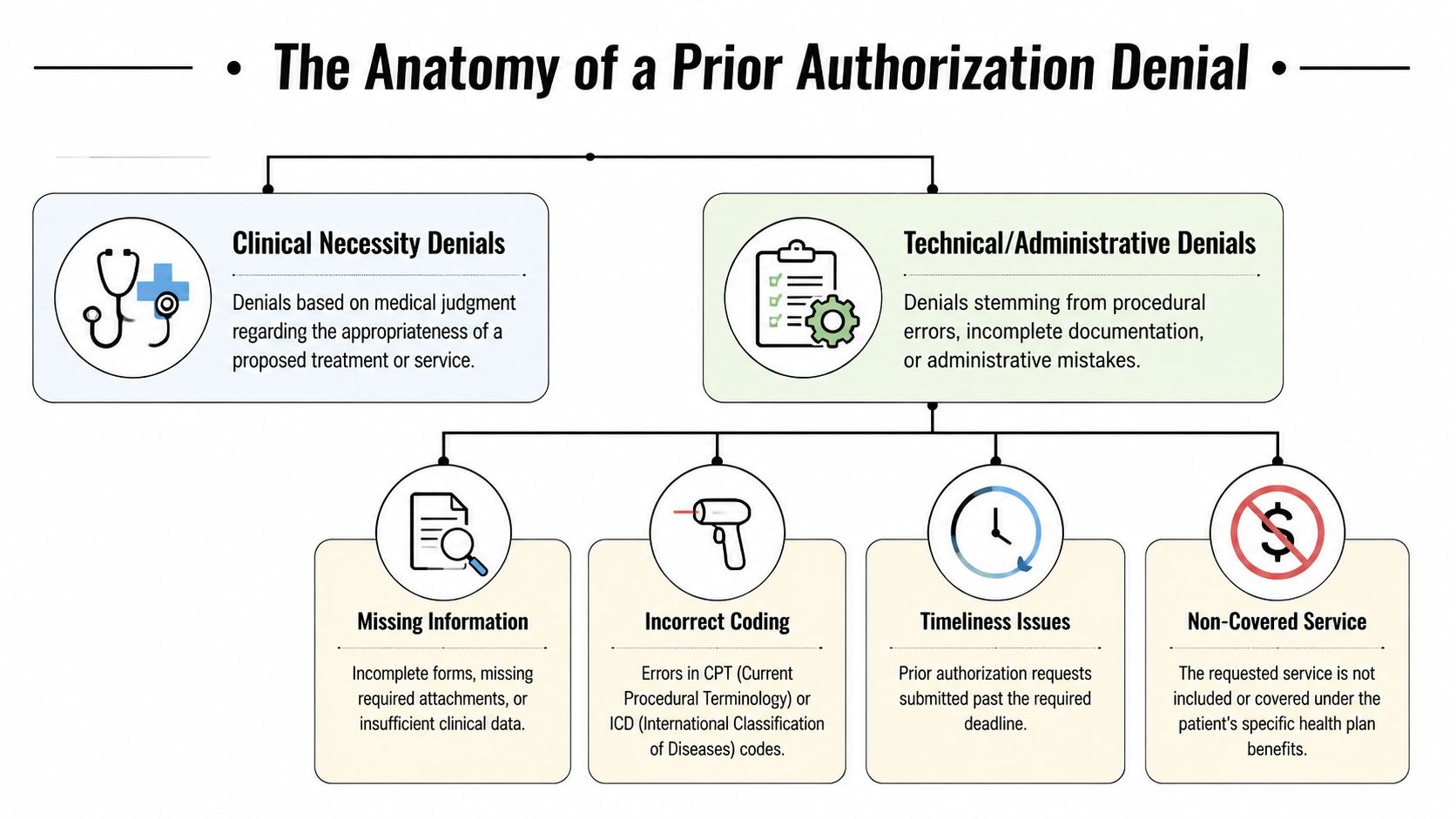
A denial usually falls into one of two buckets. The first is a clinical necessity denial, where the payer says the requested service doesn't meet its clinical criteria. The second is a technical or administrative denial, where the request failed because someone missed a rule, omitted documentation, or submitted the wrong information.
Clinical Decisions Versus Process Failures
That distinction matters because the fix is completely different. The American College of Physician Advisors notes that denials commonly happen because authorization wasn't obtained correctly or supporting documentation was incomplete, which makes many denials a matter of rule noncompliance rather than a judgment on the service itself (ACPA primer on denials). In practice, that looks a lot like a shipping manifest error. The shipment may be fine, but if the paperwork doesn't match the load, the dock won't release it.
Technical denials tend to cluster around a few operational failures:
- Missing information. The packet goes out without the note, imaging, lab result, or other attachment the payer expects.
- Incorrect coding. The request uses the wrong CPT or ICD code, so the payer reviews the wrong benefit path.
- Timeliness issues. The request lands after the deadline or the authorization expires before the service happens.
- Non-covered service. The benefit is not available under that plan.
A clean process reduces all four. A sloppy process creates denials that look clinical from the outside but are really workflow failures inside your office.
A denial letter that names the wrong problem is almost as useless as no denial letter at all.
The reason this matters for revenue protection is that technical denials are usually preventable. If your team can separate these from true medical-necessity disputes on day one, you avoid spending appeal labor on claims that should have been approved upstream. You also stop letting documentation gaps masquerade as payer resistance.
Quantifying the True Cost of Denials
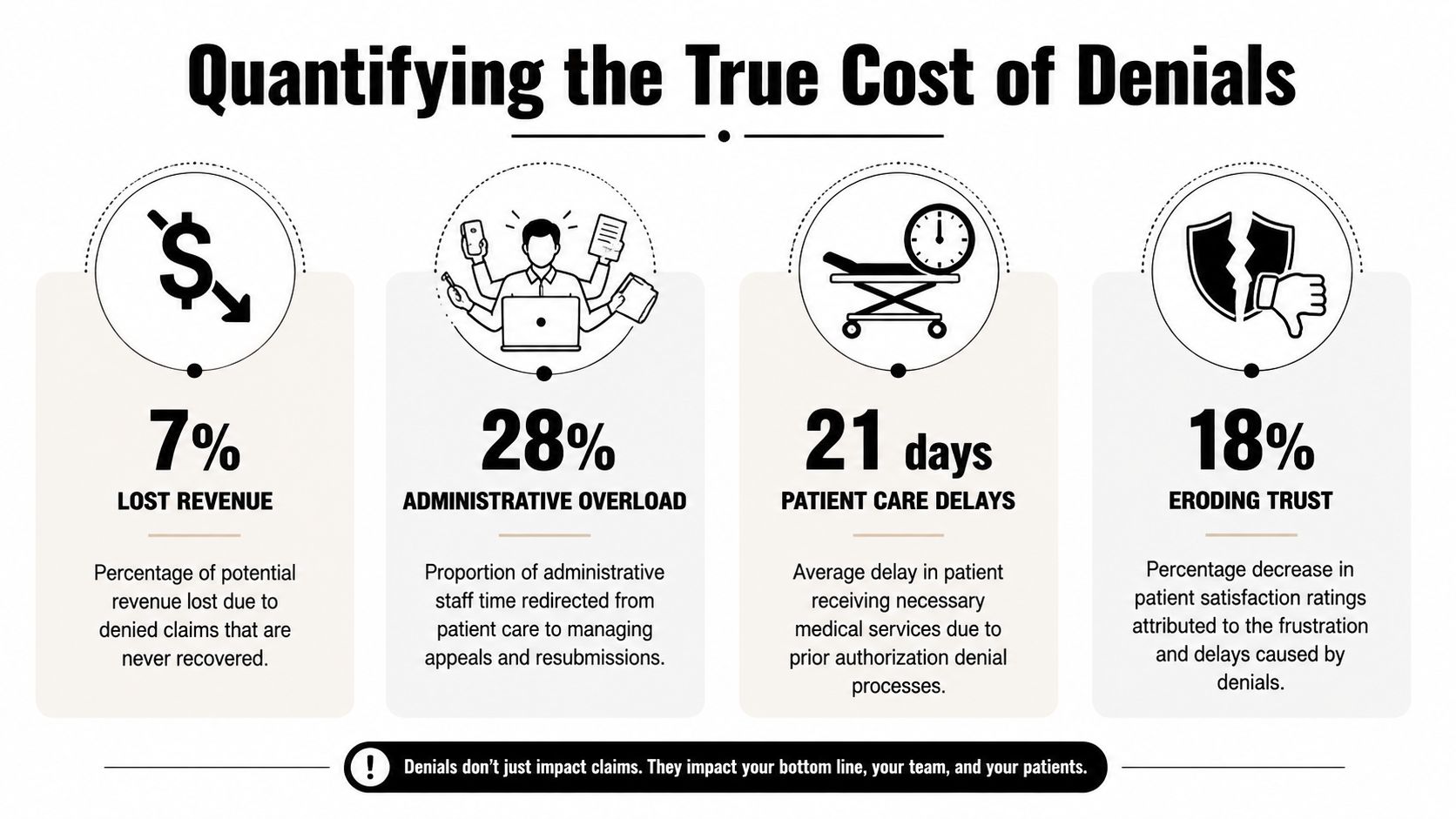
The claim amount is only part of the loss. Every denial pulls staff into rework, delays cash collection, and can push care out by days or longer. In prior authorization-heavy specialties, that delay hits both the balance sheet and the patient relationship.
The Hidden Cost Lives in Rework
If a denial is easy to overturn, the direct reimbursement may still be recoverable, but the labor is not free. Someone has to review the denial, gather records, fix the submission, and track the response. That work competes with scheduling, registration, coding, and collections, which means denials create an administrative backlog even when the claim is ultimately paid.
The patient side is just as important. An independent policy analysis notes that prior authorization can worsen health disparities and delay care, and that branded prescriptions initially rejected for prior authorization were often delayed for multiple days, with patient characteristics and claim complexity linked to longer waits and more frequent final denials (Applied Policy analysis). That's not just an access issue. It's a follow-through issue. When the process slows treatment, the practice absorbs more inbound calls, more status checks, and more frustrated patients.
Why This Becomes a C-Suite Problem
Denials become a financial problem when they repeatedly interrupt cash flow. They become a strategic problem when they push leaders to make staffing decisions based on guesswork instead of denial pattern data. Once that happens, the practice starts treating the symptom, not the cause.
A useful internal question is this, which claims are worth the effort to recover, and which denials reflect a broken upstream process? If your team can't answer that cleanly, you're probably underinvesting in prevention and overinvesting in rework.
Building a Proactive Denial Prevention Framework
The best denial is the one that never gets submitted in the first place. That starts with standard work, not heroics. Clean prior authorization workflows reduce avoidable denials because they force the right data, the right sequence, and the right checks before the claim reaches the payer.
Build the workflow around checkpoints
Standardize the front end of the process so every request moves through the same gates. Verify coverage before scheduling. Match the requested service to the payer policy. Attach the clinical support the payer expects. Capture the authorization reference number before the service is rendered. RevGuard's guide on the prior authorization process follows the same logic, with emphasis on code verification, supporting records, authorization tracking, and status checks.
The most effective teams use a documentation checklist by specialty or service line. That checklist should tell staff exactly which note, lab, referral, image, or operative detail has to be in the file before submission. When a payer changes its rules, the checklist changes with it.
Use technology to remove manual misses
Automation should handle repetitive verification tasks, not replace judgment. Eligibility checks, request routing, and status tracking are the best early wins because they reduce the number of times staff have to look up the same information by hand. For a multi-location practice, that matters because consistency breaks down fastest where volume is highest.
A clean workflow also needs ownership. One person or team should be accountable for each handoff, from scheduling to submission to follow-up. If everyone owns the request, no one owns the miss.
Train for payer variation
Payer rules change, and staff turnover makes that worse. Training has to be recurring, specific, and tied to the denial patterns your practice sees. Generic annual refreshers usually don't move the needle because they don't teach people how a denial in your specialty really happens.
Operational rule: If your team can't explain why a request failed, they can't reliably prevent the next one.
The goal is not perfection. The goal is fewer avoidable denials, faster correction when a request is incomplete, and cleaner files when the payer pushes back.
Executing a High-Success Appeals Strategy
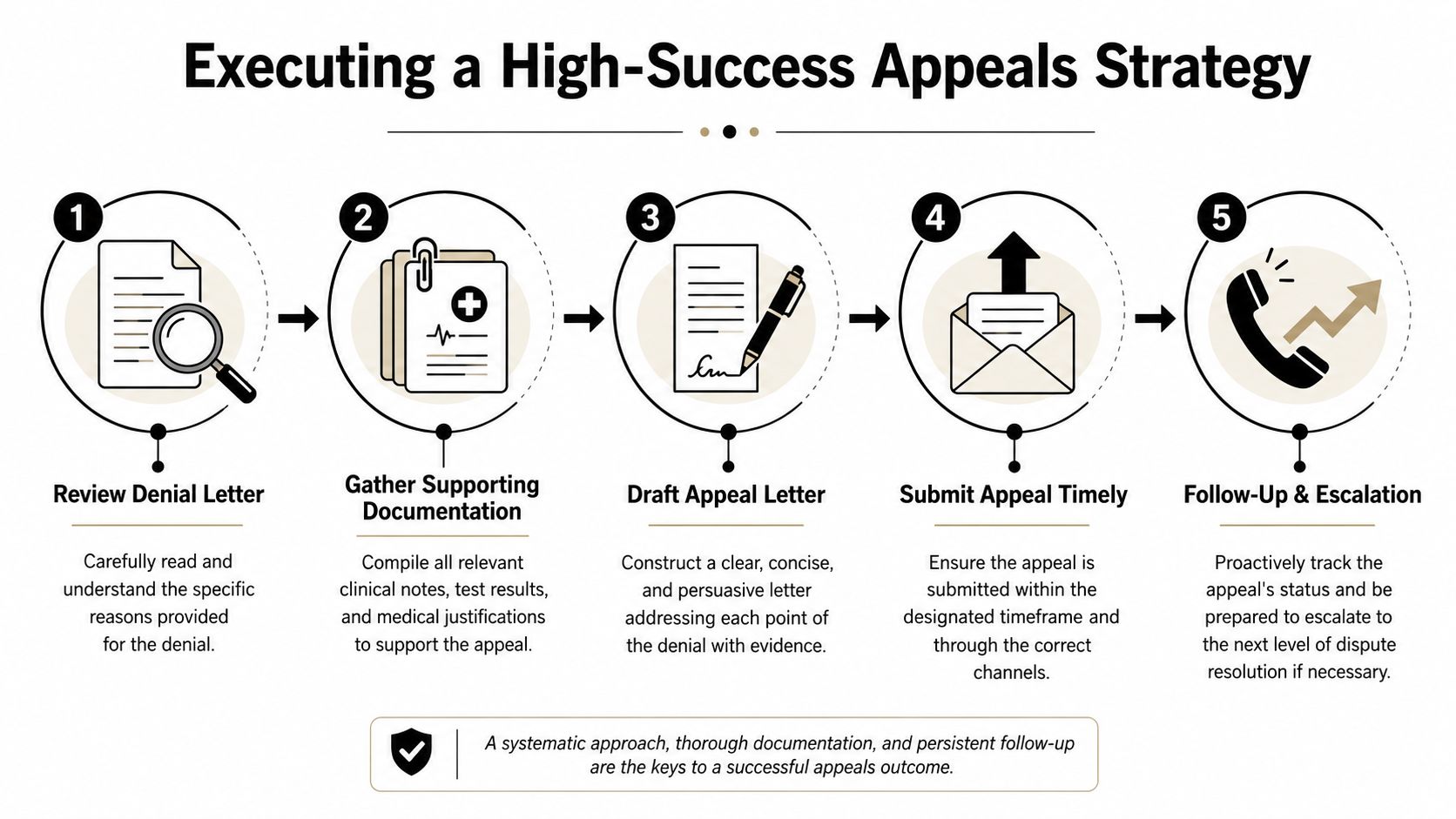
A denial that gets past prevention should still be treated as recoverable revenue until the record proves otherwise. The appeal process works best when it runs like a controlled workflow, not a pile of urgent emails. Strong teams triage quickly, decide whether the denial is worth challenging, and submit an appeal that answers the payer's objection line by line.
Start with denial triage
Every denial does not deserve the same level of effort. A technical denial with a missing attachment should be corrected fast and resubmitted. A denial tied to policy language or clinical criteria may need a formal appeal packet with supporting records, payer policy language, and a clinician narrative.
In Medicare Advantage, appealed denials were overturned at a strong rate in the KFF and CMS-based analysis, which is a clear signal that well-documented appeals often pay off when the record is complete (KFF and CMS-based analysis). The same analysis also showed that many denials were never appealed, which means too many teams still give up before the payer has fully reviewed the file.
Build the record before you write the letter
The appeal letter should not carry the case alone. Pull the clinical note, test result, referral history, prior treatment failures, and any policy citation that supports medical necessity. Then write the narrative so it answers the payer's denial reason directly, not the reason you wish they had given.
Clear EOB and denial processing also matters at this stage. If your team is reconciling the denial against the remittance in a rushed or inconsistent way, the appeal file starts weak and stays weak. That is why disciplined posting and review, like the workflows discussed in EOB handling in medical billing, belongs in the same recovery process as the appeal itself.
Practical rule: An appeal wins faster when the first paragraph explains exactly what was missing, wrong, or disputed.
Submit on time, then follow up
A strong appeal can still fail if the deadline is missed. Set internal turnaround targets shorter than the payer's deadline so your team has room to correct problems before submission. After filing, track the appeal status instead of assuming silence means progress.
If the denial survives the first review, escalate it deliberately. Do not refile the same packet and hope for a better answer. Each level should add evidence or sharpen the argument.
When and How to Escalate to Dispute Resolution
Some denials are bigger than a standard appeal. High-value claims, repeated payer behavior, and opaque denial notices all justify a closer look at formal dispute pathways. That's where denial management stops being a billing task and becomes a revenue protection strategy.

Use the right trigger to escalate
Escalation should start with three questions. Is the claim value high enough to justify formal dispute work? Does the payer have a pattern of weak or inconsistent denials? Is the file strong enough to survive review outside the normal appeal lane?
If the answer is yes, the case deserves a dispute-ready build. That means every record, timeline, and policy citation has to be organized before submission. A weak file in a formal process is still a weak file.
The AMA says denial letters should include a detailed reason, a copy of or link to the cited policy, and the rationale plus any additional documentation needed for approval (AMA guidance on denial notices). That recommendation matters because opaque notices make escalation harder, not easier. If the denial doesn't say exactly why it happened, your team spends time reconstructing the payer's case from fragments.
Build the dispute-ready file
The file should contain the denial notice, the original request, supporting clinical records, the relevant plan policy, and a concise explanation of why the denial fails under the payer's own rules. If a case is headed toward a formal process, the argument needs to be both medically sound and procedurally clean.
RevGuard's independent dispute resolution framework fits naturally here because the logic is the same. Clean claims upstream produce stronger disputes downstream. When the record is tight, the dispute is easier to defend.
Don't escalate every denial. Escalate the denials that are high-value, repeatable, or structurally weak on the payer side.
The point of escalation isn't aggression. It's recovery discipline. Practices that treat dispute resolution as a final step in the same revenue workflow usually collect more of what they've already earned.
Essential KPIs for Denial Management Success
A denial program improves only when leaders measure the right things. The dashboard should show where denials begin, how often appeals succeed, and whether the final recovery justifies the staff time. Those metrics turn anecdote into action and show whether clean RCM upstream is feeding a stronger dispute file downstream.
Track the metrics that matter
Initial Denial Rate shows how often requests are rejected on the first pass. If that number is high, the problem is usually upstream, in eligibility checks, documentation, coding, or payer matching.
Final Denial Rate shows what remains denied after appeal. That metric is the clearest signal of whether the team is recovering claim value or just creating busywork.
Appeal Success Rate measures the percentage of appealed denials that are overturned. As noted earlier, Medicare Advantage appeal results have been strong enough that many teams should challenge more denials than they currently do.
Denial Overturn Rate shows how often a payer reverses itself. If overturns are common for a specific payer or service line, the appeal packet probably needs to be standardized instead of rebuilt every time.
Specialty benchmarks should reflect the service mix
| Metric | Definition | Industry Benchmark | Specialty-Specific Goal, Orthopedics |
|---|---|---|---|
| Initial Denial Rate | Percentage of prior authorization requests denied on first review | Use payer-specific tracking, since rates vary widely by plan | Reduce avoidable denials in high-volume procedures |
| Final Denial Rate | Percentage still denied after appeal or resubmission | Lower than initial denial rate if appeals are effective | Keep final denials limited to true benefit exclusions |
| Appeal Success Rate | Percentage of appeals that result in partial or full approval | Strong performance shows the appeal process is working | Push more cases into successful review by fixing documentation |
| Denial Overturn Rate | Percentage of denials reversed by payer review | High overturns signal strong appeal packet quality | Standardize packet templates for repeat denial types |
The table is most useful as an operations tool, not a scorecard for its own sake. If orthopedics sees repeat denials on the same procedure type, the fix probably sits in pre-service authorization workflow. If appeal success is strong but appeal volume is low, the issue is triage, not case strength.
Measure the process that protects the money, then change the step that failed first. That is how denial prevention and dispute resolution work together as one revenue protection strategy.
RevGuard helps provider organizations connect clean RCM with structured dispute recovery, so denial prevention and IDR work from the same revenue file instead of competing for attention. If you're managing prior authorization denials across a specialty practice, ASC, hospital, or multi-state platform, visit RevGuard to see how a coordinated approach can tighten upstream workflows and strengthen downstream recovery.